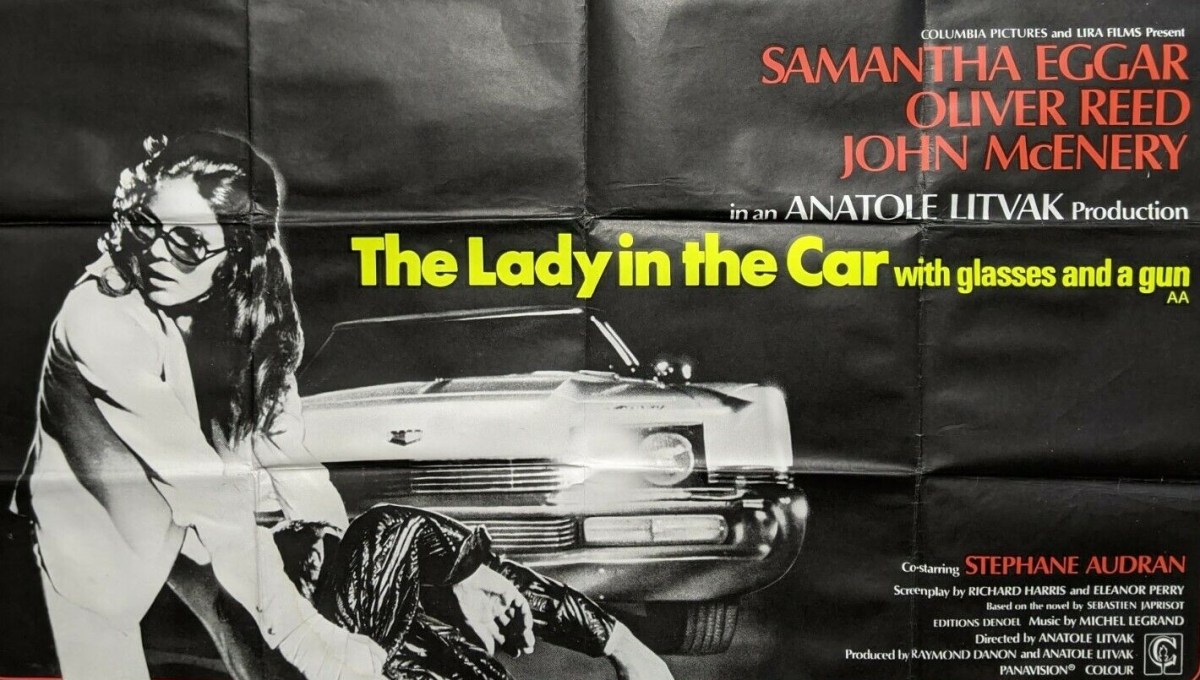
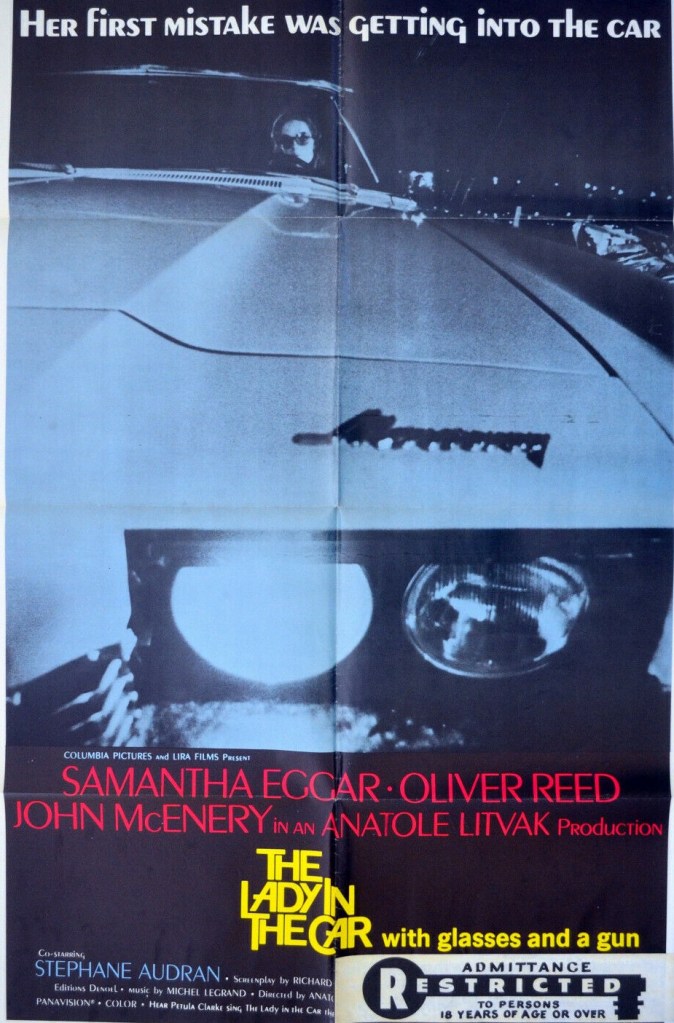
Samantha Eggar (The Collector, 1965) in her first top-billed role and an adapatation of a novel by French cult item Sebastian Japrisot (Adieu L’Ami/Farewell Friend, 1968). You couldn’t get a better mix.
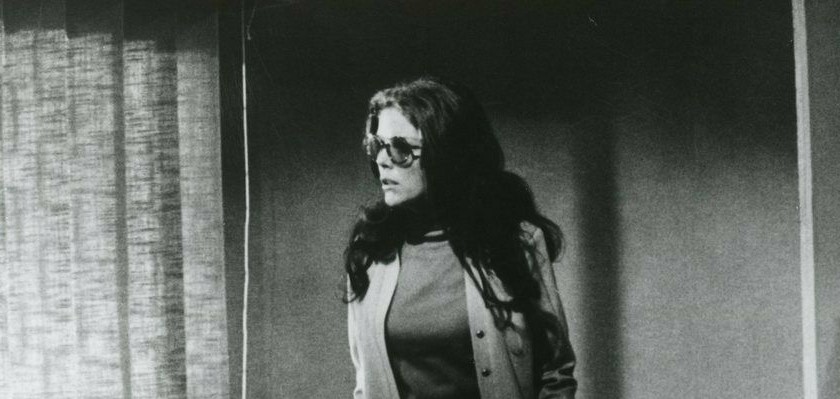
Fashion photographer Danielle (Samantha Eggar) sets off on road trip from Paris to the south of France only to discover everywhere she goes a doppelganger has been there first. She’s on edge anyway because she’s “borrowed” the car of employer Michael (Oliver Reed) and once police start recognizing her she gets jumpier still. The discovery of a body in the boot and the titular gun (a Winchester rifle) don’t help her frame of mind. But instead of reporting the corpse to the police – she’s a car thief after all – she tries to work it out herself. Amnesia maybe, madness because she keeps having flashes of memory – a spooky surgical procedure – or something worse?
She’s got a battered hand she doesn’t know how. Michael’s wife Anita (Stephane Audran) says she’s not seen Danielle in a month though she is convinced she stayed with the couple the previous night. A drifter Philippe (John McEnery) starts helping her out. Eventually she ends up in Marseilles none the wiser.
It’s a tricksy film and like Mirage (1965), recently reviewed, being limited to her point of view means the audience can only work out everything from her perspective. The string of clues sometimes lead back to the original mystery, other times appear to provide a possible solution. The explanation comes in something of a rush at the end.
Despite being the first top-billed role for Samantha Eggar (Walk Don’t Run. 1966), she would not scale that particular credit mountain again until The Demonoid (1981) but she is good in the role of a mixed-up woman struggling with identity. But since it’s based on a novel by Sebastian Japrisot (The Sleeping Car Murder, 1965) there’s a sneaky feeling a French actress might have been a better fit. Oliver Reed (Women in Love, 1969) is not quite what he seems, a difficult part sometimes to pull off, but he succeeds admirably.
Stephane Audran (Les Biches, 1969), jealous of Danielle, a friend whom she views as a rival for her husband’s affections, has the most intense part, using Danielle as an unwitting cover for betraying Michael. John McEnery (Romeo and Juliet, 1968) could almost be a London spiv, blonde hair, impecunious, clearly using women wherever he goes. Watch out for French stalwarts Marcel Bozzuffi (The French Connection, 1971) and Bernard Fresson (The French Connection II, 1975).
There’s certainly a film noir groove to the whole piece, the innocent caught up in a shifting world, and that’s hardly surprising since director Anatole Litvak began his career with dark pictures like Sorry, Wrong Number (1948) while previous effort Night of the Generals (1967) also involved murder. Litvak and Japrisot collaborated on the screenplay.
I expected a project laced with more atmosphere and a host of original characters. In truth, this is less atmospheric than the other two Japrisot adapatations , the interplay between the characters not so tightly woven, nor the climax so well-spun but it was enjoyable enough.
There was a remake in 2025 starring Freya Mayor (The Emperor of Paris, 2018).
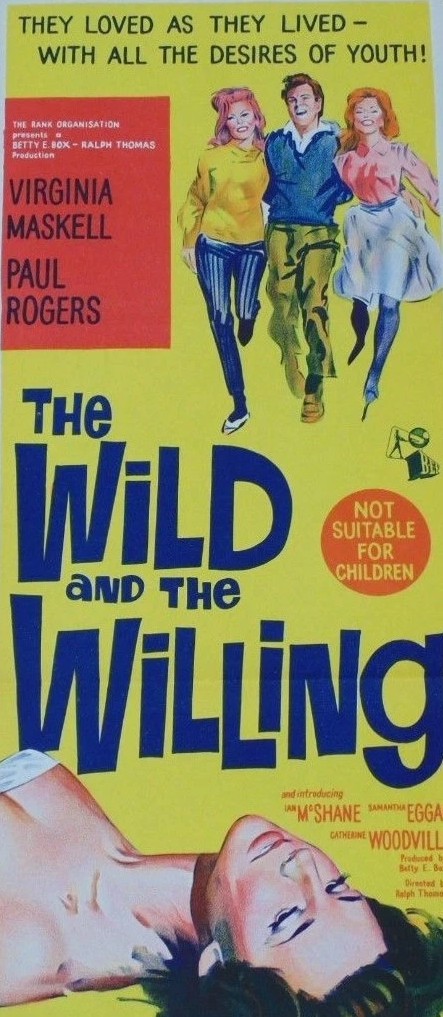
The problem with showcasing new talent is that it’s a pretty difficult sell given that all audiences have to go on is a studio’s faith in these newcomers. You can’t actually justify which of these will succeed until long after their initial forays.
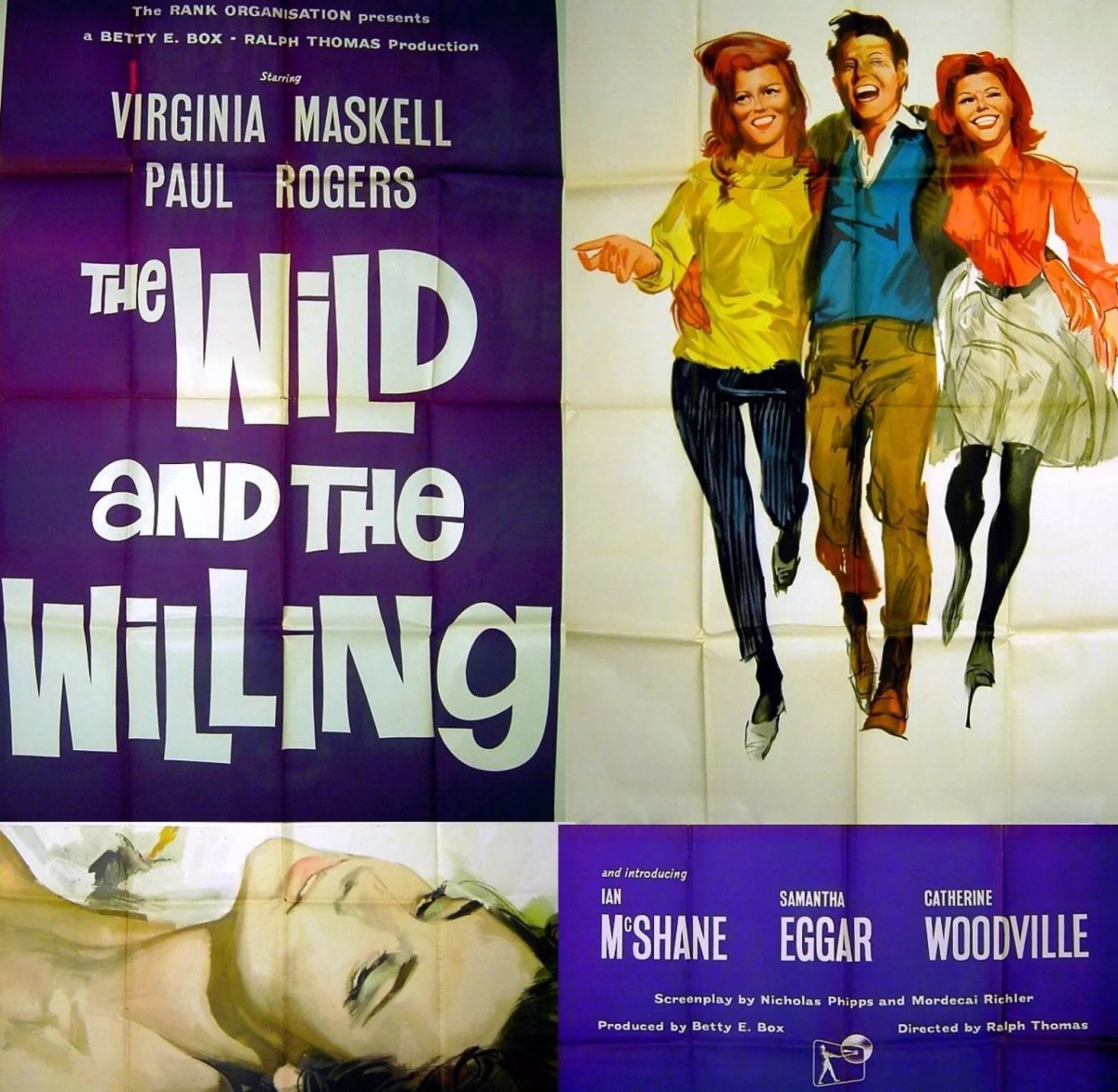
In fact, this was a pretty good indicator one way or another of the talent the Brits had at their disposal, although some only became major players via television and others like Ian McShane, making his debut, as durable as he was as occasional leading and staunch support and television work (Lovejoy, 1986-1994), really only achieved substantial fame around four decades later via Deadwood (2004-2006) and the John Wick series.
For others, this proved an ideal calling card, Samantha Eggar, another debutante, was the biggest immediate beneficiary, female lead in big-budgeters The Collector (1965) and Walk, Don’t Run (1966). But virtually everyone in the cast had a whiff of stardom at one time or another. John Hurt’s stint as Sinful Davey (1969) didn’t do him much good but his career revived through the likes of television movie The Naked Civil Servant (1975), Midnight Express (1978) and Alien (1979).
This is stuffed with names you might remember one way or another. Jeremy Brett became a television Sherlock Holmes, Johnny Briggs enjoyed one of the longest-running roles in British soap Coronation St. Paul Rogers made headway in Stolen Hours (1963) and was a solid supporting actor. Johnny Sekka made a splash in Woman of Straw (1964) and The Southern Star (1969). Some careers were short-lived, the slightly more established Virginia Maskell’s last picture was Interlude (1968).
The story itself – I’m sure you couldn’t wait till I come to that – is slight, but with sufficient complication for a narrative to flourish. Activity takes place on a university campus. Harry (Ian McShane) and Josie (Samantha Eggar) are an item, at least until his eye wanders to Virginia (Virginia Maskell), the unhappy wife of Professor Chown (Paul Rogers).
Harry’s nerdy pal Phil (John Hurt) has been knocked back by Virginia’s classy pal Sarah (Katherine Woodville) and in trying to become as popular as Harry embarks in a daft adventure that ends in disaster.
As far removed from the kitchen sink drama popular at the time, this is a well-observed piece about the young and ambitious without ever descending into the intensity that other pictures wallowed in. You can forget about the suggestiveness of the title, by today’s standards this is very tame and skirts issues of sexuality that were becoming more predominant.
Ralph Thomas (Deadlier than the Male, 1967) directs from a script by Mordecai Richler and Nicholas Phipps adapting a play The Tinker by Laurence Doble and Robert Sloman, effortlessly seguing away from the stage origins and deftly putting every aspect of the narrative jigsaw in its place.
So, part of the fun here is seeing how well actors established a screen persona, or how they moved on. Ian McShane certainly had the cocky walk, but was still too much of the ingénue, even while playing a bad boy. Samantha Eggar was more instantly recognizable for the charisma she threw off. You would see John Hurt’s nerd again and again.
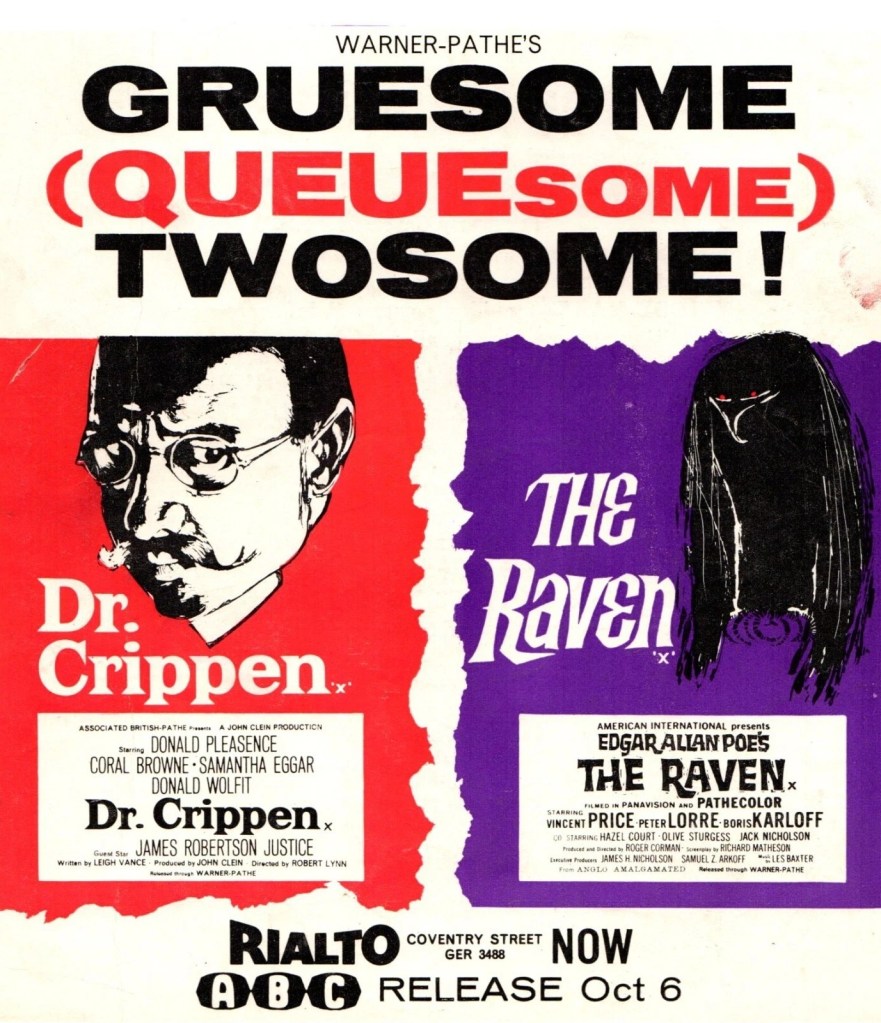
I have to confess my ignorance of this infamous British murderer. I knew the name and that he had hacked up his wife and buried her under the floorboards, so I just assumed a nutcase in the vein of Jack the Ripper, a sadist with a bent for mutilation. So I was quite surprised by this biopic which tended more towards explanation – perhaps going as far as expiation – rather than exploitation.
Mostly, this is set around a court case with flashbacks to fill in the story. This is one of these pictures where the victim is completely unsympathetic. Mrs Crippen (Coral Browne) as portrayed here was just awful. An ex-music hall artiste, she not only slept around but taunted Dr Crippen (Donald Pleasence) about how much better her, invariably younger, lovers were in bed. She treated him as her servant, always on the lookout for the opportunity to humiliate him and was at her most venomous when drunk, a common occasion.
He had fallen for a much younger woman, his secretary Ethel Le Neve (Samantha Eggar), who, despite the age difference adored him. Though the notion of her apparently inept husband consorting with a woman was hilarious to Mrs Crippen, his wife wanted to use the opportunity to humiliate him further. Divorce is out of the question. In 1908 the scandal would ruin an outwardly respectable man. In innocent fashion, Ethel plants in the doctor’s head the potential solution.
Crippen poisons his wife, chops her up, buries her in the cellar and comes up with a fantastical tale to account for her disappearance, namely that she had run off to America to take up with a previous lover. The police think he’s lying – assuming she has just run off – but don’t believe this innocuous little man could be guilty of murder. The situation only becomes dicey when Crippen and lover flee the country and this creates a hue and cry, front page news across the world, and they are apprehended on board a steamship where they maintain the charade of being father and son, a cover blown by the fact her male outfit hardly conceals her figure and that he can’t resist squeezing her hand in public..
Ethel believes Crippen is innocent and although he is found guilty, there is a coda where it might appear that the crime should be manslaughter rather than murder. He intended the poison to be used as a sedative, to stop her verbally abusing him, and he only accidentally gave her an overdose.
So it’s far from drawing a lurid picture of a terrible murderer in part due to the portrayal of his philandering, drunken, abusive wife; in part due to the meekness of the doctor; in part due to being shown exactly how the overdose could have occurred in unintentional fashion; and in part because we do not see him butchering the body. It comes across as a more sympathetic portrait of one of the most demonized figures in British criminal history.
The only problem is it’s impossible to see the attraction of a vibrant young women to this fuddy-duddy older fellow. Maybe it was his intellect – a young woman dazzled by his brain.
He’s not exactly creepy, but he lacks an ounce of charisma. But that does square with him not being a murderer, and only wishing to sedate his wife – still a crime – to give him some peace.
Resulted in Donald Pleasence (Soldier Blue, 1970) being typecast as a villain which, while limiting his range, ensured career longevity. Samantha Eggar (The Collector, 1965) continued to burnish her growing reputation. Coral Browne (The Killing of Sister George, 1969) steals the show with a vigorous performance, but, oddly enough, didn’t do her career much good, another four years would pass before she was seen again on the big screen. Inveterate scene-stealer Donald Wolfit (Life at the Top, 1965) hams it up but there’s a more measured performance from the normally ebullient James Robertson Justice (The Fast Lady, 1962).
Directed by Robert Lynn (Mozambique, 1964) from a screenplay by Leigh Vance (The Frightened City, 1961).
Had me at pirates! Unfortunately, I feel suckered. These scumbags, even with a dandified Yul Brynner (The Double Man, 1967) at the helm, give the traditional swashbuckler a bad name. That said, it’s a decent Rambo-esque adventure, derived from a Jules Verne novel, that sees Kirk Douglas (A Lovely Way To Die, 1968) single-handedly take on the venomous pirate crew, with Samantha Eggar (The Collector, 1963) thrown in as lure.
Ex-gold-miner Denton (Kirk Douglas) runs the southernmost lighthouse off the perilous coast of Argentina leading to the dreaded Cape Horn passage, the only route round South America prior to the opening of the Panama Canal. Helping him out are veteran seaman Capt Mortiz (Fernando Rey), who constantly upbraids Denton for his lack of naval lore, and young lad Virgilio (Jean Claude Drouot) and his pet monkey. When a ship hoves into view and anchors off-shore, Mortiz and Virgilio head up the welcome party only to be ruthlessly – and gleefully – cut down as they climb on board.
Pirate chief Kongre (Yul Brynner) has come up with a neat scam. Switch off the whale-oil-fuelled lights in the lighthouse, wait for unsuspecting ships to be wrecked and pocket the proceeds. After being tormented and humiliated, Denton manages to escape and hide out in the caves, but only for as long as Kongre, bored with idleness, decides to hunt him down astride his white horse armed with a unicorn-like sword, the lighthouse keeper only avoiding capture by diving into the sea, where he is presumed drowned.
But when the first victim of Kongre’s scheme breaks asunder, Denton rescues Montefiore (Renato Salvatore) from the ensuing sadistic massacre. The only other person saved, at Kongre’s behest, is the beautiful Arabella (Samantha Eggar), for whom the captain goes through an almost courtly charade before, espying photographs in the lighthouse cottage, deciding that since his captive bears some resemblance to Denton’s former lover he could inflict further torment to Denton by parading the woman, hoping to use her as lure to bring his enemy out from his hiding place.
While Denton has escaped capture and is carrying out guerrilla warfare against the invaders he’s not particularly successful, given he lacks any decent weaponry, is heavily outnumbered and Kongre is pretty cunning. Denton’s innate decency sees him attempting to rescue the girl only, in a stunning twist, to be knocked back as he has little to offer except hiding out in caves and the captain has been treating her royally. Unfortunately for her, when his ruse fails, Kongre tosses her to the sharks in the shape of the lusty crew who proceed to commit mass rape. Meanwhile, Montefiore has been captured, strung up in the rigging and is being flayed alive, slices of skin torn from his body to the delight of his captors.
As it happens, the pirates, to reinforce defence of the island should they themselves come under attack from the British or Argentinian Navy, have brought their ship’s cannons ashore. As it happens, not only are they trained on the ship, but Denton, despite no experience at all, proves an ace artillery commander. As the ship burns and sinks, he turns his attention to Kongre, conveniently swanning around in the lighthouse rather than the cottage, and in a piece of savage irony sets fire to the building with whale oil.
Could do with shaving 20 minutes off the running time, and certainly have to suspend disbelief at other points, but otherwise it’s a pretty early edition of the Rambo-style revenge, the one-man army that can wipe out a superior force. Despite my desire for a decent swashbuckler, the pirates are probably more realistic than anything served up by Errol Flynn or Johnny Depp, and their cruelty seems consistent with their profession. The scenes with Denton being pursued relentlessly by the mounted Kongre are especially effective as is the rejection of Denton by the snooty girl.
Kevin Billington (Interlude, 1968) directed from a screenplay by wife Rachel and Tom Rowe (The Green Slime, 1968).
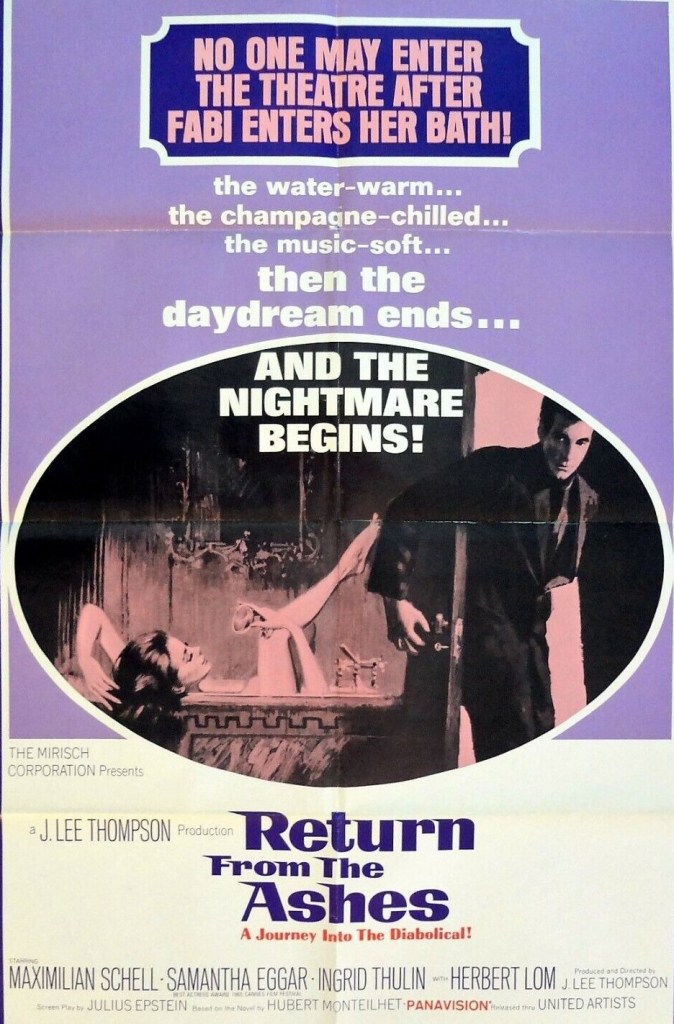
When your starting point is an arcane French inheritance law and the plot revolves around swindling a concentration camp survivor you are immediately on “icky” ground. Throw in a relationship between an adult male and the step-daughter of his deceased wife and the audience might already be backing off.
So it’s a tribute to the acting and that each character is not so much unlikeable as both vulnerable and predatory that this turns into a very involving drama. On the eve of World War Two in Paris Dr Michele Wolf (Ingrid Thulin) buys the love of penniless Polish chess player Stanislaus (Maximilian Schell) but at the cost of abandoning her step-daughter Fabi (Samantha Eggar). For him, love is contingent on wealth, but he marries Michele, a Jew, in a (failed) bid to save her from the clutches of the Nazis. Fabi, shorn of maternal love finds turns to a paternal variation, but is capable of coming up with an ingenious murder plot.
Just quite how hollow Michele has become is demonstrated in a brilliant opening scene set after the end of the war. In a railway carriage, a bored small boy endlessly kicks a door. Pretty much for 90 seconds we either see or hear that door being kicked. Foolishly, his hands wander from the window to the door handle. Next thing, he has fallen out. Cue screams, chaos, shocked passengers racing out of the carriage.
But when the conductor turns up to investigate the incident he finds Michele still sitting in her seat, oblivious to any death, even that of a child. When she returns to Paris, she takes a room in a hotel under a pseudonym, fearing that her ravaged looks make her unattractive, guilty at surviving (by volunteering to work in the camp brothel) when all her relatives were wiped out, unaware that she has unexpectedly inherited all their combined wealth.
So the story begins in a different way. When Stanislaus meets her accidentally under her false name, he immediately assumes she is just a dead ringer for his deceased wife and enrols her in a scheme to win the millions currently held in escrow under this inexplicable French law.
Since she continues to play the part of a different woman, she hears the truth about her relationship with Stanislaus, that although he committed the only unselfish “gallant act” in his life in marrying her nonetheless his prime reason was money. Already Fabi, in full femme fatale mode, is planning to rid the couple of Michele once the money has been legally acquired.
To his credit, Stanislaus initially balks at this notion, but when Michele reveals her true identity and scuppers his relationship with Fabi while at the same time trying to win back the affection of her step-daughter, matters take a deadly turn.
For the most part what we have is a menage a trois, equal parts driven by money and love, but in each instance propelled by innermost desire. Stanislaus is adept at pulling the wool over Michele’s eyes, she only too willingly blinding herself to his sexual deception. But Michele is equally willing, even when she knows his true feelings, to use her money to win him back while Fabi, aware that for her lover money will always trump romance, is determined to use her body to achieve the same effect.
What makes this so compelling is that, unusually, it avoids sentiment. It would have been easy to load each character up with such vulnerability that an audience would not condemn them. Instead, in addition to their individual weaknesses, we are shown their inherent predatory natures.
What makes it so enjoyable is the acting. So often Maximilian Schell is called upon to play stern characters, often typecast from his accent as a villainous German of one kind or another (Judgement at Nuremberg, 1961, The Deadly Affair, 1967), rather than allowing him to invent a more rounded character as he did in Topkapi (1964). This is a wonderfully involving performance, the wannabe chess grandmaster who uses his considerable charm to buttress his fears of poverty, and is only too aware of his failing, full of joie de vivre, bristling at being a kept man yet at the same time only too ready to financially exploit the situation.
Where in The Collector (1965) Samantha Eggar was constrained by circumstance and in Walk, Don’t Walk (1966) saddled with an initially cold character, here she is permitted greater freedom to develop a conflicted personality, loving and deadly at the same time, drawn to and hating her step-mother, attracted by the thought of the money that would secure Stanislaus but repulsed by the cost.
Ingmar Bergman protégé Ingrid Thulin (Wild Strawberries, 1957) is given the least leeway, another of the tormented characters in her intense portfolio. Herbert Lom (Villa Rides, 1968) puts in an appearance as a friend trying to warn her off Stanislaus.
Director J. Lee Thompson (The Guns of Navarone, 1961) takes the bold approach of allowing characters and situation to develop before moving into thriller mode. There are a couple of quite superb scenes, running the opening segment close is the much-vaunted scene of Fabi in the bath (“No one may enter the theater once Fabi enters her bath” was a famous tagline). It is brilliantly filmed in film noir tones, bright light slashed across eyes rather than through windows, and Johnny Dankworth provides an interesting score. Julius J. Epstein (Casablanca, 1942) wrote the screenplay based on the bestseller by Hubert Monteilhet.
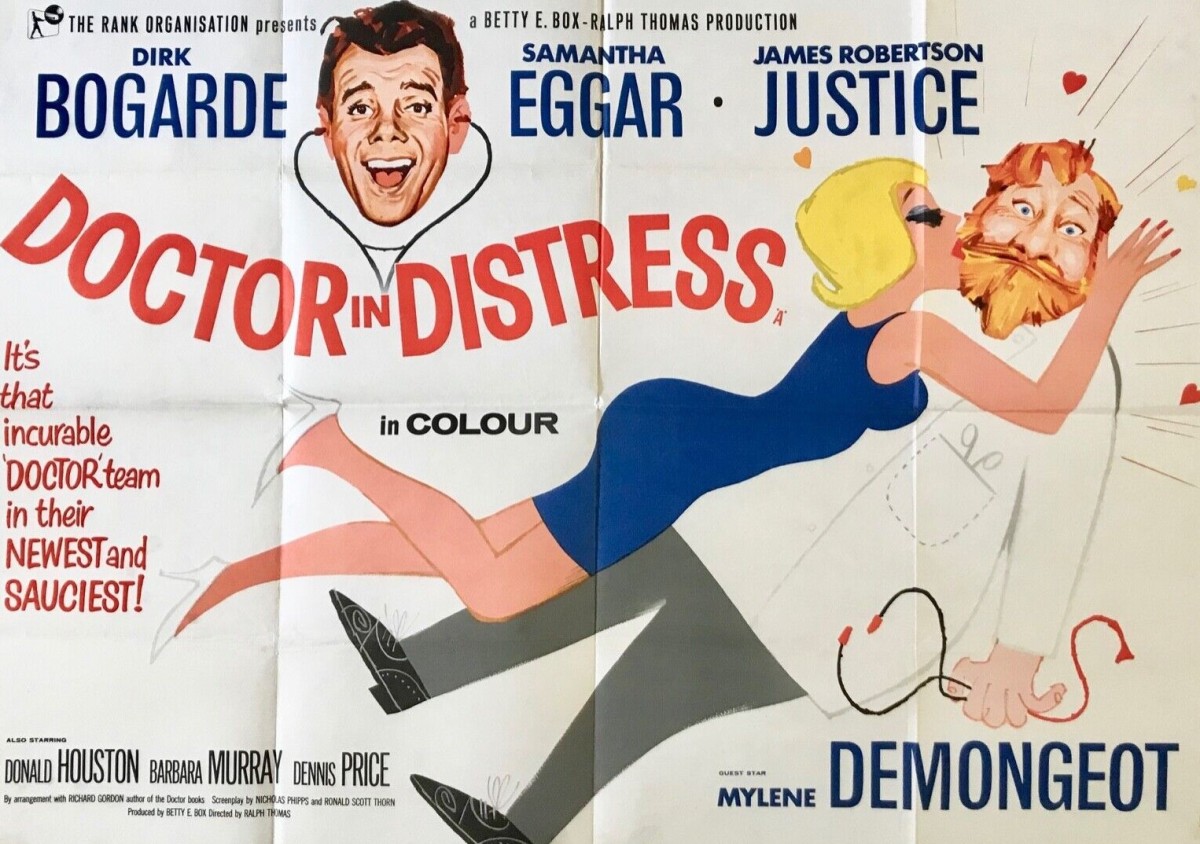
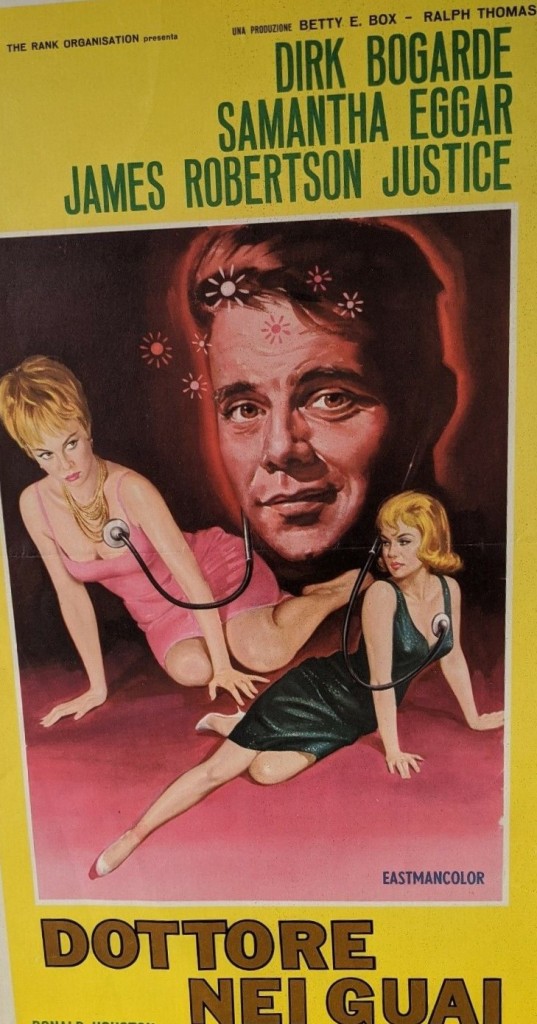
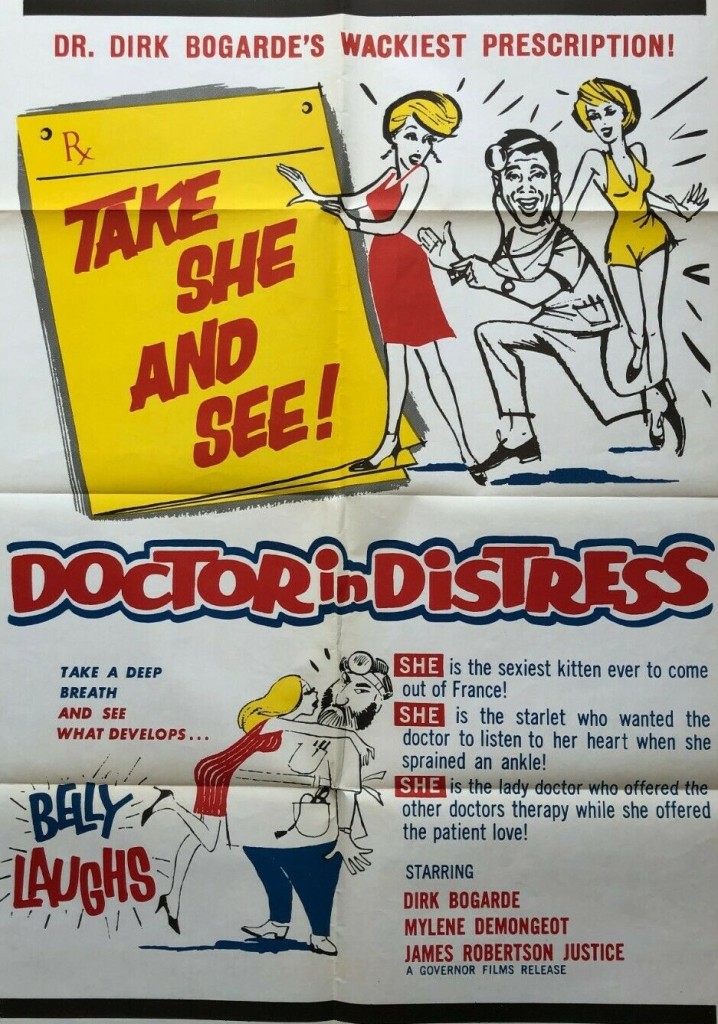
Bait-and-switch as the romantic complications of the grumpy Dr Spratt (James Robertson Justice) take precedence over the by-now pretty competent Dr Sparrow (Dirk Bogarde). Just about getting by on Bogarde’s charm in his fourth and final outing in a role that had made him a British box office star and possibly more notable as his final film as an out-and-out matinee idol before he shifted into the arthouse arena.
Dr Sparrow has come a hell of a long way since being a shy junior doctor, mercilessly bullied by Spratt and a love life that was filled with tangle. Here, he not only stands up to Spratt, but is something of a lothario, happily ditching new love Delia (Samantha Eggar), a model, albeit temporarily, in favor of French masseuse Sonia (Mylene Demongeot).
There is very little of the traditional rom-com-love-on-the-rocks in Bogarde’s relationship with Delia, who arrives as a patient with a sprained ankle at the hospital and is whisked home by Sparrow for a spot of practised seduction. Spratt, on the other hand, has fallen for physiotherapist Iris (Barbara Murray) and in trying to win her hand undergoes weight loss treatment at a health clinic, endures the indignity of wearing a corset, hires a private detective to get the lowdown on her, and finally, donning a disguise of dark glasses and hiding his bulky frame behind an umbrella, proceeds to attempt to discover who is his rival for her affections.
Sparrow is left to occasionally swat out of the way the interfering Spratt and alternatively offer him advice or a shoulder to cry on while trying to prevent Delia pursuing a movie career. So it’s just a series of situations, none of which are particularly funny, apart from the idea of Spratt getting his come-uppance.
It’s worth noting that for a British sex comedy, the females are in charge. Iris knocks back her various suitors, Delia refuses to let romance interfere with her career, jetting off to Rome over Sparrow’s objections, and the diminutive and muscular Sonia is more than a match for any man and just as predatory.
What’s most surprising is that a genial comedy like this can get away with so much permissiveness. This was opposite of the in-your-face snigger-snigger Carry On series so for Sparrow to be successfully spreading his wild oats seemed somewhat out of character. But you can see most of the jokes a mile off though probably in a packed cinema these would provoke more laughter than watching it at home on the small screen.
It’s probably worth it to see Leo McKern (Hot Enough for June, 1964) as a movie producer who envisages Sparrow as his new star and Frank Finlay as a corset salesman, a completely different role to his part in Robbery (1967). Fenella Fielding (Lock Up Your Daughters, 1969) has a cameo as a neurotic passenger on a train and Dennis Price (Tunes of Glory, 1960) as a sadistic health clinic manager while Donald Houston (A Study in Terror, 1965) has a larger part as another of Iris’s suitors.
Dirk Bogarde (Justine, 1969) can essay this kind of character in his sleep but there is no doubting his screen charisma or charm. But I doubt if James Robertson Justice (Mayerling, 1968) varied his character much from picture to picture, perhaps louder and more bumptious here but unlikely to attract audience sympathy. Samantha Eggar (The Collector, 1965) doesn’t get enough to do and has her thunder stolen by the late arrival of Mylene Demongeot (Fantomas, 1964).
Director Ralph Thomas had made more than a half-a-dozen films with Bogarde including more dramatic ventures like Campbell’s Kingdom (1957) and The Wind Cannot Read (1958) and makes the most of this undemanding feature. You would have thought this was the end of the line for the series but with Leslie Phillips (Maroc 7, 1967) as Bogarde’s replacement it soldiered on for another couple of episodes.
Proof that a true star can always help a film rise above its material.
This is a low-budget gem, an exploration of the psychological consequences of grooming. You can probably guess from the outset where it is headed but simmering tension has rarely been handled so stylistically.
With the exception of Patricia Neal, an unexpected Best Actress Oscar-winner for her previous film Hud (1963), there were no stars in the cast. Curd Jurgens was only beginning to play characters for whom a German accent was not essential, Samantha Eggar one movie shy of her breakout picture The Collector (1965), Ian Bannen, essentially a character actor, building on his success in Station Six Sahara (1963).
Blinded after an unexplained psychological trauma, Allison (Patricia Neal) welcomes back, over the objections of husband Eric (Curd Jurgens), her much younger sister Robin (Samantha Eggar) to the family home. Family friend Paul (Ian Bannen) cares (possibly overmuch) for Allison while hankering after Robin. The screenplay by veteran Julian Zimet (Saigon, 1947, with Alan Ladd) is taut as a drum, every line a threat, suppressed emotion or piece of exposition that could bring the whole house of cards tumbling down.
The blindness is exceptionally well handled, Allison’s need for physical contact with her husband sensual in its expression. Though she can a ride a horse, her vulnerability is implicit; as she is led across a beach you wonder what would happen were she to be abandoned. What she cannot see becomes central to the movie. That Robin – vivacious but damaged – clearly has some hold over Eric is demonstrated in a tete-a-tete between them but as tensions mount such scenes cannot be kept secret. When Eric grabs Robin’s hair and she retaliates by jabbing him with scissors, neither party emits a sound, leaving Allison oblivious to it all.
Robin takes delight in exposing what has lain on the surface for too long. When Paul begins to fall for Robin, the younger woman astutely remarks to her sister: “Am I taking him away from you?” Allison, however, is self-aware, convinced she could see if she wanted to, if she was prepared to lift the psychological barrier that keeps the past safely hidden. “I’m afraid to see,” says Allison, “there’s something I’m scared to look at.”
Given the period when it was made there was a lot that could not said – or shown – and even so the film was censored prior to release, but it is the direction by Alexander Singer (A Cold Wind in August, 1961) that lifts the picture up. An acolyte of Stanley Kubrick, the movie teems with imagination, close-ups and extreme close-ups are balanced by long two-shots, a conversation in a car between Eric and Paul mostly direct to camera a prime example.
Emotion is captured at every turn and Singer avoids the cardinal sin of treating Allison like an invalid or focusing on her reaction to what she cannot possibly see, her eyes hidden behind dark glasses for much of the time. Levity is provided by Mrs Crawford (Beatrix Lehmann), Eric’s sci-fi-reading horoscope-obsessed mother and by a couple of excitable children.
The grooming is in the past but the after-effects are very real. In a film like this it is tempting to consider that certain attitudes are dated, but it is clear from this film that nothing has changed, that men believe they can take what they want regardless of the impact on their victims.
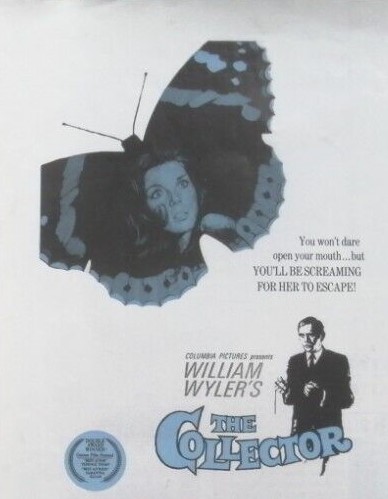
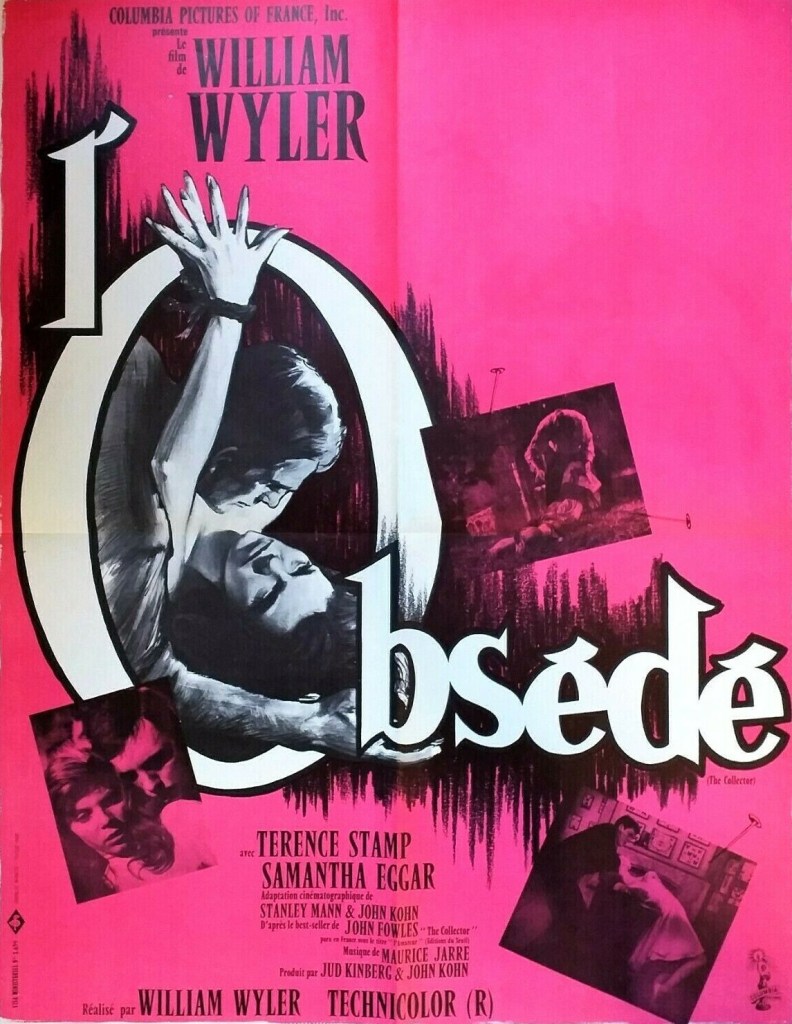
Director William Wyler was “saved,” to use the term preferred by his biographer Jan Herman, from what turned out to be the biggest picture of all time (up till then) The Sound of Music (1965) by a piece of door-stepping by two determined young producers who presented him with a pre-publication copy of John Fowles’ novel The Collector.
Wyler had been well down the pre-production route for The Sound of Music. It was he who hired Julie Andrews, having seen her performance on Broadway in My Fair Lady, and been granted access to the rushes of Mary Poppins (1964). While he was an odd choice to direct, being more of an opera buff and hard of hearing, he would later nurse Funny Girl (1967) to box office and critical acclaim.
While instinct told the German-born director that The Sound of Music “would be a success” he was troubled that it was set in Austria at a time just before World War Two when the country was mostly whole-heartedly welcoming the Nazis. “I can’t bear to make a picture about all those nice Nazis,” he said.
So when novice producers Jud Kinberg and John Kohn, television writers who had set up Blazer Films, brought him what would turn out to be a sensational bestseller, actor Terence Stamp already under contract and a deal in place with Columbia, turned up on Wyler’s doorstep with a completed screenplay they gave him a reason to pull out of The Sound of Music. He ignored the screenplay in favor of devouring the book.
“I couldn’t put the book down and I’m a man who can put down books very easily,” he said. While not so enamoured of the screenplay by Stanley Mann, he signed up, and although since the 1950s he had either officially or unofficially acted as producer on his own movies, he agreed to allow Kinberg and Kohn to do the job this time, as long as they did not interfere with direction and that he, of course, had final say.
Despite critical acclaim for Billy Budd (1962), a part he won ahead of the likes of Warren Beatty, Terence Stamp had not made a film since, and begun to doubt whether he was cut out for stardom. He wasn’t short of media attention – the various women he squired seemingly all the time made sure of that – but he was distinctly lacking in movie offers.
He took on the role of the deranged Freddie – even though he loathed the character – primarily because he had no other choice. “I hadn’t gotten any new work in roughly a year,” he explained. “I knew the camera loved me, so I had confidence in that. But I just thought this Freddie character was beyond me.” And once Wyler was signed, Stamp felt he would not come up to the director’s high standards. Told that Wyler had no objections to his casting, the still dubious actor asked to take part in the screen tests the director was holding for actresses hoping to win the role of Miranda, the female lead, partly to feel his way into the part and partly to give Wyler an opportunity to fire him if he wasn’t up to the mark.
Without the director being present, he tested with Sarah Miles, whom he had played opposite in Term of Trial (1962) and Samantha Eggar (Doctor in Distress, 1963). Once Wyler saw the footage, with Stamp clad in his own notion of the character’s clothing he expressed his confidence in the actor and told him, “I’m not going to make the book. I’m going to make a modern love story.”
Samantha Eggar was fired three weeks into rehearsals, undermined by just how good Stamp was, unable in her inexperience to cope with his “nasty attitude,” a deliberate decision by the actor, remaining in character during shooting, in part because they had attended drama school together where he had a crush on her and could not allow himself to feel inferior to her. Although his character worshipped her in one sense, his level of entitlement made him feel superior to her in another.
It turned out Stamp was following Wyler’s instructions. The director didn’t want Stamp and Eggar mixing off-set. The actor was to be as cold to her in real life as the character was in the film.
There had been enormous press coverage over Eggar being chosen, one of those Gone with the Wind-style star hunts of which Hollywood was so fond, so the press would leap at the news that she had departed the picture without shooting a scene. Wyler, in the meantime, pursued Natalie Wood (Splendor in the Grass, 1961), a far more accomplished actress and certainly not going to be dominated on screen, or in real life for that matter, by the likes of Stamp. Columbia production head honcho Mike Frankovich intervened on Eggar’s behalf, a script read-through was arranged, and Eggar was back in, on condition she agreed to an acting coach, Kathleen Freeman, of Wyler’s choosing.
But it wasn’t just the humiliation of working with a coach – although Marilyn Monroe famously employed a coach, she was scorned for relying on one – that Eggar had to put up with. Eggar wasn’t permitted to leave the set during the day, or eat with the rest of the cast, forcing her to remain in the daunting isolation of her character.
“He wanted her in a constant state of terror and that’s really very difficult to act,” revealed Stamp, who agreed to conspire with the director to drag out of her the performance of her life. It felt to Stamp that they were torturing the young actress even if that extended to no more on his part than giving her the cold shoulder.
Wyler went further. He wanted her to feel defenceless. During the rain sequence, she had a bucket of water thrown in her face so she was absolutely drenched. And while her travails were not much compared to what, for example, Kate Winslet endured on Titanic, it has been viewed as yet another example of a director bullying a young actress.
I’m not so sure about that, to be honest. The scene called for Eggar to be soaked to the skin and whatever way that occurred she would need to be absolutely drenched. Whether she believed a gentle shower of rain from a sprinkler would achieve the same effect is unknown and you might consider whether Wyler took the bucket approach because he believed her incapable of registering the required look of shock.
It transpired that Eggar hadn’t a clue, beyond checking his credits, who Wyler was. She hadn’t been allowed to visit the cinema until she was 18. And “had no knowledge…of the history of film.” Directors scarcely made the gossip pages and the flurry of biographies and critical appreciations were a few decades away. And minus VHS or DVD there was no way to easily lay your hands on a director’s back catalogue. “I was very ignorant,” she admitted, “of the position that he held as a Hollywood icon.” It’s entirely possible she never even saw Ben-Hur, for she has never mentioned doing so.
During the love scene, she was kept nude while Stamp had his clothes on. “I kept wondering why I had to stand there with no clothes on when they were only shooting me from the waist up.” (And in keeping with the Production Code rules, no nudity was shown on screen). Eggar wondered if perhaps Wyler, who had a reputation as a ladies man and enjoying dalliances during shooting with some of his actresses, had taken a fancy to her. But he showed no signs of making any moves or even making the kind of remark that suggested he was in love with her, or ogling her body. It was just another device to keep her in character. (Thought it might have been better all round if she had been given some say in this approach.)
On the other hand, Wyler clearly went out of his way to help her. He reversed his own decision to use her. To help her remain in character and develop her role, ridding her gradually of the confidence she exuded in her earlier scenes, Wyler shot the film in sequence, as unusual a method in Hollywood as the other techniques mentioned here. And when a photographer hid in the gantry to get a shot of Eggar in the nude, Wyler raced to her defence, ripping the camera from the intruder’s hand, destroying the film and throwing the man out.
A later decision in the editing room enhanced her performance without the actress having to express single emotion, speak an extra line or give another look. The script called for her character to remember her lover, using his image to see her through her ordeal. But Wyler completely cut out actor Kenneth More playing the lover, leaving in just one shot of the back of his head, so that instead of appearing to rely on that memory and those feelings to combat the situation, she was presented instead as woman of great resilience. “It’s love keeping her alive,” Eggar would later say.
And there’s certainly no sense that Wyler was dissatisfied with her performance. However, like Stamp, she doubted her own skill. “At first I just felt I couldn’t do it. It took me five weeks to get on Wyler’s wavelength. When it’s over you realise you have done the best you could do. It’s very satisfying for an actress.”
Stamp saw a different side to Wyler. He recalls a director who didn’t even call “action.” He would “simply roll his hand” in order not to disturb an actor’s concentration. Unless, of course, an actor was not up to the mark: Maurice Dallimore, who played the nosy neighbor, felt the rough edge of the director’s tongue when he could not manage the necessary English accent.
Originally, Wyler intended to shoot the film in black-and-white. But when the cinematographer did a black-and-white test of Eggar he also did a color one that captured the magnificence of her red hair and skin. Wyler had feared that color would act as a distraction and “could be phony, exaagerated.” Except for some establishing shots in Britain, the picture was shot in Hollywood. The scene with the bathwater running down the stairs was not in the book and of course Wyler took quite a different approach to the novelist. Even so, John Fowles appeared pleased with the result.
Stamp changed his views of Wyler. Initially, he told Roger Ebert, “I don’t go much for Wyler.” But, contacted by Jan Herman for the Wyler biography, he claimed Wyler and Fellini were the two best directors he had ever worked with. “It was one of the great experiences of my life. He was just wonderful in a way I’ve never come across before,” he told Brian Raven Ehrenpreis.
SOURCES: Jan Herman, William Wyler, A Talent for Trouble (Da Capo Press, 1997) p418-428; Roger Ebert, “Interview with Terence Stamp,” New York Times, June 12, 1968; Brian Raven Ehrenpreis, “Get Your Sword!”, www.thequietus.com , August 25, 2018; “Collecting Life, An iIterview with Samantha Eggar, www.terrortrap.com ; Kathleen Carroll, “Redhead Mad for Pink,” New York Daily News, June 20, 1965.
William Wyler’s paean to Incels strike such a contemporary note it’s hard to believe it was made over 60 years ago. An insightful study of male entitlement, female submission and novice serial killer that showcased two emerging British stars, this is as much about the psychological make-up of the victim as the captor.
Following a lottery win (see Note), lonely bank clerk Freddie (Terence Stamp) kidnaps the woman of his dreams, flame-haired art student Miranda (Samantha Eggar) in the hope that once she gets to know him she will fall in love. He has found a large cellar beside the secluded mansion he bought with his winnings. But this is no dank dungeon with a prisoner chained to the walls, but a comfortable abode with lighting, heating, clothing, food, and art materials. However, it is locked.
In turn angry, puzzled and submissive, Miranda tries to work out what she needs to do to achieve her liberty without realising that no matter what she does she will never fulfil his dreams. Despite his shyness, it wouldn’t be hard in other circumstances to fall for a guy as good-looking as this, if only for an affair. She is sexually experienced, but has just been rejected by an older man (Kenneth More), and love on the rebound is hardly uncommon.
Unfortunately, Freddie lives such a soulless, empty, existence, no interests beyond an obsession with butterflies, of which he has amassed a collection large enough to supply a complete museum, that the chances of finding common ground are remote and the circumstances of their meeting pretty much douse the potential for any spark.
At first, once she has expended her anger at her incarceration, she is grateful not to be murdered or raped – even pleads that if he is going to take her by force sexually not to drug her – and soon her mind turns to ways of escape, especially once he invites her into the big house, allows her to bathe, cooks her a meal and shows the world she could enjoy as his willing partner.
With every step, Freddie dares to dream more, that his insane idea will come to fruition, that a beautiful princess will love the lowly commoner. And as much as this focuses on male domination, it is also an examination of female independence, Miranda being in the foreground of that generation to espouse personal freedom, not viewing marriage as an ultimate destination, but seeking a fulfilling career with love almost a perk on the side.
Even without going to extent of kidnapping a woman, males of the period still expected a female to cater to their every whim, wife-beating hardly considered a crime, and, ironically, it would be a rare woman who would not enjoy the worship a more ordinary Freddie planned to bestow on his beloved.
It being set in the England of a particular period, Freddie blames the gulf between them on “class,” that where or to whom you are born creating an unattainable barrier between young men and young women, despite considerable evidence to the contrary. But, of course, to the thwarted, there is always someone to blame.
You will be very familiar with the cinematic tale of the imprisoned female attempting to escape by wiles and ingenuity, but even so, this will take you by surprise, in part because the idea of being forcibly detained was a rare event back then, so Miranda does not spend her time trying to chisel through loose cement using a stolen fork or other ideas along the same lines. That she has even managed to negotiate the length of her prison term makes her initial custody tolerable, especially as, in terms of material things, she wants for nothing.
Unfortunately, although Freddie is immune to normal feelings, he is alert to the slightest nuance, and would feel it an insult to his intelligence should she just play along and pretend to fall in love with as a means of engineering her escape. That the audience is probably more aware of this than Miranda makes the tension virtually unbearable.
This is a duel of the highest caliber between captor and detainee. At several moments it looks as if the tide will turn. A terrific scene with overflowing bath water fails to make a nosy neighbor suspicious. She even at one point manages to whack her assailant over the head with a shovel and attempt a genuine escape. You are left to wonder if making a sexual sacrifice, even taking the initiative with a virgin, will make the necessary difference. But one look into those implacable eyes would have told you exactly where you stood without having to wait until you were dragged by the hair across the lawn in a rainstorm.
Audiences more familiar with the director through late-career roadshows like Ben-Hur (1959) and Funny Girl (1967) or the earlier rom-com Roman Holiday (1953) would be forgiven for forgetting how adept Wyler was at racking up the tension from his early thrillers or dealing with unattainable love (Wuthering Heights, 1939) or entitlement (Jezebel, 1938). He evokes such a claustrophobic atmosphere, ingrained with pure Englishness, and plays with ironies of character beauty – Freddie’s eyes and cheekbones, that should have attracted women by the score, instead lending him devilish menace while Miranda’s sensational looks that would have most men begging for just a minute of her company prove insufficient to enslave this particular creature.
That there is genuine sexual tension, not just whether he will end up raping her, but whether she might see his more attractive version of himself and come to give him what he wants without being repulsed, brings a surprising sexual tension. You wouldn’t say there was chemistry between the characters in the normal sense, but the situation is electrifying.
This was a career high for Terence Stamp (Term of Trial, 1962), minus many of the acting foibles and vocal tics that peppered his later work, and the same went for Samantha Eggar (Walk, Don’t Run, 1966). But the performances are of such a high quality, especially when you think she has breached his defences sufficiently, that at times it is an unbearable watch. John Kohn (Caprice, 1967) and Stanley Mann (The Naked Runner, 1967) based their screenplay on the bestselling – and highly praised – novel by John Fowles, author of later cult work The Magus.
This would have stood the test of time anyway as a pure thriller but since it digs into what has now become a counter-culture it carries even greater significance today.
NOTE: He didn’t win the lottery. That didn’t exist then. Instead he won on the “Football Pools,” but that concept – it began in 1923 – is so hard to explain to non-British people that I took the easy way out. However, the “pools” was a gambling phenomenon of the times, the entry fee so low, at its peak played by 14 million people in the UK every week in the hope of winning a jackpot akin to lottery cash. In essence, you had to guess out of all the soccer games being played on a Saturday (all games in those days kicked off at 3pm on a Saturday) how many would end in draws.
Stars rarely get to choose when they want to retire. Usually, the phone stops ringing, or they slide down the credits until no one can remember who they once were, or they end up in terrible international co-productions, or like Tyrone Power (Solomon and Sheba) they die on the job or, like Spencer Tracy, because of it.
Cary Grant, on the other hand, went out at the top, or near enough, after a string of box office winners, including this one, throughout the Sixties. If you are more generally familiar with Grant through Hitchcock thrillers or Charade, you might have forgotten his comedy expertise. He was a master of the double take and the startled expression – and he needs that here in what is sometimes a pretty funny farce.
The set-up is peculiar. Grant is a businessman landing in Tokyo two days before the 1964 Olympic Games with nowhere to stay and ends up sleeping on the couch of Samantha Eggar and later sharing his room with Jim Hutton, an athlete equally lacking in the forward planning department. (Excluding the Olympics, of course, the film has a similar concept to The More the Merrier, 1943).
There’s no great plot and no great need for one. Grant’s main purpose is to play Cupid to Hutton and Eggar and steer her stuffy fiancé out of their way. But it says a lot for Grant’s talent that not much plot is required. He is just so deft, whether he is playing top dog or being beaten at his own game by a rather resilient Hutton.
Eggar is Doris Day-lite, but Hutton is a revelation, not the dour dog of later The Hellfighters (1968) and The Green Berets (1968), but showing true comedic talent, especially in quick-fire verbal duels with Grant. There is only a wee bit of stereotype, overmuch bowing mainly and a Russian shot-putter, but some other Japanese customs are more interesting, yellow flags to cross the road, for example.
There are a couple of brilliant visual gags, one involving trousers, another with Grant getting locked out of the apartment, and a terrific payoff in a Japanese restaurant. Except for thrillers, Grant did not need great directors, he knew comedy inside out and here the accomplished Charles Walters (High Society, 1956) has the sense to let him get on with it.
Grant was 62 when the film appeared so quite rightly delegates romance to Hutton, which is a shame because his (non-romantic) interaction with the pernickety Eggar (she and fiance equally matched in this department) carries all the Grant romantic hallmarks. Instead, he ensures that romance between Hutton and Eggar runs its true course, which while that is satisfying enough, is a bit like removing John Wayne from the final shootout in a western. Oh, and there is a reason for the Olympic Games setting.









 The Magnificent 60s