A Home of Your Own (1964) ***

The phrase “classic silent British comedy” isn’t one that naturally trips off the tongue. Add in “of the 1960s” and you can guarantee furrowed brows. Thanks to the boom in recycling Hollywood silent classics in the early 1960s there was a subsequent mini-boom in what were called “wordless” pictures, as if using the term “silent” was blasphemous. The oddity is that so many emerged from Britain, primarily in shortened format – not more than one hour long – as the second feature in a double bill.

Blame for this development lay in the hands of producer and later writer and later still director Bob Kellett, Britain’s unsung comedy king.

A Home of Your Own is beautifully structured, following the mishaps in building a block of new apartments. A credit sequence covers the stultifying bureaucracy involved, so that what was a pristine site at the beginning of the endeavor turns into a waterlogged dump before the first brick is laid. Sight gags and slapstick abound with mostly everyone getting in each other’s way, or not, the traditional approach of the work-shy British builder being to provide an audience for someone else to dig up a road or a trench.

No paddle goes unsplashed, mud only exists to drench people, and in pursuit of comedy gold most of building materials end up misused. The gatekeeper’s main job is to make tea and there is naturally a union official whose chief task is to obstruct.

Pick of the gags is Ronnie Barker’s laying of cement, delivered with exquisite comedy timing, followed by Bernard Cribbin’s stonemason delicately chiseling out a plaque only to discover at the end in a laugh-out-loud moment that he has misspelled one word, and the carpenter who appropriates the closest implement with which to stir his tea. Some of the jokes grow legs – the morning tea break, a ham-fisted carpenter, the pipe-smoking architect arriving in a sports car, and a patch of ground on the road outside constantly being dug up by different contractors representing water board, gas, electricity.

Once the building is complete, the job taking long enough for the aspiring apartment-owner, a mere fiancé at the outset, to lift his wife over the threshold accompanied by three kids. Any sense of personal accomplishment – the British thirst for owning property quenched – is undercut by problems the young couple now face thanks to the workmanship we have witnessed.  

All this is accompanied by a very inventive Ron Goodwin (633 Squadron, 1964) score which provides brilliant musical cues. As a bonus, the film features a roll-call of television comedy superstars  including Ronnie Barker (The Two Ronnies, 1971-1987), Richard Briers (The Good Life, 1975-1978) and Bill Fraser (Bootsie and Snudge, 1960-1974).  Peter Butterworth and Bernard Cribbins were Carry On alumni. Janet Brown achieved later fame as an impressionist while Tony Tanner hit Broadway as the star of Half a Sixpence before expanding his career to choreographer-director, Tony nominated for Joseph and his Amazing Technicolor Dreamcoat.

A Home of Your Own went out as the support to the Boulting Brothers’ comedy Rotten to the Core (1964) which gave a debut to Charlotte Rampling. Despite being effectively a B-film, primarily made to take advantage of the Eady Levy (a cashback guarantee for producers), A Home of Your Own was surprisingly successful.  “Will delight arthouse patrons” commented Box Office magazine in America (“Review,” October 4, 1965, p160) as British comedy films in those days tended to end up in the arthouses. In part, this was because it was the official British entry to the Berlin Film Festival. It was distributed there by Cinema V in a double bill with Rotten to the Core and launched in what was misleadingly called a “world premiere engagement” at the prestigious Cinema 1 in New York.

Jay Lewis (Live Now, Pay Later, 1962) directed and co-wrote, along with Johnny Whyte. Kellett continued in this enterprising vein with the 55-minute San Ferry Ann (1965) – which he wrote – about a group of British holidaymakers going abroad and the 49-minute Futtock’s End (1970) – which he directed – featuring a bunch of guests descending on an ancient country house owned by Ronnie Barker.

Television stars showcased in these two featurettes included Wilfred Bramble (Steptoe and Son, 1962-1974), Rodney Bewes (The Likely Lads, 1964-1966), Warren Mitchell (Till Death Do Us Part, 1965-1975) and Richard O’Sullivan (Man About the House, 1973-1976). Ron Moody composed the Oscar-winning Oliver! (1968) while Joan Sims and Barbara Windsor made their names in the Carry On series and theatrical knight Sir Michael Hordern appeared in Khartoum (1965) and Where Eagles Dare, 1968.

Though disdained by critics, Kellett went on to become by far the most influential British comedy director of the 1970s. His output included the Frankie Howerd trilogy Up Pompeii (1971), Up the Chastity Belt (1972) and Up the Front (1972), as well as The Alf Garnett Saga (1972). He was well ahead of his time with the transgender comedy Girl Stroke Boy (1972) and female impersonator Danny La Rue in Our Miss Fred (1972).

Fun.
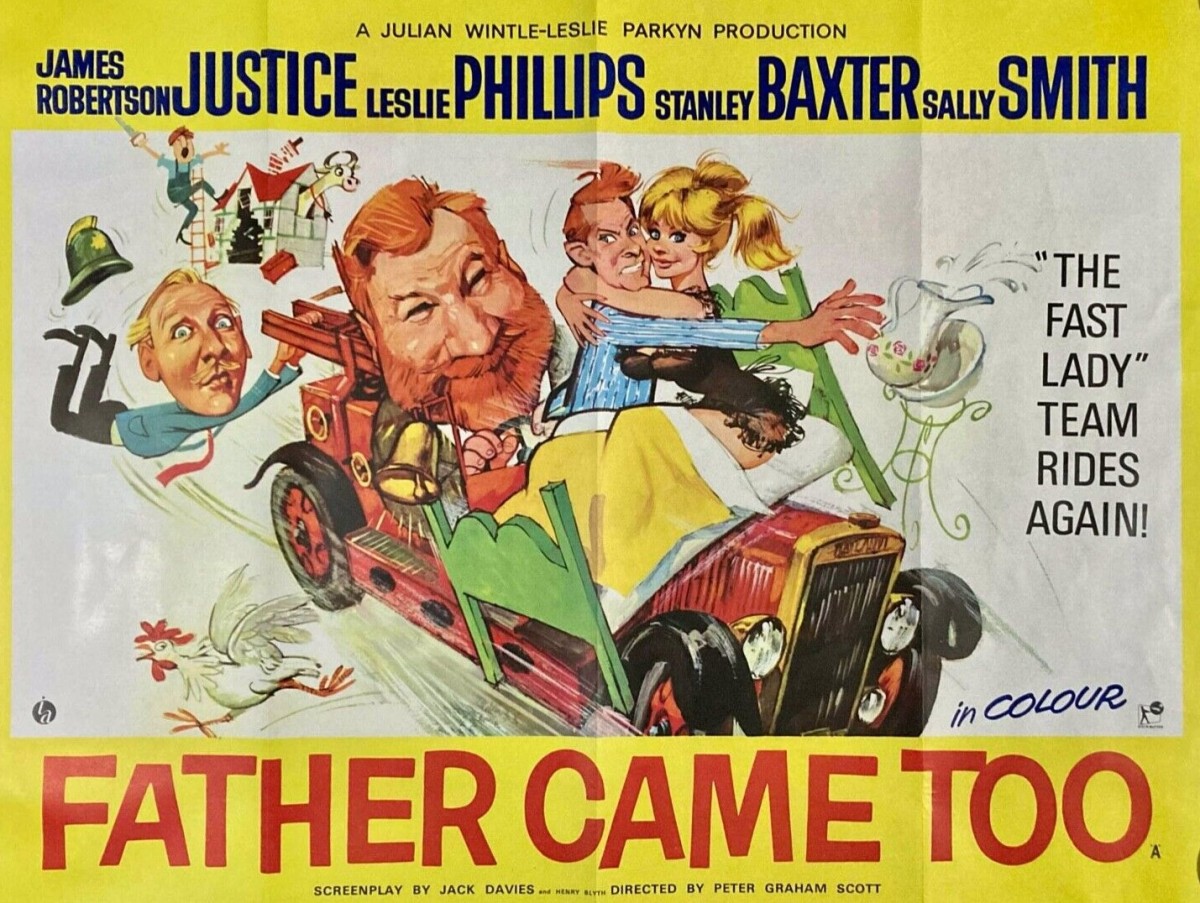
Father Came Too! (1964) ***

The gentlest of British comedies – a fading subgenre after the infiltration of the genre by the unsubtle Carry On pictures – that on the face of it appears a sequel to the very successful The Fast Lady (1962), featuring the same cast with the exception of Julie Christie. And with both Stanley Baxter (on television) and Leslie Phillips subsequently outpointing James Robertson Justice in the stardom stakes, contemporary audiences tend to come at this from a mistaken perspective.

James Robertson Justice was at the time very much a British institution and if not the star you cast him at your peril as he was likely to steal the picture from better-remembered actors such as Dirk Bogarde in the Doctor series, Margaret Rutherford in Murder, She Said (1961), David Niven in Guns of Darkness (1962) and Omar Sharif in Mayerling (1969). He was a big burly man with a bushy beard and a loud hectoring style, more Brian Blessed (Flash Gordon, 1960) than Robert Morley (Oscar Wilde, 1960).  

Misleadingly, the posters suggest another motor-centered tale.

He wasn’t the star of The Fast Lady and if it hadn’t been for the presence of Julie Christie (In Search of Gregory, 1969) he would have stolen that movie too. But when he was the denoted star, as here, the picture is built around him, so it’s not, actually, the tale of a young couple buying a money pit of a house, but of the male version of the interfering mother-in-law who makes their life merry hell.

Just married Dexter (Stanley Baxter) and Juliet (Sally Smith) purchase what appears an idyllic cottage in the countryside only to discover it requires a great deal of work. Renowned actor Sir Beverly Grant (James Robertson Justice) resents losing his daughter to a man he distrusts and to her moving out of his very grand home (named Elsinore, though I wonder how many viewers got that connection).

His attempts to take over the re-building programme are rebuffed by his son-in-law who hires the kind of builders, led by Josh (Ronnie Corbett), who give builders a bad name, tearing more tiles off the roof than they replace, creating more work for themselves or proving incompetent wherever they go. There’s a subplot involving real estate agent Roddy (Leslie Phillips), a budding thespian, desperate for the actor’s seal of approval.

But mostly, it’s everything going wrong and the father getting in the way and making things worse. But the tale doesn’t revolve around the hapless hero but around the domineering father and audiences back in the day would have recognized this, revelling in the father’s performance rather than trying to get on the side of the son-in-law.

Mostly, too, the comedic trick is slapstick, foot in paint pots, falling through floors, ceilings and roofs, an invasion of cows (one with the inevitable bonnet), being drenched by as much water as you could get on a set, and Dexter wringing his hands as the calamities – and the budget – mount.

Usually, the young couple taking on the world scenario just results in them encountering trouble from neighbors or various representations of authority and generally the focus from the outset is on them. But, here, it’s the opposite, audiences of the time waiting, not so much to see what new disaster will befall the couple, but to enjoy the carnage the father visits upon them. And viewed from that perspective it becomes far more enjoyable.

He’s far removed from the interfering mother-in-law cliché because that element of any comedy was usually a subplot played by a character actor who rarely evoked any audience sympathy. But audiences came to a James Robertson Justice picture to enjoy the mayhem he caused. He had screen charisma in spades, and especially when the screenplay was tilted in his favor, was apt to totally dominate a movie. And this is him at his best.

Stanley Baxter was somewhat miscast as a whiny incompetent husband – or, rather, he was not given a part which best utilized his uncanny skill for impersonation as later shown in his eponymous hugely successful television show. Leslie Phillips plays against type, more of an ingratiating Uriah Heep type than the uber-confident lady killer. Sally Smith (Naked You Die, 1968) hasn’t a hope of emulating Julie Christie. A slew of television comics – apart from Barker you can spot Terry Scott, Hugh Lloyd, Fred Emney and Kenneth Cope – put in an appearance.

Director Peter Graham Scott (Subterfuge, 1968) lacks prequel director Ken Annakin’s madcap zest but keeps it going none the less. Jack Davies (North Sea Hijack, 1980) and Henry Blyth (The Fast Lady) are as inventive as the idea permits.

Good old-fashioned fun but requires to be viewed from the correct character perspective.

A Home of Your Own (1964) ***

The phrase “classic silent British comedy” isn’t one that naturally trips off the tongue. Add in “of the 1960s” and you can guarantee furrowed brows. Thanks to the boom in recycling Hollywood silent classics in the early 1960s – which I may come back to in a later Blog –  there was a subsequent mini-boom in what were called “wordless” pictures, as if using the term “silent” was blasphemous. The oddity is that so many emerged from Britain, primarily in shortened format – not more than one hour long – as the second feature in a double bill.

Blame for this development lay in the hands of producer and later writer and later still director Bob Kellett, Britain’s unsung comedy king.

A Home of Your Own is beautifully structured, following the mishaps in building a block of new apartments. A credit sequence covers the stultifying bureaucracy involved so that what was a pristine site at the beginning of the endeavor turns into a waterlogged dump before the first brick is laid. Sight gags and slapstick abound with mostly everyone getting in each other’s way, or not, the traditional approach of the work-shy British builder being to provide an audience for someone else to dig up a road or a trench.

No paddle goes unsplashed, mud only exists to drench people, and in pursuit of comedy gold most of building materials end up misused. The gatekeeper’s main job is to make tea and there is naturally an union official whose chief task is to obstruct.

Pick of the gags is Ronnie Barker’s laying of cement, delivered with exquisite comedy timing, followed by Bernard Cribbin’s stonemason delicately chiselling out a plaque only to discover at the end in a laugh-out-loud moment that he has misspelled one word, and the carpenter who appropriates the closest implement with which to stir his tea. Some of the jokes grow legs – the morning tea break, a ham-fisted carpenter, the pipe-smoking architect arriving in a sports car, and a patch of ground on the road outside constantly being dug up by different contractors representing water board, gas, electricity.

Once the building is complete, the job has taken long enough for the aspiring apartment-owner, a mere fiancé at the outset, to lift his wife over the threshold accompanied by three kids. Any sense of personal accomplishment – the British thirst for owning property quenched – is undercut by problems the young couple now face thanks to the shoddy workmanship we have witnessed.  

All this is accompanied by a very inventive Ron Goodwin score which provides brilliant musical cues. As a bonus, the film features a roll-call of British television comedy superstars  including Ronnie Barker (The Two Ronnies, 1971-1987), Richard Briers (The Good Life, 1975-1978) and Bill Fraser (Bootsie and Snudge, 1960-1974).  Peter Butterworth and Bernard Cribbins were Carry On alumni. Janet Brown achieved later fame as an impressionist while Tony Tanner hit Broadway as the star of Half a Sixpence before expanding his career to choreographer-director, Tony-nominated for Joseph and his Amazing Technicolor Dreamcoat.

A Home of Your Own went out as the support to the Boulting Brothers’ comedy Rotten to the Core (1964) which gave a debut to Charlotte Rampling. Despite being effectively a B-film, primarily made to take advantage of the Eady Levy (a cashback guarantee for producers), it was surprisingly successful.  “Will delight arthouse patrons” commented Box Office magazine in America (“Review,” October 4, 1965, p160) as British comedy films in those days tended to end up in the arthouses. In part, this was because it was the official British entry to the Berlin Film Festival. It was distributed in the U.S. there by Cinema V in a double bill with Rotten to the Core and launched in what was misleadingly called a “world premiere engagement” at the prestigious Cinema 1 in New York.

Jay Lewis (Live Now, Pay Later, 1962) directed and co-wrote, along with Johnny Whyte, the mini-feature. Kellett continued in this enterprising vein with the 55-minute San Ferry Ann (1965) – which he wrote – about a group of British holidaymakers going abroad and the 49-minute Futtock’s End (1970) – which he directed – featuring a bunch of guests descending on an ancient country house owned by Ronnie Barker.

Television stars showcased in these two featurettes included Wilfred Bramble (Steptoe and Son, 1962-1974), Rodney Bewes (The Likely Lads, 1964-1966), Warren Mitchell (Till Death Do Us Part, 1965-1975) and Richard O’Sullivan (Man About the House, 1973-1976). Ron Moody composed the Oscar-winning Oliver! (1968) while Joan Sims and Barbara Windsor made their names in the Carry On series and theatrical knight Sir Michael Hordern appeared in Khartoum (1965) and Where Eagles Dare (1968).

Though disdained by critics, Kellett went on to become by far the most influential British comedy director of the 1970s. His output included the Frankie Howerd trilogy Up Pompeii (1971), Up the Chastity Belt (1972) and Up the Front (1972), as well as The Alf Garnett Saga (1972). He was well ahead of his time with the transgender comedy Girl Stroke Boy (1972) and female impersonator Danny La Rue in Our Miss Fred (1972).

You can find all four films in a compilation released by Network under the title Futtock’s End and Other Short Stories.  Thanks to Dolphin PR for a copy. You can catch it on DVD, Blu-Ray and digital services.

Discover WordPress

A daily selection of the best content published on WordPress, collected for you by humans who love to read.

The Atavist Magazine

by Brian Hannan

WordPress.com News

The latest news on WordPress.com and the WordPress community.