A Home of Your Own (1964) ***

The phrase “classic silent British comedy” isn’t one that naturally trips off the tongue. Add in “of the 1960s” and you can guarantee furrowed brows. Thanks to the boom in recycling Hollywood silent classics in the early 1960s there was a subsequent mini-boom in what were called “wordless” pictures, as if using the term “silent” was blasphemous. The oddity is that so many emerged from Britain, primarily in shortened format – not more than one hour long – as the second feature in a double bill.

Blame for this development lay in the hands of producer and later writer and later still director Bob Kellett, Britain’s unsung comedy king.

A Home of Your Own is beautifully structured, following the mishaps in building a block of new apartments. A credit sequence covers the stultifying bureaucracy involved, so that what was a pristine site at the beginning of the endeavor turns into a waterlogged dump before the first brick is laid. Sight gags and slapstick abound with mostly everyone getting in each other’s way, or not, the traditional approach of the work-shy British builder being to provide an audience for someone else to dig up a road or a trench.

No paddle goes unsplashed, mud only exists to drench people, and in pursuit of comedy gold most of building materials end up misused. The gatekeeper’s main job is to make tea and there is naturally a union official whose chief task is to obstruct.

Pick of the gags is Ronnie Barker’s laying of cement, delivered with exquisite comedy timing, followed by Bernard Cribbin’s stonemason delicately chiseling out a plaque only to discover at the end in a laugh-out-loud moment that he has misspelled one word, and the carpenter who appropriates the closest implement with which to stir his tea. Some of the jokes grow legs – the morning tea break, a ham-fisted carpenter, the pipe-smoking architect arriving in a sports car, and a patch of ground on the road outside constantly being dug up by different contractors representing water board, gas, electricity.

Once the building is complete, the job taking long enough for the aspiring apartment-owner, a mere fiancé at the outset, to lift his wife over the threshold accompanied by three kids. Any sense of personal accomplishment – the British thirst for owning property quenched – is undercut by problems the young couple now face thanks to the workmanship we have witnessed.  

All this is accompanied by a very inventive Ron Goodwin (633 Squadron, 1964) score which provides brilliant musical cues. As a bonus, the film features a roll-call of television comedy superstars  including Ronnie Barker (The Two Ronnies, 1971-1987), Richard Briers (The Good Life, 1975-1978) and Bill Fraser (Bootsie and Snudge, 1960-1974).  Peter Butterworth and Bernard Cribbins were Carry On alumni. Janet Brown achieved later fame as an impressionist while Tony Tanner hit Broadway as the star of Half a Sixpence before expanding his career to choreographer-director, Tony nominated for Joseph and his Amazing Technicolor Dreamcoat.

A Home of Your Own went out as the support to the Boulting Brothers’ comedy Rotten to the Core (1964) which gave a debut to Charlotte Rampling. Despite being effectively a B-film, primarily made to take advantage of the Eady Levy (a cashback guarantee for producers), A Home of Your Own was surprisingly successful.  “Will delight arthouse patrons” commented Box Office magazine in America (“Review,” October 4, 1965, p160) as British comedy films in those days tended to end up in the arthouses. In part, this was because it was the official British entry to the Berlin Film Festival. It was distributed there by Cinema V in a double bill with Rotten to the Core and launched in what was misleadingly called a “world premiere engagement” at the prestigious Cinema 1 in New York.

Jay Lewis (Live Now, Pay Later, 1962) directed and co-wrote, along with Johnny Whyte. Kellett continued in this enterprising vein with the 55-minute San Ferry Ann (1965) – which he wrote – about a group of British holidaymakers going abroad and the 49-minute Futtock’s End (1970) – which he directed – featuring a bunch of guests descending on an ancient country house owned by Ronnie Barker.

Television stars showcased in these two featurettes included Wilfred Bramble (Steptoe and Son, 1962-1974), Rodney Bewes (The Likely Lads, 1964-1966), Warren Mitchell (Till Death Do Us Part, 1965-1975) and Richard O’Sullivan (Man About the House, 1973-1976). Ron Moody composed the Oscar-winning Oliver! (1968) while Joan Sims and Barbara Windsor made their names in the Carry On series and theatrical knight Sir Michael Hordern appeared in Khartoum (1965) and Where Eagles Dare, 1968.

Though disdained by critics, Kellett went on to become by far the most influential British comedy director of the 1970s. His output included the Frankie Howerd trilogy Up Pompeii (1971), Up the Chastity Belt (1972) and Up the Front (1972), as well as The Alf Garnett Saga (1972). He was well ahead of his time with the transgender comedy Girl Stroke Boy (1972) and female impersonator Danny La Rue in Our Miss Fred (1972).

Fun.
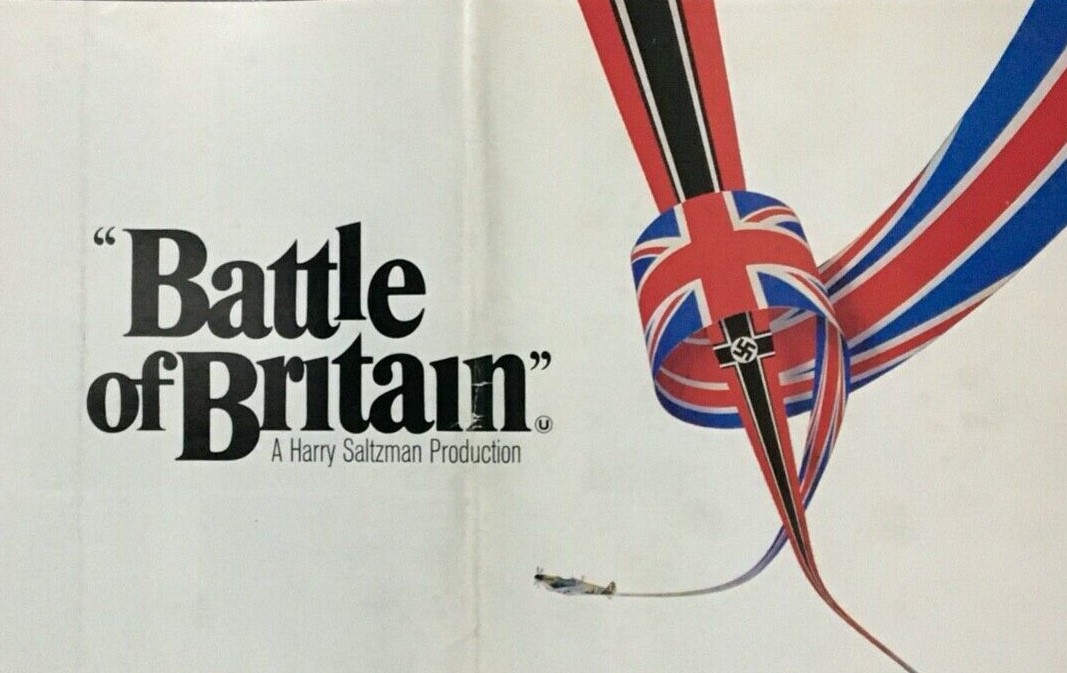
The Battle of Britain (1969) *****

Fabulous aerial sequences countered by grim reality. Like The Longest Day (1962) and Battle of the Bulge (1965) even-handedly doesn’t treat the Germans as the evil enemy, but unlike those films victory is somewhat obscure, no rattling of spears as in Zulu (1964) to announce opposition departure, just clear skies indicating an absence of foe. Anyone going into this – persuaded by Dunkirk (2017) that this retreat was a triumph – and with little knowledge that after Hitler had overrun Europe invasion was imminent might be surprised to discover that this was a campaign lasting over three months rather than one conclusive battle.

That’s to the benefit of the movie, allowing it space to breathe, for characters to develop, rather than everything crammed in pell-mell. Given the situation changed from day-to-day, the one constant, which we’re scarcely allowed to forget, is that the British are heavily outnumbered in the sky. It’s a war of attrition. The Germans can lose hundreds of planes, the British nary a one.

But it’s far from gung-ho, the British coming in for criticism for their unpreparedness, surprised when the Germans bomb airfields, even more astonished when the opponent starts dropping bombs on London. Perhaps, given the relatively short running time for an epic – 46 minutes shorter than The Longest Day, 35 minutes down on Battle of the Bulge – it might have been better to avoid slipping in a section on the impact of the Blitz on Londoners, though that is counteracted by panic in Berlin when that city is also bombed.

But, by and large, it’s an engrossing tale. And bold, too, in the version I saw no subtitles for German dialog, leaving audience reliant on facial and body expressions. To slow down the action, I guess, and add some class, several scenes involve people walking down long corridors.

All the salient points are covered, pilots thrown into battle with barely a few hours experience of flying a Spitfire, the lack of pilots, in-fighting at the top, checkers moved across the board at mission control indicating German aerial advance, the inability of getting aircraft up quick enough or repaired quick enough. Above all, the reality of death is shown in astonishing detail; once the pilot was shot or the airplane destabilized, there was almost no escape, fire enveloped anyone inside, hatches failed to open, planes burst into flame or crashed into the sea. And it was the same death, regardless of nationality. And there were no scenes of  callous Germans shooting down a British pilot parachuting to safety.

The aerial sequences are quite astonishing. I’ve seen this on big screen and small, but even on a small screen, the camerawork is quite extraordinary, even getting this number of workable planes in the air must have been some feat, then flying in formation and peeling off in attack. It is kind of hard from time to time to work out who is shooting at who since the planes are all the same grey color and only distinguished when the camera is close enough to identify  them by RAF roundel or Nazi swastika. But the overall effect is a sense of sorrow rather than triumphalism, young lives of any nationality brought to a brutal close. There is no scene, as in Battle of the Bulge, of the over-zealous Nazi, the singing that made them appear such an implacable foe. Here, there’s no need to play up implacable. Unless they abandon the fight, the Germans, courtesy of superior numbers, will inevitably win. All the British can do is stave off defeat for as long as possible.

The all-star cast is only an all-star cast if you’re British. Without a Hollywood star in the vein of John Wayne, Robert Mitchum and Henry Fonda, and in the absence of British superstars like Sean Connery and Peter O’Toole, it’s an all-star cast by default. The biggest name, Michael Caine (Deadfall, 1968), has one of the smallest parts. But the equality of the cast works in its favor, there’s none of the rubbernecking that got in the way of The Longest Day.

Christopher Plummer (The High Commissioner/Nobody Runs Forever, 1968) has the biggest role as a squadron leader determined to force his wife out of the front line working on the airfields and into a safer position. But the best acting comes from Laurence Olivier as the dry Air Chief Marshal Sir Hugh Dowding who has no truck with interfering politicians. Accused of inflating figures of German casualties he replies that if he is wrong the Germans will be in London in a week.

But it’s a close-run thing between him and Susannah York (They Shoot Horses, Don’t They, 1969) as the aforesaid wife with a growing streak of independence and Ian McShane (The Pleasure Girls, 1965) as a lowly pilot called upon to express grief more than most. There’s certainly a sense of solidarity among the cast, no show-boating from the usual scene-stealing culprits like Trevor Howard (Von Ryan’s Express, 1965) and Robert Shaw (Battle of the Bulge) whose normal determination to bristle at the slightest opportunity is dropped for the good of the cause.

The great and the good appeared to be happy with the slightest role just to take part. The roll-call includes Ralph Richardson (Khartoum, 1966), Michael Redgrave (The Hill, 1965), Kenneth More (Dark of the Sun/The Mercenaries, 1968) and a hatful more.

Guy Hamilton (Goldfinger, 1964) directs with some distinction, his biggest achievement to concentrate on fact rather than flag-waving, no better demonstrated than by my realization that the stirring theme tune that I remembered so well by Ron Goodwin (Where Eagles Dare, 1968) does not make an appearance until the very end. The screenplay by James Kennaway (Tunes of Glory, 1960), Wilfred Greatorex (The High Commissioner) and, in his only movie work,  Derek Dempster, displays more finesse than you might expect.

Almost documentary in tone, a classic.

A Home of Your Own (1964) ***

The phrase “classic silent British comedy” isn’t one that naturally trips off the tongue. Add in “of the 1960s” and you can guarantee furrowed brows. Thanks to the boom in recycling Hollywood silent classics in the early 1960s – which I may come back to in a later Blog –  there was a subsequent mini-boom in what were called “wordless” pictures, as if using the term “silent” was blasphemous. The oddity is that so many emerged from Britain, primarily in shortened format – not more than one hour long – as the second feature in a double bill.

Blame for this development lay in the hands of producer and later writer and later still director Bob Kellett, Britain’s unsung comedy king.

A Home of Your Own is beautifully structured, following the mishaps in building a block of new apartments. A credit sequence covers the stultifying bureaucracy involved so that what was a pristine site at the beginning of the endeavor turns into a waterlogged dump before the first brick is laid. Sight gags and slapstick abound with mostly everyone getting in each other’s way, or not, the traditional approach of the work-shy British builder being to provide an audience for someone else to dig up a road or a trench.

No paddle goes unsplashed, mud only exists to drench people, and in pursuit of comedy gold most of building materials end up misused. The gatekeeper’s main job is to make tea and there is naturally an union official whose chief task is to obstruct.

Pick of the gags is Ronnie Barker’s laying of cement, delivered with exquisite comedy timing, followed by Bernard Cribbin’s stonemason delicately chiselling out a plaque only to discover at the end in a laugh-out-loud moment that he has misspelled one word, and the carpenter who appropriates the closest implement with which to stir his tea. Some of the jokes grow legs – the morning tea break, a ham-fisted carpenter, the pipe-smoking architect arriving in a sports car, and a patch of ground on the road outside constantly being dug up by different contractors representing water board, gas, electricity.

Once the building is complete, the job has taken long enough for the aspiring apartment-owner, a mere fiancé at the outset, to lift his wife over the threshold accompanied by three kids. Any sense of personal accomplishment – the British thirst for owning property quenched – is undercut by problems the young couple now face thanks to the shoddy workmanship we have witnessed.  

All this is accompanied by a very inventive Ron Goodwin score which provides brilliant musical cues. As a bonus, the film features a roll-call of British television comedy superstars  including Ronnie Barker (The Two Ronnies, 1971-1987), Richard Briers (The Good Life, 1975-1978) and Bill Fraser (Bootsie and Snudge, 1960-1974).  Peter Butterworth and Bernard Cribbins were Carry On alumni. Janet Brown achieved later fame as an impressionist while Tony Tanner hit Broadway as the star of Half a Sixpence before expanding his career to choreographer-director, Tony-nominated for Joseph and his Amazing Technicolor Dreamcoat.

A Home of Your Own went out as the support to the Boulting Brothers’ comedy Rotten to the Core (1964) which gave a debut to Charlotte Rampling. Despite being effectively a B-film, primarily made to take advantage of the Eady Levy (a cashback guarantee for producers), it was surprisingly successful.  “Will delight arthouse patrons” commented Box Office magazine in America (“Review,” October 4, 1965, p160) as British comedy films in those days tended to end up in the arthouses. In part, this was because it was the official British entry to the Berlin Film Festival. It was distributed in the U.S. there by Cinema V in a double bill with Rotten to the Core and launched in what was misleadingly called a “world premiere engagement” at the prestigious Cinema 1 in New York.

Jay Lewis (Live Now, Pay Later, 1962) directed and co-wrote, along with Johnny Whyte, the mini-feature. Kellett continued in this enterprising vein with the 55-minute San Ferry Ann (1965) – which he wrote – about a group of British holidaymakers going abroad and the 49-minute Futtock’s End (1970) – which he directed – featuring a bunch of guests descending on an ancient country house owned by Ronnie Barker.

Television stars showcased in these two featurettes included Wilfred Bramble (Steptoe and Son, 1962-1974), Rodney Bewes (The Likely Lads, 1964-1966), Warren Mitchell (Till Death Do Us Part, 1965-1975) and Richard O’Sullivan (Man About the House, 1973-1976). Ron Moody composed the Oscar-winning Oliver! (1968) while Joan Sims and Barbara Windsor made their names in the Carry On series and theatrical knight Sir Michael Hordern appeared in Khartoum (1965) and Where Eagles Dare (1968).

Though disdained by critics, Kellett went on to become by far the most influential British comedy director of the 1970s. His output included the Frankie Howerd trilogy Up Pompeii (1971), Up the Chastity Belt (1972) and Up the Front (1972), as well as The Alf Garnett Saga (1972). He was well ahead of his time with the transgender comedy Girl Stroke Boy (1972) and female impersonator Danny La Rue in Our Miss Fred (1972).

You can find all four films in a compilation released by Network under the title Futtock’s End and Other Short Stories.  Thanks to Dolphin PR for a copy. You can catch it on DVD, Blu-Ray and digital services.

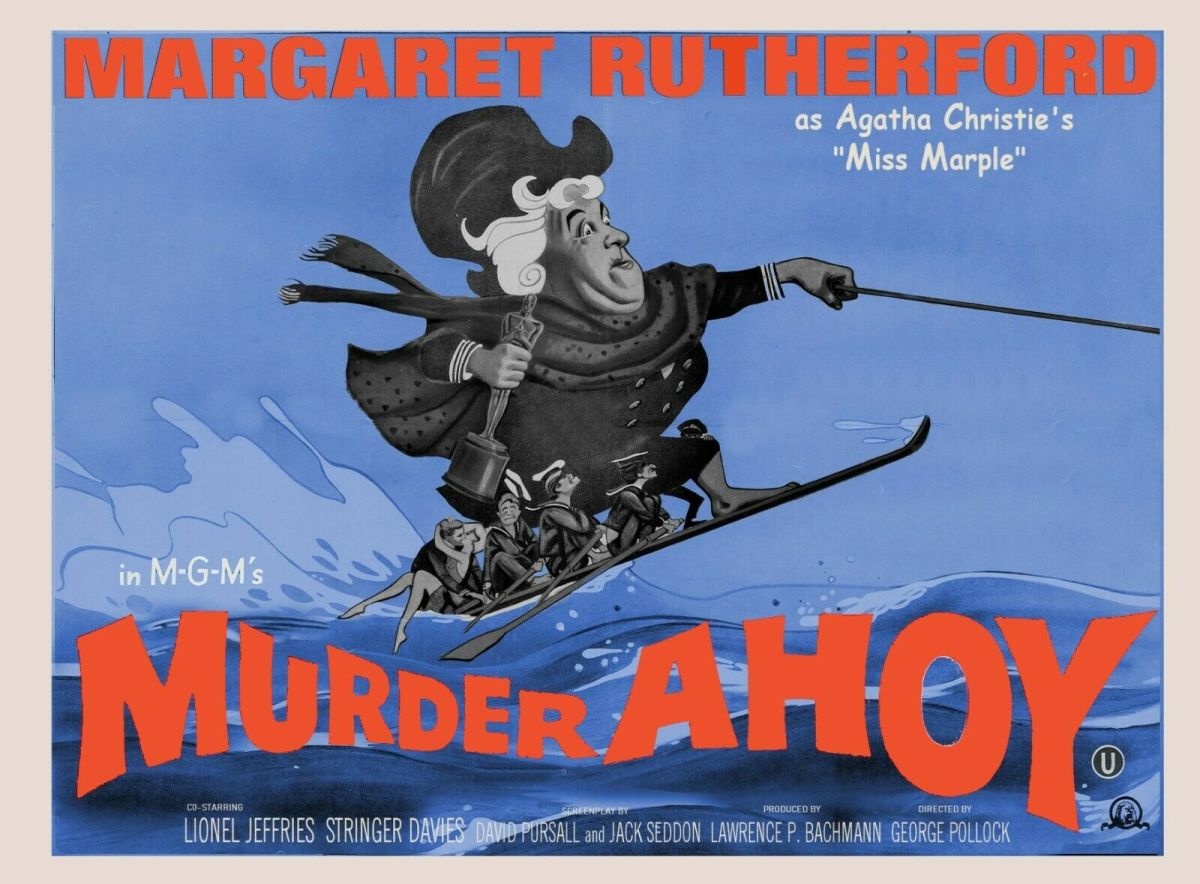
Murder Ahoy! (1964) ***

Agatha Christie tales were in a mostly B-movie limbo in the 1960s, despite Billy Wilder’s Witness for the Prosecution (1957) and would have to wait another decade before glorious all-star resurrection in Sidney Lumet’s Murder on the Orient Express (1974). In the meantime, audiences made do with Margaret Rutherford’s Miss Marple in an MGM quartet – all directed by George Pollock – that ended with Murder Ahoy! Rutherford did not enjoy the national treasure status of the likes of Maggie Smith and Judi Dench these days but she had been elevated to late-career fame by winning the Best Supporting Actress Oscar for The VIPs (1963). But she never quite made the cinematic impact anticipated after Blithe Spirit (1945) and she was mostly seen in roles that called for eccentricity or determination, characteristics associated with Christie’s second most famous sleuth.

The title had led me to expect a picture set on a liner or a cruise ship. Instead, this being a cheaply-made British black-and-white feature, we are limited to a sojourn on a sail training ship which remains moored at all times. Nonetheless, Rutherford is resplendent in naval attire and disports herself as if she were the captain. Her excuse to get on board is the sudden death of a member of the committee overseeing said ship just before he makes an announcement. Miss Marple relies on a good deal more than Hercule Poirot on little grey cells and through laboratory experiment determines the man died from strychnine poisoning. Among her other hidden talents are signaling mastery and dexterity with a sword and she drops popcorn on corridor floors to warn of imminent arrivals when she invades cabins. The suspects include Lionel Jeffries (First Men in the Moon) at his pompous best, Derek Nimmo (BBC’s Oh, Brother), and William Mervyn while Nicholas Parsons (ITV game show Sale of the Century) makes an appearance as a doctor, described in double entendre fashion as “brisk.”   

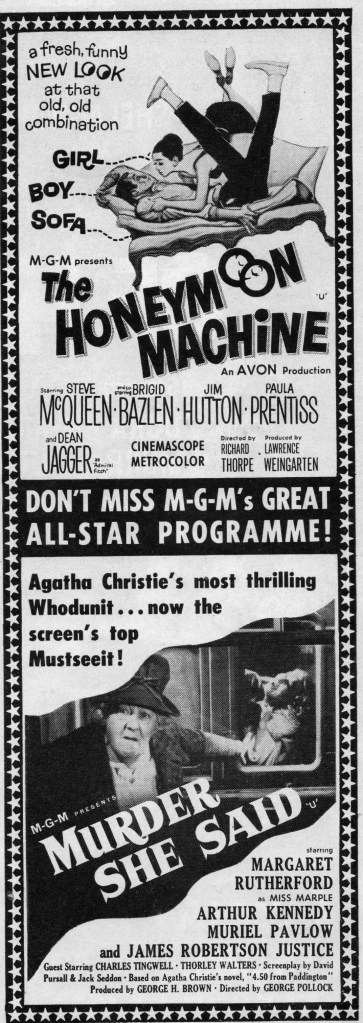
The Marple films usually ended up on the bottom half of a double bill in the UK.

Naturally, there is more murder, and the subplots include burglary, secret romance (Joan Benham) and thwarted romance (Norma Foster). However, nothing can deter Miss Marple and she soon puts the world to rights. It’s an engrossing enough little film, the resolution a surprise, and Rutherford has skill and charm enough to almost trademark the role. At one time in the 1960s in the USA the Marple pictures were revived as double bills but generally in Britain treated with less regard. Although you could argue that MGM could have bolstered the standards of production, much of the merit derives from the quaintness and the quintessential English lives portrayed. As a bonus there are moments of well-observed comedy and a very inventive score from Ron Goodwin whose 633 Squadron appeared the same year.   

Discover WordPress

A daily selection of the best content published on WordPress, collected for you by humans who love to read.

The Atavist Magazine

by Brian Hannan

WordPress.com News

The latest news on WordPress.com and the WordPress community.