Crossplot (1969) ***

Roger Moore – in his first movie in seven years – almost auditioning for James Bond with his lothario instinct, light touch for dialogue, a nice side-line in double takes, and enough action to show that even in his early 40s he was still nimble enough. Not in the Charade (1963) or Arabesque (1966) league and over-reliant on the Swinging Sixties and other “Tourist Britain” clichés and a plot that takes far too long to get going, it takes all the actor’s charm to make it watchable.

After one of his staff Warren (Dudley Sutton) switches the photo of a model in his portfolio, ad-man Gary (Roger Moore) finds himself on the trail of Marla (Claudia Lange), a sometime fugitive hiding out on a houseboat. Meet-cute is prompted when she pushes him into the Thames. On leaving he is knocked out and framed on a dope charge and once he manages to get her into the photographic studio Warren attempts to throw her off the roof, the would-be killer himself eliminated by his boss Ruddock (Francis Matthews) who in a marvelous piece of quick-thinking throws his gun to Gary who instinctively catches it, further implicating himself.

After going all round the houses (including a stately home), evading pursuit via an antique car race and a wedding, Gary finally gets to the bottom of why Marla is in such danger – she overheard a conversation between her aunt Joe (Martha Hyer) and Ruddock. Only problem is – she can’t remember it. And it takes even more time for Gary to figure it out, (not realizing, how could he,  that the clue is in the title, in fact two clues in a crossword puzzle). You can imagine how it goes from then.
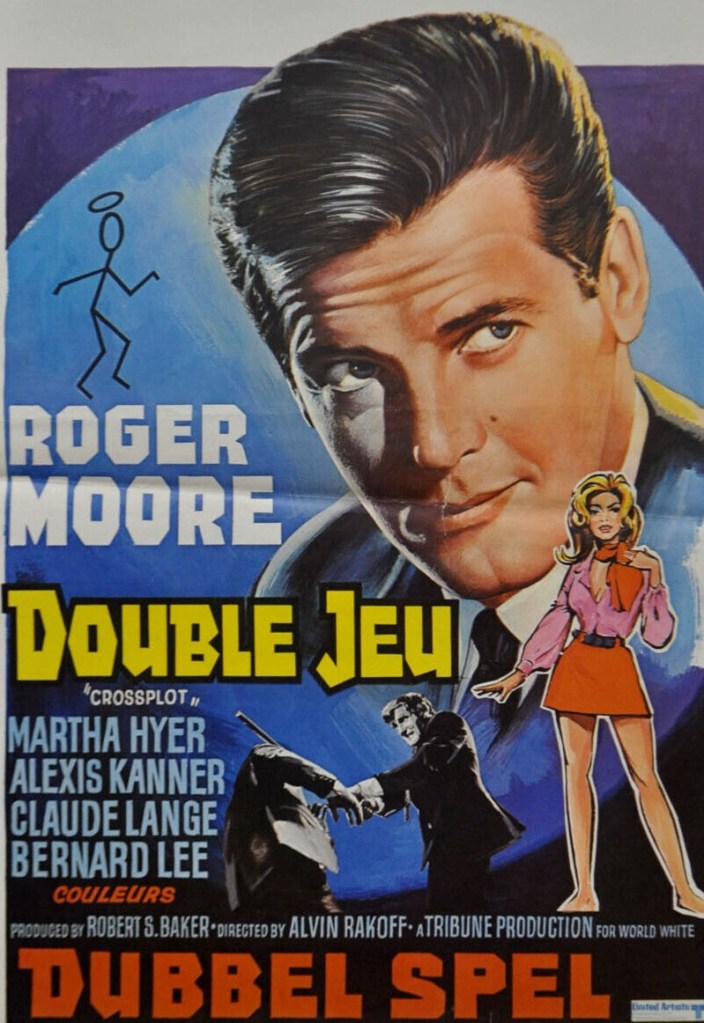
This poster takes the easy route by trying to sell the picture on the back of “The Saint.”

On the plus side is mostly Roger Moore. “I come from a long line of hippopotamuses,” isn’t the sort of line you can deliver without some skill. But Moore’s performance lifts what is for the most part  a shaggy dog story, and he’s game enough to do all the running and fighting required, even the heavy lifting (of his eyebrows), to keep the story moving. It’s far from as funny as it thinks and not as funny as it needs to be, but there are still some good stabs at humour, a pistol held to Gary’s head discovered to be a toy gun, Gary turning the tables in a shower on Marla, telling the bride that her groom is a bigamist, and a running joke about the Marla being perennially hungry.  

The politics barely touches on the conspiracy aspects that Hollywood would have pounced upon and made a better fist of, although the idea that Britain could be undermined by civil strife was not far off the mark for the times. It needed some smarter thinking, though, for that element to work.
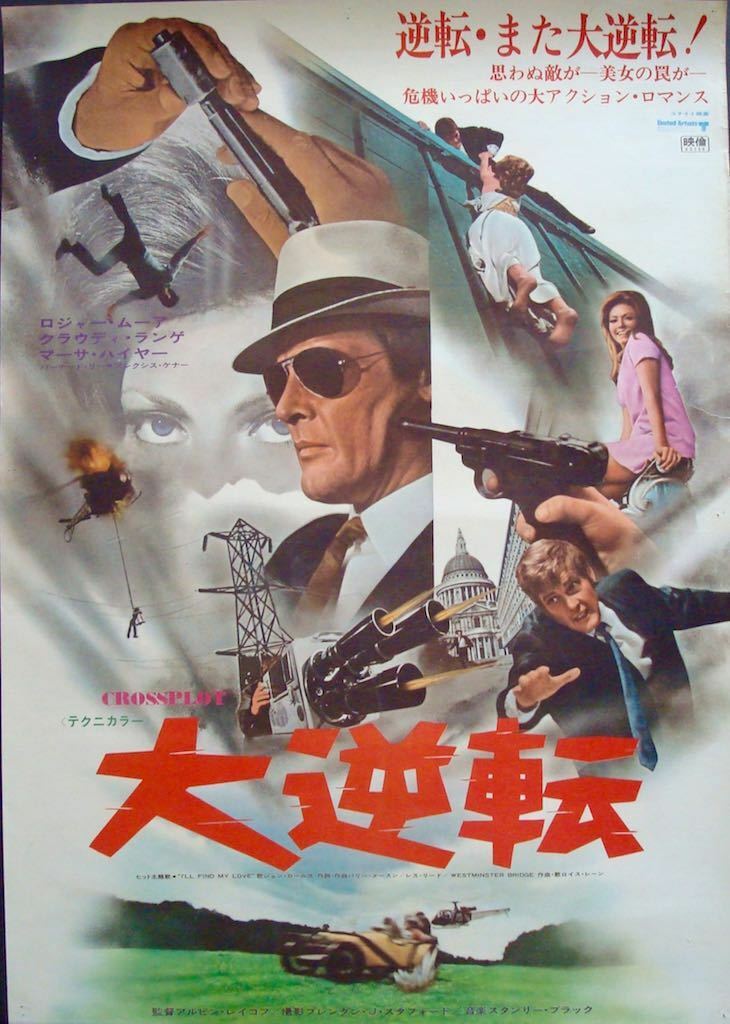
A much better attempt at selling a thriller with scenes from the film,
including the toy pistol pointed at Roger Moore’s head.

The rest of the cast are game enough. Claudie Lang (The Gatling Gun, 1968) is no Sophia Loren or Audrey Hepburn but nobody is pretending she is and she just about gets away with the dumb model approach. Martha Hyer (The Chase, 1966) delivers a glamorous villain and the suave Francis Matthews (Rasputin: The Mad Monk, 1966) her ideal match.

There’s quite a supporting cast: Veronica Carlsen (Dracula Has Risen from the Grave, 1968), Gabrielle Drake (Suburban Wives, 1972), Dave Prowse (Star Wars, 1977),  Bernard Lee (You Only Live Twice, 1967), Alexis Tanner (The Ernie Game, 1967), Ursula Howells (BBC’s The Forsyte Saga, 1967) and Dudley Sutton (Rotten to the Core, 1965).

If Alvin Rakoff (The Comedy Man, 1964) is in charge of the material he doesn’t have enough material to work with. He does enough to keep it on course but would have benefitted from a a tighter screenplay from Leigh Vance (The Frightened City, 1961). Both had done better in the past, but it is easy to be seduced by the romantic thriller format, almost a mini-genre in itself, assuming it is easier to pull off than it looks. The likes of Alfred Hitchcock (North by Northwest, 1959) and Stanley Donen (Charade) made it look easy but they had the advantage of big stars in Cary Grant and Audrey Hepburn who possessed the ability to make the lightest confection work.

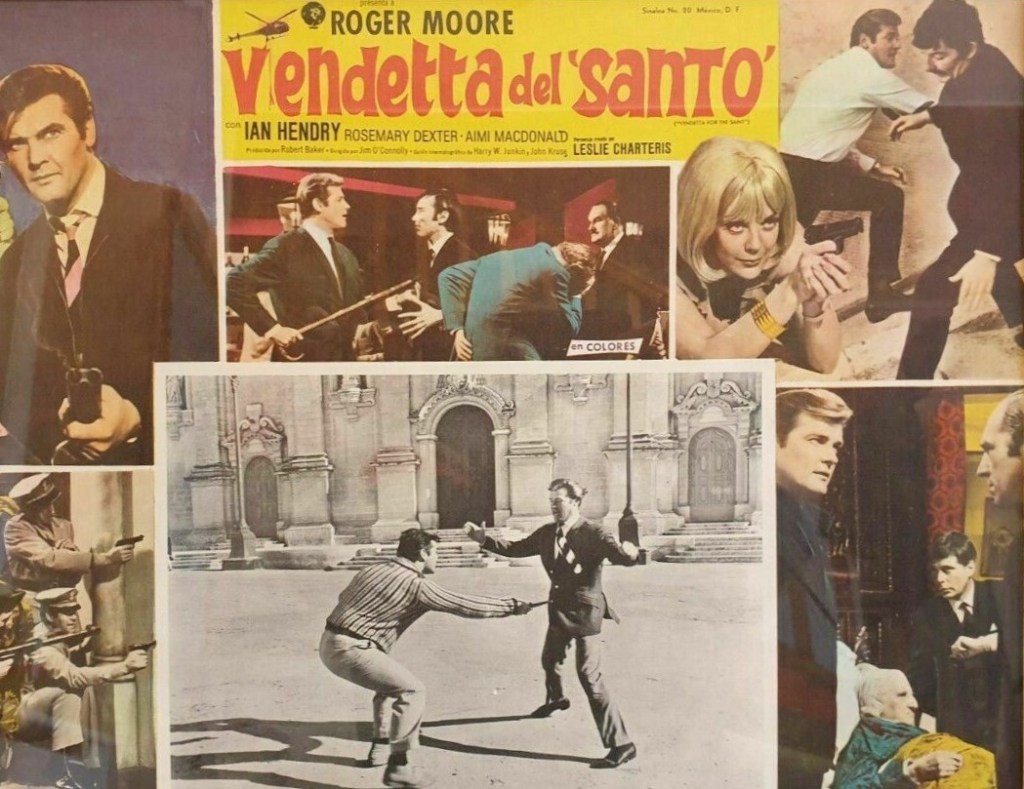
Vendetta for The Saint (1969) ***

This big-screen version of small-screen hero is as pleasant a diversion as you can get. Nostalgia pretty much gives it a free pass and in any case the action, which punctuates the drama at regular intervals, was always going to be budget-restricted. Despite being in almost constant danger the insouciance of gentleman thief Simon Templar dictates that the pace is no more than languid.

As the title suggests, we’re in Mafia country, Templar (Roger Moore) drawn into a Cosa Nostra succession scenario as the result of a casual encounter with former bank clerk Houston (Fulton Mackay) later found dead. Houston has cast doubts on the real identity of  Mafia Don Destiamo (Ian Hendry) one of several contenders to become the next Mafia overlord. Templar sneaks into Destiamo’s world by pursuing his niece Gina (Rosemary Dexter). Although outwardly respectable, Destiamo a bit too fond of using his cigar as a weapon of disfigurement, threatening his blonde English moll Lily (Aimi McDonald) in this fashion.

Part of Templar’s attraction is that although he has a nefarious side he is happy to walk those mean streets and has a strict moral code. And he moves in such elevated circles that he has a nodding acquaintance with dying Mafia chieftain Don Pasquale (Finlay Currie) who has yet to pick his successor.

The other part of his attraction is that he’s played with such suaveness by Roger Moore. For a good chunk of the time someone is trying to knife him, shoot him, blow him up, capture him, jab him with a truth serum, and generally trying to stop him. In fending off such attacks, or out-smarting the villains, there’s rarely a hair out of place. It’s not so much devil-may-care as devil-is-wasting-his-time with such an imperturbable fellow.

Although the action is pretty straightforward, Templar is not above a clever ruse – jamming a bus in a gateway preventing his pursuers continuing the chase – nor an old one such as tying sheets together to climb out of a window. While Malta stands in for Italy, the locations still look authentic enough, ancient stone buildings, the occasional horse pulling a cart. When the action/drama eases up, there’s always pleasant scenery.

Following MGM’s success in stitching together into a movie two episodes of The Man From U.N.C/L.E. television series (an idea of course the studio had pinched from Walt Disney’s cinematic re-presentation of Davy Crockett episodes) it was no surprise that ATV, then under the control of future movie mogul Sir Lew Grade (Raise the Titanic, 1980), decided to adopt the same idea. Although The Saint had been showing on British television since 1962, by the end of its run in 1969 it had stepped up to bigger budgets, 35mm and color. Given each episode lasted around 50 minutes, it was relatively simple to devise a two-part program shown over consecutive weeks on ITV in Britain and then release it throughout the rest of the world as a feature film. The first such project was The Fiction Makers (1968) followed by Vendetta for the Saint.

Roger Moore’s movie career had been in limbo since Romulus and the Sabines (1961) and there’s no doubt that his performance as Simon Templar and later in another glossier British television series The Persuaders (1971-1972) made him a candidate for James Bond. While his interpretation of Templar, especially the wry delivery, does bear some similarities to his incarnation as 007, that only holds true as long as you set aside the year’s supply of Brylcreem dumped on his hair, the shoulder-padded shoulders and the fact that he had not yet perfected his trademark move, the raising of the single eyebrow.

While no match for the quips prevalent in James Bond, Canadian screenwriter Harry W. Junkin – best known for his television work, his only other movies being a similar melding of television episodes of The Persuaders – and John Kruse (Hell Drivers, 1957) – had some neat one-liners. Despite the obvious limitations, director Jim O’Connelly (Berserk, 1967) does a decent enough job.

But Moore carries the show. Ian Hendry (The Hill, 1965) makes a passable villain but not a passable Italian. In general, not surprisingly since most characters were played by British actors, the accents are all over the place though Moore, courtesy of squiring Luisa Mattioli (later his wife) managed to deliver his Italian lines in an acceptable accent. Otherwise the only one who comes close is Rosemary Dexter (The Shoes of the Fisherman, 1968) and that’s because she was Italian. Worth checking out in the supporting cast are Finlay Currie (Ben Hur, 1959) and Fulton Mackay (BBC series Porridge, 1974-1977).

You can find a lot wrong with this without looking very hard but if you switch off your over-critical faculties you will be pleasantly surprised.

Discover WordPress

A daily selection of the best content published on WordPress, collected for you by humans who love to read.

The Atavist Magazine

by Brian Hannan

WordPress.com News

The latest news on WordPress.com and the WordPress community.