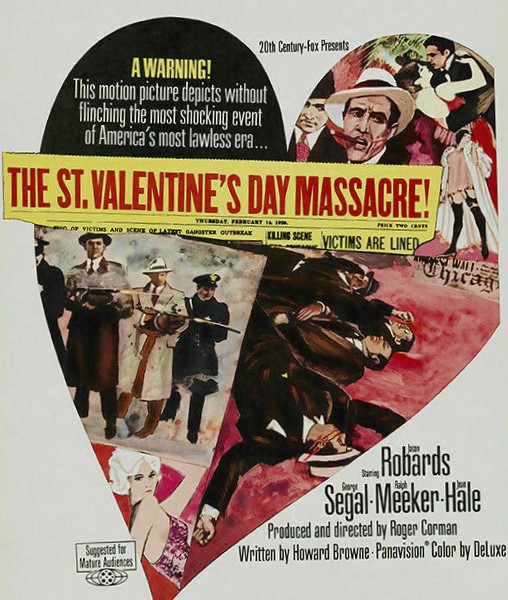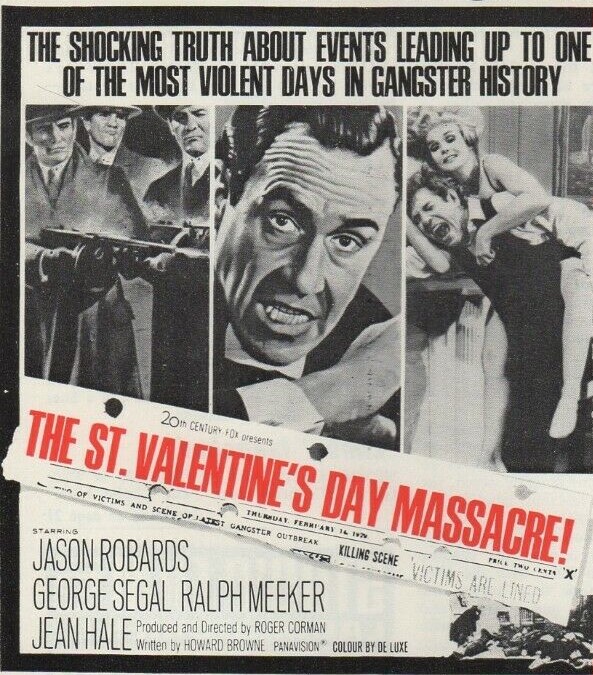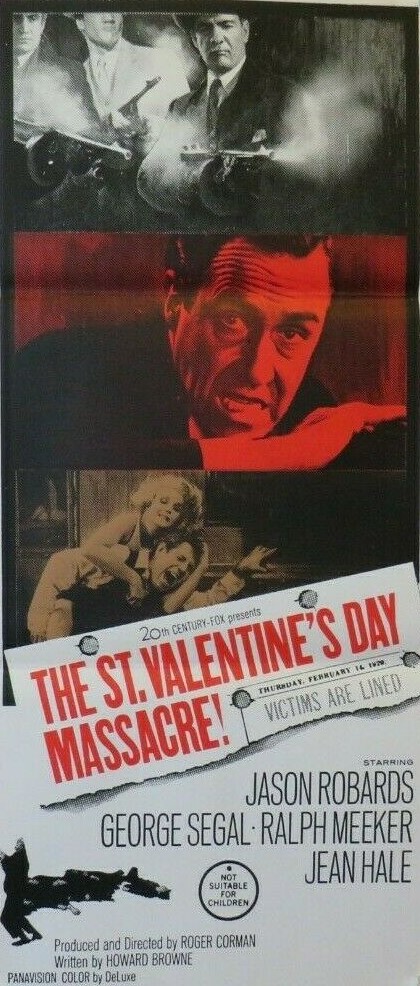
The St Valentine’s Day Massacre (1967) ***

I didn’t realise that the Prohibition gangsters who invented the drive-by shooting were perfectionists. Just to be make sure of completing the job, I found out here, they might send a dozen cars one after the other rolling past the chosen restaurant/cafe, machine guns spouting hundreds of bullets. Nobody could survive that, you would think. But there was a flaw to the idea. If someone just lay down on the floor, the bullets would pass over their head. Strangely enough, we never got a potted history of the drive-by shooting in this docu-drama because otherwise we found out just about everything we needed to know about the infamous massacre.

But I did wish that the narrator would shut up once in a while. I kept on thinking we were going to be examined afterwards. Every dumb schmuck that made even a brief appearance on screen got the full bio treatment, including when – and how (not always by violence) – they died. That annoying feature aside, it was certainly a forensic examination of the whys and wherefores of the infamous gangland slaying. Rival Chicago mobsters Al Capone (Jason Robards) and Bugs Moran (Ralph Meeker), both concluding that the other was not open to negotiation, decided instead to rub him out and the movie basically follows how each develops their murderous plan.

All the big gangster names are here – it’s like a hit man’s greatest hits – Frank Nitti (Harold J. Stone), massacre mastermind Jack McGurn (Clint Ritchie) and Capone enforcer Peter Gusenberg (George Segal) – and the movie reprises some of the classic genre tropes like mashing food (sandwich this time rather than grapefruit) in a woman’s face and Capone taking a baseball bat to a traitorous underling. And there’s the usual lopsided notion of “rules,” Capone incandescent that a ganster was murdered in his own home.

Capone’s plan is the cleverest, involving recruiting people with little or no criminal record including the likes of Johnny May (Bruce Dern in a part originally assigned to Jack Nicholson), renting a garage as the massacre venue, and dressing his hoods up as cops. The film occasionally tracks back to set the scene. And the ever-vigilant narrator makes sure to identify every passing gangster but come the climax seems to run out of things to say, a good many sentences beginning with “on the last morning of the last day of his life.”

Since there’s so much money washing around, it makes sense for the ladies to try and get their share. Gusenberg’s girlfriend (Jean Hale) casually, without seeking permission, swaps one fur for another four times as expensive. A sex worker as casually steals from her client’s wallet before demanding payment for services rendered.

The only problem with bringing in so many bit characters – either those doing the murdering or being murdered – into play is that it cuts down the time remaining to cover Capone and Moran, so, apart from the voice-over, we learn little of significance, most of the drama amounting to outbursts of one kind or another. But it’s certainly very entertaining and follows the Raymond Chandler maxim of when in doubt with your story introduce a man with a gun, or in this case machine gun. The violence is episodic throughout.

Despite the authenticity, punches are pulled when it comes to the physical depiction of Capone. The man universally known as “Scarface” shows no signs of such affliction as played by Jason Robards (Hour of the Gun, 1967). Certainly, Robards shows none of the brooding intensity with which we associate Godfather and son Michael in the Coppola epic, rather he has more in common with Sonny. He delivers a one-key performance of no subtlety but since the film has no subtlety either then it’s a good fit. Ralph Meeker (The Dirty Dozen, 1967) has the better role, since being the junior gangster in terms of power he has more to fear. I felt sorry for Oscar-nominated George Segal (No Way To Treat a Lady, 1968) since although his character is there for obvious reasons there is no obvious reason why he should be allocated more screen time. And given more screen time, nobody seems to know what to do with it.

There’s a superb supporting cast including Jean Hale (In Like Flint 1967), Bruce Dern (They Shoot Horses, Don’t They, 1969), Frank Silvera (Uptight, 1969), Joseph Campanella (Murder Inc., 1960) Alex Rocco (The Godfather, 1972), future director Gus Trikonis and future superstar Jack Nicholson.  

After over a decade of low-budget sci-fi, horror and biker pictures, this was director Roger Corman’s biggest movie to date – his first for a major studio – and, excepting the voice-over, he does an efficient job with the script by Howard Browne (Portrait of a Mobster, 1961) who was presumably responsible for the intrusive narration.

CATCH-UP: This isn’t really a good place to start with the acting of George Segal and you will get a better idea of his talent if you check out the following films covered so far in the Blog: Act One (1963), The New Interns (1964), Invitation to a Gunfighter (1964), King Rat (1965), Lost Command (1966), The Quiller Memorandum (1966), No Way to Treat a Lady (1968), The Bridge at Remagen (1969) and The Southern Star (1969).

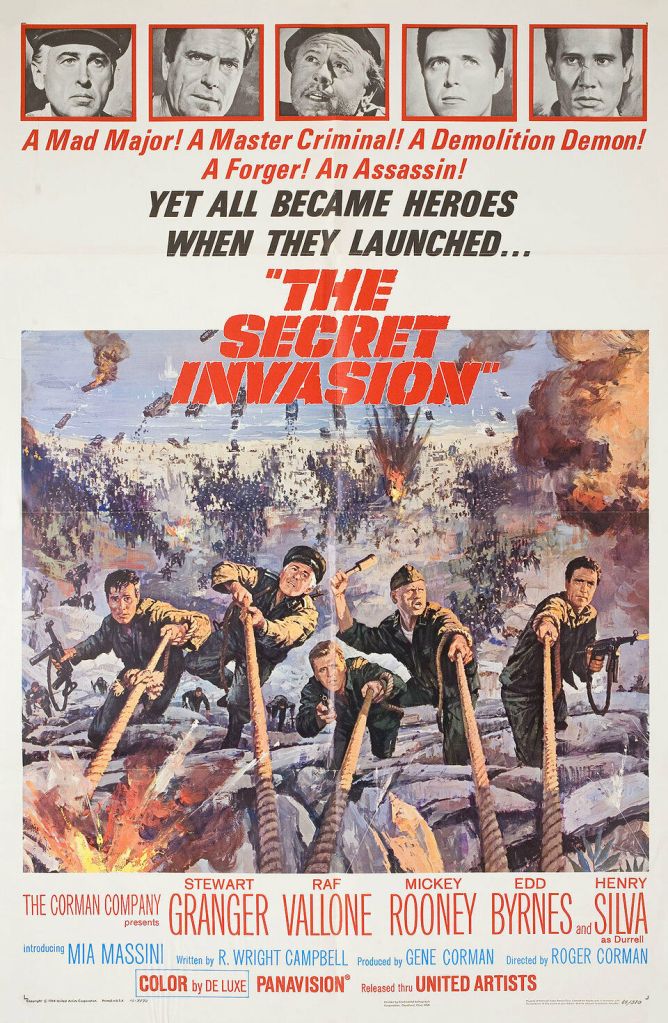
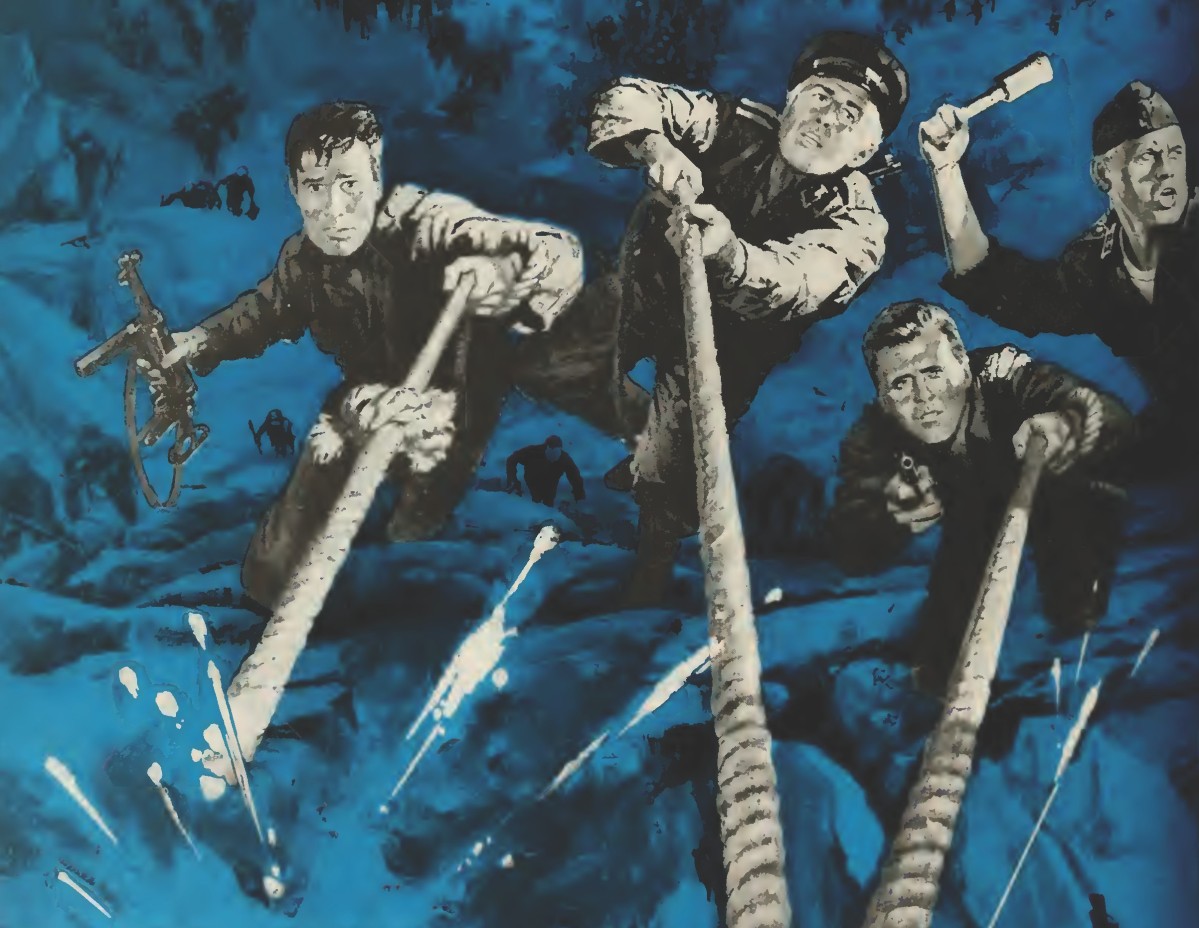
Secret Invasion (1964) ****

Dirty Half-Dozen – cashiered British major, five hardened criminals with particular sets of skills – on a mission to rescue an Italian general and start a second front in the north of Italy just as the Americans are invading the south. Throw in a grand theft of ideas from The Guns of Navarone (shoot-out with German gunboat, scaling a cliff) and The Great Escape (tunneling, although in not out) and the usual bickering and rebellion and a top-class B-list cast bringing their A-game and you have the basis of a very solid actioner.

The classy Raf Vallone (Sidney Lumet’s A View from the Bridge, 1962) is the standout here, not least because he chooses crime, pitting his wits against the authorities, rather than exploiting his university degree in philosophy. But he’s ably supported by Mickey Rooney as an unlikely IRA terrorist and various inmates from Leavenworth and Alcatraz including Henry Silva (Johnny Cool, 1963), of the fashion model cheekbones, Edd Byrnes (77 Sunset Strip), William Campbell (Dementia 13, 1963), and top-billed Stewart Granger. That any appeared in this Corman brothers (Gene directing, Roger producing) spread  suggested careers on the slide.

Still, that’s to the movie’s gain. Forget the occasional dodgy process shots and enjoy the Dubrovnik location complete with ancient fortress, cobbled streets, and tiled roofs, each of which is put to violent use, with shoot-outs in each area, not to mention a cemetery where tombs provide the perfect cover for digging into the citadel. At times, the script is snappy enough that some one-liners stick in the memory and when the characters aren’t acting up they’re doing a lot of brooding, especially Silva, the hired assassin.

This doesn’t go quite the way you would expect, especially the double twist at the end, and a couple of places where the plot gets bogged down, but there’s enough invention, interesting characters and story to see us through and one genuinely heartbreaking moment that could have been the starting point or revelatory denouement of a film all on its own.  Granger lacks Lee Marvin’s icy demeanour but delivers enough leadership in typically British style when it matters.

Silva’s icy demeanour softens enough to allow romance to peak through with local girl Spela Rozia (who you will remember from Hercules the Invincible, 1964). While trying to steal every scene, Rooney, nonetheless adds a couple of imaginative bits of business to his character. Edd Byrnes is nobody’s idea of a forger, nor would his notions, nor equipment, pass muster with the experts of The Great Escape. Vallone is terrific as the imperturbable mastermind.

This is a more hard-edged, realistic endeavor than The Dirty Dozen. In that picture every scheme goes according to plan. Here nothing does and the crew are constantly thrown back on their wits, finding what they require from the most improbable resources, and carrying out a schemed timed to the second, finger-snapping to the beat in the absence of watches. The labored and overlong interrogation sequence slows the plot down until you think it will never get back on its feet, but that complaint aside, it is full of action.

Little gem.

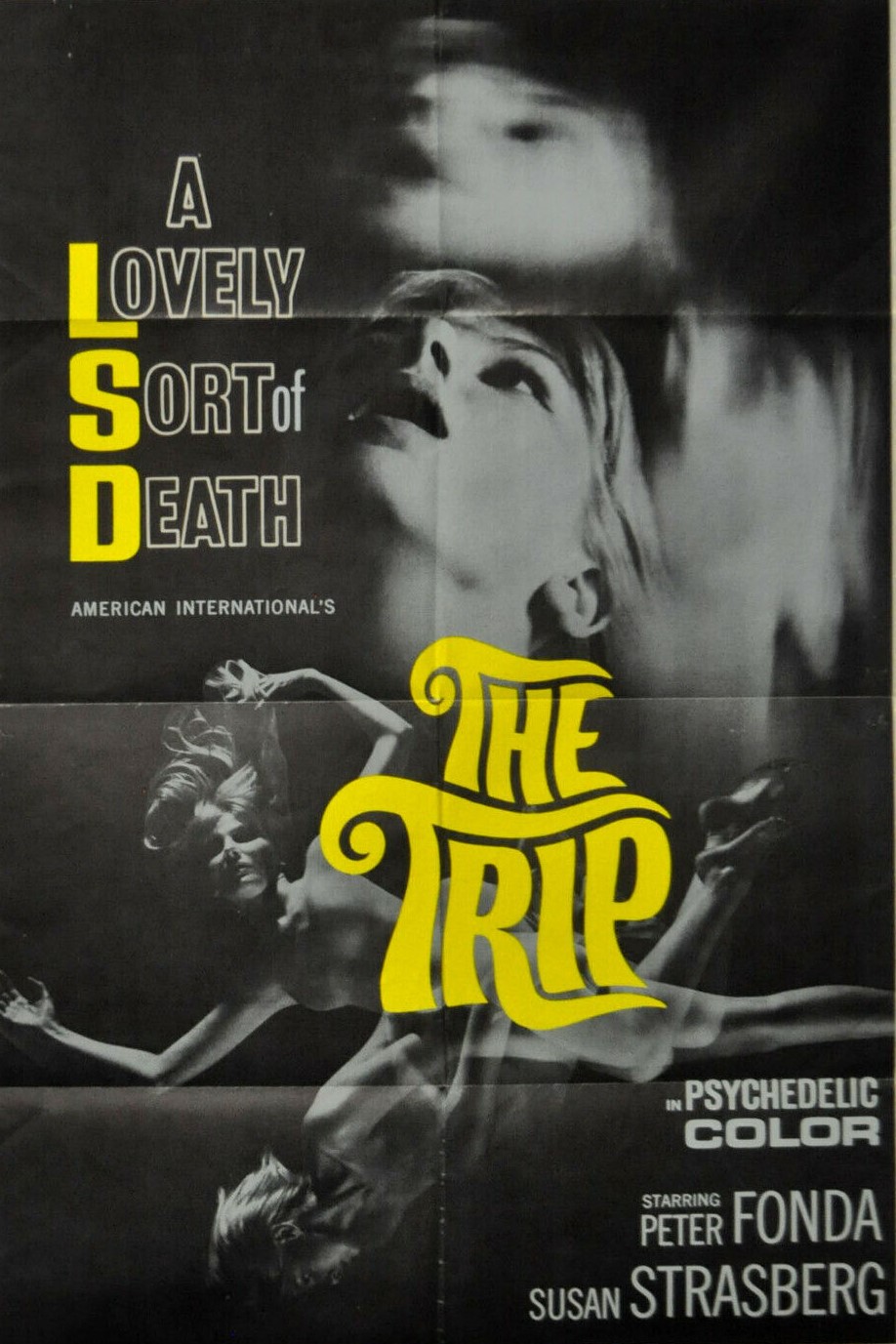
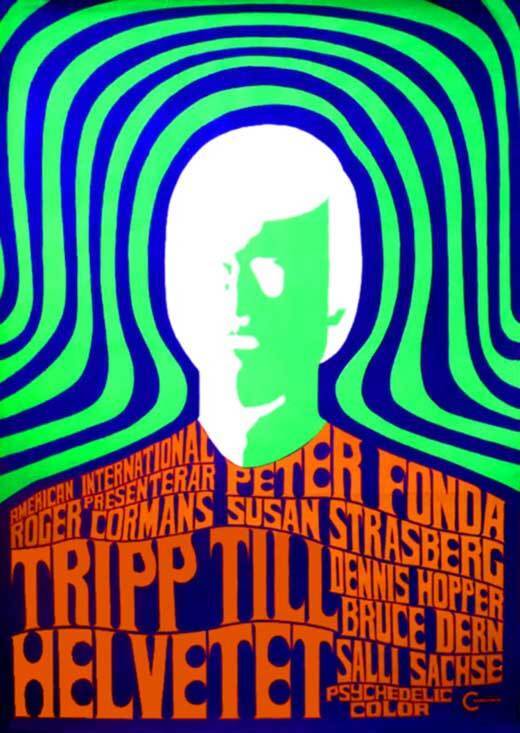
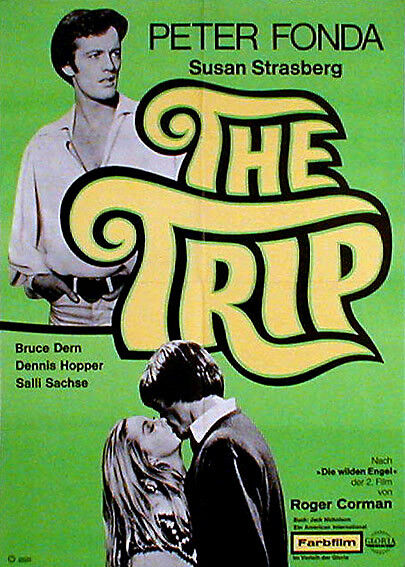
The Trip (1967) ***

Give any neophyte (word of the week!) independent film director a camera and a small budget ($100,000 in this case) and they might well have come up with something like this. Has the feel of being an advert for promoters of LSD who felt they had to play fair and show the potential downside. Meanwhile, they can jam in an absolute phantasmagoria of imagery and sit back and wait for Stanley Kubrick to rip off some of their ideas and give the whole head-spinning malarkey some credence for the conclusion of 2001: A Space Odyssey.

If there’s a story, it’s as thin as they come. Commercials director Paul (Peter Fonda), trying to understand himself better, and why, for example, wife Sally (Susan Strasberg) has left him for another man, enlists the help of self-help guru John (Bruce) to guide him through an LSD trip. The notion that there are drug guides comes as a surprise to me, and this feels like the kind of the warning you get on the side of cigarette packets, although quite what guidance anyone can expect while under the influence is anybody’s guess. If you’re high as a kite, it’s unlikely you’re on an even enough keel to do what you’re told.

Anyway, off we go. And lo and behold, before you can utter the words “groovy” or even “psychedelic,” suddenly the screen is invaded with all sorts of images, coming so quick and fast that even the ones that might makes sense – i.e. indicating paranoia – get little time to settle before the next appear. Some of the images look like they’re offcuts from an AIP horror picture, haunted houses, medieval backdrops, torture, people being mummified or hanged or drowned or all three (maybe all at once).

And from there it’s an easy step into being dazzled by headlights or climbing a cliff or running through a desert or being chased by masked men on horseback and hearing high-pitched giggling. Some of the images, while dreamlike, remain realistic, such as topless body-painted go-go dancers. And the oddest image of a woman in curlers eating a chicken leg in a laundromat feels easily like something out of a bizarre dream when in fact it isn’t.

Some stuff you might expect. Items like an orange are experienced with more intensity. And Paul is disembodied when he observes people making love. Sometimes you’re looking through a kaleidoscope, other times it’s with grim clarity. Strobe lights, hallucination, add to the dreamy expressionistic quality. Not sure the movie had much to say except drugs can be fun – or not. But, inevitably, the imagery, instead of assisting with characterization, gets in its way.

Looks strange to see so many hippies with short hair. Peter Fonda, Dennis Hopper and Jack Nicholson (here only in his capacity as the screenwriter) would come together with greater effect in Easy Rider (1969). This resembles nothing more than an audition for the later film but directed by someone (Hopper) with a bit more sense, adding a proper narrative and cutting the tripping down to the minimum.

Roger Corman (The Secret Invasion, 1964) directed but Susan Strasberg (The Sisters, 1969), Bruce Dern (Castle Keep, 1969)  and Dennis Hopper have such small parts they are almost only there to add marquee value. Not quite the ode to counter culture envisaged.

Shows how difficult it is to film the unfilmable.

https://amzn.to/3Rz1mCW

Secret Invasion (1964) ***

Dirty Half-Dozen – cashiered British major, five hardened criminals with particular sets of skills – on a mission to rescue an Italian general and start a second front in the north of Italy just as the Americans are invading the south. Throw in a grand theft of ideas from The Guns of Navarone (shoot-out with German gunboat, scaling a cliff) and The Great Escape (tunneling, although in not out) and the usual bickering and rebellion and a top-class B-list cast bringing their A-game and you have the basis of a very solid actioner.

The classy Raf Vallone (Sidney Lumet’s A View from the Bridge, 1962) is the standout here, not least because he chooses crime, pitting his wits against the authorities, rather than exploiting his university degree in philosophy. But he’s ably supported by Mickey Rooney as an unlikely IRA terrorist and various inmates from Leavenworth and Alcatraz including Henry Silva (Johnny Cool, 1963) of the fashion model cheekbones, Edd Byrnes (77 Sunset Strip), William Campbell (Dementia 13, 1963), and top-billed Stewart Granger (North to Alaska, 1960). That any appeared in this Corman brothers (Gene directing, Roger producing) spread suggested careers on the slide. Still, that’s to the movie’s gain. Forget the occasional dodgy process shots and enjoy the Dubrovnik location complete with ancient fortress, cobbled streets, and tiled roofs, each of which is put to violent use, with shoot-outs in each area, not to mention a cemetery where tombs provide the perfect cover for digging into the citadel. At times, the script is snappy enough that some one-liners stick in the memory and when the characters aren’t acting up they’re doing a lot of brooding, especially Silva, the hired assassin.

This doesn’t go quite the way you would expect, especially the double twist at the end, and a couple of places where the plot gets bogged down, but there’s enough invention, interesting characters and story to see us through and one genuinely heartbreaking moment that could have been the starting point or revelatory denouement of a film all on its own.  Granger lacks Lee Marvin’s icy demeanor but delivers enough leadership in typically British style when it matters. Silva’s own icy demeanor softens enough to allow romance to peek through with local girl Spela Rozia (who you will, of course, remember from Hercules the Invincible, 1964). While trying to steal every scene, Rooney, nonetheless adds a couple of imaginative bits of business to his character. Edd Byrnes is nobody’s idea of a forger, nor would his notions, nor equipment, pass muster with the experts of The Great Escape. Vallone is terrific as the imperturbable mastermind.

This is a more hard-edged, realistic endeavor than The Dirty Dozen. In that picture every scheme goes according to plan. Here nothing does and the crew are constantly thrown back on their wits, finding what they require from the most improbable resources, and carrying out a scheme timed to the second, finger-snapping to the beat in the absence of watches. The labored and overlong interrogation sequence slows the plot down until you think it will never get back on its feet – but that complaint aside, it is full of action and the ruses pulled fit comfortably into the genre.

Discover WordPress

A daily selection of the best content published on WordPress, collected for you by humans who love to read.

The Atavist Magazine

by Brian Hannan

WordPress.com News

The latest news on WordPress.com and the WordPress community.