Dead Heat on a Merry Go Round (1966) ****

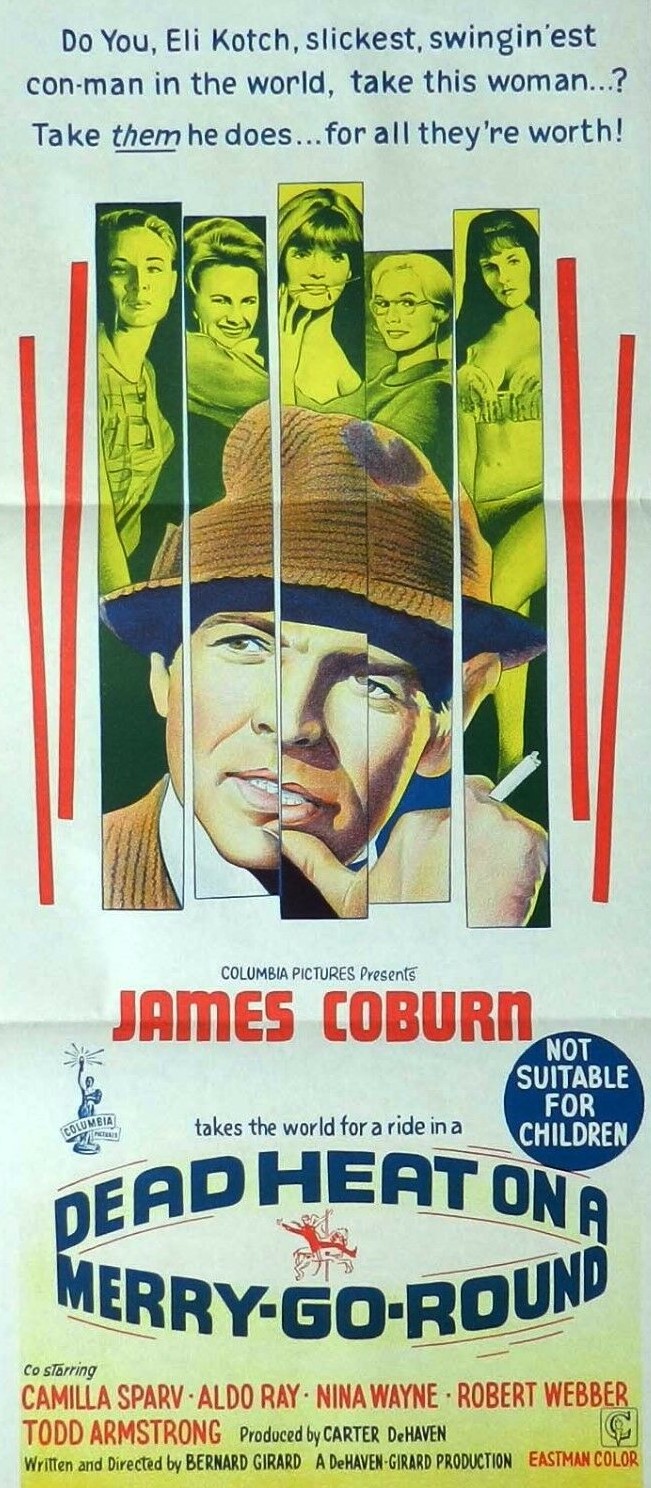
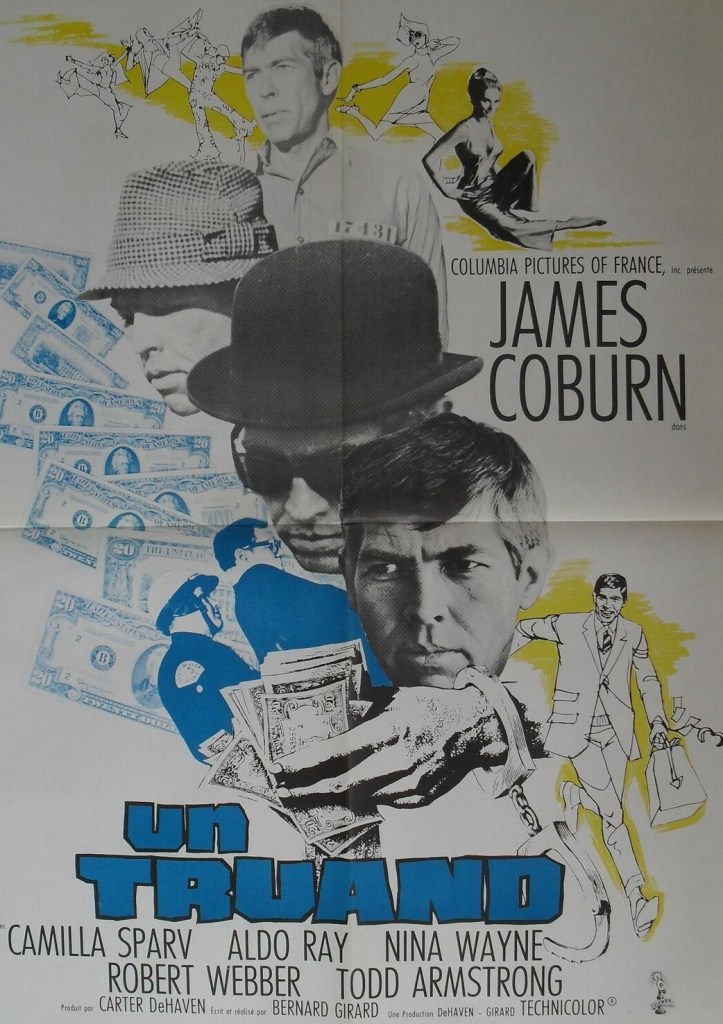
Highly entertaining woefully underrated heist picture with an impish James Coburn (Hard Contract, 1967), Swedish Camilla Sparv (Downhill Racer, 1969) in a sparkling debut and at the end an outrageous twist you won’t see coming in a million years. This is the antithesis of capers of the Topkapi (1964) variety. Not only is it an all-professional job, it takes a good while before you even realise the final focus is robbery or even the actual location. There are hints about the that event and glimpses in passing of material that may be used, and although the theft is planned to intricate detail, none of that planning is revealed to the audience.

The paroled Eli Kotch (James Coburn), who has seduced the prison psychiatrist, immediately skips town and starts fleecing any woman who falls for his charms. He changes personality at the drop of a hat, fitting into the likes of the mark, and in turn is burglar, art thief, car hijacker, in order to raise the loot required to buy a set of bank plans, and yet not above taking on ordinary jobs like shoe salesman to meet the ladies and coffin escort to get free travel across the country. So adept at the minutiae of the con he even manages to impersonate a hotel guest in order to get free phone calls.
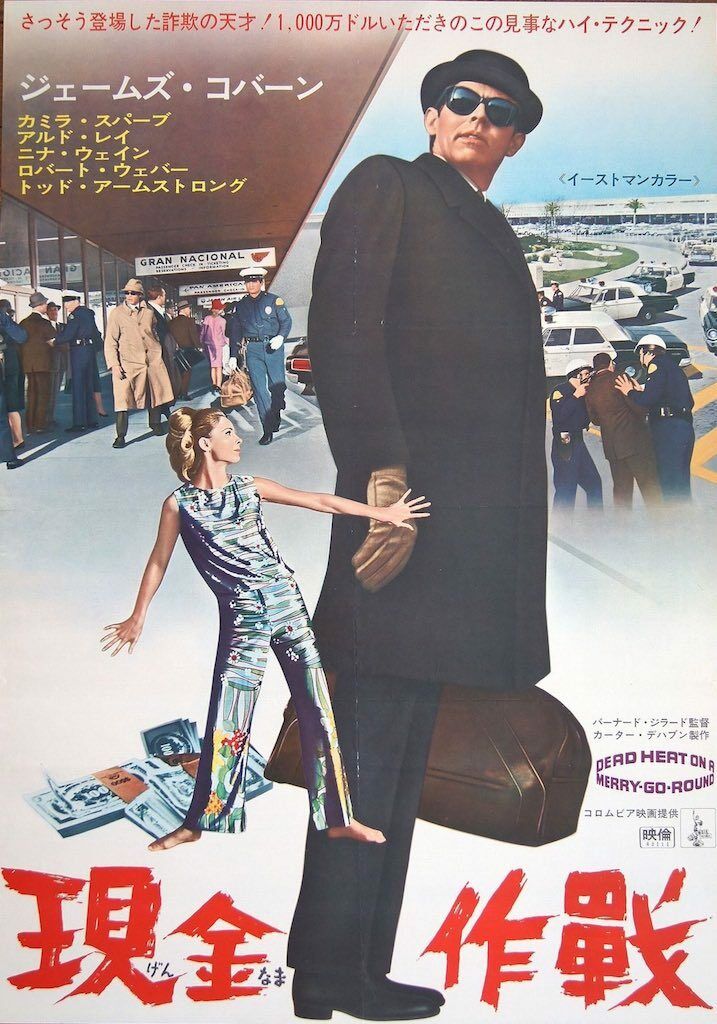
He enrols girlfriend Inger (Camilla Sparv) to act as an amateur photographer working on a “poetic essay on transient populations” to get an idea of sites he means to access. He manages to have the head of a Secret Service detail blamed for a leak. Everything is micro-managed and his final masquerade is an Australian cop with a prisoner to extradite which provides him with an excuse to linger in a police station, privy to what is going on at crucial points.

If I tell you any more I’m going to give away too much of the plot and deprive you of delight at its cleverness. The original posters did their best not to give away too much but you can rely on critics on Imdb to spoil everything.

This is just so much fun, with the slick confident Eli as a very engaging con man, the supreme manipulator, and almost in cahoots with writer-director Bernard Girardin (The Mad Room, 1969) in manipulating the audience. There are plenty films full of obfuscation just for the hell of it, or because plots are so complex there’s no room for simplification, or simply at directorial whim. But this has so much going on and Kotch so entertaining to watch that you hardly realize the tension that has been building up, not just looking forward to what exactly is the heist but also how are they going to pull it off, what other clever tricks does Kotch have up his sleeve for any eventuality, and of course, for the denouement, are they going to get away with it, or fall at the last hurdle. There is a great twist before the brilliant twist but I’m not going to tell you about that either.
There’s plenty Swinging Sixties in the background, the permissive society that Kotch is able to exploit, and yet the film has some unexpected depths. You wonder if the memories Kotch draws upon to win the sympathy of his female admirers have their basis in his own life. You are tempted to think not since he is after all a con man, but the detail is so specific it has you thinking maybe this is where his inability to trust anyone originates.

Bernard Giradin was not a name known to me I have to confess, since he was more of a television director than a big screen purveyor – prior to this he had made A Public Affair (1962) with the unheard-off Myron McCormick – and Coburn was the only big star he ever had the privilege to direct. But there are some nice directorial touches. The movie opens with a wall of shadows, there are some striking images of winter, a twist on bedroom footsie, and jabbering translators. But most of all he has the courage to stick to his guns, not feeling obliged to have Kotch spill out everything to a colleague or girl, either to boast of his brilliance, or to reveal innermost nerves, or, worse, to fulfil audience need. There’s an almost documentary feel to the whole enterprise.

James Coburn is superb. Sure, we get the teeth, the wide grin, but I sometimes felt all the smiling was unnecessary, almost a short cut to winning audience favour, and this portrayal, with the smile less in evidence, feels more intimate, more seductive. This may well be his best, most winning, performance. Camilla Sparv is something of a surprise, nothing like the ice queen of future movies, very much an ordinary girl delighted to be falling in love, and with a writer of all the things, the man of her dreams.

The excellent supporting cast includes Marian McCargo (The Undefeated, 1969), Aldo Ray (The Power, 1968), Robert Webber (The Dirty Dozen, 1967), Todd Armstrong (Jason and the Argonauts, 1963) and of course a blink-and-you-miss-it appearance of Harrison Ford as the only bellboy (that’s a clue) in the picture. You might also spot showbiz legend Rose Marie (The Jazz Singer, 1927).

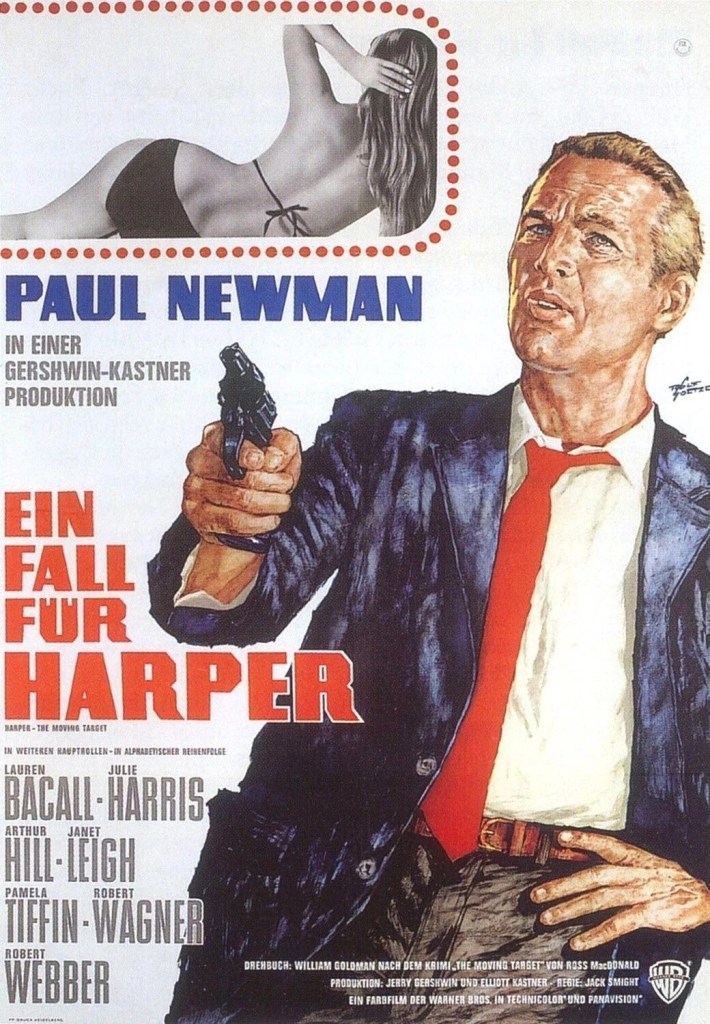
Harper / The Moving Target (1966) ****

Inventive screenplay by William Goldman (Masquerade, 1965), the ideal combination of witty lines and others that strike to the heart, and Paul Newman’s most naturalistic performance, and a family at each other’s throats, create a genuine addition to the private eye genre. Punch-ups are limited, generally the sleuth comes out worse, his skull an easy target apparently for any villain wanting to give him a good biff.

Most people remember the celebrated credit sequence. But, in fact, most people do not. They remember that this is a guy who will reuse old coffee grinds, which is as good a character definition as you’re going to get. But the opening sequence says much more – he sleeps in a pull-out couch, he falls asleep with the television on, dunking his face in ice suggests a hangover, and – the killer – he sleeps in his office. You won’t forget the ending either, the freeze frame, as fed-up Harper (Paul Newman) just gives up on the stupidity of mankind. And just before that there’s a delicious moment when crippled mother Elaine Sampson (Lauren Bacall) trills to the daughter she loathes Miranda (Pamela Tiffin) in a voice that would denote happiness but is anything but, “I’ve got some news for you,” as she looks forward to informing the child that the father she adores and that Elaine equally loathes is dead.

Not surprisingly, Harper’s on the verge of divorce from wife Susan (Janet Leigh), but he still hankers after being a knight in shining armor, those few days every year when he puts the world to rights rather than chasing down errant husbands in seedy hotel rooms.

The tale is a tad convoluted, involving initially tracking down Elaine’s estranged missing millionaire husband that turns into kidnapping and then murder with a side order of a fake cult headed by Claude (Strother Martin) that’s a front for an illegal immigrant operation, and going through the gears, character-wise, with malicious wife, an extremely flirtatious Miranda who gets her come-uppance when she tangles with Harper, faded alcoholic star Fay Estabrook (Shelley Winters) and junkie Betty (Julie Harris) sometime lover of lothario pilot Allan Taggert (Robert Wagner).

Two distinctive thugs Dwight Troy (Robert Webber) – Fay’s husband – and Puddler (Roy Jenson) offset the dumbest of dumb cops led by Sheriff  Spanner (Harold Gould) and lovesick attorney Albert Graves (Arthur Hill), Harper’s longtime buddy, who pines for Miranda.

Torture comes in two guises – the junkie gets the treatment from Dwight and Harper is put through the wringer listening to the endless whining of Fay as he tries to pump her for information. Harper avoids beatings and takes beatings and various characters bounce through doors with a gun – both Taggert and Graves save Harper from being shot.

Harper’s got a slick way about him, but mostly his charm is used to weasel information. He hasn’t got enough of it left to work on his wife.

When Harper’s not racing his sports car along twisting mountain roads, the action shifts to a cult temple, the docks and an abandoned oil tanker. Even when Harper works out who’s in on the kidnapping, it turns out he’s now got a murder to solve since someone’s bumped off the kidnappee.

Despite the endless complications, this whizzes along, helped enormously by Paul Newman’s (Cool Hand Luke, 1967) winning characterization. He’s brought a new trick to his acting arsenal, mastering a method of not listening to a conversation by tilting his head away from the speaker, and there’s a number of novel gestures. The scene where he rejects Miranda is a cracker. Tough guy running short of a soft center, he makes a very believable human being. And he’s got his work cut out because Lauren Bacall (Shock Treatment, 1964) is on scene-stealing duties. As is Pamela Tiffin (The Pleasure Seekers, 1964) though she can hardly match the older woman for arch delivery.

It’s a top-notch cast all the way down. Fans of Strother Martin (Cool Hand Luke) will enjoy his fake healer, Arthur Hill (Moment to Moment, 1966) is engaging, Robert Wagner (Banning, 1967) adds another notch to his rising star bow while Robert Webber (Don’t Make Waves, 1967) emanates menace with his “old stick” routine. Shelley Winters (The Scalphunters, 1968) is a great lush, Julie Harris (The Split, 1968) a junkie trying to pretend she’s not and Janet Leigh (Psycho, 1960), having kicked her husband out, still hoping he might come back in more acceptable form.

Jack Smight (The Third Day, 1965) directs with some zap. This should have had everyone singing the praises of crime writer Ross MacDonald, who in inventing the character (Lew Archer in the original) had inherited the Raymond Chandler mantle, but instead they came away whistling Dixie for screenwriter William Goldman.

Class act.

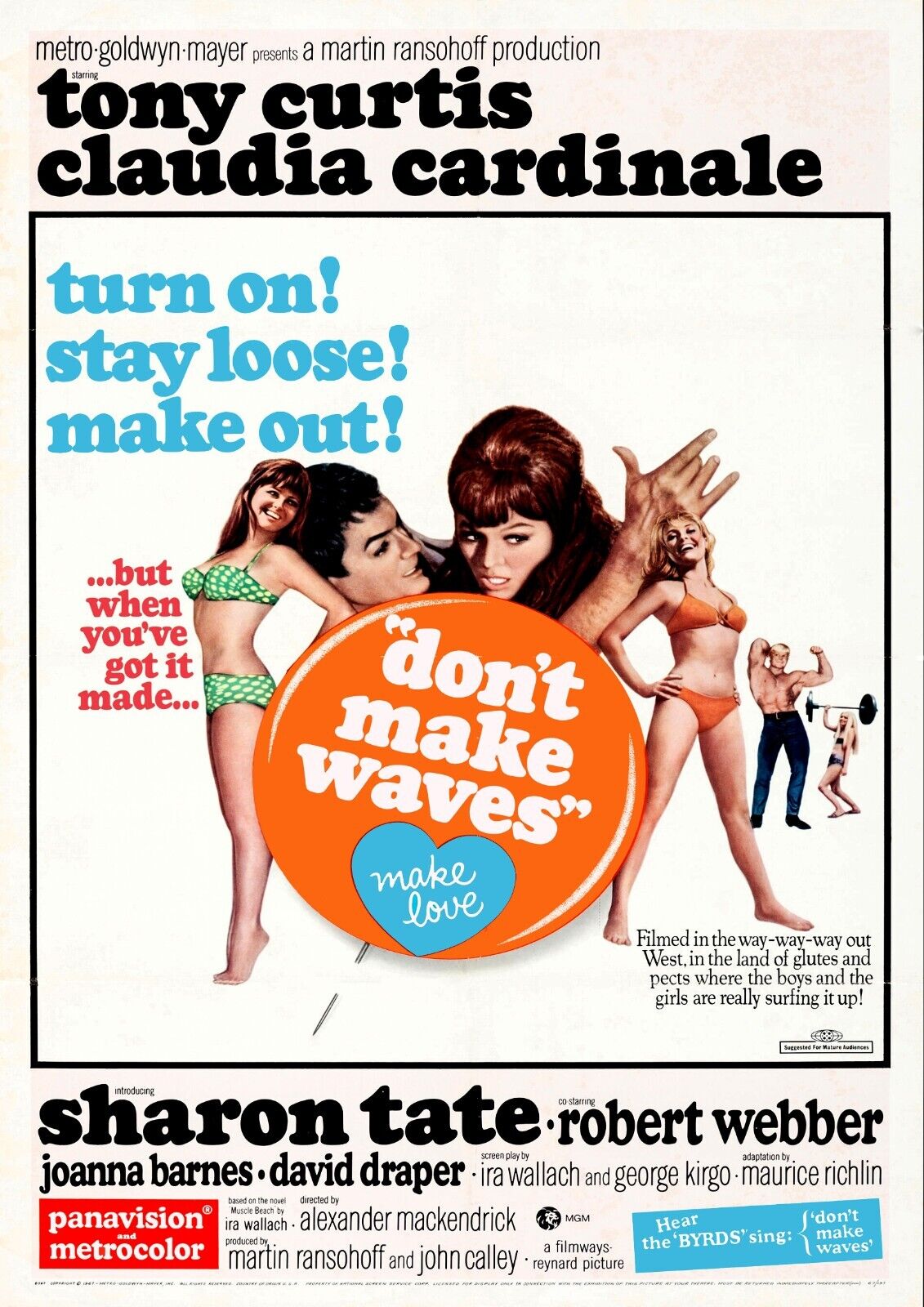
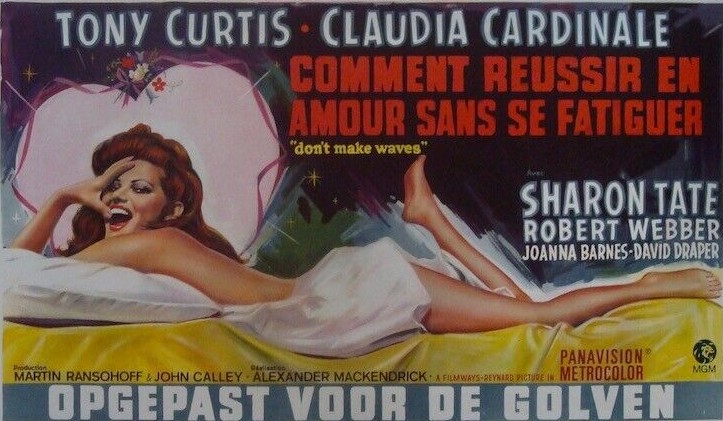
Don’t Make Waves (1967) ****

Unfairly maligned on release. Part throwback screwball comedy, part farce, part satire and in low-key fashion the first disaster movie. Oddly enough, that wild combination hits the mark. Tony Curtis makes amends for Boeing Boeing (1965). Claudia Cardinale on top form as a ditzy brunette. Last hurrah for Ealing Comedy grey eminence Alexander Mackendrick (A High Wind in Jamaica, 1965). Plus Sharon Tate as a sky-diver. What’s not to like?

Hardly surprising though at the time it got the thumbs-down from critics and the cold shoulder from audiences. A very late arrival to the short-lived beach movie cycle and unlikely to compete with the harder-edged satires like The Russians Are Coming, The Russians Are Coming (1966) and Divorce American Style (1967) or the latest off the Neil Simon conveyor belt Barefoot in the Park (1967).   

Marvelous opening with sight gags galore sees vacationer Carlo (Tony Curtis) wrestling with a runaway car then seeing hapless wannabe artist Laura (Claudia Cardinale) accidentally setting fire to the vehicle. To make amends for destroying all his belongings, she invites him to stay the night. Unfortunately, her married lover Rod (Robert Webber) turns up, cueing a whole layer of farce, traditional bedroom-style here but later even better in the office, properly done this time compared to Boeing Boeing.

The next day Carlo is rescued from drowning by Malibu (Sharon Tate) with whom he promptly falls in love and attempts to separate her from her hulk of a boyfriend Harry (David Draper), all muscle but little brain and prone to easily-exploited bouts of depression.

Carlo is the smarter younger brother of the character in Boeing Boeing, managing to muscle in on Rod’s swimming pool business and demonstrating his sharp salesmanship skills. Except that Laura is so shrill and a kept woman, you’d expect him to be more interested in her than Malibu, but then where would be we be without a love triangle. In an odd sub-plot involving an astrologer (Ed Bergen), Carlo manages to win over Malibu. Meanwhile, Rod’s smarter wife Diane (Joanna Barnes) infiltrates her husband’s cosy love nest.    

Although Carlo is effectively set up as somewhat shifty hero he undergoes a series of humiliations, brought down to earth by being repeatedly picked up and carried like a doll by Harry, and being drowned in mud. Other times he lives high on the hog, realizing he could make a killing here.

There’s no great plot, just the usual misunderstandings, but, unusually, characters are given moments of self-reflection and self-deprecation, and the satire focuses on the self-involvement of the beautiful people. There’s a fair bit of ogling but the camera is gender-equal, the toned bodies of the muscle men given as much attention as any passing female in a bikini.

I found myself chuckling all over the place, mostly at the antics of Carlo. This is a pretty good performance by Tony Curtis, mugging kept well under control but adept at physical comedy. And Claudia Cardinale (Once Upon a Time in the West, 1968) is equally game, drenched for a good chunk of time, and hit by sudden self-awareness as the tale unfolds. You might balk at her high-tempo performance but otherwise the set-up wouldn’t work. If she wasn’t so annoying why would Carlo look elsewhere for romance?

The disaster element involves a runaway clifftop house, a situation created by the unlucky Laura, and it doesn’t take much to see what elements The Poseidon Adventure filched, playing it for drama rather than comedy.

While not in the same category Mackendrick classics The Man in the White Suit (1951), The Ladykillers (1955) or even The Sweet Smell of Success (1957) – co-starring Curtis – this is not to so far off. Mackendrick excels at building the comedy, confidently marshals the farce, but, more importantly, doesn’t lose sight of the characters in the ensuing chaos.  

Producer Marty Ransohoff tries to pull a fast one by slapping an “introducing” credit on Sharon Tate, conveniently ignoring her performance in the previous year’s Eye of the Devil (1966). She’s less iconic here – unless you imagine that with her bronzed face she’s a distant cousin of George Hamilton – but she’s far from the dizzy blonde, much more pragmatic, the one who switches electricity back on after the blackout, and with her own oddball ways. Trivia note: they modelled “Malibu Barbie” on Tate.

Worth a look.   

Discover WordPress

A daily selection of the best content published on WordPress, collected for you by humans who love to read.

The Atavist Magazine

by Brian Hannan

WordPress.com News

The latest news on WordPress.com and the WordPress community.