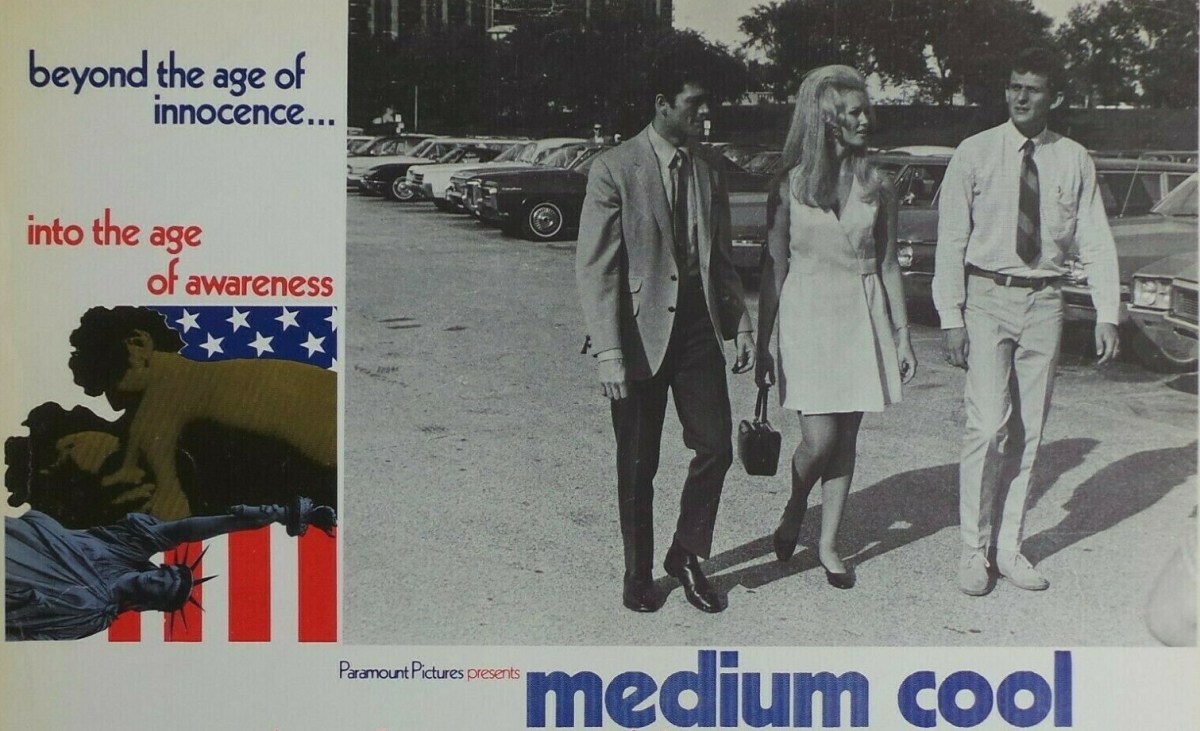
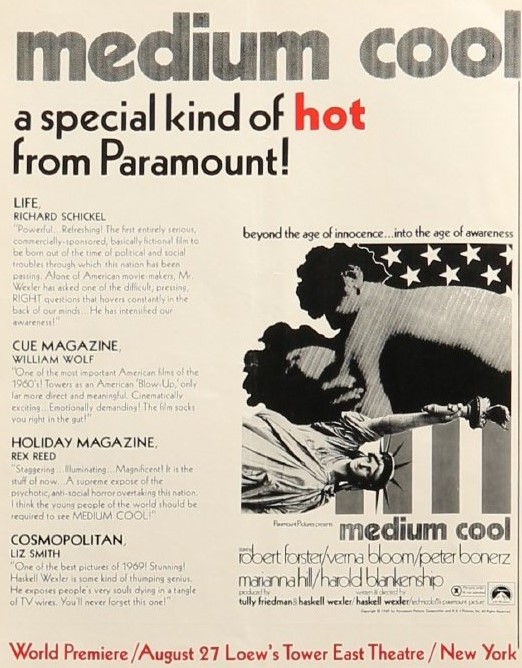
Self-important essay on the self-entitlement of journalists who see themselves as victims, hated by the authorities whose activities they expose and hated by the public for being so cold-blooded – it opens with a television cameraman getting footage of dead people in a car crash before phoning for an ambulance – and for filming stuff that genuine victims did not want filmed.
Filmed in cinema verite style and covering much of what went down in Chicago 1968 when demonstrators clashed with police and the National Guard and tanks rolled through the streets. Certainly strikes a contemporary chord when filming is an universal pastime and many criminals have been brought to book and various issues highlighted by social media.
As if making its point about action and controversy versus talking heads, the movie begins with talking heads, discussing the role of television and journalism in society, with cameramen telling stories of occasions when the public they were trying to help turned on them. The narrative is slight, following television cameraman John Cassells (Robert Forster) going about his business, and betraying girlfriend Ruth (Marianna Hill) with single mother Eileen (Verna Bloom). John is fired after objecting to his television station handing over to the cops and the F.B.I. footage he has filmed of demonstrations and incidents.
Because of the documentary style, much of what has been filmed carries particular resonance as a sign of the times, not so much the police violence because that is widely available elsewhere, but simpler scenes that seem far truer to life. Eileen’s son Harold (Harold Blankenship) is interviewed by an off-screen canvasser about his home life, age, brothers and sisters and so on. Questioned about his father, he explains his father is not at home. “Where would I find him?” asks the interviewer. “Vietnam.”
The boy’s mother Eileen, a teacher who has to manage five grades in one classroom, and John are skirting round the physical side of their romance until jokingly John takes the plunge. “I know your husband’s not going to come charging through the door.” “Buddy’s dead.” The director could already have delivered this information to the audience in talking-heads-fashion but this carries probably the biggest dramatic punch in the picture. This family provides a solid core for a movie which makes its points in more hard-hitting style.
Questions of respect and ethics loom large. Making no bones about finding audience-grabbing material, John is disgusted that people steal hubcaps and the radio antenna from his car when clearly he feels news journalists should be given more respect. But that the public hold an opposite view is clear from Ruth who instances turtles filmed going the wrong way after nuclear explosion distorted their instincts and they went inland to lay their eggs (where they would die) rather than out to sea. She complains that none of the cameramen present thought to turn the turtles round and show them the correct way.
A plot point allows Eileen and John to mingle with the demonstrators during the actual Democratic Convention. There is a shock – and ironic – ending in which John is himself photographed by a passerby after being involved in an accident.
Robert Forster (Justine, 1969) carries off the arrogant victimized reporter well and in her debut Verna Bloom (High Plains Drifter, 1973) is excellent as the real victim of the system while Mariana Hill (El Condor, 1970) raises the tempo as the volatile girlfriend. Peter Boyle (Taxi Driver, 1976) has a small part.
Oscar-winning cinematographer for Who’s Afraid of Virginia Woolf (1966), Haskell Wexler (who also wrote the script) makes a notable debut as director, mixing fact and fiction, taking a political stance and introducing a revolutionary camera technique. Half a century on, not much has changed in attitudes to media ethics although it is another photographic revolution via social media that is leading the discussion in what takes top billing in terms of news. Its content has led the film to be seen as a landmark of the cinema.
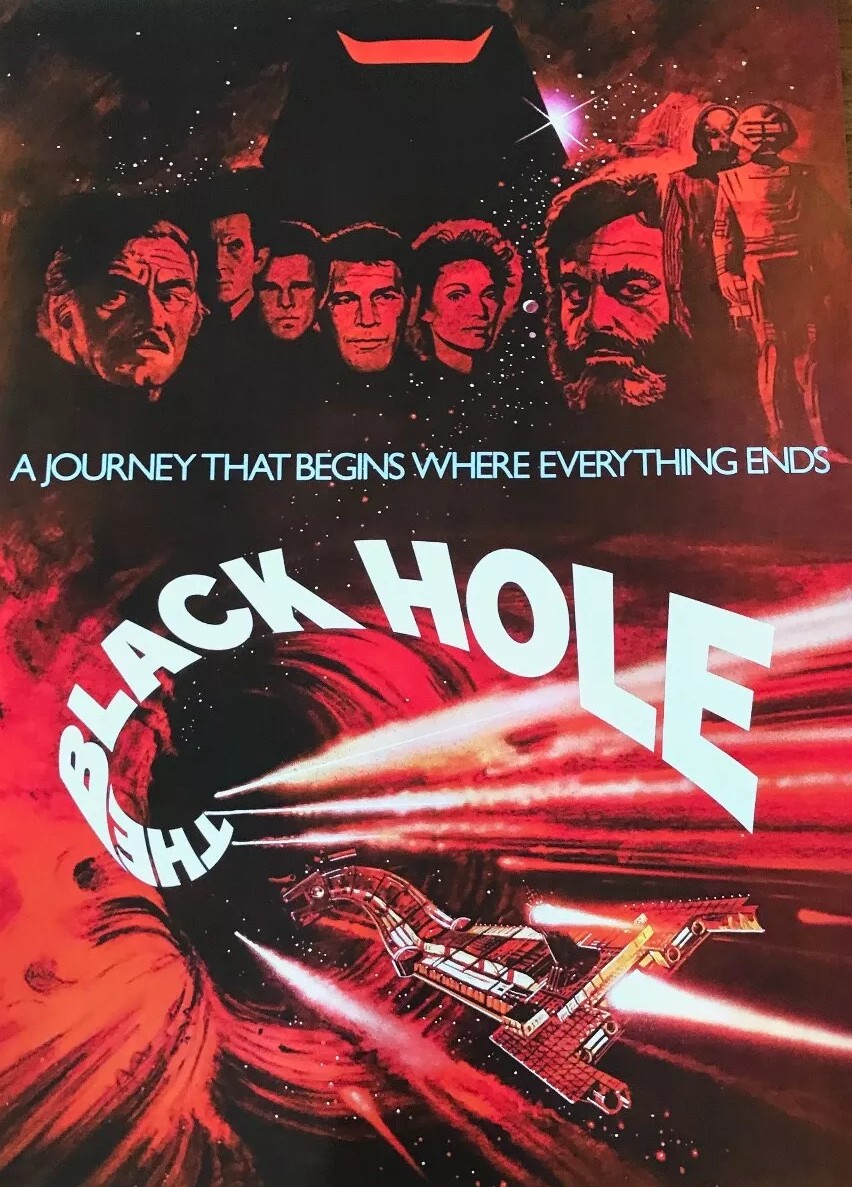
Think of this as having been made before Star Wars (1977), Close Encounters of the Third Kind, Alien (1979), heck even Star Trek (1979), changed the sci fi world forever and imagine it’s a huge advance SFX-wise on the 1950s vanguard of sci fi pictures and you’ll probably come away very happy. A lot to admire in the matte work and some groundbreaking effects and actually the story – mad scientist lost in space – has a bit more grit than was normal for the genre.
But it’s laden down with talk and the action when it comes resembles nothing more than a first draft stab at the light sabers of Star Wars and clunky robotic figures that come across like prehistoric Stormtroopers. A bit more light-hearted comedy than in the other three mentioned, various quips at the expense of the robots.
Scientists aboard space ship USS Palomino, a research vessel looking for life in space, is astonished to discover, hovering on the edge of a black hole, a missing spaceship USS Cygnus and are even more astonished to find out it’s not uninhabited, still on board is heavily-bearded Dr Hans Reinhardt (Maximilian Schell) and an army of robots that he has miraculously fashioned during his time lost in space.
This is a bit of an emotional blow to Dr Kate McCrae (Yvette Mimieux) whose father had been part of the crew of the Cygnus. Dr Reinhardt seems kosher enough except for his idea of, in the true spirit of space adventure, blasting off through the black hole. Although Reinhardt has been exceptionally clever in monitoring the invasion from the visitors and nullifying any threat with a blast from invisible laser, once they are on board that monitoring capability appears to vanish, allowing the visitors to search the ship where they find out that Reinhardt’s story doesn’t seem to add up.
Apart from Dr McCrae, the other personnel from the Palomino comprises Capt Dan Holland (Robert Forster), Dr Durant (Anthony Perkins) – the most inclined to follow Reinhardt into the greatest danger in the universe – quip merchant Lt Pizer (Joseph Bottoms) and dogsbody Harry (Ernest Borgnine). Plus there’s a cute robot Vincent (Roddy McDowall) constructed along even more rudimentary lines than R2-D2.
Vincent turns out to be a whiz at a basic version of a computer game, something between Space Invaders and Kong. But his main task is to wind up the crew with a head teacher’s supply of wisdom, spouted at the most inopportune moment. Except for the chest-bursting appearance of Alien, this might have garnered more kudos for the creepy mystery element – Reinhardt has lobotomized his crew members, turning them into these jerky robots, after they mutinied in revolt against his plan to dive into the black hole. Dr McCrae nearly joins the lobotomy brigade. And once she’s rescued it’s a firefight all the way. A stray meteor is on hand to add further jeopardy. And in the end the good guys are forced to plunge into the apparent abyss of the black hole, only to be guided by some angelic light and come out the other end unscathed, no worse for enduring the kind of phantasmagoric light show Stanley Kubrick put on in 2001: A Space Odyssey (1968).
By this point Maximilian Schell (Judgement at Nuremberg, 1961) was an accomplished bad guy, covering up inherent malignancy with charm and scientific gobbledegook. Joseph Bottoms (The Dove, 1974) is the pick of the incoming crew but that’s because he’s been dealt a stack of flippant lines. Anthony Perkins at least gets to waver from the straight-laced. But everyone else is a cipher, even Yvette Mimieux (Light in the Piazza, 1962) who might have been due more heavy-duty emotion.
This was the 1970s version of the all-star cast, all the actors at one point enjoying a spot in the Hollywood sun, but now all supporting players. Schell was variably billed in pictures like St Ives (1976), Cross of Iron (1977) and Julia (1977). Robert Forster (Medium Cool, 1969) hadn’t been in a movie in six years. Anthony Perkins was waiting for a Psycho reboot to reboot his career – only another four years to go. Yvette Mimieux had only made four previous movies during the 1970s including Jackson County Jail (1976). The most dependable of these dependables was Ernest Borgnine (The Adventurers, 1970), for whom this was the 24th movie of the decade, including such fare as Willard (1971), The Poseidon Adventure (1972) and Hustle (1975).
It didn’t prove a breakout picture for director Gary Nelson (Freaky Friday, 1976), Screenplay credits went to Jeb Rosebrook (Junior Bonner, 1972) and female television veteran Gerry Day.
Strong contender for cult status especially when post-production murder and sexploitation are thrown into the pot. A vanity picture but one with serious underlying purpose. Sole venture from director Robert Gottschalk, who doubled up as writer and producer. So, all-out auteur. This popped out by pure coincidence while I was in the middle of my annual widescreen/ 70mm/ Cinerama binge and thus pricked my interest.
And if you know your widescreen, the name of Robert Gottschalk will not be far from your lips. Because he invented Panavision. It’s still in use but in the roadshow era it was one of the contributing factors to directors heading for the biggest widescreen they could get. MGM properly introduced it with the 65mm Raintree County (1957) and then more strikingly, in terms of box office, with Ultra Panavision 70 for Ben-Hur (1959).
Ultra Panavision was used for sections of How the West Was Won (1962) and completely on Mutiny on the Bounty (1962) and Battle of the Bulge (1965) and it was revived by Quentin Tarantino for The Hateful Eight (2015). Super Panavision 70 was more regularly employed as was 35mm Panavision
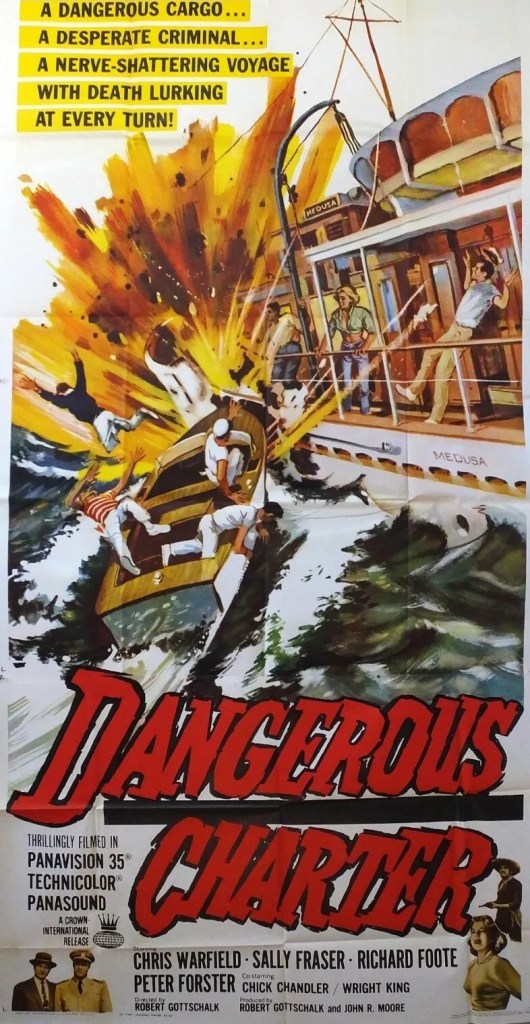
Dangerous Charter had two aims. Firstly, to showcase the advantages of Panavision, hence the lax pace, the striking images of a yacht moving in a variety of directions across the water, often with sunset behind, the kind of awesome shot that might be favored by the likes of David Lean. Secondly, Gottschalk wanted to get into the production business, aiming initially at six movies a year, including a 70mm effort called Owyhee to be filmed in Hawaii in the summer of 1959.
Ben-Hur did the job of showcasing the process for him, so the production unit fell by the wayside and Dangerous Charter, made over a few weeks in 1958, sat on the shelf for four years after an initial attempt at distribution by Filmserve Distribution Corp fell apart, and as a result now conveniently falls into my purlieu.
So really, it’s a late 1950s movie masquerading as an early 1960s one, after it was picked up as a cheap support vehicle by the nascent Crown International.
It’s a shame Gottschalk didn’t quite have the same technical mastery of other elements of movie making as he did over camera and lenses. But in its favor, the movie is short, has a terrific villain, springs more twists than you might expect and certainly showcases his widescreen invention.
Three down-on-their-luck fishermen come across a deserted drifting yacht, the Medusa, with one corpse on board. The cops give it to them in lieu of a salvage fee, intending to use, in a cute sense of irony, the fishermen as “bait” to try and hook whoever was responsible for its abandonment.
The trio are only too happy to accept the gift. Aspiring skipper Marty McMahon (Chris Warfield) is in love with daughter June (Sally Fraser) of the captain, Kick (Chick Chandler), and there’s a chirpy deckhand Joe (Wright King). Pretty soon a money-no-object charter appears in the shape of Dick Kane (Richard Foote) and for $10,000 they agree to take him to La Paz on a 10-day return trip and pick up a passenger Monet (Peter Forster). June boards as cook.
Ongoing friction between Marty and June – he refuses to marry her until he can properly earn a living – spills over into some modest canoodling between the girl and the guitar-playing Dick, a stolen kiss as far as it gets before she warns him off.
Monet turns out to be quite a character. Plummy-voiced, white-suited, charming, friendly, think a slick Robert Wagner (Banning, 1967), accommodating and even entertaining. In short order, however, the Medusa is hijacked. And not for the valuable boat but for its even more valuable cargo of drugs.
The thugs threaten to hold June, by now decked out in a fetching pink swimsuit, hostage and there’s not much the boatmen can do to counter the threat. Their radio has been disabled by Dick who turns out to be a junkie. Marty tries a clever trick, flying the boat’s flag upside down, the nautical sign of distress, but that attempt to garner local attention is nipped in the bud. Monet has planted a bomb on board so there’s a ticking-clock countdown and a zinger of a climax when Dick, furious at being tortured via cold turkey by Monet, takes his revenge in a superb suicide by ramming their speedboat into the bigger boat, killing both.
Mostly, it’s juiced up by long shots of the boat on the water, which, while selling the process, rips the heart out of any tension. But towards the end it picks up the pace. The upside-down flag idea is scuppered when other fishermen assume they’ve just made a mistake and point this out within the hearing of Monet.
Marty has to scream at the other terrified screaming crewmen to shut up because the only way he can locate the bomb is by its give-away ticking. And when the bomb explodes harmlessly over the side and Monet decides to turn round and bump off the witnesses the old-fashioned way it’s Dick who twists the wheel towards doom.
There’s no great acting, but Peter Forster does a convncing job of an unusually civilized gangster and June Fraser attracts the eye. Chris Warfield, with little claim to fame as a television and support actor in pictures, later turned to direction under the pseudonym Billy Thornberg in the sexploitation vein, Teenage Seductress (1975) and Sheer Panties (1979) among his lurid portfolio. This proved a movie swansong for June Fraser, otherwise a bit player. You might remember Robert Forster from Escape from the Planet of the Apes (1971) but not much else.
Robert Gottschalk went back to turning Panavision into a hugely successful company before being murdered by his lover at aged 64.
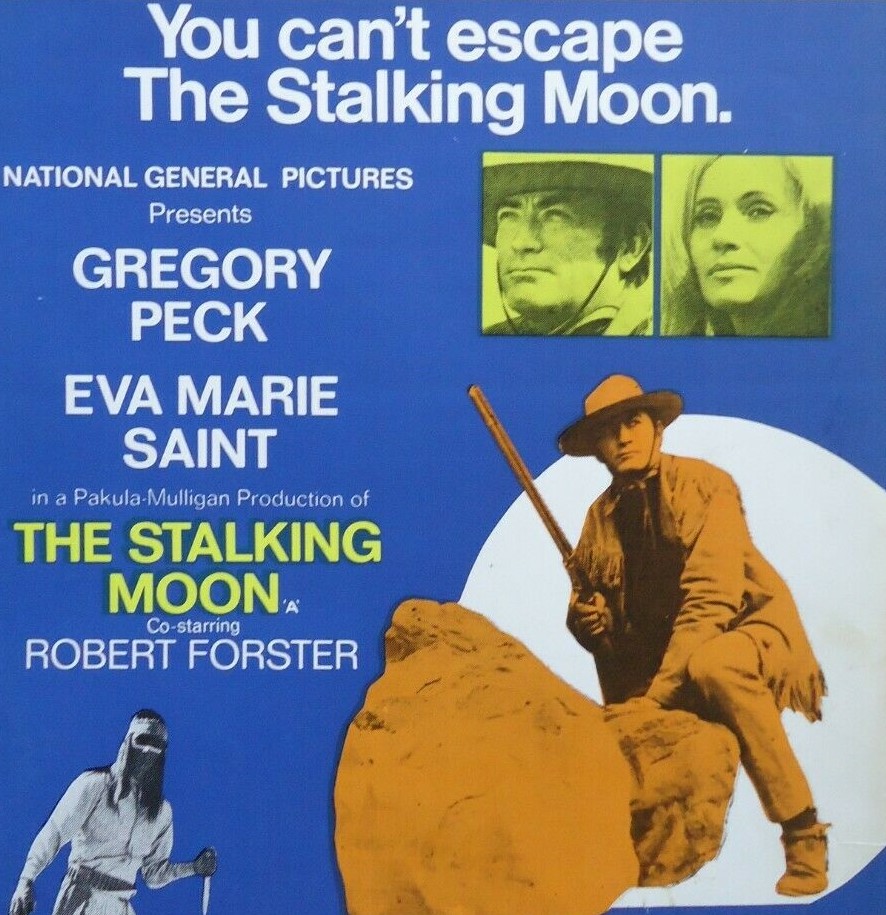
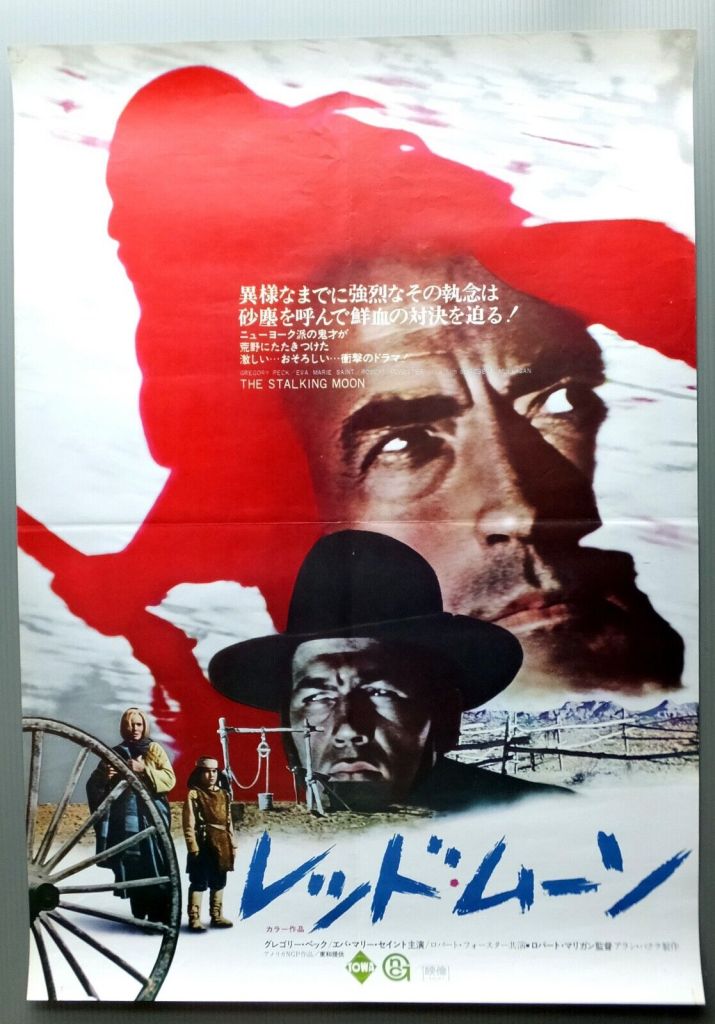
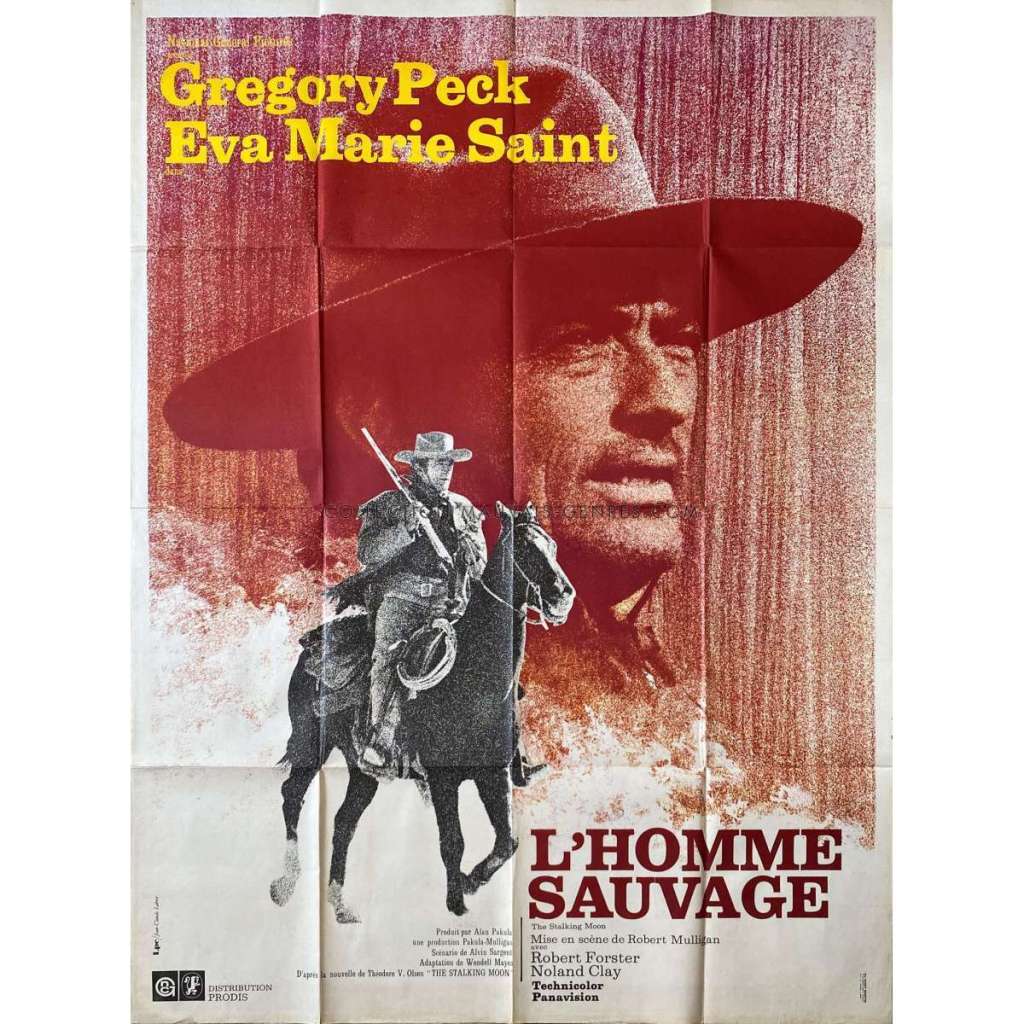
About-to-retire Indian scout Sam Varner (Gregory Peck) helps the U.S. Cavalry round up Indians to take to reservations. One of these is American Sarah Carver (Eva Marie Saint) who, with her Apache son, is attempting to escape her vengeful Apache husband Salvaje (Nathaniel Narcisco). Varner agrees to take her to the nearest stage coach post, and then to a train depot, and, finally, to his ranch in New Mexico where they enjoy a period of security. But wherever she goes, death follows, culminating in a shootout in the hills around his ranch.
But the treatment by director Robert Mulligan (Up the Down Staircase, 1967) is far more complicated, often asking questions that cannot be answered, and placing the principals in situations that cannot be easily resolved. Sarah Carver has not gone running in order to find a man to save her; she does not think she can be saved and accepts the inevitable. She feels guilty for “lacking the courage to die,” of accepting Salvaje as her husband instead of dying along with the rest of her family when attacked a decade before by Indians.
She is weak in other ways, hiding the identity of her husband from the Army and everyone else in case she is abandoned. She shows no great bond with her son, who, several times, attempts to escape.
Sam Varner is very much an ordinary guy, just wanting to quit the Army and work his ranch. He is not the traditional extrovert western hero, nor the man who reluctantly takes up arms. He has no wish to get involved with Carver and each time he does agree to help it is with a time-limited condition attached and these scenes lack any sense of meet-cuteness, no romantic interplay hastening him to a decision, little expectation that either party is angling to fall in love.
It is practicality rather than intimacy that makes them share a blanket during a dust storm and he asks her to come to his ranch because he will get on with the work quicker if he has someone to cook. In fact, his honesty prevents that: he confronts her over the fact that she “put us out here knowing all the time that he’d come after us” and making her face the corpses of men who died because she hid the truth. He is honest with his emotions and he is determined (“I got a place to go and I’m going”). But he bears none of the normal western hero’s traits, neither a hard drinker, loner, or gunman. He is not gauche like James Stewart or malevolent like Clint Eastwood.
Even more unusual is the treatment of Salvaje. Despite the savagery of his actions, there is within him a sense of honor. He only chases his wife because she has stolen his son; there could be no greater affront to his dignity. The story is told from the point of view of the pursued i.e. Sarah Carver. But, by turning that perspective on its head, The Stalking Moon more easily fits into the category of revenge western, characteristically a picture concerning chase and pursuit by someone who has been wronged.
The director takes a bold step in the presentation of Salvaje. He is not seen at all in the first hour, then in just a few glimpses of a shape, his face only revealed at the climax. He is a ghost and a killing machine combined. Like a latter-day “Terminator,” he cannot be stopped, so skilful he evades capture, and relentless.
It is also, unusually for a western, a thriller. The tension mounts from the discovery, at the 10-minute mark, of Salvaje’s first three victims, all fully-armed soldiers, and the news, one minute later, that he single-handedly killed four troopers previously. At Hennessy, a staging post, when Varner and Carver go out into a dust-storm to search for her son who has run away, they return to find all dead. Everyone they left behind at Silverton, a train depot, is also killed.
Initially, Carver appears impatient, not willing to wait five days for an Army escort, but once she reveals who the boy’s father is, the reason becomes clear, and her desire for speedier transition creates more tension. Even in New Mexico, the death toll mounts, once Salvaje arrives. Now the trap closes in on them. Even the ranch house cannot prevent Salvaje from sneaking in and kidnapping his wife, leaving her for dead outside.
When Varner and a fellow scout, the half-breed Nick Tana (Robert Forster), attempt to turn the tables on Salvaje and track him down, it ends in Tana’s death. Although most of the tension comes from the will- he-won’t-he dynamic, there are number of Hitchcockian touches such as offscreen sound cues triggering alarm in characters. In two instances, a door provides shock.
Far from providing the expected relief, the ranch house merely provides a claustrophobic setting for the characters. Varner is trapped with an inarticulate pair. Instead of arrival at the ranch house precipitating emotional response and romantic interlude, as would be par for the course for other westerns, Varner finds himself stuck with a woman who refuses to talk and a boy who does not understand a word he says. The seven-minute scene where he sits down to eat and then has to virtually command mother and son to join him and encourage them to talk even if it is just to say “pass the peas” is one of the most awkward ever filmed.
The movie is so darned awkward that you never laugh even at the few moments of comedy, the complicated issuing of train tickets, Varner keeping up a one-sided conversation at the table, Nick’s attempts to teach the boy poker. Relationships are more likely to remain in limbo than move on to any romantic or sentimental plane.
The film has a tight structure, the first 40-odd minutes setting up the story and tracing Varner and Sarah’s journey to the ranch house, the next 20 minutes at the ranch alternating between comfort and discomfort as emotional release battles with restraint, the final 40 minutes the physical battle between the mostly unseen enemy and the farm occupants.
Stylistically, it is exceptional. The first section is all open vistas, characters minute figures on vast landscapes, the middle section suggests harmony with nature, and the final battle alternating between being the hunter and the hunted. When we first see Varner he is picked out along the edges of the screen as he leaps up or down or across rocky hillsides. That he appears and disappears at will could almost be the motif for the film.
Virtually everyone is in long shot or medium shot for the first half. Varner appears on the periphery of the screen and the action. He enters scenes where something important is being discussed, such as Sarah’s pleading to be allowed to leave the Army camp quickly. Most directors present Gregory Peck with aura intact, keeping him motionless on the screen to maintain his authority, but here he is always on the move, walking across open ground or confined spaces or darting across hillsides or through bushes, dashing on foot down slopes or racing on horseback.
Although the script – by Alvin Sargent (Gambit, 1966) and Wendell Mayes (Von Ryan’s Express, 1965) based on the T.V. Olson (Soldier Blue, 1970) novel – was viewed in many quarters as being underwritten, in particular Sarah’s role, and that there were too many silences for comfort, in the view of many that is the strength of the picture. There is none of the easy dialogue, crackling lines, coarse confrontation, sentiment or raw emotion of other westerns.
The movie hardly even skirts a cliché. This is in a class of its own in terms of the distance characters maintain between each other. Varner has very little to say, Sarah’s guilt restricts her vocabulary. In one regard the thriller element gets in the way of a study of two remote characters.
If I have any reservations about The Stalking Moon it is that is neither enough of a thriller nor enough of a character study. George Stevens might have sought emotional resolution and producer Alan J. Pakula, who later went on to direct Klute (1971) and The Parallax View (1974), might have proved more adept at marrying the thriller elements to personal anguish. Although The Stalking Moon may not have entered the pantheon of the greatest westerns, it is a very noble effort indeed, its slow pace and lack of dialogue providing it with a very modern appeal.





 The Magnificent 60s