Night of the Following Day (1969) ***

As his popularity in the 1960s faded, Marlon Brando was often called upon to save, or greenlight, a picture unworthy of his talent. Except that director Hubert Cornfield failed to extract enough tension from a kidnap thriller with an inbuilt deadline and a double-crossing sub-plot this might have been one to rise out of the mediocrity.

It’s not unknown for strangers working together on a robbery to adopt pseudonyms, colors in the case of Reservoir Dogs (1992) or cities as in Spanish television hit The Money Heist. Here they are known by their designated tasks, which seemed a nod towards artistic pretension at the time. Even so, the gang have too many frailties for taking on a caper like this, the pressure of a deadline and the publicity their crime attracts exacerbating the situation. So kidnapping a millionaire’s daughter (Pamela Franklin) are: Chauffeur (Marlon Brando), in on the job because he owes a favour to Friendly (Jess Hahn), whose sister Blonde (Rita Moreno) is also the chauffeur’s drug-addict girlfriend, the psychopathic Leer (Richard Boone) and a pilot (Al Lettieri).

All except the pilot are holed up in a remote beach house in France. The first signs of cracks show when Blonde is so drugged up she fails to collect her colleagues from a small local airport and, when suspecting the chauffeur of having sex with the girl, she explodes in a tantrum. And because she can’t get her story straight she attracts the attention of a local cop (Gerard Buhr). Despite making a good job of calming down the terrified girl, Leer has other plans for her which the Chauffeur is constantly trying to thwart. At various points various people try to quit. At various points romantic and family ties are pulled tight.

The details of the cash hand-over are well done as is the unexpected double-cross and the diversion allowing them to escape but about ten minutes of the running time is people driving around in cars, only at the later stages to any useful dramatic purpose, time that would been better spent filling us in on the characters. Most of the tension derives from a gang with two loose cannons and certainly the wait for the confrontation between Chauffeur and Leer is worthwhile.

The biggest plus point is Marlon Brando (The Chase, 1966) and even – perhaps because of – sporting a blonde wig and black tee-shirt remains a compelling screen presence. He might have been slumming it but he is certainly believable as the minor criminal way out of his depth. It’s a mistake to think of him as intended to exude menace along the line of Quint in The Nightcomers (1971) because this is actually a complicated role. On the one hand he clearly never wanted to be involved, participation triggered by a sense of honor, trying to keep his girlfriend and the kidnappee safe while at the same time happy to resort to considerable violence to achieve his ends.

The malevolent Boone (The Arrangement, 1969) almost steals the show, beginning as the voice of reason and gradually succumbing to his inner vices. The love interest benefits from Brando and Moreno (West Side Story, 1961), also in blonde wig, being ex-lovers in real life and it takes little to ignite the anger in Moreno. But her portrayal of the addict who cannot stay off her chosen poison long enough to carry out a simple task is excellent. Pamela Franklin (The Prime of Miss Jean Brodie, 1968) has little to do except look scared and she has one revealing scene when in attempting to seduce the Chauffeur sets up the prospect of a different kind of liaison with Leer.

Hubert Cornfield had not directed a picture since Pressure Point (1962) which acted as a decent calling-card and showed how good he was at creating tension between opposing individuals. Instead of focusing here on the characters, Cornfield seems more interested in the visuals, none of which as it turns out are particular arresting and in one instance virtually impossible to see what is going on.

Not so much a curiosity as a masterclass in how to blow a once-in-a-lifetime gig with Marlon Brando and what not to do with a thriller.
Marlowe (1969) ***

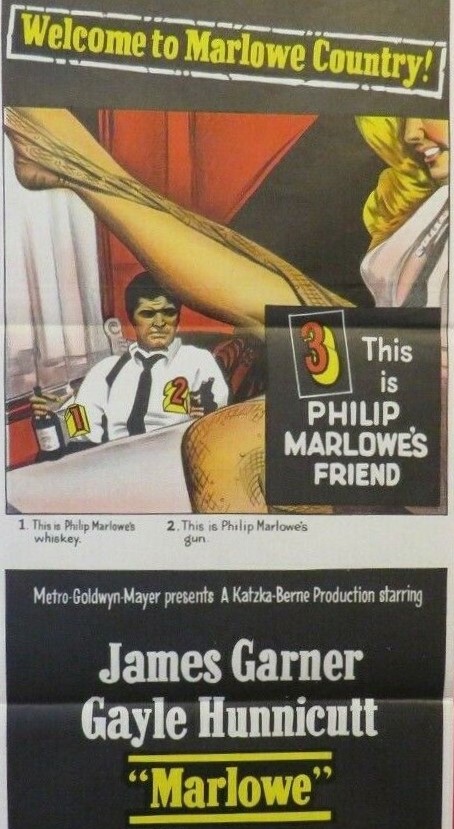
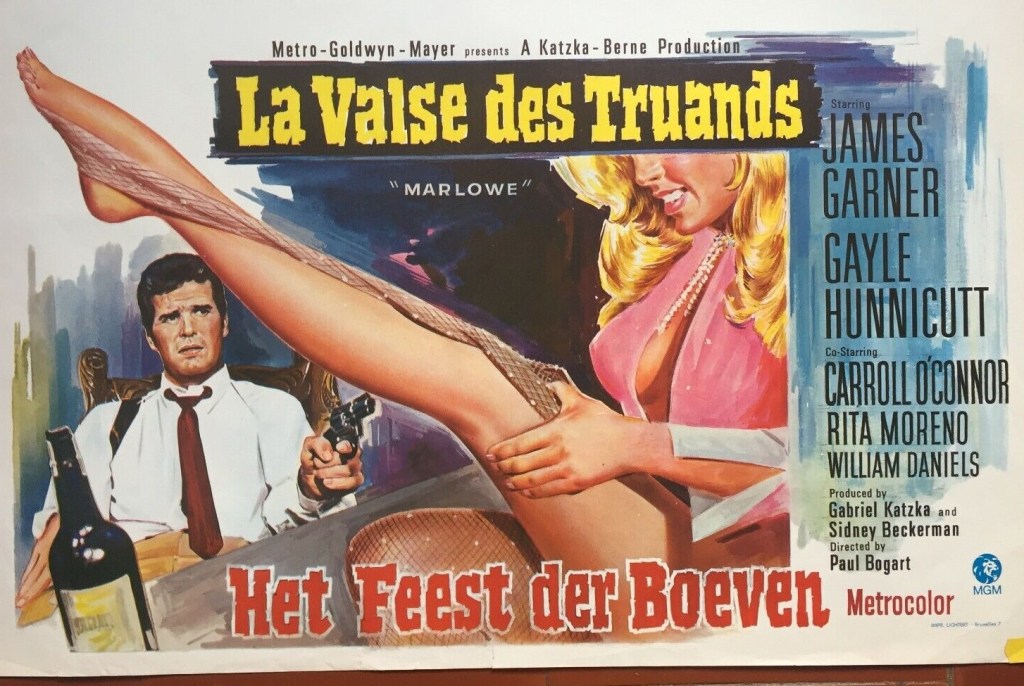
Anyone breaking into the private eye market in the late 1960s had to content not only with the ghost of Humphrey Bogart but a heavyweight slugger name of Harper (1966) whom Paul Newman had fashioned into the most likely contender for the Bogart crown. Ironically, it was growing interest in Bogart that spurred on an imitator. His movies, screened two hundred times a year on television, created an initial cult following, his persona maximized to the full by the reissue on the tenth anniversary of his death of 45 of his pictures plus the half-dozen biographies that appeared in a three-month stretch.

As it happened a couple of Raymond Chandler novels, The Little Sister and The Long Goodbye never before filmed and theoretically at least avoiding comparison with the past, were up for grabs. The Little Sister was the chosen vehicle. But, anyone chancing their arm in the role of Philip Marlowe was likely to be met with jibes of “he’s no Humphrey Bogart.”

That’s not the only problem here. The story is awfully convoluted, it’s been updated to a modern Los Angeles complete with hippies and gym work-outs and screenwriter Stirling Silliphant has chucked away the bulk of the original dialog. So, little remains of what made the character compulsive viewing in the first place.

Marlowe (James Garner) is investigating the disappearance of the brother of Orfamay Quest (Sharon Farrell), a young woman from Kansas, when he stumbles upon a couple of ice-pick murders and a pack of incriminating photos that depict television sit-com star Mavis Weld (Gayle Hunnicutt) – no slouch herself at knocking people out – in a compromising situation with top-line gangster Sonny Steelgrave (H.M. Wynant) whose speciality had been killing people with an ice-pick. So it’s a murder/blackmail double whammy.

The plot thickens when Winslow Wong (Bruce Lee) tries to pay him off and when that fails wrecks his office by demonstrating the kung fu skills that would later make that actor a star.  Detective Lt French (Carroll O’Connor) is the typical dumb cop that Marlowe runs rings round. Also entering the fray is exotic dancer Dolores (Rita Moreno), a friend of Mavis, and to liven things up for the gumshoe a girlfriend Julie (Corinne Camacho) who has some nifty one-liners when Ofamay attempts to seduce her boyfriend. And there’s any number of Steelgrave’s thugs who make any number of attempts to scare Marlow off.

Eventually, after being drugged by Dr Vincent Lagardie, Marlowe finds the missing brother, Orrin, who, while dying, attempts to kill the detective with an ice-pick. Assuming that clears up both cases, Marlowe then discovers that Orrin, Mavis and Orfamay are siblings.

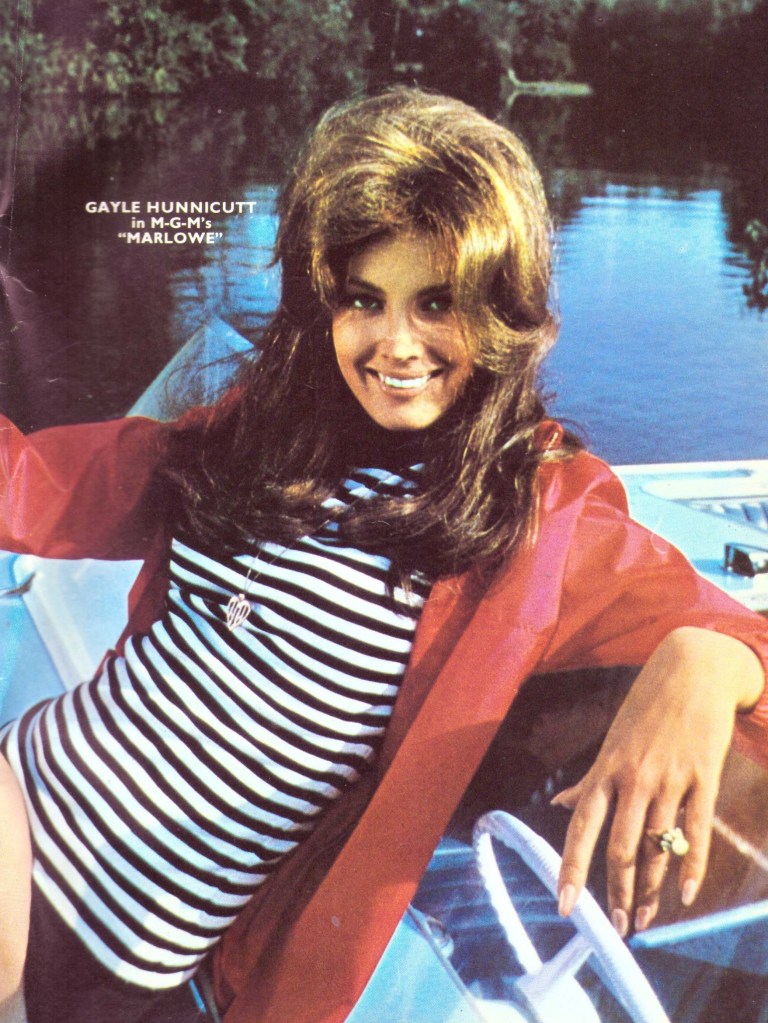
Hunnicutt is given the pin-up treatment in ABC Film Review.

But the tale still has some way to go, uncovering a hornet’s nest of spite and revenge among the warring siblings. There’s way too cute an ending though whether that was Silliphant’s invention or the tack taken by Chandler I have little interest in finding out, exhausted as I am by a seemingly endless series of twists and turns.

I’m not exactly sure what’s missing from this except a femme fatale – Mavis makes no moves on Marlowe, though her sister, who hardly qualifies as a femme fatale, does. It’s unfair in a sense to complain that it’s not following the Chandler template when so much effort has gone in to trying to initiate something new. If it had been called anything else, or the name Marlowe substituted by Smith, then we wouldn’t be thinking so much of the source material or the imitable Bogart.

Confusingly, there is a Bogart involved, director Paul Bogart (The Three Sisters, 1966 – from the Checkov play and no relation to The Little Sister) and although he keeps the plot ticking along – who wouldn’t with so much plot to tick – that’s pretty much all he does, in the cold light of Los Angeles hardly able to emulate the film noir setting.

So, effectively, it’s up to James Garner (Mister Buddwing, 1966) to pull the whole movie together, or put another way, keep it from falling apart. Audiences, much taken with the actor’s reinvention of his screen persona in his previous picture, comedy western Support Your Local Sherrif (1969), didn’t bring sufficient box office support. Garner is okay but sorry to say he’s no Bogart.

Rita Moreno (Night of the Following Day, 1969) is the pick of the supporting cast. Gayle Hunnicutt (Eye of the Cat, 1969), given the type of billing that elevated Lauren Bacall to super-stardom, doesn’t do enough to achieve the same.  Interestingly, both Garner and Hunnicutt went down the shamus route in television in the future, the former in The Rockford Files (1974-1980), the latter in an episode of Philip Marlowe, Private Eye (1983).

If you’re a fan of Garner a reasonable watch. If you’re a fan of Chandler or Bogart you’d be inclined to give it a miss.

Discover WordPress

A daily selection of the best content published on WordPress, collected for you by humans who love to read.

The Atavist Magazine

by Brian Hannan

WordPress.com News

The latest news on WordPress.com and the WordPress community.