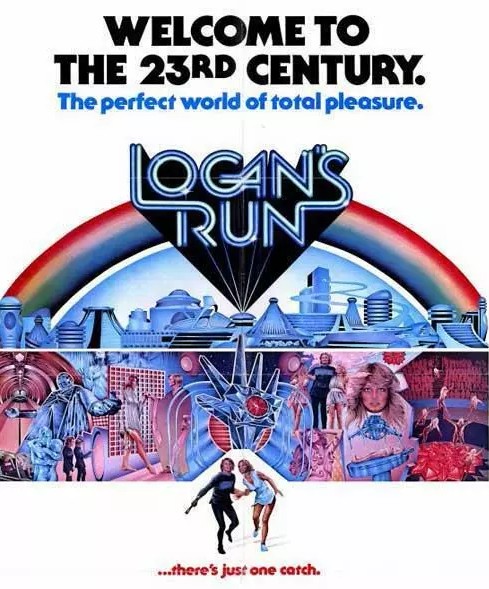
Logan’s Run (1976) ****

Shortly after this appeared the movie sci fi world imploded/exploded with the release of Star Wars (1977), followed by Close Encounters of the Third Kind (1977) and Alien (1979), which probably accounts for why this is such a throwback joy to watch and now very much a cult item. Takes in ageism, obsession with youth, death cult, the pleasure principle written in capital letters, some kind of primitive Tinder (where women place themselves on “the circuit”), Terminators, runaways, dystopia, escapees, eco-friendly food, mobile phones, computers in charge, lasers, plastic surgery, cannibalism, robots, an icy tomb, nuclear holocaust and the Lincoln Memorial.

There’s some shooting with futuristic weaponry but these handguns are virtually useless given how poor their accuracy – though that may be down to the incompetence of their users – and a couple of fist fights. And while the remainder of Earth’s population enjoys an idyllic life in a series of sealed domes, there is, as the posters point out, a catch. When you reach the age of 30 you are killed, although this occurs in the guise of rebirth in a ritual known as the Carrousel.  
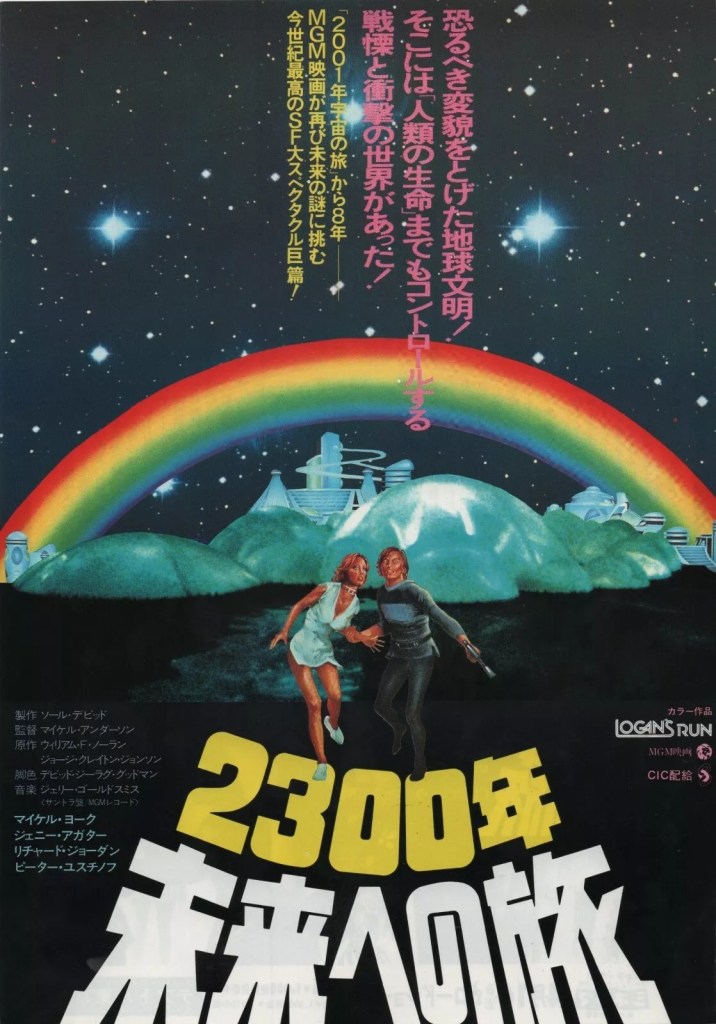
There’s no individual responsibility. Children are separated at birth from their parents and brought up in communal fashion. They eat, drink and have sex – there’s even a section set aside for sexual pleasure, full of naked writhing bodies. But generally, sex is on tap, any woman signing up to be on “the circuit” literally delivered to your door.

In this fashion Logan 5 (Michael York) encounters Jessica 6 (Jenny Agutter). He’s a terminator, chasing after runaways, she’s a virgin and much to his annoyance proves not an easy conquest, in fact sex doesn’t take place at all. However, she wears an ankh. And he’s just picked up an ankh from a runaway he just totaled. So he asks the computer for advice about the emblem. Turns out it’s worn by a rebel group – there are over 1,000 of them living in a “sanctuary” in the city – and Logan is delegated to pretend to be a runaway and with Jessica’s help infiltrate the radical organization. Unfortunately, his buddy Francis 7 (Richard Jordan) is suspicious and follows him.

After many adventures and escaping from Francis and the robot Box (voiced by Roscoe Lee Brown) who wants to freeze them, they emerge into a land that while it shows signs of devastation is not uninhabitable. They meet an old man (Peter Ustinov) and realize that it’s possible to live beyond the age of 30 and that somehow their apparent utopia is actually a dystopia. Furthermore, once outside the tomb, the internal clocks that dictate the date of their death automatically switch themselves off.
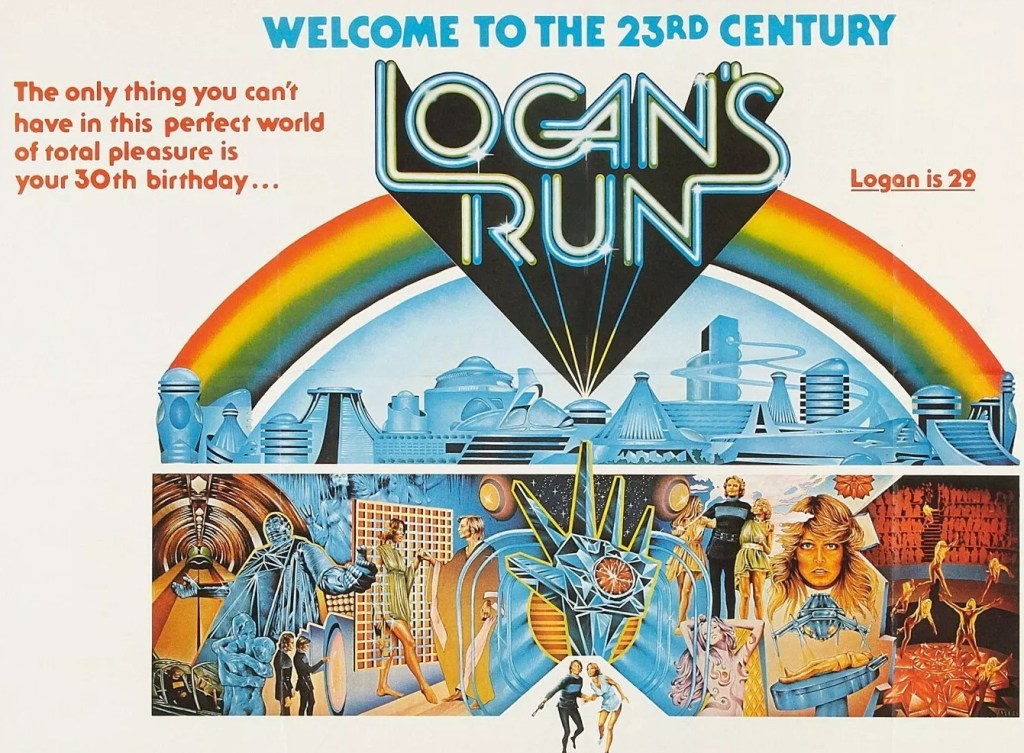
The prisoners of the dome are freed shortly afterwards.

There’s a kind of innocence about the sci fi world portrayed. Everyone dresses in primary colors, both sexes wear flimsy outfits all the easier to remove when pleasure appears imminent.  Taking place three centuries on from the date of the movie’s release, the world is the kind that would be dreamed by illustrators imagining the future for an Exposition with everything streamlined.

There’s no time and really no effort to make a serious point about any of the issues raised and it’s more a smorgasbord of ideas – quite a few of which have come to fruition. The two main characters are likeable rather than charismatic and the onset of sudden romance appears narrative contrivance rather than “across a crowded room.” Logan’s dilemma, that he is switched from having four years to live to being at death’s door, gives him incentive to escape, not to complete his mission. And at times the dialog is cumbersome but equally often just flies – that cats have three names, for example.

I never saw this on initial release and didn’t hire it on VHS or DVD but gradually it acquired cult status and I was keen to see why.

It works, is the real reason for that. It exists outside the Star Wars/Close Encounters/Alien dynamic.  I liked the jigsaw nature of the ideas and that they are thrown together and at you like you were on a rollercoaster, and you can pick and mix. The conversations with the computer sound very contemporary.

Michael York (Justine, 1969) and Jenny Agutter (East of Sudan, 1964) are pleasant company to spend time with. While Richard Jordan (Valdez Is Coming, 1971) is not much short of an eye-rolling villain, Peter Ustinov is remarkably good value in a role that could easily have been cliché. You might spot Farrah Fawcett-Major (newly-inducted as one of Charlie’s Angels, 1976-1980).

Directed by Michael Anderson (The Shoes of the Fisherman, 1968) and written by David Zelag Goodman (Straw Dogs, 1971) from the novel by William F. Nolan and George Clayton Johnson.

Any notion that it was intended to be groundbreaking was knocked on is head by Star Wars et al, and it’s for that very fact that it’s so watchable, as in, the direction sci fi could have gone had lightsabers and Death Stars, creatures phoning home and monsters erupting from stomachs, not entered the Hollywood universe.

Surprised how much I enjoyed it.
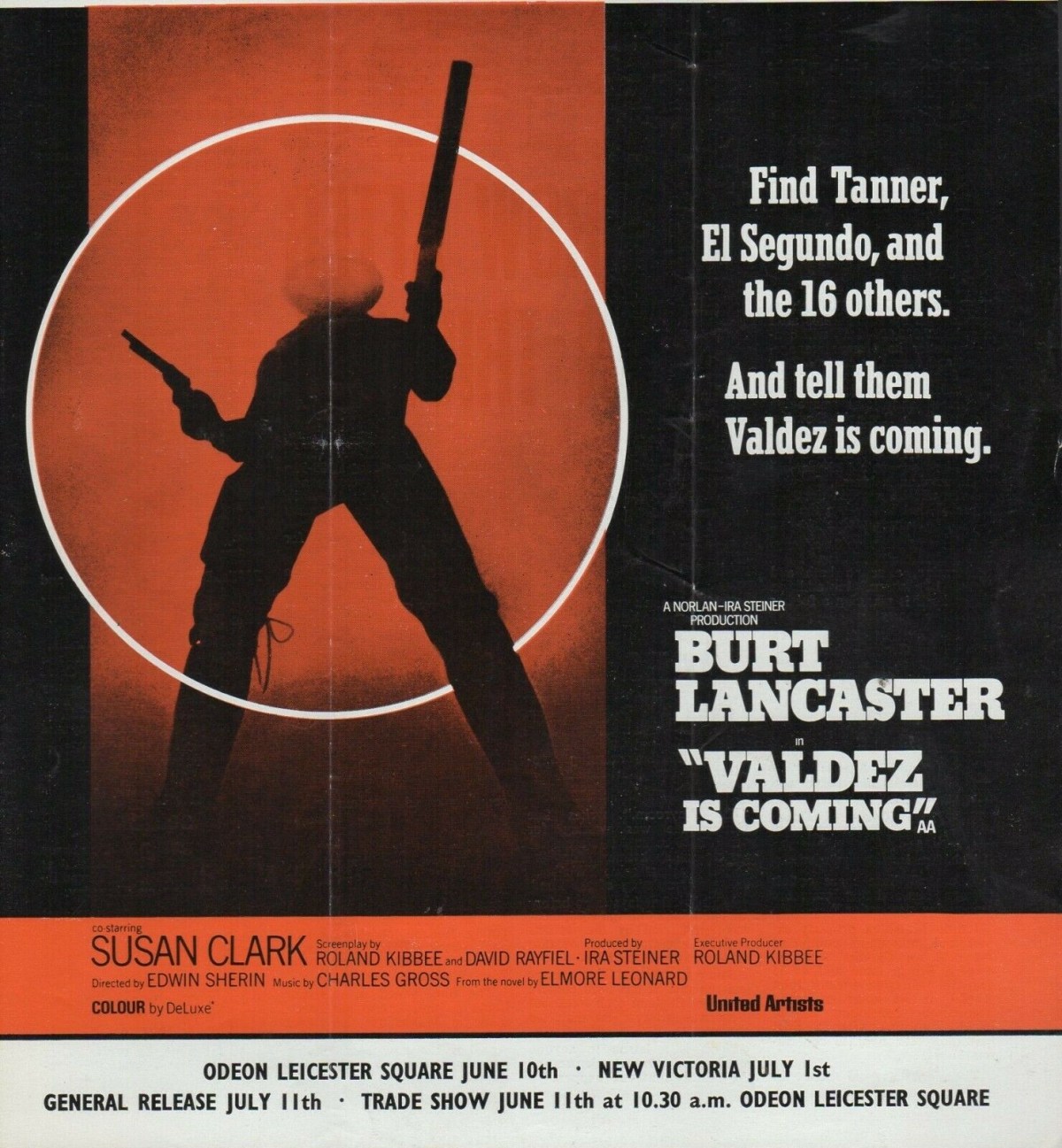
Valdez Is Coming (1971) *****

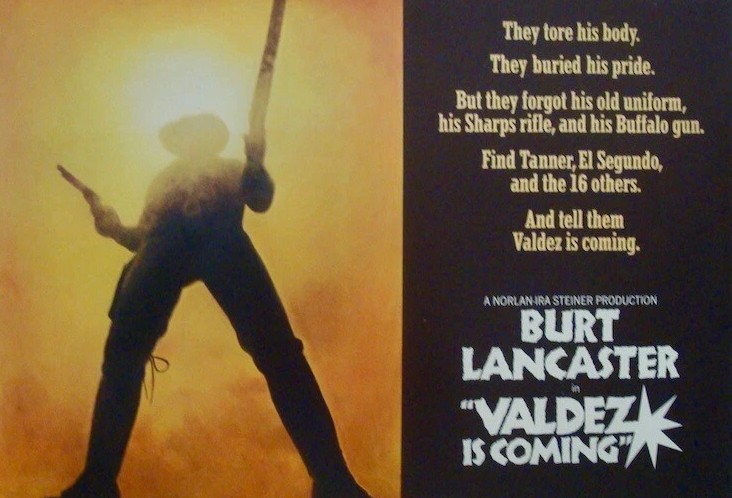
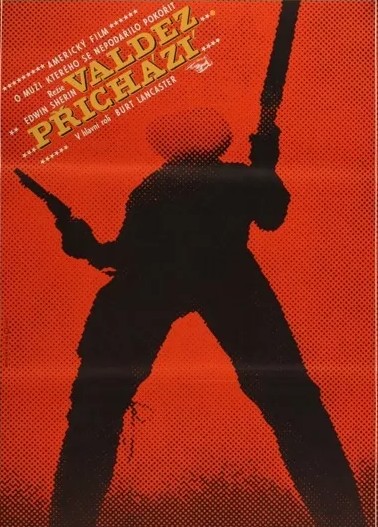
Five-star review for a long-forgotten much-maligned western? Let me explain. Let me start with one of the most stunning cinematic images I have ever seen that in the hands of a better director would be considered one of the greatest ever devised. The titular Valdez (Burt Lancaster) appears on the top of a hill arms stretched out back contorted under the weight of a crucifix strapped to his back. Another director, more conscious of the image potential, would probably have had him straighten up at that point and positioned the camera for a close-up so the image could be captured against the sky. Even so, it’s an extraordinary image for a director, Edwin Sherin, making his debut.

But that’s not the only one. We’re familiar with the innocent man being forced to dance as the area around his feet is peppered with bullets from a sadistic gunslinger. Here, the victim of gunman Davis (Richard Jordan) is an old Native American woman. As she walks from a hut to collect water, he assails her with a barrage of shots. Does she dance? Does she dickey! She doesn’t even pause. As though she’s used to worse.

The movie opens with another stunning image. Valdez, a local Arizona Territory constable (presumably a less important title than sheriff though he wears the badge), takes time out from riding shotgun to watch a bunch of young bucks blast away at a target. Which appears to be the hut I mentioned. Takes a while for an explanation to be forthcoming. Said hut houses a fugitive from justice.

There’s another startling image when Valdez is used as target practice by the thugs employed by local bigwig Tanner (Jon Cypher). As if he was the equivalent to the target girl in a knife-throwing act, every space around his body is hit by a bullet.

And that’s before we come to the audacious freeze frame ending which, theoretically at least, leaves matters unresolved.

There’s also a post-modern post-whatever feel to this which should very much appeal to the contemporary audience. Very little is explained. Valdez has anglicized his Christian name of Roberto to Bob. He can’t get rid of his Mexican accent but he talks so softly that mostly you don’t notice. From his later demeanor, it’s quite clear that earlier on he is making a huge effort to fit in, not stand out, in a town dominated by white Americans.

But we also never find out why Tanner is hunting a man. He’s responsible for putting the man in the hut under siege. And although that turns out to be  case of mistaken identity, we never find out who Tanner is chasing or why.

Tanner’s  live-in girlfriend Gay (Susan Clark), a widow, has murdered her husband and we never find out why either. But she’s not the only unusual character. The gunslinger Davies is a misfit, finding out the hard way that intemperance and impulsiveness are not the way to make friends, and even Tanner has little time for a gunslinger too handy with a gun, but despite the callous exterior he has a softer side. And while that softer side turns out to be lucky at one point for Valdez, the lawman still doesn’t trust the capricious youngster.

The tale, such as it is, is one of principle. Valdez has been tricked into killing the man in the hut. Given the man proved innocent, Valdez thinks it right his widow, the Native American victim of the target practice, should receive some compensation. A hundred dollars seems a small price to pay. But Tanner is insulted at the very thought. In his eyes, the dead man was a no-account African American.

When Valdez insists, he is trussed up in the makeshift crucifix and left to make a humiliating walk home. That’s when he reverts, shuffles off his disguise as a soft-spoken relatively harmless lawman in a town where the most he will be called upon to do is ride occasional shotgun and jail an occasional drunk.

It’s vague too – you’d have to be well up on western lore to know the significance of the photograph he keeps under his bed – regarding his past. But hidden under the bed is what was known as a buffalo gun, a long-range rifle, manufactured by Sharps (hence the term “sharpshooter”) and suddenly he’s a different, more threatening, person, kitted out in his old cavalry uniform, hat brim upturned.

He interrupts Tanner and Gay making love to demand his hundred dollars. He only takes  Gay hostage to make his escape, minus the cash, and then kidnaps her to provide him with something to trade. Unlike in The Hunting Party (1971), the weapon doesn’t magically ease his path. He doesn’t just take pot-shots from a distance. He spends most of the time rushing up and down hills, using boulders as cover. He can’t afford to use the gun since that would pinpoint his position. So he’s got to knock out Tanner’s advance scouts in other ways.   

Meanwhile, Gay, who initially sympathized with Valdez, is less keen on him once she’s a victim, and spends most of her time trying to escape. In due course, Valdez’s marksmanship reduces the pursuing force by eleven.

He just about escapes but in a spectacular piece of stunt work involving horses colliding and people being thrown from the saddle, he is surrounded. Chief thug El Segundo (Barton Heyman) realizes that he and Valdez have something in common. Valdez wasn’t a buffalo hunter at all, but a stalker of Apaches, the enemy of El Segundo.

So El Segundo pulls back his men leaving Tanner to face up to Valdez alone. Or perhaps pay up the hundred dollars. We never find out because the image is frozen on the screen as the camera pulls back.

Edwin Scherin was rewarded for his boldness by only being allowed to make one more movie (My Old Man’s Place, 1971). This was the first of Burt Lancaster’s western trilogy that encompassed Michael Winner’s Lawman (1971) and Robert Aldrich’s Ulzana’s Raid (1972), completing his move into more of the flawed character he first essayed in The Swimmer (1969). Susan Clark (Coogan’s Bluff, 1968) makes the most of a role that permits her to switch from sympathetic to hard-nosed. Richard Jordan (Chato’s Land, 1972) has a peach of a part as the swithering gunman desperate for attention. Screenplay by Roland Kibbee (The Appaloosa, 1966) and David Rayfiel (Castle Keep, 1969) based on the novel by Elmore Leonard (Mr Majestyk, 1974).

So, sure, justified vengeance but exceptionally well done.

Catch this on Amazon Prime.

Well worth checking it out.

Raise the Titanic (1980) ****

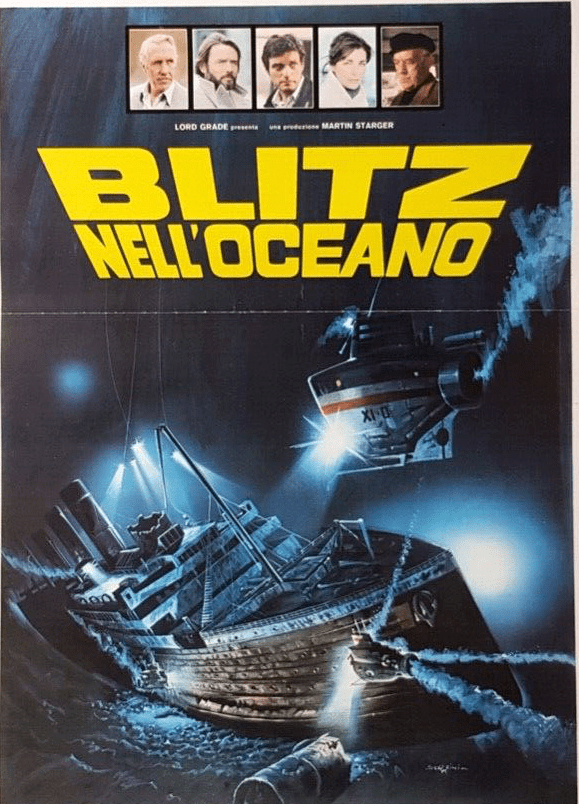
Another tricky one because, of course, I’m supposed to mock this colossal box office flop. Not least because, as later events proved, you couldn’t lift the Titanic off the seabed in one piece since it had actually broken in two. And there’s the dumb maguffin to end all dumb maguffins that kicks it all off in the first place, but you did need some excuse for the exercise. And, in fairness, in theory at least, it’s more cinematic to show the ship going down, and having lovelorn lovers to lament, than to see it coming up with no passengers to root for.

That said, the actual hunt for the lost vessel and the raising is stupendous stuff, even on the small screen, and with a director with greater visual flair than Jerry Jameson (Airport ’77, 1977) it could have been even better. But there can’t be a more iconic climactic shot than the Titanic steaming into New York, missing its scheduled arrival by a mere six decades.

Question is, does the technical stuff, the underwater photography, the raising, the impeccable model-work, make up for the lack of smarts elsewhere? Heck, who cares? No one is interested in whatever storyline the makers come up – and, let’s face it, not even DiCaprio and Winslet, good though they are, were the driving force for the James Cameron version – all they are interested is the recreation of the mythical ship, probably the only one everyone in the world can name. So get the nautical elements right and you’re pretty much there.

Critics, and crucially audiences, back in the day didn’t think so. But I disagree. I couldn’t begin to tell you much about the hare-brained narrative – some item so crucial to the present-day (1980, that is) ongoing Cold War between the U.S. and the U.S.S.R – and I couldn’t care less. Nor would you find many takers for a love triangle involved explorer Dirk Pitt (Richard Jordan), journalist Dana (Anne Archer) and all-purpose politico Gene (David Selby). And although an occasional acting heavyweight like Jason Robards (as an Admiral) and Alec Guinness (as a Titanic survivor) hoves into view, it’s the character actors like J.D. Cannon and M. Emmet Walsh who have more to do.

But that’s not much either, because anyone involved in the underwater stuff is required only to show two emotions, shock and awe, and to be honest they do a good job because really all we need are witnesses to the amazing. The picture tickles along for a bit while the principals argue about the right way to go about their task and where, specifically, to concentrate the search, and then about the actual mechnics of the raising, that aspect suddenly given the kind of self-imposed deadlines that seemed de facto for disaster pictures (they are always running out of time) because some guys are now trapped in the ship.

But just as James Cameron awed audiences with his reimagining of the interior of the mighty ship, it’s no less imposing here in its impoverished state, stripped of its glory, nothing but the naked façade of the still-amazing below decks. And when it finally does surface carries magical visual splendor.

In truth, I found I was tuning out of the human goings-on, waiting with bated breath for the next sighting – or the first – of the ship. And we’re spared the endless wittering-on about how the ship sank and who was responsible and you could argue the narrative trigger in Titanic (1997) of the old lady’s brooch is every bit as dumb as the rare mineral secretly stashed on board here.

Jerry Jameson’s cinematic career was sunk by the poor box office and he didn’t receive another movie credit for over a decade. But he does a decent enough job here in the absence of a genuine all-star cast and those sequences depicting the hunt and the triumph work very well indeed. None of the acting is awful, but the stars have been hired for obvious reasons – being inexpensive might have been the starting point – and neither Jason Robards (Hour of the Gun, 1967) nor Alec Guinness (The Quiller Memorandum, 1966) attempts anything you’ve not seen before. While Richard Jordan (Logan’s Run, 1976) is too freshfaced for his character, Anne Archer (Fatal Attraction, 1987) suggests vivacity on legs.

Screenplay credited to Adam Kennedy (The Domino Principle, 1977) and Eric Hughes (Against All Odds, 1984) in reality went through a hatful of different hands. Based on the Clive Cussler bestseller.

Don’t believe the critics – and possibly not even me – on this one but I found it a surprisingly good watch.

Discover WordPress

A daily selection of the best content published on WordPress, collected for you by humans who love to read.

The Atavist Magazine

by Brian Hannan

WordPress.com News

The latest news on WordPress.com and the WordPress community.