The Power (1968) ***

Low budget sci-fi effort that had little chance in the box office stakes that year up against the big budget psychedelic 2001: A Space Odyssey and the visceral Planet of the Apes. Producer George Pal and director Byron Haskin, the key figures behind War of the Worlds (1953), would later become among the most exalted in the sci-fi genre, but the cult of the 1950s sci-fi movies did not exist yet. Yet if made today, we would be treating this as an origin story with a sequel already in the works and creation of its own universe on the cards.

As the budget can only accommodate a few explosions and a derisory number of tiny special effects, emphasis is placed on imagination as the source of tension. The uncanny remaining unexplained helps ensure mystery remains character-driven. Wisely, the film makers steer clear of providing any detail on the strange force.

It begins with the neat title “Tomorrow.” As part of a planned space program, a team of scientists  experimenting on the limits of human endurance discover that one of them has unusual powers. As a group they are able to make revolve a piece of paper attached to a vertical pencil without establishing who is the driving force. When Professor Hallson (Arthur O’Connell) is found dead in a centrifuge, the only clue being a scrap of paper bearing the name Adam Hart, suspicion falls on the other members. Professor Tanner (George Hamilton) is dismissed when the investigation discovers his credentials are fraudulent.   

Seeking to prove his innocence, Tanner goes on the run before establishing that the main suspects are the mysterious Adam Hart and three of the original team – military chief Nordlund (Michael Rennie), Professor Scott (Earl Holliman) and Tanner’s girlfriend Professor Lansing (Suzanne Pleshette). But he is mostly baffled by the goings-on which include being dumped in an air force target range. He could be the culprit but again so many odd occurrences take place when others are present that it would be hard to pin the blame on Tanner. As the corpses begin to pile up, the list of potential suspects naturally decreases.

A toy winks at Tanner, walls appear were there were none before, a man is convinced Tanner is someone else (not Hart), a high-flying professor’s wife lives in a trailer, characters collapse under psychic assault, a young woman trying to seduce an old man discovers she is kissing a corpse, the imagery appears inspired by Salvador Dali and Hieronymus Bosch,  and you could easily argue that Tanner’s academic records have been deliberately erased. On the more prosaic side, the cops are next to useless, there’s a car chase and a sequence in a lift shaft, but the bulging eyeballs suggested in the posters are a marketeer’s invention. There’s even a clever joke, Tanner  misreading a newspaper headline “Don’t Run” as being a message to him.

The oddities are sufficiently off-beam to appear as figments of the imagination and it certainly seems Tanner suffers from hallucinations.  And there are some deliciously off-key characters, an old woman obsessed with fly-swatting, a sultry waitress. If Hart is the superhuman then experiments may have taken place long before now. In his hometown, people still act on instructions Hart handed out a decade before and accomplices are in place such as Professor Van Zandt (Richard Carlson).

Adding to the mood are philosophic discussions about the existence (as already a fait accompli) of a superhuman: some want to clone him, others would happily submit to him.

Byron Haskin (Conquest of Space, 1955) and George Pal ( The Time Machine, 1960) have marshalled their puny resources with exceptional skill, down to hiring as leading man George Hamilton (Your Cheatin’ Heart, 1964), so far from being a big star at the time that audiences would not automatically assume he had to be the good guy, and peopling the production with names from 1950s sci-fi like Michael Rennie (The Day the Earth Stood Still, 1951) and Richard Carlson (Creature from the Black Lagoon, 1954).

George Hamilton, in the days before the perma-tan became his calling card, is surprisingly good and the supporting cast does what a good supporting cast should do. Suzanne Pleshette (Nevada Smith, 1966) convinces as the lover who could be the cool killer. Also look out for 1940s glamor puss Yvonne De Carlo and a staple of The Munsters television series (1964-1966), Aldo Ray (Johnny Nobody, 1960) and Miko Taka (Walk, Don’t Run, 1966).

Perhaps the biggest coup was the recruitment of triple Oscar-winner Miklos Rosza (Ben-Hur, 1959) who provided a memorable score.

In most sci-fi films, the danger is readily identified. Here, you might hazard a guess but whenever you come close some clever sleight-of-hand misdirects. For most of the time I was happily intrigued, enough coming out of left field to provide distraction. This is a masterclass in how extract the most from very little.

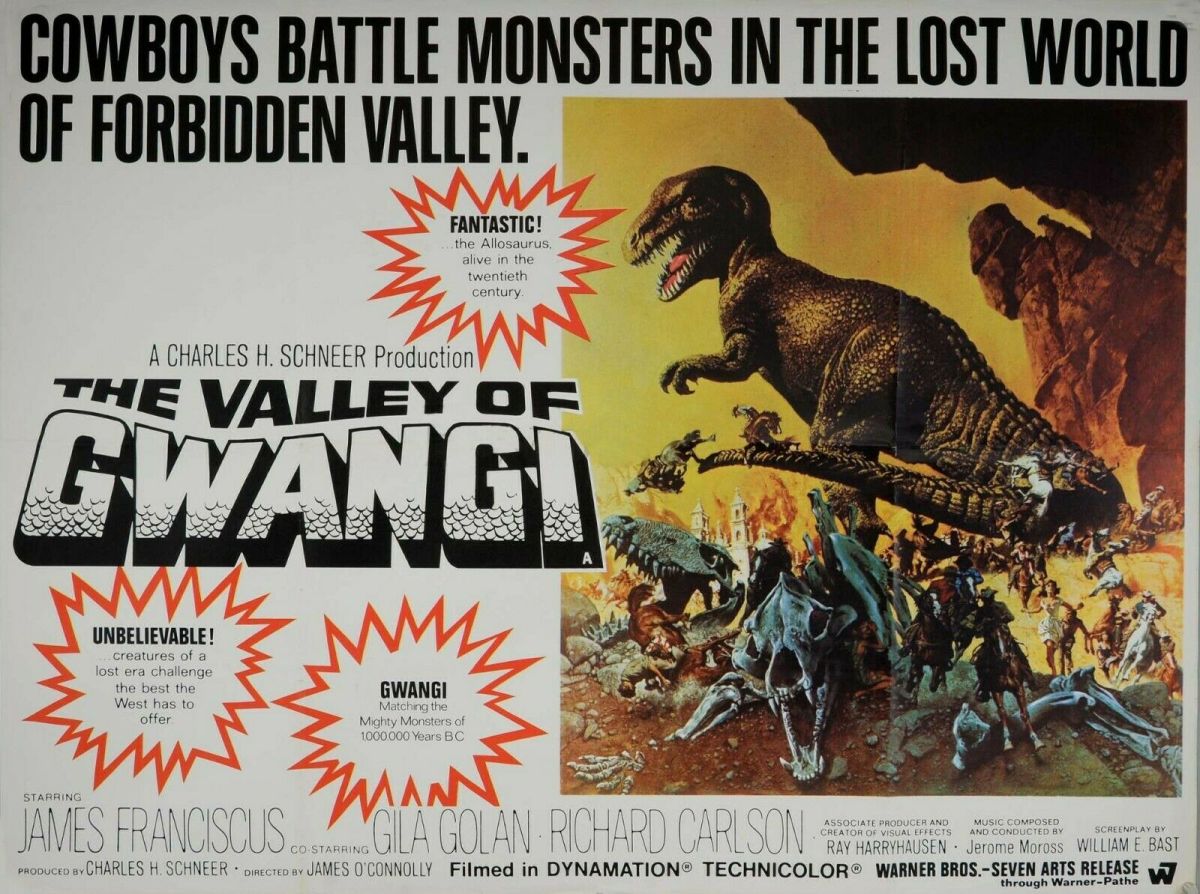
The Valley of Gwangi ****

The special effects are in the five-star range while the movie into which they fit is really worth no more than three stars so I’ve compromised, hence the four-star rating. Actually, the story and characters are interesting enough, and there are some stunning cowboy stunts,  though where is a fur-lined bikini when you need one. Although we are treated to prehistoric monsters, humans fail to have managed the transition to the hidden valley where the creatures have kept out of sight for millions of years. Instead, we are in turn-of-the-twentieth-century Mexico.

However, one specimen, a miniature horse, known as El Diablo, has been found and now resides in a rodeo, property of T. J. Breckenridge (Gila Golan) whose showstopping turn involves leaping on horseback from a high platform through a ring of fire into a pool of water.  Ex-flame and sleek salesman Tuck (James Franciscus) and archaeologist Professor Bromley (Laurence Naismith) follow gypsies who aim to return the horse to the Forbidden Valley. T.J. and a band of cowboys are in pursuit.

Widening a tiny gap into the unknown world also of course means it’s not big enough for the monsters to escape. The valley is ruled by Gwangi, an Allosaurus, which to most of the audience looks remarkably like a T. Rex. Various battles ensure. A Pteranadon swoops down from the sky and captures one of the cowboys but is killed by Carlos (Gustavo Rojo). Gwangi fights an Ornithomimus and a Styracosaurus. Even if your knowledge of prehistoric monsters  isn’t up to identifying each creature, no matter, the fights are very well done, and a step up in terms of special effects from similar tussles in Harryhausen’s previous venture in One Million Years B.C. (1966) especially as we are less distracted by females attired in fur bikinis.

Naturally, the intent is to capture Gwangi and put him on show a la King Kong (1933) and it’s equally obvious how this particular maneuver is going to work out. That the story follows this particular angle is down to the fact that this movie was the original idea of Willis O’Brien, the special effects genius to created King Kong. After considerable development, RKO shelved the project on the assumption the public was not interested in dinosaurs.

Meanwhile, back in the human tale, the previously principled T.J. lets greed get the better of her and begins resisting Tuck’s overtures. Even if you can guess the finale, it is pretty well done.

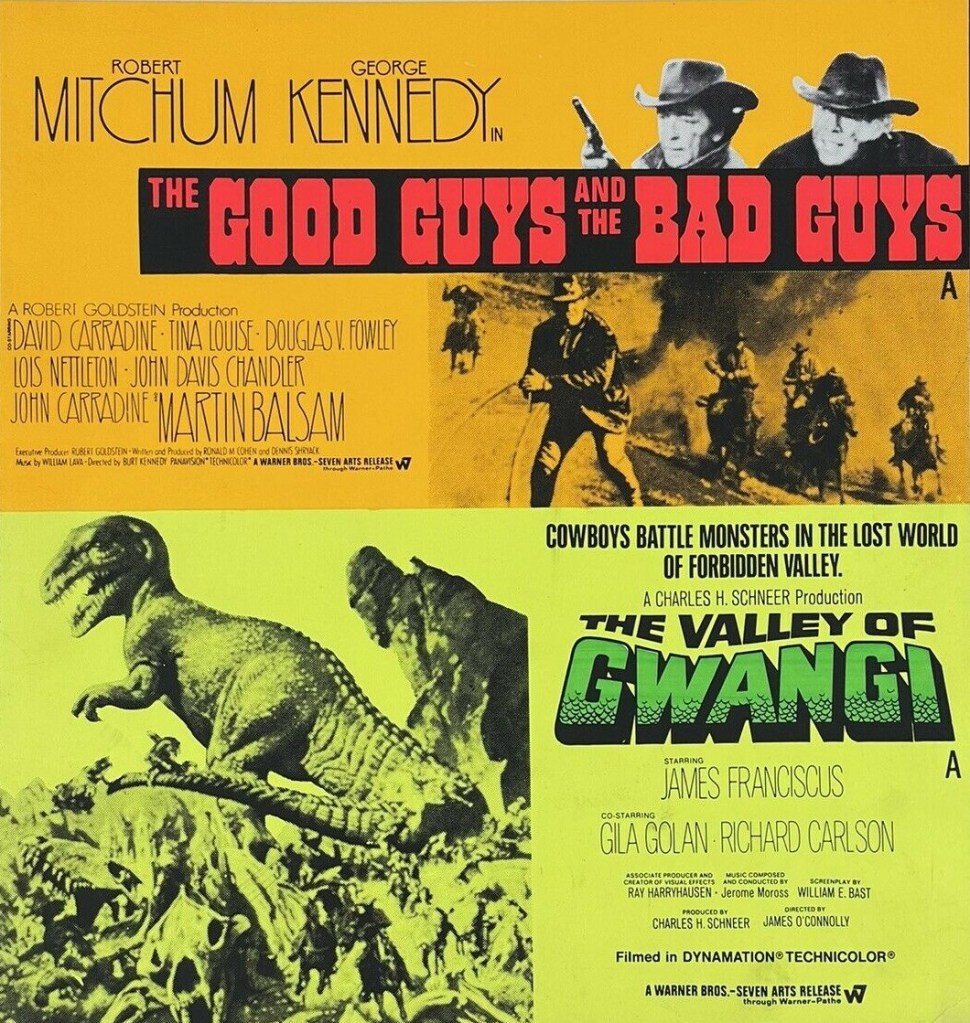
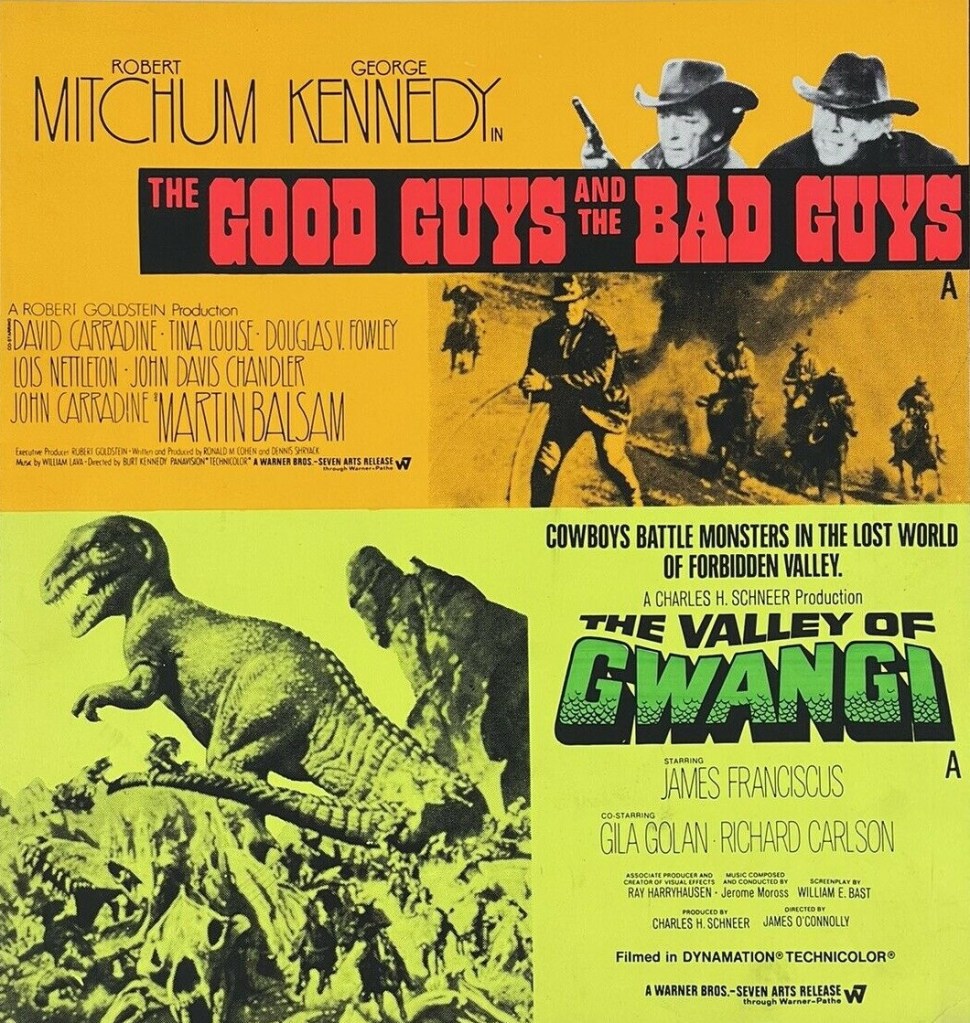
Ray Harryhausen only had a limited fanbase in the 1960s, otherwise this picture would not have done the rounds as the supporting feature to Robert Mitchum western The Good Guys and the Bad Guys (1969). You can tell it lacked the budget of One Million Years B.C. because the creatures fail to remain a consistent color. Even so, this ranks as one of the top special effects achievements and these days Harryhausen’s work is much more appreciated.

Unless you are Raquel Welch, it’s difficult for an actor to compete with prehistoric monsters. At least here, the stars had decent dialog and the tangled romance provides entertainment as do the host of stunning stunts in the rodeo and a bull running amok. Charlton Heston look-alike James Franciscus (Youngblood Hawke, 1964) is a plausible love interest who doesn’t let romance get in the way of a fast buck. The role of Gila Golan (Our Man Flint, 1966) extends to more than eye candy and there’s not a bikini in sight or disrobing of any sort. Richard Carlson (Creature from the Black Lagoon, 1954) was a sci-fi veteran and Laurence Naismith had appeared in Jason and the Argonauts (1963). British actress Freda Jackson (The Third Secret, 1964) plays a witch.

Director Jim O’Connolly (Vendetta for the Saint, 1969) keeps the human elements rolling along and once monsters join in the fun there’s scarcely time to draw breath. William Bast (Hammerhead, 1968) pulled together the human and monster elements for the screenplay.

Harryhausen fans will have a ball.

Tormented (1960) ***

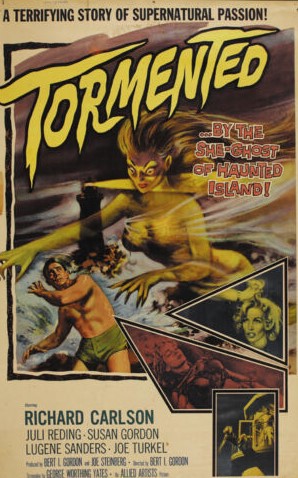
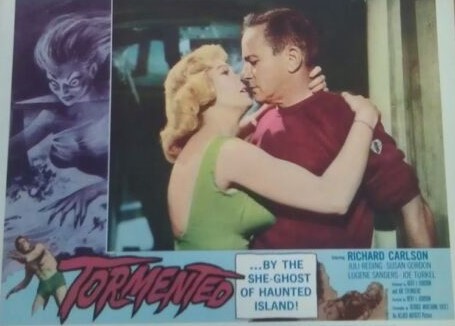
Effective island-based thriller. The marriage plans of jazz piano “genius” Tom (Richard Carlson) are thrown into disarray by the sudden arrival of old flame Vi (Juli Reding). A tryst atop an abandoned lighthouse ends in disaster when Vi tumbles over a railing and Tom refuses to rescue her. Fishing her corpse out of the water the next day he finds instead he is holding wet seaweed.

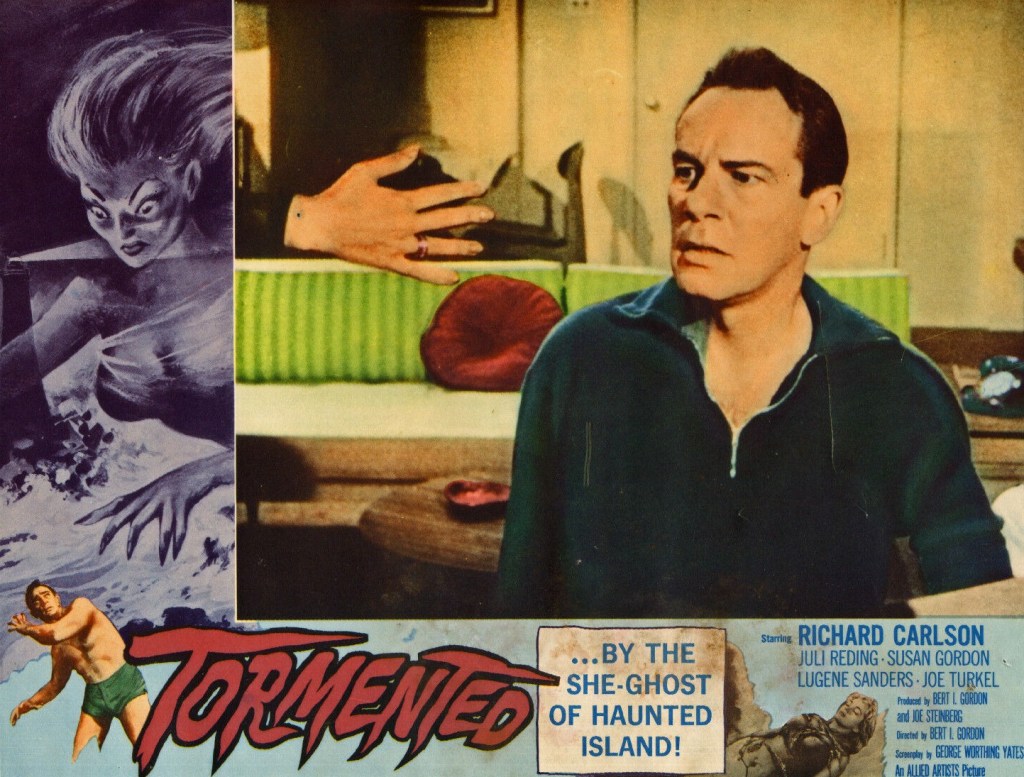
Cue all sorts of strange events: footprints on the beach, a lingering smell of perfume, a vinyl platter recorded by Vi playing all on its own, missing wedding ring, wilting flowers, wedding dress is covered in seaweed, ghostly apparitions of the dead woman.

Richard Carlson and the disembodied.

Initially denying his guilt, Tom soon finds himself consumed by it. Blind Mrs Ellis (Lillian Adams) suspects the supernatural. Fiancee Meg (Lugene Sanders) is soon on red alert, the situation exacerbated by her younger sister Sandy (Susan Hubbard) who develops an unhealthy crush on Tom and has a creepy hold over him.

Tension is racked up by the arrival of boatman Nick (Joe Turkel) intent on blackmailing Tom ahead of the imminent wedding. It doesn’t end the way you’d expect, but Tom proves a darker character. This kind of thriller you’d expect a final twist but you’d have to be very savvy to guess this one.

It’s a bold enterprise for a B-picture. Director Bert I. Gordon had made his name on special-effects-driven pictures like The Amazing Colossal Man (1957) but here that element is underplayed, the main focus on the gradual disintegration of Tom as he succumbs to guilt and the voices and sights he imagines. Some images are clearly inside his head, but Mrs Ellis and Meg detect the perfume scent, the flowers wilt in full view of everyone, and Sandy is present when the ring vanishes. Gordon employs the Hitchcockian technique of having subsidiary characters propose various unsettling possibilities to the guilty party. The jazz soundtrack is not the cool music you might expect but a more jangly score. And any time there’s a quiet moment you can hear thundering surf in the background.

B-picture and sci-fi veteran Richard Carlson (The Power, 1968) isn’t quite able to suggest sufficient internal anguish, you’d need a James Stewart in Vertigo mode to manage the kind of obsession required. But Carlsen goes neatly enough from composed epitome of “cool” to nervous wreck, likely to land himself in trouble from reacting too violently to the unreal.

And there’s enough peripheral tension, Meg’s wealthy father (Harry Fleer) opposes the wedding, believing a jazz musician a poor candidate for his daughter’s hand. Mrs Ellis probing a little too close to the bone, the innocent Sandy unwittingly endangers herself. Virgin Meg is oblivious to the fact the man she is marrying is scarcely in the same category.

It’s a chamber piece, a few characters rattling round each other, uneasiness emanating from Tom visualizing phantoms. And it’s short, barely 75 minutes, classic length for a supporting feature, and it’s to the director’s credit he makes no attempt to puff it out. One twist after another and specters everywhere, all the template you need. It set some sort of record for killing off careers. It was the last movie for Juli Reding, Susan Gordon and Lugene Sanders but you might recall Joe Turkel from The Shining  (1980).

Very good example of what you can do with a low budget, an edgy script and a director who doesn’t lean too heavily on the special effects.

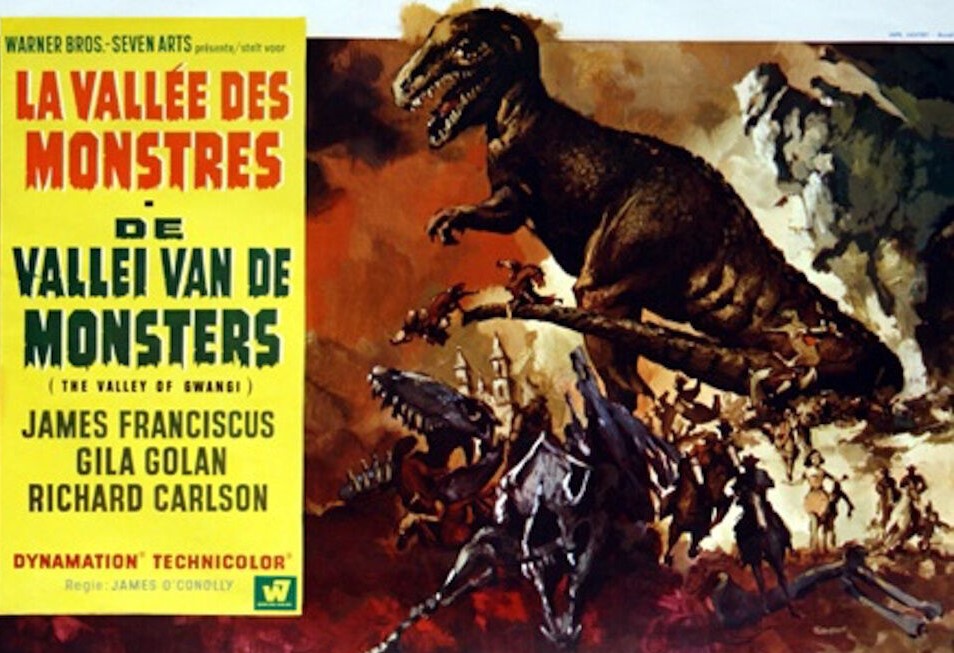
The Valley of Gwangi (1969) ****

The special effects are in the five-star range while the movie into which they fit is really worth no more than three stars so I’ve compromised, hence the four-star rating. Actually, the story and characters are interesting enough, and there are some stunning cowboy stunts,  though where is a fur-lined bikini when you need one. Although we are treated to prehistoric monsters, humans fail to have managed the transition to the hidden valley where the creatures have kept out of sight for millions of years. Instead, we are in turn-of-the-twentieth-century Mexico.

However, one specimen, a miniature horse, known as El Diablo, has been found and now resides in a rodeo, property of T. J. Breckenridge (Gila Golan) whose showstopping turn involves leaping on horseback from a high platform through a ring of fire into a pool of water.  Ex-flame and sleek salesman Tuck (James Franciscus) and archaeologist Professor Bromley (Laurence Naismith) follow gypsies who aim to return the horse to the Forbidden Valley. T.J. and a band of cowboys are in pursuit.

I saw this double bill in 1969 when it was shown on the ABC circuit in Britain.

Widening a tiny gap into the unknown world also of course means it’s not big enough for the monsters to escape. The valley is ruled by Gwangi, an Allosaurus, which to most of the audience looks remarkably like a T. Rex. Various battles ensure. A Pteranadon swoops down from the sky and captures one of the cowboys but is killed by Carlos (Gustavo Rojo). Gwangi fights an Ornithomimus and a Styracosaurus. Even if your knowledge of prehistoric monsters  isn’t up to identifying each creature, no matter, the fights are very well done, and a step up in terms of special effects from similar tussles in Harryhausen’s previous venture in One Million Years B.C. (1966) especially as we are less distracted by females attired in fur bikinis.

Naturally, the intent is to capture Gwangi and put him on show a la King Kong (1933) and it’s equally obvious how this particular maneuver is going to work out. That the story follows this particular angle is down to the fact that the movie was the original idea of Willis O’Brien, the special effects genius to created King Kong. After considerable development, RKO shelved the project on the assumption the public was not interested in dinosaurs.

Meanwhile, back in the human tale, the previously principled T.J. lets greed get the better of her and begins resisting Tuck’s overtures. Even if you can guess the finale, it is pretty well done.

Ray Harryhausen only had a limited fanbase in the 1960s, otherwise this picture would not have done the rounds as the supporting feature to Robert Mitchum western The Good Guys and the Bad Guys (1969). You can tell it lacked the budget of One Million Years B.C. because the creatures fail to remain a consistent color. Even so, this ranks as one of the top special effects achievements and these days Harryhausen’s work is much more appreciated.

Unless you are Raquel Welch, it’s difficult for an actor to compete with prehistoric monsters. At least here, the stars had decent dialogue and the tangled romance provides entertainment as do the host of stunning stunts in the rodeo and a bull running amok. Charlton Heston look-alike James Franciscus (Youngblood Hawke, 1964) is a plausible love interest who doesn’t let romance get in the way of a fast buck. The role of Gila Golan (Our Man Flint, 1966) extends to more than eye candy and there’s not a bikini in sight or disrobing of any sort. Richard Carlson (Creature from the Black Lagoon, 1954) was a sci-fi veteran and Laurence Naismith had appeared in Jason and the Argonauts (1963). British actress Freda Jackson (The Third Secret, 1964) plays a witch.

Director Jim O’Connolly (Vendetta for the Saint, 1969) keeps the human elements rolling along and once monsters join in the fun there’s scarcely time to draw breath. William Bast (Hammerhead, 1968) pulled together the human and monster elements for the screenplay.

Harryhausen fans will have a ball.

Discover WordPress

A daily selection of the best content published on WordPress, collected for you by humans who love to read.

The Atavist Magazine

by Brian Hannan

WordPress.com News

The latest news on WordPress.com and the WordPress community.