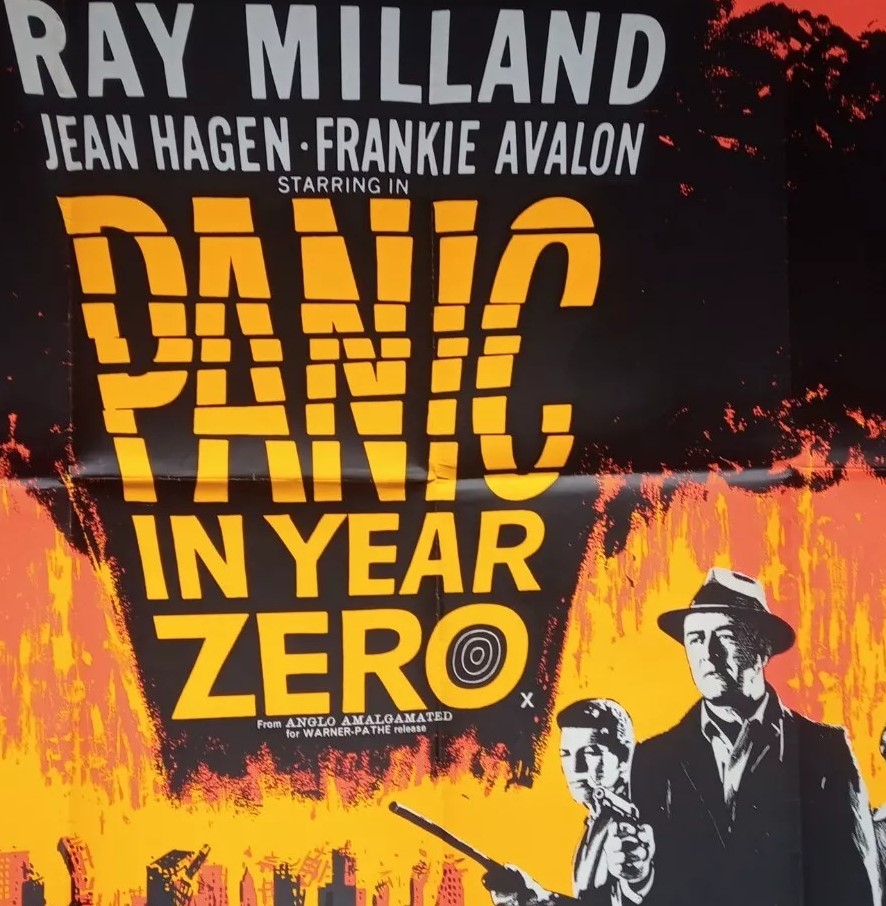
Panic in the Year Zero! (1962) ****

While the release of Conclave and Juror #2 augurs well for the future of movies made for the more mature audience, it’s worth remembering that such fare was commonplace six decades ago, even in the lower-budget strata. Well-structured, well-acted drama was never hard to find. Since I stack my DVDs on their sides and make my selection based on the title on the spine, I rarely glance at cover art, and just as well here, because the poster, I realized, in the process of selling the movie, gave away too much.

Beyond a vague notion that it concerned the aftermath of a nuclear holocaust I had no idea whether this would lean towards the dystopian or the survivalist. And there’s little clue at the start. We open on a typical suburban family holiday scene – husband Harry (Ray Milland) flexing his fishing rod, wife Ann (Jean Hagen) complaining of being overburdened with the loading of the trailer, teenage daughter Karen (Mary Mitchell) and son Rick (Frankie Avalon) moaning about being dragged out of their beds at an unearthly hour.
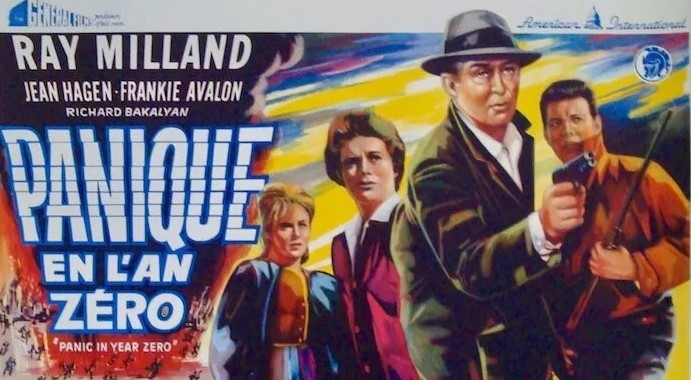
Not long into the journey they see flashes in the distance and a mushroom cloud above Los Angeles. Harry is alerted to potential danger when he observes a pump attendant being slugged by a driver over four bucks’ worth of fuel. Harry’s clearly the reserved kind of businessman, happily married, still flirting with a wife who giggles at such overt attention. But when the roads are filled with cars speeding away from the disaster area and the radio clams up and telephone lines are down, Harry’s personality undergoes a dramatic change, much to the disgust of his wife.

If this had been made these days, it would focus on the kids as they came to terms with post-apocalyptic catastrophe and some militaristic domineering governing body getting in their way or trying to control them. Or it would be some musclebound jerk only too ready to battle his way out of trouble.

Instead we have a gentleman tugging on his inner tough guy. Harry knocks around a storekeeper (Richard Garland), gets the better of a trio of thugs, charges through a roadblock, carves a route through a busy roadway by setting fire to it, destroys a bridge on a rural road to prevent being followed, and is capable of shooting anyone threatening his family. He’s not gone rogue, though, careful to keep more trigger-happy son in line, warning against civilization going to ruin.

This is so well-constructed you don’t know what’s going to happen next, nor, despite ample warning, to discover that Harry is quite the adaptable survivalist, not just stocking up on supplies, but dumping the trailer in favor of holing up in a remote cave, not quite going back to nature given the quantity of provisions to hand. But, yes, they do wash clothes in a stream, cook on a camping stove, shoot game and sleep in uncomfortable beds.
It’s not an idyll because the storekeeper and the three thugs have chosen the same locale. The hoodlums murder the storekeep’s family, kidnap young women including Marilyn (Joan Freeman) and are always on the prowl for easy pickings, which includes Karen, triggering a climactic shoot-out.

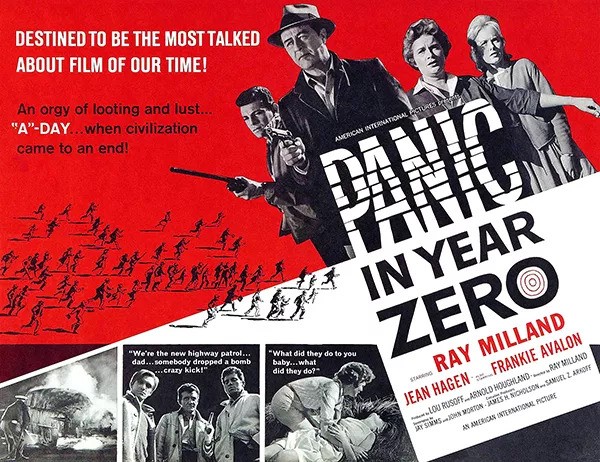
Despite the poster promising orgies of various kinds, there’s no glorifying the violence, Harry more like the frontiersman or law-abiding citizen forced to take the law into his own hands. Ann, whose maternal instinct has focused on its gentler aspects, turns into a lioness defending her cubs. It’s a brutal awakening for all, except Rick who appears to thoroughly enjoy the experience even as his father is trying to steer him clear of such thoughts.

Made by American International on a minimal budget, Ray Milland, doubling up as director, shows just what you can do with a decent script and cunning choice of locale. British-born Milland, a big star for Paramount in the 1930s-1940s and Oscar-winner to boot for The Lost Weekend (1945), read the runes right for the following decade and excepting Hitchcock’s Dial M for Murder (1954) and realizing his marquee value had tumbled, took to direction, beginning with A Man Alone (1955) and Lisbon (1956). He was top-billed in both, joined by Maureen O’Hara (The Rare Breed, 1966) for the second.

His last stab at direction was Hostile Witness (1968). But he only helmed five movies in all. While you wouldn’t say he was a natural stylist, Panic in the Year Zero! is something of a triumph, keeping audiences on edge with both narrative and character-led twists.

Apocalypse wasn’t even a sub-genre at this point, Eve (1951) the only previous example of any note. Timing didn’t help this picture, the Cuban Missile Crisis occurring a few months after its initial release.

Milland makes the most of his gritty characterization, pop star Frankie Avalon (The Million Eyes of Sumuru, 1967) surprisingly good. Written by Jay Simms (Creation of the Humanoids, 1962) and John Morton, in his debut, from source material by Ward Moore.

Rewarding.

The Swiss Conspiracy (1976) ***

One of those thrillers that only makes sense at the end. Lazy critics, too annoyed to wait or not able to work it out themselves, take out their bafflement on the picture. Or they carp at what they see as overmuch tourist influence instead of admiring the clever use made of Switzerland’s scenic attractions, the twisty cobbled streets, corkscrew highways teetering over ravines, and the apparatus of skiing – the chug-chug trains and lifts.  

Attractive too for the cast. You might put me down as overly fond of leading lady Senta Berger (Bang! Bang! You’re Dead! / Our Man in Marrakesh, 1966) but I’m equally appreciative of the casual charm and realistic qualities brought to the screen by the underrated David Janssen (The Warning Shot, 1967). And that’s before we come to Elke Sommer (The Prize, 1963) and veteran Hollywood star Ray Milland (Hostile Witness, 1969), not to mention character actors John Saxon (The Appaloosa / Southwest to Sonora, 1966) and John Ireland (Faces in the Dark, 1961).

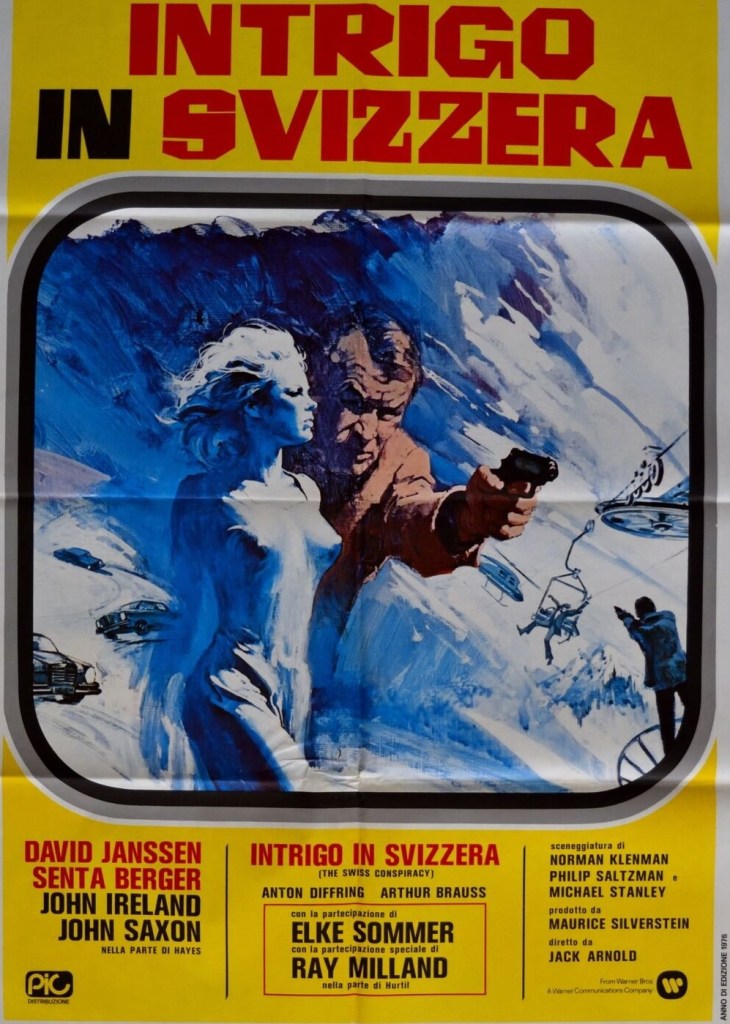
Poster designer gives himself a bit of leeway here, suggesting a lass is going to be striding around the Alps in such clingy clothing.

Former U.S. Treasury Agent David Christopher (David Janssen) is called in by Swiss bank owner Johann Hurtil (Ray Milland) to investigate a threat to expose the clients hiding behind the country’s infamous secret numbered accounts. Five clients, in particular, have been targeted including the glamorous Denise Abbott (Senta Berger), whom David first encounters in what would in other circumstances be deemed a clever meet-cute with the woman getting the upper hand.

One client is already dead, murdered in the opening sequence, as a warning. Of the others, Robert Hayes (John Saxon) is a mobster depositing illicit gains for money-laundering purposes, Dwight McGowan (John Ireland) a shady businessman on his last legs, while Kosta (Curt Lowans) equally operates in the shadows. And all is not well with the bank deputy Franz Benninger (Anton Diffring), involved in an affair with another client, Rita Jensen (Elke Sommer). On top of that, Swiss cops are on the trail of Hayes and hit men are tailing Christopher.

Christopher quickly surmises that the victims have been targeted for their undercover dealings, even the uber-glam Denise is blackmailing a former lover. But Hurtil, fearing a public and media scandal, and for whom the gangster’s demands are a mere drop in the ocean compared to the bank’s overall wealth, decides to meet their terms, which is payment of 15 million Swiss francs (equating to several million U.S. dollars, I guess) in uncut diamonds.

But before that we have a punch-up and shoot-out in a parking garage, a chase on foot on those famous narrow cobbled twisty streets with a speeding car giving the thugs unfair advantage, a race of seduction a la On Her Majesty’s Secret Service (1970) along those aforementioned treacherous mountainous roads, a literal cliffhanger in the vein of The Italian Job (1969), and one of those luscious romances beloved of the upmarket thriller (think The Thomas Crown Affair, 1968).  

While Christopher is painstakingly putting together the clues and keeping the suspicious Swiss police off his back and avoiding being killed, there’s a deadline to meet, the usual race against time, while the audience is having to fend off a surprising number of red herrings.

It’s not only glamorous, it’s short, and there’s more than enough going on, characters played by interesting actors, to keep the viewer involved. And I defy you to guess the ending. So, enough thrills, sufficient mystery, great scenery, and a female contingent (even Christopher’s secretary fits that category) with brains to match their sexiness who appear to have the upper hand in relationships with the opposite sex.

This is David Janssen at his best, that outward diffidence concealing a harder inner core, exuding a guy-next-door appeal that was never properly utilised by Hollywood, who preferred him just to reveal character by squinting. The scene where he takes in the extent of the luxury of Denise’s hotel penthouse is one of those that, while not knocking on Oscar’s door, demands true acting skills. He’s never in your face, and the camera loves him for it.

Of course, Senta Berger, what can you say, another under-rated actress never given her due in Hollywood, here finds a plum role that allows her to switch from confidence to vulnerability at the drop of a hat. John Saxon and John Ireland, as ever, are value for money. And Ray Milland keeps the show on the road.

A modern audience would be more at home with the multiplicity of plot angles and probably worked out in their own heads all that couldn’t find a place on screen, ensuring that what seemed like plot holes were anything but.

Jack Arnold (The Creature from the Black Lagoon, 1953) handles the scheming and dealing with ease. Norman Klenman (Ivy League Killers, 1959), and two television writers in their movie debuts, Michael Stanley and Philip Saltzman, wove the intricate screenplay.

Film into Book – “Hostile Witness” (1968) Movie Tie-In

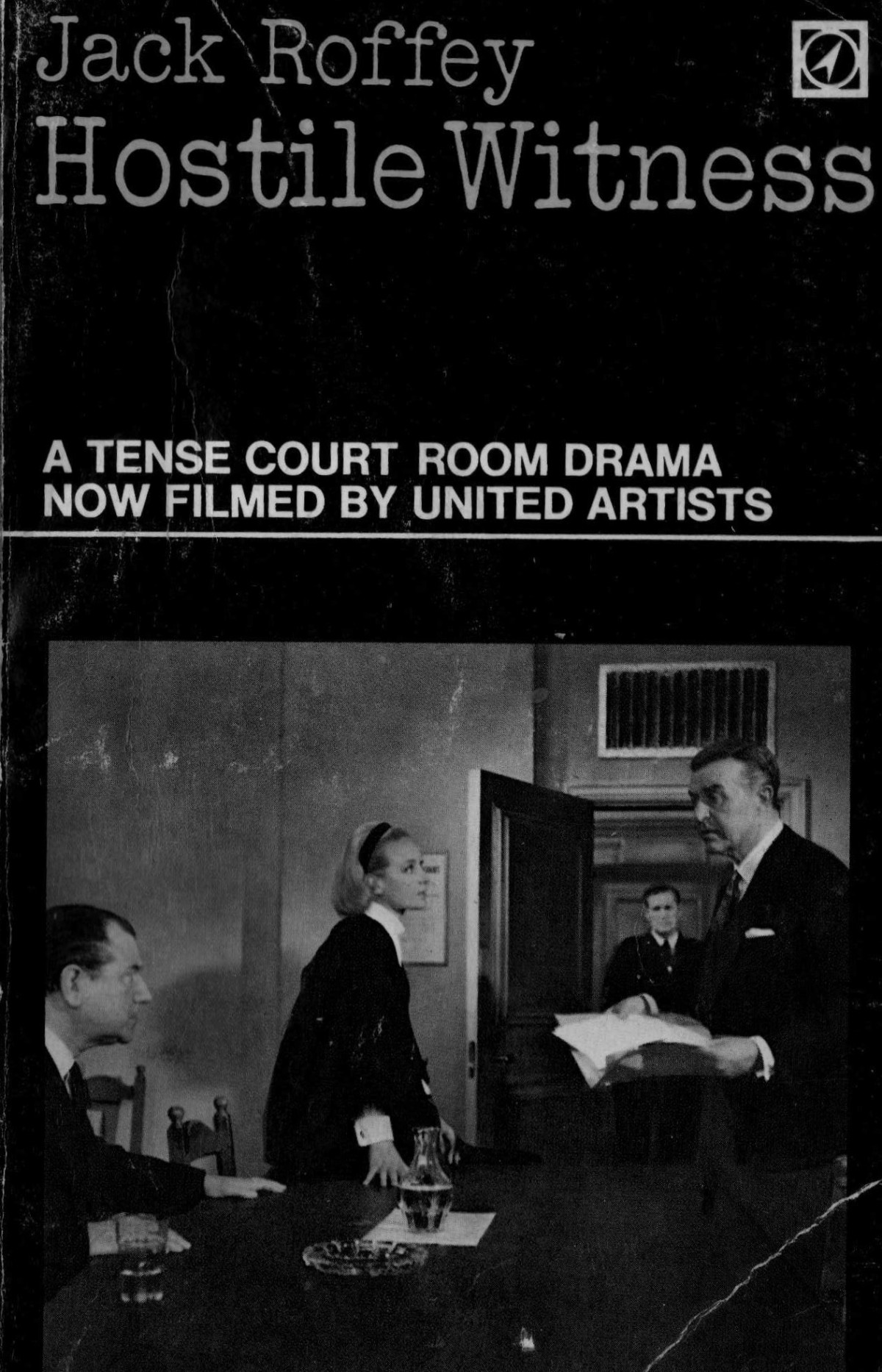
As you will be aware I have been running a little series of how books were adapted into films and I thought it would be interesting to see what happened when the process was the other way round. I have in general about the lucrative business of novelisations of screenplays as movie tie-ins but never examined any single one in particular. But I came across this book in a secondhand bookshop on holiday and gave it a read.

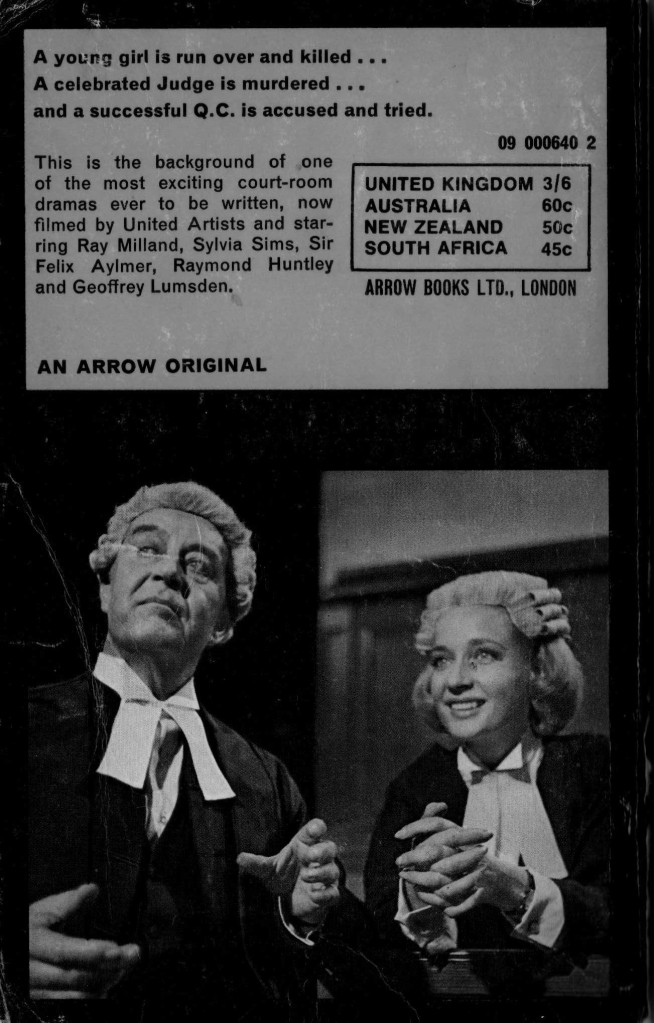
British writer Jack Roffey had turned his play – a hit in London West End and Australia though less so on Broadway – into a screenplay and was inveigled into making a quick buck by churning out the movie tie-in book, published straight into paperback in Britain by Arrow. It turned out to be an interesting exercise because the play was no longer in circulation and the film failed to get a proper release so the book had to survive on its own without the help of movie publicity or posters outside the chain cinemas.

The book is about 60,000 words long while the play/screenplay probably comprised fewer than 5,000 words so that was a lot of padding-out to do, if that was all the author could manage. Interestingly, Roffey proved himself an adept novelist, taking the opportunity to both clarify the proceedings and mystify the reader even more, accentuating the ambiguities of the initial work. Where the movie glosses over main protagonist Simon Crawford’s (Ray Milland in the film) mental difficulties until brought into question during the court case itself, in the book Roffey lays the groundwork more straightforwardly, recounting the period spent in hospital and, more importantly, his rapid decline after returning to work so that by the time he is arrested his mental health is very poor.

Sheila Larkin’s (Sylvia Syms) unspoken feelings for her boss remain just that, but there is a physical closeness – she catches him when he collapses, briefly nursing him, and she is presented as a woman more aware of her own sexuality. And the door is opened later in the book for a relationship – “intimacy umbrellaed them in soft folds, inviting positive expression.” Equally, when given the opportunity to take on the case, her first reaction is fear: “She couldn’t possibly accept it…it would be a terrifying responsibility for a junior of her standing” and she expects the episode to end in abject humiliation until she catches sight of her boss and registers the fear in his eyes. Thus, Roffey is able to get inside all the major characters rather than have the camera – and the shortage of screen time – dictate the point of view. Other characters, some incidental, are also more fully drawn.

While the play’s dialogue would not have sufficed to carry a book of this length, Roffey has to add considerably to his original material, and in most cases extended conversations are made to count. Perhaps most interesting of all since he is in charge, Roffey can dispense with the need to constantly cut back to the accused during the trial to register his facial reactions and that allows the personality of Sheila Larkins to flower and take true centre stage rather than be constantly undercut by continually focusing on Crawford. Roffey was also an expert on court procedure and the opportunity to delve into that gives the book greater authority.

The book is certainly enjoyable and well-written with some sharply observed characterisations. “Mr Justice Gregory came in, diffidently at first, like a small boy at the edge of a pond, who wonders if the ice will hold.”  Simon Crawford is introduced in court in the opening page thus: “There was an affected boredom is the half closed grey eyes – a calculated indifference to the heat and the coming verdict.” While Sheila Larkins is the opposite – “properly wrung out.”

There’s style in the descriptions. “Gordon Mews is one of those peaceful backwaters that an earlier and more gracious London put aside for a rainy day, and promptly forgot about.” And the book moves along briskly, a crime thriller with the unlucky caught in a web that is closing in fast. Roffey is able to touch on more specifically Crawford’s disintegration and his shock at being tabbed a criminal. Like the film, it was more than passably entertaining.

Play into Film – “Hostile Witness” (1968)

Adapting a play into a film requires more specialist skills than transforming a book into a movie. A book either needs considerably trimmed (example, The Detective) or the requiring a complete overall (as with Blindfold). It’s much harder to muck around with a play which has usually been well-honed, edited down night after night, from a run on the stage. The main decision the writer charged with the adaptation has to make is a tricky one – whether to open it up or not. Can a play, especially a thriller, sustain the tension it achieved on stage without additional elements – and therefore appear “stagey” on film – or must it be expanded in the hope of generating greater tension or ambiguity, making characters more sympathetic or clarifying the plot.  The story in both play and film concerns top lawyer Simon Crawford being arrest for murder.

Jack Roffey, adapting his own play, decided the original needed opening up. The play’s structure consisted of two acts, each containing two scenes. The first scene lasted 21 pages, scenes two and four 23 pages each, while scene three is considerably shorter just 12 pages. So, except for the third scene, the play’s rhythm is consistent. And while this might look as if most scenes last 20-plus minutes, an inordinately long time to sustain rhythm on the screen, there are lot of moment where various characters go offstage to concentrate action between fewer characters, thus heightening tension or creating character conflict.

 A lot of information that was imparted purely via dialogue in the play transforms on screen into a series of extra scenes. This is especially true at the beginning. The movie’s opening scene, set in a court and concerning the trial of a brothel-keeper, was not in the play; it was dealt with in passing at the beginning of the play, as a character reporting on the outcome, albeit that some of the reported speech became dialogue in the film. It was probably felt that the movie audience had to be introduced right away to a courtroom since the play’s opening scene takes place entirely outside the courtroom, in the offices of the leading character Simon Crawford (Ray Milland). The play begins in the present and the back story, that Crawford is widowed, recently lost his daughter in a hit-and-run traffic accident, and suffered a nervous breakdown as a result, is dealt with as exactly that – events from the past. The film puts them in the present. We are shown the daughter, who clearly has a strong relationship with her father, we hear the accident (which occurs offscreen), witness Crawford’s unravelling and the murder that forms the core of the story. And we are also treated to some additional scenes, not in the play, including an initial police investigation.

The upshot is that it takes 25 minutes for Crawford to be arrested. Compare that to the play. He announces his imminent arrest within the first five minutes. For pure audience shock the play holds the upper hand. I’m not sure the film ever matches that moment. Pre-arrest, in the film, Crawford’s erratic behaviour and hospital confinement add to a sense that he might be unhinged or, in classic film noir, feeding the audience a line. His state of mind is complicated by making visual some incidents that were just verbal in the play.

There are three major departures from the play. The first was the introduction of a private eye whom Crawford takes by the throat in frustration at the gumshoe producing no results. This suggests early on that Crawford is capable of violence. But it also causes a complication. In the play there is only one main private eye, name of Armitage, whose evidence proves key in the case against Crawford, but he is missing and in fact never appears. Apart from testifying to Crawford’s murderous inclination the introduction of this other private eye, named Rosen, makes little sense. The second is to bring quicker to the fore the involvement of junior lawyer Sheila Larkin (Sylvia Syms in the film). In the play she takes over his defence when her senior quits on a point of principle but in the film it is almost from the start.

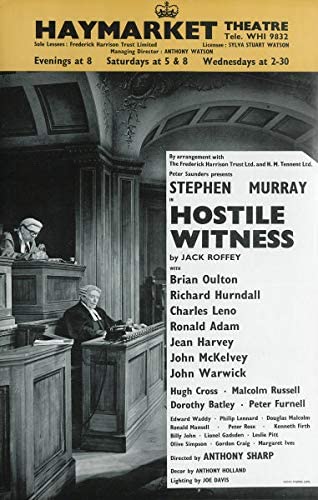
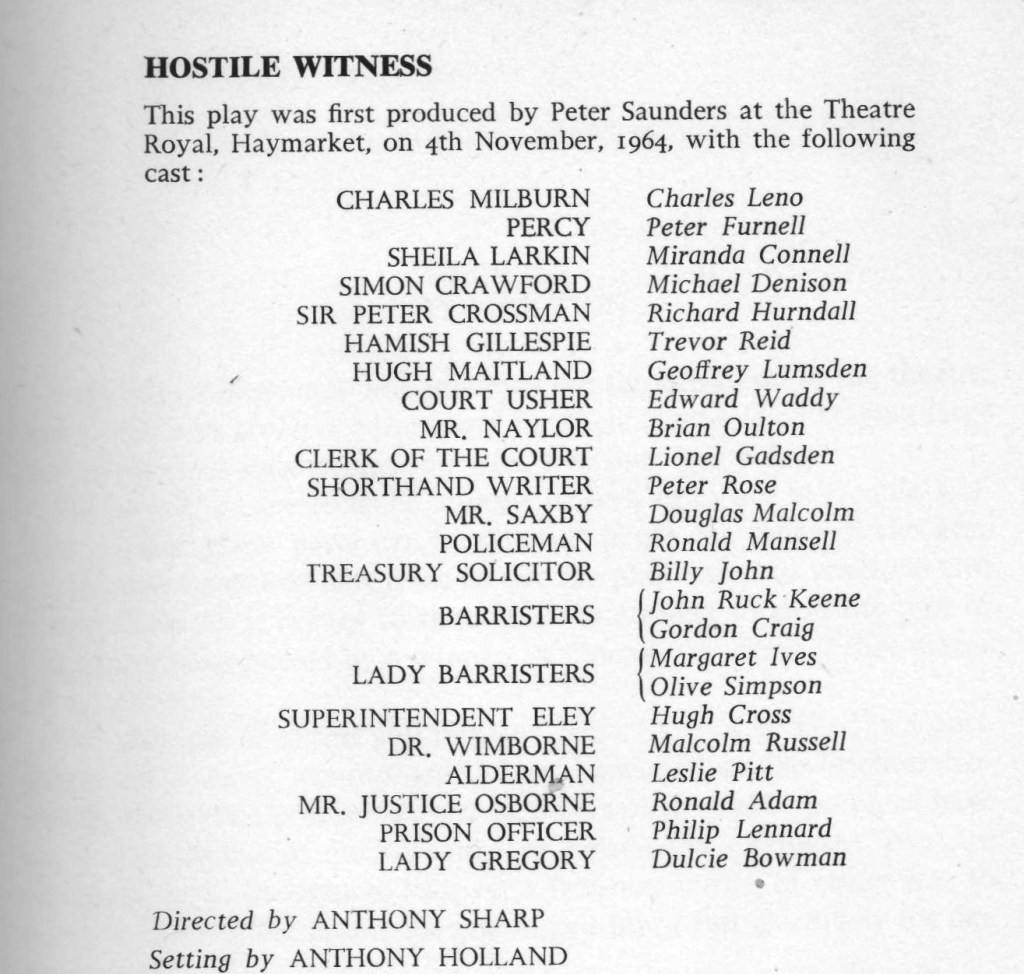
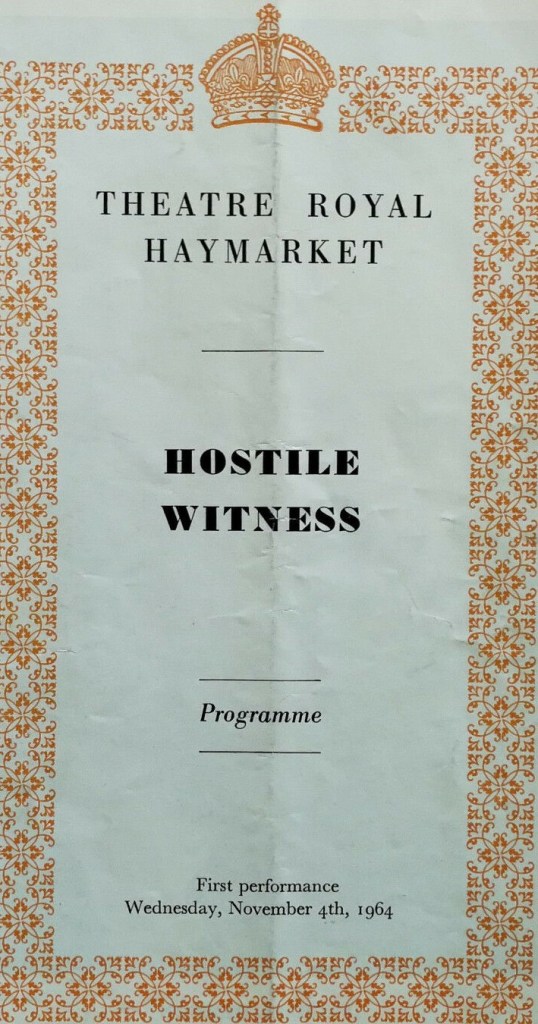
Programme for the premiere of the play in London’s West End.

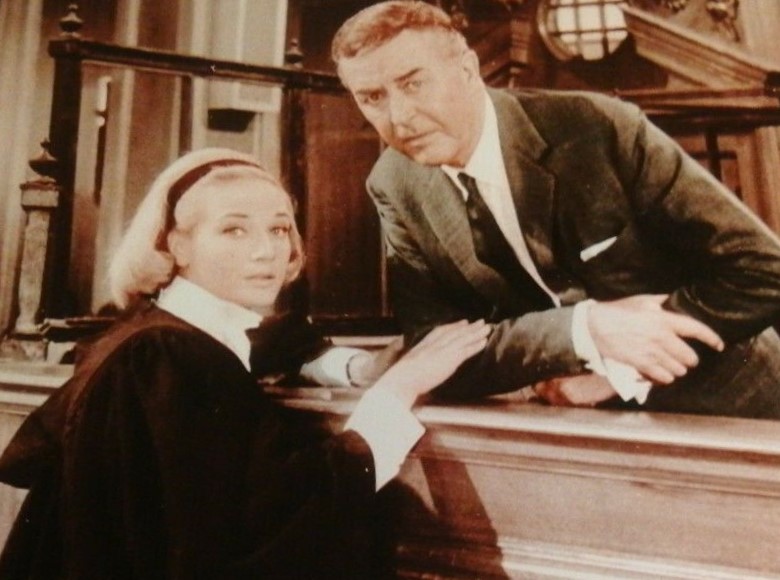
The third development also involves Larkins. But I’m not sure this one works in building up Crawford-Larkins into a potential May-December relationship. In the play it seems more obvious that Larkins is a daughter substitute rather than a potential love interest but the film adds an additional scene where she brings celebratory goodies to the lawyer and her demeanor suggests sublimated ardor. The way director Ray Milland uses looks between the pair and an occasional touching of hands makes the alternative more obvious.

You could argue that the film could have simply had Crawford arrested in the first five minutes but that would have necessitated police interrogation. The device brilliantly used in the play of imminent arrest would have worked in the film, I believe, and made for a more explosive start, and then either sticking with the play structure or dealing with the backstory in flashbacks.

It’s worth noting that plays on the page look far more intense than screenplays. There is nothing but line after line of dialogue whereas a screenplay always has cuts or directions to interrupt the flow of material. Dialogue, of course, being what a play relies upon more than the camera, Roffey, as the adaptor, was lucky in having so many choice lines at his disposal. Ray Milland, in his role as director, unfortunately, was not able to add atmospheric heft.

Hostile Witness (1968) ***

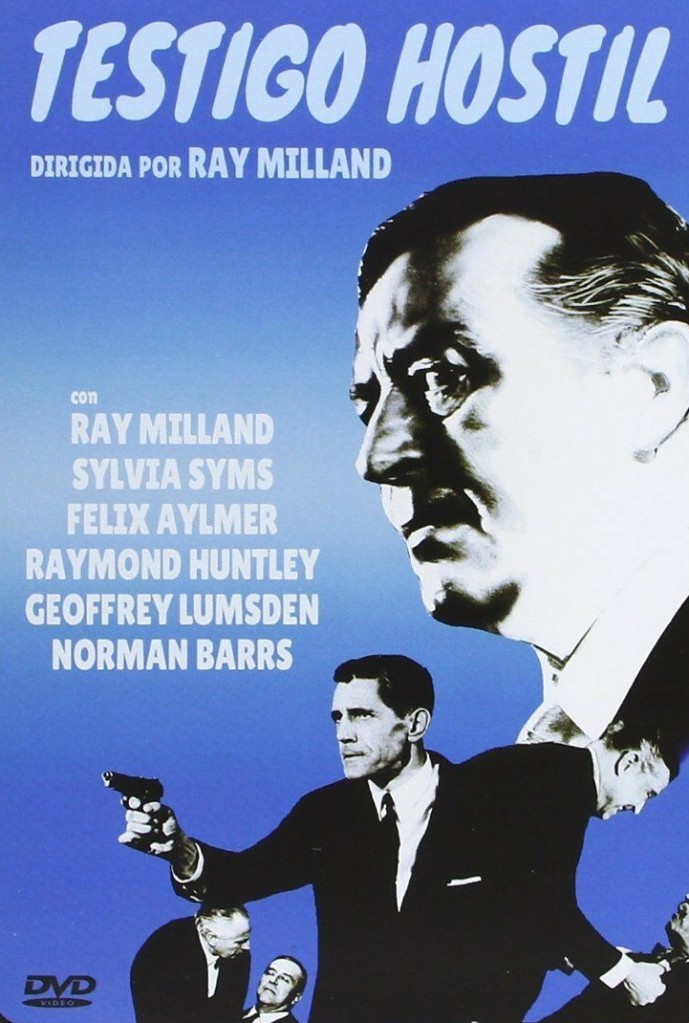
Shoddy initial release means this is unlikely to have been on your radar, but this entertaining courtroom drama plays on madness, involves minimal sleight-of-hand, employs some notable reversals as a defence strategy sinks under the weight of its own misplaced ambition.  Courtroom dramas were a scarce commodity in the 1960s, the sub-genre almost killed off by U.S. television hits like Perry Mason (1957-1966) and The Defenders (2961-1965).  Although, technically, Inherit the Wind (1960), Judgement at Nuremberg (1961) and To Kill a Mockingbird were of the same ilk, they did not rely on last-minute intervention or the normal twists and turns of legal dramas as evidenced by Witness for the Prosecution (1957). Hostile Witness only saw the light of day because Oscar-winner Ray Milland had starred in the Broadway version of the British play, author Jack Roffey experienced in the mechanics of this kind of fare after British television series Boyd Q.C. (1956-1964).

Daughter dead in a tragic car accident, top-notch Q.C. Simon Crawford (Ray Milland) is accused of killing the man he believed deliberately responsible. Unable to defend himself, he relies on his junior Sheila Larkin (Sylvia Syms). Circumstantial evidence links him to the crime. Questions surround his mental health, which disintegrated following his daughter’s death, especially after he cannot prove claims that would exonerate him. Casting around for the potential killer leads to a cul de sac, each clue that could absolve him rapidly dissolves and as he is soon fighting for his life. And as tension mounts, the defence team is soon in disarray, Sims quitting on a point of principle. Like all the best court cases the proof is in front of his eyes if only he could see it, and the traditional last-minute witness and twist does not disappoint. 

The courtroom aspect is very well done, great banter between the lawyers and swift and witty put-downs by the presiding judge (Felix Aylmer). While the story demands that Crawford remains off centre-stage at times, his presence, as a tense observer of proceedings that could spell his fate, calls on Milland to display probably the widest set of non-verbal reactions you will ever encounter. Syms (East of Sudan, 1964) is excellent in a role that offers greater scope than her usual female lead and while carrying a torch for Crawford she is more than capable to standing up to him and is ruthless in cross-examination. Geoffrey Lumsden (A Dandy in Aspic, 1968) tickles as a befuddled major and Raymond Huntley (later a success in Upstairs, Downstairs) sparkles as the grumpy prosecutor. To some extent, the picture plays on the film noir ethos that good guys often turn out to be anything but and Milland has the undoubted gift of looking both villain and hero dependent on the time of day.

By this point Welsh-born Milland was an odd refugee from Hollywood’s Golden Age, fallen far below the box office peaks of Billy Wilder’s The Long Weekend (1948) and noir turns like The Big Clock (1948). Apart from Dial M for Murder (1954) he was mostly became a television stalwart – the eponymous Ray Milland Show (1953-1955) and Markham (1959-1960) – and turned his hand to occasional direction. An unexpected dip into horror – The Premature Burial (1962), Panic in the Year Zero (1962) and The Man with the X-Ray Eyes (1963) failed to revive his mainstream career and prior to Hostile Witness had only appeared in one other movie.

For a time Hostile Witness did look as if he would put him back on top after taking up an offer to make his Broadway debut in the play. Although not a stand-out hit, it ran for a decent 157 performances, then went on tour in the U.S. and later Australia, leaving Milland with the impression that, with himself directing to cut costs and running to a tight 24-day shooting schedule in Britain, it might just be the correct vehicle. Unfortunately, it was probably the staid direction that put paid to any prospect of box office success. A director like Billy Wilder or Hitchcock would have concentrated far more on character ambiguity and  made more of the unreciprocated romance and either tightened or opened up the original play to add more tension. Even so, it is pleasant enough viewing, not a dud by any means.

Discover WordPress

A daily selection of the best content published on WordPress, collected for you by humans who love to read.

The Atavist Magazine

by Brian Hannan

WordPress.com News

The latest news on WordPress.com and the WordPress community.