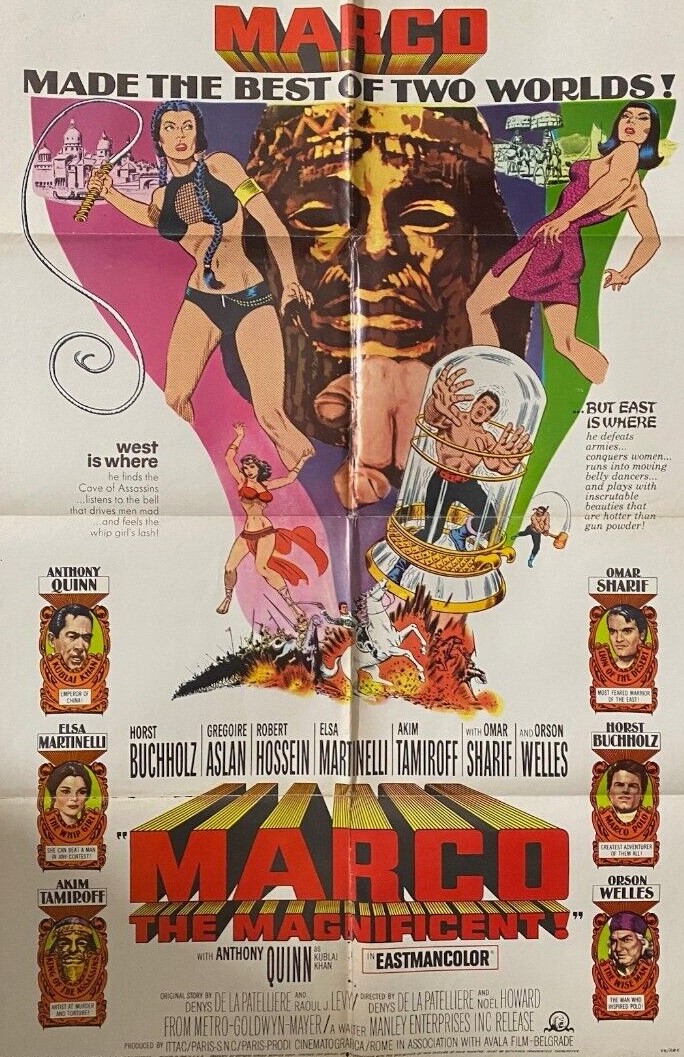
Marco the Magnificent (1965) **

Small wonder this flopped even with the requisite all-star cast of Omar Sharif (Doctor Zhivago, 1965), Anthony Quinn (Zorba the Greek, 1964), Orson Welles (Austerlitz, 1960),  Horst Buchholz (Nine Hours to Rama, 1963) and Elsa Martinelli (Hatari! 1962). Oddly enough, Quinn comes close to saving it. Although initially laughable, presented as a cross between Yul Brynner’s long-lost brother and Ming the Merciless, he tones down the trademark rasp and growl to deliver a powerful performance.

Of course, we also have to take the word of Marco Polos (Horst Buchholz) that he had all these adventures and that he did encounter The Old Man of the Mountains (Akim Tamiroff) and The Lady with the Whip (Elsa Martinelli). The former wore a mask of gold and if you ever saw his face that meant you were in for the chop. And he had a nice line in sonic torture. The latter chooses love above betrayal.
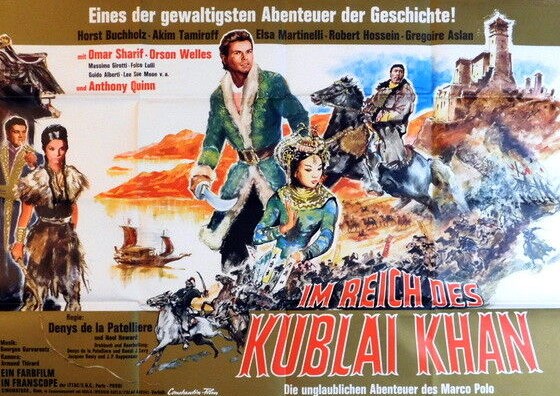
The name of Marco Polo either meant so little to German audiences or the title change was due to the producers hoping to capitalize on the success of “Genghis Khan.”

Love – or sex I guess – is a consistent theme. Marco is chosen for this adventure – whose main aim is to get a message to Mongol overlord Kublai Khan, now the ruler of China, that Italy, the dominant western power at the time, wants peace – in part because he is so handsome. He has no other pedigree that I can see. At the age of 20, he’s best described as an idler. But his father Nicolo (Massimo Girotto) is a renowned trader and has ventured along the Silk road to Samarkand.

But, would you believe it, following that old western genre trope where there’s always someone wanting to sabotage relations between Native Americans and soldiers, the idea of peace doesn’t sit well with everyone. Spies report on Marco’s every move and attempt to stop him completing his mission and when he reaches China discovers that another Mongol warlord Prince Nayam (Robert Hossein) prefers the traditional method of conquest, with the raping and pillaging that goes with it, rather than growing the economy through peaceful means.

Just as well Marco is so good-looking because whenever he is in a tight spot he is rescued by a beautiful woman, including the aforementioned Lady with the Whip, and, would you believe it, Princess Gogatine (Lynne Sue Moon), who has been chosen as a potential wife for Kublai Khan (Anthony Quinn). Multiple romance is the name of the game here – Arab chieftain Emir Alaou (Omar Sharif) has twenty-six wives, one of whom has the temerity to complain at his expanding harem.
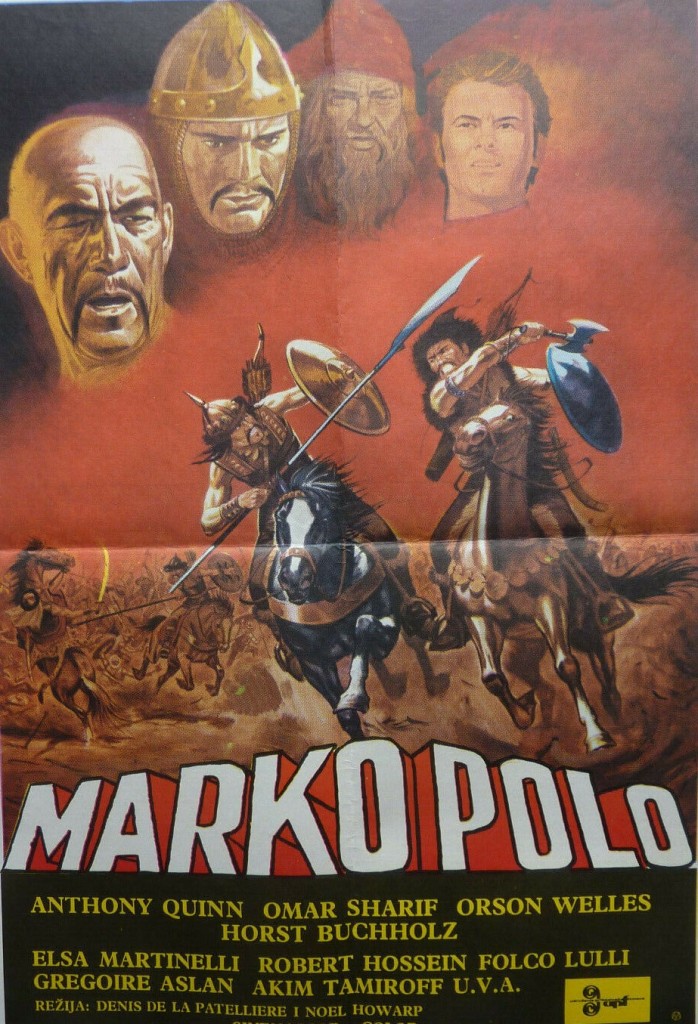
Mostly, it’s a travelog – with a bucket of travel cliches thrown in such as Russian dancing – punctuated by occasional peril. But beyond looking handsome and putting his seductive powers to the test, there’s not much else for Marco to do.

The screenplay is so limited and haphazard you get the impression it must have been heavily truncated, that there was a three-hour roadshow covering the ground in a more sensible manner, but that appears not to have been the case. Producer Raoul Levy (who wrote and produced And God Created Woman, 1956, and wrote, produced and directed The Defector, 1966) ) spent so much assembling the cast he scrimped on a workable screenplay and was so intent on ramming it with oddly-named characters (Old Man of the Mountains and Lady with the Whip) that he took his eye off the narrative ball.

The final section with Kublai Khan trying to integrate through his own marriage the conquering Mongols and the conquered Chinese and dispensing with war in favor of peace makes more sense but by then you are so exhausted by the multiplicity of star names contributing nothing and the meandering plot that you have just about given up.

And it wasn’t as if Levy didn’t have time to get a screenplay in place. He’d been working on this since 1962 when an earlier version starring Alain Delon (Once a Thief, 1965) was abandoned when finance ran out. One of the most expensive French movies ever made, and extensively funded by Levy, it proved such a flop, it wiped him out financially and contributed to his suicide.

The inconsistency may have been caused by having three directors – Levy, Denys de la Patellier (Caroline Cherie, 1968)  and Noel Howard (D’Ou Viens-Tu, Johnny, 1963).

All-star cast wasted, promise unfulfilled.

https://m.media-amazon.com/images/I/6161DUBcazL._AC_SY445_.jpg

The Defector (1966) ***

How often does a government hoodwink a morally upright citizen into deceitful action for the cause of the greater good? In this case physicist Professor James Bower (Montgomery Clift) doesn’t need a great deal of urging because what’s at stake are Russian space race secrets and the man selling them is a Russian scientist he knows from translating his books. It’s apparent from the outset that in setting out to make contact in East Germany, he is walking into a trap. It’s moody, and drab in the vein of The Quiller Memorandum (1966), shot in soulless German streets, and of course it is the final performance, after a four-year screen absence, of a frail-looking Clift, an iconic Hollywood star for nearly two decades.

But genres can be confusing. Although tagged as a spy picture it’s not really a spy film. It’s a character study. In fact, two character studies, the other being a far-from-typical communist. And when you get to the end and realize the sacrifice made in order not to compromise principle, it turns into quite a different movie, one with considerably more depth than you might have imagined.

Bower is a rather adept amateur spy, neatly dodging being followed, and capable of nipping between two moving trams to evade pursuit. His instructions lead him to asking for a particular prescription and being sent in apparent haphazard fashion to an intended meeting with Dr Salter (Hans Messemer), his contact. Instead he is led to Counselor Peter Heinzmann (Hardy Kruger). His hotel room is not merely bugged but fitted with electronic instruments to prevent sleep and distort his mind. Meanwhile Heinzmann is engaged in a hawk-vs.-dove battle with  Orlovsky (David Opatoshu) to determine whose methods, the latter preferring torture and brainwashing, would prove the more successful in forcing Bower to betray the whereabouts of the would-be defector. And there is also a doctor’s receptionist Frieda (Macha Meril), with whom romance so obviously beckons your natural moviegoer instinct is to regard her as lure rather than friend.

It’s a chess game, Bower a pawn, with the net growing tighter, imprisoned in more ways than one, being groomed for defection himself. Although there is double cross, triple cross, murder and an excellent Hitchcockian escape/chase, and a final unexpected, very human, twist, it’s far from your typical spy thriller, in general subtle in tone except for the nightmarish hotel scenes. Heinzmann is also a pawn, fighting a system that sees degradation as its most potent weapon and even while a danger to Bower displays humanity.

Clift’s physical state, skin drawn tight over his face, works to the movie’s advantage, turning him into more of a Glenn Ford-type actor, the staunch man-next-door with steely resolve, but not the kind of character you would imagine Elizabeth Taylor or Marilyn Monroe giving a second glance. In fact, since the story calls for him to be suffering from a mysterious malady – hence the need to seek out a pharmacy and doctor in a foreign country – his features endorse this plot point far better than if he had been fit and well.

Quite what the set was like is anybody’s guess given that not only was Clift dead by the time of the film’s release but that Belgian director Raoul Levy (Hail, Mafia, 1965) – better known as the producer of many Brigitte Bardot films and now helming only his second film – had committed suicide.  

If ever there was proof of star power, this is it. Even when the film is meandering and the plot at times impenetrable, Clift exerts an almost hypnotic hold on the viewer. Despite his clear infirmity, the intensity that enraptured audiences from films as disparate as Red River (1948), From Here to Eternity (1953) and The Misfits (1961) has not vanished. Since many scenes are just meetings that scarcely progress the story, it is quite a feat to keep audiences interested. Far from his greatest performance, he still displays screen presence.

He is helped along by Hardy Kruger (Flight of the Phoenix, 1965) in one of his more measured performances, both men sharing the knowledge that in doing good for their country they are betraying themselves. David Opatashu (Guns of Darkness, 1962) is excellent as his  quietly ruthless superior and there should be mention of  Karl Lieffen as the constantly complaining Major. Even as a dowdy East German, Macha Meril (Une Femme Mariee, 1964) still captivates.  Serge Gainsbourg contributed the music.

Discover WordPress

A daily selection of the best content published on WordPress, collected for you by humans who love to read.

The Atavist Magazine

by Brian Hannan

WordPress.com News

The latest news on WordPress.com and the WordPress community.