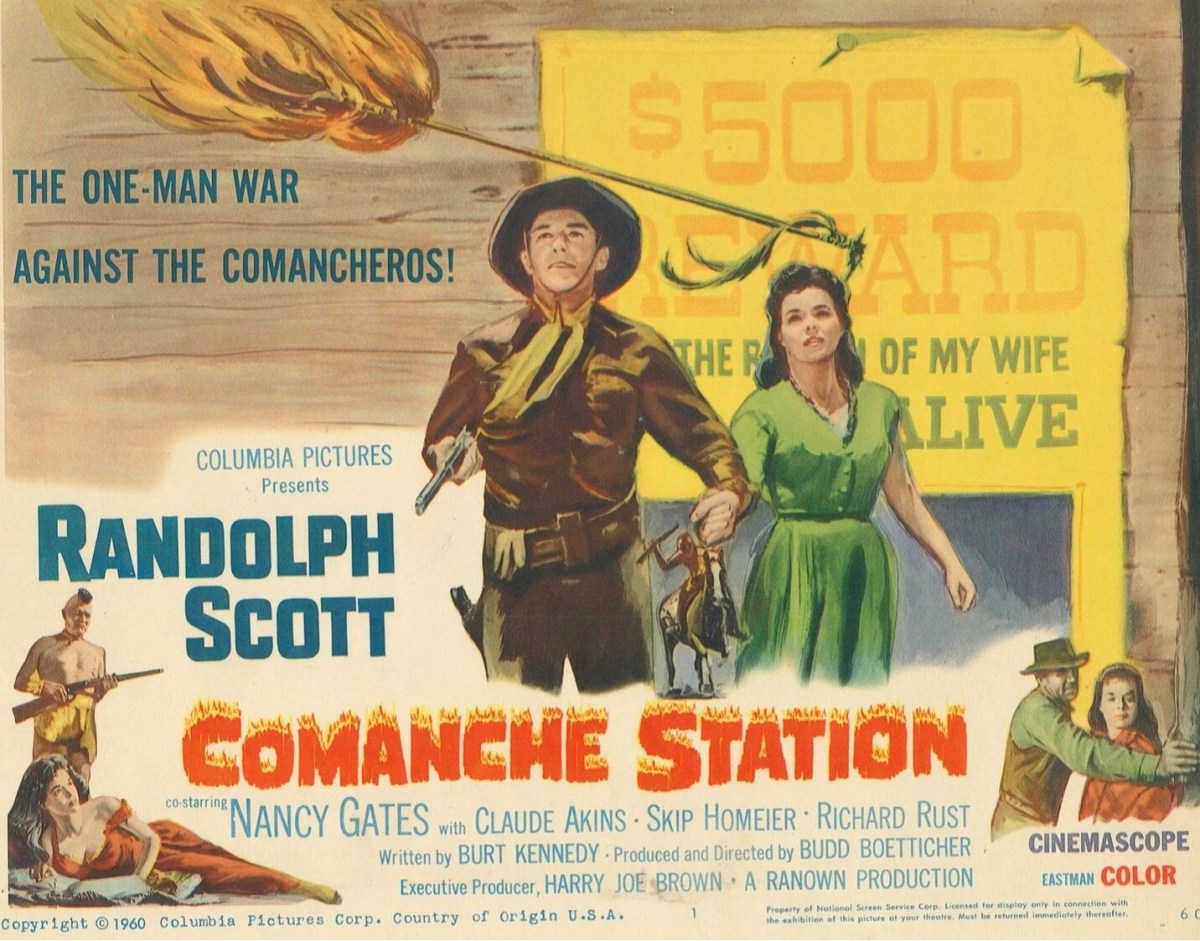
Comanche Station (1960) ****

Randolph Scott went out on a high – or at least that was the plan, his intended retirement derailed when Sam Peckinpah made him an offer he couldn’t refuse for Ride the High Country / Guns in the Afternoon (1962). But if this was his planned final movie, he couldn’t have wished for a better last hurrah.

Director Budd Boetticher (A Time for Dying, 1969) became something of a cult item once the fashionista critics of the 1960s and 1970s got their hands on him, and pulled out the stops for low-budget pictures made with tight artistic vision in preference to an overload of bloated big budget efforts. This was the last of a western quintet starring Scott.
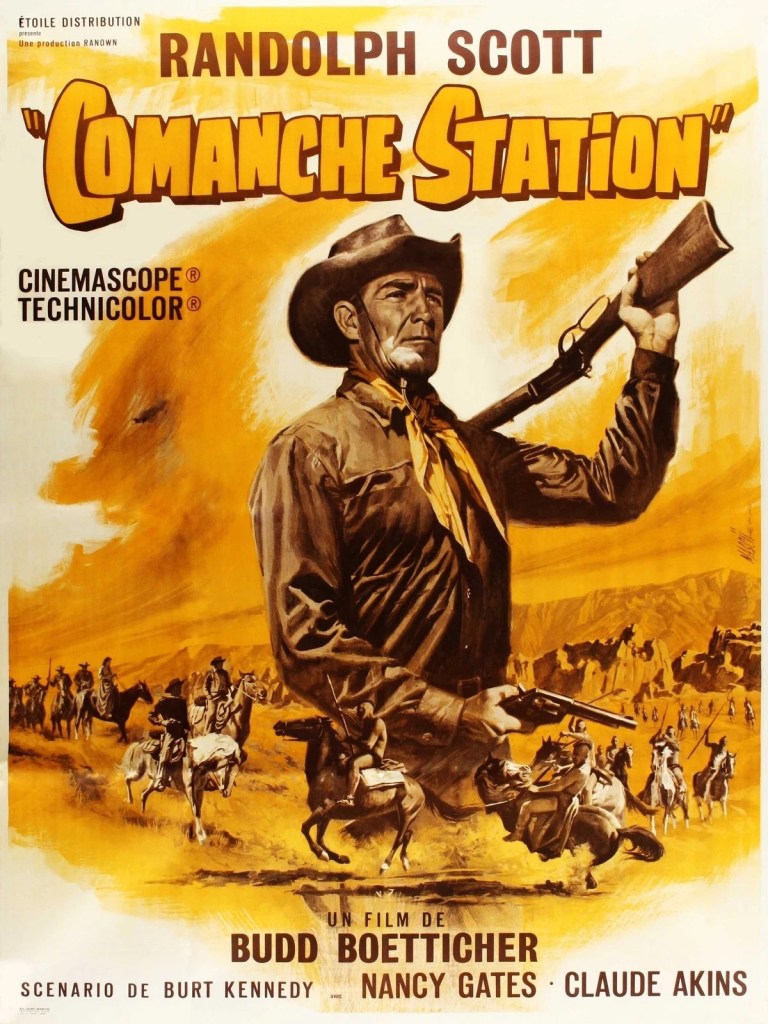
Boetticher exercises remarkable restraint throughout, very little in the way of emotion, or close-ups, and his use of widescreen follows the classic composition, relevant movement taking place to the side of the screen or in a corner or instead of left to right the action snakes top to bottom.

The story is exceptionally lean but in that simplicity carries enormous power. A man of principle Jefferson Cody (Randolph Scott) is up against the unscrupulous Ben Lane (Claude Akins), the situation complicated by the fact that the good guy isn’t going to make it out of Indian Territory without the help of the bad guy. At stake is a cool $5,000 (worth $125,000) today. Or put another way, a young woman’s life. There’s bad blood between Cody and Lane, the former court-martialing the latter while in the Army.

Cody has rescued kidnapped rancher’s wife Nancy (Nancy Gates), not by raiding the Comanche camp and pulling off the kind of action that used to take a well-practised team of experts (see The Professionals, 1966), but by hoving into view and offering to trade various goods, including a rifle, for the woman. She’s not as grateful as you might expect, fearing the reaction of her husband on her return (it’s unspoken but she would have been raped by her captors) and subsequent public humiliation.
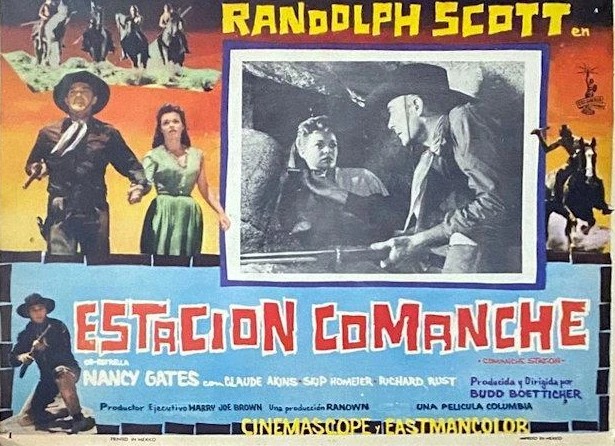
When Comanches reappear, it looks like they’ve reneged on their deal. But they’ve not. They’ve been baited by Lane and his accomplices who, seeking the reward money, have gone in all guns blazing. Nancy turns against Cody because she imagines he, too, was after her for the money and not out of the goodness of his heart.

Lane fuels the fire by casting doubts on her husband not coming after her on his own, and pointing out that women thus rescued often rewarded their rescuer with sexual favors. Lane and his two younger buddies, Frank (Skip Homeier) and Dobie (Richard Rust), briefly discuss robbing Cody once he’s been handed the reward. But Lane has a better idea. Kill them both. The husband wants his wife back dead or alive.

Lane has the sense not to perve on the woman and the director resists the opportunity to pander to the audience by showing Nancy bathing naked in a river. Outside of the gunplay, the three outstanding scenes are smaller potatoes. One of the young lads proves he can read much to the amazement of his friend. When Frank is killed by an  arrow he’s left to float down the river because nobody can afford the time to give him a proper burial. And when under attack, Cody dumps Nancy in a water trough to keep her hidden, from which she occasionally pops up sodden only to dive down again.

It’s pretty unusual for western to end on the kind of twist you’d find in film noir or a thriller. But this one is terrific. All the way through Nancy’s husband has been derided for not coming after her in person, but in the last scene we discover why. Her husband is, in fact, blind. Cody, who hasn’t been in it for the money anyway, turns away without taking a cent.

The running time is so lean – just 73 minutes – it would have been released as a supporting feature and it’s testament to the director’s principles that he didn’t try to puff out the length by sticking in some sub plots or encouraging romance.

Beautifully filmed and with a compact script by future director Burt Kennedy (The War Wagon, 1967). This was also the swansong for Nancy Gates. Claude Akins was cast by Kennedy for Return of the Seven (1966). Skip Homeier was the male lead in one of my low-budget faves Stark Fear (1962).

Compelling work and worth reassessment if you’ve not already climbed aboard the Boetticher/Scott bandwagon.

Ride the High Country (1962) ****

Far from routine western with director Sam Peckinpah, in his sophomore picture, channelling territory that would later become more familiar, old friends turning enemies, the encroachment of civilization, the passing of the Old West, and sharing with The Misfits (1961) incredulity that the once noble occupation of cowboy/lawman has become redundant.  In Major Dundee (1965) and The Wild Bunch (1969), the story turns on former friends turned enemies, here that aspect is in its infancy.

Down on his luck former lawman Steve Judd (Joel McCrea), shirt collar frayed, holes in his boots, eyesight not what it was, recruits old pal Gil Westrum (Randolph Scott), reduced to running a western sideshow, to help him escort a load of gold down from the mountains. Gil brings along his younger sidekick Heck Longtree (Ron Starr). Along the way, romance beckons for the ever romantically-inclined Heck when he encounters young Elsa (Mariette Hartley), daughter of Bible-thumping farmer Joshua. When she runs off, intending to marry prospector Billy Hammond (James Drury) at the mining camp, they act as her escort.

Gil turns out not to be the straight-shooter he originally appeared, planning to rob the gold consignment on the way back, with or without Steve’s assistance. The plot takes a wild detour in the mining settlement when Elsa realizes that her marriage will take place in a brothel, her fiancé is a drunk, and that his four brothers reckon they will have equal claim on her sex-wise. Gil arranges for the marriage to be apparently annulled, which doesn’t for a moment fool the Hammond brothers, and the return journey, already splintered by Steve working out what was on Gil’s mind, turns into one ambush after another.

The narrative switch away from the cowboys bewailing their lot, or, in Gil’s case planning payback for a life gone awry, to the plight of the vulnerable woman in the last of the lawless western wildernesses, is a nifty one. But you can’t help seeing Gil’s point, all the gun wounds, gunfights, months in hospitals, jobs lost as a result of confinement, make a man’s mind turn to the notion he has not been correctly reward for his endeavours. And not quite as convinced as Steve that honor makes up for everything.

There is some very lively dialog, great banter as Gil tries to sow sedition in Steve’s ear, Steve with an endless fund of humorous retorts, gently explaining that the hole in his boot is a masterpiece of the shoemaker’s art, a clever method of hidden ventilation, at each point deflecting a wily tongue probing for weakness. Steve is soon revealed as anything but a gunman past his past, or even a bare-knuckled fighter, knocking out cold a disbelieving Heck.

The romance is well done, Heck convinced he has prised Elsa away from her father, only to discover he is not included in her plans, and the isolated virgin unlikely to respond to male ardor. But when the reality of marriage strikes home, a slap in the face required to guarantee compliance, Elsa is extremely lucky not just to find Steve and Gil willing to come to her rescue, but for the less upstanding Gil to take legal matters into his own hand, although you can’t help feeling, in terms of the subsequent mortality rate, this is a hell of a price to pay for a young girl who was not aware of the realities of married life. But, hell, every decent western requires sacrifice.

Peckinpah introduces some excellent twists on more common scenes. A horse race is won by a camel, belly dancers instead of saloon girls, the restaurant bust up in the traditional fistfight is Chinese, Steve assumes the crowds lining the streets to witness the race are extending a hospitable welcome to him, courtesy of his previous exploits. And to Gil’s consternation, the fat pot of gold, literally, diminishes by the minute, the original quarter of a million dollars reduced first to twenty thousand and then a mere eleven, almost hardly worth reneging on a lifetime friendship. Unusually, the lusty young Heck begins to question turning criminal. And the clue to Joshua’s behavior is visual, as we glimpse his wife’s headstone, marked “harlot.”

But when it comes to the showdown you will see an early rehearsal of the famed shootout in The Wild Bunch. But here observation takes the place of action and the steady drip-drip of Gil’s moans serve to highlight a life wasted in community service and Steve’s stoical insistence on law and order, a code that demands good humor in the face of adversity.

This was a splendid last hurrah for Randolph Scott (Western Union, 1941) , well past his Hollywood heyday and now consigned to B-movie westerns, though lucky enough to team up with Budd Boetticher for the seven late-1950s pictures known as the Ranown Cycle, now held in very high esteem. Joel McCrea (Union Pacific, 1939), too, was on the downward Hollywood slide, pretty much restricted to westerns for the whole of the 1950s. This proved to be his final movie of this decade and he only made three more. So, for both, Ride the High Country, was a fitting send-off. Future Wild Bunch alumni Warren Oates and L.Q Jones had small parts.

Ron Starr (G.I. Blues, 1960) and Mariette Hartley (Marnie, 1964) were unlucky that their performances did not reach a wider audience, especially among producers, because they both created multi-faceted characters. Sam Peckinpah was far luckier, Ride the High Country becoming a calling card among foreign critics.

Discover WordPress

A daily selection of the best content published on WordPress, collected for you by humans who love to read.

The Atavist Magazine

by Brian Hannan

WordPress.com News

The latest news on WordPress.com and the WordPress community.