Conclave (2024) ****

No great surprise that the political thriller has made a return – all subgenres resurface after a while. The surprise here is the context. The Catholic Church hardly seems a fitting setting, given it’s been wracked for decades by accusations of child molestation, Oscar-winning Spotlight (2015) taking it down over historic malfeasance in Boston, though that was more in the line of another subgenre, the fearless journalistic expose.

Nor would you expect the drama of the election by all the Cardinals of a new Pope to turn into a riveting thriller, with a stunner of a twist at the end which carries considerable contemporary heft. The last time the goings-on in the Catholic Church attracted the attention of Hollywood was in Otto Preminger’s The Cardinal (1963) and The Shoes of the Fisherman (1968), which were cut from a more traditional cloth. Except for some interesting procedural background and some argument about the future direction of the Church, the bulk of this picture concerns the horse-trading and corruption that threatens to envelop the election.

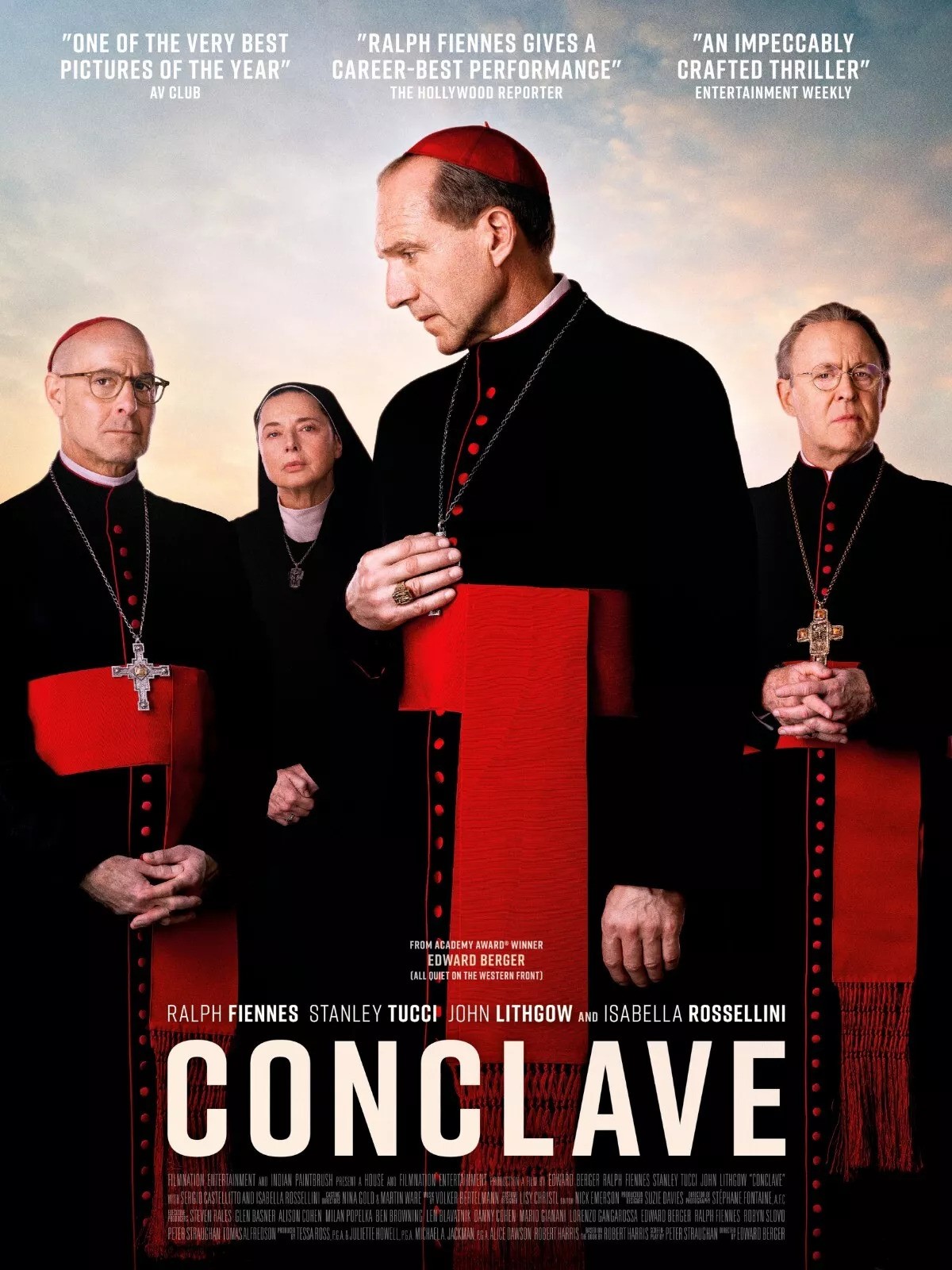
Our guide through the shenanigans is Lawrence (Ralph Fiennes), the dead Pope’s righthand man, who, although filled with his own doubts, is in charge of managing the actual election. He’s so self-effacing that it comes as something of a shock to him to discover that he’s one of the candidates. It’s a blind-voting system and continues until one person has secured 72 votes. As you might expect there’s wheeling-and-dealing with the liberal elements set against the more entrenched right-wing groups.

The main contenders are: Bellini (Stanley Tucci), favored by Lawrence, Tremblay (John Lithgow), Adeyemi (Lucian Msamati), a black African who would be a popular winner except for his stringent views on homosexuality, Tedesco (Sergio Castellito) who wants to cancel all the liberal developments of the Church in the last half century, and surprise packet Benitez (Carlos Diehz) from Afghanistan who represents the downtrodden that the rest of the high-living Cardinals appear to have forgotten.

You’re going to remember the twists more than any moral message. But it does allow time for debate of the major moral questions, mostly handled with subtlety. The Cardinals are all sequestered away from the outside world for the duration of the election. Turns out the deceased Pope was trying to rig the election to suit his own ends, conspiring against those Cardinals he felt were too ambitious, self-obsessed or had unsightly, but secret, stains on their characters.

For a holy fellow the dead Pope set some remarkable traps which leave Lawrence reeling. And as the election proceeds, Lawrence is revealed, on the one hand, to be quite a tough egg, like a good journalist determined to uncover the truth, but on the other hand given to bouts of crying as the weight of duty and expectation and, I guess, shock at the findings get to him.

This is quite an adult movie. Not in the sense that we’re dealing with a particularly controversial subject matter, but it’s a kind of courtroom drama in all but name, and except for the sprinkling of revelations, and the inherent tension of an election, apt to be slow moving, allowing characters time to breathe and to put various points across. The structure makes no concessions to the MCU generation. Nor to the traditional Hollywood approach which would have allocated a certain amount of time to tourist Rome. A couple of cheats – hidden documents, access to a computer when access to anything was denied – don’t get in the way.

I’m always worried when trailers concentrate on the number of Oscar winners or nominees involved because generally that suggests to me a weak narrative. But, in fact, two-time nominees Ralph Fiennes (No Time to Die, 2021) and John Lithgow (Interstellar, 2014), and one-time nominee Stanley Tucci (The Hunger Games, 2012) deliver terrific, largely understated performances, while director, also a nominee, Gerard Berger (All Quiet on the Western Front (2022) brings it together with a stately majesty.

He’s allowed himself a certain amount of self-indulgence. The overhead shot of the lines of Cardinals moving through the rain and carrying white umbrellas bears no narrative weight but is visually splendid. As if escaping from a more offbeat movie, turtles appear from time to time. The rigmarole of ritual is compelling.

Some scenes are conducted in Latin, with subtitles of course. Thank goodness, I know now what “in secula seculorum” now means. But you didn;t need to know back in the day. That was the point. It was like joining a secret society. The Catholic Church once had an unique ID that it threw away – the fact that all Masses were spoken in Latin, and therefore universally appreciated, and you could go to a Church in any country and understand what was going on, whereas now you’d need Google translate.

Screenwriter Peter Straughan (Tinker, Tailor, Soldier, Spy, 2011) is on something of a roll at the moment, his teleplay for Wolf Hall: The Mirror and the Light just out. Robert Harris, who’s not had much luck at the box office with the various movie interpretations of his bestsellers Enigma (2001), The Ghost Writer (2010), and An Officer and a Spy (2019) – banned pretty much everywhere because of Roman Polanski’s involvement –  gets his just reward here for laying down such a superb template. The music by Volker Bertelmann was particularly striking. Oddly enough his Oscar win for All Quiet on the Western Front didn’t warrant a mention in the trailer.

Thoroughly absorbing.
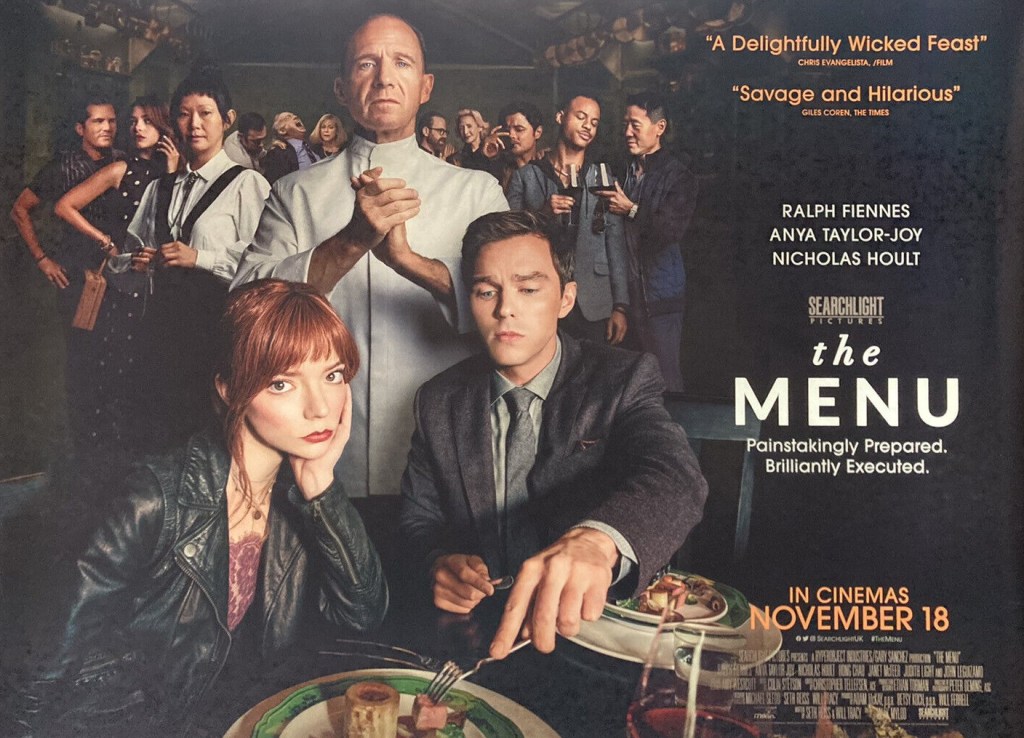
The Menu (2022) ***** – Seen at the Cinema

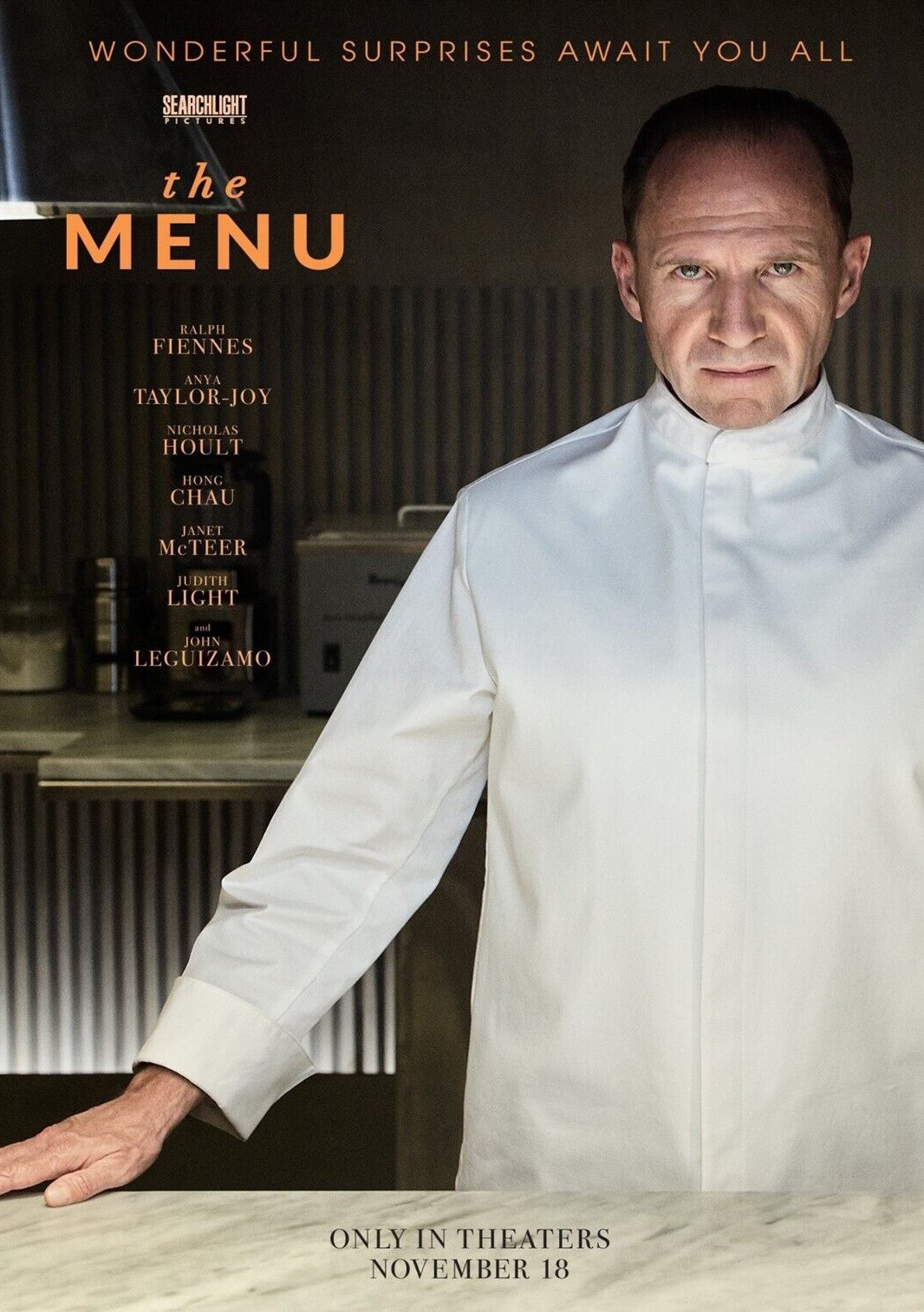
Hitchcock would have adored the apocalyptic flavour of this quasi haunted house psychological thriller. Setting aside its intellectual pretensions this is pure pedal-to-the-metal material. You never know what’s going to happen next in a tense environment created by dictatorial celebrity Chef Slowik (Ralph Fiennes) in whose eyes the entitled are likely to get their just desserts.

In most thrillers of this nature, the assorted bunch of potential victims usually attempt some kind of fightback, and they’re usually younger and sexier, but this crew are trapped in the headlights because they find it impossible to believe they could possibly be in the middle of a revolution.

The beauty of their dilemma is that Chef is trapped, too, by his desire for fame, suffocated by pursuit of perfection, but yet, as they soon come to realise, accepting punishment for his own sins (attempted rape for one). You might be fooled by the trailer into thinking there is a way out, if only a perilous one, but that’s a bit of a red herring, and as the tension grows you realise it’s heading for an incredible conclusion.

Only the rich can afford to visit this expensive restaurant on a secluded island. Most of the guests aren’t even interested in the food – that’s one strike against them – but for the experience of having said they’d been there or to, as is the prerogative of the wealthy, be pampered within a whim of their life, or to find something minute to complain about, a niggle guaranteed to cause grief.

Creepy though they are, Chef’s thunderclapping hands that demand guest attention, the cries of “Yes, chef” from his slave-like adoring workers, the detail of high-falutin’ cooking, history and ecology lessons, a ramrod sergeant-major of a maitre’d Elsa (Hong Chau), and occasional ironic twists – a bread course that contains no bread for example – are mere hors d’oeuvres for the main event.

Chef knows a tad too much about his guests’ peccadilloes – infidelity, financial irregularity – for their liking and as the evening out begins to turn into a cul de sac and shocking incident follows shocking incident, cowardice and lack of the kind of retinue that could come to their rescue, the guests can only watch as they are served up on a platter to a madman’s ideology.

Certainly, the format is exceptionally cinematic, sequences chapterized as menu courses, and the intellectual discussion that divides the world into the servers and the served well observed, but driving the thriller engine is the most refined nutcase this side of Hannibal Lecter, a thin-lipped specter at a feast of his own devising , a creator at the end of his tether, seeking revenge on those who quibble with his talent. And yet there is something  universal about this individual, a man scrabbling so hard to stay ahead of the game that he is almost on a par with Arthur Miller’s famed salesman. Is Chef doing much more than the culinary equivalent of “riding on a smile and shoeshine?”

The guests are the usual high priests of pamperdom, food critic Lillian (Janet McTeer), movie star (John Leguizamo) planning to revive his career by fronting a food show, simulating orgasm with every taste, a trio of young financiers, a couple who have come several times but can’t recall a single dish they’ve eaten, and foodie Tyler (Nicholas Hoult) accompanied by a mysterious woman Margot (Anya Taylor-Joy) who turns out to be in a different branch of the service industry.

British director Mark Mylod (Ali G in Da House, 2002, anyone?) has learned from helming episodes of Game of Thrones and Succession how to match reaction to incident. As much as Chef is in control in the restaurant, Mylod is in control of exactly what we see. There is none of the over-acting that appears to come with the territory, certainly no screams or titillation, not a whiff of cleavage, the usual recourse of a horror film run out of ideas, though, as with that genre, it is the sexually compromised who suffer first.

Mylod’s tight rein ensures shock is just an element of the overall effect, rather than its signature dish, and that all the ruffley-truffley culinary dialog only serves to heighten morbid  sensation.

Ralph Fiennes (The Forgiven, 2021) may well have delivered a career-best performance it is so constrained. Given equally little room to manoeuvre, little time for eye-rolling or exacerbated action, Anya Taylor-Joy is back to her The Queen’s Gambit (2020) best, while Nicholas Hoult (Those Who Wish Me Dead, 2021) adds sly deviance to  a screen persona that plays on innocence. It’s an astonishing screenwriter debut for television writers Seth Reiss and Will Tracy.

As it happens, I’m very familiar with the lives of chefs, having spent three decades working with them, initially as a cossetted observer, as journalists often are, being the fawned-upon editor of Caterer & Hotelkeeper, the hugely profitable industry trade weekly in Britain, with massive sales at a time when print was the dominant media, so much so that during my time we produced a world record (for a weekly) issue of 524 pages. But when I later set up the Scottish Chefs Association, whose board comprised all the top chefs in the country, and its offshoots the Scottish Chef Awards and a cookery school for chefs, I became privy to the fears and wonders of the cooking business. So I can attest to the fear and loathing for some customers and most critics, who seemed determined in the days before social media to spoil anything they could, or demand preferential treatment.

Certainly, the restaurant is a unique kind of business, food being cooked to order, “a la minute” as the saying went, and customers disrupting a tight ecology by simply turning up late, or early, or not at all. Customers were prone to theft, teaspoons in particular replaced on a titanic scale, and the litany of complaints could outweigh a Bible. Then, as now, reputation was everything, and could be destroyed by a food critic or word-of-mouth. It wasn’t just chefs who sought perfection, but customers, any deviation from expectation harshly dealt with.

Successful chefs with investors would find that somehow they saw little share of the profits. Chefs minus investors lived a precarious existence. Good reviews would  bring in bad customers, the kind who pored over every detail, like Tyler wanting to share their paltry culinary knowledge with the expert, needed extra attention, and came to say they had been there. But I can sympathise with Margot who felt she was being experimented upon rather than fed and can recall several times buying fish and chips immediately after dining in a Michelin-starred establishment.

I remember, too, industry astonishment that celebrity-chef-du-jour Anton Mosimann began the day by walking round the kitchen shaking hands with every chef, no matter their rank, rather than starting off their day with a rant. Kitchens are organised on a brigade system, obedience imperative, no questioning of authority. But rather than derogating talent as occurs here, many top chefs proved apt talent-spotters. The Roux Brothers, for example, created a magnificent template, finding backers among their appreciative wealthy customers for the young talent in their kitchens, which resulted in a new generation of chefs setting up in business without the usual financial woes.

In Britain and Europe, however, perfection could be achieved. If you reached the highest standards set by the Michelin Guide inspectors and were awarded the coveted three stars, the highest culinary accolade that could be bestowed, you had reached the top of the tree. You couldn’t relax because one or more of the stars could be taken away, but the kind of personal obsession that afflicts Chef here would be lessened. However, since very few chefs hit the three-star mark you have hundreds if not thousands beavering away trying to achieve it.

Triple Bill Blues: Fall (2022) ***; The Forgiven (2021) **; Three Thousand Years of Longing (2022) ** – Seen at the Cinema

You may be aware that I am partial to a triple bill on my weekly Monday trip to the cinema. I’m rather an indiscriminate cinemagoer and generally just see what’s available, though it’s true return trips to view Top Gun: Maverick have helped paper over cracks in the current distribution malaise. Sometimes a triple bill can reveal unsung gems, sometimes I am rowing against the critical tide in my opinions and sometimes, not too often thank goodness, I end up seeing movies with few redeeming qualities. That was the circumstance this week.

FALL

So now I know. If I need to get a mobile phone dropped 2,000 feet without it breaking into pieces, the thing to do is stuff it inside a cadaver. That’s one of the more outlandish suggestions in this climbing picture two-hander that for most of the time is quite gripping.

So as not to have to spend the first anniversary of her husband’s death sozzled in booze and despair, Becky (Grace Caroline Currey) agrees to partner YouTube click-hound Hunter (Virginia Gardner) in scaling an extremely high disused radio mast. Becky, a mountaineer, had watched her husband fall to his death, so is pretty iffy about the expedition. When they reach the top they can’t get down again since the ladder they climbed has disintegrated. Although there was mobile phone reception at ground level, there’s none this high up. Hunter has 60,000 followers and reckons if only her phone reached the ground it would automatically activate so they toss it down in a shoe stuffed with a bra.

That doesn’t work nor does firing a flare pistol to alert two guys in a nearby RV – all they are alerted to is the girl’s vehicle which they promptly steal. The girls are trapped without water or drone, both stuck 50ft below on radio dishes. At one point you think this is going to go in an entirely different – murderous – direction after Becky discovers Hunter had an affair with her husband. But they manage to get over that hiccup. Recuing their water and drone results in Hunter being out of action as far as further climbing goes and it’s up to Becky to reach the top of the mast and recharge the drone from the power there, fending off a passing vulture.

There’s definitely one weird bit where it turns out that Hunter, who you imagined was up there all the time supporting a defeatist Becky, is already dead. But, luckily, the corpse provides the cavity in which to bury the mobile phone. I’m not sure much of a human body survives a drop of 2,000 ft, certainly not enough to safeguard a phone, but that’s the way this plays out.

A great mountaineering film is always a welcome find in my book. This isn’t great but it’s certainly passable. And while Becky is more interesting than the gung-ho Hunter, the pair, emotions almost spinning out of control, make a very watchable pair.

Grace Caroline Curry aka Grace Fulton (Shazam!, 2019) does well in her first starring role and Virginia Gardner (Monster Party, 2018) is as convincing. Jeffrey Dean Morgan (Rampage, 2018) has a small role. A novel take on the mountaineering sub-genre, it’s kudos to director Scott Mann (Heist, 2015) – who co-wrote the screenplay with Jonathan Frank (Final Score, 2018)  that I spent a lot of time wondering just how the hell they managed to make it look so realistic.

THE FORGIVEN

Note to studios, no matter how much you plan to tart up a modern version of Appointment in Samarra – aka a tale of unavoidable fate – you ain’t going to get anywhere if it’s filled with entitled obnoxious characters. The worst of it is this is well-made.

Functioning alcoholic doctor David Henninger (Ralph Fiennes) knocks down and kills young Muslim boy Driss (Omar Ghazaoui) while on the way with wife Jo (Jessica Chastain) to a hedonistic weekend party in Morocco hosted by Richard Galloway (Matt Smith) and his partner Dally (Caleb Landry Jones). There are hints that Driss was planning to hijack the tourists, but while his death is deemed an accident by the local cops, David agrees to go back with the boy’s father Ismael (Abdellah Taheri) and observe the local funeral rites and possibly pay the father off.

While her husband is away Jo has a one-night stand with serial seducer Tom (Christopher Abbott) while the rest of the party – including Lord Swanthorne (Alex Jennings) and assorted beautiful men and woman – trade bon mots and make racist and sexist remarks. While the arrogant David changes his perspective and accepts his fate, there is not, himself included, a single likeable person in the whole of the tourist contingent which makes it impossible to care what happens to anybody. Written and directed by John Michael McDonagh (Calvary, 2014) it spends all its time trying to make clever points, not realizing the audience has long lost interest.

THREE THOUSAND YEARS OF LONGING

Note to studios, if you’re going to indulge an action director in a vanity project, make sure he hires actors who don’t just drone on. It might also help if the director could decide what story he wants to tell, and not essentially present a voice-over narrative of stuff that happened in the past, no matter how exotic the timescale.

I was astonished to discover there actually is a job called narratologist. Alithea (Tilda Swinton) is a dried-up old stick of a narratologist who summons up the dullest genie/djinn in movie history known – no names, no pack drill – just as The Djinn  (Idris Elba) who proceeds to bore the audience to death with his stories of how he came to end up in a bottle.  

There’s a bundle of academic nonsense about storytelling, a swathe of tales that sound like rejects from The Arabian Nights, and a lot of unconnected characters. The invention of director George Miller (Mad Max: Fury Road, 2015) just isn’t inventive enough and the visuals just aren’t arresting enough. I’m assuming this got greenlit on the basis Miller would turn in a couple more in the Mad Max franchise.

The Dig (2021) **

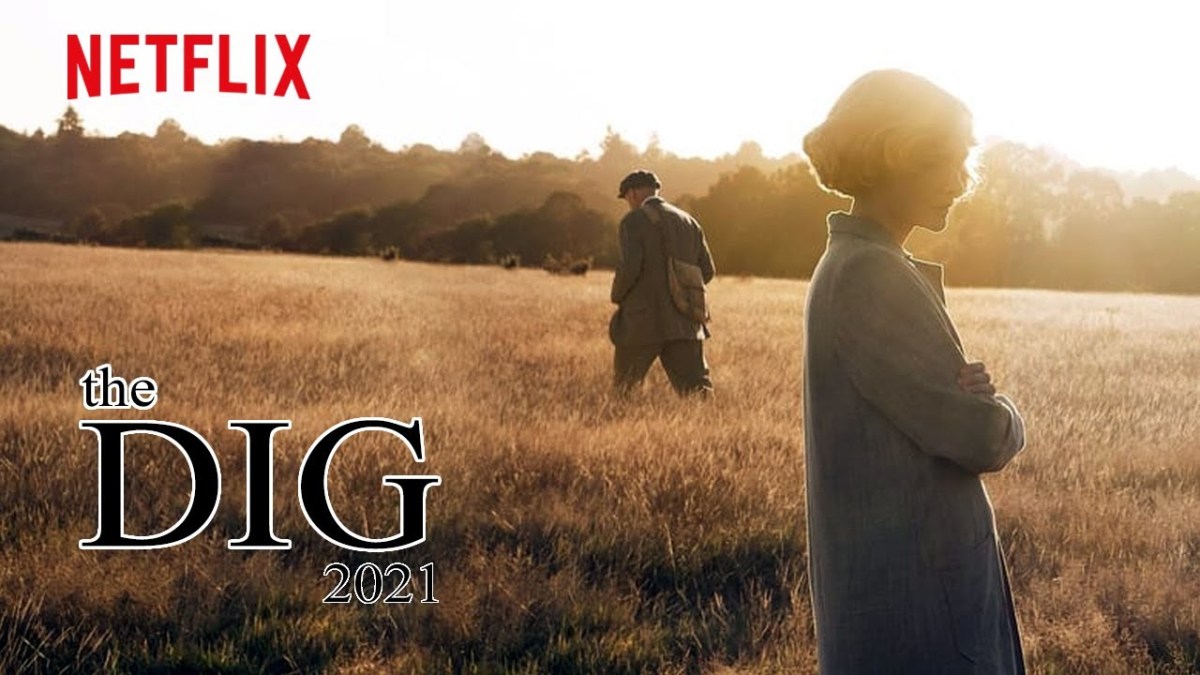
When stuck in a plot hole, crime writer Raymond Chandler used to send in a new character  with a gun. Director Simon Stone has employed the same concept, minus weaponry. People just keep turning up in The Dig, adding very little to the story, which in itself, setting aside National Trust hype, is on the slim side. A sixth-century Suffolk burial site (thought it does cast new light on the Dark Ages so we are told) is not in the same archeological class as a velociraptor or an Egyptian tomb.  Mostly, we are misled. For the first third it looks like we are heading for Lady Chatterley’s Lover territory with posh lady (Carey Mulligan) eyeing up the digger (Ralph Fiennes) until his wife turns up. Then it looks like it’s going to be a battle royal between Fiennes and the Establishment, but that is headed off.  

It’s 1939 so the Second world War is on its way. Cue the arrival of wannabe pilot (Johnny Flynn). A top archaeologist (Ken Stott) also appears but that doesn’t go anywhere either, bringing with him Ben Chaplin and Lily James fresh from their honeymoon. James gets the hots for Johnny Flynn and there’s just enough time before the credits roll for them to get at it.

This is the kind of film that has money to spend on an old WW2 aeroplane or maybe a CGI version of one but not enough for decent sound recording equipment. Most of the time conversations are over the shoulder or in long shot. It’s not just words, it’s expressions, faces that tell a story, and being denied these seems bizarre. It may be an artistic decision, some critic thought we were being made to “dig” for the story. But it’s hard enough to work up any enthusiasm without being made to work harder.

Ralph Fiennes is excellent, a son of the soil, self-taught, but no shrinking violet either. His scenes with posh lady’s son (Archie Barnes) are very touching, the young lad having invented a whole world for himself. Carey Mulligan just looks as though she’s about to burst into tears, probably wondering how she managed to be talked into playing (at age 34) a woman who was actually 56 at the time of the dig and wishing Nicole Kidman and Cate Blanchett (closer to that age) who were at one point attached had not left her to it.

The dig itself is interesting – but only for about five minutes. We know all we need to know about the boring sifting and brushing and digging from other films and we don’t learn more from this except how easy it is for a wall to suddenly collapse and nearly kill someone.

The most intriguing part of the film came at the end when we discovered that the burial ship dug up was buried for the duration of the war in an Underground station in London. How did they manage that, I wondered. Whereas I didn’t wonder much about anything else in this film.  

https://www.netflix.com/gb/title/81167887

Discover WordPress

A daily selection of the best content published on WordPress, collected for you by humans who love to read.

The Atavist Magazine

by Brian Hannan

WordPress.com News

The latest news on WordPress.com and the WordPress community.