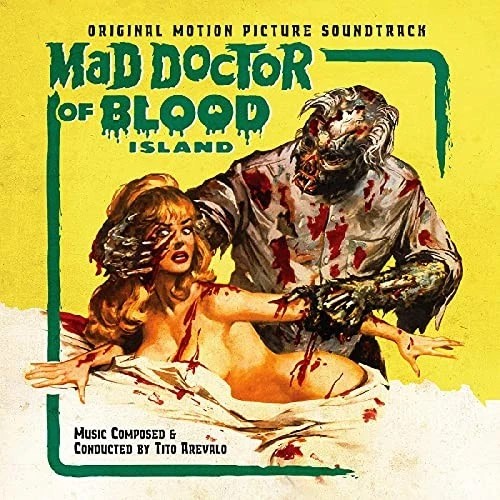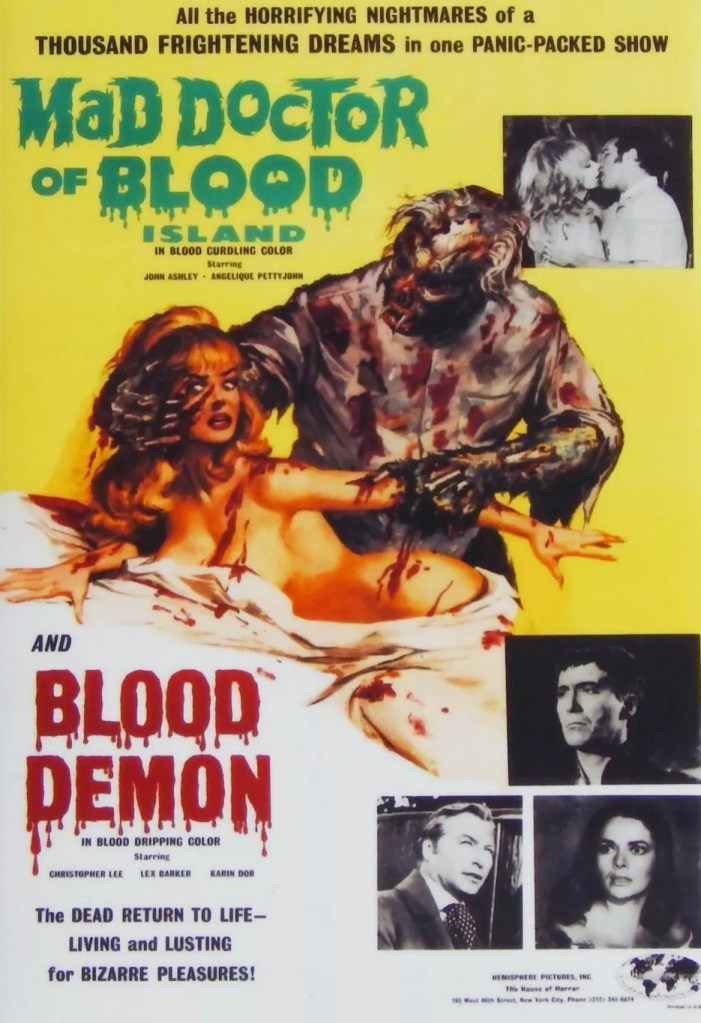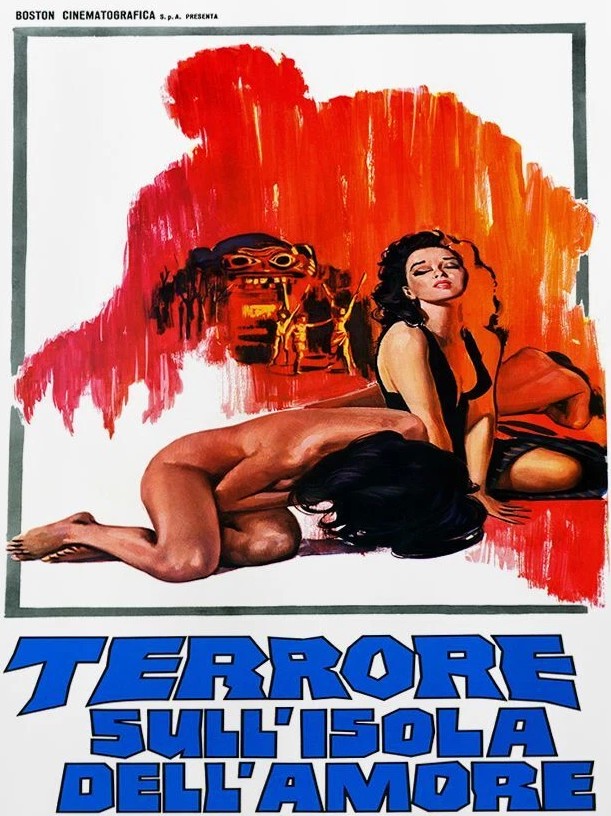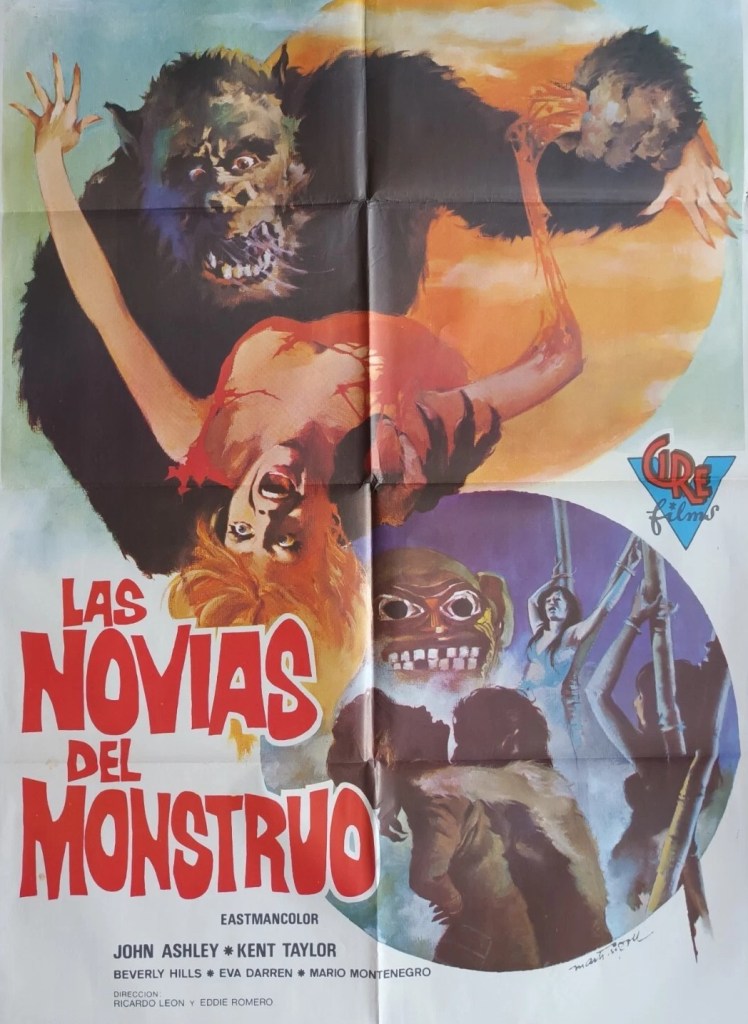
Brides of Blood (1968) ***

More than passable low-budget horror effort taking in atomic bomb mutation, human sacrifice, killer trees, giant moths and cockroaches and a fairly decent monster. Given the budget, the special effects are fine. The fact that it was shot in the Philippines gives the jungle scenes more validity. And while the main characters are submerged in exposition that still leaves room for a sassy flirtatious wife to snare all the best lines and for the guy whom we expect to be the villain of the piece to turn out to be the tragic one.

Scientist Dr Paul Henderson (Kent Taylor), wife Carla (Beverley Hills) and do-gooder Jim (John Ashley) arrive at the “wrong time” on a remote Pacific island which has reverted to primitivism. This is kind of place where sunset arrives too early and land crabs assume bizarre shape. Dr Henderson is here to assess the potential effect of radiation from A-bomb tests nearby. Jim is here to help build health centers,  schoolhouses and to explain the benefits of irrigation. Carla is here to make fun of her older husband, flirt with any fit male and give in to advances.

They encounter a piano-playing rich American Powers (Mario Montenegro) who employs an overseer given to savagery. But despite his name, Powers isn’t the power in these parts. The local witch doctor is, and the island is already knee-deep in human sacrifice. Local girls have to do the equivalent of pick their names out of a hat to see who will be sacrificed next.

The new arrivals try to intervene but fail and their nerve is tested when trees with serpentine branches try to strangle them to death. Jim has enough time to fall for an islander, Alma (Eva Darren), which is just as well because, eventually, she needs an outsider to rescue her from the sacrificial cross. Carla has enough time to slip into Powers’ bedroom not realizing he’s in the process of mutation – his wife died in horrible circumstances after their yacht strayed too close to the atomic test grounds – and when she ventures outside runs into the monster making up for lack of sacrifice being laid out on a plate (I mean, a cross).

While Henderson and Farrel verge on cliché, and 1950s cliché at that, Henderson with his pencil-thin action-man Clark Gable moustache, and Farrell with ingenue written all over him, Carla is a different kettle of fish, blonde hair mounted in a beehive, bosom heaving at every opportunity, and she’s sassy enough to put her husband in his place and introduce inuendo at every opportunity, and inclined to indicate passion by stroking the bedpost, and looking as if she’s auditioning for a femme fatale role in film noir.

For exploitation purposes, it’s lucky that the monster prefers his victims naked.

All in all entertaining hokum. And it must have done well at the box office because it spawned another three. John Ashley (Young Dillinger, 1965) went on to have a bigger career as a producer. Kent Taylor (Law of the Lawless, 1964) was at the tail end rather than the beginning of his career. Miss Beverley Hills (she won a beauty competition of that name) changed her name to Powers without any more significant effect on her career.

Philippine ambassador’s son Eddie Romero (Black Mama White Mama, 1973) directed along with compatriot Gerardo de Leon (Women in Cages, 1971) from a script by Cesar Amigo (The Hunted, 1970).

Better than I expected. Quite fun, really. YouTube has a decent print.

The Extraordinary Seaman (1969) **

It wouldn’t be the first time that a director, disgruntled by his fee or some snit with the producer, was wrong in his summation. But John Frankenheimer’s pronouncement that it was “an absolute disaster from beginning to end” is only slightly off the mark. It only really comes apart mid-section when you discover what makes the British Lt. Commander Finchhaven (David Niven) anything out of the ordinary.

Up till then it resembles a decent enough riff on The African Queen (1951), the bearded Finchhaven perennially drunk though not wild-eyed and disorderly like Humphrey Bogart, and take your pick from Lt Krim (Alan Alda) or Jennifer (Faye Dunaway) as the character trying to keep him on the straight and narrow. Instead of being sharp-tongued, Jennifer is a sharp-shooter.

And if anyone’s in the habit of communing with God, it appears to be the British captain. And it’s a bit more upscale, Finchhaven in charge of a ship – the oddly named HMS Curmudgeon, which should give you a hint all is not fine and dandy –  rather than a small steamboat.

But he’s stranded on a Philippine island towards the end of World War Two when rescued by four U.S. Marines who themselves have been uncommonly detached from their vessel during a lifeboat exercise in the fog.

But there is more than enough talent assembled to keep any seagoing yarn shipshape. You wouldn’t discount an immediate return to form, despite flopping with The Fixer (1969), by director John Frankenheimer, a huge name after The Manchurian Candidate (1962), Seven Days in May (1964) and Grand Prix (1966) though you might have worried a tad since comedy did not appear to be his forte.

David Niven, whose war movie credentials were still held in high regard after The Guns of Navarone (1961), had resurrected a fading career with unexpected hits The Impossible Years (1968) and Prudence and the Pill (1968) while Faye Dunaway was riding extremely high in Hollywood following the double whammy of Bonnie and Clyde (19670 and The Thomas Crown Affair (1968) and a pre-Mash Alan Alda was a rising star.  

Cut off from contact with either British or American forces, and unaware of Hiroshima turning the tide in the Far East, Finchaven and Co (Krim has three buddies) set off in pursuit of the enemy. If anybody is the odd one out at this point in proceedings, you would put your money on Krim who is liable to fall overboard with every turn of the wheel.

But before they get anywhere near the kind of action that typified The African Queen or the later The Sea Wolves (1980 – also starring Niven), there’s the big reveal. Krim is puzzled that the captain never seems to eat and continues to drink constantly despite no sign of any obvious supplies, doesn;t require sleep or to launder his uniform. Krim would never get his detective’s badge, his suspicions are only really raised when he discovers an old photograph of the captain, dated 1914, and when Finchhaven’s empty whisky bottle miraculously refills.

Finchhaven is a ghost. Yep. Have you ever? Nope. The dumbest notion ever to set sail or be funded by a major studio. His back story is worth the price of admission alone if you have your heart set on the so-bad-it’s-good fraternity. He died, wait for it, at the start of World War One, when he fell overboard drunk on this very ship and is condemned, so it would appear, to a hellish life of captaining the ship.

Well, after that, you just couldn’t care less.

You might have already begun to get itchy feet by the constant barrage of newsreel or stock footage interjections, presumably offered as social and/or comic commentary, or perhaps to augment the length which stands at a very neat 80 minutes, somewhat short of the standard feature. Or the fact that after demonstrating her shooting skills, Dunaway gets nothing more to do.

On the plus side, which is still stretching it a bit, David Niven makes a believable ghost, not existing in an imaginary world of his own making, behaving in every way as a normal ship’s master. And Alan Alda gives glimpses of his somewhat unique screen persona. This might have worked on paper – the source is a novel by Phillip Rock – but Frankenheimer makes a pig’s ear of translating it to the screen.

I’m still toying with giving this a one-star review.

Discover WordPress

A daily selection of the best content published on WordPress, collected for you by humans who love to read.

The Atavist Magazine

by Brian Hannan

WordPress.com News

The latest news on WordPress.com and the WordPress community.