The Brides of Fu Manchu (1966) ***

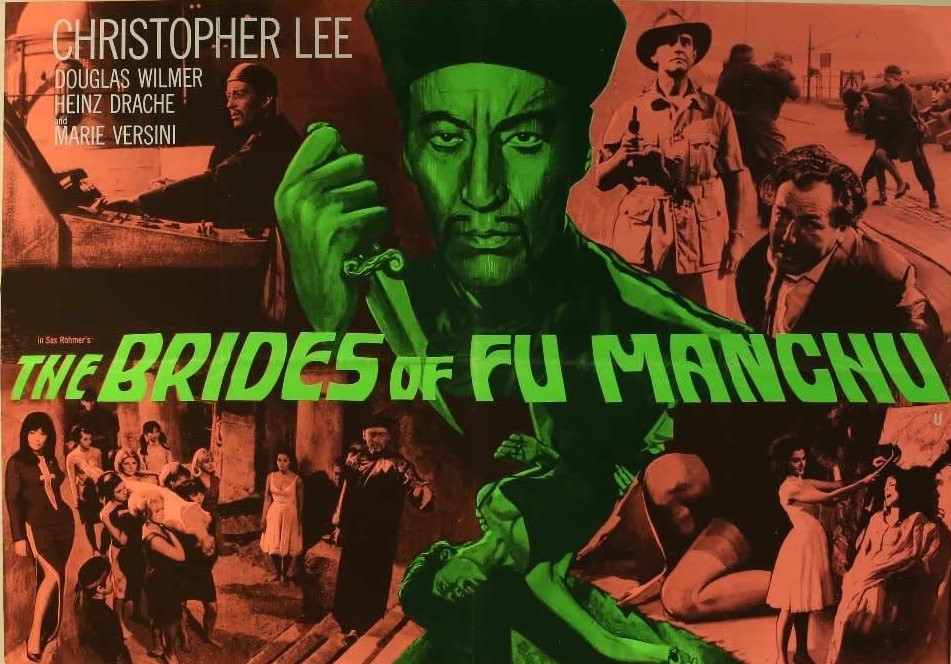
The 1960s was awash with movie megalomaniacs, most courtesy of the spy vogue. You could also count on secret agents for trailing in their wake bevies of beauties. So no surprise then that criminal mastermind Fu Manchu (Christopher Lee) has his own gang, his “brides,” although they are hardly volunteers, being the kidnapped daughters of top scientists. His plan for global domination this time consists of transmitting energy as sound waves, using miniaturization, a sonic death ray, with enough power to destroy a city.

The result is good hokum, a thriller set in the 1920s with a cracking pace, plenty of action, explosions, burgeoning romance, and a plot that gets more complicated by the minute as a tribe of worthies try out to outwit the evil genius. There is a terrific lair – where the disobedient end up in a snake pit – a passable laboratory, chases, truth serums (“the dust that loosens tongues”), hypnotism, bait-and-switch tricks and decent special effects.  Three stories race along in a parallel pell-mell: Manchu needs one more kidnapping to complete his complement of daughters, while the good guys headed by Fu Manchu’s old adversary Nayland Smith (Douglas Wilmer) are trying to locate the bad guy’s secret location while at the same time attempting to find out where he will strike next. 
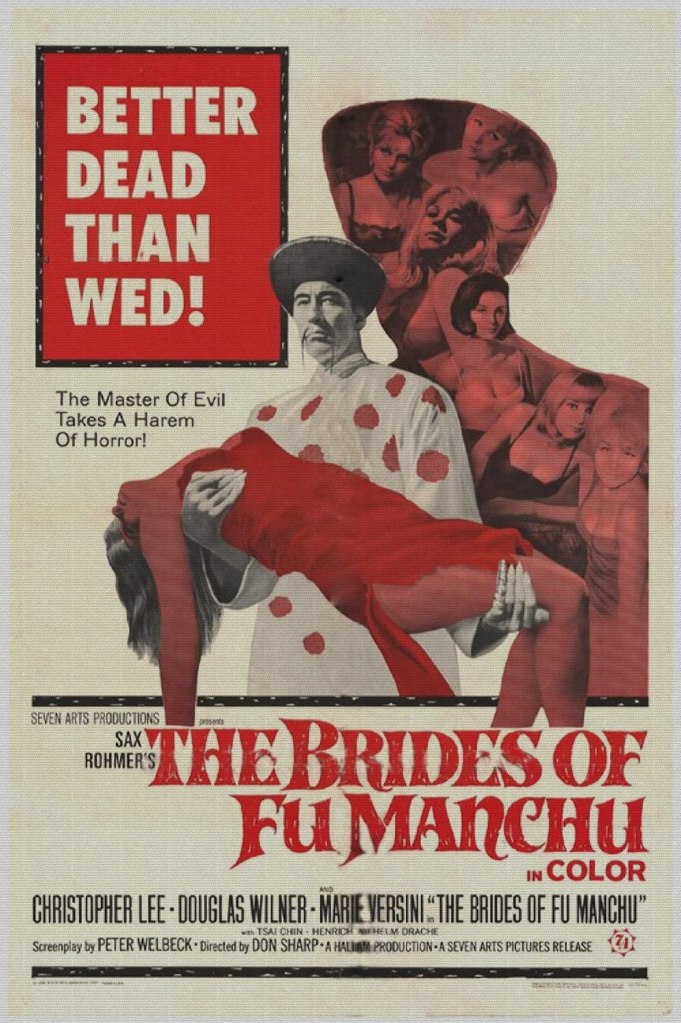
While Fu Manchu is indestructible – supposed dead after the previous film – his henchmen (and henchwomen) are all too human. It takes three attempts to kidnap Manchu’s next victim. They are easily identifiable by their giveaway cummerbunds and bandanas and their method of assault is not kung fu but brawling so a good solid British punch of the old-school soon sorts them out. Manchu’s daughter Lin Tang (Tsai Chin) is a chip off the old block, delighted at any opportunity to torment the brides.  

The brides, in diaphanous gowns that might have been a job-lot from the set of She, are far from compliant, even rebelling at one point, and employing vicious fight tactics. Fans of director Don Sharp will find him every bit as inventive as in The Devil-Ship Pirates (1964) and  Bang, Bang, You’re Dead  (1966) . It’s another Harry Alan Towers (written under his pseudonym Peter Welbeck) effort so that means an international cast.

Two television cops, British Rupert Davies (BBC’s Maigret) and German Heinz Drache (cop in a Francis Durbridge series), plus Francois Mitterand’s brother-in-law Roger Hanin, provide solid support. Not forgetting Burt Kwouk as a henchman. Brides of the year include French Marie Versini (German western Winnetou, 1963) and Rhodesian Carole Gray (Curse of the Fly, 1965). The film did not prove much of a jumping-off point for other brides such as Ulla Berglin, Danielle Defrere and Anje Langstraat, for whom this debut was as far as their careers went.

Christopher Lee, despite the dodgy moustache, is resplendent, exuding evil, and with a gift for rising again (just like Dracula) as he would do for another three films in the series.
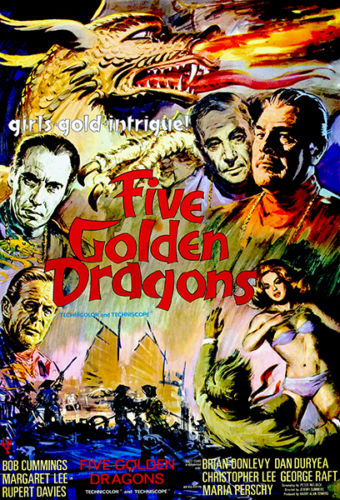
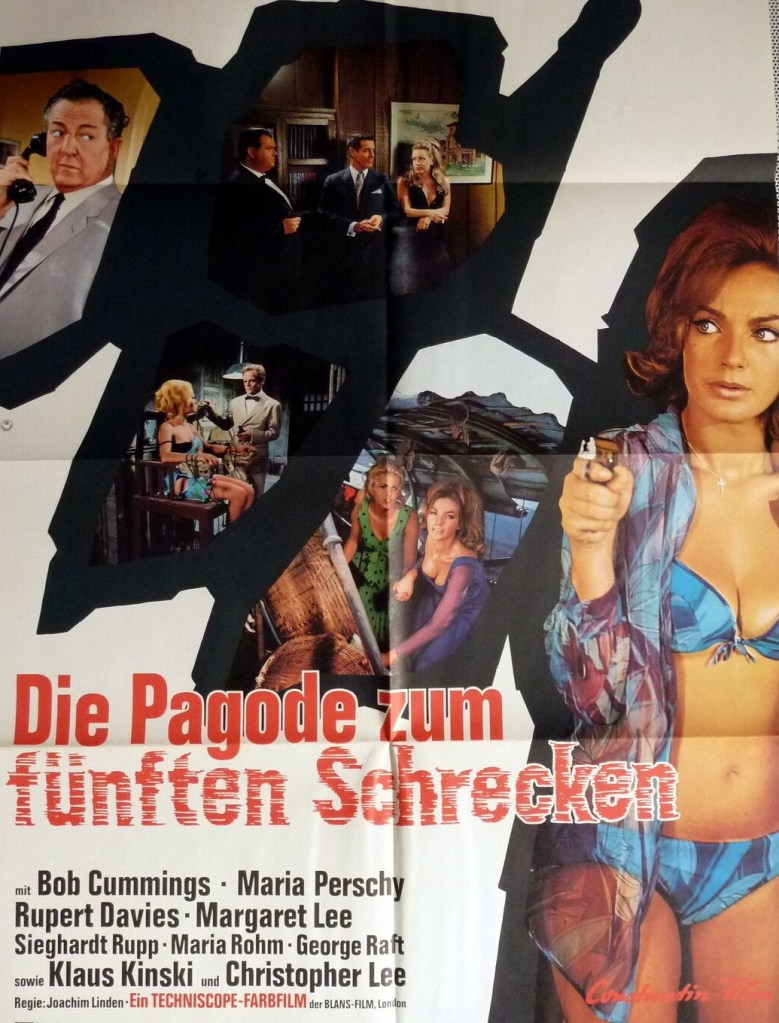
Five Golden Dragons (1967) ***

Producer Harry Alan Towers, himself something of a legend, had put together a quite superb cast – rising Eurostar Klaus Kinski (A Bullet for the General, 1967), Hollywood veterans Robert Cummings (Dial M for Murder, 1954), George Raft (Scarface, 1932), Dan Duryea (Black Bart, 1948) and Brian Donlevy (The Great McGinty, 1940) plus British horrormeister Christopher Lee and Rupert Davies (television’s Maigret). Throw in Margaret Lee (Secret Agent, Super Dragon, 1966) and Austrians Maria Perschy (Kiss, Kiss, Kill, Kill, 1966) and  Maria Rohm (Venus in Furs, 1969).

And all in aid of an enjoyable thriller set in Hong Kong that dances between genuine danger and spoof. I mean, what can you make of a chase involving rickshaws? Or a race over bobbing houseboats parked in a harbor? There’s a Shakespeare-quoting cop Sanders (Rupert Davies) whose sidekick Inspector Chiao (Tom Chiao) often out-quotes him. And there’s British-born Margaret Lee, a cult figure in Italian circles,  belting out the title song and just for the hell of it Japanese actress Yukari Ito in a cameo as a nightclub singer.

A newly arrived businessman is chucked off the top of a building by an associate of gangster Gert (Klaus Kinski)  but not before leaving a note that falls into the hands of the police. The note says, “Five Golden Dragons” and is addressed to playboy Bob (Robert Cummings) for no particular reason. No matter. A MacGuffin is still a MacGuffin, and probably best if left unexplained.

Bob is soon involved anyway after falling for two beautiful sisters, Ingrid (Maria Rohm) and Margret (Maria Perschy). Turns out Margret knows more about Bob than he would like, and knows too much for her own good, namely that the titular dragons are the heads of an evil syndicate, specializing in gold trafficking, meeting for the first time in Hong Kong in order to organize the handover of their empire to the Mafia for a cool $50 million  

In a nod at the spy genre, there are secret chambers opened by secret levers. There are double-crosses, chases, confrontations, not to mention a a trope of sunglasses being whipped off, voluntarily I might add.  Apart from breaks here and there for a song or two, director Jeremy Summers (Ferry Across the Mersey, 1964) keeps the whole enterprise zipping along, even if he is stuck with Cummings.

In truth, Cummings (Stagecoach, 1966) is a bit of a liability, acting-wise. While the rest of the cast takes the film seriously, he acts as if he’s a Bob Hope throwback, cracking wisecracks when confronted with danger or beautiful women, or, in fact, most of the time, which would be fine if he wasn’t a couple of decades too old (he was 57) to carry off the part of a playboy and if the jokes were funny. 

Towers (under the pseudonym Peter Welbeck responsible for the screenplay, loosely based on an Edgar Wallace story) was a maverick but prolific British producer who would graduate to the likes of Call of the Wild (1972) with Charlton Heston but at this point was churning out exotic thrillers (The Face of Fu Manchu, 1965) and mysteries (Ten Little Indians, 1965) and had a good eye for what made a movie tick. This one ticks along quite nicely never mind the bonus of a sinister George Raft and the likes of Margaret Lee and Maria Rohm (Towers’ wife).

Cult contender that doesn’t take itself too seriously.

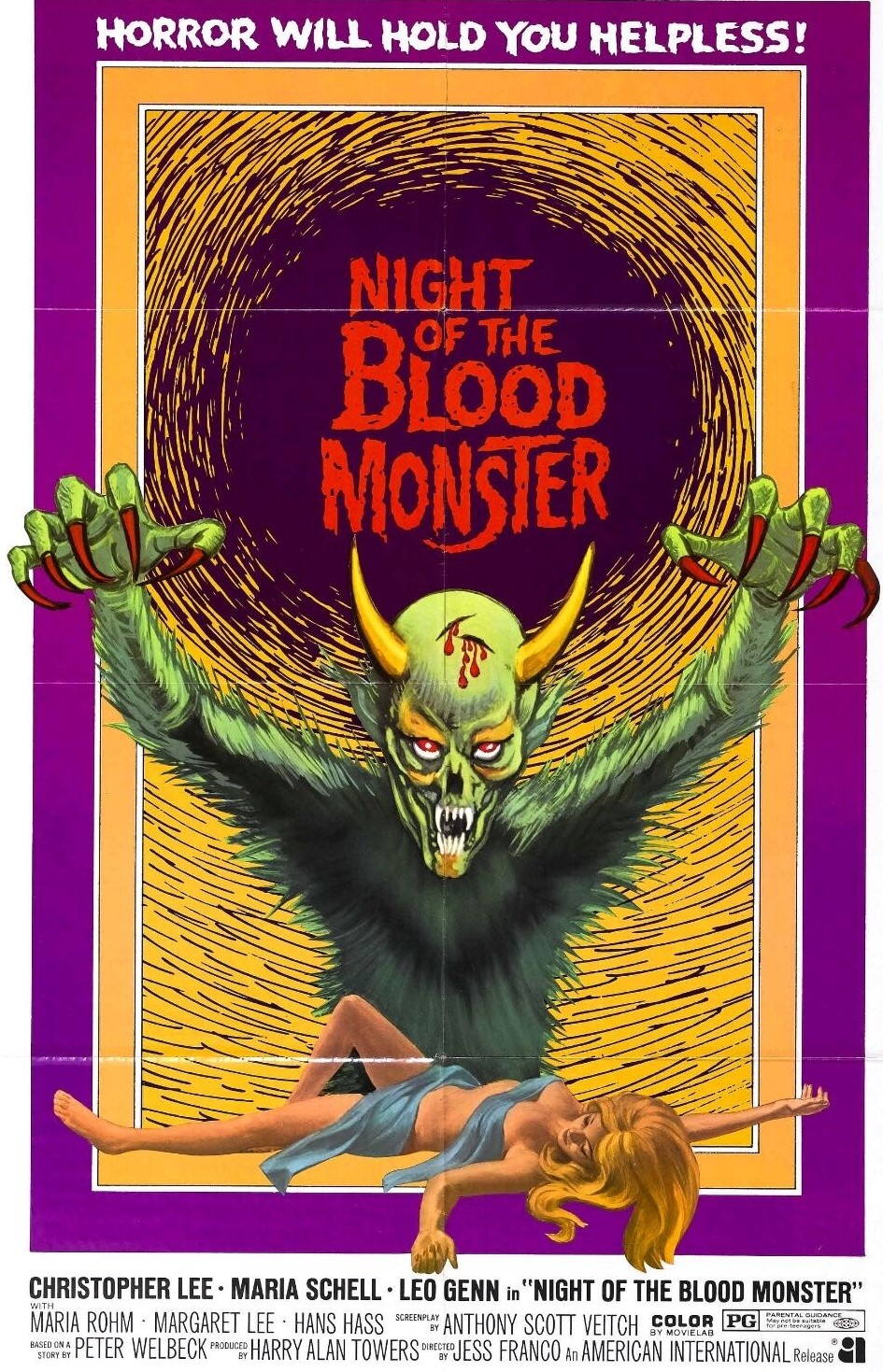
Night of the Blood Monster / The Bloody Judge (1969) ***

Handsomely mounted historical drama set in 17th century England on the brink of revolution  meets Son of Witchfinder General. An uprising headed by the Duke of Monmouth in the south-west threatens to overthrow King James II. Involved in the plot are Harry Selton (Hans Hass), son of suspected agitator Lord Wessex (Leo Genn), whose beloved Mary Gray (Maria Rohm) is in the sights of Judge Jeffreys (Christopher Lee) after he has condemned her sister Alicia (Margaret Lee) to be burned as a witch.

The minute witchcraft enters the equation the narrative thrust is constantly interrupted by scenes of nudity, blood and torture, mostly involving women, but actually the film does attempt to cover the rebellion and its notorious aftermath when hundreds of rebels were executed, the “Bloody Assizes” with “Bloody Judge” Jeffreys to the fore. Conflating witchcraft with a genuine historical episode does not work very well and unlike Witchfinder General (1968), the murder of innocent women is more of a sideshow, despite the brutality involved, and you get the impression the story has been hijacked to accommodate supposed witch Mary in the interests of adding titillation.

Even as the story of the rebellion unfolds, the threat to the crown spelled out, the origins of the revolt mostly made clear (Monmouth being the illegitimate son of Charles II, and nephew to James II) although the sectarianism behind the rebellion is ignored, the narrative keeps jumping back to the witch element. Jeffreys connects the parallel narratives, hunting down rebels and witches, while handling most of the exposition. Given the budget, there’s a surprisingly good battle sequence, cavalry charging cannon. Given his later reputation, Jeffreys also reflects on the meaning of justice.

And while there are some camp moments – Jeffreys playing the organ while attired in grand robes, dancing girls sticking pins in his effigy – the twists and turns (Mary captured and rescued, captured again)  are effective enough. Despite the copious nudity, there a couple of low-key love scenes and, oddly enough, a touching moment when Mary licks the blood from a dead prisoner. And for all the blood, that is effect rather than cause, nothing too gory.

But with the powerful all-mighty, and investigators able to plant evidence, and the innocent forced into immoral acts to save their loved ones, lawlessness is apparently next to godliness. But in reality the wicked did not get away with their crimes so various villains get their come-uppance.

Most peculiar sight is Christopher Lee in a love scene where he is not about to sink his incisors into a neck. Occasionally, the film bursts into German with English subtitles – as if various versions were pillaged to produce this copy – or has lines like “you turn me on.”

However, fans of Spanish cult director Jess Franco (The Girl from Rio) who expected something more along the lines of 99 Women (1969) and Venus in Furs (1969) may be disappointed that he spends so much time on the historical elements and less on the random T&A. You might not be surprised to learn of the involvement of ubiquitous producer Harry Alan Towers (Five Golden Dragons, 1967).

Discover WordPress

A daily selection of the best content published on WordPress, collected for you by humans who love to read.

The Atavist Magazine

by Brian Hannan

WordPress.com News

The latest news on WordPress.com and the WordPress community.