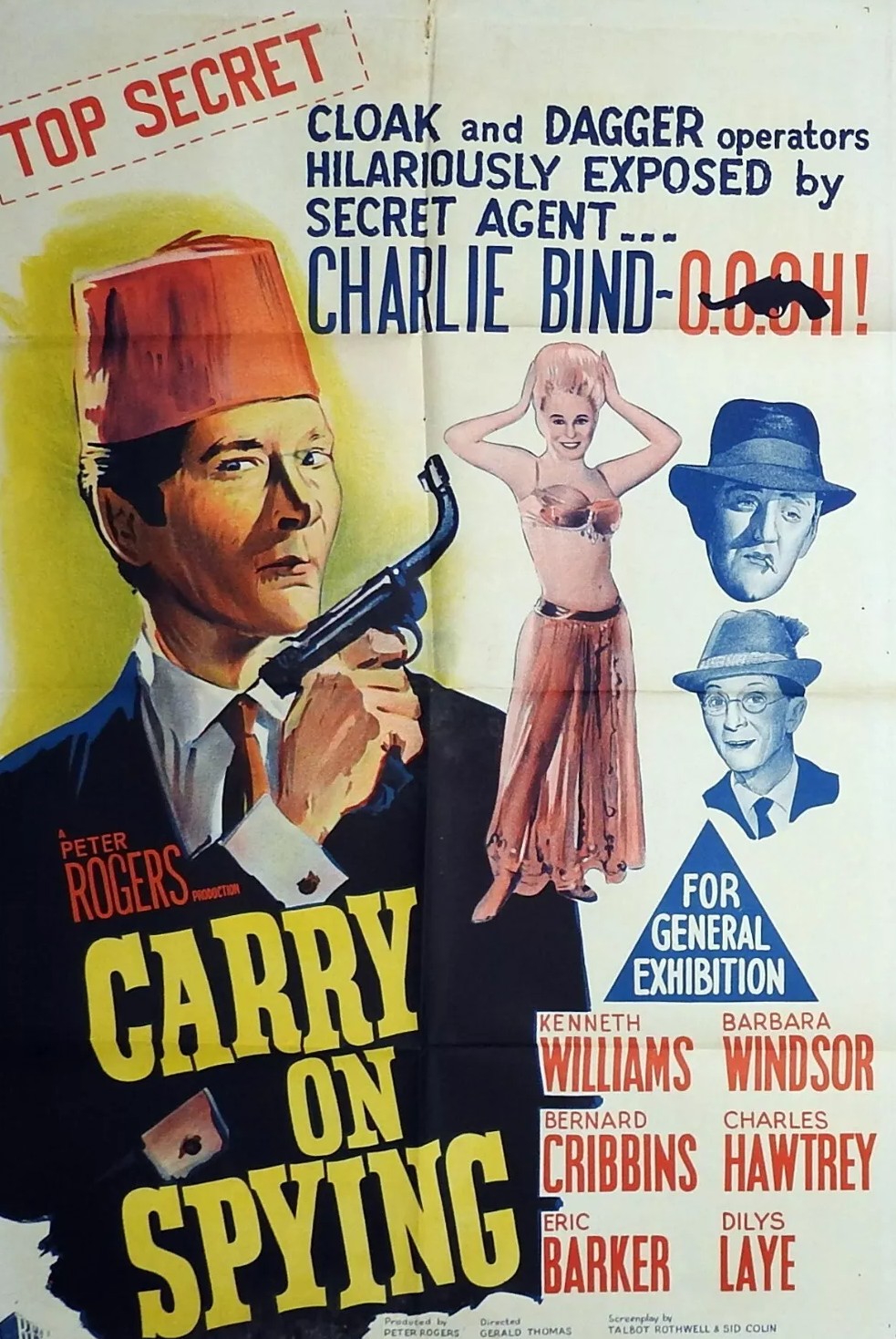
Carry On Spying (1964) ***

The potential for leering – given the squads of bikinied beauties, cleavage abounding and partial nudity a prerequisite in the standard James Bond picture  – could have gone into the stratosphere. So it’s to the producer’s credit that they opted to drop ogler-in-chief and Carry On perennial Sidney James from this enterprise. So, automatically, there’s more of a gentler  Ealing or Doctor in the House vibe to the satire.

Given the propensity for inuendo and said ogling, there’s a general perception that doesn’t stand up to scrutiny that women in this series are portrayed as objects existing solely for the pleasure of men. However, as here, women are often in charge and certainly more sensible than the males.
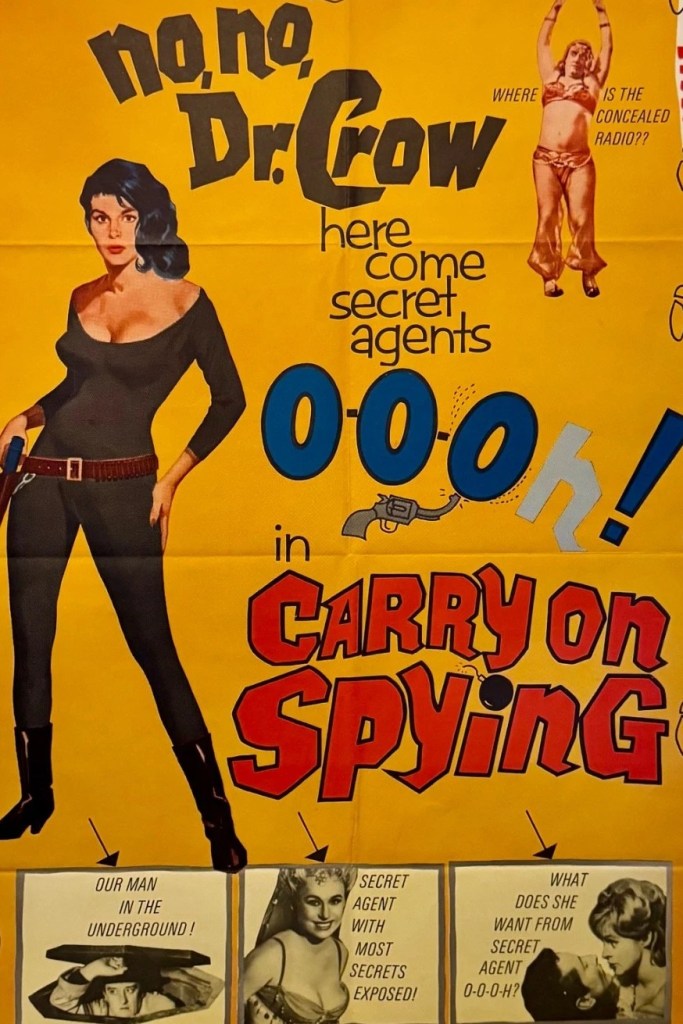
Here dumb Desmond Simpkins (Kenneth Williams), dumber Harold Crump (Bernard Cribbins) and dumbest Charlie Bind (Charles Hawtrey) are easily put in the shade by fellow spy Daphne Honeybutt (Barbara Windsor), she of the photographic memory, and deadly enemy Dr Crowe (Judith Furse) who has the sense to steer clear, unlike James Bond’s deadliest enemies, of cats and heads up an organization called STENCH.

And while generally the focus of the fun is the James Bond series – of which only two at this point had been made – the movie also draws on antecedents such as The Third Man (1949) and, dare I say it, Casablanca (1942) and film noir. And there’s an acceptance that Britain has not shot to the top of the espionage premier league courtesy of one bed-hopping spy but is more likely to drown in officialdom and inefficiency.

We begin with a particularly British joke that a milkman would have access to even the most top-secret laboratories simply because every living person in the country can’t do without their daily hand-delivered pint of milk, thus permitting an enemy secret agent in the most simple of disguises to nip in and steal a top secret formula and blow up the lab.

The four agents are despatched to Vienna, primarily so the movie can take advantage of jokes about sewers and zithers a la The Third Man, and prove how inadequate our quartet actually are. From there, they hare over to Algiers, because that’s the kind of locale where Crump and Honeybutt can infiltrate a club disguised as belly dancers. Naturally, they are captured by STENCH and while enemy agents are often as comfortable in bikinis and the cleavage-showing malarkey here the females, while wearing skintight outfits, reveal no flesh, and there’s – shock! horror! – no ogling.  
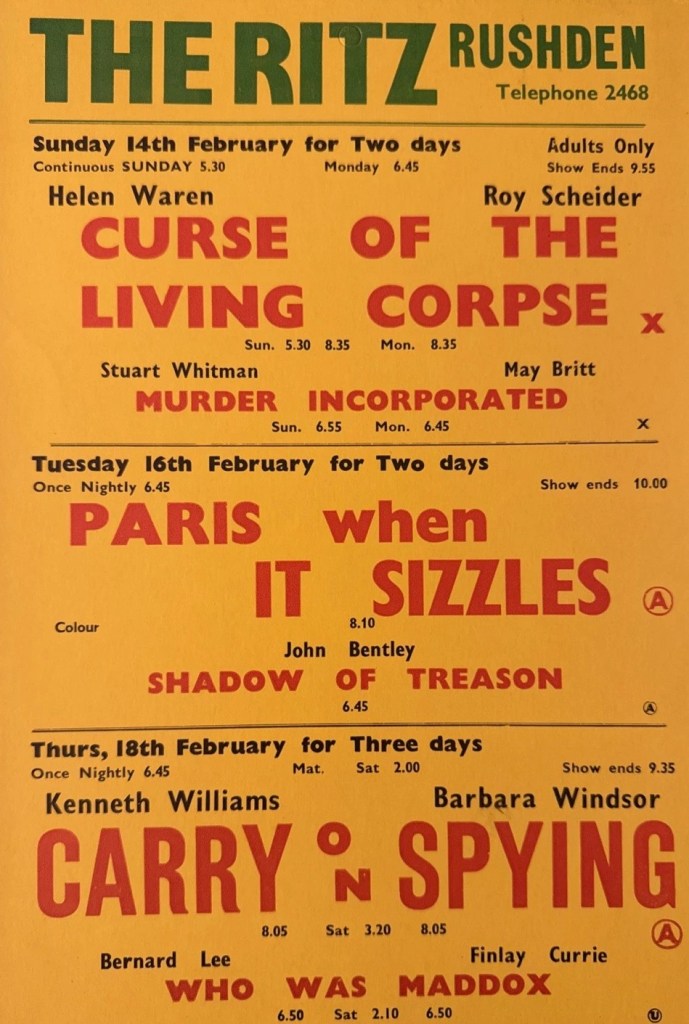
Typical British small town cinema requiring three changes of program a week to survive. Generally, horror pictures were limited to single showing on a Sunday, but that was when cinemas screened oldies. This one was contemporary and yes that’s Roy Scheider from “Jaws.” The movie expected to be most lucrative played the weekend. Public response to “Paris When it Sizzles” was as poor here as anywhere else, thus the midweek slot.

There’s a very humorous twist on the trope of a spy eating top secret material wherein our quartet need soup and bread to help it go down. However, there’s a clever reversal when Honeybutt’s photographic memory, allowing her to instantly recall the secret formula, makes her prey to Dr Crowe.

There’s a stab at romance, although hapless males Simpkins and Crump are ill-prepared to deal with the advances of, respectively, double agent Lila (Dilys Laye) and Honeybutt. Pratfalls are limited though Inspector Clouseau would have welcomed the comic relief afforded by doors.

This was Barbara Windsor’s first Carry On venture. Most of the rest of the cast were series regulars and pretty much played the characters they always play.

Cleaner fun than it might have been had Sid James headed the cast. One of the better spoofs in the series. Directed as usual by Gerald Thomas and written by Talbot Rothwell (Three Hats for Lisa, 1965) and Sid Colin (Up Pompeii, 1971).

Well up to standard.
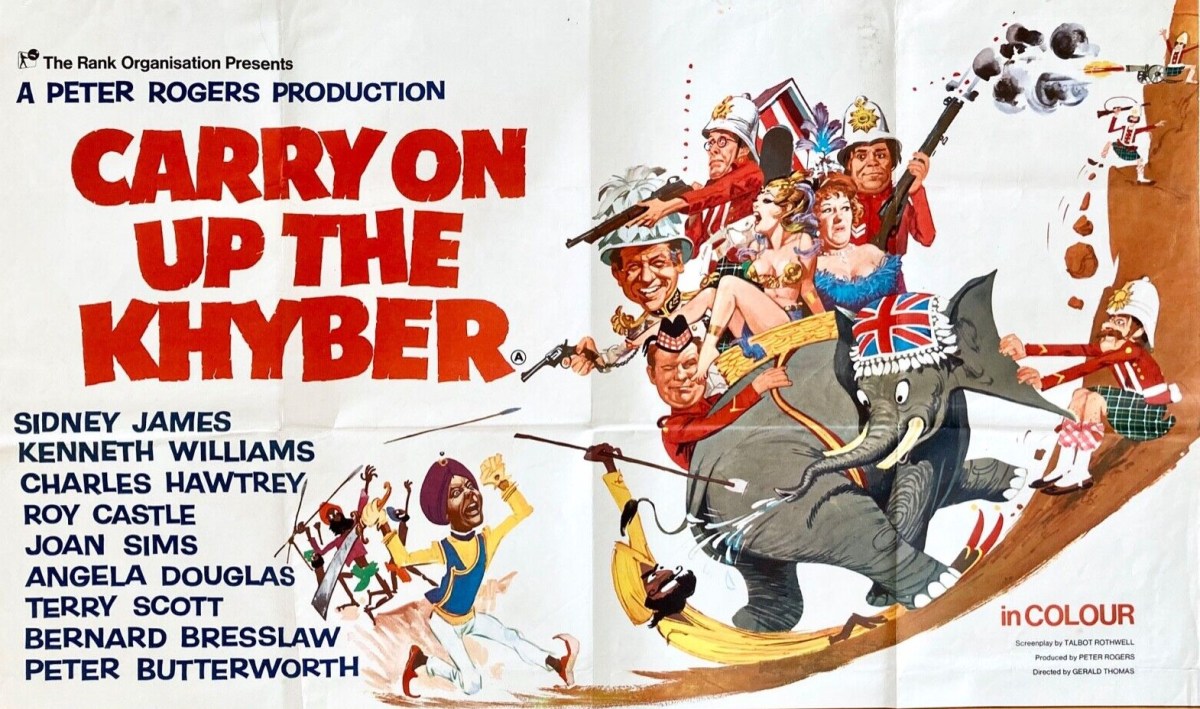
Carry On Up the Khyber (1968) ***

After a spate of serious pictures I thought I’d treat myself to some lighter fare and indulge in double entendres and lavatorial humor. I didn’t realise I had picked the only Carry On picture with serious undertones, exploring the hypocrisy endemic among leadership as much as witnessed in The Charge of the Light Brigade (1969), taking a distinct anti-colonial stance, and poking fun at military inefficiency.  

Despite the need to keep up appearances, British governor Sir Sidney Ruff-Diamond (Sidney James) despises Indian counterpart The Khasi of Kalabar (Kenneth Williams), the truth of their feelings towards each other revealed in muttered asides. Appearances are all that stand between the British and an Indian revolution, the natives fearing the Scottish regiments, the famed kilt-wearing “devils-with-skirts.”

The notion that any army would run a mile from a pair of bollocks – unless of course they had the faint-inducing dimensions of a Thor – is of course bollocks but that’s the film’s central conceit. But when the Indians discover that the British actually wear cotton undergarments as protection against the windy privations of the northernmost parts of the country, and, through the treacherous Lady Ruff-Diamond (Joan Sims), gain potential access to photographic proof, the status quo is threatened.

Lady Ruff-Diamond, furious at her husband’s constant infidelities, has set her eye on the Khasi, and is willing to betray her country for a bit of what could be termed “the other.” A squad of the usual British misfits, despatched to recover the incriminating evidence, naturally enough finds itself in a harem while Sir Ruff has to keep the British end up by entertaining native lasses by the score (he keeps count). When war does break out, the British, under siege, do what they are famous for, which is nothing.

You might have to be British to grasp many of the jokes, Khyber Pass and Khazi both have toilet associations, for example, but other visual gags would not be out of place in a Charlie Chaplin sketch. “Please close the gate” reads a sign on the border. Outside the Governor’s mansion is another sign “No Hawkers.” And you might at times believe the entire production was Chaplinesque, some of the jokes being ancient – “call me an elephant” orders Sir Sidney, referring to the mode of transport, only to be hit by the rejoinder “you’re an elephant.”

Many set-ups are obvious – black-faced British troops tumble into a bath. The double entendres are occasionally inspired – fakir, bullocks and shot among the perfectly innocent words so rendered. But the jokes come so thick and fast that by the time you’ve complained about a poor one an absolute cracker is on the way. Some contemporary notes are struck, references to cuts (at a time when Britain was suffering economically) and a muscular servant striking a gong (reference to the introduction to all films made by British studio Rank).

However, the political insight, if that’s not too complimentary, is not sustained and it soon collapses into more straightforward Carry On territory. A film like this comes of course with multiple warnings about sexism, racial stereotypes, blackface and anything else that could possibly offend, since that was the team’s denoted purpose, and, as you will be aware, it couldn’t be made nowadays so enjoy it – or as much of it as you can stomach – while you can.

Prior to the emergence of the Bond goldmine this was the closest thing the British movie industry had to a solid-gold franchise, this being the 16th in the series. Gerald Thomas directs from a Talbot Rothwell screenplay and the cast involves usual suspects Sidney James, Kenneth Williams, Joan Sims, Charles Hawtrey and Peter Butterworth. Angela Douglas (The Comedy Man, 1964) supplies the glamour and you might spot Wanda Ventham (The Blood Beast Terror, 1968) and Valerie Leon (Blood from the Mummy’s Tomb, 1971) in walk-on parts.

Oddly enough, the early Carry On pictures, seen as the natural successors to Ealing, if somewhat ruder, achieved minor cult status in the United States, Carry On Nurse (1960), the flagship, playing for over 40 weeks in Denver and clocking up $2 million in nationwide rentals (“Carry On Nurse US Rentals Run Over $2,000,000,” Variety, February 14, 1962, p3). However, no others approached that peak and “never received any hard sell to the U.S. and it remained for audiences to discover their buffoonery on double bill programs usually playing second fiddle to reissues of major British  hits” (“Carry On Mostly Discovered By Yankee Fans,” Variety, February 5, 1969, p22). Despite a positive review in Variety (Dec 25, 1968, p18) which deemed it a “beautifully timed and very funny piece of comedy film-making,” Carry On Up the Khyber made little impact on U.S. audiences recording just about $100,000 in rentals (“Variety B.O. Charts 1969 Results,” Variety, April 29, 1970, p26), that figure achieved by rounding up in the normal fashion.

Discover WordPress

A daily selection of the best content published on WordPress, collected for you by humans who love to read.

The Atavist Magazine

by Brian Hannan

WordPress.com News

The latest news on WordPress.com and the WordPress community.