Behind the Scenes: United Artists Goes to War on a Low Budget – “Submarine X-1” (1968) and Five Others

With the contraction of Hollywood production in the 1960s, cinemas worldwide were always crying for pictures – any pictures – that could take up a weekly slot or pad out a double bill. (The single-bill programming that is standard these days was not welcome in most cinemas, except a prestigious few, and audiences expected to see two movies for the price of their ticket). Indie unit Mirisch had scored such a big hit with aerial war number 633 Squadron (1964) – it recouped its entire cost from British distribution so was in profit for the rest of its global run – that Walter Mirisch persuaded distribution partner United Artists to attempt to capitalize on the idea and thus set in progress a series of war pictures to be made in Britain.

There would be cost savings through the Eady Plan. Each film would have a “recognizable American personality in the lead” and have American directors. Budgets would be held under $1 million. Half a dozen movies were planned, the first appearing in 1967, the last in 1970.
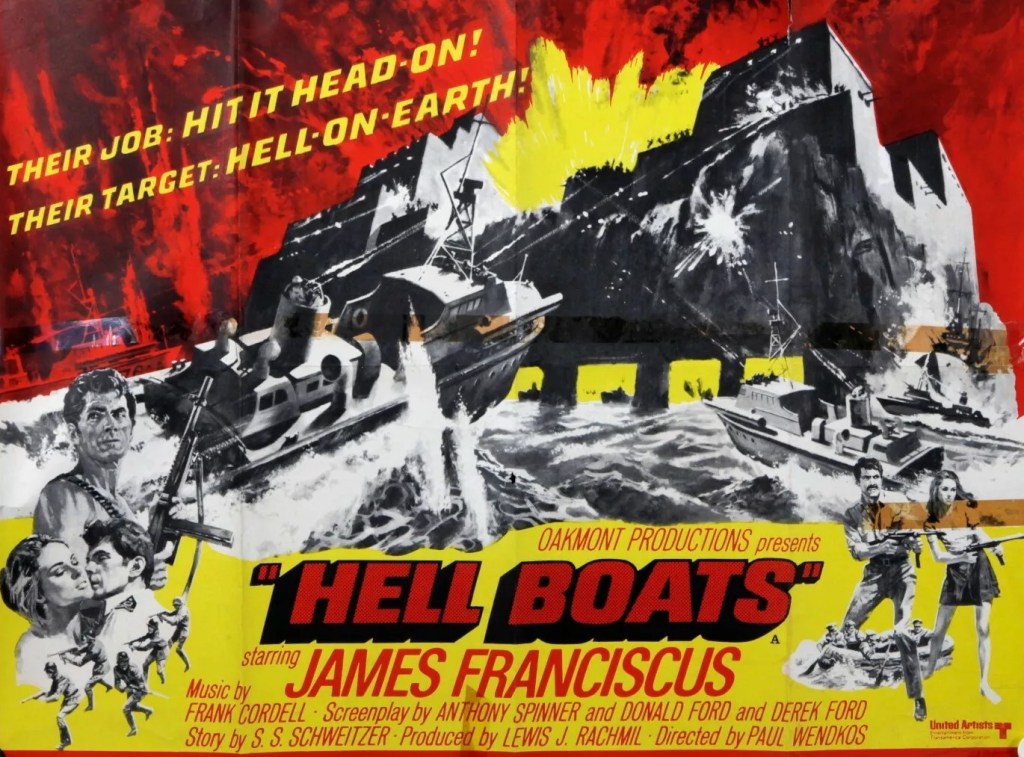
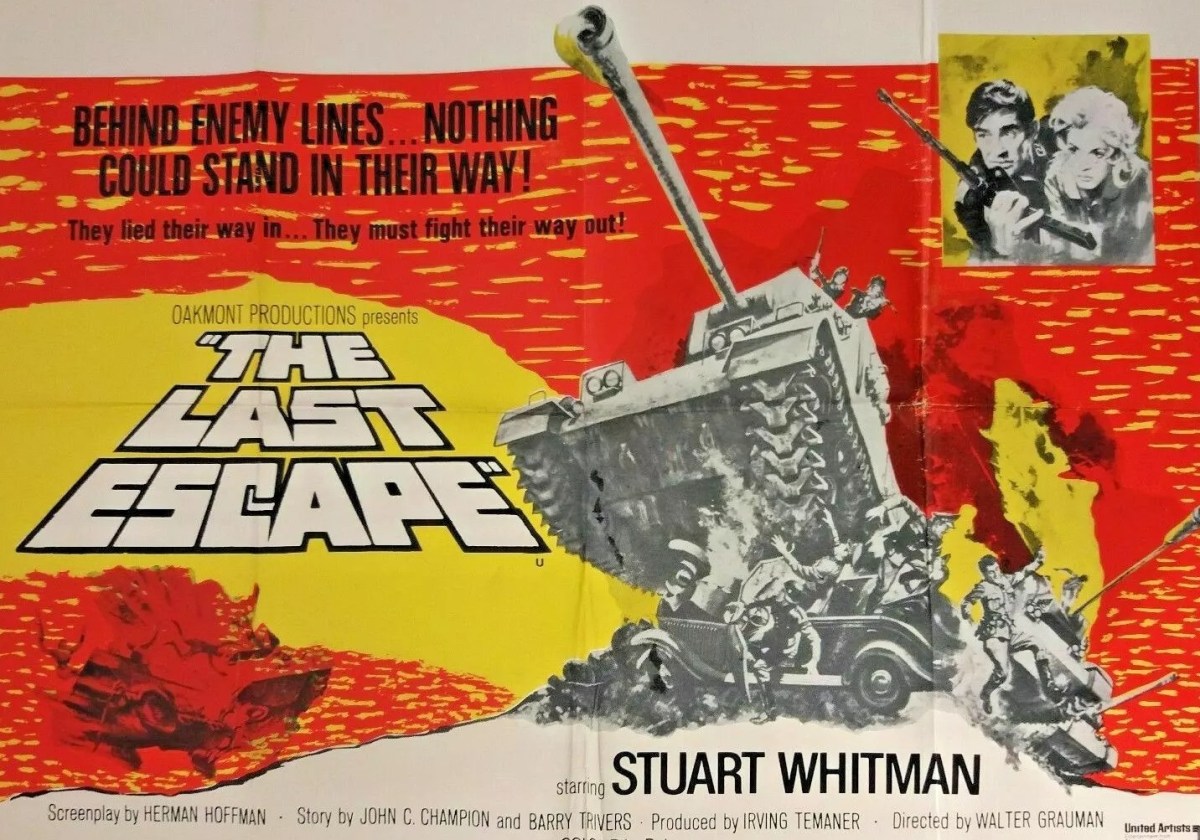
Quite whether James Caan (Red Line 7000, 1965) passed muster as a well-known enough star to qualify as a “personality” at the time he headlined Submarine X-1 (1968) is debatable, as was the presence of James Franciscus (The Valley of Gwangi, 1969) in Hell Boats (1970) and Christopher George (Massacre Harbor, 1968)  in The Thousand Plane Raid (1969) though Stuart Whitman (Rio Conchos, 1964)  exerted a higher marquee appeal for The Last Escape (1970). Veteran Lloyd Bridges (Around the World under the Sea, 1966) who headlined Attack on the Iron Coast (1968) was probably the best known, but these days that was mostly through television. And David McCallum owed whatever fame he had to television as part of The Man from U.N.C.L.E. double act and the idea that would still be enough to attract an audience for Mosquito Squadron (1969) seemed dubious.

Beyond setting up the project, Walter Mirisch had little to do with the actual production, putting that in the hands of Oakmont Production, which beefed up the action with judicious use of footage from other pictures. Invariably, reasons had to be given to explain why actors with American accents were members of the British fighting forces – most commonly they were represented as Canadian volunteers or might have British nationality by dint of having a British mother.

Storylines followed a similar template. At its heart was a dangerous mission. Leaders were invariably hated for some previous misdemeanor or because they were ruthless and drove the men too hard. If there was romance – not a given – it would border on the illicit. And someone required redemption.

And while none of the stars chose – or were chosen to – repeat the experience, Oakmont established something of a repertory company behind the scenes, writers, directors and producers involved in more than one movie.
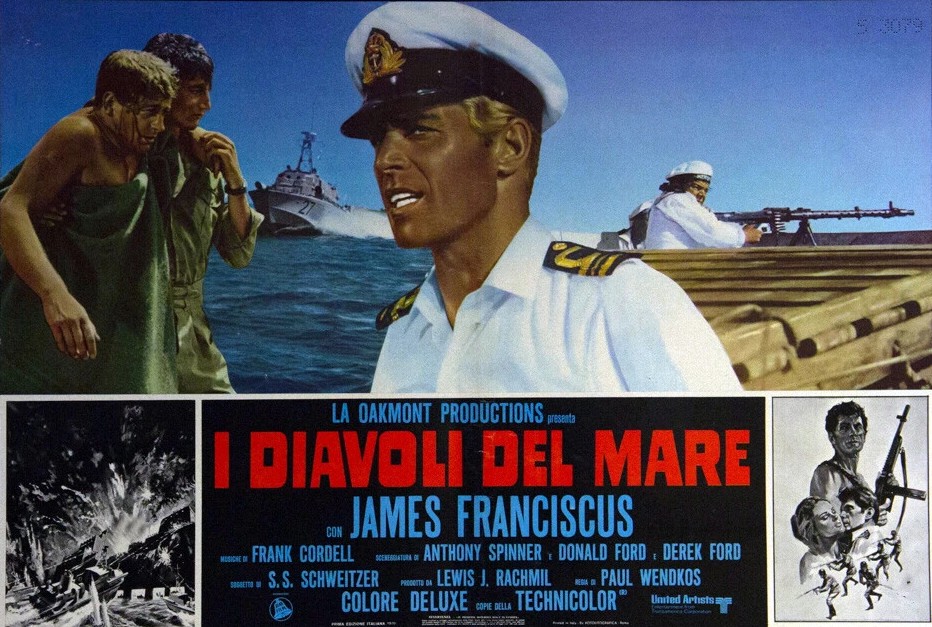
Italian poster (photobusta) for “Hell Boats”. I found Japanese and Australian posters
for most of the films in the series.

Boris Sagal (Made in Paris, 1966) directed both The Thousand Plane Raid and Mosquito Squadron and then made his name with The Omega Man (1971). Paul Wendkos (Angel Baby, 1961) helmed Attack on the Iron Coast and Hell Boats. Walter Grauman who had kicked off the whole shebang with 633 Squadron returned for The Last Escape. William Graham (Waterhole #3, 1967) as the only outlier with just Submarine X-1 to his name.

Veteran producer Lewis Rachmil (A Rage to Live, 1965) oversaw three in the series – Hell Boats, Mosquito Squadron and The Thousand Plane Raid. Another veteran John C. Champion, younger brother of celebrated Broadway choreographer Gower Champion, was involved in a variety of categories. Champion is almost an asterisk these days, best known these days for producing the film Zero Hour! (1957) that inspired disaster parody Airplane! (1980). He was only 25 when he produced his first picture, low-budget western Panhandle (1948). He was behind another four low-budget westerns pictures before Zero Hour!, which had a decent cast in Dana Andrews and Linda Darnell. But that was his last movie for nine years as he switched to television and Laramie (1959-1963), barely reviving his movie career with The Texican (1966) starring Audie Murphy.

He produced Attack on the Iron Coast and Submarine X-1 and was credited with the story for both plus The Last Escape. Irving Temaner produced The Last Escape and received an executive producer credit on Attack on the Iron Coast and Submarine X-1.  Donald Sanford (Battle of Midway, 1976) was the most prolific of the writers, gaining screenplay credits for Submarine X-1, The Thousand Plane Raid and Mosquito Squadron. Herman Hoffman (Guns of the Magnificent Seven) wrote Attack on the Iron Coast and The Last Escape.

Cinema managers were not, it transpired, queuing up for the product. Most commonly, when reviewed in the British trade press, their release date was stated as “not fixed” which generally meant that United Artists was hoping the review would do the trick and alert cinema owners.

In the United States, they rarely featured in the weekly box office reports, though Portland in Oregon appeared partial to the product, Attack on the Iron Coast appearing there as support to Hang ‘Em High (1968), Mosquito Squadron supported The Christine Jorgensen Story (1970), Hell Boats supported Lee Van Cleef western Barquero (1970) while The Last Escape supported Mick Jagger as Ned Kelly (1970). To everyone’s astonishment a double bill of Hell Boats / The Last Escape reported a “big” $10,000 in San Francisco, but that proved an anomaly.

In Britain, the movies fulfilled their purpose as programmers, not good enough to qualify as a proper double bill, but accepted as supporting feature for a circuit release on the Odeon chain. Since UA supplied Odeon with its main features, it proved relatively easy to persuade the circuit to take the war films to fill out a program. This kind of second feature would be sold for a fixed price not sharing in the box office gross. However, they were given the kind of all-action poster they hardly deserved.

So in 1968 Attack on the Iron Coast went out with The Beatles Yellow Submarine. In 1969, Submarine X-1 supported slick heist picture The Thomas Crown Affair, which with Steve McQueen and Faye Dunaway in top form scarcely needed any help securing an audience. Hell Boats was supporting feature in 1970 to Master of the Islands (as The Hawaiians starring Charlton Heston was known). As well as accompanying it on the circuit Mosquito Squadron in 1970 made a very brief foray into London’s West End with thriller I Start Counting and then reappeared a few months later as an alternative choice of support for Billy Wilder flop The Private Life of Sherlock Holmes. If you went to see Burt Lancaster western Lawman in 1971 you might have caught The Last Escape – equally it could have been If It’s Tuesday, It Must Be Belgium (cinema managers could choose either).

United Artists, under the financial cost in the early 1970s, pulled the plug on “programmers” such as these. Walter Mirisch in his biography, disingenuously suggested that the six movies had done relatively well. But that wasn’t supported by the studio’s own figures.

Collectively, they made a loss of $1.7 million. Only Attack on the Iron Coast made it into the black and then by only $59,000. Hell Boats lost $700,000. None of the movies earned more than $200,000 in rentals in the United States.

Although Mirisch managed to keep budgets down to around the million-dollar mark, they would have had to be much smaller to see a profit. Ironically, it was the cheapest, Attack on the Iron Coast costing $901,000,  that made the most. Submarine X-1 lost $150,000 on a $1 million budget, Mosquito Squadron lost $253,000 on a $1.1 million budget while The Thousand Plane Raid lost $50,000 more on the same budget. The longer the series went on, the worse the losses – The Last Escape lost $449,000 on a $995,000 budget while for Hell Boats the budget was $1.36 million.

SOURCES: United Artists Archives, University of Wisconsin; Walter Mirisch, I Thought We Were Making Movies, Not History (University of Wisconsin Press, 2008) p204; Reviews, Kine Weekly – Feb 9 1968, Aug 31 1969, January 1970, April 18 1970; “Flops Loss-Cutting,” Variety, August 26, 1970, p6; “Picture Grosses,” Variety – March 13 1968, May 8 1968, April 24 1968, October 2 1968, June 10 1970, July 1 1970, July 8, 1970, August 12 1970, August 26 1970.

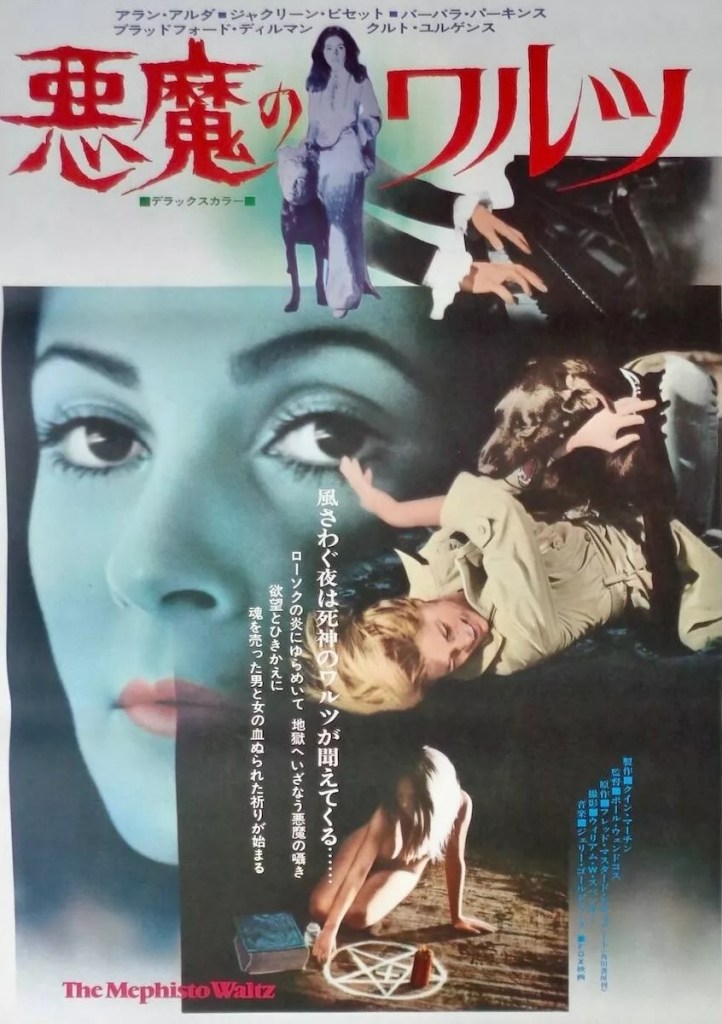
The Mephisto Waltz (1971) ****

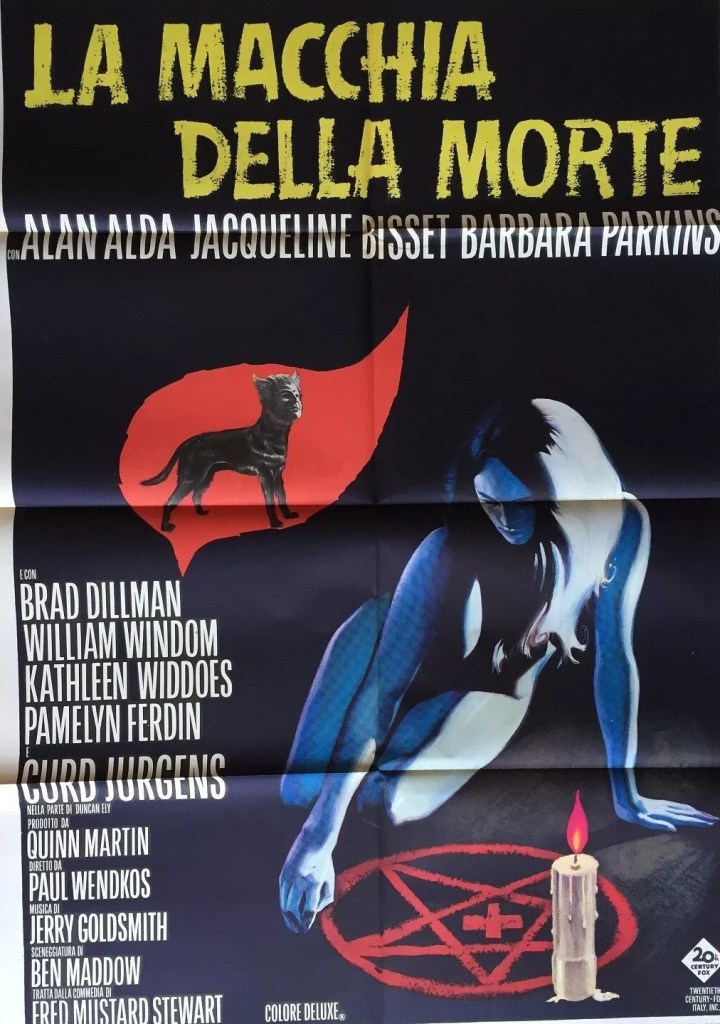
Jacqueline Bisset’s good looks often got in the way of her acting. Or, more correctly, in the way of producer perception about what she could do.  Too often she was the female lead that simply hung on the arm of the male lead. But, here, to my surprise, she is not only the narrative fulcrum, but steals the show from Alan Alda, mostly remembered these days for TV’s M*A*S*H (1972-1983) but at the start of the 1970s being heralded in Hollywood as the next big thing and top-billed.  

Alda’s character here is little more than his screen persona in embryo – glib, wise-cracking, cocky. In an earlier Hollywood he would have been the smooth-talking gangster beefing up B-pictures.

Appearing between the demonic high-spots of Rosemary’s Baby (1968) and The Omen (1976), director Paul Wendkos (Cannon for Cordoba, 1970) escapes his journeyman roots to suffuse the picture with nightmarish scenes, and clever use of the fish-eye lens, treating Satanism with the most subtle of brushes, restricted to a mark daubed in a forehead and a pentagram on the floor but minus any chorus of witches or warning from priests or sundry other holy persons.

Myles (Alan Alda), piano prodigy who never made the cut, now a journalist, is encouraged by interviewee, concert pianist Duncan Ely (Curt Jurgens), to take it up again. Under the older man’s tutelage, he thrives, promising career beckons, plus an entrée into quite a heady world of parties, sex and wealth. Wife Paula (Jacqueline Bisset) is more sceptical especially once Duncan and his buddies start buying up everything in sight in her new antiques emporium. She’s especially perturbed to see Duncan sharing an intimate kiss with his married daughter Roxanne (Barbara Parkins) never mind wondering whether her husband is going to fall prey to the daughter’s seductive technique.

Just what’s going on is never entirely obvious, making the audience work rather than bombarding them with shock scenes. I’m not sure what you’d call it in demonic terms, some kind of transference, body and soul. Once Duncan dies, Myles’s life is transformed, not just thanks to an extremely generous bequest in the old man’s will, but a dramatic increase in his piano-playing prowess, plus, almost as a bonus, the increased attentions of Roxanne.

True scares are limited, mostly a huge drooling black mastiff who may or may not be a killer, and so the tale remains more subtle and eventually boils down to whether Paula will follow her husband on his satanic journey or lose him to the wiles of Roxanne and, perhaps more importantly, never enjoy him as the personality he once was.

We all know that, where money and career is concerned, Myles has a cynical bone in his body and has already demonstrated a capacity for the finer things in life, whether they be animate or inanimate. So his character carries little dramatic tension. And so Paula carries the dramatic burden and she bears that, too, with surprising subtlety.

There’s almost a reverse Gaslight vibe to the whole exercise, Paula convincing herself that she must take this step into what would otherwise be considered madness. It’s worth noting that nobody’s pushing her. She makes the decision herself, although takes you a while (that subtlety again) before you cotton on to consequence. And while we’re on the subject of subtlety, full marks to Wendkos for treating two scenes in particular of Bisset nudity with commendable restraint.  

Quite where Satan’s apparent mission to bring classical music to the masses fits into his plans for global domination is never made clear, leanings of such an esoteric nature rarely a prerequisite of the evil mastermind.

Still, a much classier feast than I was expecting, Bisset (The Sweet Ride, 1968) the standout. Her performance served to give Hollywood notice of a classier star than merely the barely seen girlfriend of Steve McQueen in Bullitt (1968). From here on in she would catch the eye of a better grade of director, including Francois Truffaut in Day for Night (1974) though it can be arguedthat it was her looks that sent her into the stratosphere after the wet t-shirt modelling in The Deep (1977).

Alda, meanwhile, jumped straight into M*A*S*H and didn’t resurface as a creditable movie marquee name until California Suite (1978) and The Seduction of Joe Tynan (1979).  Curt Jurgens (Psyche ’59) as ever is good value, Barbara Parkins (Puppet on a Chain, 1970) his rather slinky associate and Bradford Dillman (The Bridge at Remagen, 1969) also pops up.

Wendkos in top gear. Screenplay by Ben Maddow (The Way West, 1967) from the Fred Mustard Stewart bestseller. Excellent Jerry Goldsmith score.

Well worth a look.

Cannon for Cordoba (1970) ***

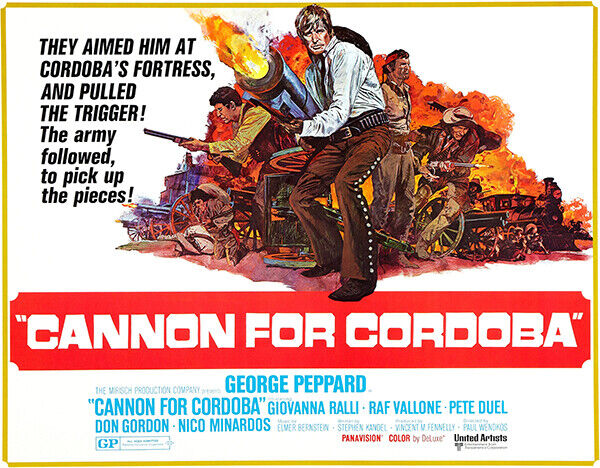
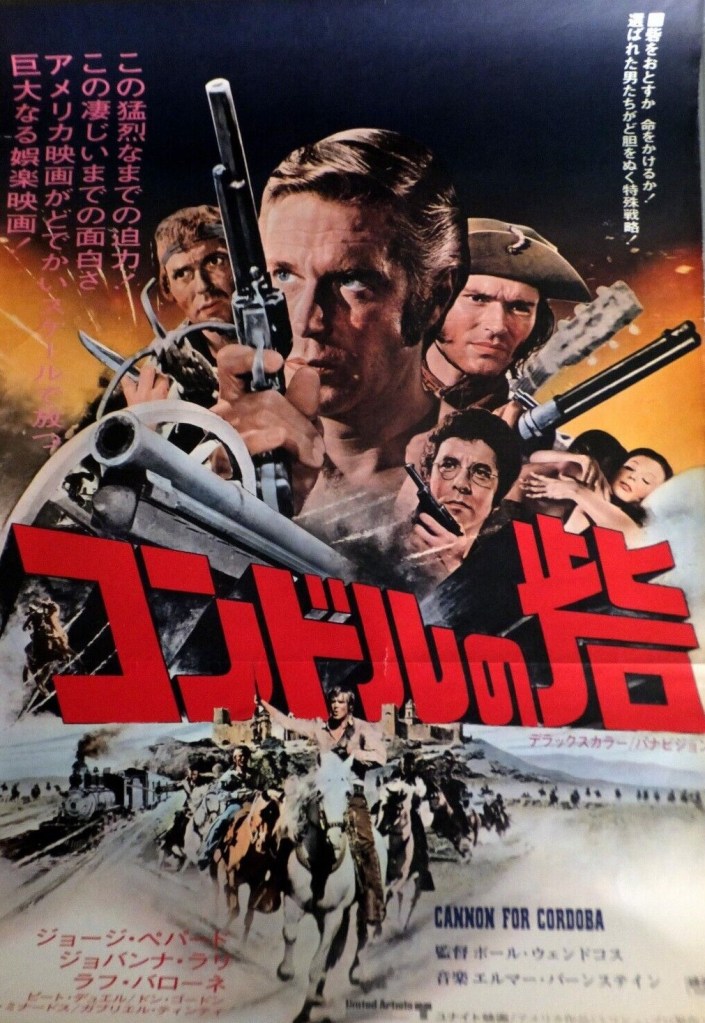
Why settle for a measly Gatling Gun, as Mapache does in Sam Peckinpah’s gloriously violent The Wild Bunch (1969), when you can just as easily relieve government troops of serious artillery. It’s 1912 and the U.S. has sent General Pershing (John Russell) into Mexico with the titular weaponry in a bid to subdue Mexican rebels led by the titular Cordoba (Raf Vallone) raiding across the border and annoying powerful ranchers like Warner (John Larch).

Over-plotted to within an inch of its life and atmospherically indulgent – the natives are constantly whooping it up – and with star George Peppard trying out cigars for size for future enterprises like The A-Team (American television 1983-1987), this comes up short when compared to similar hard-nosed incursions into enemy territory like The Professionals (1966) and The Dirty Dozen (1967).

It’s a movie of many – too many – parts. First of all, we have rebellious U.S. soldier Capt Douglas (George Peppard), who gives superiors the finger, packed off with a small team to infiltrate the rebel army and find out what they’re up to. Not that that would require any infiltration. It’s pretty obvious with a prize plum like artillery suddenly arrived, the rebels are going to chance their arm and steal it.

Lo and behold that’s exactly what Douglas’s gang – which includes Jackson Harness (Don Gordon) quickly embittered because the good captain, in order to maintain his disguise, refuses to save one of his captured team being slowly roasted over a pit – does discover. But they don’t quite manage to get this information back to Pershing before those dashed clever Mexicans are blowing everything to hell and stealing the train containing the guns.

So now Douglas has to put together another team, the aforementioned Harkness augmented by Rice (Pete Duel) and Antonio (Gabriele Tinti), a Mexican who wants Cordoba brought to justice, and a few others, and infiltrate the Mexican stronghold. Along the way, they acquire the assistance of the beautiful Leonora (Giovanni Ralli) who is willing to use her body any which way (not going quite as far as Marianna Hill in El Condor out the same year) to gain revenge for Cordoba slaughtering her family and raping her. That last aspect seems a psychological stretch, but what the hell, how otherwise will the gang get close enough to the rebel leader.

Of course, just to sauce up the story, as if anything more is required, they are captured and need to bust out of jail and what with one thing and another it takes a goodly time before they can get close to achieving their objective. And that’s not to mention the betrayal that simmers in the background, Leonara having her own way of getting close to Cordoba, Warner not  quite as right-minded as he appears, and the aforementioned Harkness waiting for the right moment to blow away his leader.

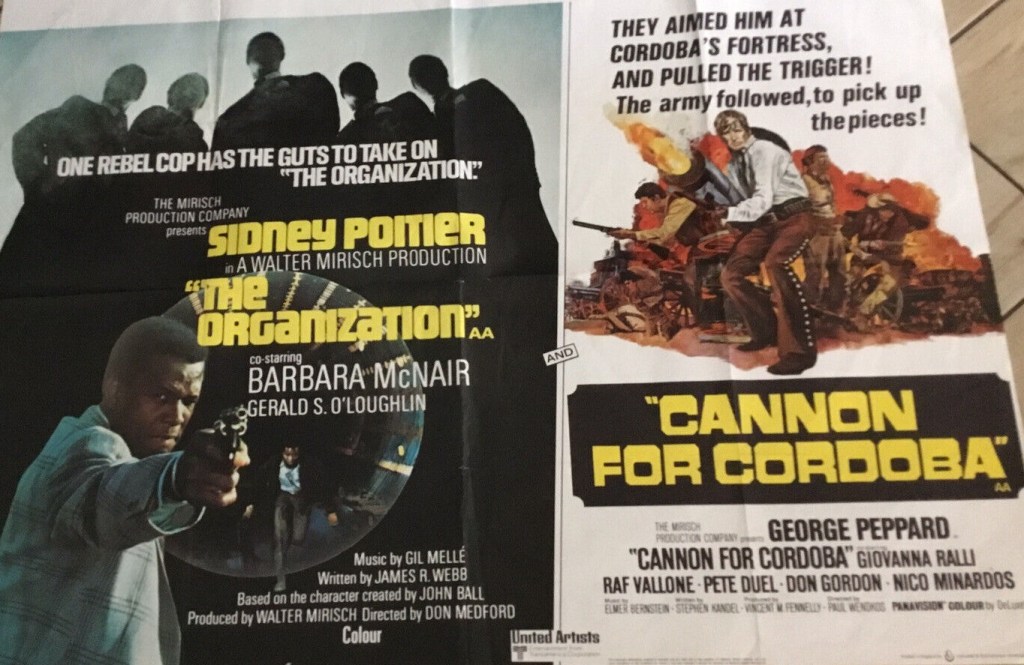
Not too well received, the movie went out in the supporting role in a double bill.

Plenty explosions, plenty action, and plenty living it up, scantily-glad women appearing at every turn, firecrackers going off, dancing in the streets, but somehow too much of this scrambles the focus while subsidiary characters take center stage too briefly too often, as with rebel women in the 100 Rifles (1969)-Raquel Welch mold. It gets there in the end of course but you just wish it would hurry up or expend more of its running time on developing the main personnel.

George Peppard (The Groundstar Conspiracy, 1972) is having a ball, but that’s only because every other character is so reined-in and there’s little else character-wise for him to hold onto. It wouldn’t have taken that much for him to command center stage, for competition in the acting stakes he’s only got Raf Vallone (The Cardinal, 1963), in worldly-wise form, and Don Gordon (Bullitt, 1968), stewing away. Giovanni Ralli (Deadfall, 1968) arrives too late in the proceedings to make much impact. Pete Duel (Alias Smith and Jones, 1971-1973) looks cute but has little to do.

Diligently put together by Paul Wendkos (Guns of The Magnificent Seven, 1969) but coming across as trying too hard, from a screenplay by Stephen Kandel (Chamber of Horrors, 1970).

Enjoyable if you enjoy shoot-em-ups, and even more if you’ve been charting the career of George Peppard who here makes the switch from all those uptight characters of the previous few years to letting a whole lot more hang out.

https://amzn.to/49SXTGg

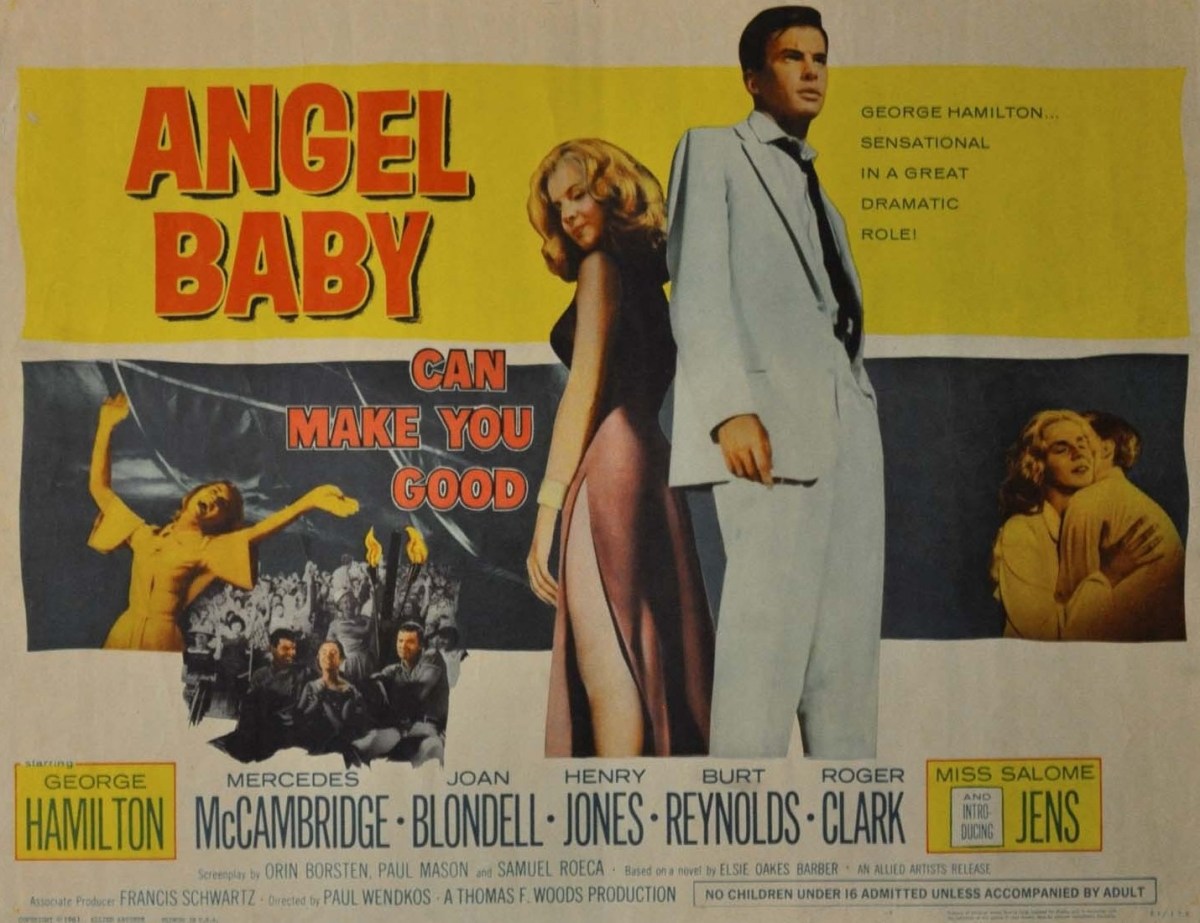
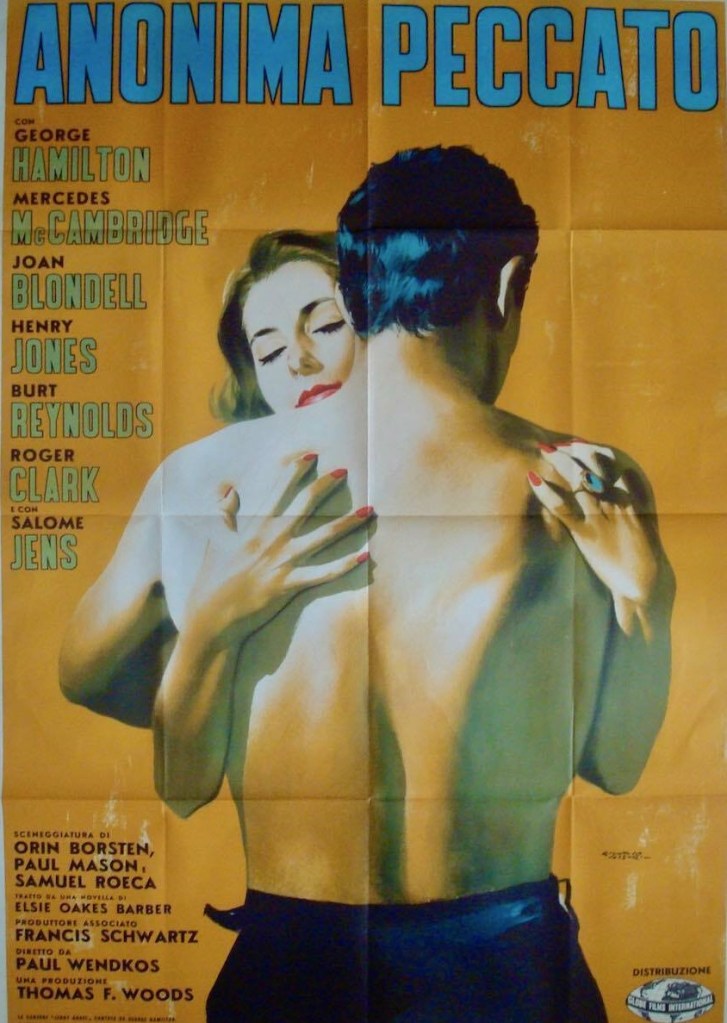
Angel Baby (1961) ***

Stunning cast – George Hamilton, Burt Reynolds, Mercedes McCambridge, Joan Blondell – in low-rent version of that ode to evangelism Elmer Gantry (1960) but here focusing on misplaced zeal and corruptible innocence. Strikes a contemporary note with “MeToo” reversal – elder woman grooming a choir boy – and fake news, how else to describe public gullibility for the so-called miracles that were the stock-in-trade of the revivalist business.

Would have been an interesting addition to the portfolio of the erratic director Hubert Cornfield (Pressure Point, 1962 a high, but Night of the Following Day, 1969, a low) except he took ill and passed the reins to Paul Wendkos (Guns of The Magnificent Seven, 1969).

Takes an interesting narrative slant, the three original principals bowing out after a strong start, leaving the way free for the titular character to come unstuck in the sleazy world of religious make-believe before they all turn up again for a rip-roaring finale.

Young charismatic preacher Paul (George Hamilton) is at odds with his dominating older wife Sarah (Mercedes McCambridge). She is all hellfire-and-brimstone while he wants to preach about love. They are in an “unholy marriage,” he plucked from the choir as a teenager and molded by her, her invocations to prayer always accompanied by sex, and once Jenny Angel (Salome Jens), a mute he heals and with an unwelcome boyfriend Hoke (Burt Reynolds), appears on the scene he begins to question his sexual and religious grooming.

Recognizing a love rival, Sarah bribes ambitious couple, resident alcoholics Mollie (Joan Blondell) and Ben (Henry Jones), to take her on and they, in turn, trade her to Sam (Roger Clark) who turns her unfulfilled potential as a preacher into box office dynamite by capitalizing first on her beauty, low-cut gowns emphasizing her physical attributes, and then by fake healings, not realizing, in his greed, that a preacher who can make reputedly make the blind see is asking for trouble.

Having seen the error of his way, Paul chases after Angel, Sarah chases after Paul and Hoke just happens to be in vicinity to ensure it all ends in colossal disaster, though with an unusual twist ending.  

But it’s surprisingly good in an old-fashioned way. The depiction of the corrupt evangelists and, more importantly, the spiritual and actual poverty of the congregations, desperately looking for salvation, occasionally blaming God for their woes, and hoping sheer blind faith will see them through, is well done, even if Paul’s preaching sails close to the unsavory, with rather lewd accompaniments.

Jenny’s conviction in the face of initial failure that she can bring solace to the people is also believable. All innocence, no idea she is being duped, she simply perseveres, undaunted at  the scale of her task, faced with dozens of critically-ill expecting cure.

Sam’s real scam is selling some kind of miracle potion that Jenny has apparently endorsed, the phone ringing off the hook with customers wishing to buy it once the preacher’s fame spreads. He, too, despite apparently God-fearing ways, is partial to liquor.

Given Jenny never doubts her vocation, you’d expect an innocence-sized hole at the center of the drama, but that’s filled up by the growing conflict between Paul and Sarah and a very humorous section dealing with the idiotic Mollie and Ben, especially in an inspired drunken scene.

It could easily have been a more cynical take on the dumb audience, so easily taken in, but instead, they are presented as individuals at the end of their tether with nowhere else to go but the Almighty in the hope that the burden of living terrible lives will be eased. How easily they are manipulated is no surprise.

George Hamilton (A Time for Killing, 1967) is unrecognizable, not just in the acting which at times has the charming creepiness of Anthony Perkins, but because, since this is made in black-and-white, he is devoid of his usual inches-thick tan. I was reminded a lot of Carrie (1976) in that Piper Laurie’s portrayal of the obsessed mother appeared modelled on that of Mercedes McCambridge (99 Women, 1969) as the scary wife and in Sissy Spacek’s imperturbability as she strides through the chaos she has caused that was a throwback to the gait of Salome Jens (Seconds, 1966) as she walks unharmed away from the wreck of her work.

Except for her physical presence, Jens isn’t given sufficient contemplation to make her stand out, and to some extent is just an object of other people’s satisfaction, but is at her best when clearly puzzled that, believing herself touched by God, her initial ministry fails to take off.  

Burt Reynolds (Fade In, 1968) makes the kind of debut that would have gone unnoticed had he not a decade later transmogrified into a superstar. Hollywood Golden Age star Joan Blondell (Model Wife, 1941) has a sparkling turn as the blowsy alcoholic who invents Jenny’s stage name of Angel Baby.

Paul Wendkos makes the whole thing work by concentrating on two-character scenes,  limited movement creating intensity, that works equally well for conflict and humor, while deftly managing the crowd scenes and pulling off the unexpected ending. Took considerable effort to knock Elsie Oakes Barber’s novel into shape, three screenwriters, neophytes in the main, involved – Orin Borstein in his debut and only screenplay, Paul Mason, no other screenplay credit until The Ladies Club (1986) and Samuel Roeca (Fluffy, 1965).

An interesting watch, not just for the cast, but as a reminder that it’s never too difficult to dupe a willing audience.

Discover WordPress

A daily selection of the best content published on WordPress, collected for you by humans who love to read.

The Atavist Magazine

by Brian Hannan

WordPress.com News

The latest news on WordPress.com and the WordPress community.