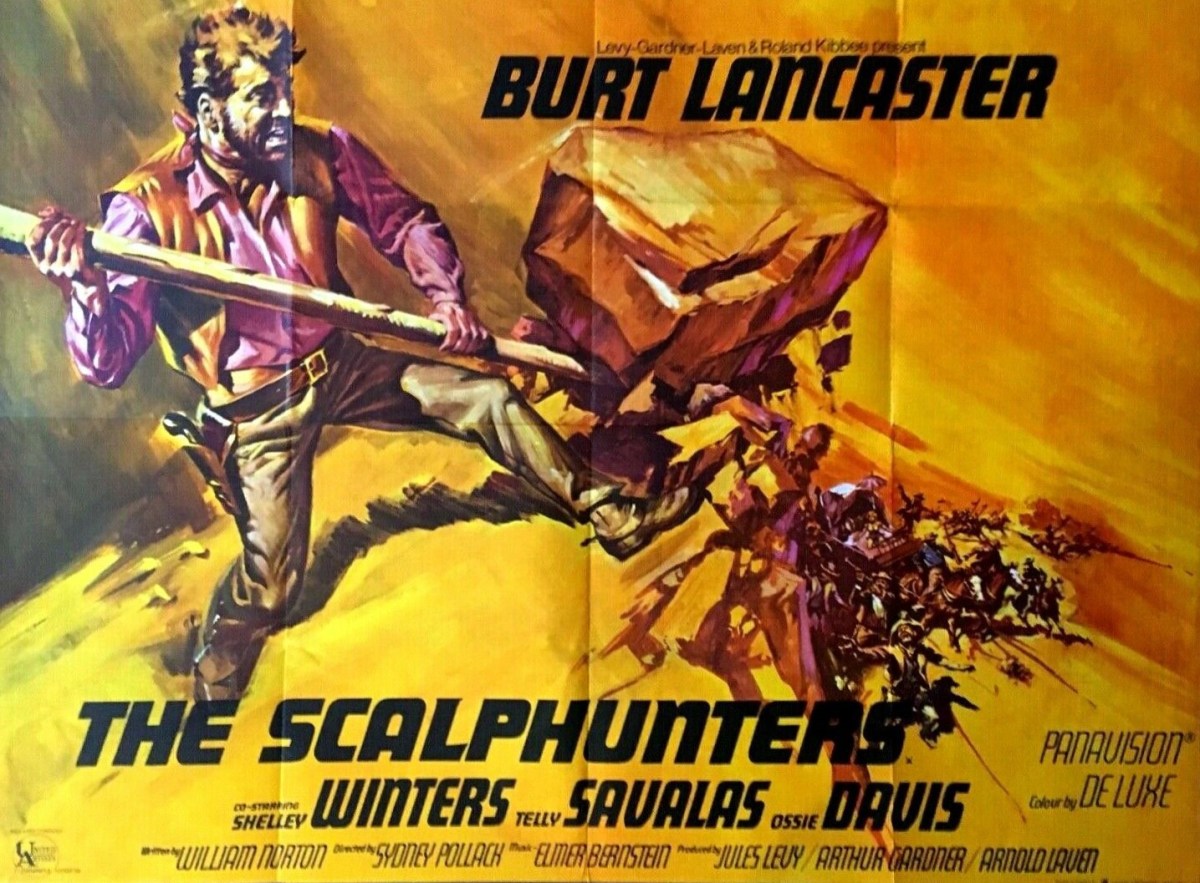
The Scalphunters (1968) ****

If ever a film deserves reassessment, this is it. This western, marketed as a vehicle for Burt Lancaster in the wake of hugely successful The Professionals (1966), sees the star playing  cussed trapper Joe Bass trying to retrieve furs stolen first by Native Americans and then by outlaws. That the serious race issues tackled here were dressed up in very broad comedy and typical western action ensured it missed out on the kind of recognition that critics would assign a straightforward drama and lost its rightful place as a pivotal picture of the decade.

In theory, a somewhat unusual Burt Lancaster western. In reality something else entirely. For large chunks of the movie Lancaster is absent as the story follows the fortunes of Black slave Joseph Lee (Ossie Davis) as he achieves not just freedom but genuine equality. Joseph is introduced as a slave of the Kiowa, left behind when the Indians steal Joe Bass’s furs. In compensation for his loss, Bass plans to sell Lee in the slave market in St Louis and in the meantime enrols him to help recover his furs.

However, a band of outlaws, specializing in collecting Native American scalps (hence the title) and selling them at $25 a time, get to the furs first as a by-product of a raid on the Kiowas. In pursuit with Bass, Lee falls into a river at the outlaw encampment and becomes the slave of Jim Howie (Telly Savalas) who also aims to sell him. Lee plans to escape until discovering Howie’s large troop is headed for Mexico where the slave would automatically become free. With clever talk, beauty-treatment skills and knowledge of astrology and ecology, Lee insinuates himself into the wagon of Howie’s paramour Kate (Shelley Winters).

With Bass still in pursuit, there are several excellent action scenes as the outnumbered trapper seeks to outwit Howie who turns out to be just as devious. But the main question is not whether Bass will recover his stolen property but which side will Lee pick. Will he act as spy to help Bass get back his furs or will he disown Bass and remain with the murderous genocidal gang who could provide a prospct of freedom? Either in the company of Bass or Howie, he is constantly reminded of his status, taking a beating from one of Howie’s thugs, Bass refusing to share his whisky because he views him not just as a slave who “picked his master” but as a coward refusing to fight back when attacked and beaten up.

The film comes to a very surprising ending but by that time through his own actions Lee is accepted as an equal by Bass and the issue of slavery dissolved. In effect, it is a tale of self-determination. Lee effects liberty by taking advantage of situations and standing up for his own cause.

Lee is one of the most interesting characters to appear on the western scene for a long time. Exactly where he acquired his education is unclear and equally hazy are how – and from where – he escaped and how he ended up as slave of the Commanches before they traded him to the Kiowa. However he came to be in the thick of the story, his tale is by far the most original. But he’s not the only original. The fearless Bass was an early ecological warrior with an intimate understanding of living off the wild, not in normal genre fashion of killing anything that moves, but in knowing how to find sustenance from plants. That in itself would endear him to modern lovers of alternative lifestyles.

Normally the derogatory term “scalphunters” would be reference to Native Americans, but here it is American Americans who exploit this market. Despite being the leader of a vicious bunch, Howie turns out to be a bit of a romantic and Kate a bit more interested in the world than your average female sidekick.

Director Sydney Pollack (The Slender Thread, 1965) does a marvelous job not just in fulfilling action expectations and taking widescreen advantage of the locations but in allowing Lee to take center stage when, technically, according to the credits, Ossie Davis was only the fourth most important member of the cast. Burt Lancaster was approaching an acting peak, following this with The Swimmer (1968) and Castle Keep (1969), happy to take risks on all three pictures, especially here where for most of the movie he is outwitted and ends up in a mud bath.

Both Telly Savalas (Sol Madrid, 1968) and Shelley Winters (A House Is Not a Home, 1964) rein in their normal more exuberant personas.  Savalas, in particular, cleaves closer to his straightforward work in The Slender Thread than the over-the-top performance of The Dirty Dozen (1967). Winters, usually feisty, is here more winsome and vulnerable, apt to be taken in by sweet-talking men.

But Ossie Davis (The Hill, 1965) is the standout, his repartee spot-on. It is a hugely rounded performance, one minute wheedling, the next sly, boldness and cowardice blood brothers, and while his brainpower gives him the advantage over all the others he is only too aware that such superiority counts for nothing while he remains a slave.

It’s dialog rich and it’s a shame it wasn’t a big hit for that would have surely triggered a sequel – especially in the wake of the following year’s buddy-movie Butch Cassidy and the Sundance Kid – because the banter between Lee and Bass is priceless. For the dialog thank the original screenplay by future convicted gun-runner William W. Norton (Brannigan, 1975), father of director Bill Norton (Cisco Pike, 1971).

Go see.

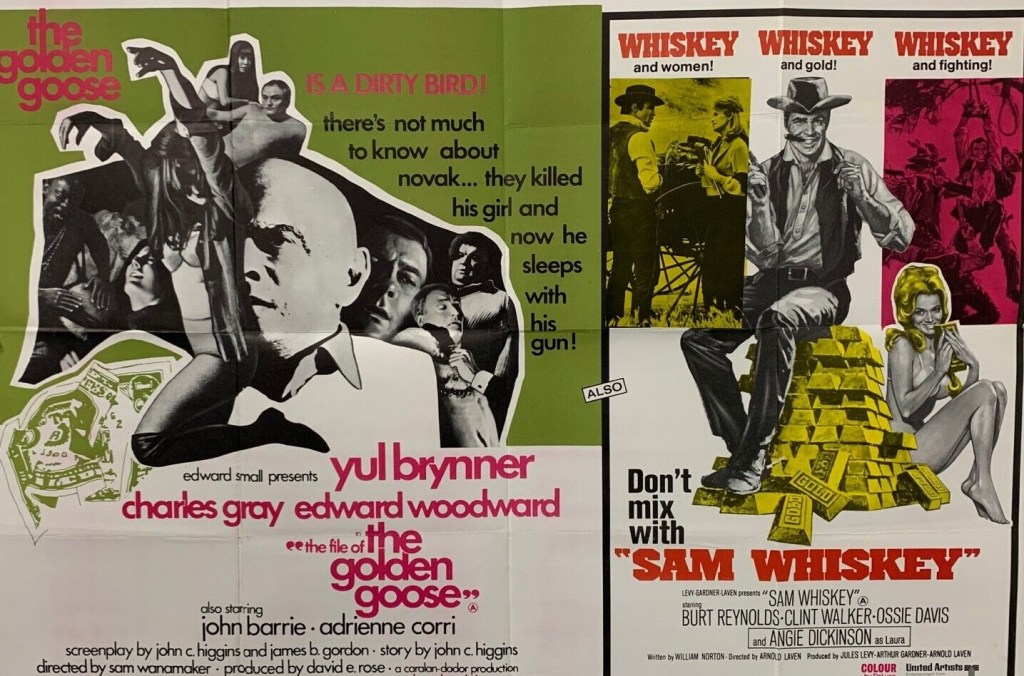
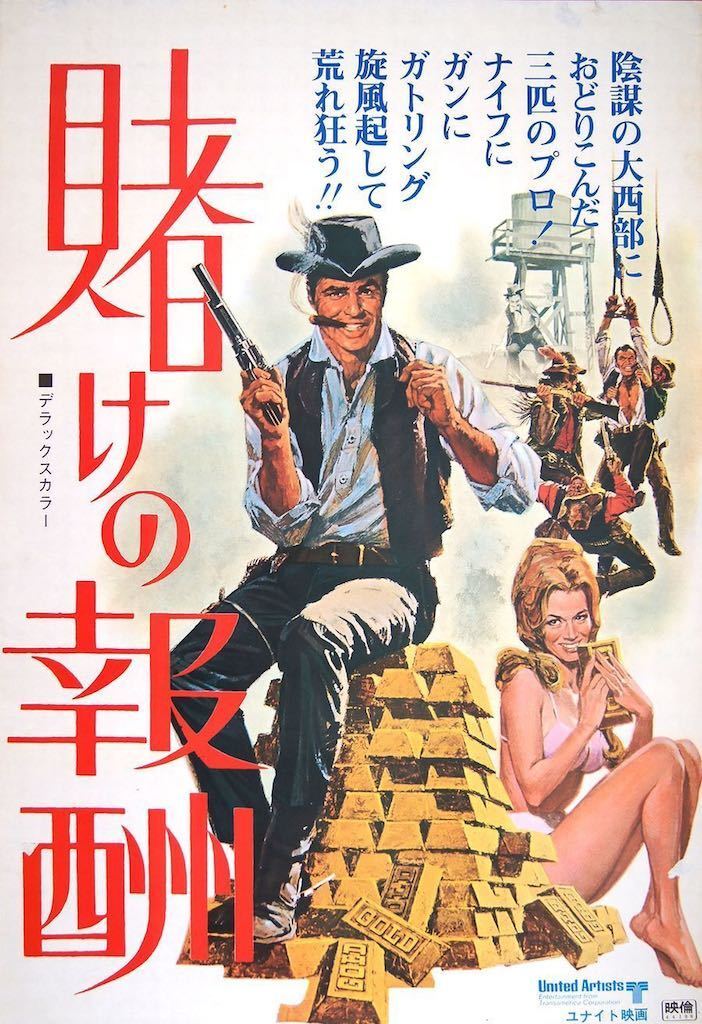
Sam Whiskey (1969) ***

You don’t realize the importance of treatment until you see an interesting story mangled. Taking the comedic approach to a heist picture is tricky. You can’t just make it happen because that’s what the script says, you’ve got to prove to an audience that whatever takes place is believeable. And frankly, asking three inexperienced dudes to smelt down a ton of gold and sneak it into a government building in the shape of a bust (the statue kind, not the other) and then smelt it back down again while inside and turn it into gold bars is a stretch too far.

This is amiable enough as far as it goes, and Burt Reynolds gives his good-ol’-boy routine a try-out, Angie Dickinson strays from her usual screen persona, and it does present some interesting screen equality – a Yaqui Indian shown as someone you would pay a debt to, Ossie Davis making a pitch for the African American acting crown.

I saw this double bill at the time of original release.

But it’s bogged down in a cumbersome plot that I guess many in the audience, like me, would have been begging for a switcheroo at the end that made more sense for the genre.

So, bear with me, Laura (Angie Dickinson) hires ex-gambler Sam Whiskey (Burt Reynolds) to retrieve $250,000 worth of gold ingots lying inside a sunken riverboat at the bottom of a river. Fair enough, you think, it’s the nineteenth century, nobody would be able to hold their breath that long to attempt to retrieve it even one gold bar at a time.

But she only wants the gold back to satisfy family honor. You see, her dead husband was in charge of transporting the gold to the local mint and to cover up his calmaity he replaced the gold with ingots made of lead. And hold on, there’s more, a Government inspector is due at the mint.

So, Sam and his buddies, blacksmith Jed (Ossie Davis) and strongman turned inventor O.W. Bandy (Clint Walker) have not just to recover the gold, and resist the temptation to simply spirit it away over the border, but find a method of getting it back inside the mint without anyone knowing and at the same time smuggle out the false ingots.

Of course, Laura has a blueprint of the plans of the mint so that’s okay then. And there’s a bust of her dead husband in the hallway of the mint and if Sam can just find the right excuse to take it away – and bearing in mind he has no obvious mold to use to re-cast it – he can re-make it in gold, return it, sneak it down into the smelting room and turn it back into gold bars.

Yes, the story is that complicated. Sam is only prevented from stealing the haul for himself by the seductive presence of Laura, who also has to act femme fatale enough to waylay the real inspector, whose identity Sam steals. I was praying that Laura, who seemed to be too good to be true what with all that family honor, was actually playing Sam for a patsy and that what was being removed from the mint was the real gold and what was being substituted was the fake.

No such luck. And this might well have worked if it had been treated seriously, if Sam was a famous robber, and if the director hadn’t interrupted proceedings every few minutes with some woeful comedy music and littered it with non-sequiturs or even provided a decent villain apart from Fat Henry (Rick Davis) and his motley crew who suspect something is up and attempt to hijack the gold before it reaches the mint.

And it’s a shame because the leading players are all an interesting watch. Burt Reynolds (Fade In, 1968), still a few years short of stardom, takes a risk in playing his character in light comedy fashion, coming off second best in his opening encounter with Jed. Angie Dickinson (Jessica, 1962) is far too genteel to play the femme fatale and it’s clear she only goes down the seduction route when Sam balks at the barminess of the idea, but it’s equally clear she’s the brains of the operation, and that’s pretty much a first in the western robbing business, and her character is so deftly acted that it’s only later, when you add everything up, you realize the depths of the character and that’s she only allowed audiences a glimpse of the surface.

Ossie Davis (The Scalphunters, 1968) doesn’t attempt the obvious either. He’s not after the Jim Brown action crown. He can look after himself with his fists, but he’s got the intelligence to avoid getting trapped by violence. And Clint Walker (The Great Bank Robbery, 1969), also primarily playing against type, is a muscular version of the crackpot inventor you usually found in a British comedy, but who is capable of coming up with an early version of  diving equipment. And he has a great line that despite endless rehearsal he muffs up, “Aha!” he proclaims, battering in a bedroom door, in best Victorian melodrama fashion, “I caught you trifling with my wife.”

So it’s worth it for the performances and if you ever hankered after the seminal shot of a squirrel overhearing a conversation or wondered how many shots in one movie a director could contrive to make through a small space then this is for you. Screenwiter William Norton (The Scalphunters) had better luck with other directors but here Arnold Laven (Rough Night in Jericho, 1967) takes a wrong turning. Amiable is not enough, certainly not for a complicated heist picture.

Angie Dickinson and Burt Reynolds completists, though, will not want to miss this.

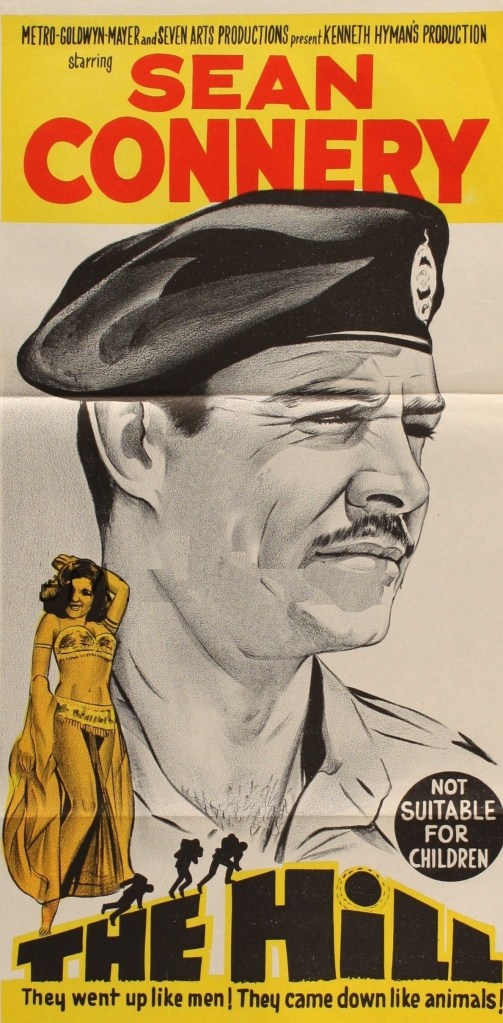
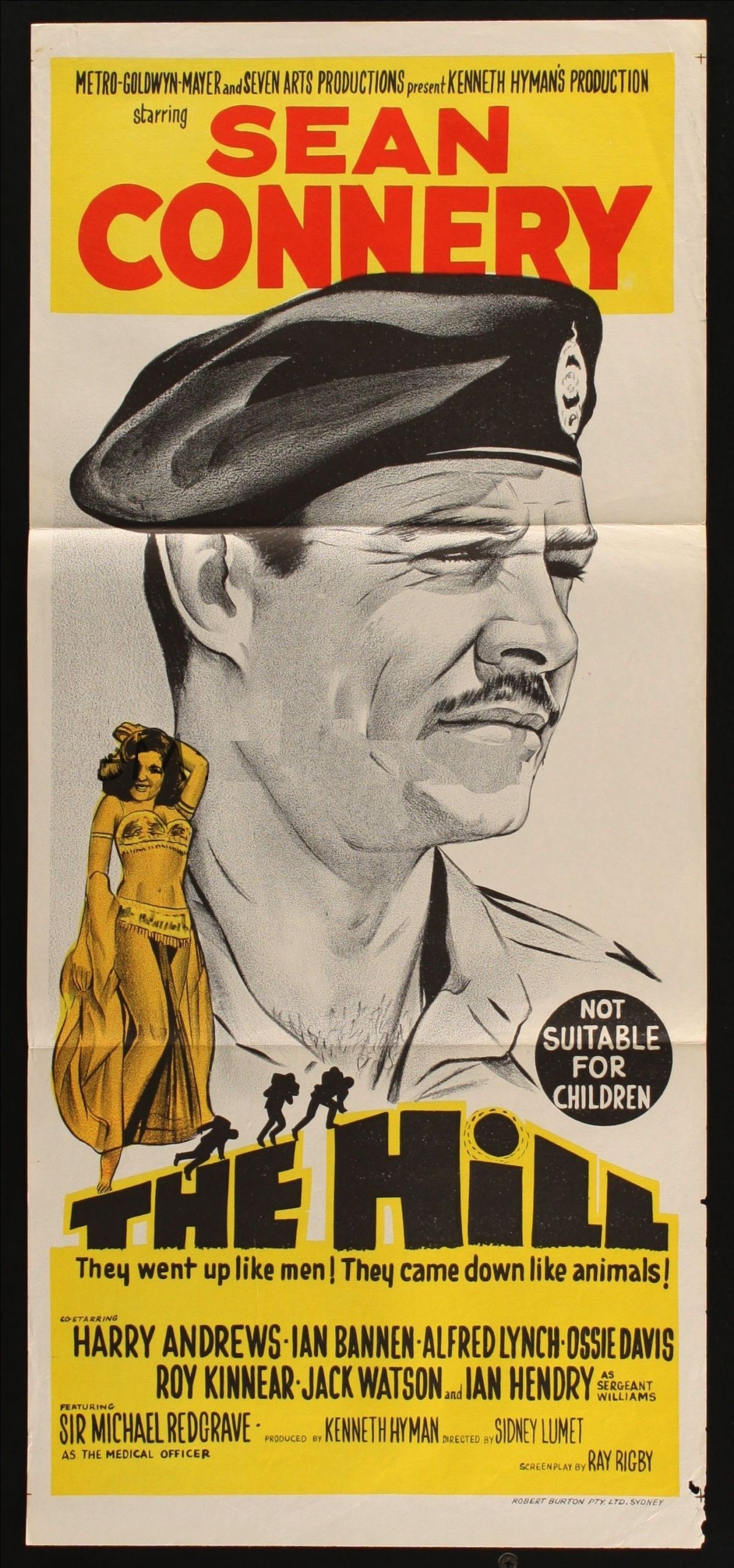
The Hill (1965) ****

Set in a British Army prison camp in North Africa during World War Two ruled by sadistic Sgt Wilson (Harry Andrews) who believes himself above the regulations he forces others to follow, The Hill is a parable about the hypocrisy of totalitarian rule. And much of what is shown would be offensive to modern sensibilities.

Although the commandant and medical officer (Michael Redgrave) are his superior officers, Wilson runs the unit by force of personality. He believes his ruthless treatment of the prisoners turns them into proper soldiers. Into his fiefdom come five new prisoners including coward Joe Roberts (Sean Connery), spiv Monty Bartlett (Roy Kinnear), African American Jacko King (Ossie Davis) – a “different colored bastard” – another Scot Jock McGrath (Jack Watson) and weakest link George Stevens (Alfred Lynch).

Most films about prisons emphasize imprisonment, most scenes taking place in cells or other places of confinement. Sidney Lumet (The Pawnbroker, 1964) directs this film as though it is a paeon to freedom with incredible shots of the vista within which the men are contained. He uses some of the most bravura camerawork you will ever see outside of David Lean.

The film opens with a two-minute crane shot credit sequence that pulls back from a prisoner collapsing on the titular hill to reveal the entire encampment and follows with a one-minute reverse tracking shot of Wilson striding through his domain. And while the camera controls what we see, our ears are constantly assailed by the constant drumbeat of other marching prisoners. 

Climbing the hill in full pack would break any man and those who collapse are roused by buckets of water. The first to crack is Stevens who is constantly tormented by homophobic jibes. Continuous racist abuse is heaped on Jacko King “you blacks don’t have brains – you got it downstairs, we got it upstairs” until driven to the point of madness he begins to behave like a gorilla which frightens the life out of his superiors.

Obeying orders, says Joe Roberts, is “like a dog picking up a bone.”  RSM Wilson is out of control, the commandant spending his nights with a prostitute, the medical officer clearly sent here as punishment for some previous misdemeanor. Of the senior staff only Harris (Ian Bannen) comes away with any dignity, constantly trying to thwart the worst bullying.

When Stevens dies suddenly, the film changes tack and becomes a battle for survival among those who could be blamed for causing his death and those who dare to point the finger.  Wilson has no problem stitching up his colleagues and blackmailing the medical officer while Roberts is beaten up for his effrontery in standing up to authority.

But the astonishing presence and self-confidence and, it has to be said, courage of Wilson lords it over everyone, and there is an extraordinary scene where he forces the entire battalion of prisoners to back down when they are on the brink of open rebellion.

Connery is superb in what is his first dramatic role in a bread-and-butter dramatic production rather than the glossier Marnie (1964) and Woman of Straw (1964) and while he has his moment of defiance he gives enough glimpses of vulnerability and fear to ensure we do not mistake him for his alter ego James Bond. Ian Bannen delivers a touching, assured, performance, far removed from the nasty sarcastic personalities he portrayed in his other desert pictures, Station Six Sahara (1963) and the Flight of the Phoenix (1965). 

Ossie Davies (The Scalphunters, 1968), as defiant as Connery, is brilliant as the man who works out a way to beat the enemy by confusing them; the scene in the commandant’s office where he treats the officer as his inferior is a tour de force.   

Although the Army is meant to run according to established regulation, where obedience to a superior is paramount, it is equally apparent that it can also become a jungle if those who are the fittest assume control. Sgt Wilson demands unquestioned discipline even as he is breaking all the rules in the book. But he retains his authority not just by bullying, but by intelligence, exploiting weakness, coolness under pressure and by welcoming confrontation, his personality as dangerous as any serial killer.   

Harrowing, superb, true.

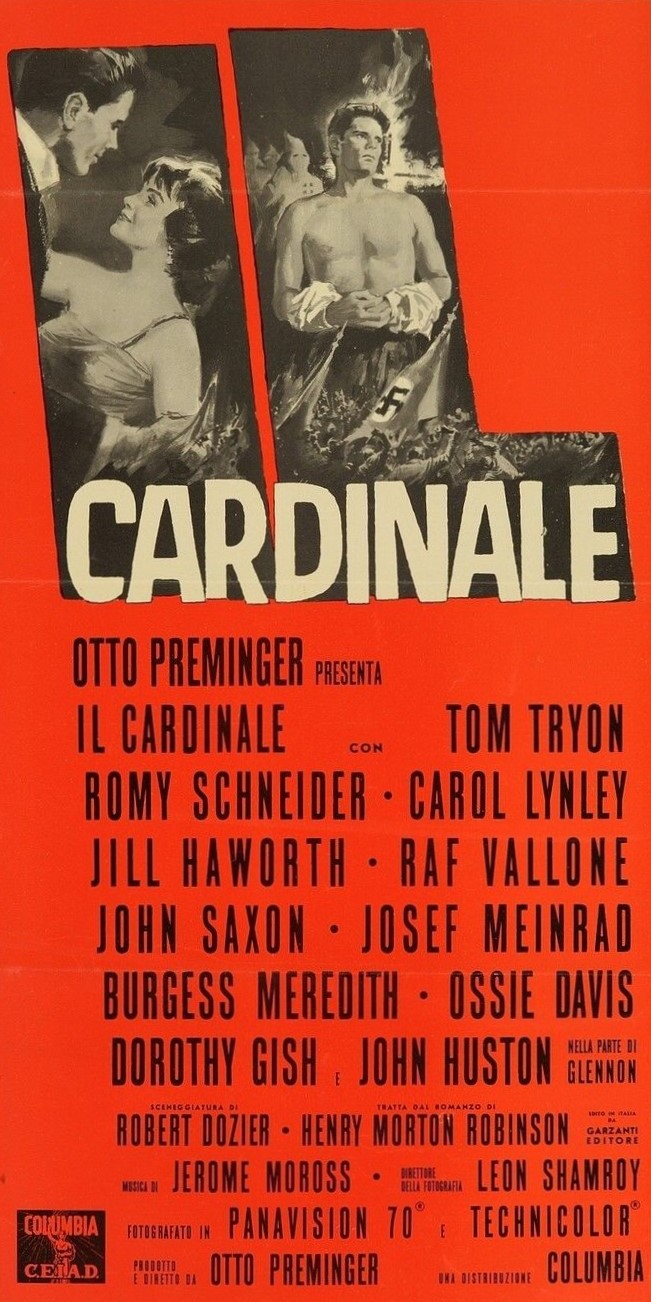
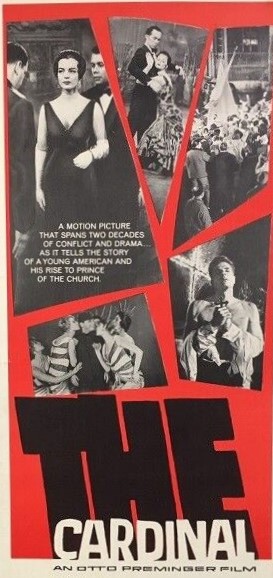
Behind the Scenes: “The Cardinal” (1963)

Otto Preminger was beaten to the punch on this one, the scandalous Henry Morton Robinson bestseller snapped up in 1955 by producer Louis de Rochemont (The Roman Spring of Mrs Stone, 1961) who had a tie-up with Columbia. Due to interference from the Catholic Church, de Rochemont dropped his option which Preminger picked up in 1961 while working on Advise and Consent (1962).

The last section of the novel, set in Austria during the Anschluss, reverberated with the director who was born in what was then the Austro-Hungarian Empire and although a Jew was well acquainted with Catholic society.  One of his most significant changes to the book was introducing the Austrian cardinal who endorsed Hitler.

The first two screenwriters James Lee (Banning, 1967) and Daniel Taradash (Castle Keep, 1969) failed to whittle down the complex novel to cinematic proportions. So Preminger brought in Robert Dozier (The Big Bounce, 1969) and began working with him in summer 1962 making other alterations to heighten the drama. The incident involving the unborn child of the sister of Fr Fermoyle (Tom Tryon) acquires greater emotional power in the film, touching on the ambiguities inherent in any institution and provoking the priest’s guilt.

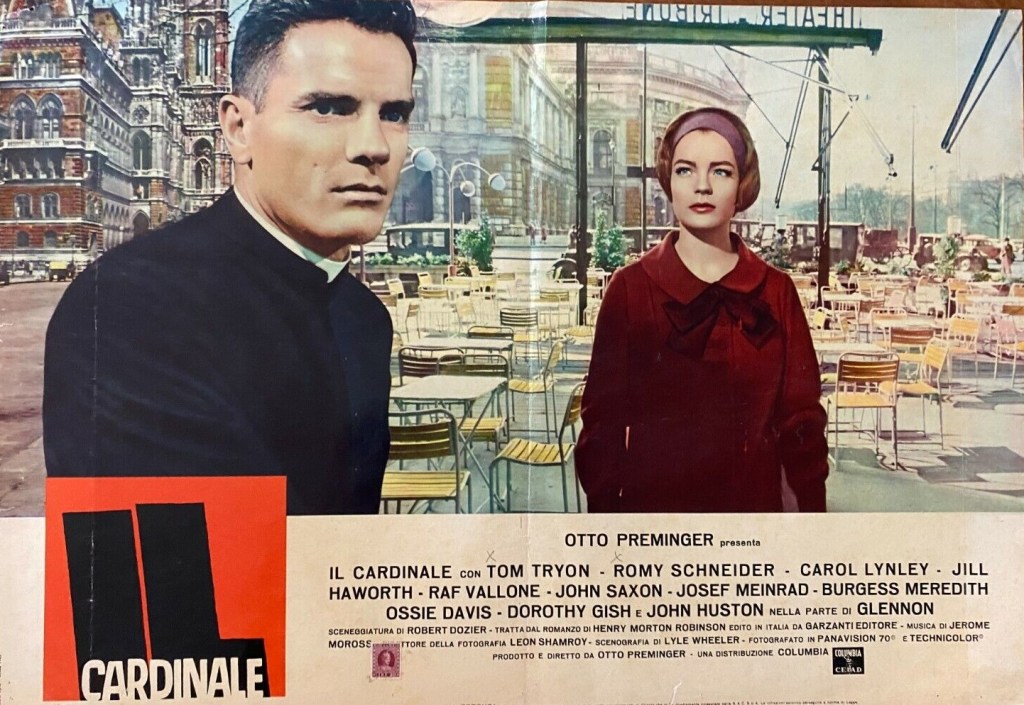
Gore Vidal (The Best Man, 1964) also worked on the script, swapping the novel’s Italian countess for the Viennese Annemarie (Romy Scheider) who, abandoned by the priest had married and was reunited with him prior to the Anschluss, and is sympathetic to Hitler until her husband’s faith endangers them both. Ring Lardner, who had satirized the Catholic church in a recent novel, was the final screenwriter added, his main task to rewrite scenes “to achieve what he (Preminger) wanted,” and, more importantly, to introduce the flashback structure. Ironically, both Vidal and Lardner were atheists.

Tom Tryon and Romy Scheider meet again in Vienna.

The director considered five actors for the leading role – Hugh O’Brian (Africa – Texas Style, 1967), Stuart Whitman (The Commancheros, 1961), Cliff Robertson (The Devil’s Brigade, 1968), Bradford Dillman  (Circle of Deception, 1960) and Tom Tryon (In Harm’s Way, 1965), the latter three advancing to the screen-testing stage. The 34-year-old Tryon won the role and a five-picture contract he would later regret. Carol Lynley (Bunny Lake Is Missing, 1965) who plays the priest’s sister also pacted for five movies.

Romy Scheider’s (Triple Cross, 1966) part was enhanced by the work of cinematographer Leon Shamroy who “fell madly in love with her,” resulting in the actress virtually shimmering on screen, never before “looking as beautiful.” Held in warm regard by the director, she was exempt from his tirades.

It took considerable persuasion on the part of Preminger for John Huston to participate. Curd Jurgens, initially cast as the Austrian cardinal, pulled out and was replaced by character actor Josef Meinrad whose lack of English meant he had to learn his lines phonetically.

Tom Tryon described Preminger as “tyrant who ruled by terror.” He was fired on the first day and probably wished the director had not rescinded the decision, for thereafter the actor was tabbed “lazy…a fool…stupid and unprofessional.” Commented Tryon, “I was so frightened he was going to scream that…I (just) wanted the experience to end.”

One scene with John Huston took 78 takes because Tryon could not deliver what the director wanted. And at one point first assistant director Gerry O’Hara (later director of The Bitch, 1979) found the star in tears and refusing to return unless the director agreed not to shout at him. Eventually, during the Italian section of the shoot, Tryon collapsed from nervous exhaustion, and was prescribed two days rest, and after this incident Preminger let up on his demands of the actor. 

Explained Preminger, “I probably chose him without deliberation because he is weak.” He felt than an ordinary person would not side with the Church against a family member in a predicament, and that only a person “with weakness in his character” would be believable in the role. The character “fails because when you become a priest you substitute your own judgement and your own feelings for the law of the Church…The big decisions are made for him.” (Quite why he never chose an actor who could portray such weakness is not known.)

Tryon admitted that he owed a brief let-up in the bullying to “Schneider’s benign presence.” He commented, “The only fun I ever had on The Cardinal was a (ballroom) scene I did with Romy.” Prior to turning the cameras, Prior called both over, appeared ready to issue instructions, but instead waved them away “you know what to do.”

Added Schneider, “Preminger taught me an important thing: work fast. It’s true that it greatly helps our acting. Each of his directions, whether of gesture or of intonation, is precise and correct. Even better, it’s the only one possible…Each phrase, each world, each syllable are minutely weighed.” That dexterity applied to his positioning of the camera. He made decisions immediately, never hesitating “over the placement of the camera and each time…it was the simplest, the most natural and, dramatically, the best.”

Ossie Davis (The Scalphunters, 1968),  who professed to have enjoyed a marvellous relationship with the director, observed:  “I met actors whom Otto liked, I met actors that had no relationship or feelings one way or the other and I met actors who were almost absolutely destroyed, almost literally in panic because of Otto Preminger (who) was always looking for a spark…whether you had the spark or not, he was going to find it and even put it in you.”

But Patrick O’Neal stood his ground. “I woiuld not take it from him.” And they became friends.

The unit shot for five weeks in New England before heading to Vienna, Preminger choosing to stay in the same suite in the Hotel Imperial as appropriated by Hitler when visiting the city. Permission to shoot in the National Library, “one of the most beautiful monuments in the city” was attacked by the current minister of education who wanted the Hitler era erased from memory. And he was barred from using other government buildings for spurious reasons.

After four and a half months in Austria, the unit shifted to Rome, locations including St Peter’s Square and inside St Peter’s Cathedral and the Santa Maria sopra Minerva church, with priests and monks hired as extras for the various ceremonies. The Georgia scenes were shot in Hollywood on the Universal back lot.

Although generally dismissed by the critics and given a hard time as you might expect from the Catholic Church, The Cardinal hit a chord with audiences, who turned it into Premigner’s second-biggest hit of the decade.

The Hill (1965) ****

Set in a British Army prison camp in North Africa during World War Two ruled by sadistic Sergeant Wilson (Harry Andrews) who believes himself above the regulations he forces others to follow, The Hill is a parable about the hypocrisy of totalitarian rule. And much of what is shown would be offensive to modern sensibilities. Although the commandant (Norman Bird) and medical officer (Michael Redgrave) are his superior officers, Wilson runs the unit by force of personality. He believes his ruthless treatment of the prisoners turns them into proper soldiers. Into his fiefdom come five new prisoners including coward Joe Roberts (Sean Connery), spiv Monty Bartlett (Roy Kinnear), African American Jacko King (Ossie Davis), another Scot Jock McGrath (Jack Watson) and weakest link George Stevens (Alfred Lynch).

Most films about prisons emphasize imprisonment, most scenes taking place in cells or other places of confinement. Sidney Lumet (The Pawnbroker, 1964) directs this film as though it is a paeon to freedom with incredible shots of the vista within which the men are contained. He uses some of the most bravura camerawork you will ever see outside of David Lean. The film opens with a two-minute crane shot credit sequence that begins with a prisoner collapsing on the titular hill and pulls back to reveal the entire encampment and follows with a one-minute reverse tracking shot of Andrews striding through his domain. And while the camera controls what we see, our ears are constantly assailed by the constant drumbeat of other marching prisoners.  

Climbing the hill in full pack would break any man and those who collapse are roused by pails of water. The first to crack is Stevens who is constantly tormented by homophobic jibes. Continuous racist abuse is heaped on Jacko King until driven to the point of madness he begins to behave like a gorilla which frightens the life out of his superiors. Obeying orders, says Joe Roberts, is “like a dog picking up a bone.”  RSM Wilson is out of control, the commandant spending his nights with a prostitute, the medical officer clearly sent here as punishment for some previous misdemeanor. Of the senior staff only Harris (Ian Bannen) comes away with any dignity, constantly trying to thwart the worst bullying.

When Stevens dies suddenly, the film changes tack and becomes a battle for survival among those who could be blamed for causing his death and those who dare to point the finger.  Wilson has no problem stitching up his colleagues and blackmailing the medical officer while Roberts is beaten up for his effrontery in standing up to authority. But the astonishing presence and self-confidence and, it has to be said, courage of Wilson lords it over everyone, and there is an extraordinary scene where he forces the entire battalion of prisoners to back down when they are on the brink of open rebellion.

Connery as Roberts is superb in what is his first dramatic role in a bread-and-butter dramatic production rather than the glossier Marnie (1964) and Woman of Straw (1964) and while he has his moment of defiance he gives enough glimpses of vulnerability and fear to ensure we do not mistake him for his alter ego James Bond. Ian Bannen delivers a touching assured performance far removed from the nasty sarcastic personalities he portrayed in his other desert pictures, Station Six Sahara (1963) and the Flight of the Phoenix (1965).  Ossie Davies, as defiant as Connery, is brilliant as the man who works out a way to beat the enemy by confusing them; the scene in the commandant’s office where he treats the officer as his inferior is a tour de force.   

Although the Army is meant to run according to established regulation, where obedience to a superior is paramount, it is equally apparent that it can also become a jungle if those who are the fittest assume control. Sgt Wilson demands unquestioned discipline even as he is breaking all the rules in the book. But he retains his authority not just by bullying, but by intelligence, exploiting weakness, coolness under pressure and by welcoming confrontation, his personality as dangerous as any serial killer.   

Discover WordPress

A daily selection of the best content published on WordPress, collected for you by humans who love to read.

The Atavist Magazine

by Brian Hannan

WordPress.com News

The latest news on WordPress.com and the WordPress community.