The Angel Wore Red (1960) ***

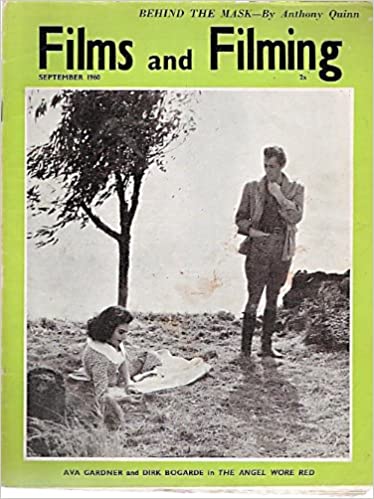
Given that this is filmed in black-and-white, it seems a curious title. So I’m assuming the color is a reference to a scarlet woman which, indeed, Ava Gardner (Mayerling, 1968) is, working in a “cabaret” in an unnamed town at the start of the Spanish Civil War. Strangely enough, the decision to shoot in black-and-white works in the actress’s favor. She was one of the last relics of the Hollywood Golden Age when brilliant cinematographers used innovative lighting to capture on screen not so much great beauty but tantalizing emotion.

The close-up was almost exclusively the preserve of actresses who could convey deep feeling with minute changes of expression or simply through their eyes. Here, a couple of joint close-ups prove the point: Gardner’s face illuminated, even in repose struggling to contain passion; that of lover Dirk Bogarde (Victim, 1961) merely the same as always.  

This Italian-American production is a curiosity, part homily, part reverential, part brutal. Arturo (Dirk Bogarde) is a priest on the run from the invading Communist forces. He takes refuge in a cabaret (code for brothel) where he is sheltered by Soedad (Ava Gardner). He has just denounced his faith so when captured is not executed as an enemy of the state, thus allowing him to begin a relationship with her.

They share an unusual type of innocence, Soledad because, as what was known in those days as a woman of easy virtue, she has never known true love, Arturo, for obvious reasons, denied such an emotion. Their trembling acceptance of this wondrous state of affairs is the beauty of the film.

The love story which would surely in any case have a tragic outcome unfortunately too often plays second fiddle to a subsidiary tale of safeguarding a sacred relic – about whose importance, strangely enough, both sides are agreed – and of arguments between various other political elements over the conflict. Hawthorne ( Joseph Cotton), a cynical journalist – are there any other kind? – bears testimony to the opposing perspectives while no-nonsense General Clave (Vittorio de Sica) deplores the “dirty” war. Neither side comes out well in the conflict the Communists, like a mob storming Dracula’s castle, destroy the cathedral, the Republicans committed to killing all prisoners so as not to hold up their advance. Only the clergy retain their principles even when tortured. 

No one can portray a fallen woman like Gardner, but even as a mature woman her steps towards true love are hesitant, almost believing it is tucked away beyond the rainbow way out of reach, while inner conflict had become central to the Bogarde screen persona.

Writer-director Nunnally Johnson (The Three Faces of Eve, 1957), in his final movie in the hyphenate capacity, had good reason for choosing to film in black-and white – it permitted use of newsreel footage of diving Stuka bombers and more importantly since much of the story takes place at night it creates a haunted background of dark alleys. Color would have destroyed such a vision. You could argue there is artistic purpose here, filming a country which has fallen into a state of spiritual darkness. But that would not be true of the star – black-and-white allows rare opportunity to show what the camera adores in Ava Gardner, her face, even in repose, absorbing the light, as if she were, indeed, redemption. 

A film that doesn’t take sides with characters caught in the middle can’t quite make up its mind where it wants to go.   

Garner rather than Bogarde is the reason to see it.

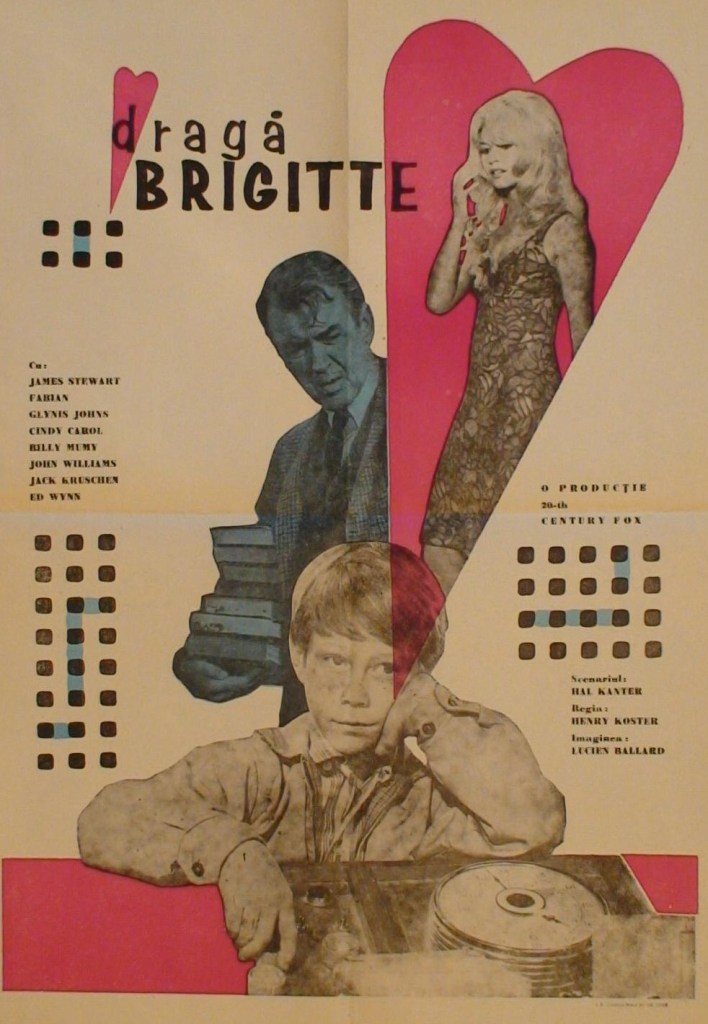
Dear Brigitte (1965) ***

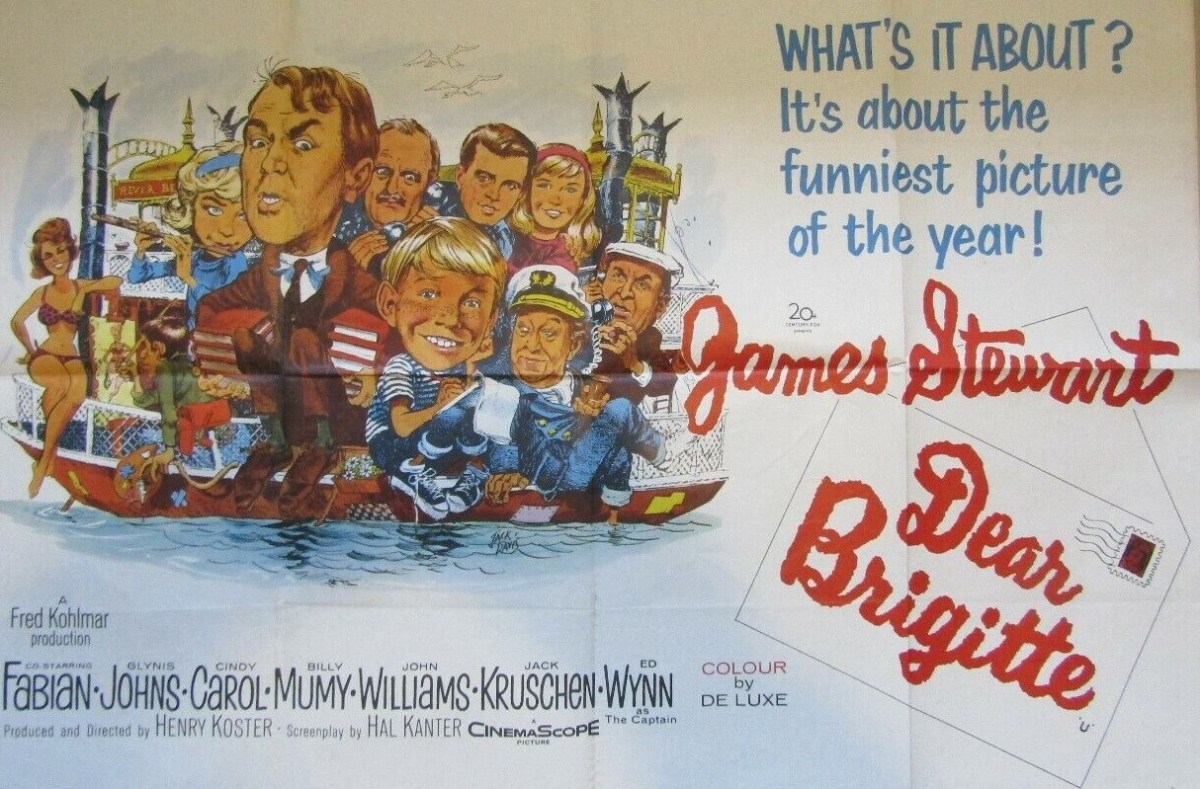
In the same year as his momentous turn in Shenandoah, James Stewart at his exasperating best has the time of his life in this throwback comedy that takes its time getting all its ducks in a row while taking a tilt at nuclear energy, computers and the eternal battle between the arts and science with a fair chunk of whimsy thrown in.

Surprisingly contemporary nod to this whole business of actors speaking directly to the camera, with the ramblings by the Captain (Ed Wynn) in this capacity constantly being interrupted by passersby in the vein of “you talking to me?” or “stop talking to yourself.” Professor Leaf (James Stewart), a distinguished poet constantly at odds with Dean Sawyer (Howard Freeman) at the local college where he teaches – on the few times when he’s not handing in his resignation – and which has a nuclear power station next door, tries to espouse the arts at every opportunity, including a family four-piece outfit playing classical music, only to discover son Erasmus (Bill Mummy) doesn’t have an artistic bone in his body.

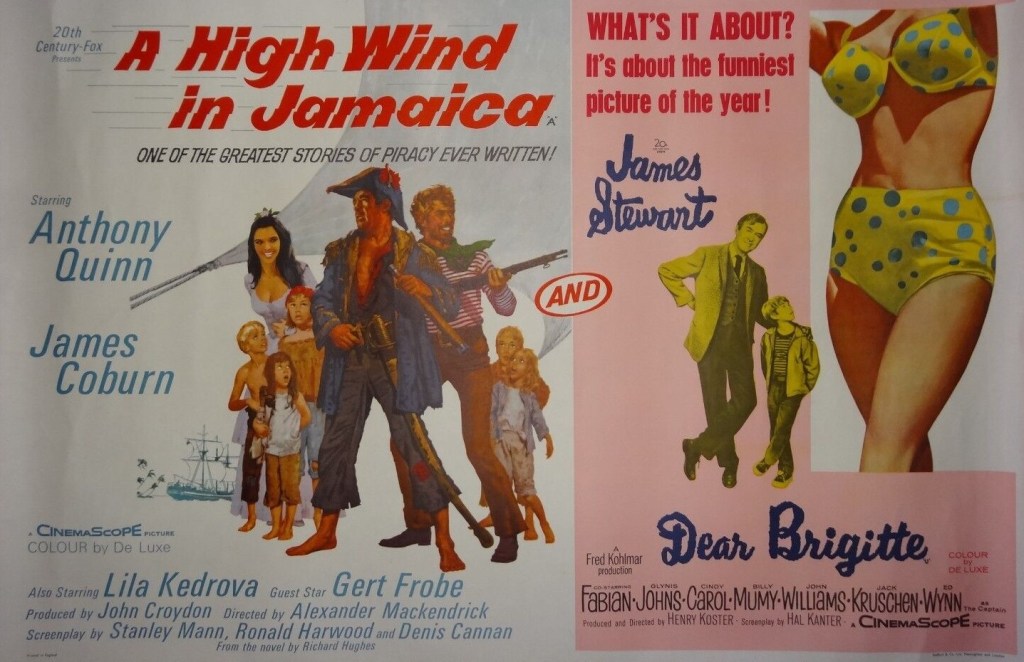
Surprisingy, in the UK down-graded to supporting feature in this kid-centric double bill. The marketing men pulled another fast one in the poster, leading audiences to believe that was BB in the bikini when it was only the usually-nude model of an artist neighbour attempting to be decent.

What Erasmus has, for some reason only now coming to the fore although he must be about ten or so, is that he’s a mathematical prodigy, able to work out complicated sums faster than a computer and pointing out errors in the calculations of the local bank. Leaf’s wife Vina (Glynis johns) doesn’t have a great deal to do except rein in the professor but she has a wonderful scene where she brings the local bank manager to book.

Anyway, eventually, Erasmus gets hooked into helping the boyfriend Kenneth (pop singer Fabian) of Leaf’s daughter Pandora (Cindy Carol) guess the winners of horse races as a way of assisting the couple in raising enough money to get married. By this time, Leaf has finally resigned and worked out he won’t pick up easy cash from the Government – another terrific scene – and is hoodwinked by con artist Peregrine Upjohn (John Williams) into setting up a charity to help disadvantaged students by employing his son’s skills.

Anyone familiar with horse racing will be aware how preposterous the conceit that anyone, no matter how scientifically skilled at working out the odds, can consistently pick winners. But this all flies by since it’s that kind of movie, one that not only defies belief, but basically sucks you into believing the whole thing, the way the untalented youngsters always managed in Hollywood times gone by to muster a great stage show or turned any kind of loser into a winner.

Still, all this goes on before we get close to the nub of the title. Erasmus has fallen in love with Brigitte Bardot and because he’s basically the family’s sole breadwinner eventually dad takes son to France to meet the real-life superstar who is far more charming than you would expect, the sexpot on hold for the occasion.

So, mostly, as I said, it’s an old-fashioned confection, the kind you could still get away with in the mid-1960s before the changing times demanded that comedies take on a harder edge. And with James Stewart in top form and husky-voiced English star Glynis Johns (who had her own television series in the U.S.) jumping in now and then to prevent him from making things worse it works a treat. Stewart exaggerates all those mannerism you might have thought mildly irritating before – he’s all limbs and sentences cut off in their prime and telling people to leave their own houses. But if he had toned any of that down, the air would have quickly escaped the balloon, for really he’s the only thing keeping it afloat.

But that’s stardom for you. A vehicle comes along that in total isn’t really worthy of the involvement of a marquee attraction like Stewart, who could be lending his talents to more solid fare like Shenandoah and The Flight of the Phoenix (also released the same year). While he’s crucial to both those other pictures, giving one of his best performances in the former, perhaps surprisingly, U.S. audiences, voting with their dollars, felt his performance here trumped that of the Aldrich picture.

Ir’s usually believable roles that attract the greatest critical plaudits for stars, but actually their most notable contribution is in making fly movies that should never work on paper but somehow with their magical injection not necessarily makes the screen sizzle but turns doughy material into something lighter and more easily digestible.

Henry Koster (Mr Hobbs Takes a Vacation, 1962) directs with occasional flair from a screenplay by Hal Kanter (Move Over, Darling , 1963) and Nunnally Johnson (The Dirty Dozen, 1967) based on the bestseller by John Haase.

As under-rated as The Trouble with Angels (1966) as lightweight comedies of the decade generally were, this is worth a look for Stewart alone.  

https://amzn.to/3RiMcjX

Mr Hobbs Takes A Vacation (1963) ***

Audiences reared on the actor’s westerns and Hitchcock thrillers of the 1950s might have been somewhat taken aback to see the hard-hitting star turning up in a comedy. Setting aside Bell, Book and Candle (1958), he hadn’t been seen in anything that would resemble a Hollywood confection since a couple of lack-luster Post-War comedies – Magic Town (1947), Jackpot (1950) –  when he was trying to regain the marquee status he had lost by going off to fight. Of course, having gone heavyweight with Anatomy of a Murder (1959), Two Rode Together (1961) and The Man Who Shot Liberty Valance (1962) he might have thought he was due some movie R’n’R.

Whether this contemporary equivalent of a beachside air bnb gone wrong was the ideal choice is a moot point. But he would certainly be playing against type. After all those tough guys, principled leaders and occasional dodgy characters, you wouldn’t have to go far to find people who might enjoy seeing him taken down a peg or two.

Harassed banker Roger (James Stewart) wants a quiet getaway with wife Peggy (Maureen O’Hara). But she has different ideas and he finds himself bunked down with a brood too many, his own family, in-laws and unexpected guests. Naturally some of these unexpected guests included rats, happily infesting this shambling house that could have been second-choice for Bates Motel, and there are plenty running gags about what doesn’t work or falls off and a shared telephone line.

If there was such a sub-genre as the mature coming-of-age picture, this would be it, Roger realizing he has a lot of catching up to do in the emotional relationship department.

Mostly, it’s one episode after another. The cook quits, his daughter and son-in-law have eschewed the traditional approach to child-rearing, son Danny wants to be left alone to play his computer games, sorry watch television, teenage daughter Katey (Lauri Peters) is turning into a wallflower, rather well-endowed neighbors catch his eye. To show willing, he’s the yachtsman who gets lost and bored bird-watcher.

But if audiences have learned one thing from a decade of Stewart-watching, it’s that he’s generally far from hapless and although it’s not his fault he’s trapped in the shower room with a naked woman (Marie Wilson), he’s not so much a do-gooder as a do-er, setting out to repair as much as possible the fractured relationships, not above a bit of bribery or cutting a few corners.

This is amiable enough stuff, a few good laughs, and much merriment to be had from the mere sight of the banker, lord of his domain at work cast adrift outside it, and having to adapt to different perspectives. There’s a harder edge than you might expect and some of the scenes of relationships under pressure don’t make easy viewing.

These days, everything wouldn’t work out so well, but in the 1960s I guess the tension was derived from working out exactly how it would work out. And waiting for teen heartthrob Fabian (North to Alaska, 1960) to sing. It seems a contradiction in terms that a pop star trying to prove himself as an actor has to fall back on singing. But them’s the breaks.

A mixture of situational comedy and sharp repartee, it never falls apart at the seams, enough in the tank to keep everything on an even keel.

James Stewart moves from coldness at finding himself in awkward situations to warmth as he finds ways to retrieve the best elements out of them. Stewart doesn’t have to adapt his screen persona that much, he was always a tad grouchy, and he’s packed a briefcase full of sarcastic remarks. But the scene where he reconnects with his son is very touching, Stewart at his heartfelt best.

Maureen O’Hara (The Battle of the Villa Fiorita, 1965) who also has a few icy veins sets those aside to mother all and sundry. Stewart and O’Hara prove an excellent screen partnership and they would be paired again in The Rare Breed (1966), where he was on more solid ground.

John Saxon (The Appaloosa, 1966) gets a chance to show what he can do besides being tough and John McGiver (My Six Loves, 1963) adds another interesting character to his portfolio of offbeat roles.

Veteran Henry Koster (Harvey, 1950) knows how to handle any amount of handfuls and when to pick out the comedy or head straight for the drama. Nunnally Johnson (The Dirty Dozen, 1967) based the screenplay on the bestseller by Edward Streeter, an expert in domestic upsets, previously penning Father of the Bride.

The Angel Wore Red (1961) ***

Given that this is filmed in black-and-white, it seems a curious title. So I’m assuming the color is a reference to a scarlet woman which, indeed, Ava Gardner (On the Beach, 1959) is, working in a “cabaret” in an unnamed town at the start of the Spanish Civil War. Strangely enough, the decision to shoot in black-and-white works in the actress’s favor. She was one of the last relics of the Hollywood Golden Age when brilliant cinematographers used innovative lighting to capture on screen not so much great beauty but tantalizing emotion.

The close-up was almost exclusively the preserve of actresses who could convey deep feeling with minute changes of expression or simply through their eyes. Here, a couple of joint close-ups prove the point: Gardner’s face illuminated, struggling to contain passion; that of lover Dirk Bogarde (Song without End, 1960) merely the same as always.  

This Italian-American production is part homily, part reverential, part brutal. Bogarde plays a priest on the run from the invading Communist forces during the Spanish Civil War. He takes refuge in a cabaret (code for brothel) where he is sheltered by Gardner. He has just denounced his faith so when captured is not executed as an enemy of the state, thus allowing him to begin a relationship with her. They share an unusual type of innocence, Gardner because, as what was known in those days as a woman of easy virtue, she has never known true love, Bogarde, for obvious reasons, the same. Their trembling acceptance of this wondrous state of affairs is the beauty of the film. No one can portray a fallen woman like Gardner, but even as a mature woman her steps towards true love are hesitant, almost believing it is tucked away beyond the rainbow far out of reach, while inner conflict had become central to the Bogarde screen persona.

The love story which would surely in any case have a tragic outcome unfortunately too often plays second fiddle to a subsidiary tale of safeguarding a sacred relic – about whose importance, strangely enough, both sides are agreed – and of arguments between various other political characters over the conflict. Joseph Cotten as a cynical journalist – are there any other kind? – bears testimony to the opposing perspectives while Vittorio de Sica has a glorious cameo as a no-nonsense general who nonetheless deplores the “dirty” war. Neither side comes out well in the war, the Communists, like a mob storming Dracula’s castle, destroy the cathedral, the Republicans committed to killing all prisoners so as not to hold up the advance of their troops. Only the clergy retain their principles even when tortured.  

Writer-director Nunnally Johnson had good reason for choosing to film in black-and white – it permitted use of newsreel footage of diving Stuka bombers and more importantly since much of the story takes place at night it creates a haunted background of dark alleys. Color would have destroyed such a vision. You could argue there is artistic purpose here, filming a country which has fallen into spiritual darkness. But that would not be true of the star – black-and-white allows rare opportunity to show what the camera adores in Gardner, her face, even in repose, absorbing the light, as if she were, indeed, redemption.


Discover WordPress

A daily selection of the best content published on WordPress, collected for you by humans who love to read.

The Atavist Magazine

by Brian Hannan

WordPress.com News

The latest news on WordPress.com and the WordPress community.