The Damned / Gotterdammerung / Twilight of the Gods (1969) **

Ponderous, gratuitous, offensive. Let’s start with the pedophile, spoiled grandson Martin (Helmut Berger) of industrialist patriarch Joachim (Albrecht Schonhals). We already guess he has this kind of predilection for young girls as that’s suggested during a game of hide-and-seek at the family mansion and by a scream in the night that is ignored. He keeps a mistress Olga (Florinda Balkan) and is drawn to the young girl in the apartment next door, bringing her the kind of expensive present that her impoverished mother believes she must have stolen. So we know what he’s all about. It’s discreetly enough stated without the inclusion of a scene which I doubt would pass the censor these days and should the young actress be still alive in these MeToo times might be considering legal action for being taken advantage of.

Although the storyline is similar to the director’s earlier The Leopard (1963) of the powerful – there a wealthy landowner, here an arms manufacturer – trying to hold onto their status in times of change (then the invasion of Sicily by forces wanting to unite Italy, now the rise to eminence of Hitler), there’s little of the cinematic flair of the latter. Long scenes are played out at dinner tables or in bedrooms. And most of that is machination, someone or other wanting to take over the family firm or be the power behind the throne.

You need some knowledge of German history to understand the significance of some events. Hitler, then the German Chancellor, burned down the Reichstag (the German Parliament) in 1933 in a ruthless bid for power. Hitler employed two factions, the predominantly working class brownshirts (the SA) and the mainly middle class blackshirts (the SS), the former a paramilitary organization committed to actions against Jews and backing his early bid for power. In 1934, in the Night of the Long Knives, the SS obliterated the SA.

The first section of the picture straddles these two events with a Succession-style drama. In reaction to the burning of the Reichstag, Joachim replaces Herbert (Umberto Orsini), his top executive and outspoken anti-Nazi, with boorish nephew Konstantin (Reinhard Koldehoff) who is a high-ranking member of the SA.

This doesn’t sit well with Friedrich (Dirk Bogarde), who expected preference. Urged on by lover Sophie (Ingrid Thulin), Joachim’s widowed daughter-in-law,  and Aschenbach (Helmut Griem), Joachim’s nephew and an ambitious high-ranking SS official, Friedrich kills Joachim but pins the blame on Herbert who has to flee.  
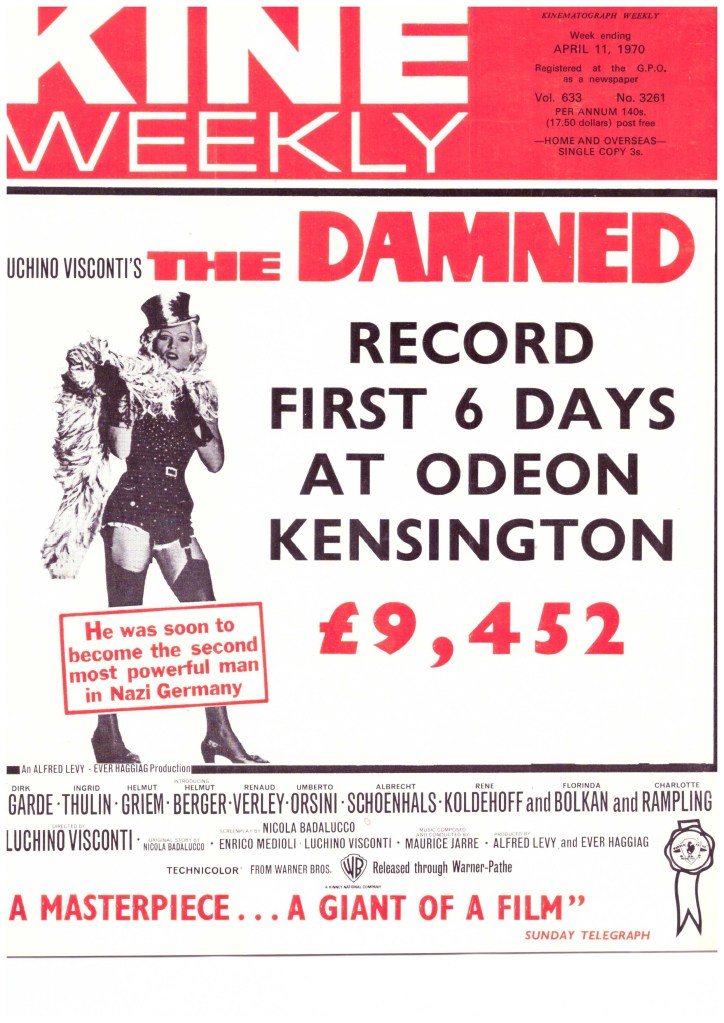
Konstantin is thwarted because although technically in charge it’s now Martin who owns the business and nudged by Sophie gives Friedrich the top management role. So Konstantin resorts to blackmail, having uncovered the pedophile. In steps Sophie who uses Aschenbach to thwart him again. Though there’s not much need because Konstantin is eliminated as one of the SA members executed in 1934 at some kind of gathering where the attendees all appear to have homosexual tendencies.

Aschenbach and Martin nurse grievances. Aschenbach feels Friedrich isn’t ostentatious enough in support of Hitler and Martin is furious that Sophie manipulated his difficulties with Konstantin to Friedrich’s benefit. So the SS man and the dissolute conspire. In the way of this kind of heightened melodrama it’s revealed that Friedrich killed Joachim. That doesn’t send Friedrich to trial, instead wins him a get-out-of-jail-free card by turning into a radical Nazi.

Martin, meanwhile, is also a member of the SS. He rapes Sophie, Friedrich loses his way and in one of those moments Francis Ford Coppola would appreciate Martin kills them on their marriage day.

There are a couple of oddities. It’s hard to believe a young girl – we’re talking a 7-8-year-old – would actually manage the mechanics of hanging herself. And when Friedrich is drawn into joining the slaughter of the SA members, there is over-emphasis on his perceived sensitivity  when previously he had cold-bloodedly despatched Joachim.

So glorified soap opera with too much virtue signalling for its own good. Excepting Herbert and wife Elizabeth (Charlotte Rampling) and another grandson, who play minor roles, there’s not  a single character to care for.

Despite the unusual backdrop, there’s nothing particularly unusual about the succession/inheritance scenario. The tough self-made millionaire or latest head of a wealthy family seeks to maintain power and guard against diminishing its status and lineage by ensuring the correct successor is groomed and that capital is not dissipated through unsuitable marriage or indulging weaker offspring. Thomas Mann, who fled the Nazis in the 1930s, covered this ground more successfully in his debut novel Buddenbrooks, although admittedly with less decadence.

Setting The Damned against the rise of the Nazis is an attempt to give it more artistic status than it merits because it’s really not much more than a standard study of ambition and ruthlessness.  
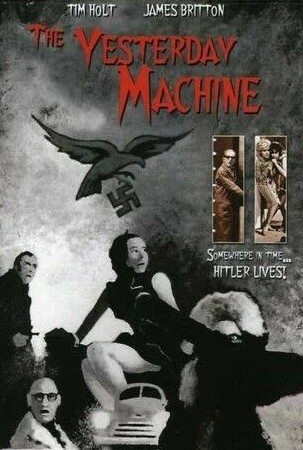
The Yesterday Machine (1965) ***

Some big-name director, especially these days, would have seen the potential, injected some action and jeopardy, a good dose of awe and maybe more of a hint of a romance. You can’t help but feel this would be exactly the kind of enterprise that might get a more favourable hearing from a contemporary audience that’s sucked up even worse baloney in the multiverse and beyond.

Despite you might thinking concentration camps should not be used for superpower fiction, they were essential to the Magneto narrative in the X-Men Files, a set-up which also involved Captain America and Wolverine. So you can’t really show revulsion at attempts by a low-budget sci-fi B-picture to shoehorn in a concentration camp element. This doesn’t have the budget to “show” and must rely simply on “tell” to get over the essential story element. But we’re also bouncing around the time universe to the extent of the American Civil War and the French Revolution.

When the car of college kids Ellison (Jay Ramsay) and drum majorette Margie (Linda Jenkins) breaks down on a dirt road on the way to a football match, they end up confronting soldiers from the Civil War. The boy is shot and taken to hospital, but the girl disappears, plain vanishing, sniffer dogs finding the trail suddenly stops.

In the absence of another poster of the movie reviewed I’ve opted for something with the word “machine.” This at least concerns time travel.

Journalist Jim (James Britton), investigating, discovers the Civil War link because Ellison has been shot by a bullet from that war and the uniform of the Civil War soldiers couldn’t be mere replicas worn by historical re-enactors because the uniform manufacturer went out of business in 1869. Jim hooks up with Margie’s sister, nightclub singer Sandy (Ann Pellegrino). Soon, thanks to a cop, they are on the trail of a time machine created by Professor Von Hauser (Jack Herman) who experimented on inmates in concentration camps, ageing young people and the reverse.

Jim and Sandy fall into the time machine’s orbit and are teleported to Von Hauser’s lab. The professor, a contemporary of Einstein, aims to go back in time and prevent his hero, Adolf Hitler, from committing suicide. Jim and Sandy are imprisoned until freed by an Egyptian serving girl, also teleported from a couple of millennia back, and the professor’s heinous plan is scuppered.

Occasionally, writer-director Russ Marker (Night Fright, 1967) allows himself a bit of visual leeway, a jackboot appears in the undergrowth to stamp out a cigarette, Jim and Sandy running down a hill vanish only to reappear seconds later in a different time zone, Margie practizing her moves while the car is being fixed.

But mostly, it’s dogged detective work, Jim helped along by people who favor the odd interpretation of events, a doctor who collects Civil War memorabilia, the cop whose outfit liberated the camp with the time machine. There’s enough mystery to keep you hooked and if you imagine the likes of Tom Hanks in Da Vinci Code mode uncovering this bizarre collection of facts you’d be far more inclined to go along with the presentation rather than treating it as the kind of baloney that had “cult” written all over it.

See above but no time travel.

I’m not sure I agree with the “dreary pace” – while progress was stately to say the least, it took that length of time to establish the groundwork – and the second half is enlivened not so much by the professor defending Hitler as the look on his face when Jim delivers a coruscating critique on the Fuhrer. I’m always partial to scientists explaining their barmy notions and jargon – nobody balked at James Cameron’s “unobtainium” in Avatar (2009).

This is what comes of trawling YouTube in an idle moment.

Sure, it really is nothing more than two-star material but I enjoyed it more than I expected, and, these days, worse notions have been served up to unsuspecting audiences.

Night of the Generals (1967) ****

Impressive vastly underrated whodunit that breaks all the rules. Take the length for a start – just stopping short of two-and-a-half hours. The investigation covers multiple time periods – 1942, 1944 and 1965. The killer outwits the detective. Most important of all, the murder is clearly a MacGuffin to examine politics among the German officer class.

A Polish woman who turns out to be a German agent is viciously stabbed to death in Warsaw in 1942 during a period of staunch resistance by the inhabitants. General Tanz (Peter O’Toole), sent in to quell a potential uprising, is one of three generals on the suspect list compiled by Major Grau (Omar Sharif), the others being the alcoholic General Khalenberge (Donald Pleasance) and the philandering General von Seidlitz-Gabler (Charles Gray).

But Grau is no ordinary detective or, put another way, this not an ordinary investigation.

Grau lacks any of the powers we associate with an investigator. Yes, we expect obstruction, perhaps collusion, as the murderer tries to avoid detection. But Grau might well have been a sergeant for the disdainful treatment and lack of cooperation he receives. And there’s a fair chance he’s going to be shot at as he prowls the streets, and resistance fighters in tenement exchange fire with the invaders. None of the generals can account for their whereabouts on the night in question.

While Tanz is benign to children, ordering a hungry bunch fed from his own supplies, he is ruthless with adults, willing to employ flamethrowers (Phase Two of his plan) to drive snipers out of buildings and if that fails move onto Phase Three which simply uses tanks to obliterate everything. Like some knight of old, Tanz stands upright in his jeep directing operations in full view of the enemy, almost taunting them to kill him.

The most powerful image in the film – the one used in the posters – has Tanz standing (on the right of the screen) upright in his jeep with the world on fire behind him. What’s edited out of the poster is that Grau occupies the left side of the screen, standing like a servant awaiting his master’s orders.

That Grau makes no progress at all is down to the power of his superiors. Since he commits the cardinal sin of getting in the way, he is just shuttled out of Warsaw, promoted to Colonel and given other duties in Paris. So the scene shifts to the Parisian capital in 1944 after D-Day. The same three generals are on duty in the French capital, not supervising, as you might expect, the defence of the city against the encroaching Allies, but planning an attempt on the Fuhrer’s life (Operation Valkyrie). This time it’s Tanz, returning from the Russian front where his regiment has been decimated, who is shuttled to one side, ordered to take two days leave so he doesn’t get in the way of the saboteurs.

At this point, the movie boldly switches perspective, in part to encompass the assassination subplot, in part to focus more closely on Army politics, in part to follow Tanz, not just an alcoholic but a poster boy for OCD, as he tries to enjoy some downtime. He is accompanied on his tourist trip through the city and jaunts to visit museums by his chauffer/butler Corporal Hartmann (Tom Courtenay) whose other duties include spying on the general on behalf of the plotters. Grau, meanwhile, recruits French Inspector Morand (Phillippe Noiret) to assist in his investigation, which is otherwise being obstructed on all sides.

I won’t reveal the shocking ending which shows just how clever the murderer is because that’s not actually the ending and the story shifts to 1965 when the generals have been rehabilitated after the war, the case still open because a third woman has been killed in the same fashion.

I may have seen this back in the day and certainly remember it vaguely from a pan-and-scan version edited for television, but I had generally avoided it because of the poor reviews. I wonder how many critics just found it in poor taste, to be spending big Hollywood bucks on a story that treated German generals as pretty well ordinary human beings, the war itself so much in the background you would think it non-existent. Plenty critics sniped at the performance of the principles, perhaps because Peter O’Toole (Becket, 1964) and Omar Sharif (Genghis Khan, 1965) played so much against type. The image I mentioned of O’Toole with the world ablaze is an ironic one, not charged with the glory of David Lean’s vision of the actor in Lawrence of Arabia (1962). Similarly, not once does director Anatole Litvak (Five Miles to Midnight, 1962) rely on Omar Sharif’s soulful brown eyes the way Lean did in Doctor Zhivago (1965), in fact there is no such shot here at all. Sharif looks weary and jaded, kept going in the face of obstruction by his own convictions about justice. O’Toole is so wound up he likes like he’s about to explode and at times certainly teeters off-balance.

Critics seemed so intent on dishing out barbs that they missed two excellent performances, Sharif , in particular, unable to call on his romantic side, delivering very fine work. Donald Pleasance (Soldier Blue, 1970), devoid of his usual physical tics, is also memorable. And there is so much to enjoy from the direction. Litvak, in particular, makes superb use of the tracking shot. Often a scene begins with a close-up, tracks back to reveals others, allows them to deliver their lines, then tracks back into the original character, usually the one with most to lose at this moment. He allows time to develop the other characters. Without ever appearing drunk in the way of Tanz, Khalenberg is always pouring or drinking a shot of alcohol. Seidlitz-Graber is inhibited by family politics as his wife (Coral Browne) attempts to ease their daughter Ulrike (Joanna Pettet) into high society.  

I must also mention the brilliant score and the pithy lines that shoot out from cynical mouths. “Making up one’s mind is one thing,” observes Seidlitz-Graber acidly, “speaking it is another.” On hearing of the assassination plot, Grau points out, “when things were going well, the generals enjoyed the war as much as Hitler.” Music came courtesy of Maurice Jarre (Doctor Zhivago) and the screenplay was a joint effort between Joseph Kessel (Army of Shadows, 1969) and Paul Dehn (The Spy Who Came in from the Cold, 1965) who hacked away at the H.H. Kirst novel, retaining only the opening.

Well worth watching.

Discover WordPress

A daily selection of the best content published on WordPress, collected for you by humans who love to read.

The Atavist Magazine

by Brian Hannan

WordPress.com News

The latest news on WordPress.com and the WordPress community.