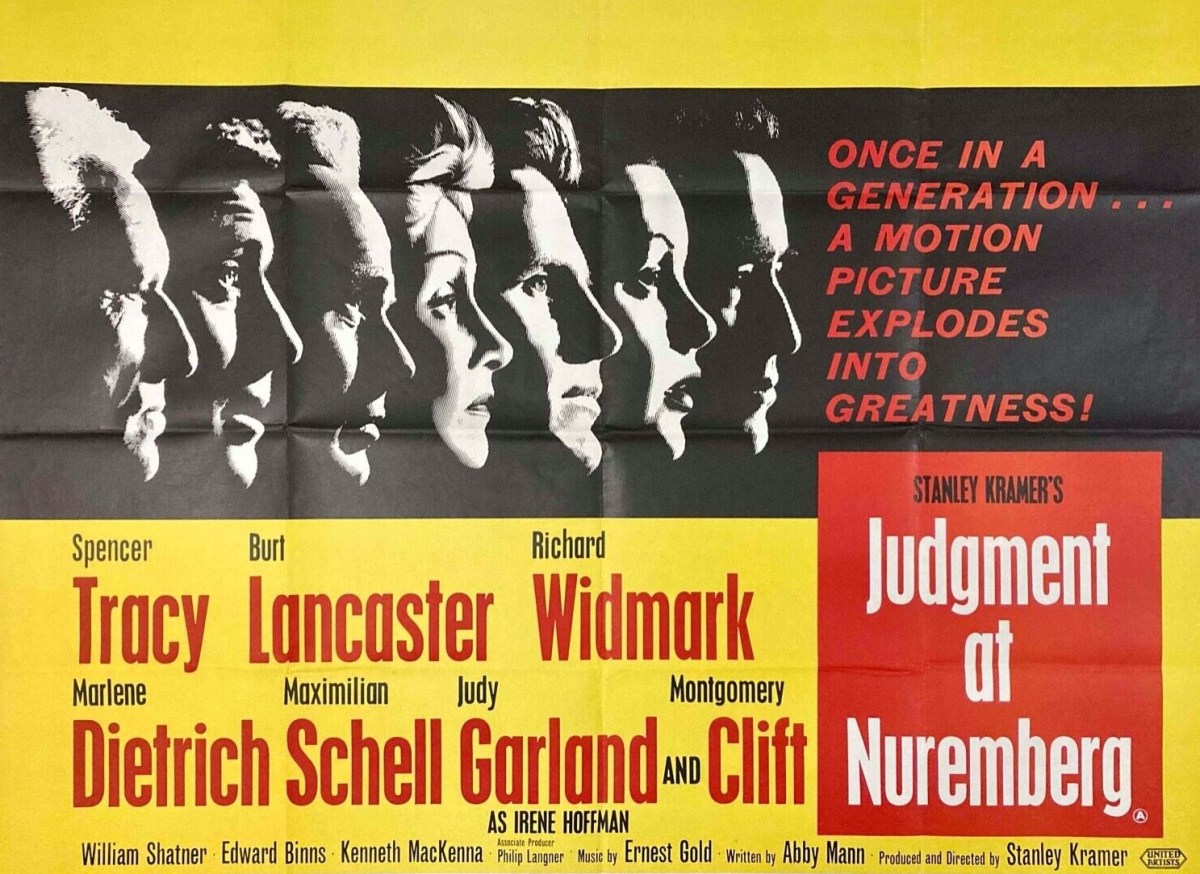
Judgment at Nuremberg (1961) ****

Stanley Kramer never caught a decent academic/critical break. Subject matter worthy, execution poor, was the overall consensus. But Judgement at Nuremberg, with its long tracking shots, sometimes turning 360 degrees around a character, should have changed all that. But the kind of critics who would have appreciated such bravura technique weren’t around at the time and even when Antonioni’s The Passenger (1975) appeared nobody thought to reference Kramer, believing this was a new cinematic invention by the esteemed Italian maestro.

So, Judgement at Nuremberg is remembered, if at all, for the subject matter and elevated by the performances rather than the director’s input. Most people misremember what the movie’s about. The main concern here isn’t the war criminal, the men personally involved in running the ghettos. Instead, it’s about those behind the scenes who could, theoretically, have prevented the camps flourishing, or at least challenged their opening.
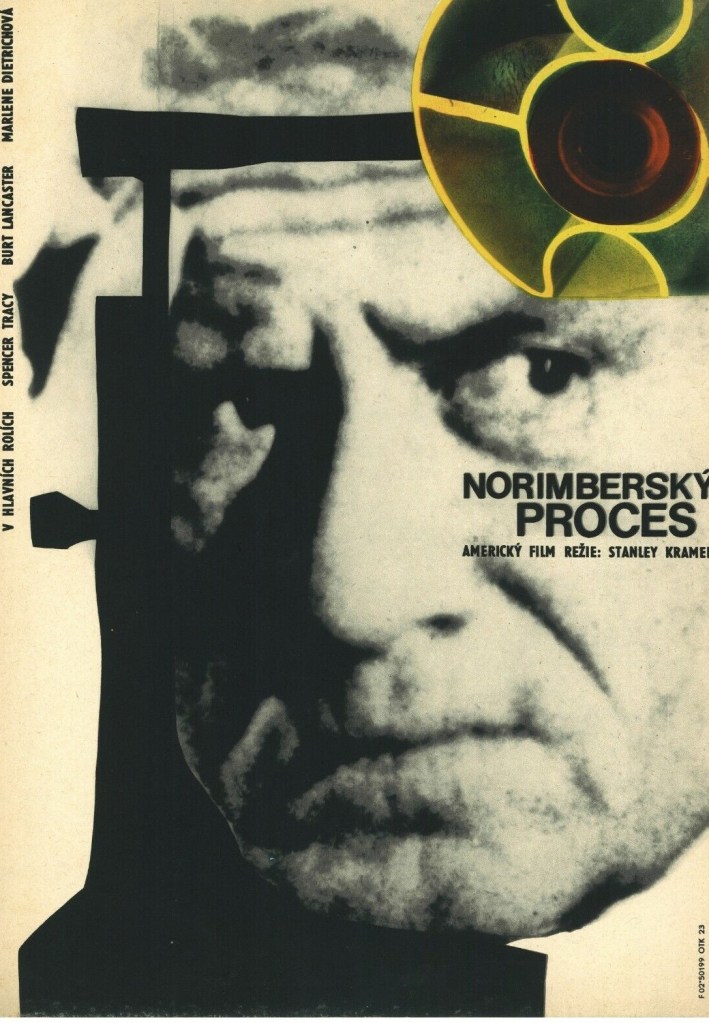
Those on trial were freedom fighters of a different sort. As judges, the top tier of the legal system, their job was not just to uphold law and order and individual freedoms, but to take government to task for illegal action. It’s a basic tenet of the democratic world that governments cannot act in autocratic fashion but work within public accord.

Should the legal guardians find fault with government activity, their job is to take the ruling body to task – the European Court of Human Rights was set up with exactly that principal in mind, and various British and American law agencies have over time called a halt or questioned government proposals.

Some of the judges were clearly ill-fit for the task, lick-spittle jobsworths, desperate to hold onto rank and privilege, many sharing the same anti-semitic views as Hitler. But the Allied forces, being democratic, have to proceed along proper lines, taking potential criminals to court and allowing them legal defence.

So the main target is Dr Ernst Janning (Burt Lancaster), German’s pre-eminent legal force, a quiet, dignified man, who refuses to fawn or react to the charges. On the attack is prosecutor Col Tad Lawson (Richard Widmark). Acting for the defence is the wily, emotional, Hans Rolfe (Maximilian Schell) who is not above comparing the Holocaust to the Americans dropping the atom bomb on Hiroshima, indiscriminate terror brought on innocent civilians the result of both actions. He also brings to the court’s attention the distasteful theories that once held sway in high American legal circles as promulgated by Oliver Wendell Holmes, a Supreme Court judge, whose views on eugenics aimed at withholding procreation rights from the mentally handicapped.   

As referee we have Dan Heywood (Spencer Tracy), the American chief judge, who didn’t want the job and was way down the pecking order of those best qualified. And he’s a bit of a detective on the side, trying to discover how much ordinary people –  such as the flirtatious Mrs Bertholdt, widow of an executed German general, as well as the housekeeper and butler looking after him in some style – knew about the atrocities as they were taking place.

In the background is an Allied command not wishing to stir up any more controversy, conscious of the rising power of the Communist bloc, seeing West Germany as a bulwark against Stalin, concerned that forcing the country’s inhabitants to wallow in the past will turn their political minds towards the east rather than the west.

In due course, a variety of witnesses are called, testifying to ill-treatment under the German government including the backward Rudolph Pedersen (Montgomery Clift) and Irene Hoffman (Judy Garland).

What makes this so different is that innocence or guilt is not what’s under scrutiny, but reason. Why did such high-minded legal experts like Dr Janning give in to Hitler. And when? And do they recognise their role in providing Hitler with credence to continue with his massacre of the Jews?

Individual conscience and, conversely, collective guilt, might have been the driving force then but they are more than relevant today when actions in war come under even greater scrutiny and politicians are held to account. Perhaps, it’s ironic how little judgement was passed in the end on those convicted in these trials. Nobody was hanged, nobody received even a life sentence. In fact, by the time the movie was released, all were free men.  

Stanely Kramer, the Scorsese or Nolan of his era regarding running time  (it clocks in a just shy of three hours), does a superb job with his even-handed approach. While his technical skills were perhaps under-appreciated, he certainly knows how to command an audience’s attention and draws terrific performances from his actors.

Maximilian Schell, who won the Oscar, is perceived as the standout, but for me the highpoints were Burt Lancaster (The Swimmer, 1968) and Montgomery Clift (Freud, 1962). Abby Mann’s (The Detective, 1968) screenplay was an expanded version of his teleplay of two years before.

Has more than enough humanity to keep you riveted.

https://amzn.to/3Mh4v7c

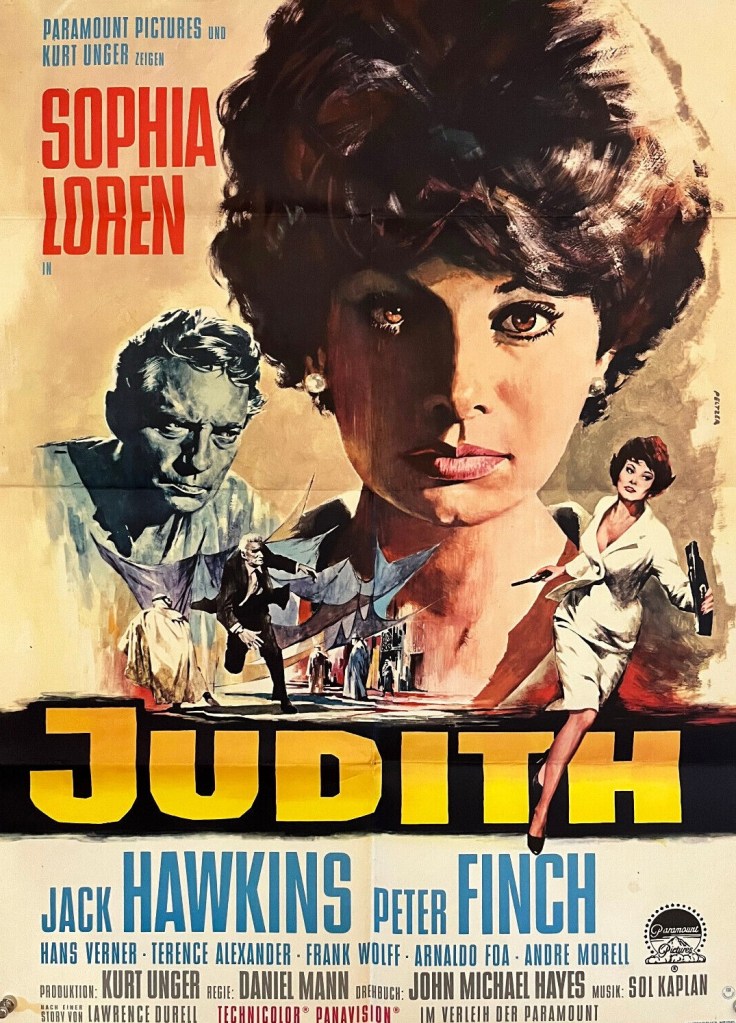
Judith (1966) ***

This is why you hire Sophia Loren. In the middle of a complicated story she provides the  emotional anchor.. And she can do it without words. A few close-ups are all you need to guess at her inner turmoil in a world where, as with Play Dirty (1968), the individual is disposable. The good guys here, Israelis fighting for survival at the rebirth of their country, are every bit as ruthless as the commanding officers in the World War Two picture.

And it’s just as well because the tale is both straightforward and overly complex. Like Cast a Giant Shadow, out the same year, or the earlier Exodus (1961), it’s about the early migrants staving off Arab attempts to destroy the tenuous foothold Jewish immigrants on the land with  the British, stuck in the role of maintaining law and order, cracking down on illegal landings of refugees and arms smuggling.  But where the earlier movies take the war to the enemy, this is all about defence, holding on to hard-won positions.

Israeli leader Aaron (Peter Finch) discovers General Schiller (Hans Verner), a former German WW2 commander wanted for war crimes, currently in charge of the Arab tank regiment, is planning imminent assault. After locating Schiller’s wife Judith (Sophia Loren), he smuggles her into Israel with the intention of using her as bait to kidnap the general.

This would be no romantic reunion. The general had abandoned his wife, a Jew, and she spent the war in Dachau where she survived as a sex worker. She wants nothing more than revenge. But it takes a fair while for the cloak-and-dagger elements to warm up. First of all she has to seduce British Major Lawton (Sophia Loren) into revealing details of her husband’s whereabouts.

Turns out Lawton is the only principled official on show, out of general decency and a British sense of fair play (unlike the soldiers, for example, in Play Dirty)  turning down the offer of her body in return for his aid.  But it also transpires that Judith also lacks any notion of fair play and stabs her husband at the first opportunity, making it virtually impossible for his captors to discover the specifics of the planned attack. You wouldn’t need much of a sense of irony to share the Israeli anger when uner interrogation the captured general tosses back at them the Geneva Convention.

Judith’s involvement in the hunt for the general had the potential to be a very fine film noir on its own, especially had the wife been required to show willing to the husband in order to lure him out into the open.

Unfortunately, that’s not the tack the movie takes. Instead, we follow a series of forgettable characters either espionage agents, or at the kibbutz or effectively just there in passing, on the edge of the action, even when they might be in the heart of the real action either being unloaded into the surf or under attack from Arabs. There’s a sense of trying to cram too much historical incident into what would have worked best as a straightforward thriller. How far would Judith go to extract revenge? And, can Aaron stop her ruining his delicately-balanced plans?

Plenty of room for maneuver too on the sticky point of country vs individual. Where Aaron is happy to sacrifice or exploit Judith to satisfy his agenda, albeit to the greater glory of his country, so, too, is Judith unwilling to surrender her individuality for that more beneficial cause.

So what we get is a riveting mess. When Sophia Loren (Operation Crossbow, 1965) is onscreen you can’t take your eyes off her. When the action switches to the sub-plots, you keep on wondering where she’s got to and when will she next turn up. Judith is a fascinating character, batting away contempt about the way she survived the concentration camp, arriving in an old-fashioned cargo container with the corpse of a companion who failed to last the journey, and before long sashaying through the kibbutz delighted to attract male attention.

Yet, despite the hard inner core, and keeping one step ahead of both Aaron and Schiller, as if she had long ago stopped trusting men, she is emotionally vulnerable and proves easily manipulated when either pierces the carapace.

That director Daniel Mann feels duty bound to attempt to tell the bigger story of the Israeli struggle is  somewhat surprising since he was best known as a woman’s director. Under his watch both Shirley Booth and Terry Moore were Oscar-nominated for  Come Back, Little Sheba (1953), both Susan Hayward and Anna Magnani Oscars winners for I’ll Cry Tomorrow and The Rose Tattoo, respectively.

John Michael Hayes (Nevada Smith, 1966) cooperated with Lawrence Durrell (Justine, 1969) on the screenplay.

Worth it for Sophia Loren’s stunning performance.

Marathon Man (1976) ****

Over-complicated occasionally thoughtful thriller studded with contemporary nods to ecology and keeping fit pits history student Babe (Dustin Hoffman) against war criminal Szell (Laurence Olivier) in latter-day version of a hunt of Nazi ‘gold.’ Although obsessed with clearing the name of his dead father from charges trumped up during the Communist witch hunt, Babe is not the nerd of The Graduate, his persistence resulting in a romantic tryst with out-of-his-league Swiss blonde Elsa (Marthe Keller). The existence of a secretive government agency tilts this towards the paranoia thriller mini-genre.

It takes a while for all the pieces of the jigsaw to fall into place as we try to absorb the importance of a freak accident in New York that kills a German whose diamonds end up in the hands of Babe’s brother Doc (Roy Scheider), a rich businessman who appears to double up as a courier of some kind. Delivering the jewellery to connection LeClerc (Jacques Marin) in Paris, Babe’s suspicions that something is awry are confirmed when he realizes a bomb planted in the street was intended for him, later finds LeClerc dead and is attacked in his hotel room.

Didn’t take long for the British newspapers to cotton on to the punning possibilities of the title.

Meanwhile, the mysterious Szell emerges from his South American hideout and heads for New York. Doc blows up Babe’s romance by revealing his girlfriend is lying about her origins. Doc then keeps an appointment with Szell who proceeds to knife him although he manages to survive long enough to die in Babe’s apartment, shadowy government agent Janeway (William Devane) among others convinced Doc told Babe something important before he died.

That notion paints Babe as the target especially as Szell is of the same opinion. Soon Babe, literally on the run, is enmeshed in lethal game of double-cross but not before he makes the acquaintance of Szell who puts his dentistry skills to work in a still wince-inducing torture scene. It takes another fair while to work out not just who is who, but who Babe can trust, and what’s going on, the true nature of his brother’s employment and what exactly is the role of the government “special division that does what the F.B.I. and C.I.A. can’t handle.”  

By the time it becomes a straightforward thriller, the tension has ratcheted up to eleven and Babe is fighting for his life not just against a killing machine but a sadistic one at that. It’s not just the hint of the government black ops lurking in the background that gives this picture an extra dimension, but it presents an eerie prediction of contemporary concerns with its  acknowledgement of ecological activists, the interest in running that was just a sneered-at fad at the time, and a world that could at any time be disrupted by strike action.

There are some terrific set pieces and bold directorial choices, one murderous assault mostly seen from the point of view of an elderly invalid across the street who can scarcely see what is going on for curtains in the way. Trapped in the bathroom Babe can only watch as assailants prise the door off, especially terrifying as the bath has been previously signalled as Babe’s refuge, slumped in the water with a cloth masking his face. There’s a clever meet-cute and any number of incidentals in the passers-by caught on camera.

Dustin Hoffman (wearing the baseball cap in case you couldn’t guess) with director John Schlesinger on set. Hoffman’s ‘method’ acting riled Laurence Olivier, who, exasperated at yet another delay as the younger actor sought his motivation for a scene, beseeched him to ‘just act.’

This was as slick an A-list picture as Hollywood could muster in the 1970s with Dustin Hoffman on an Oscar- (three nominations so far) and commercial-streak – Papillon (1973) and All the President’s Men (1976) solidifying his box office marquee. Laurence Olivier (Sleuth, 1972) cemented his position as the world’s best actor heading a top-notch cast that included Roy Scheider (The French Connection, 1971) and the teeth-baring William Devane (Rolling Thunder, 1977),  directed by British Oscar-winner John Schlesinger (Midnight Cowboy, 1969) and written by the legendary William Goldman (Butch Cassidy and the Sundance Kid, 1969) from his own bestselling novel. Marthe Keller was at the start of a Hollywood roll with Black Sunday (1977), Bobby Deerfield (1977) and Billy Wilder’s Fedora (1978) to come.

Echoing Alan J. Pakula in The Parallax View (1974), Schlesinger lets many tense scenes roll minus music and the score, when it does appear, is by the king of the eerie score, Michael Small (The Parallax View).  Pick of the images, though, is the football bouncing from nowhere into a scene that triggers Doc’s panic. It’s not a paranoia thriller in quite the same vein as The Parallax View or Three Days of the Condor, but the existence of a secret government agency willing for its own reasons to do a deal with the most horrific people strikes another contemporary note.

Discover WordPress

A daily selection of the best content published on WordPress, collected for you by humans who love to read.

The Atavist Magazine

by Brian Hannan

WordPress.com News

The latest news on WordPress.com and the WordPress community.