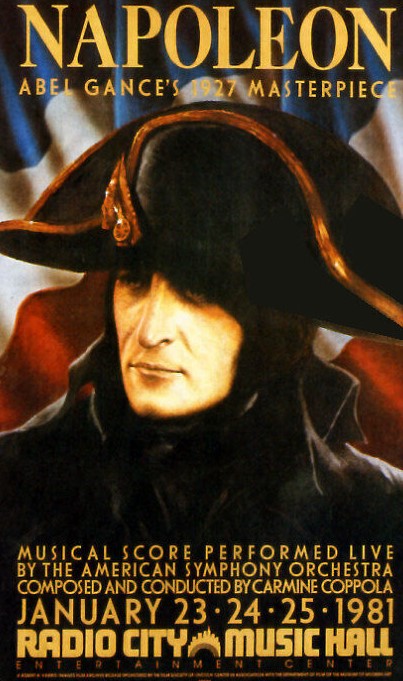

Purportedly, Frenchman Abel Gance got the idea for his film while walking down Broadway in New York in 1921. At that point he envisaged what we would these days term a “Napoleon Universe,” a series of six interlinked films (although early U.S. reports promised eight films) tracking the Emperor from his student days to exile in St Helena. Gance was a successful director, from La Droit a la Vie in 1917 to J’Accuse two years later each successive film had out-grossed the last. His La Roue / The Wheel (1923) was so lauded that French critics put it on a par with the later Citizen Kane.
He conceived each film to run about 5,500 feet for domestic release with a reduced version for the United States market. Unfortunately – or fortunately, depending – he could not contain his ambition. The film, eventually restricted to just the early part of Napoleon’s career, took two years to make, beginning in 1925. But his innovations included dolly shots, handheld camera, overhead camera, footage shot from the back of a horse, tracking, rapid editing and split screen. It’s worth remembering just why cameras were so static during that period – moving them was extremely laborious and time-consuming, which meant it cost too much money to do. And when it did move, the unsteady camera attracted too much attention. Gance wanted movement to be discreet, not just for its own sake.
He also invented an extremely wide-angle lens and then the camera employed for the triptych. Anticipating the arrival of sound, and although they could not be heard, he made his actors speak dialog, which facilitated later dubbing. And if that wasn’t enough, he conducted tests in 3D – used in the battle scenes it was discarded for distracting the eye. Rock salt substituted for hail and filming proved so dangerous there were 220 insurance claims.

but no better results at the box office.
It cost $500,000 – equivalent to $8.7 million today – a hefty sum for those days but nothing compared to MGM’s Ben-Hur which cost eight times as much. However, Gance had anticipated box office returns of $4.4 million. As well as his technical skills, Gance was a whiz at salesmanship and eventually secured the bulk of his funding from Russian entrepreneur Vladimir Wengeroff who had previously invested in German films. Wengeroff had earmarked Gance as a potential director for a projected movie version of War and Peace.
But with little finance from the major French studios, Gance retained control. Initially, he promised the first part would be completed by the end of 1924 with the rest two years later. In the end, part one was as far as he got. Initially, he planned to use four actors to play the Emperor at different stages of his life. Oddly perhaps from the modern perspective, he placed more emphasis on physical resemblance to Napoleon than acting ability and screen-tested over a dozen actors. In fact, the actor who won the part of the adult Napoleon was a “rank outsider,” considered too old and too fat. When tested Albert Dieudonne “looked rather like an old woman.” But when Gance’s original choice rejected the role, he returned to Dieudonne who had transformed himself into a slimmer person after undertaking an extreme diet.
The first of the innovative multi-screen images – nine in total – occurs early in the picture, in the snowball fight. Later, as many as 16 images would be superimposed. All this was achieved through technical drudgery, repeating shots endlessly until they fitted into a pattern, and Gance likened the effect to listening to an orchestra, not necessarily taking in each instrument but enjoying the accumulated effect. The snowballs were actually made from cotton wool so didn’t fly far. To achieve authenticity, the sequence took place in winter, parents outraged that their children in the conditions risked flu or bronchitis.
The chase scene filmed in Corsica employed camera cars, with other shots from cameras placed in pits, while extreme long shots over the hills and the use of wide angle lens enhanced the experience. But there were three cameras on the one car, one facing back, one sideways and another fixed to the running board. He also filmed from the back of a horse devising his own means of working the camera.
Ambition cost money. And soon the movie was in financial trouble, filming put on hold while the director sought new backers. Eventually, funding came from a new source. Despite its name, the Societe Generale du Films, originally set up to develop film itself, was actually owned by a Russian. The SGF funding came with a proviso – that if necessary it was entitled to edit the film to bring it down to the contractual length.
Gance’s boldest innovation was without doubt the triptych (more easily explained as film projected on three screens simultaneously in the manner, a quarter of a century later, of Cinerama). “I felt in certain scenes I lacked space,” he said, “That the picture was too small for me. Even a big picture was too small…I had the idea of stretching the screen. I didn’t know how. I vaguely thought if I put one camera on the right, one in front and one on the left I would have an enormous panorama.” To achieve this effect – his name is on the patent – he intended to mount three cameras on top of each other, in a pyramid linked by a motor.
There was no time to test the new equipment, manufactured by Debrie. It was completed just in time for the filming of the battle scene on 11 August 1926. When shooting ended in October 26 (though editing and post-production would continue into the following year), the producers had cause for celebration, the signing of a distribution deal with MGM, which promoted it in Variety as a “celebrated world epic.”
The version that premiered in Paris ran for 210 minutes although the following month the trade press were treated to a longer version. But it proved a flop. Even in France where audiences had been reared on the myth of Napoleon, and revered him, it was too long. Though MGM purchased it for American consumption, and some critics enthused (Variety deemed it an “extremely impressive job”) they cut it down (Variety was in agreement – noting “it would have to be sliced” while conceding “no picture producer can picture Napoleon in 70 minutes”) and it was given a very restricted number of showings. It was expected to attract most attention from the “sure-seaters” (i.e. arthouses).
Response was poor. Although shown in New York, it didn’t warrant information on the box office, suggesting it had been such a disappointment the figures were not revealed. At the 600-seat Arcadia in Philadelphia box office was “very bad.” However, returns at the 3,200-seat Loews in Montreal the returns were “above average.” That could possibly explained by Canadian affinity with France except that in Toronto the 2,300-seat Loews “took one in the jaw” at the box office. In Baltimore audiences “let it alone.” In Havana, exhibitors complained of Napoleon overload, this being the third film on the subject in as many months.
Although most U.S. exhibitors contended that interest from “the horde” in Napoleon was extremely limited that didn’t stop studios from churning out rivals. Films that may have got in its way included Frank Lloyd’s The Eagle of the Sea (1926), Napoleon (1927) with Lionel Atwill, Glorious Betsy (1928) with Dolores Costello, the German Queen Louise and Napoleon (1928) and Napoleon’s Barber (1928), one of the first talkie shorts.
In Britain, while critics doubted the effect of the triple screen, it was shown to “great success” at the Tivoli in London’s West End. But the promised general release failed to materialize.
The cost of creating “a new alphabet for the cinema” proved excessive. That the film sank into the vaults, quickly forgotten, ensured that when critics came to assess foreign silent pictures inevitably they alighted instead on Battleship Potemkin (1925) and Metropolis (1927). To all intents and purposes, Abel Gance’s Napoleon was gone – but it turned out not to be quite so forgotten and its resurrection ushered in a new experience in cinema-going.
SOURCES: Kevin Brownlow, Napoleon, Abel Gance’s Classic Film (Threefold Music, 2009); “French Napoleon,” Billboard, March 21, 1925, p85; Review, Variety, April 27, 1927, p20; Advertisement, Variety, October 26, 1927, p14; “Napoleon,” Kinematograph Weekly, December 15, 1927, p59; “Napoleon,” Variety, March 7, 1928, p50; Review, Kinematograph Weekly, July 5, 1928, p41; “Scenes From,” Kinematograph Weekly, July 26, 1928, p4; “Theatre Atmosphere,” Kinematograph Weekly, August 2, 1928, p50; “Too Many Napoleons,” Variety, October 24, 1928, p2; “Picture Grosses,” Variety, November 14, 1928, p9; “Picture Grosses,” Variety, December 5, 1928, p10; “Picture Grosses,” Variety, January 9, 1929, p7; “The Empire 13,” Kinematograph Weekly, January 17, 1929, p34; “Advertising Cost Biz for Stanleys,” Variety, February 6, 1929, p9.
Behind the Scenes: Napoleon (1927)
Purportedly, Frenchman Abel Gance got the idea for his film while walking down Broadway in New York in 1921. At that point he envisaged what we would these days term a “Napoleon Universe,” a series of six interlinked films (although early U.S. reports promised eight films) tracking the Emperor from his student days to exile in St Helena. Gance was a successful director, from La Droit a la Vie in 1917 to J’Accuse two years later each successive film had out-grossed the last. His La Roue / The Wheel (1923) was so lauded that French critics put it on a par with the later Citizen Kane.
He conceived each film to run about 5,500 feet for domestic release with a reduced version for the United States market. Unfortunately – or fortunately, depending – he could not contain his ambition. The film, eventually restricted to just the early part of Napoleon’s career, took two years to make, beginning in 1925. But his innovations included dolly shots, handheld camera, overhead camera, footage shot from the back of a horse, tracking, rapid editing and split screen. It’s worth remembering just why cameras were so static during that period – moving them was extremely laborious and time-consuming, which meant it cost too much money to do. And when it did move, the unsteady camera attracted too much attention. Gance wanted movement to be discreet, not just for its own sake.
He also invented an extremely wide-angle lens and then the camera employed for the triptych. Anticipating the arrival of sound, and although they could not be heard, he made his actors speak dialog, which facilitated later dubbing. And if that wasn’t enough, he conducted tests in 3D – used in the battle scenes it was discarded for distracting the eye. Rock salt substituted for hail and filming proved so dangerous there were 220 insurance claims.
It cost $500,000 – equivalent to $8.7 million today – a hefty sum for those days but nothing compared to MGM’s Ben-Hur which cost eight times as much. However, Gance had anticipated box office returns of $4.4 million. As well as his technical skills, Gance was a whiz at salesmanship and eventually secured the bulk of his funding from Russian entrepreneur Vladimir Wengeroff who had previously invested in German films. Wengeroff had earmarked Gance as a potential director for a projected movie version of War and Peace.
But with little finance from the major French studios, Gance retained control. Initially, he promised the first part would be completed by the end of 1924 with the rest two years later. In the end, part one was as far as he got. Initially, he planned to use four actors to play the Emperor at different stages of his life. Oddly perhaps from the modern perspective, he placed more emphasis on physical resemblance to Napoleon than acting ability and screen-tested over a dozen actors. In fact, the actor who won the part of the adult Napoleon was a “rank outsider,” considered too old and too fat. When tested Albert Dieudonne “looked rather like an old woman.” But when Gance’s original choice rejected the role, he returned to Dieudonne who had transformed himself into a slimmer person after undertaking an extreme diet.
The first of the innovative multi-screen images – nine in total – occurs early in the picture, in the snowball fight. Later, as many as 16 images would be superimposed. All this was achieved through technical drudgery, repeating shots endlessly until they fitted into a pattern, and Gance likened the effect to listening to an orchestra, not necessarily taking in each instrument but enjoying the accumulated effect. The snowballs were actually made from cotton wool so didn’t fly far. To achieve authenticity, the sequence took place in winter, parents outraged that their children in the conditions risked flu or bronchitis.
The chase scene filmed in Corsica employed camera cars, with other shots from cameras placed in pits, while extreme long shots over the hills and the use of wide angle lens enhanced the experience. But there were three cameras on the one car, one facing back, one sideways and another fixed to the running board. He also filmed from the back of a horse devising his own means of working the camera.
Ambition cost money. And soon the movie was in financial trouble, filming put on hold while the director sought new backers. Eventually, funding came from a new source. Despite its name, the Societe Generale du Films, originally set up to develop film itself, was actually owned by a Russian. The SGF funding came with a proviso – that if necessary it was entitled to edit the film to bring it down to the contractual length.
Gance’s boldest innovation was without doubt the triptych (more easily explained as film projected on three screens simultaneously in the manner, a quarter of a century later, of Cinerama). “I felt in certain scenes I lacked space,” he said, “That the picture was too small for me. Even a big picture was too small…I had the idea of stretching the screen. I didn’t know how. I vaguely thought if I put one camera on the right, one in front and one on the left I would have an enormous panorama.” To achieve this effect – his name is on the patent – he intended to mount three cameras on top of each other, in a pyramid linked by a motor.
There was no time to test the new equipment, manufactured by Debrie. It was completed just in time for the filming of the battle scene on 11 August 1926. When shooting ended in October 26 (though editing and post-production would continue into the following year), the producers had cause for celebration, the signing of a distribution deal with MGM, which promoted it in Variety as a “celebrated world epic.”
The version that premiered in Paris ran for 210 minutes although the following month the trade press were treated to a longer version. But it proved a flop. Even in France where audiences had been reared on the myth of Napoleon, and revered him, it was too long. Though MGM purchased it for American consumption, and some critics enthused (Variety deemed it an “extremely impressive job”) they cut it down (Variety was in agreement – noting “it would have to be sliced” while conceding “no picture producer can picture Napoleon in 70 minutes”) and it was given a very restricted number of showings. It was expected to attract most attention from the “sure-seaters” (i.e. arthouses).
Response was poor. Although shown in New York, it didn’t warrant information on the box office, suggesting it had been such a disappointment the figures were not revealed. At the 600-seat Arcadia in Philadelphia box office was “very bad.” However, returns at the 3,200-seat Loews in Montreal the returns were “above average.” That could possibly explained by Canadian affinity with France except that in Toronto the 2,300-seat Loews “took one in the jaw” at the box office. In Baltimore audiences “let it alone.” In Havana, exhibitors complained of Napoleon overload, this being the third film on the subject in as many months.
Although most U.S. exhibitors contended that interest from “the horde” in Napoleon was extremely limited that didn’t stop studios from churning out rivals. Films that may have got in its way included Frank Lloyd’s The Eagle of the Sea (1926), Napoleon (1927) with Lionel Atwill, Glorious Betsy (1928) with Dolores Costello, the German Queen Louise and Napoleon (1928) and Napoleon’s Barber (1928), one of the first talkie shorts.
In Britain, while critics doubted the effect of the triple screen, it was shown to “great success” at the Tivoli in London’s West End. But the promised general release failed to materialize.
The cost of creating “a new alphabet for the cinema” proved excessive. That the film sank into the vaults, quickly forgotten, ensured that when critics came to assess foreign silent pictures inevitably they alighted instead on Battleship Potemkin (1925) and Metropolis (1927). To all intents and purposes, Abel Gance’s Napoleon was gone – but it turned out not to be quite so forgotten and its resurrection ushered in a new experience in cinema-going.
SOURCES: Kevin Brownlow, Napoleon, Abel Gance’s Classic Film (Threefold Music, 2009); “French Napoleon,” Billboard, March 21, 1925, p85; Review, Variety, April 27, 1927, p20; Advertisement, Variety, October 26, 1927, p14; “Napoleon,” Kinematograph Weekly, December 15, 1927, p59; “Napoleon,” Variety, March 7, 1928, p50; Review, Kinematograph Weekly, July 5, 1928, p41; “Scenes From,” Kinematograph Weekly, July 26, 1928, p4; “Theatre Atmosphere,” Kinematograph Weekly, August 2, 1928, p50; “Too Many Napoleons,” Variety, October 24, 1928, p2; “Picture Grosses,” Variety, November 14, 1928, p9; “Picture Grosses,” Variety, December 5, 1928, p10; “Picture Grosses,” Variety, January 9, 1929, p7; “The Empire 13,” Kinematograph Weekly, January 17, 1929, p34; “Advertising Cost Biz for Stanleys,” Variety, February 6, 1929, p9.
Behind the Scenes: Napoleon (1927)
Purportedly, Frenchman Abel Gance got the idea for his film while walking down Broadway in New York in 1921. At that point he envisaged what we would these days term a “Napoleon Universe,” a series of six interlinked films (although early U.S. reports promised eight films) tracking the Emperor from his student days to exile in St Helena. Gance was a successful director, from La Droit a la Vie in 1917 to J’Accuse two years later each successive film had out-grossed the last. His La Roue / The Wheel (1923) was so lauded that French critics put it on a par with the later Citizen Kane.
He conceived each film to run about 5,500 feet for domestic release with a reduced version for the United States market. Unfortunately – or fortunately, depending – he could not contain his ambition. The film, eventually restricted to just the early part of Napoleon’s career, took two years to make, beginning in 1925. But his innovations included dolly shots, handheld camera, overhead camera, footage shot from the back of a horse, tracking, rapid editing and split screen. It’s worth remembering just why cameras were so static during that period – moving them was extremely laborious and time-consuming, which meant it cost too much money to do. And when it did move, the unsteady camera attracted too much attention. Gance wanted movement to be discreet, not just for its own sake.
He also invented an extremely wide-angle lens and then the camera employed for the triptych. Anticipating the arrival of sound, and although they could not be heard, he made his actors speak dialog, which facilitated later dubbing. And if that wasn’t enough, he conducted tests in 3D – used in the battle scenes it was discarded for distracting the eye. Rock salt substituted for hail and filming proved so dangerous there were 220 insurance claims.
It cost $500,000 – equivalent to $8.7 million today – a hefty sum for those days but nothing compared to MGM’s Ben-Hur which cost eight times as much. However, Gance had anticipated box office returns of $4.4 million. As well as his technical skills, Gance was a whiz at salesmanship and eventually secured the bulk of his funding from Russian entrepreneur Vladimir Wengeroff who had previously invested in German films. Wengeroff had earmarked Gance as a potential director for a projected movie version of War and Peace.
But with little finance from the major French studios, Gance retained control. Initially, he promised the first part would be completed by the end of 1924 with the rest two years later. In the end, part one was as far as he got. Initially, he planned to use four actors to play the Emperor at different stages of his life. Oddly perhaps from the modern perspective, he placed more emphasis on physical resemblance to Napoleon than acting ability and screen-tested over a dozen actors. In fact, the actor who won the part of the adult Napoleon was a “rank outsider,” considered too old and too fat. When tested Albert Dieudonne “looked rather like an old woman.” But when Gance’s original choice rejected the role, he returned to Dieudonne who had transformed himself into a slimmer person after undertaking an extreme diet.
The first of the innovative multi-screen images – nine in total – occurs early in the picture, in the snowball fight. Later, as many as 16 images would be superimposed. All this was achieved through technical drudgery, repeating shots endlessly until they fitted into a pattern, and Gance likened the effect to listening to an orchestra, not necessarily taking in each instrument but enjoying the accumulated effect. The snowballs were actually made from cotton wool so didn’t fly far. To achieve authenticity, the sequence took place in winter, parents outraged that their children in the conditions risked flu or bronchitis.
The chase scene filmed in Corsica employed camera cars, with other shots from cameras placed in pits, while extreme long shots over the hills and the use of wide angle lens enhanced the experience. But there were three cameras on the one car, one facing back, one sideways and another fixed to the running board. He also filmed from the back of a horse devising his own means of working the camera.
Ambition cost money. And soon the movie was in financial trouble, filming put on hold while the director sought new backers. Eventually, funding came from a new source. Despite its name, the Societe Generale du Films, originally set up to develop film itself, was actually owned by a Russian. The SGF funding came with a proviso – that if necessary it was entitled to edit the film to bring it down to the contractual length.
Gance’s boldest innovation was without doubt the triptych (more easily explained as film projected on three screens simultaneously in the manner, a quarter of a century later, of Cinerama). “I felt in certain scenes I lacked space,” he said, “That the picture was too small for me. Even a big picture was too small…I had the idea of stretching the screen. I didn’t know how. I vaguely thought if I put one camera on the right, one in front and one on the left I would have an enormous panorama.” To achieve this effect – his name is on the patent – he intended to mount three cameras on top of each other, in a pyramid linked by a motor.
There was no time to test the new equipment, manufactured by Debrie. It was completed just in time for the filming of the battle scene on 11 August 1926. When shooting ended in October 26 (though editing and post-production would continue into the following year), the producers had cause for celebration, the signing of a distribution deal with MGM, which promoted it in Variety as a “celebrated world epic.”
The version that premiered in Paris ran for 210 minutes although the following month the trade press were treated to a longer version. But it proved a flop. Even in France where audiences had been reared on the myth of Napoleon, and revered him, it was too long. Though MGM purchased it for American consumption, and some critics enthused (Variety deemed it an “extremely impressive job”) they cut it down (Variety was in agreement – noting “it would have to be sliced” while conceding “no picture producer can picture Napoleon in 70 minutes”) and it was given a very restricted number of showings. It was expected to attract most attention from the “sure-seaters” (i.e. arthouses).
Response was poor. Although shown in New York, it didn’t warrant information on the box office, suggesting it had been such a disappointment the figures were not revealed. At the 600-seat Arcadia in Philadelphia box office was “very bad.” However, returns at the 3,200-seat Loews in Montreal the returns were “above average.” That could possibly explained by Canadian affinity with France except that in Toronto the 2,300-seat Loews “took one in the jaw” at the box office. In Baltimore audiences “let it alone.” In Havana, exhibitors complained of Napoleon overload, this being the third film on the subject in as many months.
Although most U.S. exhibitors contended that interest from “the horde” in Napoleon was extremely limited that didn’t stop studios from churning out rivals. Films that may have got in its way included Frank Lloyd’s The Eagle of the Sea (1926), Napoleon (1927) with Lionel Atwill, Glorious Betsy (1928) with Dolores Costello, the German Queen Louise and Napoleon (1928) and Napoleon’s Barber (1928), one of the first talkie shorts.
In Britain, while critics doubted the effect of the triple screen, it was shown to “great success” at the Tivoli in London’s West End. But the promised general release failed to materialize.
The cost of creating “a new alphabet for the cinema” proved excessive. That the film sank into the vaults, quickly forgotten, ensured that when critics came to assess foreign silent pictures inevitably they alighted instead on Battleship Potemkin (1925) and Metropolis (1927). To all intents and purposes, Abel Gance’s Napoleon was gone – but it turned out not to be quite so forgotten and its resurrection ushered in a new experience in cinema-going.
SOURCES: Kevin Brownlow, Napoleon, Abel Gance’s Classic Film (Threefold Music, 2009); “French Napoleon,” Billboard, March 21, 1925, p85; Review, Variety, April 27, 1927, p20; Advertisement, Variety, October 26, 1927, p14; “Napoleon,” Kinematograph Weekly, December 15, 1927, p59; “Napoleon,” Variety, March 7, 1928, p50; Review, Kinematograph Weekly, July 5, 1928, p41; “Scenes From,” Kinematograph Weekly, July 26, 1928, p4; “Theatre Atmosphere,” Kinematograph Weekly, August 2, 1928, p50; “Too Many Napoleons,” Variety, October 24, 1928, p2; “Picture Grosses,” Variety, November 14, 1928, p9; “Picture Grosses,” Variety, December 5, 1928, p10; “Picture Grosses,” Variety, January 9, 1929, p7; “The Empire 13,” Kinematograph Weekly, January 17, 1929, p34; “Advertising Cost Biz for Stanleys,” Variety, February 6, 1929, p9.


 The Magnificent 60s