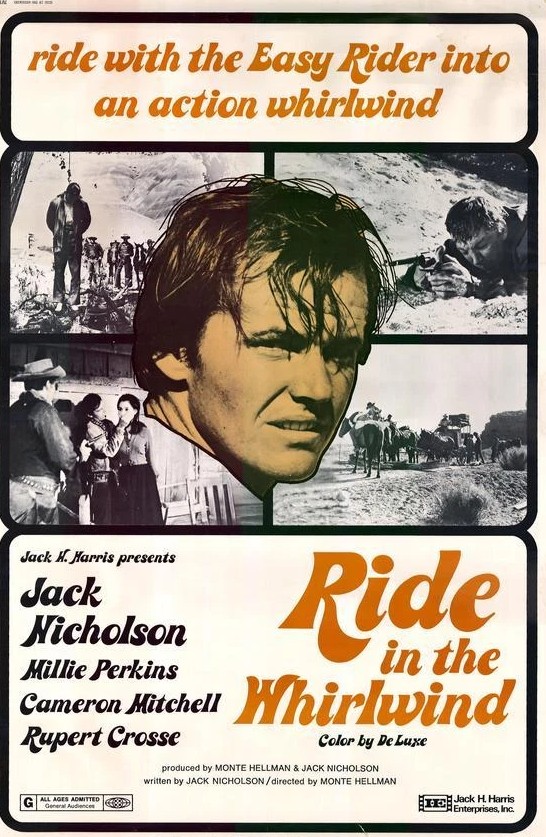
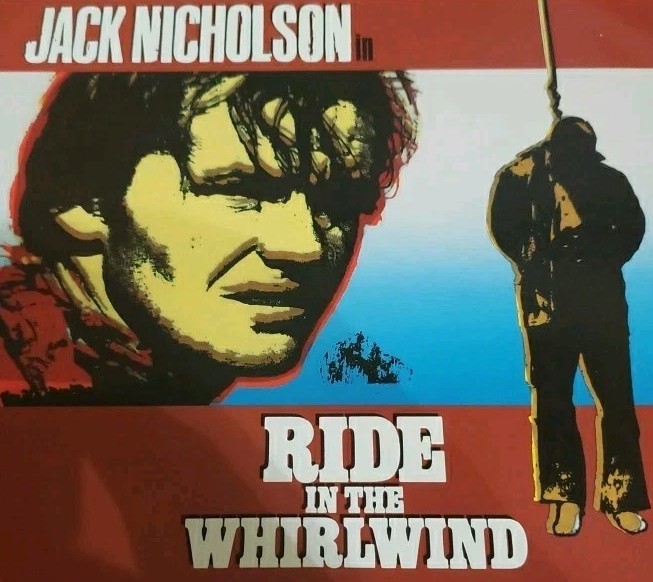
Ride in the Whirlwind (1966) **

Lightning didn’t strike once never mind three times as with Monte Hellman’s predecessor The Shooting (1966) and all the flaws of that picture are multiplied without either the free pass of being classed as existential or a central performance such as that of Millie Perkins to give it an boost and, as importantly, to provide it with a contemporary edge.

All it proves is that Jack Nicholson should stick to acting rather than screenwriting. Most of the dialog in trying to be authentic just doesn’t ring true and the story is muddled with many too many characters. Calling this offbeat is doing it a favor.
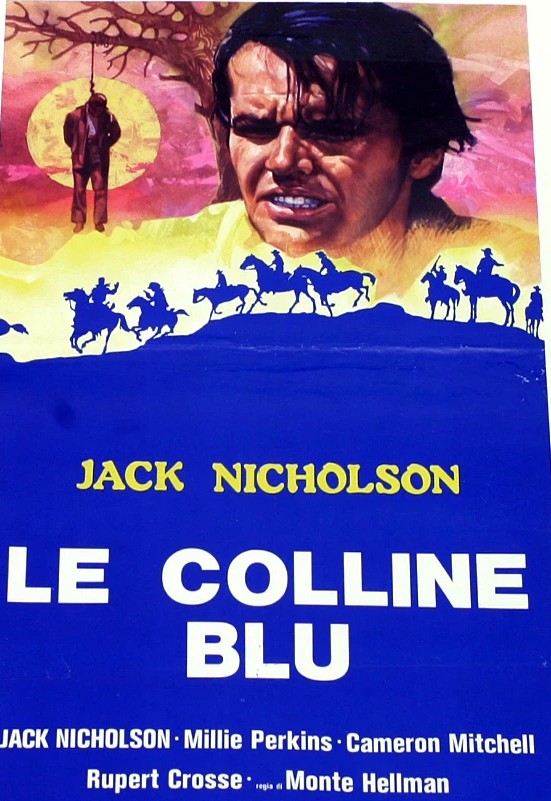
And although, in any poster or copy of the picture you’re likely to see now, Jack Nicholson is top-billed, he’s far from the main act – though the movie dodges around so much it’s hard to find a central character to focus. And if you came to this expecting another acting tour de force from Millie Perkins, you had to wait a good hour before she appeared.

Theoretically, Monte Hellman was inheriting the Budd Boetticher mantle, but that only went as far as making do with a low budget. Though there’s the occasional striking visual, he can’t match Boetticher in terms of composition nor in clarity of narrative. But this was the era when the waters were being muddied between good guys and bad guys, so in a sense, taking Hellman as pre-empting that particular charge, he scores some points there.

Budget deficit led to the other element of authenticity to which this can lay claim. It’s noisy. I mean, noise of the wind – perhaps hence the title – constantly intrudes. Cinema verite perhaps but more likely lack of proper sound equipment.

A bunch of outlaws led by Blind Dick (Harry Dean Stanton) who’s only half-blind, patch over one eye,  robs a stage and holes out in a cabin in the hills. A meandering trio of cowboys – Vern (Cameron Mitchell), Wes (Jack Nicholson) and Otis (Tom Filer) – looking for shelter encounter them. For a time it looks like the outlaws are just going to shoot them and be rid of the intruders. Instead, they feed them beans and biscuits and liquor.
Next morning a posse turns up and starts shooting at anyone in sight, including Vern and his buddies. They burn out the cabin and hang Blind Dick. Otis is shot but now, thanks to guilt by association, Vern and Wes are wanted fugitives. Requiring refuge, and although innocent they lean into guilt by commandeering the house of farmer Evan (George Mitchell), wife Catherine (Katherine Squire) and daughter Abigail (Millie Perkins) and hold them hostage.

Doesn’t take long for them to be rumbled by a member of the posse. They escape but Vern is wounded and Wes kills the farmer. Now they are reduced to one horse. The dying Vern does a self-sacrificial number and holds off the posse until Wes can escape on the horse.

Although I’m sure many an innocent person was killed in the Wild West, and it didn’t take much for people to cross over into criminality, especially when threatened (Wes would now be wanted for murder), and so it is interesting on that score, it’s just so muddled it lacks any real weight.

We are introduced to way too many characters as a result of lack of narrative cohesion. On this performance I doubt if you would have tagged Jack Nicholson as the breakthrough performer of Easy Rider (1969) and Millie Perkins is given nothing on which to build from what should have been her breakthrough turn in The Shooting.

In fact, most of the honors go to old-timer Cameron Mitchell (Blood and Black Lace, 1964) who’d had to head to Italy to get some decent top-billed work. If you were looking for the Jack Nicholson of the gleaming teeth and distinctive diction, then you’ll find him here but not much else. Monte Hellman would go on to find some mainstream credibility, though still erring on the offbeat, in the likes of Two-Lane Blacktop (1971) and Cockfighter (1974). But this is embryo work.

File under disappointment.
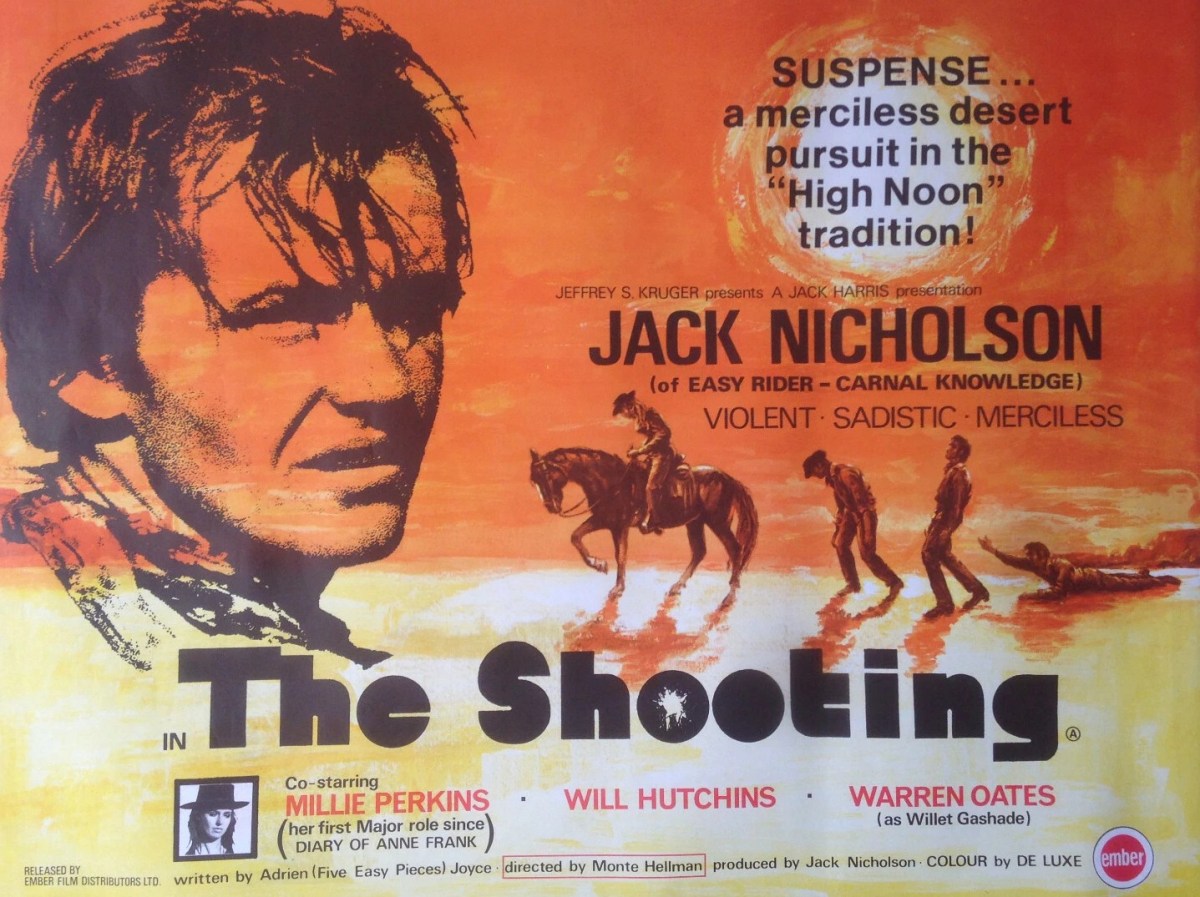
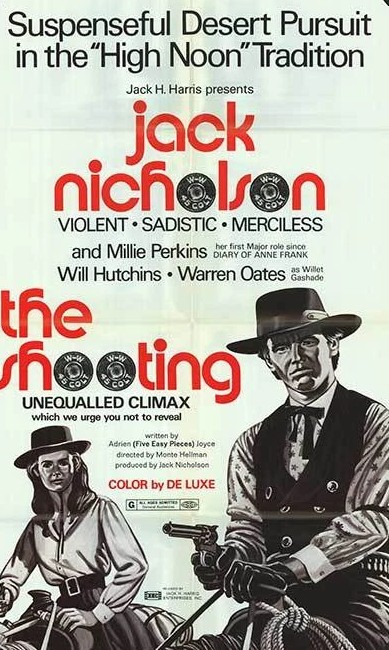
The Shooting (1967) ****

Director Monte Hellman struck lucky three times. In the first place French critics took such a shining to this disjointed elliptical western that they tabbed it a work of existential genius. Then Jack Nicholson, who only has a small part, became a global star and it picked up a second head of steam. And now, with grief porn the latest craze thanks to the likes of Hamnet (2025) and Wuthering Heights (2026) I reckon it’s worth reassessment. But not for that wallowing in grief aspect so popular these days, but for the way genuine grief works its way out in cantankerous maddening fashion.

You’d have thought the performance of Millie Perkins would have been highlighted long before now for its feminism. Her un-named woman runs contrary to the notion of the female star in a western. She doesn’t come on all sexy in a Raquel Welch fashion, nor does she fall victim to a predatory male. But she is a heck of a creation.

She doesn’t play by any of the man-made rules in this male-dominated world. She gets what she wants by foul means and she doesn’t give a hang about whose feelings she tramples underfoot. She’s not interested in seduction, nor in finding a man, so strike out any thoughts of sex or romance, and she’s domineering, rude and contrary.

Given the western is weighted down with enigma, you have to work hard to find out what it’s all about and what’s she’s after. And her introduction tells you she’s trouble. She kills her own horse so she can appear to two cowboys running a defunct mine as a woman needing help. The younger Coley (Will Hutchins) would be easily duped by any woman with an ounce of the smarts. The older Willett Gashade (Warren Oates) is less easily led, though when the woman offers $500 if they help her reach the nearest town, they’re ready to oblige.

But she wants to make haste, while Willett wants to ensure they are equipped for the journey, so saddling up an extra mule to carry their supplies. But a mule slows them down, so she finds a way to stampede it off. And every now and then she lets off a random shot, Willett working out she’s trying to attract someone’s attention. The someone turns out to be gunslinger Billy Spear (Jack Nicholson). When she insists on going off-trail Gashade works out she’s hunting for someone.

That’s another elliptical moment. She’s hunting the killer of her son. Even though it was an accident, she wants revenge.

And that’s the grief spelled out in a variety of ways but never with the usual emotional baggage, not even a tear. Eventually, we’re in Treasure of the Sierra Madre (1948) territory where men are going mad. Here, they keep going after their horses die and trek over desolate merciless country until they find their quarry, who turns out to be Gashade’s brother.

Turns out, too, she hardly needs her entourage. She finishes off her nemesis while Spear and Gashade struggle behind. She only needed the men for their tracking skills.

So what we have instead of the existential is something considerably more solid and worth far more than falling in with some arthouse accolade. This is both an exceptional study of grief and an exceptional study of a woman, possibly the first in the feminist line if you discount Barbara Stanwyck who still, generally, was better off with a man at her side.

All her deriding of the men, her mental cruelty, her whimsical actions, make every bit of sense when you realize these are all expressions of grief. Except for her murderous intent, she’s almost stoical in her grief, never allowing wanton emotion to get in the way, and even when turning tearful might work in winning men over she doesn’t give in to the temptation. She can twist Coley round her little finger anyways and she knows how to handle Gashade, teaching him in no uncertain terms who’s boss.

In some respects Monte Hellman (Ride the Wild Whirlwind, 1966) is the inheritor of the Budd Boetticher mantle, purveyor of lean westerns short on running time with a principled hero, here read heroine. But Hellman lacks Boetticher’s compositional artistry and could do with putting some more work into the storytelling department.

If you’ve come looking for the Jack Nicholson of Chinatown (1973) you’ll be disappointed. He’s hardly in it, though he is an exemplar of that mantra in The Housemaid (2025) of teeth being a privilege. Warren Oates (The Wild Bunch, 1969) is a better bet, providing a foretaste of his grizzly characters to come.

But Millie Perkins (Wild in the Streets, 1968) tears up the screen. From her bold introduction to the savage conclusion she presents a vivid characterization of a woman expunging her grief with violence. Written by Carole Eastman (Five Easy Pieces, 1970).

Well worth a look.

Discover WordPress

A daily selection of the best content published on WordPress, collected for you by humans who love to read.

The Atavist Magazine

by Brian Hannan

WordPress.com News

The latest news on WordPress.com and the WordPress community.