Tarzan and the Great River (1967) ***

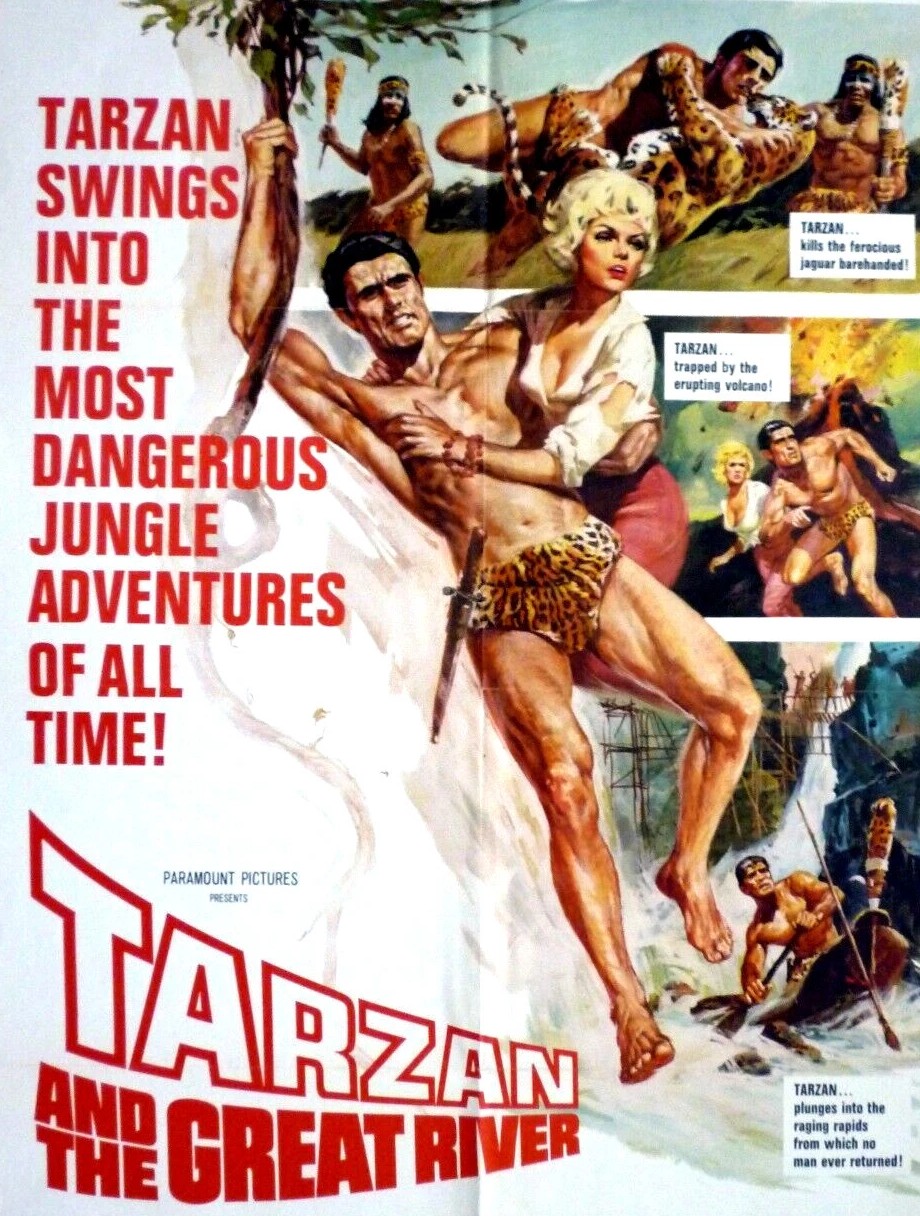
Tarzan (Mike Henry) has been repurposed as an international adventurer dropped into trouble spots an ocean away from his African roots. He’s the male equivalent of the bikini-clad females peppering the espionage genre, kitted out in only a loincloth, torso kept bare for the titillation of the ladies. And just like the James Bond series, there’s an evil personage, and while not in the business of taking over the world still wanting to dominate a good chunk of it in South America. Barcuna (Rafer Johnson), espouses the Jaguar death cult, terrorizing villages and enslaving their inhabitants for the purpose of searching for diamonds.

To fill out the narrative, a good chunk of the picture is spent with riverboat Captain Sam Bishop (Jan Murray) and the native orphan Pepe (Manuel Padilla Jr.) he has unofficially adopted and their comic shtick mostly involving the older man cheating at cards is all we’ve got to keep the drama going until the female in distress, Dr Ann Philips (Diana Millay), turns up. But, as you know, Tarzan is no lothario, unlike his colleagues in the espionage department, so we don’t have to wonder if romance is going to raise its ugly head.

Wrong continent. No tigers were used in this film.

In the meantime the producer has scoured the vaults for stock footage and clearly is of the opinion that if you can transplant Tarzan from his natural African habitat you can do the same with hippos. Tarzan wrestles a lion and a crocodile and despatches Barcuna’s henchmen on land and in the river, swimming underwater and tipping over canoes to do his part in keeping the local crocodiles well-fed.

Barcuna, meanwhile, roasts alive anyone caught trying to escape, though he allows the good doctor to escape either because he’s not partial to blondes or he reckons she won’t be much good at hunting for diamonds or, as suggested once he burns her village, because he wants her to let everyone know that he’s the big cheese around here.

There’s the usual plague subplot. Dr Millay is waiting on the arrival of a vaccine to fight a new plague – Bishop is delivering the stuff – but she has a job getting the natives to accept inoculation and it’s only when Pepe offers himself as a guinea pig that the others queue up.

Devoid of the gadgets, speedboats and fast cars of the espionage genre, Tarzan relies on the speed of his legs as if he was auditioning for the Tom Cruise role in Mission Impossible or that of Liam Neeson in the Taken series. There’s a spectacular fight between Tarzan and Barcuna for the climax.

Harmless stuff, as innocuous as the others in the trilogy featuring former football player Mike Henry (The Green Berets, 1968). They were filmed back-to-back in 1965 and released at the rate of one a year from 1966. This was the third time producer Sy Wintraub’s had reinvented Tarzan. He had previously shepherded home a pair – starting with Tarzan’s Great Adventure (1959) – starring Gordon Scott. Jock Mahoney inherited the mantle with Tarzan Goes to India (1962) and lasted for one more adventure.

This was the last of a quartet of outings with Tarzan for director Robert Day (She, 1965). Written by Bob Barbash (The Plunderers, 1960).

Perfect Saturday matinee material.
Tarzan and the Valley of Gold (1967) ***

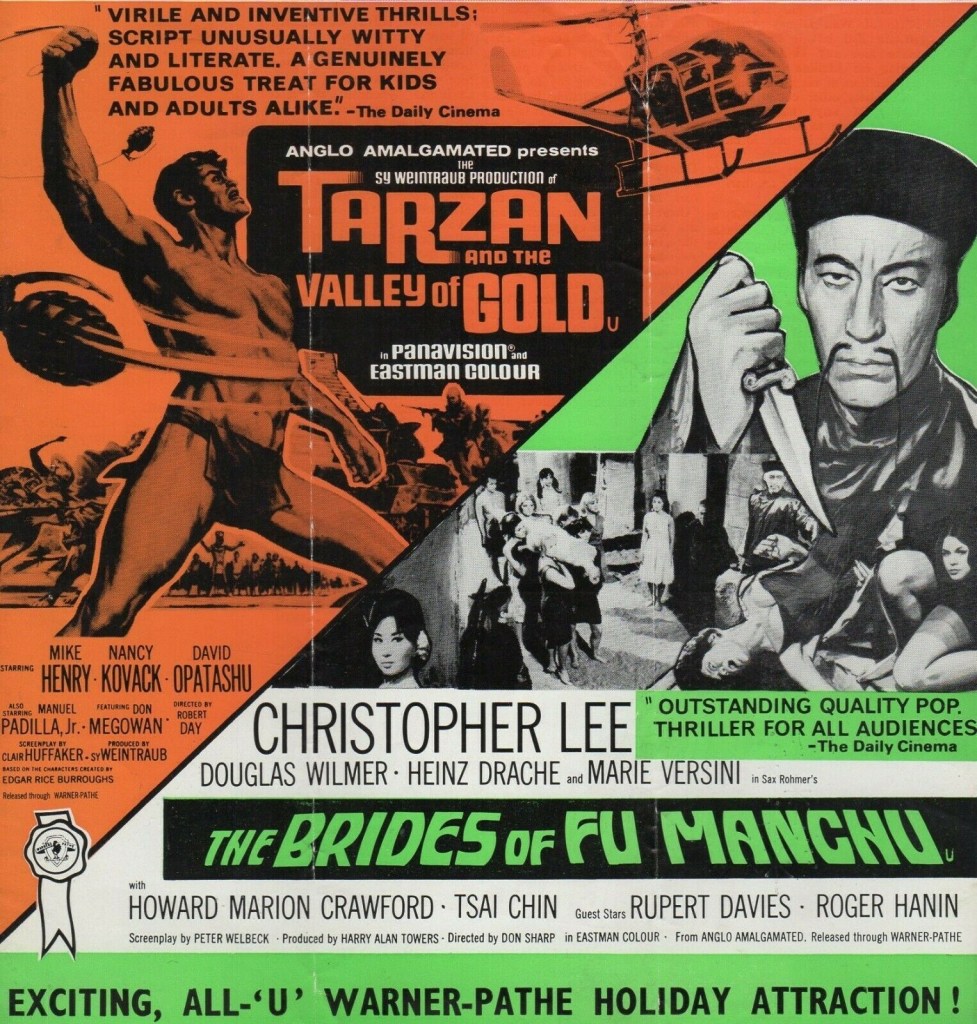
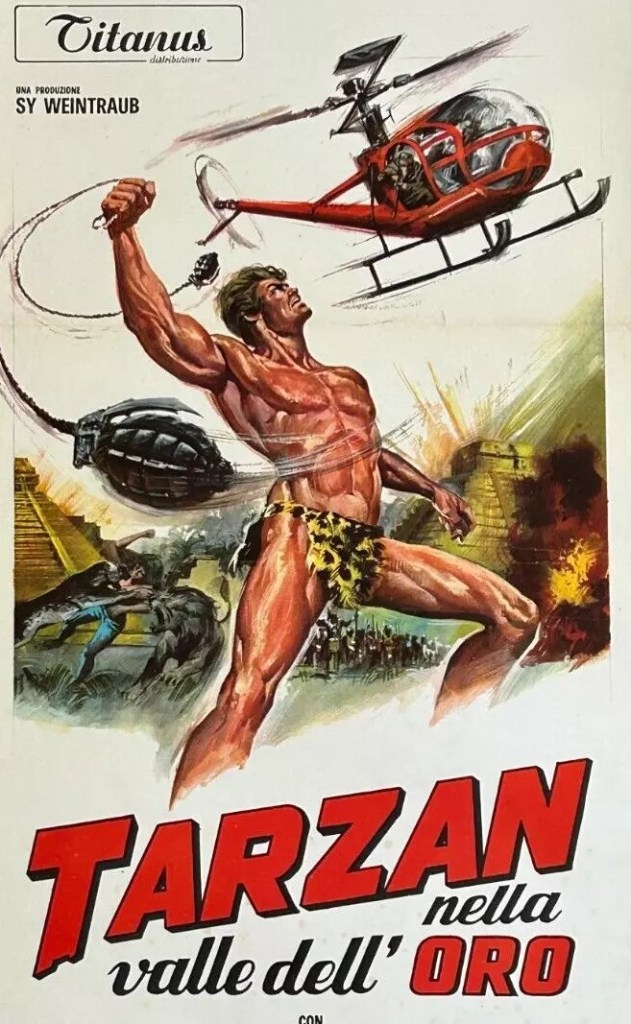
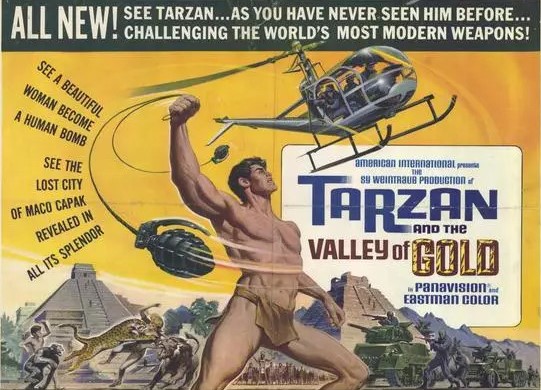
Hooray for hokum. What should have been termed Tarzan: The Next Generation takes our hero temporarily out of loincloth but equips him with a hefty Browning machine gun and rudimentary grenade launcher, not to mention the neat tricks of  repurposing a giant Coca-Cola bottle and bringing stalactites down on the heads of pursuers. Hardly surprisingly he’s toting such weaponry given he’s not just, as was more common, wrestling pesky crocodiles and punching the living daylights of any villain stupid enough to get in his way.

Sadistic evil mastermind Vinero (David Opatashu), has raided the Army Surplus stores for a World War Two M5A1 Stuart light tank, an M3 half track and a Bell 47 helicopter to augment his battalion of 40-odd mean-looking mercenaries. Though he hardly requires them since his favored device is an exploding watch.

Vinero has kidnapped a small native boy Ramel (Manuel Padilla Jr. who reputedly knows the way to an ancient El Dorado complete with Aztec pyramid. Yep, we’re in Mexico, which, incidentally, should screenwriter Clair Huffaker so require, does boast crocodiles as well as jungle. Tarzan is called in to rescue the lad.

He only wears a suit long enough to dispatch an assassin who has dumped him in a football stadium. Once he smells the wild it’s into the traditional loin cloth. He teams up with a Dirty Quarter Dozen comprising chimp Dinky (recruited for his scouting skills, you understand, and his three wise monkeys impersonation), lion Major (specialty: human flesh) and the boy’s pet leopard who will lead our merry crew to the child.

Quite how Ramel was found wandering in the jungle is never explained though it’s perfectly believable that, once lost, he wouldn’t know his way back and would rely on that well-known human compass Tarzan to help him find the way.

There’s quite a lot of trekking one way or another, but, thankfully, that’s interrupted by spurts of sadistic behaviour, an entire village gunned down by Vinero’s henchmen and the big bad guy only too delighted to take time out to demonstrate his incendiary ability in despatching unworthy lieutenants.

To be honest, the jungle doesn’t provide much cover, helicopter ferreting out Tarzan with little problem, only to be downed by his inspired trick of throwing a home-made hand-grenade bolus at the aircraft.

You won’t be surprised to find there’s a fair maiden involved. Her task, unlike previous incursions into this kind of  jungle, is not to be discovered deshabille swimming in a pool. Instead, she’s bait. It’s hard to get a precise fix on Sophia (Nancy Kovack) since for most of the picture she’s Vinero’s mistress. It’s taken her quite some time to become disgusted by his sadistic tendencies. Probably, her rescue is to demonstrate Tarzan’s inherently gentle nature, given he’s got to separate her from a deadly necklace that will explode, so we have been led to believe, by the slightest tremor.

When they reach the lost city – who am I to quibble that a pyramid that can be seen for miles around hardly qualifies as a valley – they discover it is of a distinctly pacific nature, the chief willing to give away all their gold rather than sacrifice a single life, the kind of attitude that conspires against the traditional Hollywood notion of collateral damage.

Chief’s not much trusting of Tarzan and Sophia either and locks them up. Oddly enough, there could easily be an exquisite zero-sum-game at work, a winners-take-all scheme where everyone is a winner, except Tarzan has no truck with the chief’s notion of letting the bad guys get away with as much as they can carry, and Vinero literally digs his own grave by insisting on taking more than he can carry (though I doubt if this is where the makers of Witness, 1985, found their silo death scene).

Mike Henry (The Green Berets, 1968) hulks up pretty well, Nancy Kovack (Marooned, 1969) – replacing Sharon Tate – adds to the scenery, David Opatoshu (Torn Curtain, 1966) underplays the villainy to good effect. Clair Huffaker (Hellfighters, 1968) sufficiently updates Tarzan to a James Bond world. Robert Day (She, 1965) – who had also directed Gordon Scott in the role – delivers the goods.

Enjoyable matinee fare.

Discover WordPress

A daily selection of the best content published on WordPress, collected for you by humans who love to read.

The Atavist Magazine

by Brian Hannan

WordPress.com News

The latest news on WordPress.com and the WordPress community.