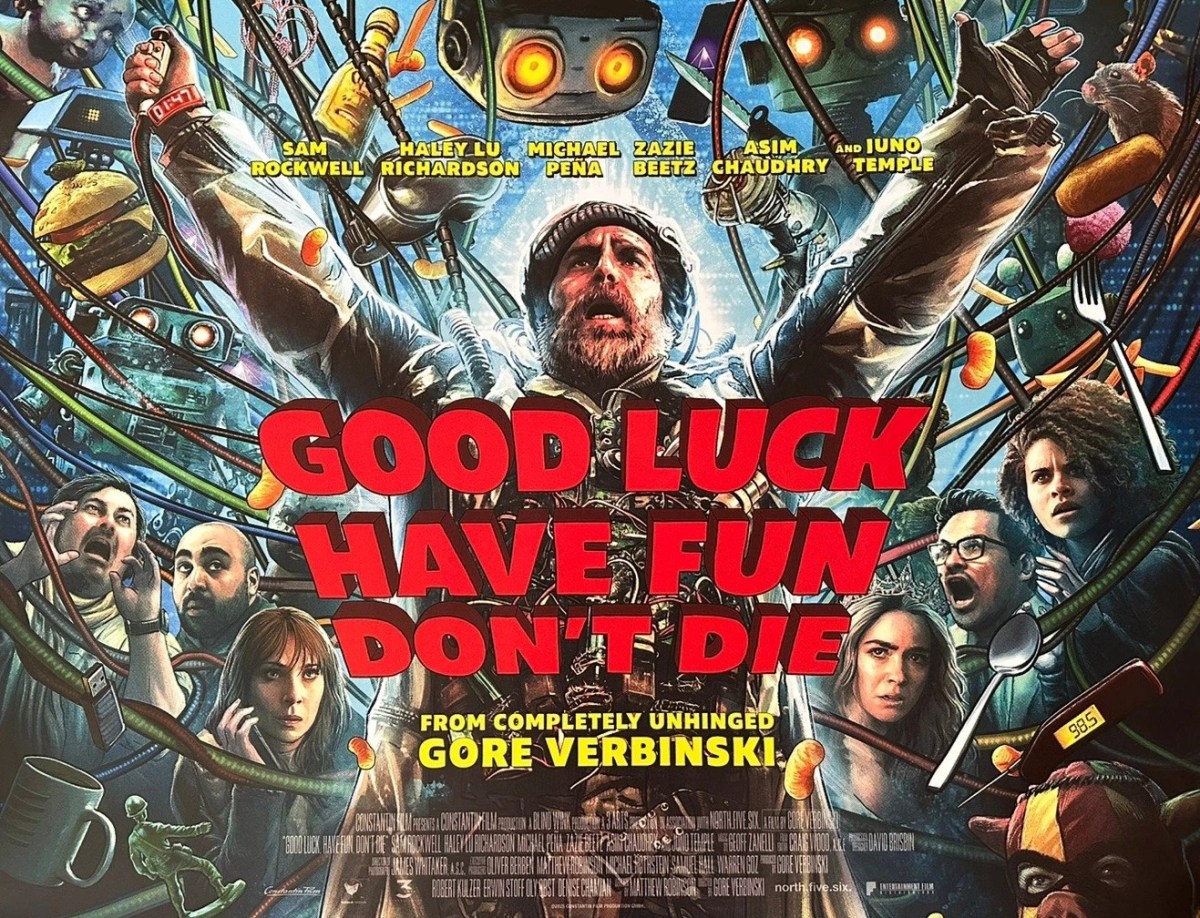
Good Luck, Have Fun, Don’t Die (2025) **** – Seen at the Cinema

In theory a cult film in the making. In reality, how is it even possible for a film to achieve cult status these days? Back in the day, there were a variety of routes. Reissue, for example, saved The Magnificent Seven (1960) from box office oblivion in the United States – but as a tool for building cult from a genuine revival wide release that’s gone. When was the last time you saw an arthouse event revival as epitomized by Metropolis (1927) or Abel Gance’s Napoleon (1927)? Does anyone even run midnight screenings any more –  the way The Rocky Horror Picture Show (1975) wormed its way into huge profit? Could a DVD release work its magic the way it did for box office flop The Shawshank Redemption (1994).

The “long tail” that kept movies in circulation for decades is long gone. How long do movies even survive on streaming? No streamer has the technology to literally keep thousands of movies available online for the time it would take for an underrated movie to pick up the head of steam necessary for reassessment.
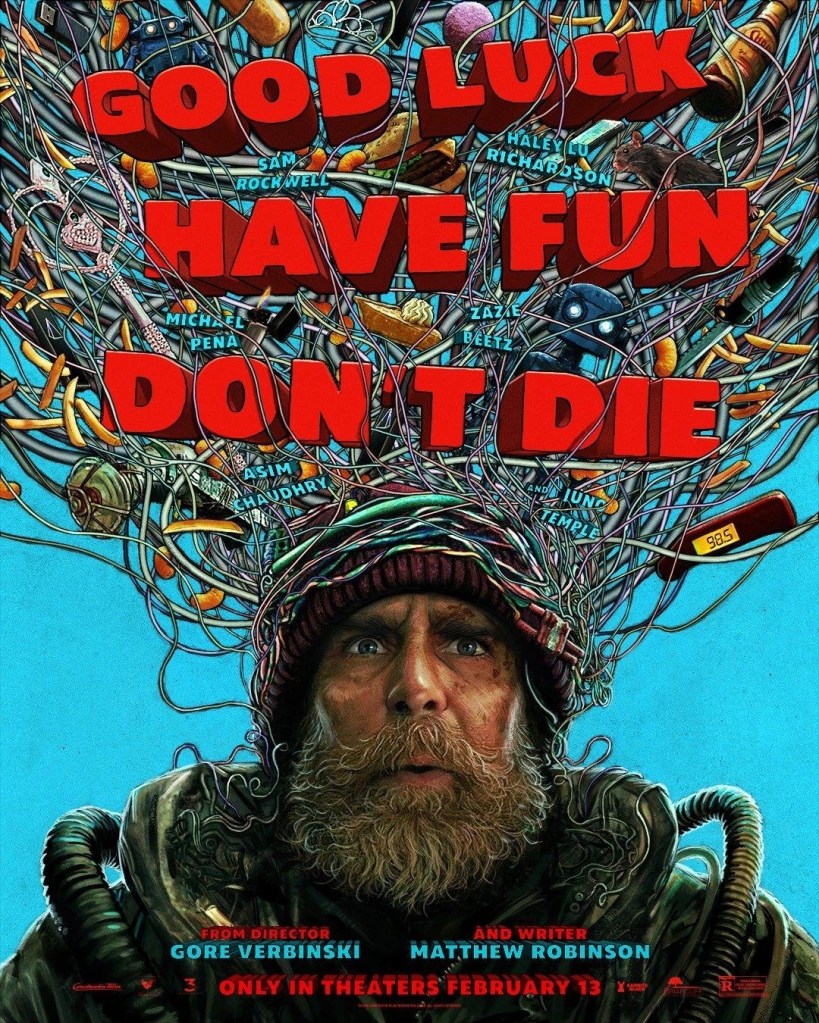
For sure, this isn’t the greatest film ever made and it could certainly due with trimming, lop off the 15-20 minutes devoted to tedious exposition and cut down on the need to get reaction shots from each of its main characters any time anyone says something interesting. But it has certainly misfired at the box office, in part I guess because it was set up as Valentine’s Day counter programming but is so wacky that it didn’t stand a chance against the romantic box office powerhouse of Wuthering Heights.

Forget about the main storyline of AI taking over the world and concentrate on the other aspects which make this an enticing number. Its antecedents are appealing. For a start it draws on Groundhog Day (1993), The Twilight Zone (1959-1964), The Magnificent Seven (1960), 2001: A Space Odyssey (1968) – twice I should add, once in technological rebellion and once in a version of the “star child”- the cover art from Pink Floyd album Dark Side of the Moon, Interstellar (2014), Back to the Future (1985), reimagines the zombie movie if you imagine the zombies as a horde without the slime and teeth, and finishes with the kind of stinger that the best sci fi movies deliver – think the original Planet of the Apes (1968) or the original Carrie (1976).

Intrigued? You should be. Some of the concepts here are just terrific especially when it slips into flashback and we discover what kind of world the characters inhabit. School shootings are so common that the U.S. Government helps finance clones to replace your dead child. Dare switch off any teenager’s mobile phone and they come after you in a predatory pack. You can choose to live in virtual reality over the real world.

Someone being sent back from the future to save the world from apocalypse is a fairly straightforward sci fi trope. But this time, the threat emanates from a nine-year-old child. In any other picture, especially in this genre, you would just send a crack military outfit to eliminate the kid. But people here have principles. So instead The Man from the Future (Sam Rockwell), decked out like a homeless dude except with a bomb, has to recruit a team of individuals, most of whom you wouldn’t trust to form a community baseball team, from a diner.
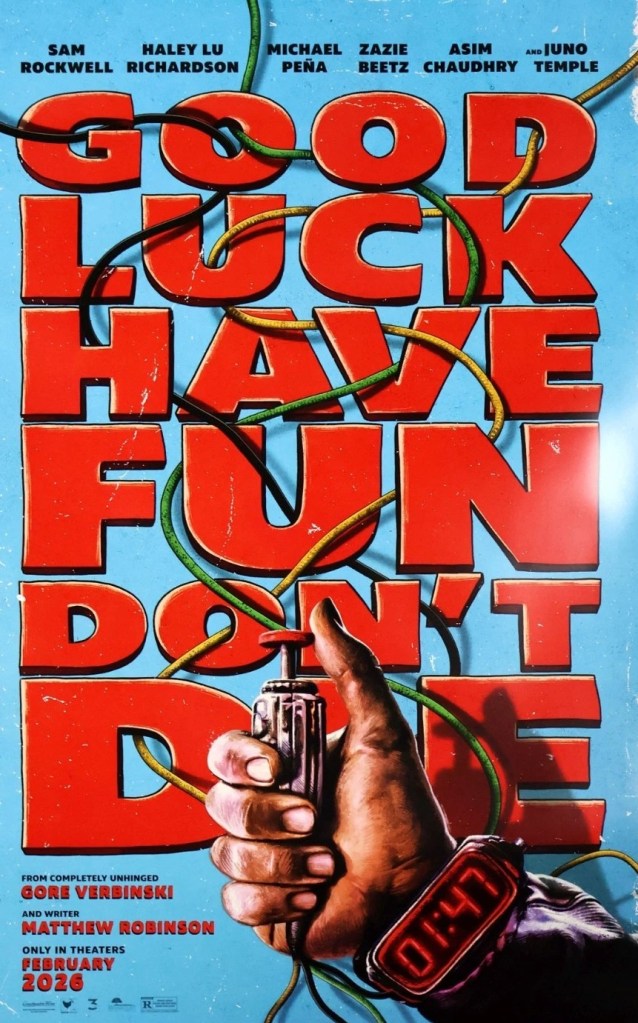
So we’ve got grieving mother Susan (Juno Temple), lovelorn Ingrid (Haley Lu Richardson) decked out in a princess outfit who’s medically allergic to mobile phones, ineffective substitute teacher Mark (Michael Pena) and potential girlfriend Janet (Zazie Beets), and your standard grumpy guy Scott (Asim Chaudry). Their mission doesn’t look that complicated – they’ve hardly got to cover a mile to reach their destination – which is just as well because you wouldn’t trust any of them to get your back much less expect them to clamber over a fence. Not all are going to make it. The Man from the Future has done this before – 117 times it transpires – but never achieved his mission.

It does need to get quicker to the brilliant climax and the stinger scenes that follow. The truth vs reality vibe is a bit over complicated. And I doubt if anyone has been waiting with bated breath – that would be a nearly decade-long wait – for the latest effort from director Gore Verbinski (Pirates of the Caribbean franchise).

Sam Rockwell (Argylle, 2024) is covered in a beard and all sorts of stuff which conceals all his annoying acting tics, Juno Temple (Roofman, 2025) has the most emotional part and Michael Pena the most baffled and Zazie Beets (Bullet Train, 2022), Haley Lu Richardson (Love at First Sight, 2024) and Asim Chaudry (People Just Do Nothing: Big in Japan, 2021) do well and in his movie debut creepy kid Artie Wilkinson-Hunt is in the top bracket of creepy kids. Written by Matthew Robinson (Love and Monsters, 2020).

Not as wacky as it sounds, especially when all the apparently random themes start adding up and connect into terrifying logic.

It was much better than I expected. And probably the first potential cult film denied such status by the onset of streaming.

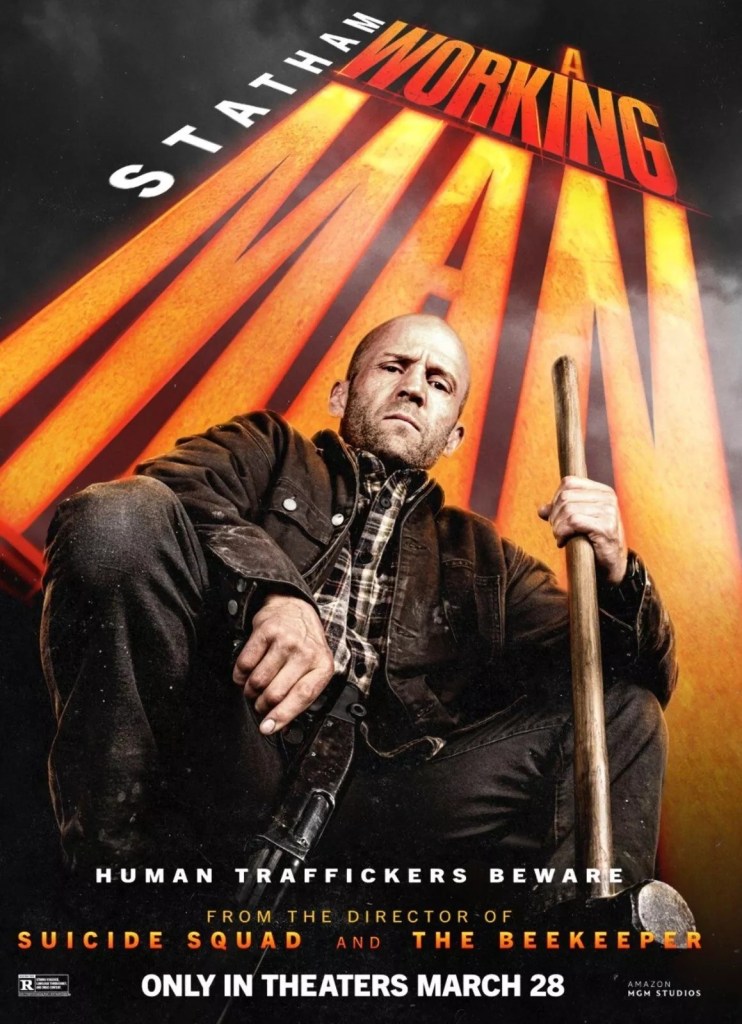
A Working Man (2025) **** – Seen at the Cinema

Audiences have been so let down by high-profile big-budget disasters like Snow White, Captain America, The Joker Folie a Deux, and critical clunkers like Anora, is it any wonder that they queue up to see a movie with a star who generally delivers. Sure, this is a meat-and-potatoes picture and it might well spell a new trend and consign high concept to the trash basket. That’s not to say our star Jason Statham hasn’t had his share of high concept – he doesn’t jump the shark but is inclined to punch it on the nose in the various The Meg iterations and his usual beating up bad guys routine was nearly snarled up in high concept politics in last year’s The Beekeeper.

I saw this at a matinee performance on Monday and the place was packed and as I left I overheard two ladies saying how much they had enjoyed it. Critics have been a bit sniffy about this because the plot is old hat. Who cares? All plots are old hat and those that aren’t are too new hat for audiences to enjoy.

There’s some attempt to repurpose the lonely hero, generally estranged from his family and down on his luck. Here Levon, an ex- (British) soldier, is suffering from PTSD, kept away from his only child by a wealth father-in-law who bankrolls teams of lawyers to ensure visitation rights are kept to a minimum. And Levon blames himself – as does the father-in-law – for being away fighting for Queen and Country when he should have been at home helping his depressed wife and stopping her committing suicide.

It’s piling it on a bit thick though to have him living in his automobile when as a boss on a construction site he must be earning enough to rent even the lowliest bug-ridden apartment, which he eventually does, since “no fixed abode” doesn’t look good on legal papers.

Anyways, we’re soon introduced to his special set of skills when he sets about some gangsters picking on one of his workers. You think the narrative’s going to involve some backlash from the guys he’s beaten up. But it takes a different route. The daughter Jenny (Arianna Rivas) of his boss Joe (Michael Pena) is kidnapped to order by a human trafficking operation headed up by Dimi (Maximilian Osinski), disgraced son of Russian Mafia head honcho Wolo (Jason Flemyng).

Posing as a drug dealer, after carrying out a ton of clever reconnaissance, Levon infiltrates the drugs outfit at a very low level and then works his way up, knocking off members of Wolo’s clan and various affiliates. Meanwhile, Jenny proves herself adept at improvising, in the violence arena, you understand – when your hands and feet are tied, remember you’ve still got your teeth.

This is the kind of film where you’re going to lose count of the number of violent deaths but all you’re interested in is Levon cutting through the wheat and chaff and getting to the top so he can save the girl. Luckily, it doesn’t try to build up a mythical gangster backstory in the manner of John Wick, but there are some interesting scenes where Wolo, initially introduced as sitting at the high table, is put in his place by someone higher up the rankings, and a great scene just at the end where Wolo, by now bereft of his sons, is told by the big boss to accept his losses and get on with the job of selling drugs and leave Levon alone, at which point he lets out the kind of wail that, had he been a bereft hero, would have had him in contention for an Oscar.

There’s no romance either to get in the way so it’s very strictly meat-and-potatoes. In an era when MCU and DC are flailing, Hollywood could do worse than resorting to a more basic kind of hero. Let’s call him, since all superheroes need titles, Workingman Man.

Directed with a zest for pace and tension by David Ayer (The Beekeeper). Interesting to see Sylvester Stallone’s name attached as co-screenwriter and a producer, so I wonder if this had been originally touted as starring him.

Does what it says on the tin.

Moonfall (2022) ***- Seen at the Cinema

Whether you enjoy the latest offering of Roland Emmerich (Independence Day, 1996) depends very much on how you liked your sci-fi served up. If you require your characters to wear long robes, spout cod philosophy, use superpowers and exist in empires with deposed heirs and family conflict, and whose story cannot be told in one sitting, this may not be for you. Emmerich protagonists tend to be ordinary people, albeit of the planet-saving variety if push comes to shove, and in this case not only does he prioritize diversity but the two most courageous are the wrong shape for heroes.

Where his previous films have enjoyed a longer build-up before catastrophe or invasion, here we are almost straight into the action. The moon is out of orbit, the government wants to hush it up against the advice of senior scientist Jo Fowler (Halle Berry), but conspiracy theory geek K.C. Houseman (John Bradley) activates social media to send the world into panic. Into the mix comes disgraced astronaut Brian Harper (Patrick Wilson) and it falls to these three not to just save the world, but first save the moon in order to prevent Earth’s destruction. They are certainly not quick enough off the mark to stop tidal waves swamping Manhattan, a bombardment of moon debris, and assorted earthquakes and tectonic activity, and in a piece of sfx bravura a gigantic gravity wave.

The trio leave behind loved ones, who are basically left to their own devices to combat the onslaught of destruction. And that is in stark contrast to officials in high office who abandon their positions in order to head for the hills (literally). In one spicy exchange two generals who hold the keys to a nuclear weapon are divided over who to save. In the various sub-plots which all coalesce, the theme is character transition.

The trailer doesn’t give away the movie’s big secret and I’m not about to either but it’s a whopper as Emmerich tracks back to favored ruminations about Earth’s origins. You can chuck away Genesis and the Big Bang as he settles on a different explanation. There are nods to Ridley Scott and even Stanley Kubrick’s 2001: A Space Odyssey, but in the end Emmerich ploughs his own path of originality. The second half is amazing and really lifts the picture.

One of the problems of science fiction movies is that virtually every one falls apart under micro examination. They are filled with plot holes and make up for lack of genuine characterization by having heroes plagued by preposterous villains and back stories that lack any sense. But who the hell cares?

Emmerich films tend to take a hammering because the hero is a close relative of Tom Hanks, the dependable guy whose life has gone a little awry but wants to make amends. Here, both Brian and Jo have family issues and make wrong decisions, both, in effect, abandoning their children for the greater good, and while that might seem to set up a series of sub plots it’s no different to any superhero picture where a beloved relative is put in harm’s way because  said superhero unleashes devastation in order to rein in the villain.

Emmerich could easily have anchored this with younger talent. Will Smith was in his late 20s when he starred in Independence Day. But going for older actors allows Emmerich more leeway with the family issues he brings to the fore. Nor do his disaster movies tend to top-bill a female star. That changes here with Oscar-winning Halle Berry (Bruised, 2020), who hasn’t had a hit in years, receiving a well-deserved career boost for a thoughtful role. Patrick Wilson, usually relegated to horror, also steps up.

John Bradley (Game of Thrones) is the wide-eyed geek who sees disaster as another name for adventure and as far removed from the clever-clogs Jeff Goldblum of Independence Day as you can get. Michael Pena (Fantasy Island, 2020) is the pick of the supporting roles. Donald Sutherland (The Hunger Games) has a cameo. Younger players worth a mention are Charlie Plummer (All the Money in the World, 2017) and Wenwen Yu (Forever Passion, 2021) and

Admittedly, the dialogue is cheesy in places, occasionally overburdened with scientific gibberish, but that’s par for the course.

A good old-fashioned fun ride.  

Discover WordPress

A daily selection of the best content published on WordPress, collected for you by humans who love to read.

The Atavist Magazine

by Brian Hannan

WordPress.com News

The latest news on WordPress.com and the WordPress community.