Behind the Scenes: “Bus Riley’s Back in Town” (1965)

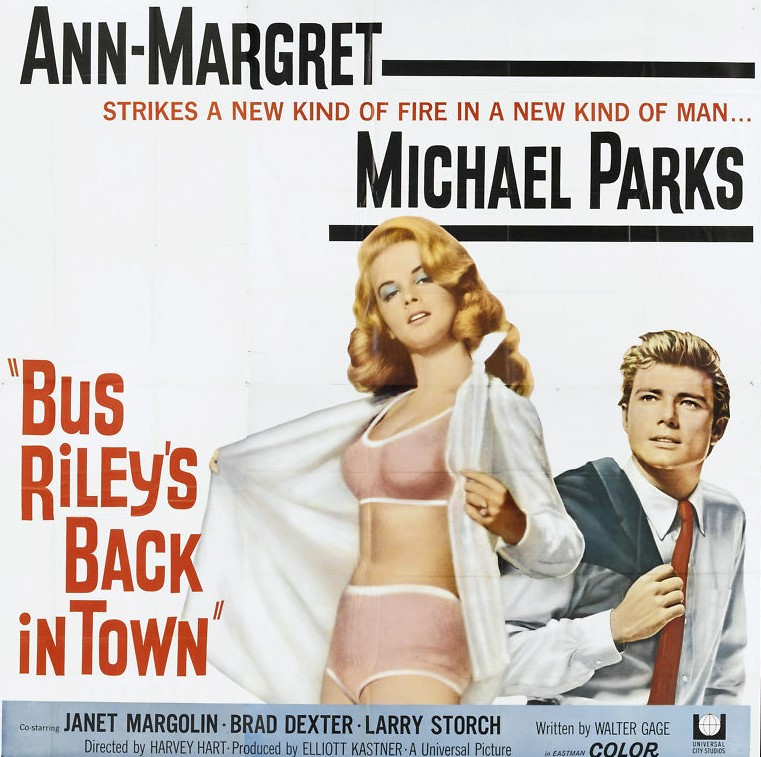
Small wonder that Bus Riley’s Back in Town found scant appreciation on producer’s Elliott Kastner’s dance card. He preferred to have people believe that his career began with box office smash Harper / The Moving Target (1966) rather than the two flops – Kaleidoscope (1966) and Bus Riley’s Back in Town (1965) – that preceded it. As his son Dillon Kastner pointed out: “He always preferred to forget his first film. He liked to think his first film was Harper so he never put that title (Bus Riley) on his list of credits for investors.”

After jockeying in the Hollywood trenches for three years, Kastner should have been delighted to finally get his name on a picture after so many potential movies had slipped through his grasp. But he had good reason to want to forget the experience of working on Bus Riley. It sat on the shelf for a year and, minus the involvement of the producer, was “butchered” by the studio.

By the time the movie appeared it was the latest in a long line of failed attempts by former agent Elliott Kastner to get onto the Hollywood starting grid. He had previously been involved in a pair to star Warren Beatty – Honeybear, I Love You with a screenplay by Charles Eastman and Boys and Girls Together adapted from the William Goldman bestseller with Joseph Losey (Accident, 1966) lined up as director. Also on his scorecard were 1963 William Inge play Natural Affection, Tropic of Cancer from the controversial Henry Miller novel and The Crows of Edwina Hill. At the time of the Bus Riley opening, he had acquired a further seven properties.

Bus Riley was never intended as a major picture, the budget limited to $550,000 – at a time when a decent-sized budget was well over $1 million. Shot in Spring 1964, and in post-production in July, release was delayed until Universal re-edited it and added new scenes because Ann-Margret had  achieved surprising movie stardom between her recruitment and the film’s completion. Along with Raquel Welch, she became one of the most glamorous stars of the decade and in building up her own career Welch clearly followed the Ann-Margret template of taking on a bucket of roles and signing deals with competing studios.

After making just three movies – A Pocketful of Miracles (1962), State Fair (1962) and Bye, Bye Birdie (1963) – Ann-Margret shot into the fast lane, contracted for three movies with MGM at an average $200,000 per plus an average 12% of the profit, substantial sums for a neophyte. On top of that she had four far less remunerative pictures for Twentieth Century Fox, three for Columbia, Marriage on the Rocks with Frank Sinatra and a couple of others. By the time Bus Riley finally appeared, she had expanded her appeal through Viva Las Vegas (1964) opposite Elvis and top-billed roles in Kitten with a Whip (1964) and The Pleasure Seekers (1964).
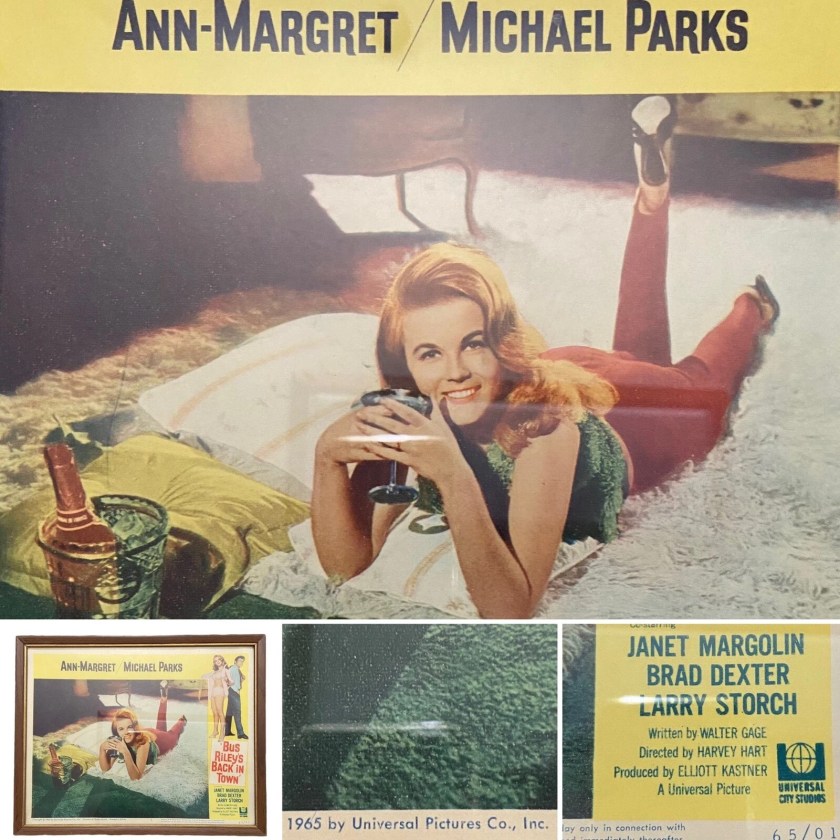
Universal also had another property to protect. Michael Parks was one of small contingent of novice actors in whom the studio had invested considerable sums, using them in television roles before placing them in major movies. Others in this group – at a time when most studios had abandoned the idea of developing new talent – included Katharine Ross and Tom Simcox who both appeared in Shenandoah (1965), James Farentino (The War Lord, 1965), Don Galloway (The Rare Breed, 1965), Doug McClure (The Lively Set, 1964) and Robert Fuller and Jocelyn Lane in Incident at Phantom Hill (1965).

However, the introduction of Parks had not gone to plan. He was set to make his debut in The Wild Seed (1965) – originally titled Daffy and going through several other titles besides – but that was also delayed until after Bus Riley, riding on Ann-Margret’s coat-tails, offered greater potential. Kastner had been instrumental in the casting of Parks – whom he tabbed as “a wonderful up-and-coming actor” – in The Wild Seed.

Also making their movie debuts in Bus Riley were Kim Darby (True Grit, 1969) and Canadian director  Harvey Hart (Dark Intruder, 1965), an established television name. Hart joined David Lowell Rich and Jack Smight as the next generation of television directors making the transition. Universal was on a roll, in 1964 greenlighting 25 pictures, double the number of productions in any year since 1957.

Falling just behind Tennessee Williams league in terms of marquee clout, playwright William Inge had won an Oscar for Splendor in the Grass (1961) and been responsible for a string of hits including Come Back Little Sheba (1952) – Oscar for Shirley Booth – the Oscar-nominated Picnic (1955) starring William Holden and Kim Novak and Bus Stop (1956) with Marilyn Monroe.

Kastner had persuaded him to turn his little-known 1958 one-act play All Kinds of People into a movie-length screenplay. Inge was initially keen to work on a low-budget picture, anticipating “more freedom with an abbreviated budget.” He asserted, “You don’t have the front office calling you up all the time.” Since the movie was not initially envisaged as a star vehicle for Ann-Margret (and, in fact, she plays the supporting role) he saw it as a “way of breaking up that old Hollywood method of selling pictures before they were made” on the back of a big star and hefty promotional budget.

Unfortunately for him, once Universal realized they had, after all, a star vehicle, the studio concluded that her image was more important than the “dramatic impact” of the film. “When we signed Ann-Margret she wasn’t a big star but in six months she was and Universal became very frightened of her public image. They wanted a more refined image.”

Kastner and Inge were elbowed aside as Universal ordered a rewrite and reshoots. Inge took his name off the picture. The credited screenwriter Walter Gage did not exist, he was created to get round a Writer’s Guild dictat that no movie could be shown without a writer’s name on the credits.

Despite her supposed growing power, Ann-Margret had little say in preventing the changes either. She expressed her disappointment to Gordon Gow of Films and Filming: “You should have seen the film we shot originally. William Inge’s screenplay…had been so wonderful. So brutally honest, And the woman, Laurel, as he wrote her, was mean and he made that very sad. But the studio at the time didn’t want me to have that image for the young people of America. They thought it was too brutal a portrayal. They wanted me to re-do five key scenes. And those scenes completely changed the story. There were two of these scenes that I just refused to do. The other three I did, but I was upset and angry.”

Film historian James Robert Parish refuted Ann-Margret’s recollection of events. He claimed the changes were made at her insistence because she wanted to be the focal point of the narrative rather than Bus Riley (Michael Parks).

Harvey Hart reckoned Universal got cold feet after the audience attending a sneak preview made “idiotic” comments on the questionnaire. Recalled Kastner, “I had nothing but heavy fiddling and interference from Universal.” Even so, given it was his debut production, he wasn’t likely to disown then and didn’t follow Inge in removing his name.

Despite the changes, the movie received a cool reception at the box office. It turned in opening weeks of a “modest” $7,000 in Columbus, “slow” $9,000 in Boston, “modest” $9,000 in Washington, “lightweight” $10,000 at the 1642-seat Palace in New York, “mild” $4,000 in Provident, “so-so” $4,000 in Portland, “not so good” $7,000 in Pittsburgh, “okay” $7,000 in Philadelphia, and $98,000 from 22 houses in Los Angeles with the only upticks being a “good” $7,000 in Cincinnati and a “fast” $7,000 in Minneapolis. The movie didn’t register in Variety’s Annual Box Office Chart which meant it earned less than $1 million in U.S. rentals and was listed as a flop.

SOURCES: Elliott Kastner Memoir, courtesy of Dillon Kastner; “Elliott Kastner’s Partner on Honeybear Is Warren Beatty,” Variety, January 23, 1963, p4; “Elliott Kastner Will Helm Crows for U,” Variety, May 1, 1963, p21; “Escalating Actress,” Variety, May 22, 1963, page 4; “Raid Canadian Director,” Variety, March 4, 1964, p24; “Inge Thinks Writer Contentment May Lie in Creative Scope of Cheaper Pix,” Variety, May 6, 1964, p2; “Ann-Margret Into the Cash Splash,” Variety, July 22, 1964, p5; “Universal Puts 9 Novices Into Pix,” Variety, March 3, 1965, p25; “ A Collective Byline,” Variety, March 17, 1965, p2; “U Stable of Promising Thespians,” Variety, March 17, 9965, p2; “Fear Ann-Margret Going Wrongo in Her Screen Image,” Variety, March 24, 1965, p5; “Radical Kastner-Gershwin Policy: Get Scripts in Shape Way Ahead,” Variety, May 19, 1965, p19; “Warren Beatty Partner and Star of Goldman Tale Via Elliott Kastner,” March 31, 1965, p7; “Picture Grosses,” Variety – March-May 1965.

Bus Riley’s Back in Town (1965) ***

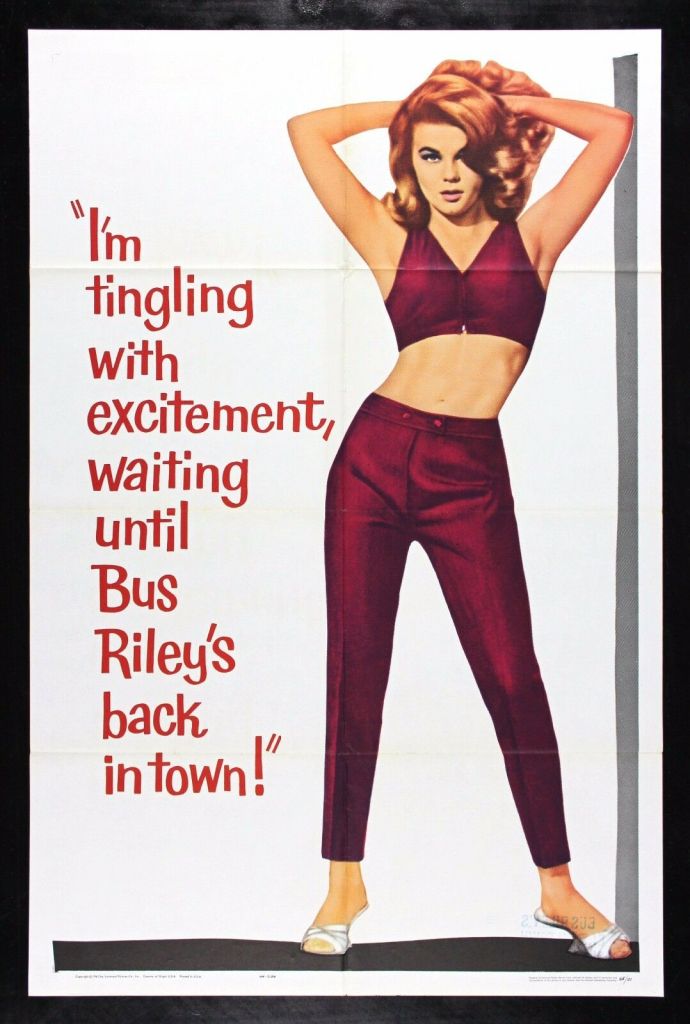
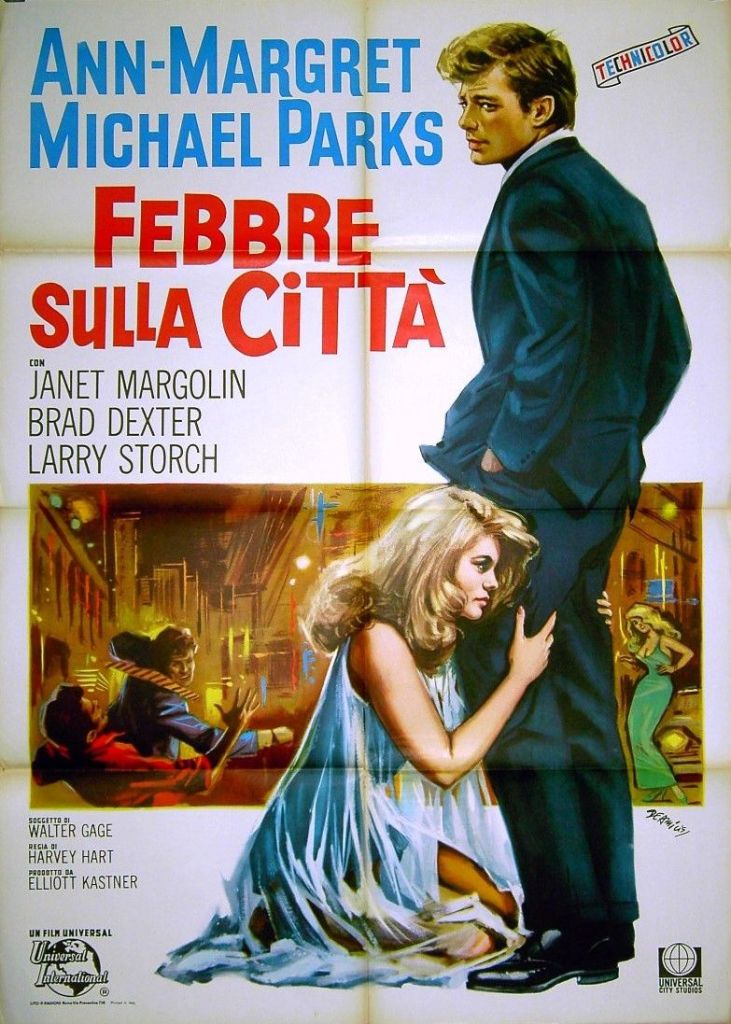
Given Ann-Margret receives top billing I had automatically assumed she was the Bus Riley in question. Although decidedly the female lead, her role is secondary to that of a sailor returning to his small town. The backstory is that Bus – no explanation ever provided for this nickname – Riley (Michael Parks) had been too young to marry the gorgeous Laurel (Ann-Margret) before he joined the U.S. Navy and in his absence she married an older wealthy man.  

Bus dithers over his future, re-engages with his mother and two sisters and finds he has not lost his attraction to Laurel. Although a handy mechanic, he has his eye on a white collar  career. An initial foray into becoming a mortician founders after sexual advances by his employer (Crahan Denton). Instead he is employed as a vacuum salesman by slick Slocum (Brad Dexter).  

While his sister’s friend Judy (Janet Margolin) does catch his eye, she is hardly as forward or inviting as the sexy Laurel who crashes her car into his to attract his attention. But the easy sex available with Laurel and the easy money from exploiting lonely housewives trigger a crisis of conscience.

Perhaps the most prominent aspect is the absence of good male role models. Bus is fatherless, his mother (Jocelyn Brando) taking in boarders to meet her financial burden – including the neurotic Carlotta (Brett Somers) – and while younger sister Gussie (Kim Darby) adores Bus the other sister Paula (Mimsy Farmer) is jealous of his freedom. Judy’s father is also missing and her mother (Nan Martin) a desperate alcoholic. The biggest male players are the ruthless Slocum and Laurel’s husband who clearly views her as a plaything he has bought. The biggest female player, Laurel, is equally ruthless, boredom sending her in search of male company, slithering and simpering to get what she wants.   

Scandal is often a flickering curtain away in small towns so it’s no surprise that Bus can enjoy a reckless affair with Laurel or that a meek mortician can get away with making his desires so quickly apparent, or that behind closed doors houses reek of alcohol or repression. A couple of years later and Hollywood would have encouraged youngsters like Bus and Laurel to scorn respectability in favor of free love. But this has a 1950s sensibility when finding a fulfilling job and the right partner was preferred to the illicit.

In that context – and it makes an interesting comparison to the more recent Licorice Pizza that despite being set in the 1970s finds youngsters still struggling with the difference between sex and love – it’s an excellent depiction of small-town life.

While Michael Parks (The Happening, 1967) anchors the picture, it’s the women who create the sparks. Not least, of course, is Ann-Margret (Once a Thief, 1965), at her most provocative but also revealing an inner helpless core. And you can trace her screen development from her earlier fluffier roles into the more mature parts she played in The Cincinnati Kid (1965) and more especially Once a Thief (1965).

In her movie debut Kim Darby (True Grit, 1969) is terrific as the bouncy Gussie and Janet Margolin (David and Lisa, 1962) invests her predominantly demure role with some bite. Jocelyn Brando (The Ugly American, 1963) reveals vulnerability while essaying the strong mother. Mimsy Farmer (Four Flies on Grey Velvet, 1971) also makes her debut and it’s only the second picture for David Carradine (Boxcar Bertha, 1972). Brad Dexter (The Magnificent Seven, 1960) is very convincing as the arrogant salesman.

It’s also the first film for Canadian director Harvey Hart (The Sweet Ride, 1968) and he has some nice visual flourishes, making particular use of aerial shots. The scenes of Bus trudging through town at night are particularly well done as are those of Laurel strutting her stuff.

It was also the only credit for screenwriter Walter Gage. That was because Gage didn’t exist. Like the Allen Smithee later adopted as the all-purpose pseudonym for pictures a director had disowned, this was the name adopted when playwright William Inge (Oscar-winner for Splendor in the Grass, 1961) refused to have anything to do with the finished film.

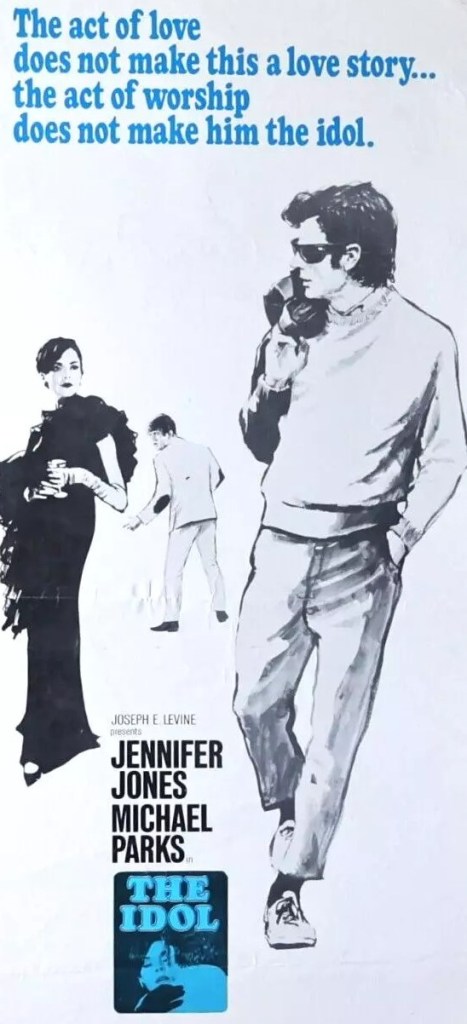
The Idol (1966) ***

By this point in the 1960s the use of black-and-white photography was a statement of artistic intent. So no bright red London buses or other colorful tourist features here. Instead, there’s an overall drabness, lack of bite and energy and a curious tale headlined by a purportedly rising star and a faded Hollywood marquee name. We’re back in rebel territory without much to distinguish it, a poor American studying art on a scholarship who gets in with a wealthier crowd, an under-explored Oedipal theme. On the other hand, the gender-reversed May-December episode is treated with more realism. There’s one superb scene of spite.

The impoverished Marco (Michael Parks), friendly with medical student Timothy (John Leyton), quickly appropriates his girlfriend Sarah (Jennifer Hilary), the cuckolded one too spineless to object, too needy of the arrogant buddy’s attention. They move into an apartment together. Timothy’s over-protective widowed mother Carol (Jennifer Jones), seeing the dangerous influence Marco wields, tries to separate them. She’s worried about how her son will react to her plan to marry confident businessman Martin (Guy Doleman).

Marco is theoretically at least the kind of pushy character who’s had to pull himself up by the bootstrings and despises his friends who merely inherited their good luck. He’s less of an Alfie (1965) than a self-destructive version of the rough-hewn Albert Finney character in Saturday Night and Sunday Morning (1960) but minus any genuine redemptive working class credentials. We never learn much about him.

When he makes an ill-advised play for Carol she dismisses his “schoolboy attempts at flirtation” and humiliates him. When she catches him in a bedroom in her house with Sarah. she wipes the lipstick from his mouth with a linen handkerchief and tosses said item out of the window. This scene taking place in front of a bunch of partygoers being given a tour of her grand house. He is thrown out.

Later, he wins back her favor after saving Timothy from being beaten up in a fight. What begins as a demonstration of maternal instinct soon leads to bed. But in the morning, in a reversal of the scene at the party, his draws lipstick on her lips, then wipes it off with a linen handkerchief and tosses the item out of the window. He was just using her. One of the best revenge scenes you’re likely to come across and carrying contemporary reverberation, not so much of the older woman falling for the younger man (an ongoing trope these days) but of the foolish woman trusting a man who has little interest in being faithful and treats her either as a sex object or an extension of his domination over the opposite sex.

Doting mother, spineless son.

It doesn’t end well, once Tomothy gets wind of his act, but the climax, especially the minor twist, feels tacked on. Marco’s the kind of character who romances them and leaves them, no love involved (except for himself), relatively little consequence, only tripped up by happenstance, and without engendering any empathy or sympathy from the audience.

In part this is because Michael Parks was an inexperienced movie actor, a rising talent after landing the male lead in Bus Riley’s Back in Town (1965) opposite Ann-Margret, which had a much better script, was in color (natch) and any time the plot slackened the camera could turn to the actress to save the day.

And in part it fails because Jennifer Jones was attempting one comeback too many, her first picture in four years, and only in her second in a decade, the marquee appeal that won her an Oscar for Song of Bernadette (1943) and a quartet of nominations besides long gone. Like contemporary Olivia de Havilland in Light in the Piazza (1962) she’s on relatively solid ground as a mother, but it’s quite a stretch for her to fall, even in a moment of weakness – unlike de Havilland who resists blandishments – for the churlish Marco.

It’s not helped by the weakness of the rest of the acting. John Leyton (The Great Escape, 1963) never managed the leap from pop star to movie star and Jennifer Hilary (The Heroes of Telemark, 1965) was merely another ingenue.

Daniel Petrie (Stolen Hours, 1963) is out of his depth with material that doesn’t quite fit together and doesn’t get a tune out of his male lead. Script by Millard Lampell (Escape from East Berlin, 1962).

The lipstick-wiping scenes stand out, and Jones is always watchable, but this is hardly memorable.

Bus Riley’s Back in Town (1965) ***

Given that Ann-Margret receives top billing I had automatically assumed she was the Bus Riley in question. Although decidedly the female lead, her role is secondary to that of a sailor returning to his small town. The backstory is that Bus – no explanation ever provided for this nickname, Buster perhaps? – Riley (Michael Parks) had been too young to marry the gorgeous Laurel (Ann-Margret) before he joined the U.S. Navy and in his absence she married an older wealthy man.  

Bus dithers over his future, re-engages with his mother and two sisters and finds he has not lost his attraction to Laurel. Although a handy mechanic, he has his eye on a white collar  career. An initial foray into becoming a mortician founders after sexual advances by his employer (Crahan Denton). Instead he is employed as a vacuum salesman by slick Slocum (Brad Dexter).  While his sister’s friend Judy (Janet Margolin) does catch his eye, she is hardly as forward or inviting as the sexy Laurel who crashes her car into his to attract his attention. But easy sex available with Laurel and the easy money from exploiting lonely housewives trigger a crisis of conscience.

Perhaps the most prominent aspect is the absence of good male role models. Bus is fatherless, his mother (Jocelyn Brando) taking in boarders to meet her financial burden – including the neurotic Carlotta (Brett Somers) – and while younger sister Gussie (Kim Darby) adores Bus the other sister Paula (Mimsy Farmer) is jealous of his freedom. Judy’s father is also missing and her mother (Nan Martin) a desperate alcoholic. The biggest male players are the ruthless Slocum and Laurel’s husband who clearly views her as a plaything he has bought. The biggest female player, Laurel, is equally ruthless, boredom sending her in search of male company, slithering and simpering to get what she wants.     

Scandal is often a flickering curtain away in small towns so it’s no surprise that Bus can enjoy a reckless affair with Laurel or that a meek mortician can get away with making his desires so quickly apparent, or that behind closed doors houses reek of alcohol or repression. A couple of years later and Hollywood would have encouraged youngsters like Bus and Laurel to scorn respectability in favor of free love. But this has a 1950s sensibility when finding a fulfilling job and the right partner was preferred to the illicit.

In that context – and it makes an interesting comparison to the more recent Licorice Pizza that despite being set in the 1970s finds youngsters still struggling with the difference between sex and love – it’s an excellent depiction of small-town life.

While Michael Parks (The Happening, 1967) anchors the picture, it’s the women who create the sparks. Not least, of course, is Ann-Margret (Once a Thief, 1965), at her most provocative but also revealing an inner helpless core. And you can trace her screen development from her earlier fluffier roles into the more mature parts she played in The Cincinnati Kid (1965) and more especially Once a Thief (1965).

In her movie debut Kim Darby (True Grit, 1969) is terrific as the bouncy Gussie and Janet Margolin (David and Lisa, 1962) invests her predominantly demure role with some bite. Jocelyn Brando (The Ugly American, 1963) reveals vulnerability while essaying the strong mother. Mimsy Farmer (Four Flies on Grey Velvet, 1971) also makes her debut and it’s only the second picture for David Carradine (Boxcar Bertha, 1972). Brad Dexter (The Magnificent Seven, 1960) is very convincing as the arrogant salesman.

It’s also the first film for Canadian director Harvey Hart (The Sweet Ride, 1968) and he has some nice visual flourishes, making particular use of aerial shots. The scenes of Bus trudging through town at night are particularly well done as are those of Laurel strutting her stuff.

It was also the only credit for screenwriter Walter Gage. That was because Gage didn’t exist. Like the Allen Smithee later adopted as the all-purpose pseudonym for pictures a director had disowned, this was the name adopted when playwright William Inge (Oscar-winner for Splendor in the Grass, 1961) refused to have anything to do with the finished film.

The movie was in limbo for over a year. It was never intended as a major picture, the budget limited to $550,000. Shot in Spring 1964, release was delayed for about a year until  Universal re-edited it and added new scenes. In part this was because Ann-Margret had  achieved surprising movie stardom between her recruitment and the film’s completion. Along with Raquel Welch, she became one of the most glamorous stars of the decade and in building up her own career Welch clearly followed the Ann-Margret template of taking on a bucket of roles and signing deals with competing studios.

After making just three movies, Ann-Margret was contracted for three movies with MGM at an average $200,000 per plus an average 12% of the profit, substantial sums for a neophyte. On top of that she had four far less remunerative pictures for Twentieth Century Fox, three for Columbia, Marriage on the Rocks with Frank Sinatra and a couple of others.

Universal also had another property to protect. Michael Parks was one of small contingent of novice actors in whom the studio had invested considerable sums, using them in television roles before placing them in major movies. Others in this small group – at a time when most studios had abandoned the idea of developing new talent – included Katharine Ross and Tom Simcox who both appeared in Shenadoah (1965), James Farentino (The War Lord, 1965), Don Galloway (The Rare Breed, 1965), Doug McClure (The Lively Set, 1964) and Robert Fuller and Jocelyn Lane in Incident at Phantom Hill (1965).

However, the introduction of Parks had not gone to plan. He was set to make his debut in The Wild Seed (1965) – originally titled Daffy and going through several other titles besides – but that was also delayed until after Bus Riley, riding on Ann-Margret’s coat-tails, offered greater potential.

SOURCES: “Escalating Actress,” Variety, May 22, 1963, page 4; “Inge Thinks Writer Contentment May Lie in Creative Scope of Cheaper Pix,” Variety, May 6, 1964, p2; “Ann-Margret Into the Cash Splash,” Variety, July 22, 1964, p5; “Universal Puts 9 Novices Into Pix,” Variety, March 3, 1965, p25; “Fear Ann-Margret Going Wrongo in Her Screen Image,” Variety, March 24, 1965, p5.

There’s a VHS copy available on Amazon, but otherwise it’s Ebay or this decent enough print on YouTube.

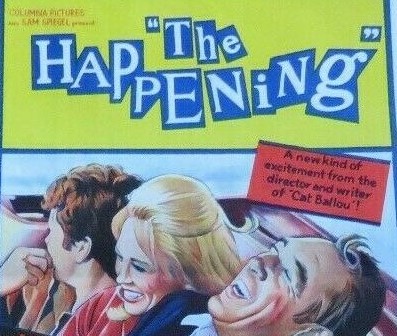
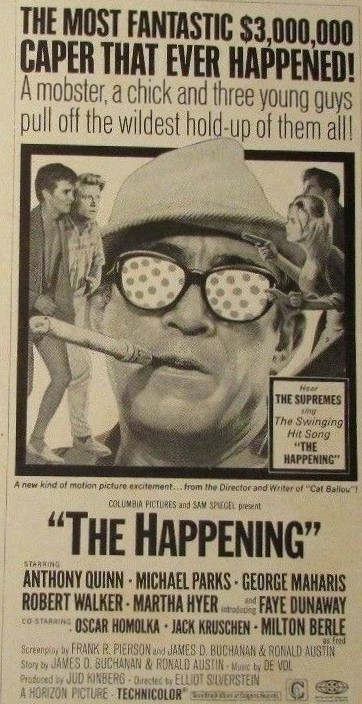
The Happening (1967) ***

Poor casting blows a hole in this picture’s great premise and only an excellent turn by Anthony Quinn as an indignant kidnappee prevents it achieving “so-bad-it’s-good” infamy. In fact for the first third of the movie you could pretty much guarantee it’s going to be a stinker, so dire are the performances of the quartet of hippy kidnappers. Only when the camera cuts  Quinn a bit more slack and the script skids into a clever reversal does the movie takes flight although still hovering dangerously close to the waterline.

Faye Dunaway (Sandy), all blonde hair and pouting lips, looks for the most part as though she has entered an Ann-Margret Look-A-Like Competition. Michael Parks (Sureshot) resembles a fluffy-haired James Dean. George Maharis is condemned to over-acting in the role as ringleader Taurus while Robert Walker Jr. as Herby does little more than mooch around. None shows the slightest spark and behave virtually all the time as if they are in on the joke.

For no special reason, beyond boredom, they kidnap hotel tycoon Roc (Quinn) hoping to make an easy score with the ransom. Unfortunately for Roc, none of those he is counting on to cough up the dough – wife Monica (Martha Hyers), current business partner Fred (Milton Berle), former business partner Sam (Oscar Homolka) and offscreen mother – will play ball. In fact, Monica and Sam, enjoying an affair, would be delighted if failure to produce a ransom ended in his death.

Eventually, while the movie is almost in the death throes itself, Roc fights back, using blackmail to extort far more than the kidnappers require from his business associates and taking revenge on his wife by setting her up as his murderer. It turns out Roc is a former gangster and well-schooled in the nefarious. So then we are into the intricacies of making the scam work, which turns a movie heading in too many directions for its own good into a well-honed crime picture.

Quinn is the lynchpin, and just as well since the others help not a jot. From a kidnappee only too willing to play the victim in case he endangers wife and son, he achieves a complete turnaround into a mobster with brains to outwit all his enemies. But in between he has to make a transition from a man in control to one realizing he has been duped by all he trusted.

Director Elliott Silverstein, who got away with a lot of diversionary tactics in Cat Ballou (1965) – such as musical interludes featuring Stubby Kaye and Nat King Cole – essays a different kind of interlude here, fast cars speeding across the screen at crazy angles. But that does not work at all. Probably having realized pretty quickly that he can’t trust any of the young actors, he mostly shoots them in a group.  

Some scenes are completely out of place – a multiple car crash straight out of It’s A Mad, Mad, Mad, Mad World, for example. But occasionally he hits the mark in ways that will resonate with today’s audience. Sureshot, confronted by a policeman, refuses to lower his hands in case he is shot for resisting arrest. Although drug use is implied rather than shown, Sureshot is so stoned he can’t remember if he has actually made love to Sandy. And like any modern Tinderite, neither knows the other’s name after spending a night together.  

The strange thing about the youngsters was that they were not first-timers. Dunaway had made her debut in Hurry Sundown (1967). George Maharis had the lead in The Satan Bug (1965) and A Covenant with Death (1967), Michael Parks the male lead in The Idol (1966) and played Adam in The Bible (1966) and although it marked the debut of Robert Walker Jr. he had several years in television. Oh, and you’ll probably remember a snappy tune, the music more than the lyrics, that became a single by The Supremes.

I’ve got an old DVD copy but I don’t think this is readily available but you can catch it for free on YouTube, although it’s not a good print. Via Google you should be able to see The Supremes performing the title song.

Discover WordPress

A daily selection of the best content published on WordPress, collected for you by humans who love to read.

The Atavist Magazine

by Brian Hannan

WordPress.com News

The latest news on WordPress.com and the WordPress community.