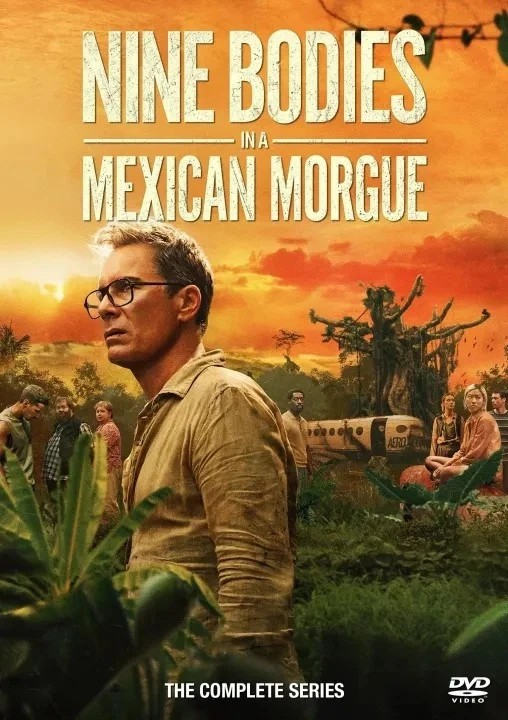
Nine Bodies in a Mexican Morgue (2025) ** or **** (depending)

Ludicrous production values point this in the direction of a laughable project, but a clever twist on both the detection picture and the survival genre and a heck of a lot of fun once it gets into the swing tilt this into the So Bad It’s Good category and a four-star rating for that.

Maybe there’s some of that post-ironic modernist stuff flying around in that we’re not meant to take the setting seriously. How could you when the only attempts to fill out the background of the Mexican jungle are one snake, one lizard and one crow and a pool of barracuda (yep, you heard me, somebody’s got to be able to chew off, for narrative purposes, a human face). Occasionally, reminiscent of the worst of the B-picture horror movies where actors had to strangle themselves with plastic snakes, here the characters take it in turns to slap their faces at supposed insects.

Other morgues you might be interested in…

But they’re never covered in sweat and there’s nary a tarantula or rattlesnake in sight. And any time one of them is due to be bumped off, they just have to wander away from camp.

This sets out its stall in disaster movie fashion. In classics like The Poseidon Adventure (1972), The Towering Inferno (1074) and Earthquake (1974) part of the fun was working out who would bite the dust.

Here, we’re told at the outset that out of the ten people aboard a light aircraft that’s crashed into the jungle nine don’t make it. So, over six episodes, we’ve got to guess who’s the survivor as well as why he or she feels obliged to get rid of his fellow passengers and it’s not as simple as in Sands of the Kalahari (1965) where it’s simply to increase one individual’s food stock.

Nor is it a simple matter of checking the billing. We know that Paul Newman and Steve McQueen aren’t going to be victims in The Towering Inferno, likewise Charlton Heston in Earthquake, but here none of the cast is familiar in the slightest, so no fans are going to bitch at their beloved idol being killed off, though Game of Thrones showed little compunction.

“The Living Dead at the Manchester Morgue” should you be interested.

Naturally, the one creature that’s dominant in the jungle is the red herring. Virtually every character isn’t what they seem. Kevin (Eric McCormack), an ex-doctor, feels like somewhere along the line he’s been struck off; Zack (David Ajala) is certainly no insurance investigator; Dan (Adam Long) isn’t a novelist; millionaire’s daughter Amy (Jan Le) clearly has issues; Lisa (Siobhan MacSweeney) ain’t no ordinary housewife; and everyone’s suspicious of Sonja (Lydia Wilson) because she’s so guarded.

Alliances crumble once the body count rises. And gradually, the survivors realize they are not alone, there’s someone else in this neck of the jungle who will sabotage their efforts to set up a rudimentary transmitter. It’s not Flight of the Phoenix (1965) either or those others in the survival sub-genre where characters use their skills to find an escape. This lot do nothing more energetic than wait. Though they don’t have much energy left over after all their confrontations and squabbling over who’s the killer among them.

What writer Anthony Horowitz (Foyle’s War, 2002-2025) does brilliantly is take the hoary old detective tale and turn it upside down. Sure, we’re accustomed to multiple murders in virtually any episode of a television mystery, but setting the bar as high as nine killings, and telling us that fact from the off, making us wonder who will be next – a bit like Strictly, wondering who will be axed this week – provides this with the narrative fillip it requires.

And you forget about the lousy production values and go with the flow. Here and there sub-plots turn up the puzzle factor.

You may well, like me (he boasted), work out who the killer is and what he’s up to, but likely as not you won’t.

Apart from a marvelous turn from Siobhan MacSweeny, the dry head nun from the Derry Girls (2018) television series, nobody’s called upon to do much acting, except of the duplicitous kind as they keep their real characters under wraps.

Couple of good twists at the end.

Guilty pleasure (four-stars) or utter rubbish (two stars) – you choose.

Catch it on BBC and various streamers or on DVD.

Behind the Scenes: “One-Eyed Jacks” (1961)

A three-hour western epic directed by Stanley Kubrick (2001: A Space Odyssey, 1968), written by Sam Peckinpah (The Wild Bunch, 1969) and The Twilight Zone’s Rod Serling and starring Spencer Tracy (Judgement at Nuremberg, 1961) and Marlon Brando. What’s not to like? That all of these major players, with the exception of Brando, had nothing to do with the final product was par for the course for a movie that didn’t reach cinema screens until two years after shooting was completed.

Marlon Brando was riding high when the project was first mooted in 1956. The box office and critical sensation of the 1950s, four Oscar nominations in successive years, winner for On the Waterfront (1954), his price was rising by the minute. And he had ambitions to take control of his career, set up his own production shingle, a trend that was beginning to gather pace.

He established Pennebaker (named after his mother) Productions in 1957 with ex-marketeer Walter Seltzer, producer of 711 Ocean Drive (1950), and George Glass, a former partner in Stanley Kramer’s independent production company. Paramount agreed to back the company. A western, A Burst of Vermilion, was intended as the company’s first offering. Soon there were five movies on the schedule including The Authentic Death of Hendry Jones by Charles Neider.

Brando had paid $150,000 for the rights to the book and a script by Sam Peckinpah. The original title was changed to Guns Up. It was going to mark the debut of the new Pennebaker outfit ahead of other projected movies like Shake Hands with the Devil to star James Cagney and Anthony Perkins (he didn’t make it to the final cast), The Raging Man and Ride, Comancheros (no relation to The Comancheros, 1961) and C’Est La Vie to be filmed in Paris.

Paramount paid through the nose, committing to an unprecedented deal. The studio would fund the entire cost of Guns Up and as well as $150,000 upfront Brando would receive 100 per cent of the profits, Paramount relying on its 27% of the gross as a distribution fee to turn a profit. Stanley Kubrick, riding high after Paths of Glory (1957), was hired to direct. While the studio preferred Spencer Tracy as co-star, Brando wanted old buddy Karl Malden who had co-starred with Brando in A Streetcar Named Desire (1951) and On the Waterfront, winning an Oscar for the former and a nomination for the latter.

And in part to reflect the Asian community in Monterey, location of the main section of the film, he also wanted current squeeze France Nuyen (A Girl Named Tamiko, 1962) to play his lover in the film, but Kubrick was aghast and instead cast Mexican debutante Pina Pellicer (Rogelia, 1962). There were roles for Katy Jurado (Barabbas, 1962) and recognizable western types like Ben Johnson (The Undefeated, 1969), Slim Pickens (Firecreek, 1968) and Elisha Cook Jr (The Great Bank Robbery, 1969).

Shooting was set for June 1958, then it shifted to September and then November. To Brando’s shock, Kubrick pulled out two weeks before production was due to begin, citing pre-production on Lolita (which, ironically, didn’t go ahead for a couple of years). To salvage the situation, Brando decided to direct. He wasn’t the first actor to go down this route, especially if you count Charlie Chaplin, Buster Keaton and Orson Welles as actors first and foremost. Laurence Olivier helmed Henry V (1944) and three others, Jose Ferrer The Cockleshell Heroes (1955), hoofer Gene Kelly Singin’ in the Rain (1951) and Charles Laughton Night of the Hunter, 1955. So he was in good company.

Cameras turned on December 2, 1958. It was an auspicious era for westerns, a total of 41 had appeared that year. Although budgeted for three months, it took six months to shoot in locations like Sonora in Mexico and Monterey in California (where the film was set) as well as Pfeiffer Beach on the Big Sur and the Warner Ranch.

Although prior to shooting commencing the title had changed to One-Eyed Jacks, scoring and editing were well in hand and Paramount announced it as one of its 17 pictures set for 1959 release. In the end Shake Hands with the Devil beat it to the punch as Pennebaker’s initial release, in 1959. But it didn’t favor so well, skipping the more lucrative but riskier Broadway first run in favour of hitting the circuits.

Meanwhile, Brando was angling for a three-hour running time. The budget kept increasing. The original $2m budget had doubled. Eventually, Paramount acknowledged it had cost $5 million though other estimates put it closer to $6 million.

Part of the problem in readying it for release was Brando’s other commitments. He was still a working actor and could hardly resist the offer of a record-setting one million bucks to star in The Fugitive Kind (1960). Even so, the bigger problem was not time, but experience and a first-time director being unable to make up his mind, having shot a colossal amount of footage and having tremendous difficulty trimming it down to workable length. Paramount still had it on the release agenda in 1960. It was going to be a “special release,” which most people took, especially given the running time, to be roadshow.

But by December 1960, the studio had waited long enough and just before Xmas the studio took over the editing and after editing out around 40 minutes from Brando’s three hour cut, Paramount scheduled it for a world premiere in New York in March 20, 1961, in a kind of semi-roadshow – moviegoers could buy in advance but the tickets did not come with reserved seats, which was the whole point of roadshow. Nor were prices hiked, which was gave roadshow its prestige.

Already deemed “Brando’s Folly” and coming in the wake of The Alamo (1960), the John Wayne-directed epic which had flopped in roadshow, commercial hopes were not high. In part, because production had been so long ago it had skipped under the journalistic radar which was concentrating on skewering The Alamo and the equally troubled The Misfits (1961). So it didn’t come trailing disaster. Still, it seemed more likely, audiences would not take to the odd tale which didn’t fit so easily into the western genre. Plus Brando’s previous effort The Fugitive Kind had been his first outright flop.

Turned out, though, Brando still was a major attraction. It snaffled a “huge” $81,000 in its opener at the 4,820-seat Capitol in New York. There was a “smasheroo” $21,000 in Detroit, a “big” $14,000 in Buffalo, a “hotsy” $15,000 in Cincinnati. “Giant” was the preferred adjective, covering $60,000 in Chicago, $32,000 in Philadelphia and $15,000 in Boston.

Rentals (what studios make after cinemas have taken their share of the gross) amounted to a very decent $4.3 million, enough to rank seventeenth for the year. And whereas those figures were considered decent enough, it did “substantially better abroad.”

So, more than likely, against all the self-destructive odds, it earned a profit.

SOURCES:  Stefan Kanfer, Somebody, The Reckless Life and Remarkable Career of Marlon Brando (Faber & Faber, 2008); “Glass, Seltzer in Brando Co Berths,” Variety, April 17, 1957, p22; “Chatter, Hollywood,” Variety, May 22, 1957, p62; “Marlon Brando Guns Up for Paramount,” Variety, April 30, 1958, p22; “Chatter, Paris,” Variety, July 30, 1958, p126; “Brando Gets 100% of Film Profit!”, Variety, August 6, 1958, p1; “Briefs from Lots,” Variety, September 24, 1958, p15; “Marlon Brando’s Own,” Variety, November 26, 1958, p5; “Shake Hands First with Circuits,” Variety, May 6, 1959, p4; “Brando’s Ugly American,” Variety, July 1, 1959, p3; “Par 17 Pix Set for Release,” Variety, July 15, 1959, p5; “Par Division Eyes Upcoming Product,” Variety, November 25, 1959, p22; “Doubt or Delay re Brando’s Jacks,Variety, August 10, 1960, p3; “Brando Jacks Editing,” Variety, December 21, 1960, p7; Advert, Variety, January 6, 1960, p32; Box Office Figures, Variety, April 5-Jul 24, 1961; “Hoss Operas in O’Seas Gallop,” Variety, August 23, 1961, p16; “1961 Rentals and Potential,” Variety, January 10, 1962, p13.

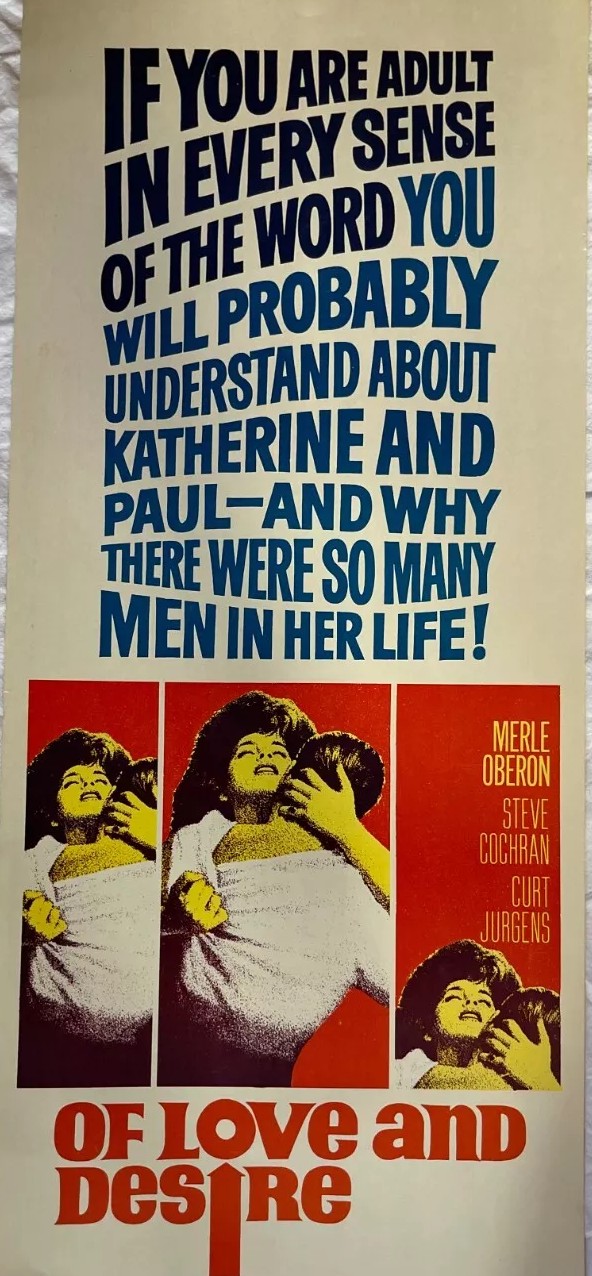
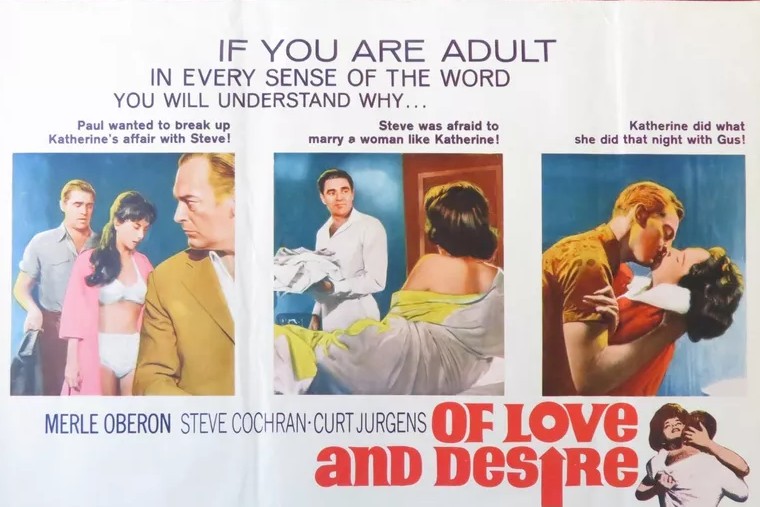
Of Love and Desire (1963) ***

As contemporary as you could get with the core theme of a sexually independent woman picking and choosing her men. Otherwise, a smorgasbord of talent. Star Merle Oberon (Hotel, 1966) hadn’t appeared in a movie in seven years, for co-star Steve Cochran (Tell Me in the Sunlight, 1967) the screen absence was two years, Curd Jurgens (Psyche 59, 1964) was still very much a jobbing actor restricted to playing good and bad Germans, and director Richard Rush (Psych-Out, 1968), in his sophomore effort, was as erratic in the early part of his career as he would be in his later (six years between Freebie and the Bean, 1974, and The Stunt Man).

Of course, this being a somewhat mealy-mouthed decade, psychological mumbo-jumbo was required to explain the woman’s actions rather than the notion that a woman could enjoy being sexually unrepressed and free of desire for marital security. So if you manage to separate the actual movie from the required fitting-in to moral standards, it’s a darned interesting examination of the kind of free spirit later exemplified by Darling (1965) or Modesty Blaise (1966).

Mining engineer Steve (Steve Cochran) on a job in Mexico begins an affair with wealthy Katherine (Merle Oberon), half-sister of his employer Paul (Curt Jurgens). There’s nothing of the usual will-she-won’t-she in this romance, she virtually flings herself at him. Not only that, the morning after, she arranges for all his belongings to be shipped to her splendid mansion, proof of who is usually in control. Just as, more traditionally, males are instantly aroused by beautiful women, she is excited in the presence of an attractive man and makes no bones about it, not too bothered about consequent scandal even though she does her best to keep her activities discreet.

Paul isn’t so happy with the affair. He clearly prefers her unhappy and dependent on him for emotional support. And a bit like Julie in Steve Cochran’s later picture Tell Me in the Sunlight, there’s certainly an assumption that she jumps from man to man, though out of boredom rather than financial security.

So Paul sets out to sabotage the affair by putting in Katharine’s way previous boyfriend  Gus (John Agar) who feels he is owed some sex and is determined she repay the debt. Although she almost succumbs and is subsequently ashamed of how easily her desire is inflamed, she resists and after he has had his way with her attempts to commit suicide.

But the question of rape is never raised and to Steve it appears she has merely resorted to type, falling into bed with the closest man. And in the time it takes to resolve the situation, we are treated to the psychological mumbo-jumbo which falls into two parts. In the first place, there has clearly been a strong sexual attraction between Paul and Katharine, and the strength of their emotional bond is in some ways a substitute for not indulging in incest. Secondly, her fiancé, a fighter pilot, was killed in the Second World War. Based on no evidence whatsoever, she has convinced herself that he committed suicide because she refused to have sex with him before marriage. To make up for that, she gives herself to any man who comes along. Yep, claptrap with a capital C. Which somewhat torpedoes the picture, which had been heading comfortably towards a feminist highpoint.

Merle Oberon almost turns the clock back a couple of decades to Wuthering Heights (1939) and her role there in physically expressing forbidden desire. You can almost feel her quivering with pent-up sexuality and she is unexpectedly superb, in what is essentially a B-picture, especially as the opportunity to tumble into melodrama – which she can’t escape in the final act – so obviously beckons. That the first two acts work so well is primarily down to her believable characterization. And Steve Cochran is no slouch either, shaking off the coil of his pervious incarnation as a tough guy. Curt Jurgens is creepy and sinister.

Director Richard Rush manages to hold his nerve until the end and then it all runs away from him into turgid melodrama. Screenplay contributions from the director, producer Victor Stoloff, Jacquine Delessert  in his debut and Laszlo Gorog (Too Soon to Love, 1960, Richard Rush’s debut)

Nearly but not quite a feminist breakout.

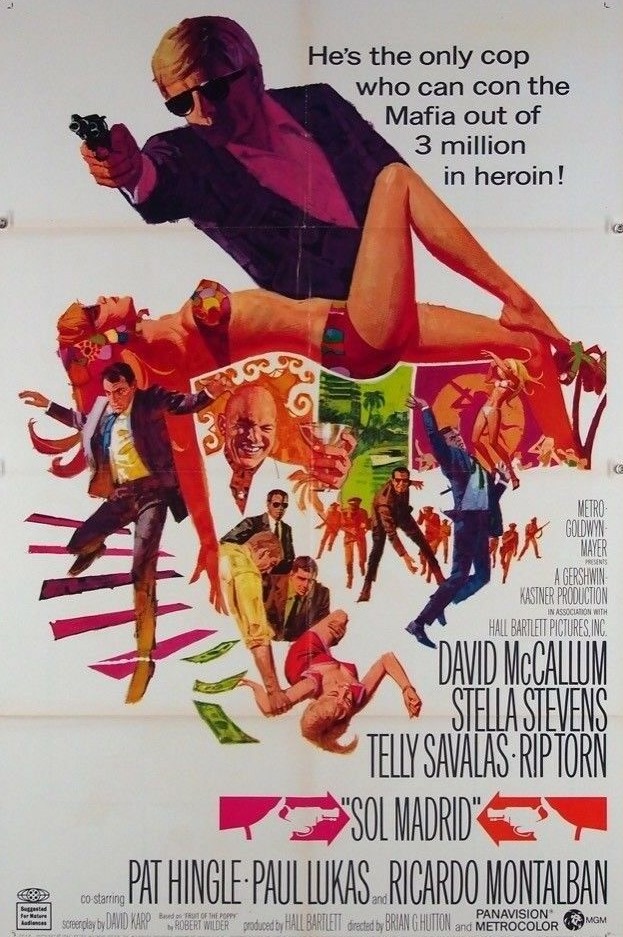
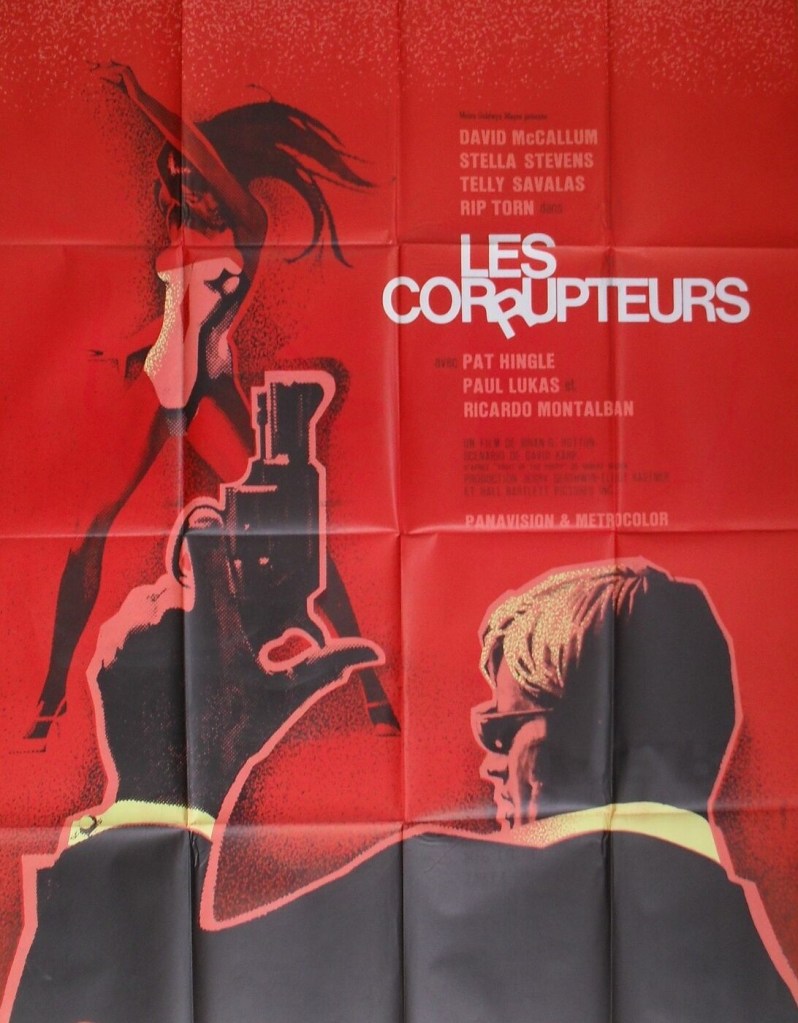
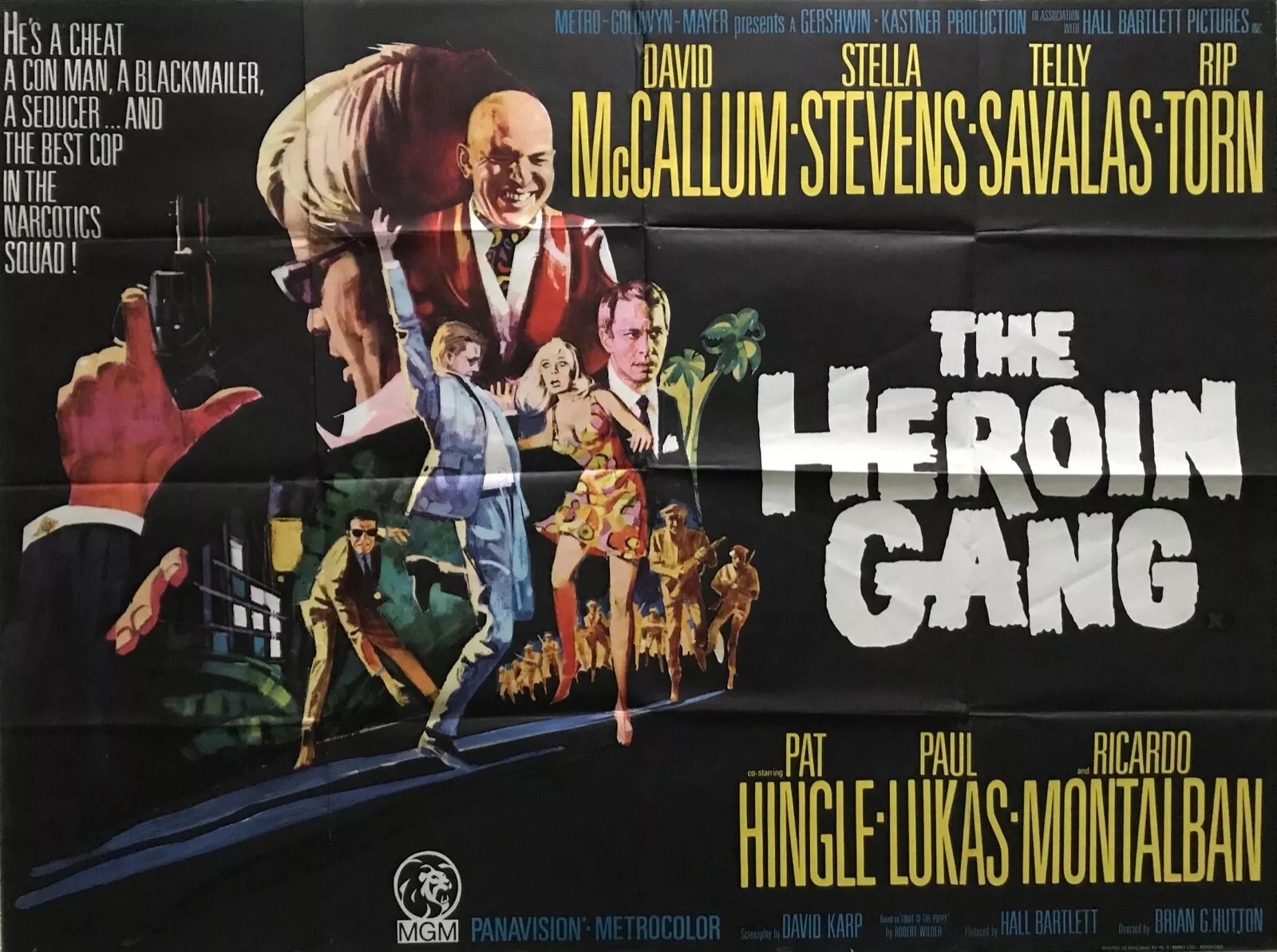
Sol Madrid / The Heroin Gang (1968) ***

Was it David MacCallum’s floppy-haired blondness that prevented him making the jump to movie action hero because, with the ruthlessness of a Dirty Harry, he certainly makes a good stab at it in this slightly convoluted drugs thriller? Never mind being saddled with an odd moniker, the name devised surely only in the hope it would linger in the memory, Sol Madrid (David MacCallum) is an undercover cop on the trail of the equally blonde, though somewhat more statuesque, Stacey Woodward (Stella Stevens) and Harry Mitchell (Pat Hingle) who have scarpered with a half a million Mafia dollars. Mitchell is the Mafia “human computer” who knows everything about the Cosa Nostra’s dealings, Woodward the girlfriend of Mafia don Villanova (Rip Torn).

Sol tracks down Woodward easy enough and embarks on the audacious plan of using her share of the loot, a cool quarter of a million, to fund a heroin deal in Mexico with the intention of bringing down both Mexican kingpin Emil Dietrich (Telly Savalas) and, using the on-the-run pair as bait, Villanova. A couple of neat sequences light this up. When Sol and Woodward are set upon by two knife-wielding hoods in a car park, he employs a car aerial as a weapon while she taking refuge in a car watches in terror as an assailant batters down the window. Sol has hit on a neat method of transferring the heroin from Tijuana to San Diego and that is filled with genuine tension as is the hand-over where Sol with an unexpected whipcrack slap puts his opposite number in his place.

Meanwhile, Villanova has sent a hitman to Mexico and when that fails turns up himself, kidnapping Woodward and planning a degrading revenge. Most of the movie is Sol duelling with Dietrich, suspicion of the other’s motives getting in the way of the trust required to seal a deal, with Mitchell, who has taken refuge in Dietrich’s fortified lair, soon being deemed surplus to requirements. Various complications heighten the tension in their flimsy relationship.

Sol Madrid is Dirty Harry in embryo, determined to bring down the gangsters by whatever means even if that involves going outside the law he is supposed to uphold, incipient romance with Woodward merely a means to an end.

David MacCallum (The Great Escape, 1963) certainly holds his own in the tough guy stakes, whether trading punches or coolly gunning down or ruthlessly drowning enemies he is meant to just capture, and trading  steely-eyed looks with his nemesis.

It’s a decent enough effort from director Brian G. Hutton (Where Eagles Dare, 1968), but is let down by the film’s structure, the expected confrontation with Villanova taking far too long, too much time spent on his revenge with Woodward, for whom audience sympathy is slight. Just at the time when Hollywood was exploring the fun side of drug taking – Easy Rider just a year away – this was a more realistic portrayal of the evil of narcotics.

It is also quite prescient, foreshadowing both The Godfather Part II (1974) in the way Villanova has modernised the organisation, achieving respectability through money laundering, and the all-out police battles with the Narcos. And there is a bullet-through-the-glasses moment that will be very familiar to fans of The Godfather (1972), and you will also notice a similarity between the feared Luca Brasi and the Mafia hitman Scarpi (Michael Conrad) here.

The action sequences are excellent and fresh. Think Madeleine cowering in terror as the car window is battered in No Time to Die (2021) and you get an idea of the power Hutton brings to the scene of a terrified Woodward hiding in the car. Incidentally, you might think MacCallum was more of a secret agent than a cop with the cold-blooded ruthlessness with which he dispatches his enemies.

Stella Stevens (Rage, 1966) is the weak link, too shrill and not willing to sully her make-up or hair when her role requires degradation. Her role is better written (“I never met a man who didn’t want to use me”) than Stevens can deliver and she gets a clincher of final one. Telly Savalas (The Dirty Dozen, 1967) surprises by delivering a playful villain, though the trademark laugh is in occasional evidence whereas Rip Torn is all villain. Ricardo Montalban (Madame X, 1966) is Sol’s Mexican sidekick and Paul Lukas, a star of the Hollywood “golden age”, puts in a fleeting appearance. Written by David Karp (Che!, 1969) and Robert Wilder (The Big Country, 1958).

Proved a winner for Brian G. Hutton – next gig Where Eagles Dare. Less so for David MacCallum – next outing The Mosquito Squadron (1969).

Has its moments.

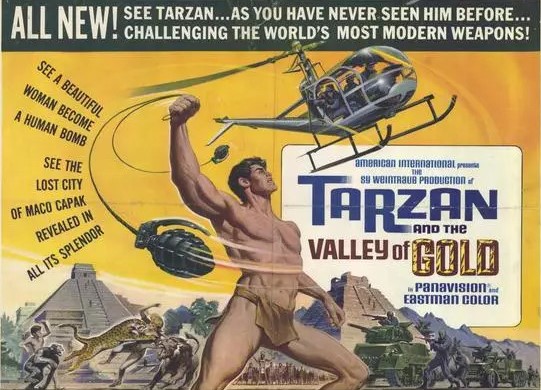
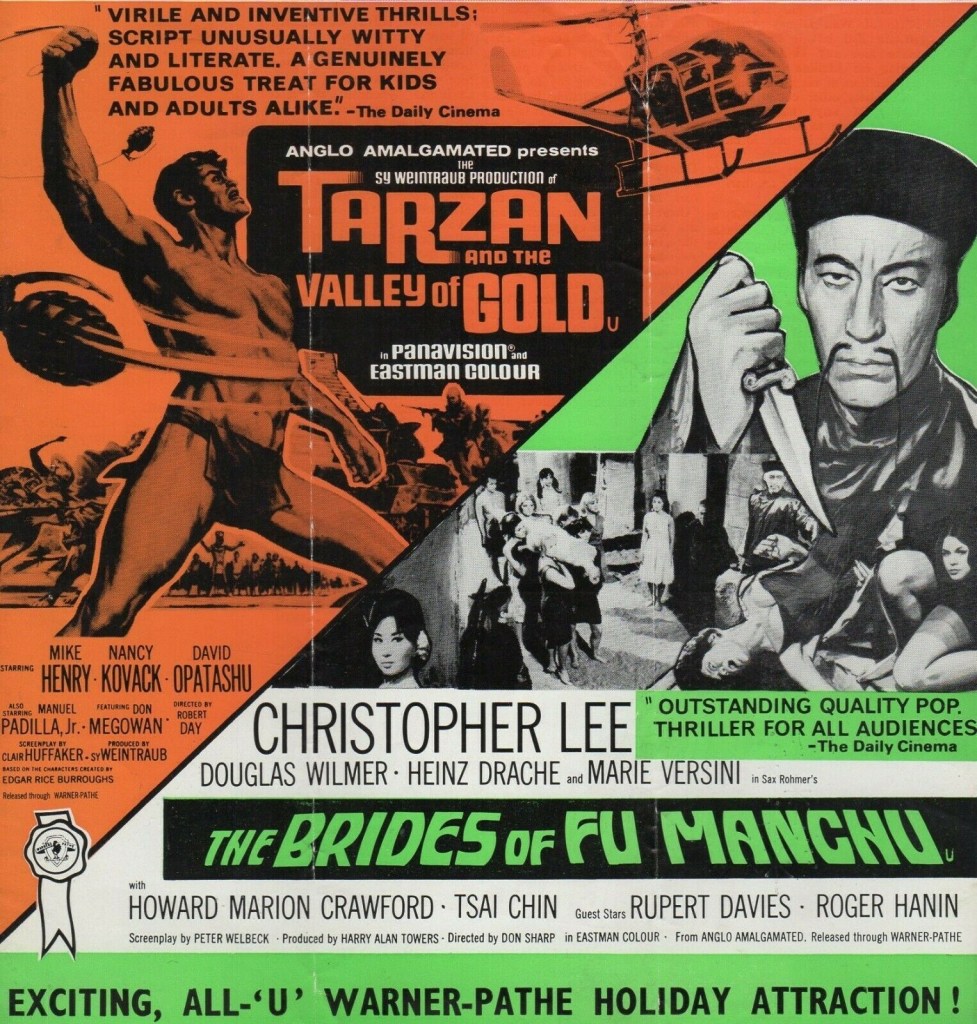
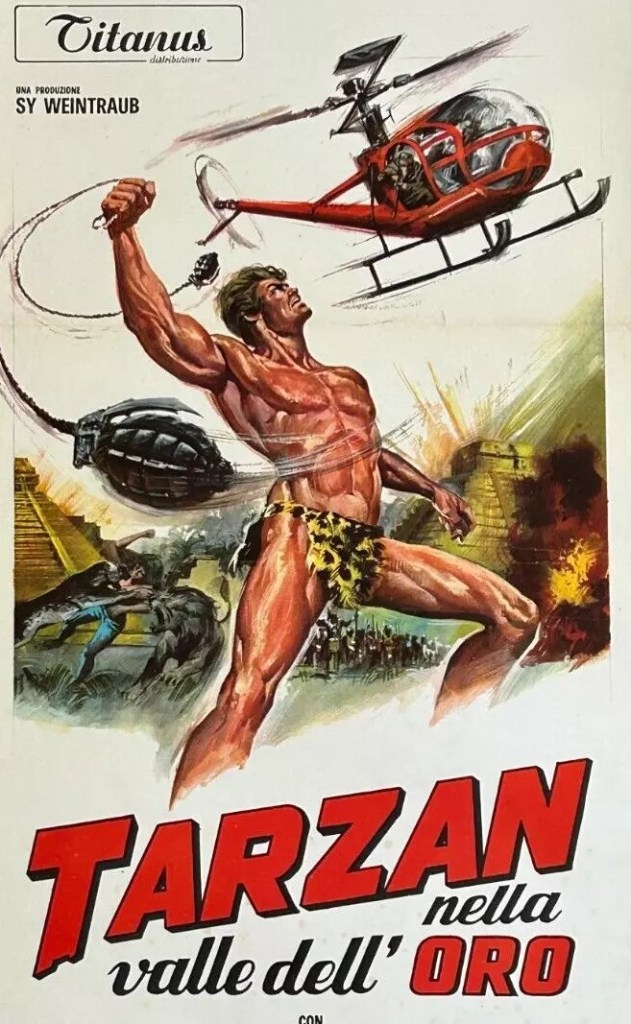
Tarzan and the Valley of Gold (1967) ***

Hooray for hokum. What should have been termed Tarzan: The Next Generation takes our hero temporarily out of loincloth but equips him with a hefty Browning machine gun and rudimentary grenade launcher, not to mention the neat tricks of  repurposing a giant Coca-Cola bottle and bringing stalactites down on the heads of pursuers. Hardly surprisingly he’s toting such weaponry given he’s not just, as was more common, wrestling pesky crocodiles and punching the living daylights of any villain stupid enough to get in his way.

Sadistic evil mastermind Vinero (David Opatashu), has raided the Army Surplus stores for a World War Two M5A1 Stuart light tank, an M3 half track and a Bell 47 helicopter to augment his battalion of 40-odd mean-looking mercenaries. Though he hardly requires them since his favored device is an exploding watch.

Vinero has kidnapped a small native boy Ramel (Manuel Padilla Jr. who reputedly knows the way to an ancient El Dorado complete with Aztec pyramid. Yep, we’re in Mexico, which, incidentally, should screenwriter Clair Huffaker so require, does boast crocodiles as well as jungle. Tarzan is called in to rescue the lad.

He only wears a suit long enough to dispatch an assassin who has dumped him in a football stadium. Once he smells the wild it’s into the traditional loin cloth. He teams up with a Dirty Quarter Dozen comprising chimp Dinky (recruited for his scouting skills, you understand, and his three wise monkeys impersonation), lion Major (specialty: human flesh) and the boy’s pet leopard who will lead our merry crew to the child.

Quite how Ramel was found wandering in the jungle is never explained though it’s perfectly believable that, once lost, he wouldn’t know his way back and would rely on that well-known human compass Tarzan to help him find the way.

There’s quite a lot of trekking one way or another, but, thankfully, that’s interrupted by spurts of sadistic behaviour, an entire village gunned down by Vinero’s henchmen and the big bad guy only too delighted to take time out to demonstrate his incendiary ability in despatching unworthy lieutenants.

To be honest, the jungle doesn’t provide much cover, helicopter ferreting out Tarzan with little problem, only to be downed by his inspired trick of throwing a home-made hand-grenade bolus at the aircraft.

You won’t be surprised to find there’s a fair maiden involved. Her task, unlike previous incursions into this kind of  jungle, is not to be discovered deshabille swimming in a pool. Instead, she’s bait. It’s hard to get a precise fix on Sophia (Nancy Kovack) since for most of the picture she’s Vinero’s mistress. It’s taken her quite some time to become disgusted by his sadistic tendencies. Probably, her rescue is to demonstrate Tarzan’s inherently gentle nature, given he’s got to separate her from a deadly necklace that will explode, so we have been led to believe, by the slightest tremor.

When they reach the lost city – who am I to quibble that a pyramid that can be seen for miles around hardly qualifies as a valley – they discover it is of a distinctly pacific nature, the chief willing to give away all their gold rather than sacrifice a single life, the kind of attitude that conspires against the traditional Hollywood notion of collateral damage.

Chief’s not much trusting of Tarzan and Sophia either and locks them up. Oddly enough, there could easily be an exquisite zero-sum-game at work, a winners-take-all scheme where everyone is a winner, except Tarzan has no truck with the chief’s notion of letting the bad guys get away with as much as they can carry, and Vinero literally digs his own grave by insisting on taking more than he can carry (though I doubt if this is where the makers of Witness, 1985, found their silo death scene).

Mike Henry (The Green Berets, 1968) hulks up pretty well, Nancy Kovack (Marooned, 1969) – replacing Sharon Tate – adds to the scenery, David Opatoshu (Torn Curtain, 1966) underplays the villainy to good effect. Clair Huffaker (Hellfighters, 1968) sufficiently updates Tarzan to a James Bond world. Robert Day (She, 1965) – who had also directed Gordon Scott in the role – delivers the goods.

Enjoyable matinee fare.

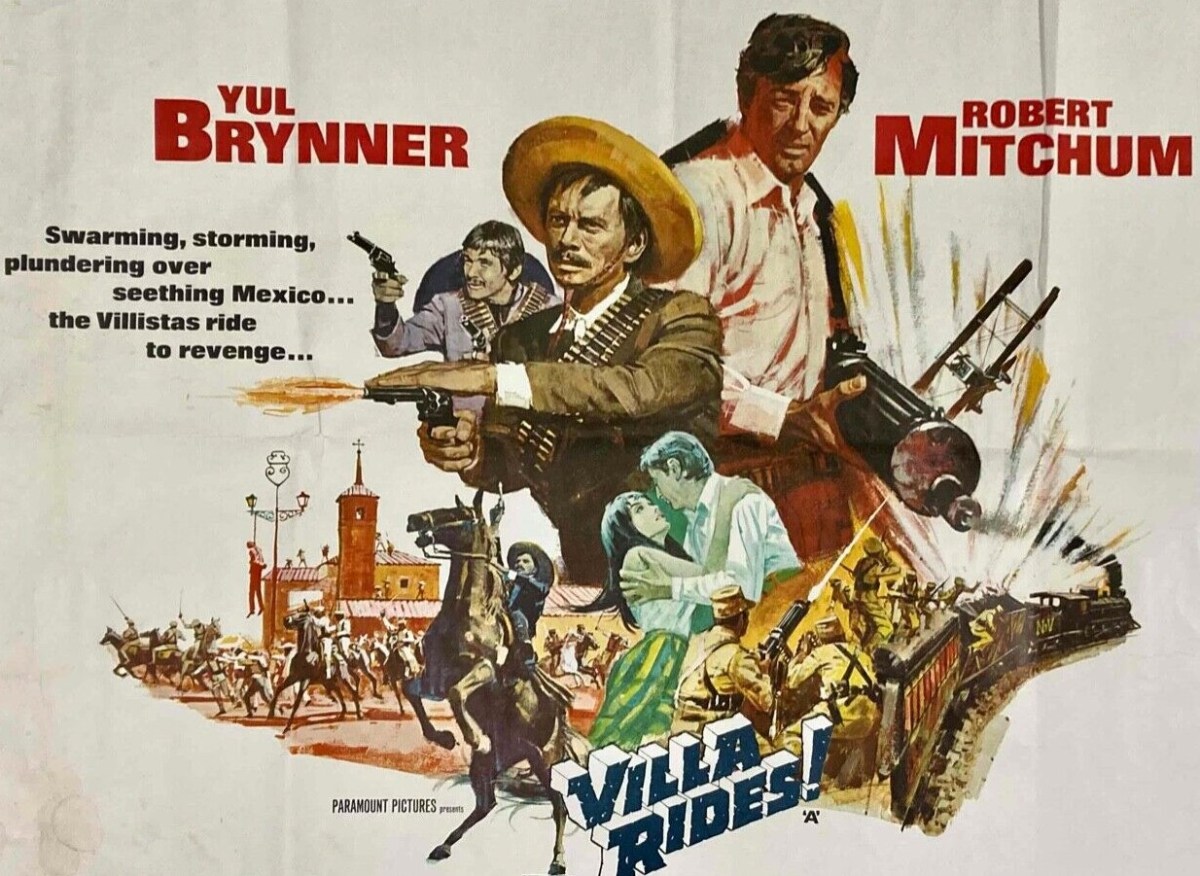
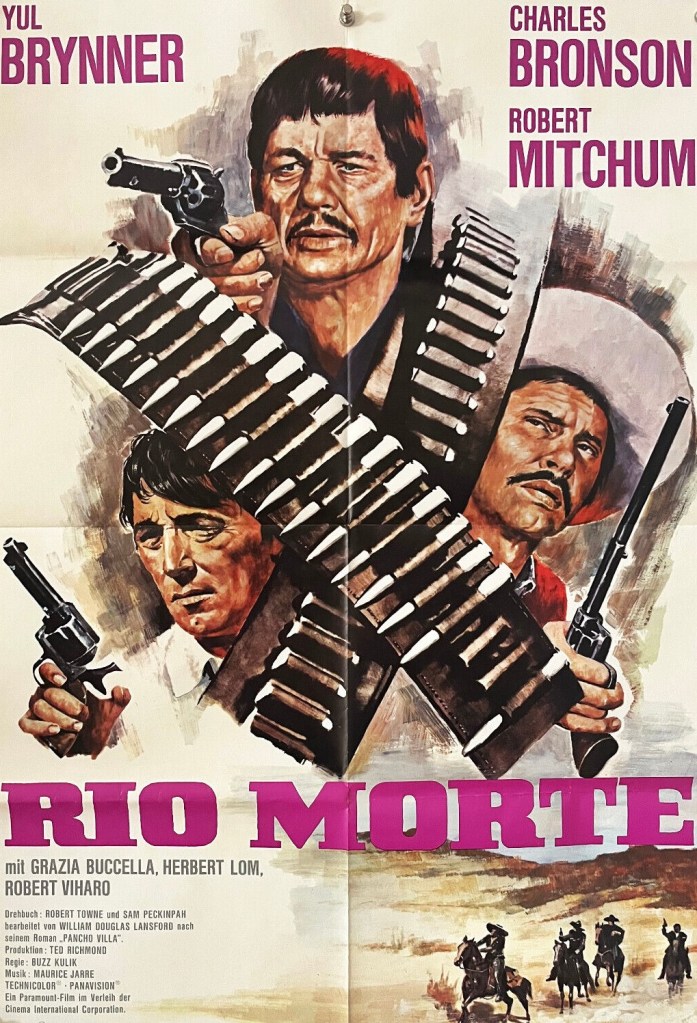
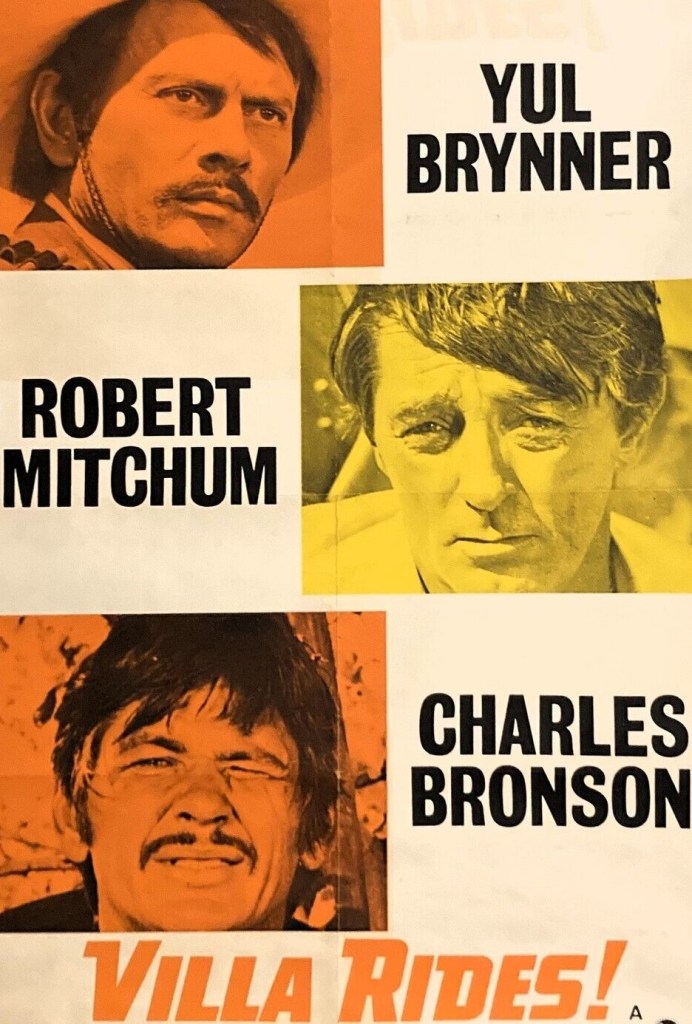
Villa Rides (1968) ***

Best viewed as Charles Bronson’s breakout movie. Yes, he had played supporting roles in The Magnificent Seven, The Great Escape and The Dirty Dozen, but these had all been versions of the same dour, almost monosyllabic, persona. Here, though somewhat ruthless, he steals the show from the top-billed Robert Mitchum and Yul Brynner with many of the best lines and best situations with an extra slice of humor (make that first-ever slice of humor) to add to the mix. He is the most interesting of the three main characters, in part because he does not have to spout any of the “good revolution/bad revolution” dialog that falls to the other two.

Villa (Brynner) is fighting the Colorados but his superior General Huertas (Herbert Lom) is planning to overthrow President Madero (Alexander Knox). Mitchum is an aeronautical gun-runner from El Paso, initially against the revolutionaries, stranded in Mexico when his plane breaks down. He has just about time to romance a local woman Fina (Maria Grazia  Buccello) before the Colorados arrive, take over the village, start hanging the leaders and raping Fina. Villa saves them, Bronson slaughtering the Colorados with a Gatling gun on the rooftop. Faced with the one-man firing squad that is Bronson, Mitchum turns sides. His plane comes in handy for scouting the enemy, then bombing them.

The actions sequences are terrific especially Villa’s attack on a troop train. To get Villa out of the way, Huertas puts him in the front line in a suicidal attack on a heavily-defended stronghold which turns into another brilliant set-piece with cavalry charges.  The plot is constantly interrupted by politics of one kind or another and comes to dead stop when Villa is arrested by Heurtas and Villa demands a proper trial. It’s kind of hard to take when a murdering bandit, no matter how legendary, decides that he has been hard done by.

That aside, there are interesting attempts to build up his legend. He doesn’t want power for himself, but to give it to the people, although he has sat back and let the first village be attacked so that the people there learn to hate the Colorados enough to join the fight. There’s not really any good guys – Brynner and Bronson are stone-cold killers, Mitchum a mercenary. But Brynner does marry Fina in order to prove that a raped woman should not be treated with dishonor, though he has a tendency to marry other women as well.

Bronson’s unusual one-man firing squad involves him laying on the ground with a pistol in each hand and giving prisoners the opportunity to escape before he shoots them. After all that hard work, he bathes his hands. Then he decides he can kill three men with one bullet, lining them up exactly so he can drill them all in the heart. But he’s also the one who shoots a molester in a cantina, then delivers the classic line: “Go outside and die, where are your manners?” He is at the heart of some well-judged comedy – continually sending back his meals and trying to get out of getting into a plane with Mitchum. Without him, there would be too much justification of slaughter (Brynner) and arguments against (Mitchum). This is the first time in the kind of action role that suits him that he has an expanded characterization.

Brynner did not like Sam Peckinpah’s original script so Robert Towne (Chinatown) was brought in to present Villa in a more appealing light. Bronson (Adieu L’Ami/Farewell Friend, 1968) shows hints of the screen persona that would so appeal to the French. Yul Brynner (The Double Man, 1967) adorns his character with many shades of grey, but Robert Mitchum (Secret Ceremony, 1969) has less to do.  Buzz Kulik (Warning Shot, 19660 has great fun with the action, less fun with some of the turgid dialog-ridden scenes.   

Good for action and Bronson.

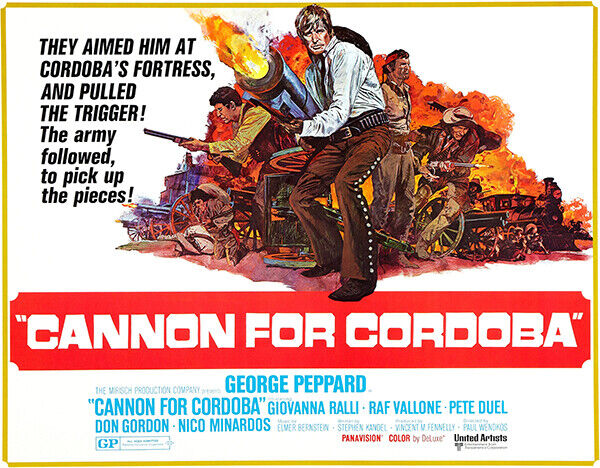
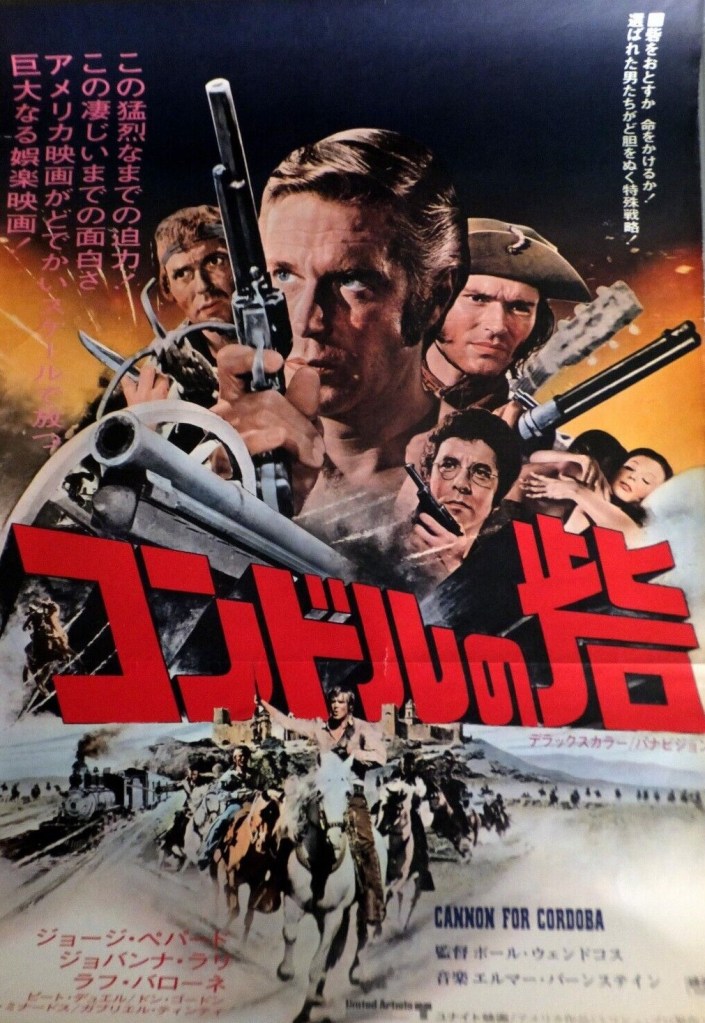
Cannon for Cordoba (1970) ***

Why settle for a measly Gatling Gun, as Mapache does in Sam Peckinpah’s gloriously violent The Wild Bunch (1969), when you can just as easily relieve government troops of serious artillery. It’s 1912 and the U.S. has sent General Pershing (John Russell) into Mexico with the titular weaponry in a bid to subdue Mexican rebels led by the titular Cordoba (Raf Vallone) raiding across the border and annoying powerful ranchers like Warner (John Larch).

Over-plotted to within an inch of its life and atmospherically indulgent – the natives are constantly whooping it up – and with star George Peppard trying out cigars for size for future enterprises like The A-Team (American television 1983-1987), this comes up short when compared to similar hard-nosed incursions into enemy territory like The Professionals (1966) and The Dirty Dozen (1967).

It’s a movie of many – too many – parts. First of all, we have rebellious U.S. soldier Capt Douglas (George Peppard), who gives superiors the finger, packed off with a small team to infiltrate the rebel army and find out what they’re up to. Not that that would require any infiltration. It’s pretty obvious with a prize plum like artillery suddenly arrived, the rebels are going to chance their arm and steal it.

Lo and behold that’s exactly what Douglas’s gang – which includes Jackson Harness (Don Gordon) quickly embittered because the good captain, in order to maintain his disguise, refuses to save one of his captured team being slowly roasted over a pit – does discover. But they don’t quite manage to get this information back to Pershing before those dashed clever Mexicans are blowing everything to hell and stealing the train containing the guns.

So now Douglas has to put together another team, the aforementioned Harkness augmented by Rice (Pete Duel) and Antonio (Gabriele Tinti), a Mexican who wants Cordoba brought to justice, and a few others, and infiltrate the Mexican stronghold. Along the way, they acquire the assistance of the beautiful Leonora (Giovanni Ralli) who is willing to use her body any which way (not going quite as far as Marianna Hill in El Condor out the same year) to gain revenge for Cordoba slaughtering her family and raping her. That last aspect seems a psychological stretch, but what the hell, how otherwise will the gang get close enough to the rebel leader.

Of course, just to sauce up the story, as if anything more is required, they are captured and need to bust out of jail and what with one thing and another it takes a goodly time before they can get close to achieving their objective. And that’s not to mention the betrayal that simmers in the background, Leonara having her own way of getting close to Cordoba, Warner not  quite as right-minded as he appears, and the aforementioned Harkness waiting for the right moment to blow away his leader.

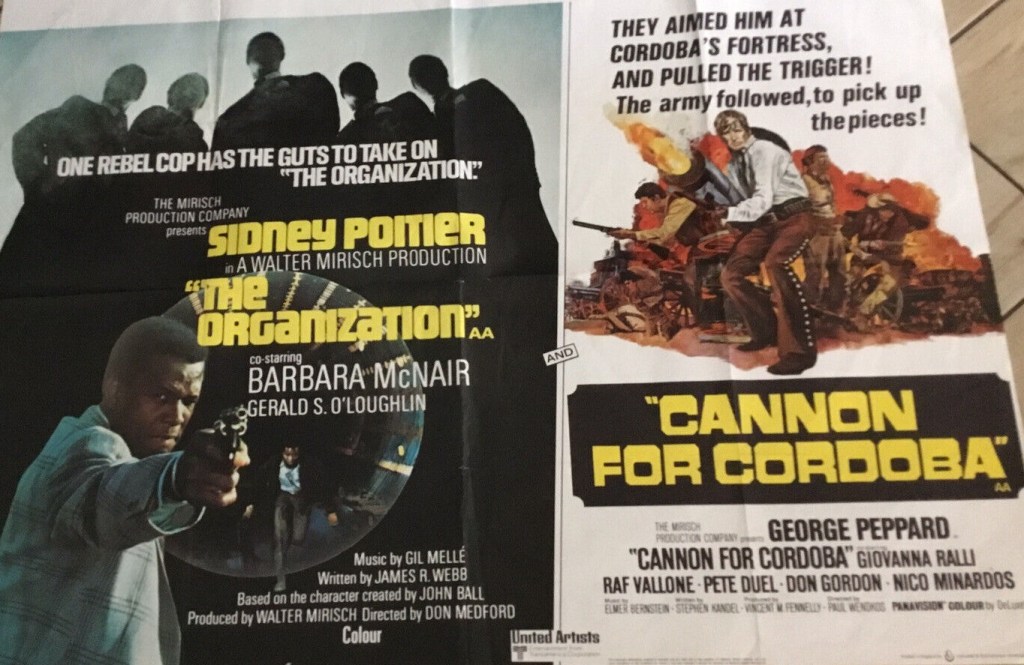
Not too well received, the movie went out in the supporting role in a double bill.

Plenty explosions, plenty action, and plenty living it up, scantily-glad women appearing at every turn, firecrackers going off, dancing in the streets, but somehow too much of this scrambles the focus while subsidiary characters take center stage too briefly too often, as with rebel women in the 100 Rifles (1969)-Raquel Welch mold. It gets there in the end of course but you just wish it would hurry up or expend more of its running time on developing the main personnel.

George Peppard (The Groundstar Conspiracy, 1972) is having a ball, but that’s only because every other character is so reined-in and there’s little else character-wise for him to hold onto. It wouldn’t have taken that much for him to command center stage, for competition in the acting stakes he’s only got Raf Vallone (The Cardinal, 1963), in worldly-wise form, and Don Gordon (Bullitt, 1968), stewing away. Giovanni Ralli (Deadfall, 1968) arrives too late in the proceedings to make much impact. Pete Duel (Alias Smith and Jones, 1971-1973) looks cute but has little to do.

Diligently put together by Paul Wendkos (Guns of The Magnificent Seven, 1969) but coming across as trying too hard, from a screenplay by Stephen Kandel (Chamber of Horrors, 1970).

Enjoyable if you enjoy shoot-em-ups, and even more if you’ve been charting the career of George Peppard who here makes the switch from all those uptight characters of the previous few years to letting a whole lot more hang out.

https://amzn.to/49SXTGg

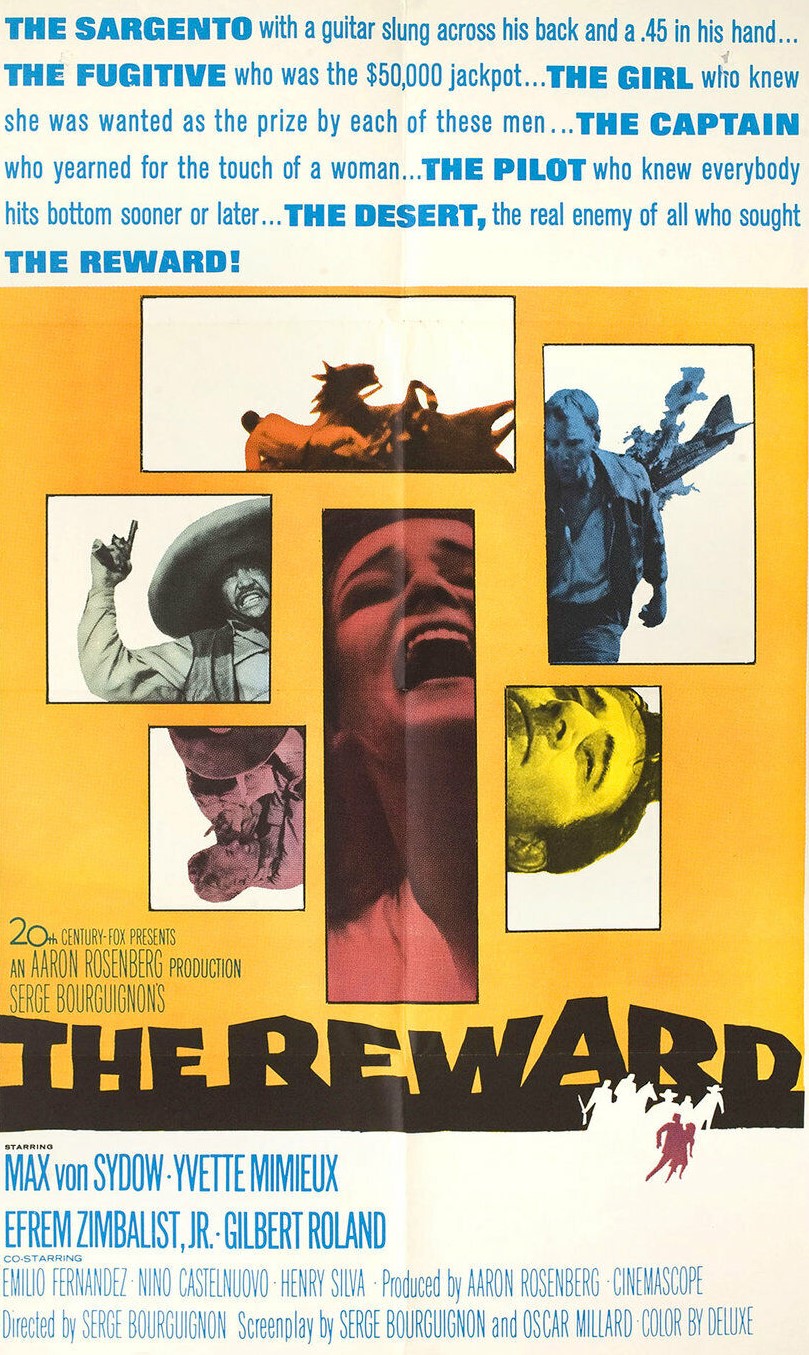
The Reward (1965) ***

Max von Sydow’s Hollywood career might have gone in a different direction had this brooding modern western remake of The Treasure of the Sierra Madre (1948) taken off. Instead of a screen persona as a heavily-accented somewhat awkward foreigner, he would have been viewed as a lean adventurer in the laconic Steve McQueen mold.

There’s no actual gold here, American airline pilot Scott Swenson (Max von Sydow) and his impromptu gang chasing into the Mexican desert human prey worth $50,000. Frank Bryant (Efrem Zimbalist Jr) is wanted for kidnapping and killing his own child. His virtually monosyllabic girlfriend Sylvia (Yvette Mimieux) is viewed as a bonus, clearly rape in the mind of some of his pursuers.

In normal circumstances, Swenson would spend his time dusting crops but he is being held for inadvertently destroying a water tower that will cost $20,000 to repair. But when he spots old buddy Bryant drive into town, he turns bounty hunter, cutting local English-speaking sheriff Capt Carbajal (Gilbert Roland), an exile in this remote town, in on the deal to repay the debt. The rest of the posse, led by his guitar-playing deputy Sgt Lopez (Emilio Fernandez) are initially misled as regards reward. So,when they do find out, greed will out.

When the escapees run out of road, they take to horses, but are located pretty quickly by the posse, also on horseback. Finding them was easy compared to getting them back. In fact, the posse seems to return via a different route that takes them through an abandoned town complete with church bell that Lopez makes ring through the simple device of battering it with his head.

It’s that kind of movie, filled with odd scenes that reflect character. In one episode, at the start of the chase and in a truck, a flat tyre is caused by one dumb occupant chucking his beer bottle in front, rather than to the side, of the vehicle. Flute-playing Joaquin (Henry Silva) tames a wild horse which, when he’s not around, has a bit of a rebellious streak, apt to lead the other mounts astray.

But it’s realistic, too. There’s not enough food to go round and even that seems limited to tortilla. There’s no reason to tie up the prisoners because there’s no escape in the desert hell. But although Swenson has betrayed an old friend in order to get himself out of a hole, there’s none of the guilty dialog you might expect and Sylvia turns out to be more cynical, not intent on building romance out of a brief fling in Acapulco, and only too aware of what captivity might mean. As is pointed out, the reward will be paid out for a decapitated head as much as a complete living person.

Rather than being devastated at killing his son, Bryant wants sympathy. It was an accident. Blame the police for starting a shoot-out that ended with the child dying in the crossfire. Blame his wife for taking the child away in the first place.

Nobody comes out of this well, except Sylvia whose good deed might result in rape, but whose motives you would also question, given she is harboring a child killer, an action not excused as would be the norm by being rapturously in love with him. She is resigned to her fate rather than flirting  with the gang as a way of avoiding it.

So it’s tension all the way, Lopez working on the principle that the fewer claimants of the reward the better. But it’s not just lack of water that’s the most dangerous element in this perilous landscape, but lack of horses. Water isn’t in dramatically short supply anyway not when you can count on the occasional thunderstorm, which, unfortunately, makes Sylvia a more attractive reward when she is soaked to the skin.

The body count, as you might expect, mounts as Lopez takes control, his boss, coming down with a fever, growing weaker by the day.

But it’s not as noir as you might imagine. Mostly, it’s just characters trudging through the desert, enlivened by some flute- and guitar-playing, heading into a doom of their own making. There’s very little in the way of heated dialog and there’s a very bold decision to dispense with subtitles – only the sheriff and Swenson are bilingual, helping them devise a  conspiracy to keep the reward to themselves  – but it’s easy enough to work out what’s going on with the Spanish-speaking Mexicans and it does explain why Sylvia says so little.

If you managed to get hold of The Picasso Summer (1969) – reviewed earlier in the Blog – this is for you since it has the same director Serge Bourguignon whose style is elliptical to say the least. But cutting down on expository consequence is spot-on. We don’t need characters bewailing their fate to know the potential outcome. Circumstance makes menace implicit rather than explicit.

The actors are good enough not to be laden down with overwrought dialog. This is certainly presents a refreshing aspect of Max von Sydow (The Quiller Memorandum, 1966). Yvette Mimieux (The Picasso Summer) is mostly a bewildered fragile beauty. Emilio Fernandez (The Wild Bunch, 1969) would be at his scene-stealing best except he has to contend with Henry Silva (Secret Invasion, 1964) in one of his few heroic parts. Veteran Gilbert Roland (Cheyenne Autumn, 1964), who made his name as The Cisco Kid, is the surprise turn, authority sapped as illness takes hold.

If you want a peek at a curiosity, it might as well be this one.

Rage (1966) ***

You can count on Glenn Ford to bring his A-game to a B-picture. While never reaching the top tier of stardom he had been a box office stalwart in the 1950s until gradually losing his marquee touch in the early 1960s.

This is an odd one, with some nods at Wages of Fear (1953) and any picture that involved a trek or featured a hooker with a heart of gold. The story was certainly unusual – rabies. And the idea of a resulting pandemic will resonate more now than it did then. But it takes quite a long time for the key storyline to emerge, which is just as well because it allows Glenn Ford (Experiment in Terror, 1962) time to turn in one of his best characterisations.

Generally, Ford was Mr Dependable, very capable of holding his own and meting out punishment to anyone who crossed the line. So, this is as far from typecasting as you can get.

Dr Reuben (Glenn Ford) is a washed-up alcoholic working in a flyblown mining pitstop in Mexico, riddled with guilt at the death of wife and child. So when a posse of prostitutes turns up, he’s last in the queue, possibly his disinterest the attraction for Perla (Stella Stevens). By the time he realises he’s contracted rabies, he’s up against the clock, 48 hours to reach a town with an antidote, but still a baby to deliver, a jeep that has to cross a rickety bridge and then runs out of gas, so that, once linked up again with Perla and helped by Pancho, he has to cross mountain and desert to reach safety.

Logic isn’t in much evidence here. Despite knowing he has contracted the disease, he still delivers a baby and then spends most of the final 36 hours in the company of Perla and Pancho (David Reynoso), not to mention that the Mexican has abandoned his wife, who has just given birth in a shack, in order to accompany the doctor, or that the doc finds his way onto a bus loaded up with kids (presumably they are immune).

Not to mention that with a jeep running out of gas surely the last thing you’d want is to weight it down with passengers. And with a budget that’s not going to cater for a proper runaway bus that sequence falls back on the old speeded-up film.  And if you’re going down the line of a rickety bridge, do it once, don’t repeat it.

But then you wouldn’t have anyone on hand to deliver philosophic lines, or to start to fall in love (wih Perla, you understand, not Pancho).

Take away the illogicality and there is still quite enough that works. The driver of the hooker truck unceremoniously jacks up his load to dump them in the town. A woman is tied to a table in preparation for giving birth. A suspected rabies victim is dragged through the streets by rope. The hunt for gas leads them to drain oil lamps. There’s a very self-aware Perla, more than enough common sense for both of them. She knows exactly what she has become and that’s something for which there ain’t no cure. But there are a couple of beautifully-wrought scenes that would allow Reuben and Perla to express their true feelings if either was capable of letting go, and you won’t see more expressive fingers.

They struggled to sell this one. The old “woman scorned” line is out of place as is a town eaten up with rage and Glenn Ford does little pistol-packing. But Stella Stevens does look pretty in pink.

And the clock running down also means that the symptoms are building up. Reuben’s senses are heightened. Light is too bright, sounds deafening, and if the doctor is already too ill he won’t be able to drink from a waterfall.

Every now and then director Gilberto Gazcon – who hadn’t made a picture in four years since La Risa de la Ciudad (1962) and wouldn’t make another for three years – chucks in a cinematic morsel, the camera whizzing around or racing back, to show Reuben’s state of mind. But, honestly, he needn’t have bothered.

You hire Glenn Ford and you get everything through his eyes, maybe a sly tensing of his features or a gesture from time to time, but this is one actor – mostly under-rated – who is just rock solid when it comes to displaying character. So when he’s not trying to save himself, dashing from one scheme to the next, he’s flat out trying to stop himself going mad, and only pausing for a bit of reflection as Perla tries to inject some meaning into his life.

Stella Stevens (Sol Madrid, 1968) ain’t that gold-hearted she’s going to let men treat her like dirt, she hands out a couple of good thumpings, but in her world you’re not going to come across any men who aren’t pure predatory, and it’s a shock for her to meet someone who thinks a woman can’t be bought. This is a rounded character – tough but vulnerable, and surprisingly tender should the opportunity arise.

Definitely a mixed-bag and a bit more work on the screenplay would not have gone amiss but top-drawer performance from Glenn Ford.

Behind the Scenes: “100 Rifles” (1969)

100 Rifles was easily the most underrated film of the year. Even if the sum of all its parts did not add up to greatness, it had a lot more going for it than has generally been attributed. For a start, there was the attempt to build Jim Brown into a mainstream African American star. Secondly: the return of the bold female character that had largely disappeared since the heyday of Barbara Stanwyck, and Joan Crawford. Thirdly: the conjunction of these first two elements in a sex scene raised the issue of miscegenation that Hollywood had otherwise sought to avoid.

Fourthly, and perhaps most hard- hitting of all: the issue of genocide, the mass slaughter of the Yaqui Indian population providing an uneasy parallel not just to the United States treatment of its own indigenous Native American population but also to its actions in Vietnam.

But there was a danger that, without both incisive direction and potent performances, the movie would spiral downwards into another simple case of “When Beefcake (Jim Brown) Met Cheesecake (Raquel Welch).” Since nobody had expected Sidney Poitier to ascend the Hollywood ladder so fast, and in so doing set a trend, the industry had nobody lined up to ride in his wake and exploit what now appeared to be, at the very least, acceptance of African Africans as stars in their own right, with an audience ready to embrace a new kind of hero. Although MPAA president Jack Valenti called for more African Americans in more African American films, the number of highly touted big- budget African American–oriented pictures that offered stardom potential rarely made it out of the starting blocks.

But there was one potential crossover star waiting in the wings: Jim Brown. While lacking Poitier’s acting chops, he had the physique, looks and charisma. Cleveland Browns football legend with strong supporting roles in The Dirty Dozen (1967), Dark of the Sun (1968) and Ice Station Zebra (1968), top-billing had been limited to low-budgeters like Kenner (1968), The Split (1968) and Riot (1969).

But Variety had singled him out at the start of 1969 as one of its “new stars of the year” and judged him “the strongest contender to inherit some of Sidney Poitier’s earning power.” 100 Rifles had double the budget of any of his previous pictures.

Raquel Welch was in a similar situation to Jim Brown regarding Hollywood acceptance. However, she was not in a minority as far as female stars were concerned. The 1960s had been dominated by the likes of drama queen (in more ways than one) Elizabeth Taylor,  comedy queen Doris Day and musical queen Julie Andrews, not to mention Audrey Hepburn, (Breakfast at Tiffany’s, 1961), Italian import Sophia Loren (El Cid, 1961), Jane Fonda (Cat Ballou, 1965), Natalie Wood (Sex and the Single Girl, 1964) and Shirley MacLaine (Sweet Charity, 1968). There was also an overabundance of new talent in Julie Christie (Doctor Zhivago, 1965), Vanessa Redgrave (Blow Up, 1966), Lynn Redgrave (Georgy Girl, 1965), Mia Farrow (Rosemary’s Baby, 1968) and Faye Dunaway (Bonnie and Clyde, 1967).

But those stars had more to offer than mere beauty, whereas Welch, having made her name primarily as a pin- up and as eye candy in movies like One Million Years B.C. (1966) and Fantastic Voyage (1966), had trouble shaking off the idea that she won more parts on the basis of her body than for the acting skills, appearing in a dry bikini in Fathom (1967) and a wet one in Lady in Cement (1968).

However, like Jim Brown, she was actively looking to fill a niche, and set out her stall as a player of dramatic intensity, and she found it in the most unlikely of places: the western. That she chose 100 Rifles was interesting given her other choices. She was offered the Katharine Ross part in Butch Cassidy and the Sundance Kid when the lead roles had been offered to Steve McQueen and Warren Beatty and again when Paul Newman came into the frame. She was also up for the Faye Dunaway role for The Crown Caper (title later changed to The Thomas Crown Affair), again with McQueen, and a film with Terence Stamp (which was never made). But she clearly felt those roles were more decorative.

At one time, the female western star had been a staple. Claire Trevor was the star of Stagecoach (1939) and Texas (1941). Gene Tierney made her name with The Return of Frank James (1940) and Belle Starr (1941). Barbara Stanwyck carved out her own niche as a western icon after taking top billing in Union Pacific (1939), California (1947), The Furies (1950), Cattle Queen of Montana (1954), The Maverick Queen (1956) and Forty Guns (1957). While Maureen O’Hara took second billing in Rio Grande (1950), McLintock! (1963) and The Rare Breed (1965), she was the star of Comanche Territory (1950), The Redhead from Wyoming (1953) and The Deadly Companions (1961). Yvonne De Carlo headlined Black Bart (1948), The Gal Who Took the West (1949) and Calamity Jane and Sam Bass (1949). Rhonda Fleming had the female lead in The Redhead and the Cowboy (1951), The Last Outpost (1951), Pony Express (1953) and Gunfight at the O.K. Corral (1957). Johnny Guitar (1954) achieved classic status largely on the performance of Joan Crawford.

There had even been modern precedent: Inger Stevens had nearly cornered the recent market after A Time for Killing (1967), Firecreek (1968), Hang ’Em High (1968) and 5 Card Stud (1968) while Claudia Cardinale went from a supporting role in The Professionals (1966) to top billing in the forthcoming Once Upon a Time in the West.

Raquel Welch set out to follow suit. In Bandolero (1968) she proved capable not only of holding her own against veterans James Stewart and Dean Martin but as adept on the pistol- packing side of things. While Welch professed herself “no Anne Bancroft,” she was pleased that she was not “running around half- naked all the time.” After that punched a hole in the  box office, she was offered the female lead in 100 Rifles to be directed by Tom Gries who had made his name as a director with his unflinching portrayal of the cowboy in Will Penny (1968).

The basis of the film was Robert MacLeod’s The Californio, published in 1966, and the essence of the story concerned a “reckless stranger” who refused to turn the other cheek while innocent people were being killed. After Clair Huffaker turned in his screenplay, Gries wrote two further drafts. It is safe to assume that the casting of Jim Brown came after the Huffaker script had been handed in. When Huffaker did not like the way his work had ended up on screen, he insisted on using the pseudonym Cecil Dan Hansen, as he had done on The Second Time Around.

For 100 Rifles, he was so upset at the end result that he demanded either his name removed or the pseudonym installed, complaining that the finished product “bears absolutely no resemblance to my script.”

The story of The Californio bears little resemblance to 100 Rifles. Not only is the hero of the book, Steve McCall, white, he is a rawboned young man and not a lawman in his 30s. He is not a gunman either, being more proficient with the lasso. In fact, when forced into bloody action, he discovers that he abhors violence. The book could more aptly be described as a “rite of passage” novel where a young man, sent south “on legitimate business in the interests of the (U.S.) Federal Government,” leaves home for the first time, becomes a man, loses his virginity and kills his first man.

Nor is Yaqui Joe a bank robber in the book, and after meeting up with McCall, they embark on further legitimate business. Maria, named Sarita in the film, is most like her feisty movie counterpart, and although in the MacLeod version she is married, that does not prevent her taking Steve’s virginity. Of the villains, Verdugo (the name means “Hangman”), while not elevated to general, is still as ruthless, but the foreign adviser is not.

Most of the film’s action was invented by the screenwriters, including the concept of the 100 Rifles, Sarita’s sexy shower as a way of stopping the troop train, and the children being taken hostage (although in one episode in the book, children are shot). Trying to reshape the book to suit the new requirements of the characters makes the picture unnecessarily complicated. Burt Reynold’s solution was simpler: “Keep his shirt off and her [Raquel Welch’s] shirt off and give me all the lines,” he reportedly advised producer Marvin Schwartz.

The movie was shot over a ten- week period in Spain beginning in July 1968. Although that country had become a viable alternative for westerns looking to keep budgets low, in part in 1968 due to the devaluing of the peseta against the dollar, the volume of films shot there had declined by nearly a third compared to the previous year.

Despite the popularity of the location, Almeria, the actual area of countryside where most spaghetti westerns were shot, was very small. This resulted in a limited variety of available landscapes compared with films shot in the U.S. such as The Stalking Moon. The actors had to contend with extreme heat, and Gries was laid low for three days after contracting typhus. Gries decided to get the sex scene out of the way on the first day of shooting, probably to ensure that tension about the content was not allowed to linger until later in the shoot. However, it had the opposite effect. Neither Brown nor Welch had been given time to get to know one another nor to adjust to different styles of acting and to understand the perspectives of each other’s characters. Welch was not happy with the scene and tensions between the two stars continued throughout the film, some press reports putting this down to squabbles over close- ups, others to unresolved sexual tension. Welch later complained that scenes edited out of the picture had reduced audience understanding of her motivations. The MPAA also did some judicial trimming, axing Welch’s shrieks during lovemaking.

Critical reception ranged from sniffy to downright hostile. Perhaps like The Stalking Moon, advance publicity, although not this time pointing in the direction of the Oscars, had served to put critics off what sounded like an exploitative film. For the western traditionalist, sex scenes were off- putting, and although naked breasts had started appearing in a handful of movies, there were precious few full- on sex scenes, never mind one that featured miscegenation. Variety judged it a “routine Spanish- made western with a questionable sex scene as a possible exploitation hook.” On the plus side, Welch’s performance was “spirited” as was the Jerry Goldsmith score; Brown and Reynolds were just “okay.” The Showmen’s Servisection took a different view: “Fast pace, fine performances lift western several notches above the ordinary.” Roger Ebert in the Chicago Sun- Times called it “pretty dreary.” Howard Thompson, the New York Times’ second- string reviewer, said it was a “triumphantly empty exercise.”

Twentieth Century–Fox had been affected by recent financial disasters such as Doctor Dolittle (1967) and Star! (1968); the former collecting $6.2 million in domestic rentals on a budget of $17 million, the latter $4.2 million in rentals after costing $14.5 million. To counter mounting exhibitor panic about production being slashed, Fox had drawn up an ambitious program for 1969, promising one new movie every month. The program kicked off with a $7.7 million adaptation of the Lawrence Durrell classic Justine with Dirk Bogarde (January), followed by Michael Caine and Anthony Quinn in the $3.77 million film of the John Fowles bestseller The Magus (February) and the trendy $1.1 million Joanna from new director Mike Sarne (March). British star Maggie Smith in the $2.7 million The Prime of Miss Jean Brodie (April) came next with 100 Rifles (May) and another Marvin Schwarz production, Hard Contract starring James Coburn, costing $4 million (June). Summer highlights were Omar Sharif in the $5.1 million biopic of Che! directed by Richard Fleischer (July) and Gregory Peck in the $4.9 million Cold War thriller The Chairman (August). Come fall it was the turn of Paul Newman and Robert Redford in the western Butch Cassidy and the Sundance Kid coming in at $6.8 million (September), Richard Burton and Rex Harrison as aging homosexuals in The Staircase costing $6.3 million (October) and Warren Beatty and Elizabeth Taylor in George Stevens’ $10 million The Only Game in Town (November). The year ended with John Wayne and Rock Hudson in the $7.1 million Civil War western The Undefeated (December).

The studio needed several box office home runs because the following year it was already committed to three roadshows—Tora! Tora ! Tora!, Hello, Dolly and Patton—costing over $60 million. By spring it was clear that the first two movies in the schedule had been major flops, Justine bringing in only $2.2 million in rentals, The Magus $1 million. Income from Joanna and The Prime of Miss Jean Brodie barely exceeded costs.

By the time 100 Rifles swung into action with two largely untried leads and a director making only his second major picture, the pressure was on. “

At the box office 100 Rifles got off to a great start and Twentieth Century–Fox reported with delight that it had outgrossed Bandolero! by 40 percent in Washington (and by 500 percent in the ghetto areas), and by 300 percent in Philadelphia. In Baltimore it grossed $50,000 from a single theater compared to $80,000 from eight for Bandolero! and in Atlanta first run it had been $61,000 for the new film compared to $38,000 for the previous one. However, while Brown and Welch fans were out in force in certain areas, that did not make up for less interest in regions where westerns were associated with bigger or more traditional names. Ultimately, 100 Rifles fell short of expectations given the budget. U.S. rentals amounted to $3.5 million, and it registered in 29th position on the annual chart— the sixth highest- grossing western of the year and ahead of Mackenna’s Gold, The Stalking Moon, Paint Your Wagon and Once Upon a Time in the West.

But, of course, the domestic performance did not take into account the popularity of westerns overseas and the distinct following Raquel Welch had accumulated. So where some of the studio’s major dramas stumbled in the global market, 100 Rifles hit the ground running.

SOURCES: This is an abbreviated version of much longer chapter devoted to the film that ran in The Gunslingers of ’69: Western Movies’ Greatest Year (McFarland, 2019) by Brian Hannan (that’s me). All the references mentioned can be found in the Notes section of that book.

Discover WordPress

A daily selection of the best content published on WordPress, collected for you by humans who love to read.

The Atavist Magazine

by Brian Hannan

WordPress.com News

The latest news on WordPress.com and the WordPress community.