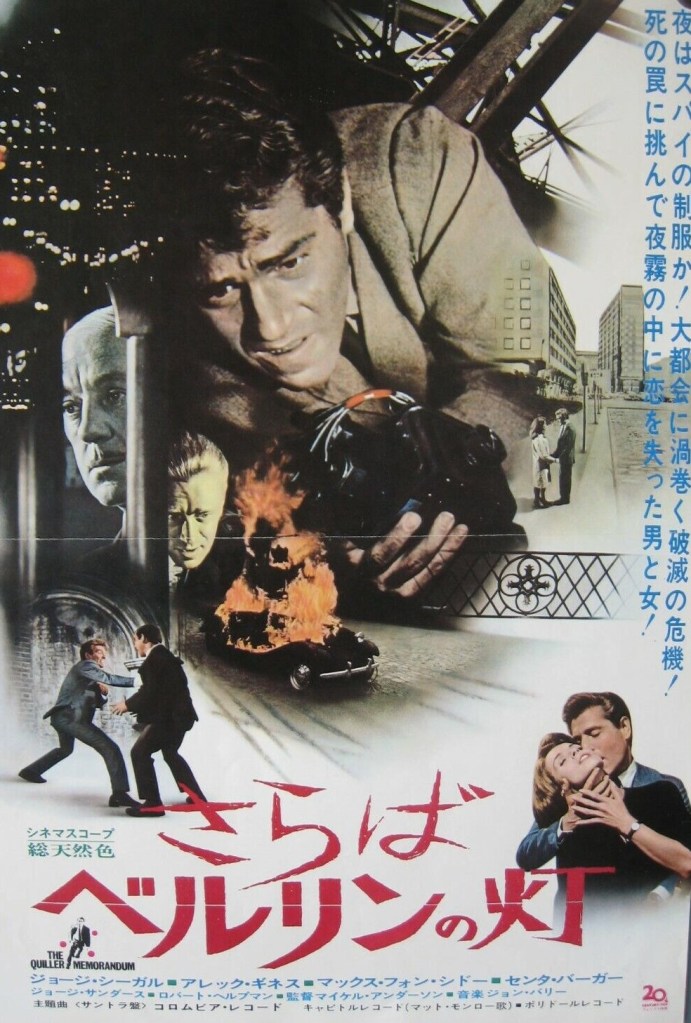
The Quiller Memorandum (1966) ****

Stylish cat-and-mouse thriller that fits into the relatively small sub-genre of intelligent spy pictures. George Segal was a difficult actor to cast. He had a kind of shiftiness that lent credibility to a movie like King Rat (1965), a cockiness that found a good home in The Southern Star (1969) and an earnestness ideal for Who’s Afraid of Virginia Woolf (1966).

But Quiller fit his screen persona like a glove. The part called for charm to the point of smarminess and courage to the point of callousness. A lone wolf for whom relationships were a means to an end, he adopted identities – journalist, swimming coach etc– as the occasion suited. His undercover mission is to expose a neo-Nazi organisation. But just as he seeks to discover the location of this secret enterprise, so his quarry attempts to find out where his operation is based. 

Michael Anderson (The Dam Busters, 1955) had just finished his first spy effort, Operation Crossbow (1966) and that film’s documentary-style approach was carried on here but with a great deal more style. There is consistent use of the tracking shot, often from the point-of-view of one of the protagonists, that gives the film added tension, since you never know where a tracking shot will end. Although the film boasts one of John Barry’s best themes, Wednesday’s Child, there was a remarkable lack of music throughout. Many chase scenes begin in silence, with just natural sounds as a background, then spill out into music, and then back into silence.

But much of the heavy lifting is done by playwright Harold Pinter (The Servant, 1963) in adapting Adam Hall’s prize-winning novel. Hall was one of the pseudonyms used by Trevor Dudley-Smith who wrote The Flight of the Phoenix (1965) under the name Elleston Trevor. The Quiller Memorandum involved wholesale change, from the title (the book was called The Berlin Memorandum) onwards. Quiller is now an American, not British, drafted in from the Middle East.

The book is set against the background of war crime trials; Quiller a British wartime rescuer of Jews now tracking down war criminals; the main female character (played in the film by Senta Berger) had, as a child, been in Hitler’s bunker; and there is a subplot concerning  a bubonic plague; there was a preponderance of obscure (though interesting for a reader) tradecraft; plus the Nazi organisation was named “Phoenix.”

While retaining the harsh realities of the spy business, Pinter junks most of this in favour of a more contemporary approach. Instead of meeting his superior Pol (Alec Guinness) in a theater, this takes place in the Olympiad stadium. Guinness’s upper crust bosses, Gibbs (George Sanders) and Rushington (Robert Flemyng), are more interested in one-upmanship. Berlin still showed the after-effects of the war and Pinter exploits these locales.

One lead takes him to Inge (Senta Berger), an apparently innocent teacher in a school where a known war criminal had worked.

But the core remains the same, Quiller prodding for weaknesses in the Nazi organisation. his opposite number Oktober (Max von Sydow) allows him to come close in the hope of reeling him in and forcing him to reveal the whereabouts of his operation. Quiller plays along in order to infiltrate the Nazis.

There is a lot of tradecraft: “do you smoke this brand” (of cigarettes) is the way spies identify themselves; Quiller followed on foot turns the tables on his quarry; the American is poisoned after being prodded by a suitcase; Quiller employs word associations to avoid giving away real information.

Having flushed out his adversaries, Quiller is now dangerously exposed. But that’s his job. He’s just a pawn to both sides. He’s virtually never on top unlike the fantasy espionage worlds inhabited by James Bond, Matt Helm and Derek Flint.

The structure is brilliant. Quiller spends most of the picture in dogged bafflement. The  supercilious Pol flits in and out, as if such work is beneath him.Quiller is stalked and stalks in return. There are exciting car chases but the foot chases (if they can be called that) are far more tense.

But the core is a bold thirteen-minute interrogation scene where Quiller s confronted by Oktober. As an antidote to the thuggery and danger to which he is exposed, Quiller becomes involved with Inge.

Segal is a revelation, grown vastly more mature as an actor after Who’s Afraid of Virginia Woolf (1966) for which he was Oscar-nominated, confident enough to abandon the showy carapace of previous pictures. This is a picture where he sheds layers, from the opening brashness to the sense of defeat in surviving the interrogation ordeal, knowing the only reason he is still alive is to lead the enemy to his own headquarters, buoyed only by inner grit. He hangs on to his identity by his fingertips.

And it’s a revelation, too, or perhaps a backward step for Max von Sydow, who presented a less clichéd character in The Reward (1965). While dangerous enough, it looks like he is already slipping into the category of foreign villain.

Senta Berger (The Secret Ways, 1961) is hugely under-rated as an actress. She was in the second tier of the European sex bombs who came to prominence in the 1950s and 1960s, the top league dominated by Brigitte Bardot, Sophia Loren and Gina Lollobrigida. On screen she is not as lively as those three, but the quiet intensity of her luminous beauty draws the camera in.

Here, she is utterly believable as the innocent women who, in falling for Segal, is dragged into his dangerous world.  She was criminally under-used by Hollywood, often in over-glamourous roles such as The Ambushers (1967) or as the kind of leading lady whose role is often superfluous.

Discussion of Alec Guinness as a spy inevitably turns to his role as George Smiley in the BBC series Tinker, Tailor, Soldier, Spy (19790 and its sequel three years later, but this is a less dour portrayal, almost whimsical in a way.  

A must-see for collectors of the spy genre.

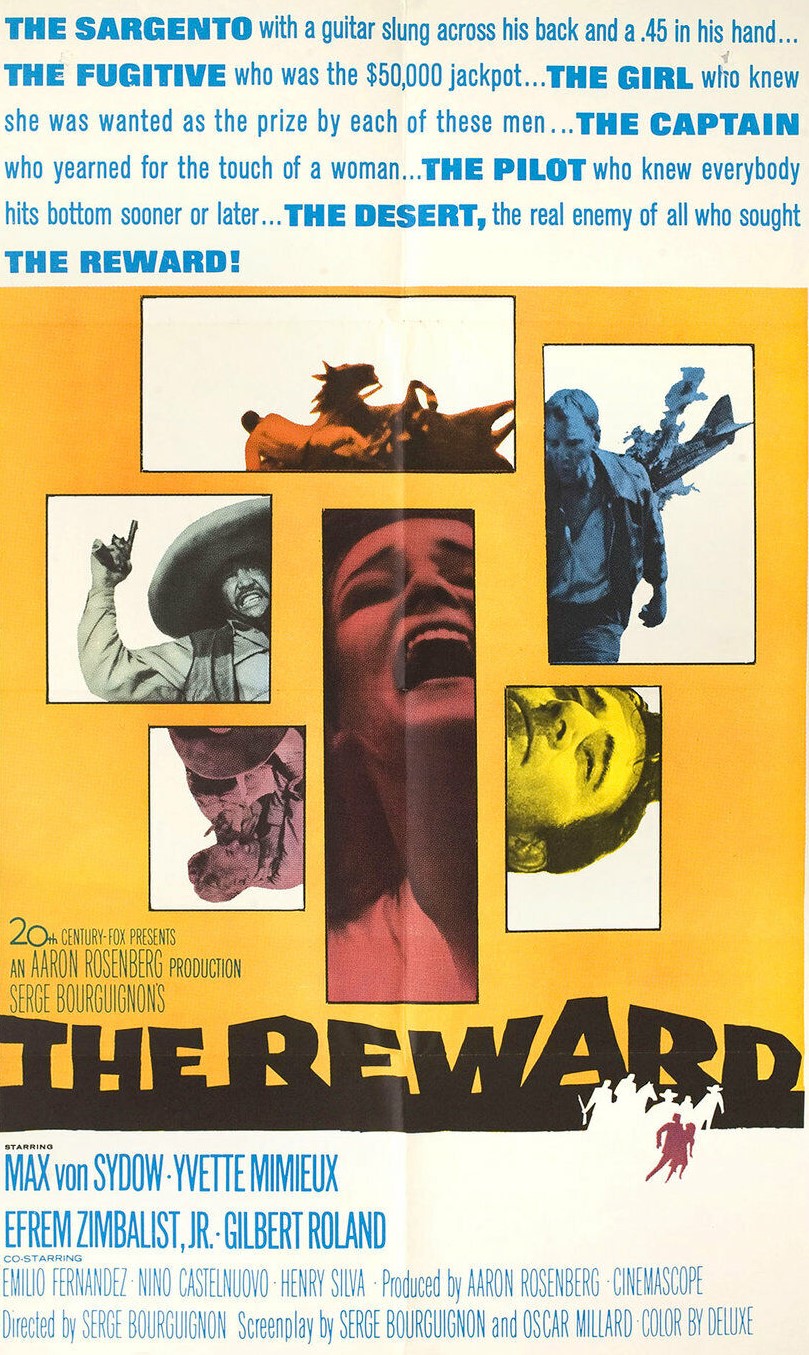
The Reward (1965) ***

Max von Sydow’s Hollywood career might have gone in a different direction had this brooding modern western remake of The Treasure of the Sierra Madre (1948) taken off. Instead of a screen persona as a heavily-accented somewhat awkward foreigner, he would have been viewed as a lean adventurer in the laconic Steve McQueen mold.

There’s no actual gold here, American airline pilot Scott Swenson (Max von Sydow) and his impromptu gang chasing into the Mexican desert human prey worth $50,000. Frank Bryant (Efrem Zimbalist Jr) is wanted for kidnapping and killing his own child. His virtually monosyllabic girlfriend Sylvia (Yvette Mimieux) is viewed as a bonus, clearly rape in the mind of some of his pursuers.

In normal circumstances, Swenson would spend his time dusting crops but he is being held for inadvertently destroying a water tower that will cost $20,000 to repair. But when he spots old buddy Bryant drive into town, he turns bounty hunter, cutting local English-speaking sheriff Capt Carbajal (Gilbert Roland), an exile in this remote town, in on the deal to repay the debt. The rest of the posse, led by his guitar-playing deputy Sgt Lopez (Emilio Fernandez) are initially misled as regards reward. So,when they do find out, greed will out.

When the escapees run out of road, they take to horses, but are located pretty quickly by the posse, also on horseback. Finding them was easy compared to getting them back. In fact, the posse seems to return via a different route that takes them through an abandoned town complete with church bell that Lopez makes ring through the simple device of battering it with his head.

It’s that kind of movie, filled with odd scenes that reflect character. In one episode, at the start of the chase and in a truck, a flat tyre is caused by one dumb occupant chucking his beer bottle in front, rather than to the side, of the vehicle. Flute-playing Joaquin (Henry Silva) tames a wild horse which, when he’s not around, has a bit of a rebellious streak, apt to lead the other mounts astray.

But it’s realistic, too. There’s not enough food to go round and even that seems limited to tortilla. There’s no reason to tie up the prisoners because there’s no escape in the desert hell. But although Swenson has betrayed an old friend in order to get himself out of a hole, there’s none of the guilty dialog you might expect and Sylvia turns out to be more cynical, not intent on building romance out of a brief fling in Acapulco, and only too aware of what captivity might mean. As is pointed out, the reward will be paid out for a decapitated head as much as a complete living person.

Rather than being devastated at killing his son, Bryant wants sympathy. It was an accident. Blame the police for starting a shoot-out that ended with the child dying in the crossfire. Blame his wife for taking the child away in the first place.

Nobody comes out of this well, except Sylvia whose good deed might result in rape, but whose motives you would also question, given she is harboring a child killer, an action not excused as would be the norm by being rapturously in love with him. She is resigned to her fate rather than flirting  with the gang as a way of avoiding it.

So it’s tension all the way, Lopez working on the principle that the fewer claimants of the reward the better. But it’s not just lack of water that’s the most dangerous element in this perilous landscape, but lack of horses. Water isn’t in dramatically short supply anyway not when you can count on the occasional thunderstorm, which, unfortunately, makes Sylvia a more attractive reward when she is soaked to the skin.

The body count, as you might expect, mounts as Lopez takes control, his boss, coming down with a fever, growing weaker by the day.

But it’s not as noir as you might imagine. Mostly, it’s just characters trudging through the desert, enlivened by some flute- and guitar-playing, heading into a doom of their own making. There’s very little in the way of heated dialog and there’s a very bold decision to dispense with subtitles – only the sheriff and Swenson are bilingual, helping them devise a  conspiracy to keep the reward to themselves  – but it’s easy enough to work out what’s going on with the Spanish-speaking Mexicans and it does explain why Sylvia says so little.

If you managed to get hold of The Picasso Summer (1969) – reviewed earlier in the Blog – this is for you since it has the same director Serge Bourguignon whose style is elliptical to say the least. But cutting down on expository consequence is spot-on. We don’t need characters bewailing their fate to know the potential outcome. Circumstance makes menace implicit rather than explicit.

The actors are good enough not to be laden down with overwrought dialog. This is certainly presents a refreshing aspect of Max von Sydow (The Quiller Memorandum, 1966). Yvette Mimieux (The Picasso Summer) is mostly a bewildered fragile beauty. Emilio Fernandez (The Wild Bunch, 1969) would be at his scene-stealing best except he has to contend with Henry Silva (Secret Invasion, 1964) in one of his few heroic parts. Veteran Gilbert Roland (Cheyenne Autumn, 1964), who made his name as The Cisco Kid, is the surprise turn, authority sapped as illness takes hold.

If you want a peek at a curiosity, it might as well be this one.

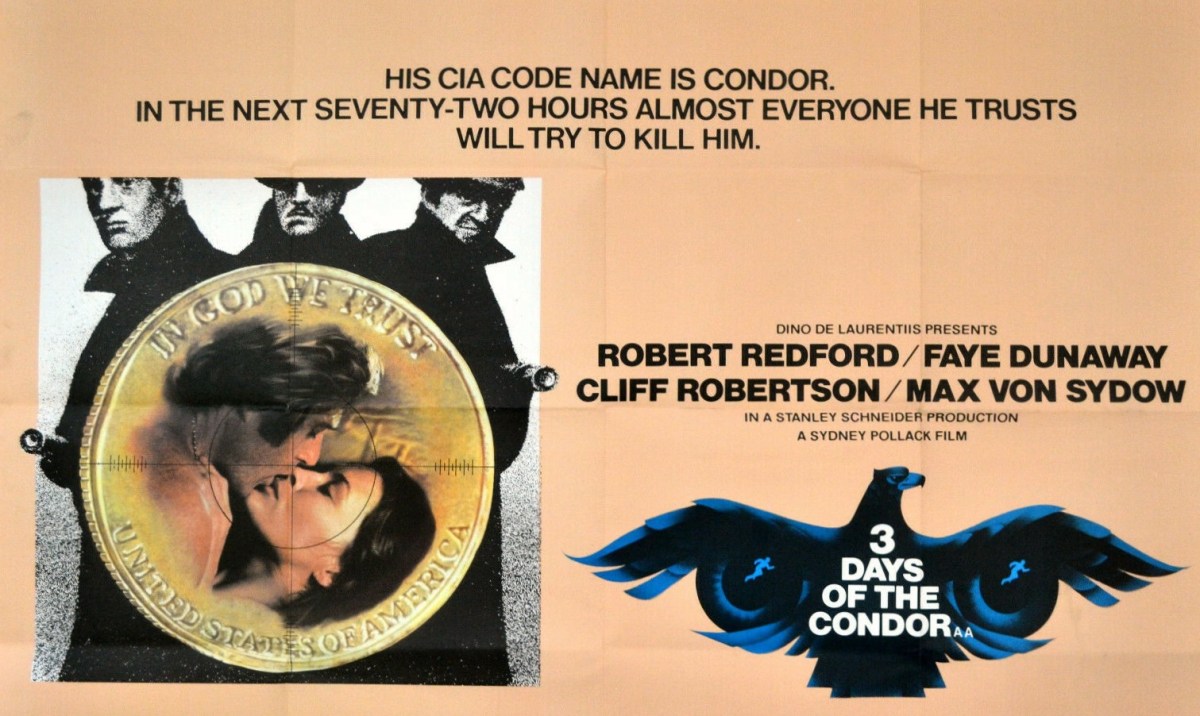
Three Days of the Condor (1975) *****

Outstanding thriller in the paranoia vein with Robert Redford delivering one of his best performances. Never mind the terrific score by Dave Grusin (Tell them Willie Boy Is Here, 1969), the soundtrack to this tale of political chicanery involving the C.I.A. is the chattering of computer printers.

Joe Turner (Robert Redford) is an amiable geek – beanie hat, unfashionable Solex moped – working in an obscure department of the C.I.A. (although one where the receptionist has a gun in her desk drawer) looking for codes in novels. He doesn’t quite conform to type, irritating his rules-conscious colleagues, late for work, illicitly using the back door instead of the front. On returning from collecting lunch, he finds the entire department massacred. His  Washington boss Higgins (Cliff Robertson) promises to bring him in but instead arranges an ambush.
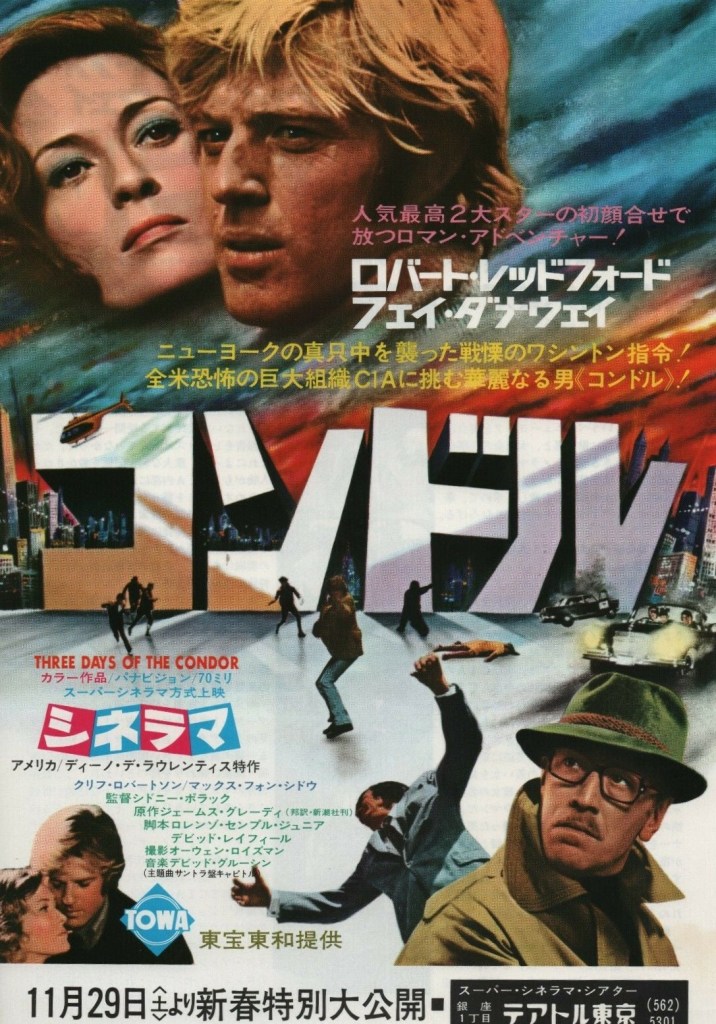
On the run, unable to return to his own apartment, his girlfriend Janice (Tina Chen) among those murdered, he kidnaps photographer Kathy (Faye Dunawaye) at first content to find somewhere to hole up but then using her to help him resolve the issues. It’s soon apparent  that Turner, in his desk job, has stumbled upon a secret organisation deep within the C.I.A. In a touch of the Hitchcocks, director Sydney Pollack (The Scalphunters, 1968) lets the audience know what Turner does not, that Higgins and his bosses Wabash (John Houseman) and Atwood (Addison Powell) are out for his blood, assassin Joubert (Max von Sydow) the triggerman.  

But as Joubert points out, Turner is an amateur and that makes him unpredictable. The killers believe Turner will easily be dealt with. But he’s not as stupid or unresourceful as they might expect. The opening section reveals just how handy he is: fixing a computer, knowledgeable about plants and for some reason the weather, working out an insoluble murder in a book, and most important of all has learned to trust nobody especially his bosses. It turns out he’s got a few of his own tricks up his sleeve, not least how to work a telephone exchange to his advantage and how to flush out his adversaries.

There’s a terrific game of cat-and-mouse and in possibly the only picture in the early cycle of conspiracy pictures the first character capable of harnessing technology.

You often read about character-driven movies but that’s only usually in the sense of dramatic flaws or preferring exploring personality to action. This is character-driven in an entirely different way. Turner’s life depends on him being able to read character, to notice what’s wrong or false in a given situation, to assess the qualities of those around him. For much of the dialogue, Turner is observing as much as listening, watching for behavioural clues.

Even without the presence of Kathy, this would have been a highly satisfactory thriller. But the tentative romance takes it to another level. Unusually, she is a loner, whose photographic metier is loneliness. That they bond at all is surprising, that they do so with such touching emotion brings unexpected intimacy.

There’s a very contemporary feel to the politics, not just American authorities doing what they want but the idea that liberal values will vanish the moment there is genuine threat to loss of the high living standards citizens enjoy or, worse, oil or gas rationing or famine. “Do we have plans to invade the Middle East?” Turner demands of Higgins. And at one point Turner uses unsuspecting people as a human shield.

For such a fast-moving picture, time is taken out to understand the characters involved, Higgins not quite as far up the espionage tree as he should be, Joubert’s hobby the meticulous painting of model soldiers. A peck on the cheek is all the information we are given that Tina, a work colleague, is Turner’s girlfriend.  

As Kathy moves from indignant captive to welcome participant, you can see that she represents the desire of many liberals to give the authorities a bloody nose. There is one brilliant moment at the end where Turner’s fears overcome his feelings and the devastation of what she perceives as emotional betrayal is seen on her face.

But this is Robert Redford’s picture. He was on an almighty box office roll – Jeremiah Johnson (1972), The Sting (1973), The Way We Were (1973), The Great Gatsby (1974), The Great Waldo Pepper (1975) and on the horizon All the President’s Men (1976). Every minute of the movie his face or body are working hard, eyes constantly involved in the character observation I mentioned. He goes from being light-hearted and handsome at the start to serious and deadly at the end. And there are some superb bits of business. When the rain stops, for example, he checks his watch to see it has ended when he predicted. When he returns after lunch, he peers down over the steps to see that his moped that earlier some kids had tried to steal was still there.

This is probably the quietest you’ll ever see Faye Dunaway (A Place for Lovers, 1968). She is an enigma, the puzzle only uncovered in her photographs. But as a photographer, she is also an observer, and she soon likes what she sees in Turner. The strong supporting cast includes Cliff Robertson (Masquerade, 1965), Max von Sydow (The Quiller Memorandum, 1966), John Houseman (Seven Days in May, 1964), Tina Chen (Alice’s Restaurant, 1969) and Addison Powell (The Thomas Crown Affair, 1968).

Sydney Pollack does an exceptional job, cutting between the pursuers and the pursued. The opening sequence itself is quite superb as the director sets up the massacre which is carried out in silence, machine guns fitted with suppressors, while providing insight into Turner. Based on the bestseller Six Days of the Condor by James Grady, the intelligent screenplay by Lorenzo Semple Jr.(Fathom, 1967, and The Parallax View, 1974) and David Rayfiel (Castle Keep, 1969) keeps everyone on their toes.

More straightforwardly enjoyable than Coppola’s self-conscious The Conversation (1974) and Pakula’s occasionally opaque The Parallax View (1974) with computer surveillance, giving this another contemporary edge, a key factor in the way the tale that switches between pursued and pursuer
You can catch this on Netflix.  

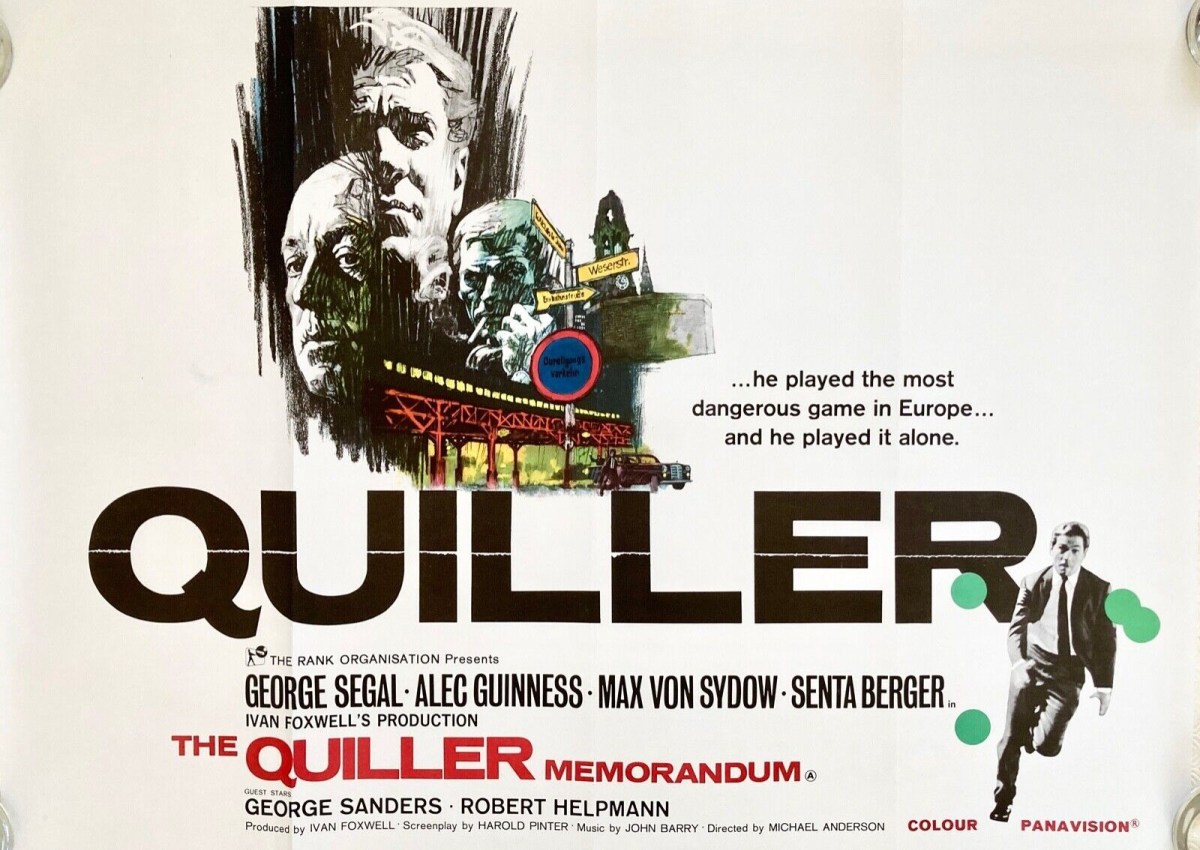
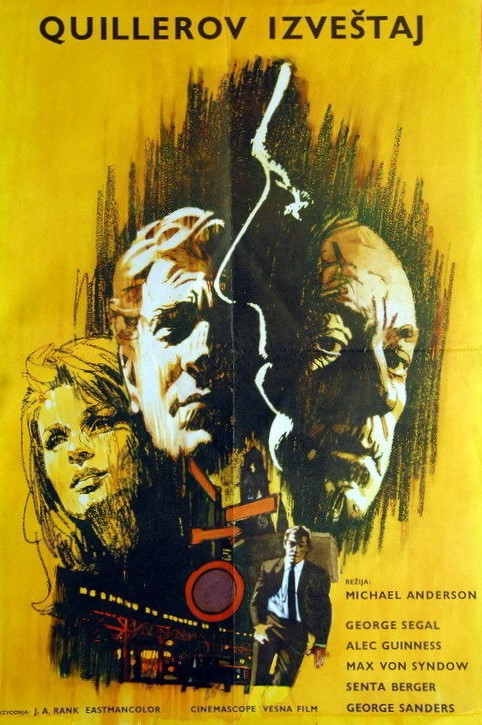
The Quiller Memorandum (1966) ****

The Quiller Memorandum (1966) ****

Stylish cat-and-mouse thriller that fits into the relatively small sub-genre of intelligent spy pictures. George Segal was a difficult actor to cast. He had a kind of shiftiness that lent credibility to a movie like King Rat (1965), a cockiness that found a good home in The Southern Star and an earnestness ideal for Who’s Afraid of Virginia Woolf (1966). But Quiller fit his screen persona like a glove. The part called for charm to the point of smarminess and courage to the point of callousness. A lone wolf for whom relationships were a means to an end, he adopted identities – journalist, swimming coach etc– as the occasion suited.

Quiller’s undercover mission is to expose a neo-Nazi organisation. But just as he sought to discover the location of this secret enterprise, so his quarry was attempting to find out where his operation was based. 

Michael Anderson (The Dam Busters, 1955) had just finished his first spy effort, Operation Crossbow (1966) and that film’s documentary-style approach was carried on here but with a great deal more style. There is consistent use of the tracking shot, often from the point-of-view of one of the protagonists, that gives the film added tension, since you never know where a tracking shot will end. Although the film boasts one of John Barry’s best themes, Wednesday’s Child, there was a remarkable lack of music throughout. Many chase scenes begin in silence, with just natural sounds as a background, then spill out into music, and then back into silence.

But much of the heavy lifting was done by playwright Harold Pinter (The Servant, 1963) in adapting Adam Hall’s prize-winning novel. Hall was one of the pseudonyms used by Trevor Dudley-Smith who wrote The Flight of the Phoenix (1965) under the name Elleston Trevor. The Quiller Memorandum involved wholesale change, from the title (the book was called The Berlin Memorandum) onwards. The book is set against the background of war crime trials; Quiller a British wartime rescuer of Jews now tracking down war criminals; the main female character (played in the film by Senta Berger) had, as a child, been in Hitler’s bunker; and there is a subplot concerning  a bubonic plague; there was a preponderance of obscure (though interesting for a reader) tradecraft; plus the Nazi organisation was named “Phoenix.”

Book jacket for film tie-in for what was originally entitled “The Berlin Memorandum.”

While retaining the harsh realities of the spy business, Pinter junks most of this in favour of a more contemporary approach. Instead of meeting his superior (Alec Guinness) in a theatre, this takes place in the Olympiad stadium. Guinness’s upper crust bosses, played by George Sanders and Robert Flemyng, are more interested in one-upmanship. Berlin still showed the after-effects of the war and Pinter exploited these locales. Senta Berger is an apparently innocent teacher in a school where a known war criminal had worked. And, of course, Segal is an American, not British, drafted in from the Middle East.

But the core remains the same, Segal prodding for weaknesses in the Nazi organisation, the Nazis hoping to reel him in and force a confession from him, Segal planning on roping them in by getting close to them. Despite receiving second-billing Alec Guinness has a minor role, but Max von Sydow as Segal’s adversary more than makes up.

There is still a lot of tradecraft: “do you smoke this brand” (of cigarettes) is the way spies identify themselves; Segal being followed on foot turning the tables on his quarry; Segal poisoned after being prodded by a suitcase; and the use of word associations Segal employs to avoid giving real information. Having flushed out his adversaries, Segal is now dangerously exposed. But that’s his job. He’s just a pawn to both sides. He’s virtually never on top unlike the fantasy espionage worlds inhabited by James Bond, Matt Helm and Derek Flint.

The structure is brilliant. Segal spends most of the picture in dogged bafflement. Guinness at his most supercilious flits in and out. Segal is stalked and stalks in return. There are exciting car chases but the foot chases (if they can be called that) are far more tense. But the core is a bold thirteen-minute interrogation scene where Segal is confronted by von Sydow, head of the shadowy neo-Nazis. And as an antidote to the thuggery and danger to which he is exposed, Segal becomes involved with Senta Berger.

Berger is hugely under-rated as an actress. She was in the second tier of the European sex bombs who came to prominence in the 1950s and 1960s, the top league dominated by Brigitte Bardot, Sophia Loren and Gina Lollobrigida. On screen she is not as lively as those three, but the quiet intensity of her luminous beauty draws the camera in. Here, she is utterly believable as the innocent women who, in falling for Segal, is dragged into his dangerous world.  She was criminally under-used by Hollywood, often in over-glamourous roles such as The Ambushers (1967) or as the kind of leading lady whose role is often superfluous.

Segal is a revelation, grown vastly more mature as an actor after Who’s Afraid of Virginia Woolf (1966) for which he was Oscar-nominated, confident enough to abandon the showy carapace of previous pictures. This is a picture where he sheds layers, from the opening brashness to the sense of defeat in surviving the interrogation ordeal, knowing the only reason he is still alive is to lead the enemy to his own headquarters, buoyed only by inner grit. He hangs on to his identity by his fingertips.

A must-see for collectors of the spy genre.

Discover WordPress

A daily selection of the best content published on WordPress, collected for you by humans who love to read.

The Atavist Magazine

by Brian Hannan

WordPress.com News

The latest news on WordPress.com and the WordPress community.