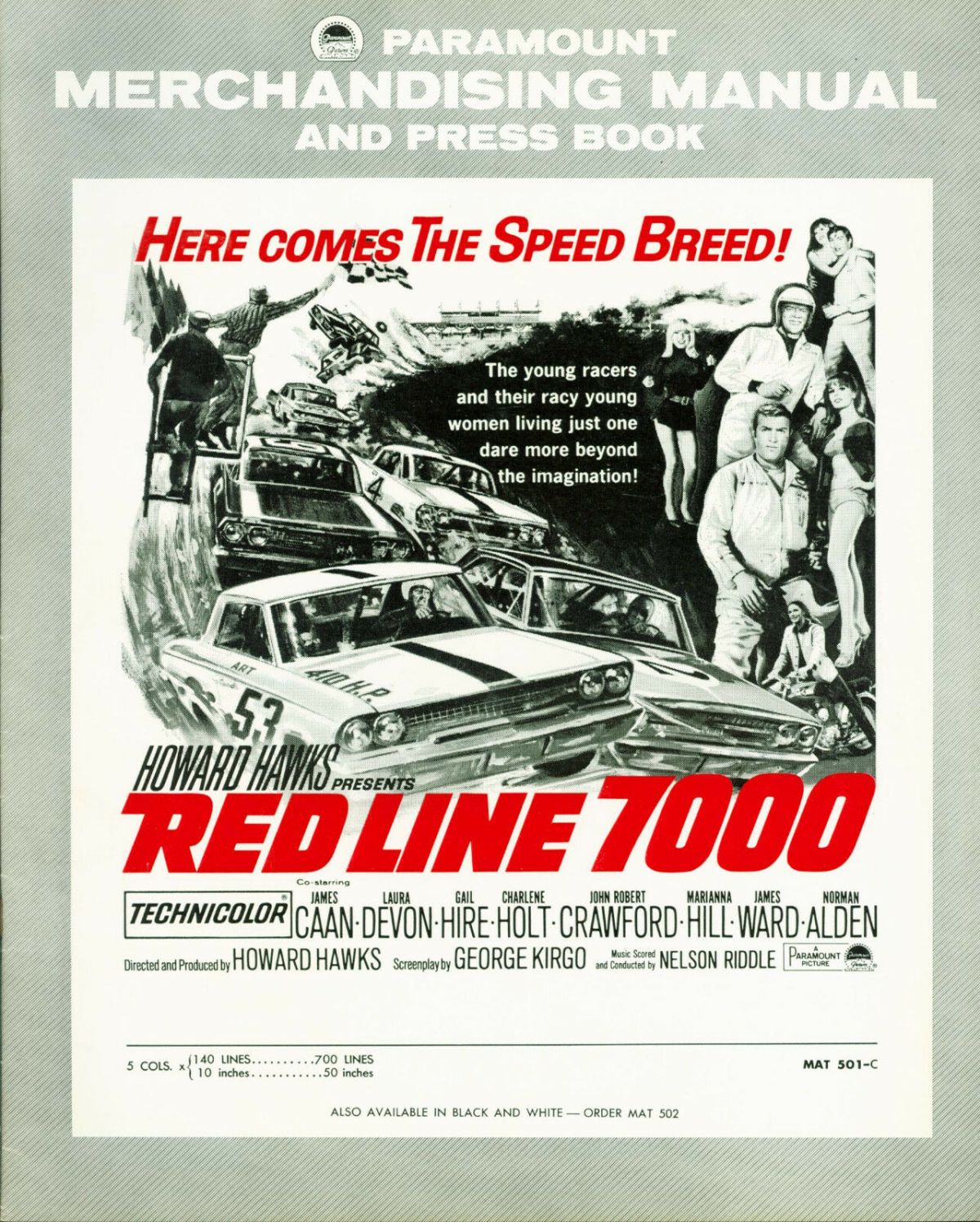
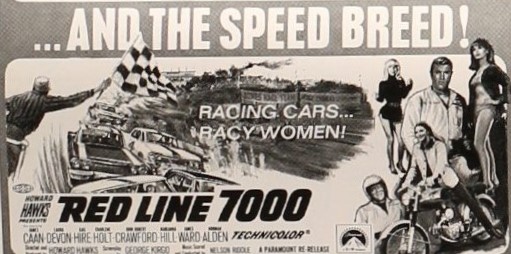
Quentin Tarantino is probably alone in preferring this movie mishap to John Frankenheimer’s Grand Prix (1966) – or I have somehow missed a “cult” picture. There was no doubt director Howard Hawks could handle speed. Check out the action in Hatari! (1962) as jeeps battle across tougher terrain than NASCAR racing circuits. But for some reason, he thought he would get away with interspersing footage of races and spectacular crashes with shots of actors behind the wheel. Any time something exciting is about to happen we’re alerted by the commentator saying “oh oh” or “wait a minute” or “hold it.” There’s none of the feverish excitement or authenticity of Grand Prix.
Hawks hired a no-name cast in a bid a) to become a star-maker, b) to prove he did require the marquee wattage of the likes of John Wayne and c) to show he could make a movie cheaply. He failed on all three counts. He probably didn’t think he was taking any kind of gamble at all, as a man approaching 70, in trying to depict the lives of people around 50 years younger. James Caan, in his sophomore outing, comes out best, but that’s not saying much since he has very little to do except growl and look broody. Marianna Hill (El Condor, 1970) is also believable.
While the racing footage has dated in a way that Grand Prix has not, the main problem is just a jumble of characters getting lost in a jumble of stories. No sooner has one character been introduced than we are onto another. There’s none of the cohesive story-telling that marked out The Big Sleep (1946) or Rio Bravo (1959) and, frankly, none of the characters are particularly interesting. And what possessed him to stick in a song sung by a character (Holly, played by Gail Hire) who cannot sing – she talks the lyrics – with a backing group made up of waitresses, I can’t begin to guess.
The most fun to be had is spotting in bit parts people famous for other reasons. Carol Connors, for example, who co-wrote the lyrics to “Gone Fly Now” (Rocky, 1976) appears as a waitress. As does Cissy Wellman, daughter of veteran director William Wellman. Comedian Jerry Lewis has a cameo. It says much for Hawk’s star-spotting abilities that of two female leads, Laura Devon only made five pictures and Gail Hire just two.
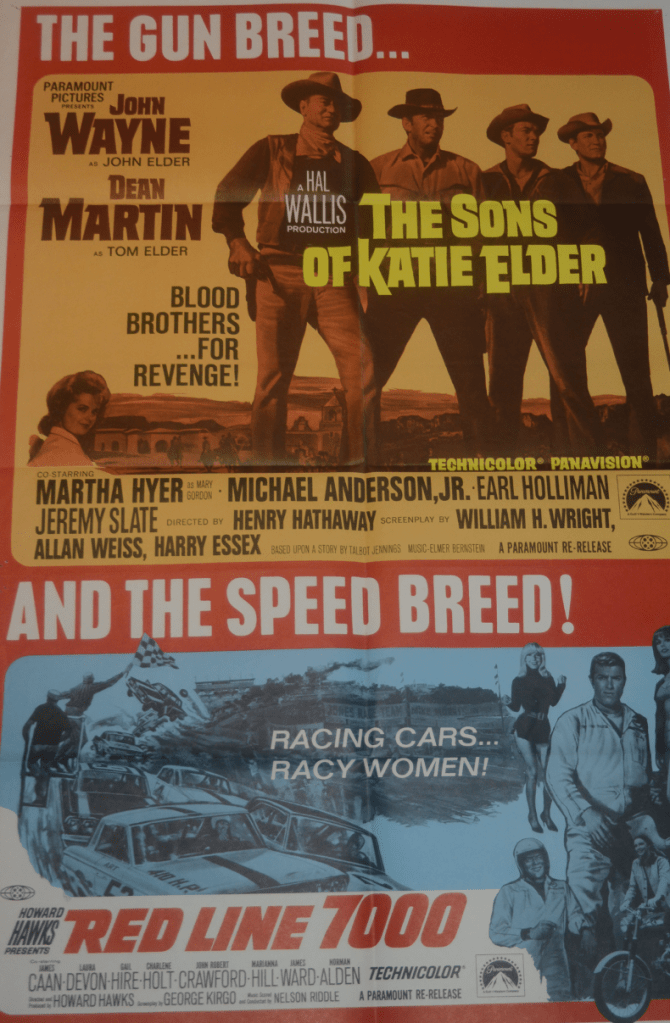
Henry Hathaway and Howard Hawks…Together!
Of the main supporting males, this was the beginning and end of John Robert Crawford’s movie career while Skip Hire made a bigger splash as a producer of television series The Dukes of Hazzard. Co-written by the director, George Kirgo (Spinout, 1966) and Steve McNeil (Man’s Favorite Sport, 1964)..
However, the French had a word for it – “genius.” Despite being dismissed as a rare misstep by the bulk of critics worldwide, Cahiers du Cinema decided it was one of the year’s Top Ten pictures. So what do I know?
Highly under-rated western, directed with some style by a Britisher, bolsters Jim Brown’s marquee credentials and twists and turns every inch of the way. The basic story couldn’t be more cliché: outlaw Luke (Jim Brown), after escaping from a chain-gang, hooks up with gunslinger Jaroo (Lee Van Clef) and his gang of Apaches to steal the gold bullion hidden inside a Mexican fortress.
It just doesn’t work out that way. Any time a cliché rears its ugly head, director John Guillermin (The Blue Max, 1966) treats it as narrative obstacle and finds a neat way round it. Luke’s attitude doesn’t help either. Looking at a woman the wrong way, not showing Apaches sufficient respect, failing to rein in his larcenous partner, all lead to trouble. But at the right time and the right place, the pair show – almost show off – their respective skills, permitting escape when necessary and finding a way into the citadel.
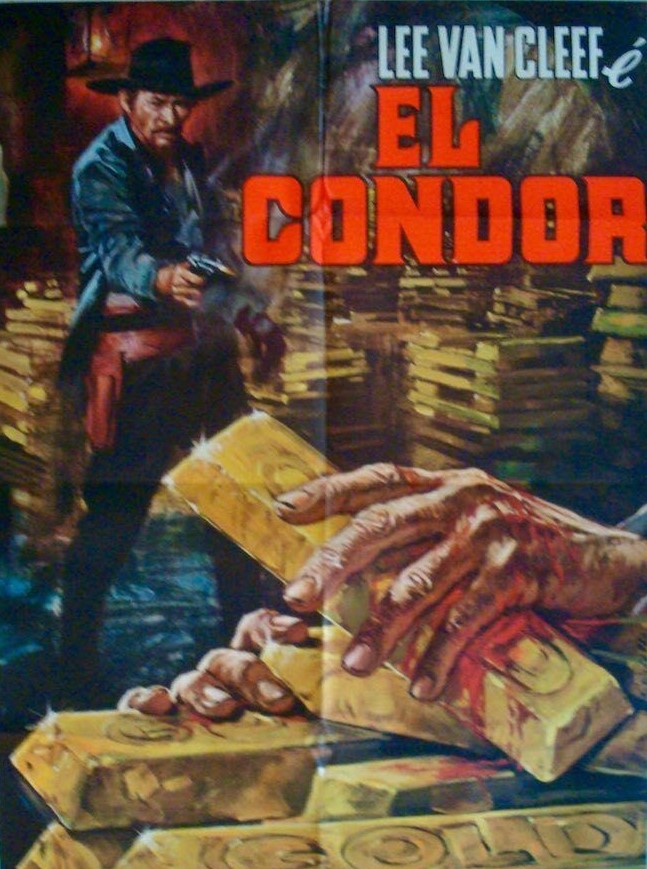
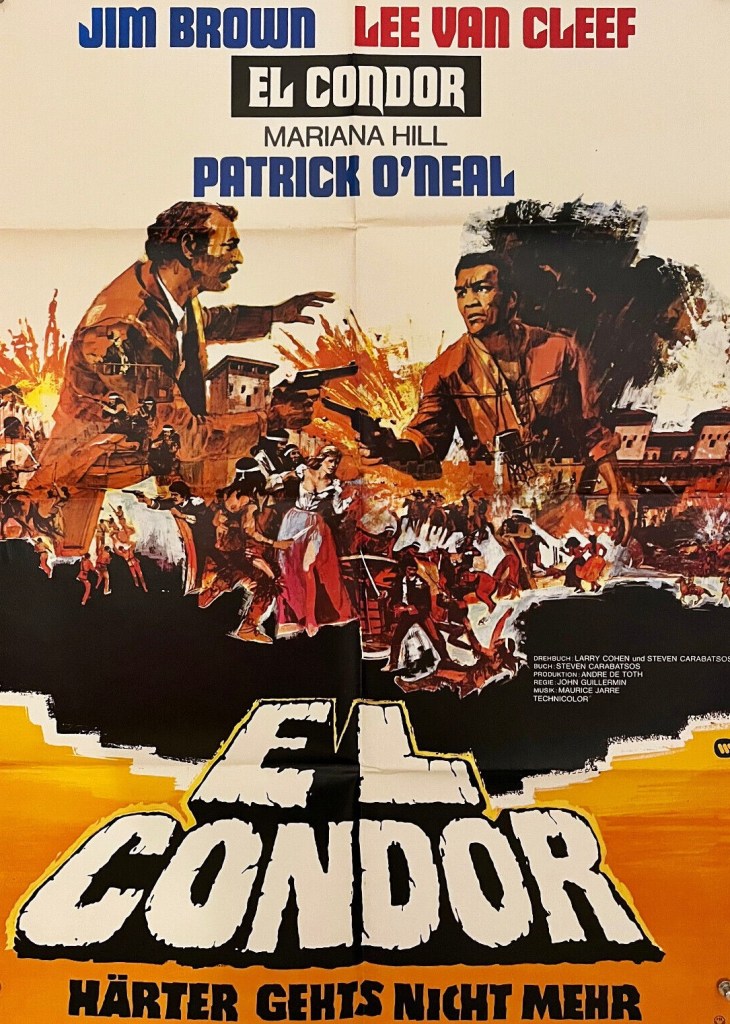
Lee Van Cleef takes top billing in the Italian poster which adopts a more thematic approach than the normal action-oriented marketing.
Did I mention there was a bullfight with fort commander Chavez (Patrick O’Neal), wielding a saber, dancing around the animal on horseback, or that at one point Luke becomes the bull substitute. Or that, in the picture’s most notorious scene, shades of Raquel Welch taking an impromptu shower in 100 Rifles (1969), the invaders are helped by Chavez’s disgruntled mistress Claudine (Marianna Hill) distracting the defending soldiers by disrobing.
And, though minus such distractions, this is probably where the white walkers in Game of Thrones learned to scale a mighty wall. Even so, it’d be a pretty big ask to infiltrate a fortress almost medieval in its construct with an outer and an inner wall, so Luke evens the odds by subjecting the inmates to involuntary thirst, having destroyed their water tower and poisoned all nearby wells.
Given the heist involves gold, it’s no surprise that the weaselly Jaroo is overcome by greed, taking any opportunity to help himself to more than his fair share, encouraged of course by the even wilier Chavez who has the measure of the potential thief. Luke might have been cautioned about entering into a partnership with such a character after witnessing a couple of Jaroo’s schemes backfire. In one of them, in just about the cleverest and most audacious cut you will ever see, we go from Jaroo in a store stuffing illicit goods under his coat to the pair emerging tarred and feathered from a pond.
And this ain’t The Dirty Dozen, nobody appears to understand a command structure, or even stick to orders, Apache chief Santana (Iron Eyes Cody), left to his own devices, liable to attack a wagon train despite that giving due warning of their presence in the vicinity. But then Luke doesn’t show due respect either, resulting in the pair being staked to the ground in the boiling sun, and finding it impossible to dislodge an Apache clinging to his back.
As you might expect, it’s a bloody affair, but without dwelling on gore, none of the visceral exploding body parts of The Wild Bunch (1969). And there is a surprisingly touching moment when, shades of Charles Bronson in The Magnificent Seven (1960), the hard-nosed Jaroo bonds with a young boy on the grounds that they are both illegitimate and parts with one of his two precious gold nuggets to give the child a start in life.
Harsh reality intrudes. Unspoken racism on the part of Chavez sets him against Luke. And that women are prizes of war provides an uneasy undercurrent. Claudine is Chavez’s lover because he offers safe haven, a security not afforded other Mexican woman, forcibly parted from husbands to provide soldiers with sexual playthings.
Jim Brown (100 Rifles) and Lee Van Cleef (The Good, the Bad and the Ugly, 1967) are an inspired teaming, both playing against type, incurring more laughs than you might expect, and less inclined to play their previous stock characters, the former just a tough guy, the latter a ruthless professional. Patrick O’Neal (Stiletto, 1969) is a formidable opponent, perfectly capable of outwitting the more easily-duped Jaroo.
Despite, perhaps unfairly being remembered more for her nudity than her acting, Marianna Hill (Medium Cool, 1969) exhibits vulnerability as well as a tough core. Iron Eyes Cody (Nevada Smith, 1966) has a very refreshing take on an Apache war chief. And you might spot British starlet Imogen Hassall (The Long Duel, 1967) and veteran Elisha Cook Jr (Welcome to Hard Times, 1967).
But this movie really belongs to director John Guillermin who takes a fairly routine western and turns it on its head, extracting reversals at every opportunity, and clearly delighting in the several twists in the tail. Larry Cohen (Daddy’s Gone A-Hunting, 1969) and in his movie debut Steven Carabatsos (The Revengers, 1972) wrote the screenplay and the presence in the producer’s chair of Andre de Toth (Play Dirty, 1968) might account for some of the movie’s subversiveness.
There’s a historical footnote to El Condor. In a revision of the certificates issued by the censor, the British Broad of Film Classification in 1970 introduced the “AA” certificate, permitting people aged over 14 to view material that would previously have been restricted to the X-certificate. Admission to that category was raised to 18. So for a whole generation of teenage boys, hormones going wild, the first glimpse they had of a naked woman was in El Condor. (In the US it was an “R”.)
Not only well worth seeing but free to view on YouTube.
And when that source dries up you can find it on the Warner Archive.
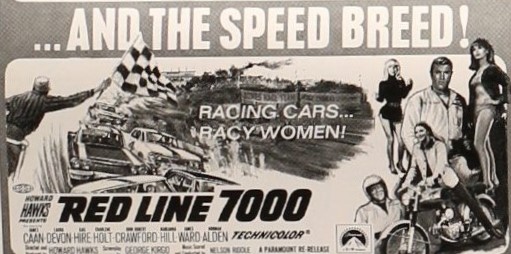
Quentin Tarantino is probably alone in preferring this movie mishap to John Frankenheimer’s Grand Prix (1966) – or I have somehow missed a “cult” picture. There was no doubt director Howard Hawks could handle speed. Check out the action in Hatari! (1962) as jeeps battle across tougher terrain than NASCAR racing circuits. But for some reason, he thought he would get away with interspersing footage of races and spectacular crashes with shots of actors behind the wheel. Any time something exciting is about to happen we’re alerted by the commentator saying “oh oh” or “wait a minute” or “hold it.” There’s none of the feverish excitement or authenticity of Grand Prix.
Hawks hired a no-name cast in a bid a) to become a star-maker, b) to prove he did not require the marquee wattage of the likes of John Wayne and c) to show he could make a movie cheaply. He failed on all three counts. He probably didn’t think he was taking any kind of gamble at all, as a male approaching 70, in trying to depict the lives of people around 50 years younger. James Caan, in his sophomore outing, comes out best, but that’s not saying much since he has very little to do except growl and look broody. Marianna Hill (El Condor, 1971) is also believable.
While the racing footage has dated in a way that Grand Prix has not, the main problem is just a jumble of characters getting lost in a jumble of stories. No sooner has one character been introduced than we are onto another. There’s none of the cohesive story-telling that marked out The Big Sleep (1946) or Rio Bravo (1959) and, frankly, none of the characters are particularly interesting. And what possessed him to stick in a song sung by a character (Holly, played by Gail Hire) who cannot sing – she talks the lyrics – with a backing group made up of waitresses, I can’t begin to guess.
The most fun to be had is spotting in bit parts people famous for other reasons. Carol Connors, for example, who co-wrote the lyrics to “Gonna Fly Now” (Rocky, 1976) appears as a waitress. As does Cissy Wellman, daughter of veteran director William Wellman. Comedian Jerry Lewis has a cameo. It says much for Hawk’s star-spotting abilities that of two female leads, Laura Devon only made five pictures and Gail Hire just two. Of the main supporting males, this was the beginning and end of John Robert Crawford’s movie career while Skip Hire made a bigger splash as a producer of television series The Dukes of Hazzard.
However, the French had a word for it – “genius.” Despite being dismissed as a rare misstep by the bulk of critics worldwide, Cahiers du Cinema decided it was one of the year’s Top Ten pictures. So what do I know? Make up your own mind – catch it on Amazoon Prime.



 The Magnificent 60s