
Babylon (2022) **** – Seen at the Cinema

Wild raucous’n’roll rollercoaster that, contrary to expectation, I found totally absorbing, length not an issue. Employing a simple structure of rise and fall, and exploring the upside and downside of Hollywood in the transition from silent to sound, it seemed to me in essence to capture movie-making. A Broadway play could be a hit if seen by 100,000 people, that size of audience constituting a flop for a movie, but the play was viewed by 100,000 of the “right” people, the moneyed elite who could afford the tickets, a movie by the flotsam and jetsam that made up the majority of the American population even when, theoretically, the country was going through the boom times of the “Jazz Age.”

Most films and books concentrate on the downside, the battle to get to the top, the seamy undercurrent, the inevitable collapse, but none capture the giddy heights like this. Silent movies were viewed primarily as technical, nobody had to even talk, much less learn lines or spout Shakespeare. Initially, the stars were drawn from vaudeville so had some proven talent but then it was clear anyone could become a star, such as here Nellie LaRoy (Margot Robbie), or a producer like Manny Torres (Diego Calva) by simply being in the right place at the right time, initiating a gold rush to Los Angeles.

Just as there is no single reason for the camera and audience to turn a person into a star, the same applies when they fall out of favor. In a movie thankfully given little to long lectures on filmmaking beyond aspirations to “form” and wanting to do something good, the best explanation about how/why careers end is delivered in dry tones by columnist Elinor St John (Jean Smart) to disillusioned out-of-favor Jack Conrad (Brad Pitt).

The narrative shuttles between Conrad, LaRoy and Torres, interweaving the lives of trumpet player Sidney Palmer (Jovan Adepo),  Conrad’s multiple wives, LaRoy’s hapless father (Eric Roberts), director Ruth Adler (Olivia Hamilton) studio wunderkind Irving Thalberg (Max Minghella), publishing magnate William Randolph Hearst (Pat Skipper), gangster James McKay (Tobey Maguire) and imperious director Otto (Spike Jonze). Excess is the name of the game whether ostentatious consumption Hollywood-style or the more sedate black tie dinners of caviar and lobster enjoyed by the elite.

The elite looked down their noses on a new class of wealthy individuals who were ill-educated, didn’t talk proper, but had struck gold simply from being able to stand in front of a camera without being able to tell their Ibsen from their Shakespeare and didn’t understand art. 

Surprisingly, this is a pretty good comedy, slapstick sometimes but excelling at setting up visual jokes, though audiences might recoil from a rare reliance on elephant ordure and vomit. Some scenes are pure standout: Nellie’s first talk scene where the sound engineer has tyrannical control; Nellie’s fight with the snake; Manny’s race to find a camera before the director loses the light; the uncontrolled venom of battle scenes; the black Sidney not black enough; and of course the various wild parties although nothing in the Hollywood imagination could match the depravity of one where Manny is the unwilling guest of gangster McKay, as if fiction cannot match reality.
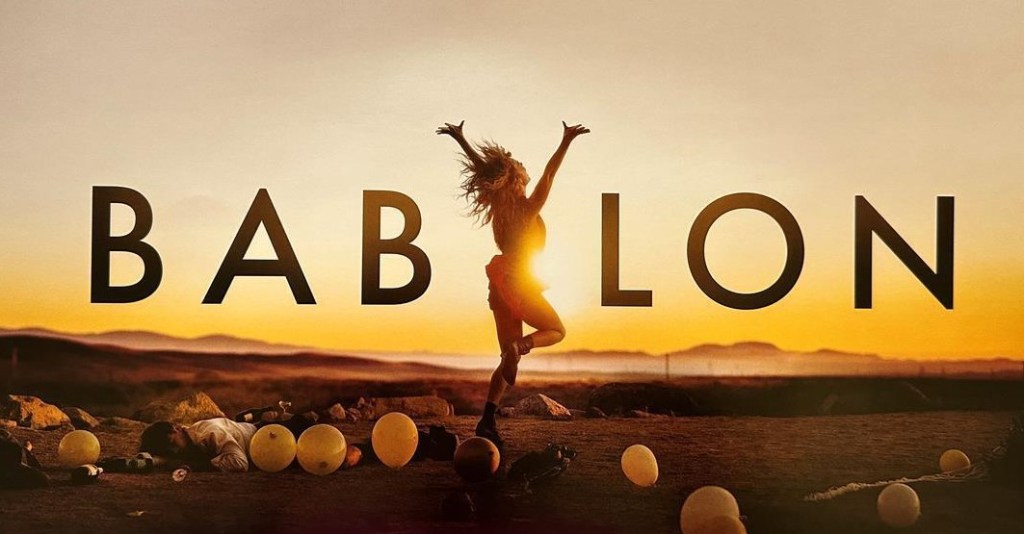
Of course, people who have everything rarely know what they actually want and spend their lives throwing away what they have in pursuit of the unattainable, so Conrad is apt to view wives as disposable, Nellie finds relief in drugs and gambling, Manny’s obsession with Nellie which should lead to ruin paradoxically by happenstance brings him happiness. The rampant unchecked hedonism that runs through the picture could well just be a metaphor for the helter-skelter modus operandi of the movies, enjoy it while you’re hot, cram in as much as you can, because, heaven knows, something from left field (sound, for example) could dramatically upend everything.

Brad Pitt (Bullet Train, 2022) is very good as the often drunk but generally streetwise star. You can hardly take your eyes off Margot Robbie (Amsterdam, 2022), not just for her brazen sexuality, but her ability to cry on cue, awareness of her self-destructive personality, inherited from self-destructive parents, greedy idiotic father, mother committed to an upmarket mental institution. Diego Calva (Beautiful Losers, 2021) is good in a less showy part. Interesting cameos abound.

This has the intensity of Damien Chazelle’s Whiplash (2014) rather than the cleverness of La La Land (2016).

I mentioned in my review of Tar that it could have done with a stronger producer to cut down on the running times and some elements I felt were bound to alienate audiences. I would make the same suggestion here, though not so forcefully. Elephant shit and urination are always, I reckon, going to be a major turn-off for audiences. While I had no trouble with the length, that’s clearly been an issue and it would hardly be a problem for a decent editor to snip chunks out of party scenes or eliminate non-essential characters.

Emotionally and artistically this seems to me to capture the essence of the formative days of Hollywood before the double whammy of the Great Depression and the Hays Code brought about a systematic rethink with studios insisting their stars take more care hiding their proclivities from general view.

Ignore the reviews and check it out.

Amsterdam (2022) **** – Seen at the Cinema

Shaggy dog story wrapped up in paranoia thriller. A shade overlong, with too many characters and too much plot but such flaws should not detract from that rare cinematic animal, a truly original movie. Brilliant screenplay, believable characters and superb acting prove an irresistible combination.

Though you can see why this sank like a stone at the box office, the all-star cast generally acting against type, idiosyncratic director given vast sums to play with, a tale that goes in too many directions at once, and the unconstitutional events of January 6, 2021, bringing this too close to home for fractured American audiences.

You don’t get this kind of writing much anymore. When individuals come together on a project – to save the world the most likely reason these days – their individuality is usually subsumed to the plot. Here, instead, the reactions of the characters remain distinct and no matter what is going on there is always time for individuality. And some of the invention is just deliciously insane, the nonsense songs for example.

Touching on the World War One aftermath of recovering from mental and physical wounds plus profiteering glee, a sense of a country racked by the Depression on the brink, mind-inducing experimentation of the political and pharmaceutical kind. A trio of war veterans, soldiers Burt (Christian Bale) and Harold (John Davidson Washington) and nurse Valerie (Margot Robbie) investigate a mysterious death, an illegal autopsy uncovering poison, only to find themselves framed for murder.

Burt is not a prime-time player according to wife Beatrice (Andrea Riseborough), and her wealthy family had dispatched him to the war in the hope he would return with bankable glory, but generally treat him as an unwanted black sheep. Valerie now makes art out of war debris, bullet shells and shrapnel, her charming brother Tom (Rami Malek) and his wife Libby (Anya Taylor-Joy) embedded in malevolence. Harold is a lawyer, for whom racism is a constant.

American and British secret service operatives, Norcross (Michael Shannon) and Canterbury (Mike Myers), float in and out. The moneyed business elite, despising White House incumbent Roosevelt, cast envious eyes at the dictatorial economic miracle of Mussolini in Italy.

On everyone’s dance card is General Dillenbeck (Robert De Niro), sought out by our intrepid trio and a mysterious cabal. All he has to do is make a speech at a veteran’s dinner. Make the right kind of speech and the trio are vindicated. Make the wrong kind and he could be assassinated.   

Like Chinatown (1974), Amsterdam is representative, a state of mind, but of freedom rather than endemic corruption. This is an intricate piece and a bit slow for today’s fast-paced generation and with more dialog than might sit well with a modern audience and flights of fancy that are far more original than anything you would find in the MCU. But it’s a hell of an intelligent thriller driven by a bunch of deadbeats.

It never goes down the obvious route. Instead of a love triangle – Valerie and Harold a pair – it’s an evocation of friendship. You don’t need umpteen clues to find the villains, they’re upfront, and they don’t think they are baddies, but cleverer people coming to the aid of the dumb masses putting too much blind faith in democracy. While this is based on a true story, in reality it’s based on the constant of the rich trying to get richer and the wealthy believing they are the best, even if unelected, candidates to run the world.

All that political stuff could have been a big turn-off if it had gone down the preachy route, but it doesn’t, instead it’s almost a miracle that it arrives at any conclusion given in whose hands the narrative has been placed. The Three Stooges would have done a better job of getting there quicker, but then you wouldn’t have had so much fun.

Not only are all the stars on their A-game but acting-wise it delivers some career-reviving turns not least from Christian Bale (Ford v Ferrari, 2019), devoid of a lifetime’s acquisition of irritating tics, John David Washington (Tenet, 2020) called upon to develop a character rather than an action-driven hero. I had to check the end credits to find out it was Mike Myers (Bohemian Rhapsody, 2018) playing the understated Canterbury and hogging the screen with none of the acting pyrotechnics that dogged previous attempts at mainstream work. Ditto Robert De Niro (The Irishman, 2019) and Rami Malek (Bohemian Rhapsody), no grandstanding this time round – don’t worry I recognized both from the off – and Anya Taylor-Joy finally delivering on the promise of The Queen’s Gambit (2020).

Margot Robbie (The Suicide Squad, 2021) is already on the rise and this will add to her growing portfolio of fascinating characters. And if you’re fed up watching any of these stars in brilliant form, there are other distractions in the form of Chris Rock (Spiral, 2021), Taylor Swift (Cats, 2019), Andrea Riseborough (The Electrical Life of Louis Wain, 2021) and Alessandro Nivolo (The Many Saints of Newark, 2021).

You often hear the term “visionary director” thrown about with indiscriminate regard, but this is the right kind of visionary, director David O. Russell (Joy, 2015) with his own way of seeing the world, and delivering it in distinctive fashion, with less of an eye on camera movement and more on dialog and motivation and staying true to a coterie of original individuals.  

I guess the money was spent on atmosphere, this is 1930s USA regurgitated in enormous detail. But you’ll forget the background, the costumes and sets, and be dazzled instead by the script and the acting, and the enveloping tale of friendship.   

Discover WordPress

A daily selection of the best content published on WordPress, collected for you by humans who love to read.

The Atavist Magazine

by Brian Hannan

WordPress.com News

The latest news on WordPress.com and the WordPress community.