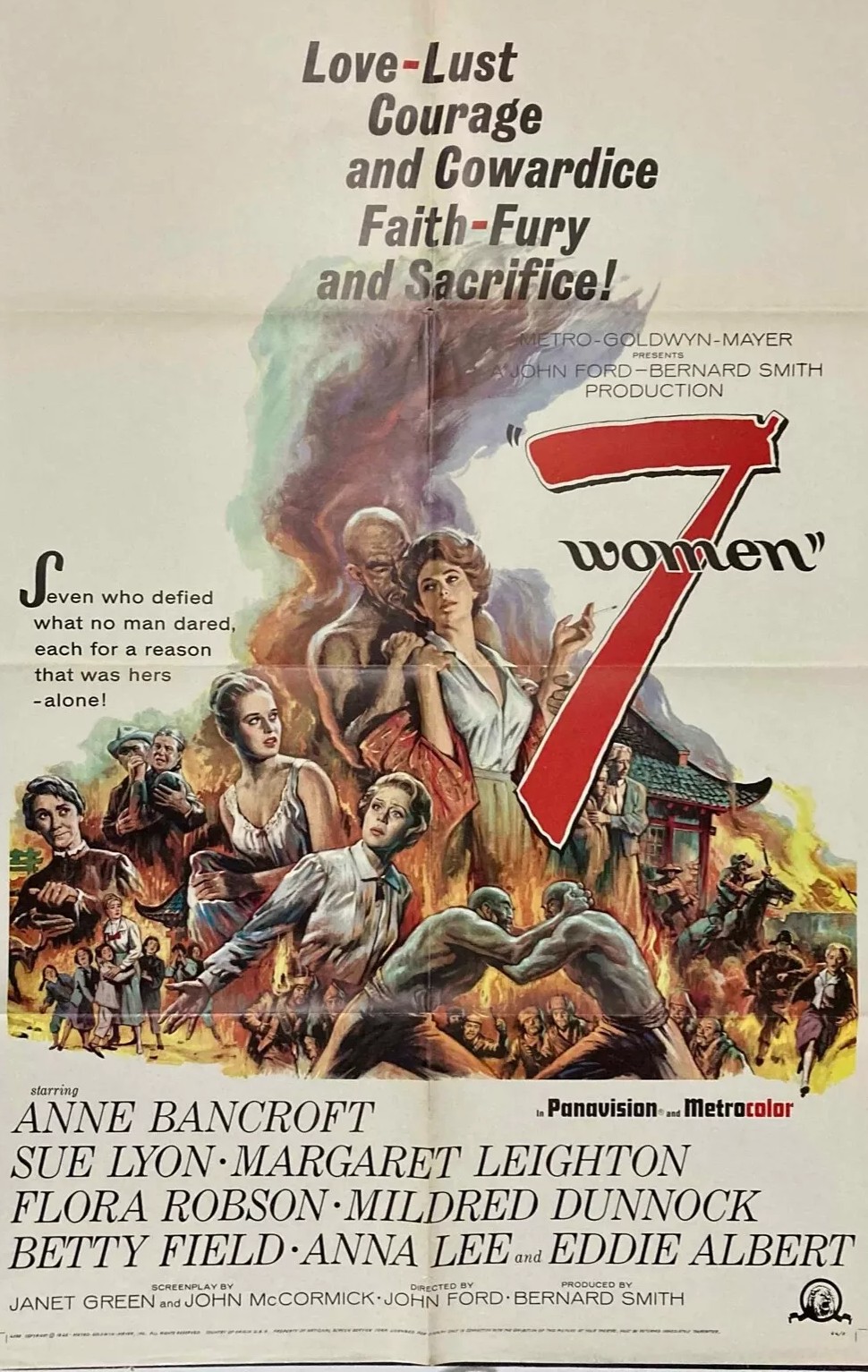
7 Women (1966) **

This is a very difficult review to write. John Ford has been one of my idols and to some extent when I first became interested in the movies I was force-fed the director, who was considered at the time to be a demi-god. While he has moved up and down in terms of critical acclaim, his westerns have stood the test of time, The Searchers (1956) still considered one of the best ever made and The Man Who Shot Liberty Valance (1962) fast challenging that dominance.

When he made westerns, he tended to be on safe ground. For other genres, acceptance was more fleeting. I can’t be the only one who was appalled by Gideon’s Day (1958) and found The Last Hurrah (1959) somewhat ho-hum and took Donovan’s Reef (1963) with a large pinch of salt. Even so, it’s with some regret that I have come to the conclusion that his final film, 7 Women, falls not just short of the high standards he set but is a poor picture.
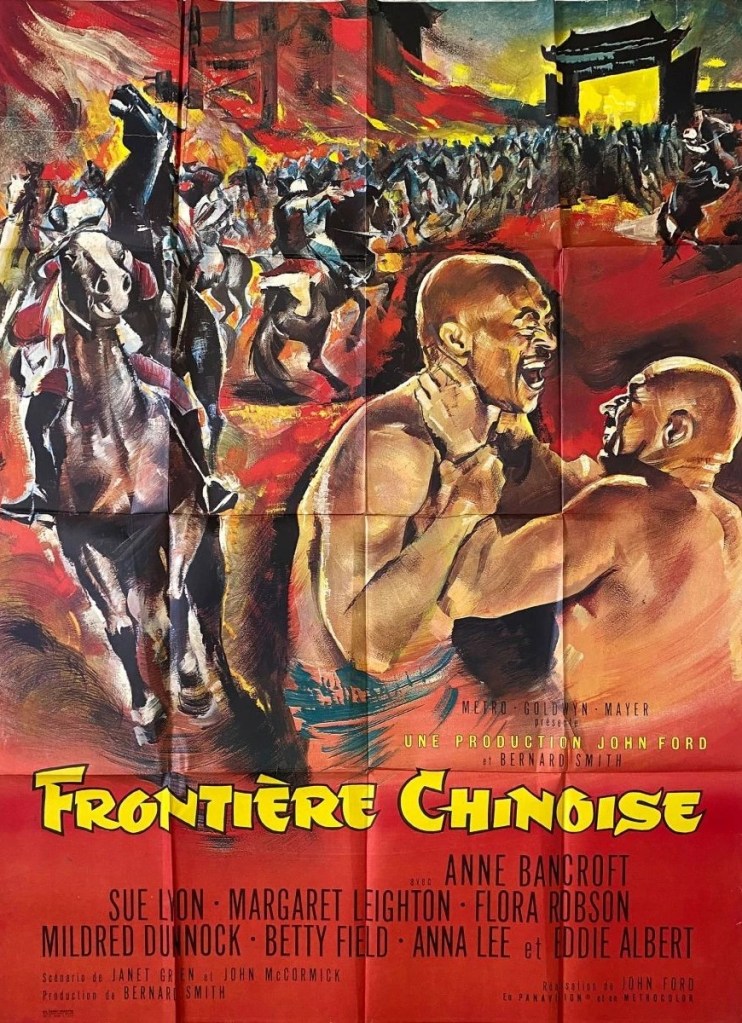
You have to wonder if he was still on the redemption streak that fueled Cheyenne Autumn (1964) and wanted to make amends for by and large reducing women to also-rans in his movies. There are some plus-points. It takes a rawer view of the Chinese missionary movie, this one set in 1935, not just the notion that Chinese rebels would not dare attack Americans but also that such establishments major on the pious and the gentle.

But in turn the constant bitching between the virtually all-female cast turns this into a glorified soap opera. There’s a constant battle between incoming heavy drinking free thinker  Dr Cartwright (Anne Bancroft) and prim mission chief Agatha Andrews (Margaret Leighton) whose management style errs on the dictatorial. Cartwright is upbraided for smoking at dinner, bringing booze to the table, not standing for Grace, and worse of all, it would appear, having had sex. While there were further penalty points for taking a married man as her lover, it’s the mere notion of anyone having sex that sets off the over-pious Andrews.

Setting a new bar in the entitlement stakes is pregnant Florrie Pether (Betty Field) who’s coming very late to motherhood – she’s 42 – and was so determined to have a baby it was conceived with two months of marriage to ineffectual second husband Charles (Eddie Albert)  and takes to the extreme the idea of pregnancy stimulating odd food needs – in the middle of nowhere in the middle of China she demands melon.
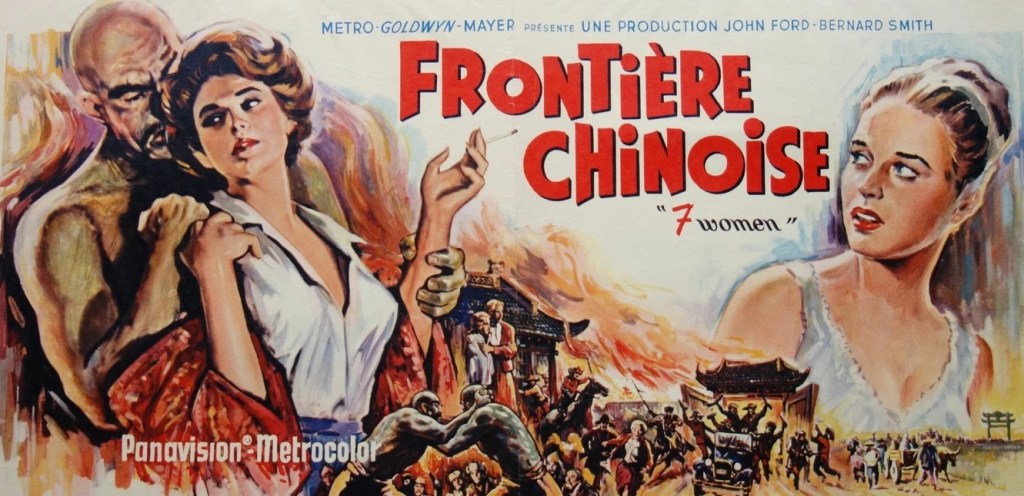
Added into the mix is that standard trope of the Chinese missionary picture, an outbreak of cholera. Mrs Pether can’t come to grips with the notion that the good doctor might have to concentrate on saving patients from plague rather than come running every time the pregnant gal feels the foetus kick.

So while Andrews and Cartwright are scoring points off each other, with the doctor further accused of corrupting the innocent young Emma Clark (Sue Lyon), outside pressures, introduced during the credit sequence but then left alone for way too long, grow. Chinese bandits are on the rampage. Another mission of a rival denomination led by Miss Binns (Flora Robson) turns up seeking refuge and eventually the bandits charge into the compound and demand ransom.

Naturally, such an invasion is going to get in the way of imminent birth, and while Andrews falls to pieces at the thought of sex producing an actual “brat”, it’s left to Cartwright to negotiate with the bandits. In return for cooperation, bandit chief Tunga (Mike Mazurki) demands sex with Cartwright. While such sacrifice only triggers further contempt and denunciation from Andrews, it does provide the other women with free passage out.

Cartwright, left behind, poisons the bandit chief and commits suicide.

There’s a heck of a lot of talk, which seems rather alien to Ford, who directs as if he’s fashioning a stage play rather than a movie, characters arranged almost in a series of tableaux. And the lighting and general atmosphere would have you believe you were watching a western rather than something set thousands of miles away.

 Anne Bancroft (The Slender Thread, 1965) looks as if she’s strolled in from a western or a film noir with her tough talking stance and cigarette perpetually dangling and all those slugs from a bottle. Margaret Leighton (The Best Man, 1964) overplays the nervous breakdown and Betty Field (Coogan’s Bluff, 1968) is too often in a lather, as if they are in a hysteria competition. Sue Lyon (The Night of the Iguana, 1964) isn’t given enough to do. The other women, since we’re counting, include a more self-aware Flora Robson (Young Cassidy, 1965), Mildred Dunnock (Sweet Bird of Youth, 1962) and Anna Lee (In Like Flint, 1967). Written by the team of Janet Green and John McCormick (Victim, 1961) from the Norah Lofts short story.

Given John Ford went to extremes to place the Native Americans who had so often played the bad guys in his movies in a better light in Cheyenne Autumn, it seems odd he has reverted to instinctive racism here. There’s no suggestion that the bandits might be trying to win their freedom and they are often referred to as degenerate and by that awful epithet regarding their supposed color of “yellow.”

And it’s about time that revisionism was applied to the notion that Christianity had any right to be invading a country that had its own long-established traditions of religion and worship.

Has more of the feel of a Tennessee Williams text gone badly wrong than a John Ford number. Not the swansong the director deserved.
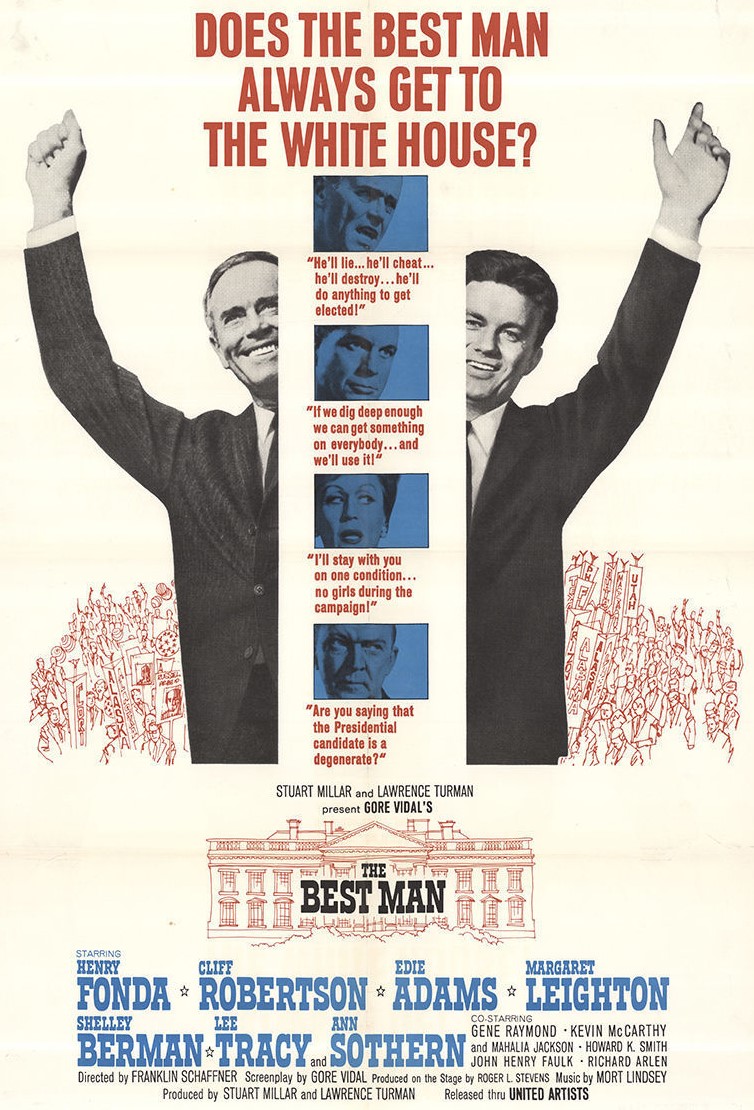
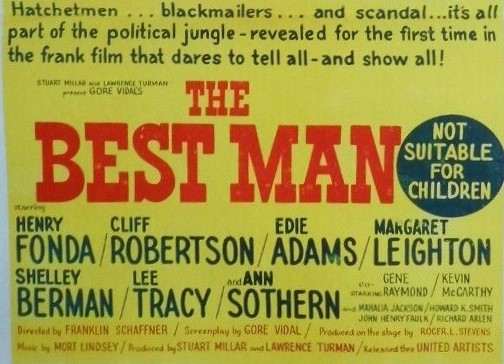
The Best Man (1964) ****

Current openness towards mental health issues has bestowed a contemporary vibe on this lively political drama. The other topic raised here has long ceased to be controversial. Not that far removed from Otto Preminger’s Advise and Consent (1961) in terms of dirty dealing and horse trading, flaw is the weapon used to cut opponents down to size.

The two principal candidates seeking their (un-named) party’s Presidential nomination could not be further apart, William Russell (Henry Fonda) a rich intellectual, Joe Cantwell (Cliff Robertson) a self-styled man of the people. Cantwell chases the populist vote with a  campaign built on fulminating against immigration and Communism, driving down taxes and spending more on the military. Russell seems unsuited for the cut-and-thrust of politics, too idealistic, too indecisive.

But he is a good judge of character whereas Cantwell most decidedly is not and in misreading the intentions of President Hockstader (Lee Tracy) shoots himself in the foot and leaves the nomination wide open, triggering his use of the dark arts, planning to circulate a file on his opponent’s problems with mental illness. Existing on a much higher plane, Russell refuses to fight back, although he has access to a witness claiming Cantwell was gay.

Apart from discussing these taboo issues – this was the first time the word “homosexual” was uttered in a movie – what’s interesting is that Russell’s philandering is not deemed damaging as long as his wife Alice (Margaret Leighton) is seen to publicly stand by him. Despite the fact that Cantwell is as clean as a whistle – doesn’t drink or smoke or have a lover – affairs are seen as such a fact of life of politics that Cantwell’s wife Mabel (Edie Adams) assumes he will have one. Cantwell, very much one to go for the jugular, clearly believes the public takes the same non-judgemental view otherwise he would easily skewer Russell on his marital discord.

In some respects, Cantwell is by far the better candidate if you were to judge him on personal behaviour, but he lacks the necessary savvy, “ a tragedy in a man and a disaster in a president.

As you might expect from a script written by novelist Gore Vidal, sometime political heavyweight, there are plenty zingers: “expect 22 minutes of spontaneity”; “I don’t object to you being a bastard, I object you being a stupid bastard;” and “I won’t throw my mud if you won’t throw your mud.”

It may be artistic irony that determined director Franklin J. Schaffner to film in black-and-white since politics is nothing but various shades of grey, but there was probably a more practical reason, to incorporate footage from conventions.

Somewhat surprisingly, both men are honest with their wives, Russell making a pact to divorce Alice if not elected, their marriage long ago defunct, while Cantwell’s wife is fully aware of the slur on her husband’s name. The women here are well-drawn, not quite the submissive types you might expect, certainly not Alice who has every right, given his infidelities, to act the shrew, instead of which she plays the shrewd card. Mabel proves a loving wife but a little indulged to the extent her teetotal husband has no idea how much alcohol she can shift and she reserves her right to keep him waiting. Alice, it might be noticed, is more vicious than her husband should it come to the down-and-dirty.

And there’s a stack of wannabe power-makers from pushy busybody Mrs Gamidge (Ann Sothern) – so full of her own importance that she fails to see the slight in being told that “talking to you is like talking to the average American housewife” – to walking timebomb Sheldon Bascomb (Shelley Berman).

Not so full of arcane American politics as Advise and Consent, and with a more straightforward narrative, it digs the dirt in compulsive fashion on the dirt-diggers. In questioning whether someone with mental health issues could be a worthy national leader, the movie naturally ignores the narcissism and megalomania that seemed essential criteria for any person achieving high office or excessive business success. It’s probably a subject that remains unresolved, although a good many personalities have admitted to such problems.

Cliff Robertson (The Honey Pot, 1967) takes the acting honours if only because we have seen a version of the Henry Fonda (Battle of the Bulge, 1965) political idealist before in Advise and Consent. Robertson essays a character of Donald Trump dimensions and Fonda is clearly modelled on Kennedy, but Robertson comes across stronger and even Fonda may have been getting fed up with being such a straight-shooter as seen by his later villainous choices. Edie Adams has a more complex part here than in The Honey Pot and Margaret Leighton (The Fighting Pimpernel, 1949) can play ramrod-stiff women till the cows come home.

Hollywood veteran Ann Sothern of Maisie fame is terrific as the interfering Mrs Gamidge and Shelley Berman (Divorce American-Style, 1967), making his movie debut, is one of the most irritating characters you will ever see. Kevin McCarthy (Mirage, 1965) plays Russell’s whip-smart aide with Lee Tracy (Dinner at Eight, 1933) in his first movie in nearly two  decades as the wily President. 

Audiences were denied the first glimpse of Penny Singleton (the Blondie series) in fourteen years when her part was excised. To make up for that, we get to see Mahalia Jackson sing.

Director Franklin J. Schaffner (The Double Man, 1967) keeps characters to the fore rather than relying on the many twists, and does a decent job, complete with aerial helicopter shots, of opening up Gore Vidal’s stage play. Vidal (Ben-Hur, 1959) had stood unsuccessfully for Congress so had an insider’s viewpoint.

Discover WordPress

A daily selection of the best content published on WordPress, collected for you by humans who love to read.

The Atavist Magazine

by Brian Hannan

WordPress.com News

The latest news on WordPress.com and the WordPress community.