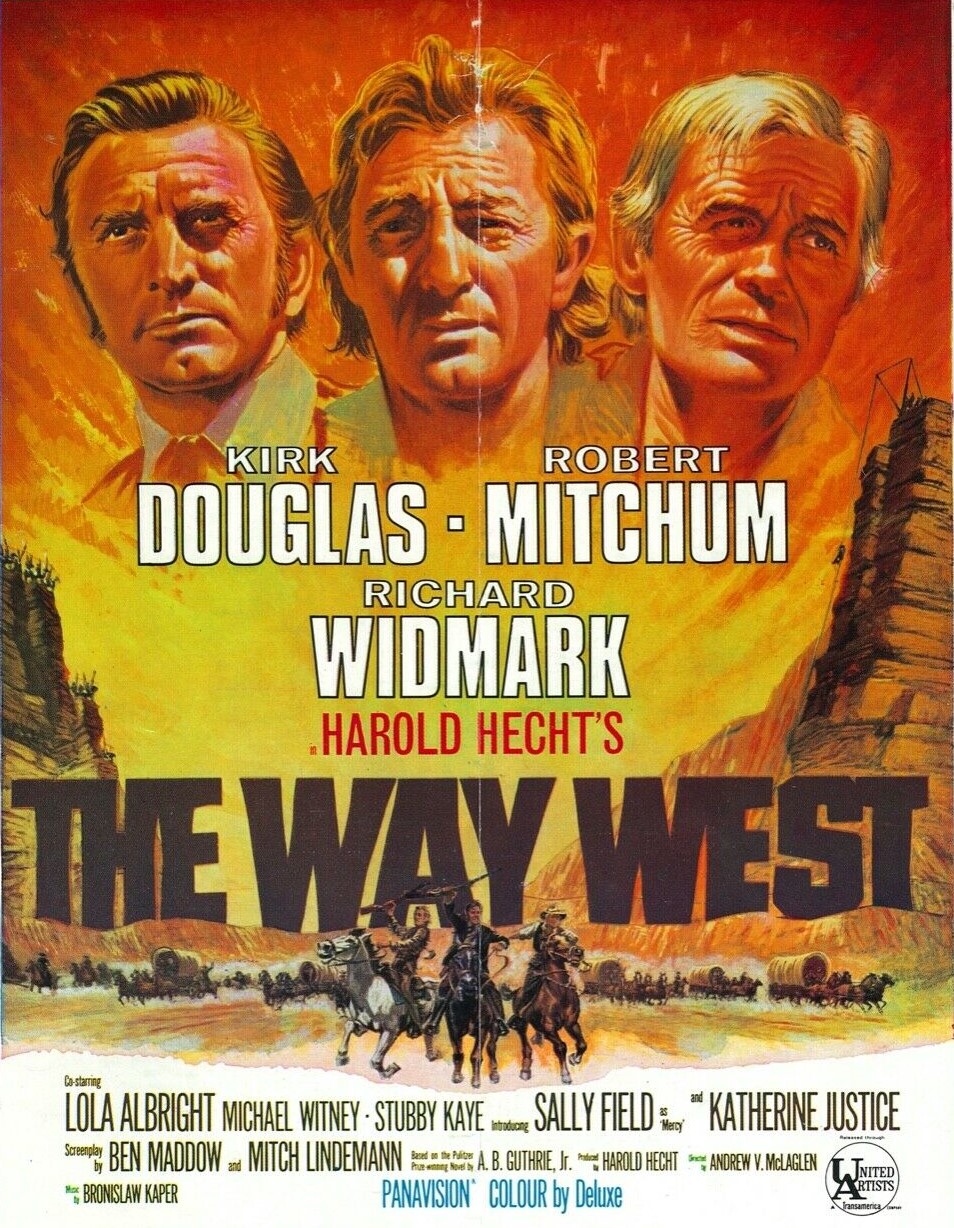
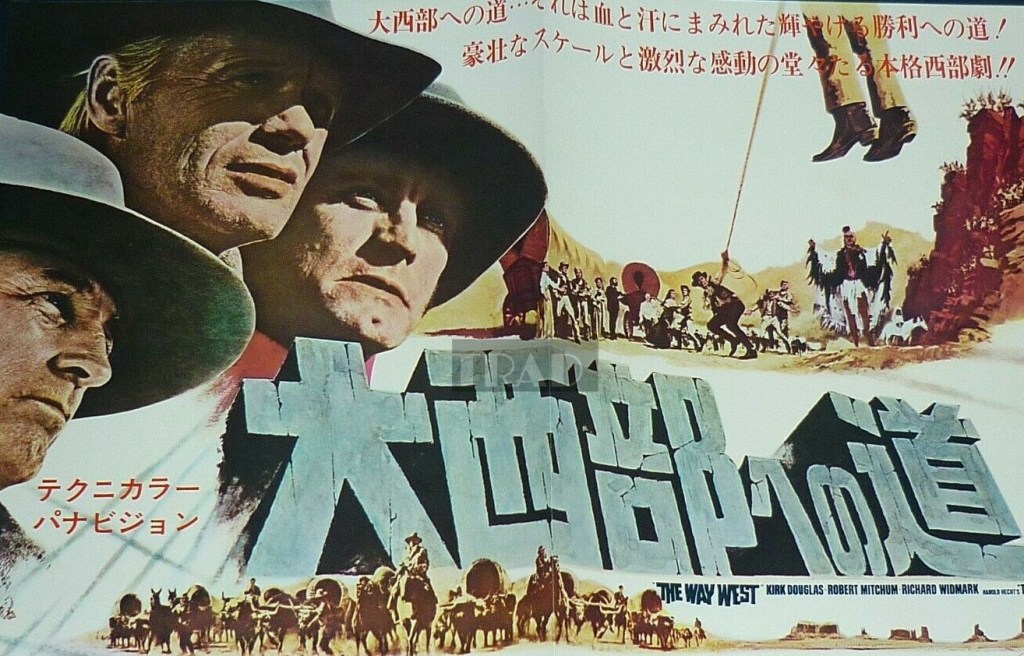
The Way West (1967) ****

How this crispy-told beautifully-mounted character-driven western ever languished among the also-rans is beyond me. I suspect the specter of John Ford hung heavily over it in the eyes of critics at the time but it more correctly belongs to the cycle of Cecil B. DeMille westerns that told stories with a true historical bent. Often detrimentally compared to How the West Was Won (1963), which told a similar tale of endeavor, this movie deliberately lacks that movie’s inflated drama in which every incident was built up, not least influenced by the need for Cinerama effect, rather than seeking an authentic truth.

Plainly put, the difference is here there are no charges, no races, no fording of rivers in the wrong places. Native Americans are treated with respect. Above all, an epic crossing of the continent with fully-loaded wagons is necessarily going to be slow, risk avoided at all costs, and yet this is not without incident or character arc. In fact, the script is terrific, not just dialog that rings true, but among the elements brought into play are male rivalry, clash with authority, guilt, young love, revenge, vision, justice, America in embryo. That the movie maintains a stately pace, no fistfights descending into brawls, and a shock ending indicate a director in charge of his material.

Based on A.B. Guthrie’s Pulitzer Prize-winning novel set in 1843, the first wagon train heads for Oregon under the iron rule of Senator William Tadlock (Kirk Douglas) and guided by a scout with failing eyesight in Dick Summers (Robert Mitchum), both men widowed and in emotional limbo, and in the cantankerous company of Lije Evans (Richard Widmark) and his glamorous wife Rebecca (Lola Albright). There’s a stowaway (Jack Elam), a preacher who can’t afford the price of transportation, an illicit love affair between the vibrant and lusty Mercy (Sally Field) who “hankers after any three-legged boy” but makes eyes at married man Johnnie Mack (Michael Witney), and enough obstacles to keep less determined settlers from reaching their promised land.

Tadlock is the visionary, a politician suffering from an overblown estimation of his self-worth,  who “might have been President except for a woman,” ruthless, valuing only his own ideas. “Point the way,” he tells Summers, “don’t gall me with opinions.” For fear it might interfere with his role as commander, he hides his vulnerability. There’s a plaintive moment when he shares his vision of a city with Rebecca, on the one hand full of his own importance, on the other clearly needing the pat on the back. Later, an occasion of death sees him falling prostate with grief on a grave and on breaking his own laws demands to whipped. The over confident blustering individual is by the end almost suicidal. What is a leader if there is no one to lead?
Summers stoically accepts his infirmity, constantly dropping his head so his eyes are hidden from sight under his hat as if his ailment could be easily detected, mourning the loss of his Native American wife, and while full of Western lore as easily passing on gentle wisdom about love, and his “lucky necklace” to an unrequited lover, but still accused of unworldliness, “for a smart man you ain’t got a lick of sense.”  Evans bristles at any authority, believing independence means he goes his own way, especially if that permits the freedom to get drunk at a time of his choosing, and especially once he realizes such lack of inhibition riles the repressed Tadlock. But his fondness for alcohol triggers an incident that almost costs his son his life.

Celebrations he started catch the attention of the nearby Sioux and in the communal drunkenness a Native American child is accidentally killed. In the best scene in the film battle Sioux seeking justice and intent on attack are thwarted only by the “sacrifice” of the killer.

The picture is packed full of incident, many characters coming alive in a single shot or with one line of dialog. A woman tramps on her husband’s foot to prevent him challenging Tadlock’s authority. A woman with a baby retorts that she is afraid when bolder settlers facing potential Native American attack assert the opposite. The bravest man in the camp, the first volunteer to be lowered down a canyon, dies when his rope snaps.  

There are any number of reversals. Buffalo, instead of being a danger and prone to stampede, create a dust cloud to hide behind. Rivers are crossed at sensible points, rapids avoided. An African American whips a white man. A boy becomes a man through honor rather than violence. Stories, large and small, play out in a succinct script.  
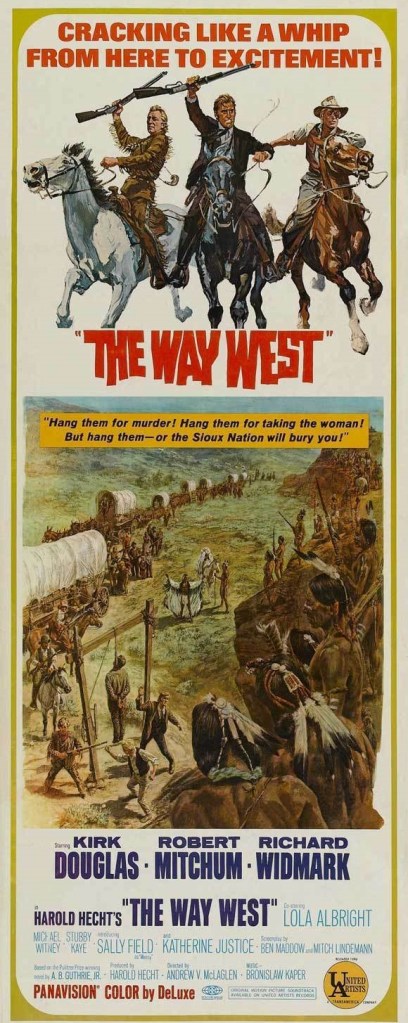
Kirk Douglas (The Arrangement, 1969) is superb as a man whose iron core deserts him. Robert Mitchum (Secret Ceremony, 1969), in almost a supporting role, excellent in full awareness that the sight on which his reputation and job depend will vanish, brings a subtlety to his performance that would be recognized as ideal for Ryan’s Daughter (1970). Richard Widmark (The Bedford Incident, 1965), who is generally simmering, gets to mix in a bit of fun in with the simmering.

Lola Albright (A Cold Wind in August, 1961) swaps seductiveness for sense. In her debut Sally Field (Smokey and the Bandit, 1977), filled with zip and zest, sparkles as the lusty young woman and it’s astonishing to realize she would not make another movie for nearly a decade while another debutante Katherine Justice (Five Card Stud, 1968) finds her inner fire when it’s too late.  There’s supporting talent a plenty – Jack Elam (Once Upon a Time in the West, 1968), Stubby Kaye (Cat Ballou, 1965), Harry Carey Jr. (The Undefeated, 1969) and William Lundigan (The Underwater City, 1962) in only his second film of the decade.

Director Andrew V. McLaglen (The Rare Breed, 1966) captures the correct tone for the film, making up for the essential slow pace with brilliant use of widescreen, coaxing great performances from all concerned. Screenwriters Ben Maddow (The Chairman, 1969) and Mitch Lindemann (The Careless Years, 1957) compress Guthrie’s tome with considerable skill.  

Woefully underrated at the time and since, this deserves reassessment. This is a truer version of how the west was won. And I surely can’t be alone in demanding that McLaglen’s talent be more properly recognized.

You might be interested to know there are two other articles on this film – a “Behind the Scenes” and a “Book into Film.”
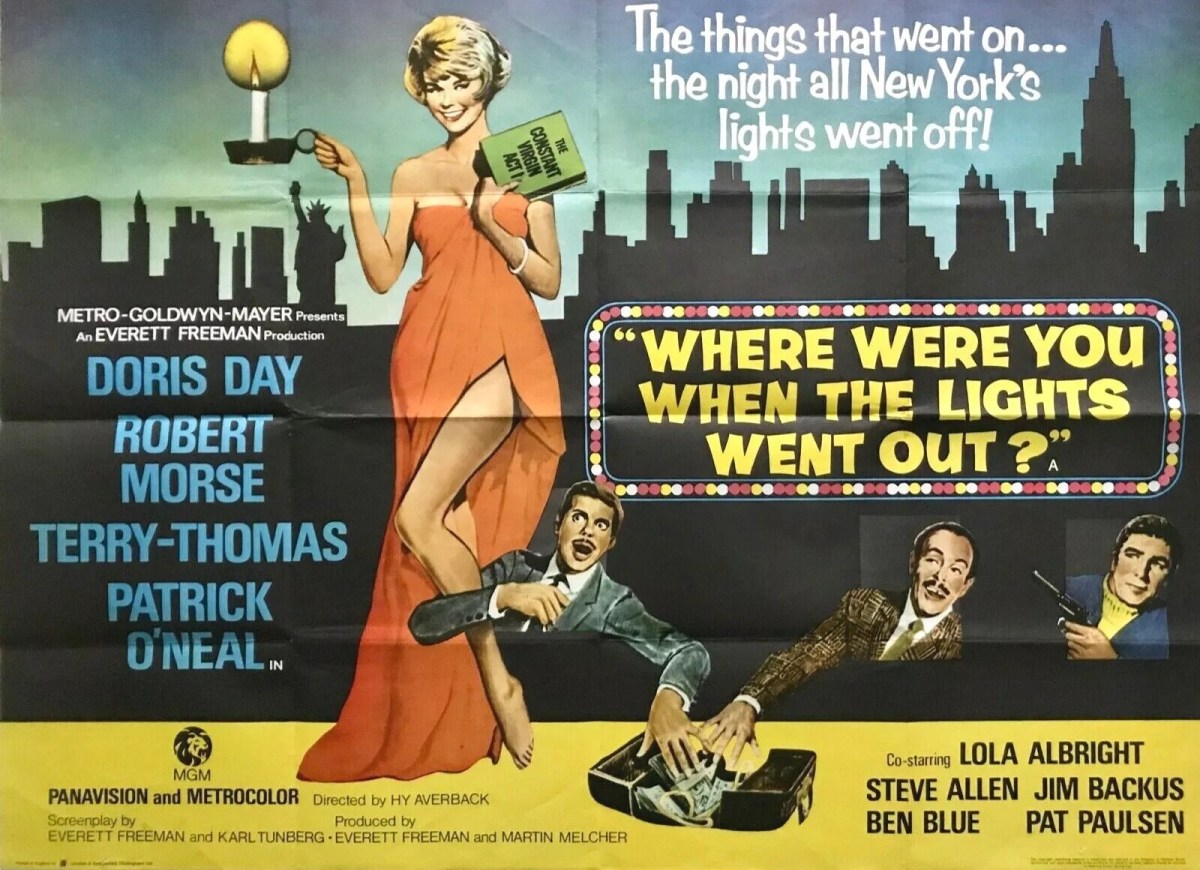
Where Were You When The Lights Went Out (1968) **

Of the 25 million stories you could have chosen when New York and the surrounding area was hit by an electricity blackout in the mid-1960s, you could have elected for something more interesting than this farce-style comedy that after the opening sections resembles nothing more than a stage play. But that’s because, somewhat surprisingly, it is based on a play and one concerning not the great fracas in the Big Apple but a similar occurrence in Paris almost a decade before. Once you know that, the farce element makes sense, but not much else does.

The three constituent parts that eventually coalesce into little more than a collage of double takes and startled expressions are: thwarted businessman Waldo (Robert Morse) making off with a couple of million bucks; Broadway star Margaret (Doris Day) finding architect husband Peter (Patrick O’Neal) in a clinch with journalist Roberta (Lola Albright); and impresario Ladislaus (Terry-Thomas), the most English-sounding Eastern European you ever came across, terrified Margaret is going to quit his play.

The lights going out malarkey is an ill-judged MacGuffin so that all except Roberta can end up in a classy Connecticut apartment and get into a quandary about who loves who and who’s cheating on who and career choices to be made. It’s pretty hard work all round to make all the pieces misalign and then fit. Waldo’s car has broken down so he has no real reason to be there nor to gulp down a beaker of alcohol that knocks him out without noticing that Margaret is fast asleep on the same couch after imbibing the same concoction.

Cue not much hilarity when guilty Peter turns up hoping to win back his wife, not expecting to find her unconscious from booze and once he discovers her bed partner convinces himself that she is as much of a cheat as himself. Meanwhile, Ladislaus tries to keep the jealousy pot boiling in the hope that she will divorce her husband and be forced to continue working.

I’m not sure I really cared whether it all worked out or not. Sure, comedies often pivot on bizarre instance, but this is just awful. More to the point, the structure doesn’t focus sufficiently on Margaret. The Waldo scenario seems wildly out of place and not enough is made of the chaos of the blackout. More to the point, with streets completely jammed and traffic signals not working, just how all four manage to get out of the city is beyond belief.

Sure, Doris Day grew up fast in the decade; at the start we worry about her losing her virginity; by the end it’s whether she’s going to embark on an affair. She’s always on the brink of the kind of sophistication that might tolerate an affair before drawing back in shock at such a notion.

The laffs are thin on the ground, even Doris Day drunk – one of her trademark touches – seems to lack punch. The best written scenes are those between Ladislaus and his cynical psychiatrist

Doris Day does her best but it’s far from the sparkling form of Pillow Talk (1959) that kicked off her very own rom-com subgenre. The quality of her male co-star had diminished over the years, from the peaks of Rock Hudson and Cary Grant to the acceptable Rod Taylor and James Garner but Patrick O’Neal (Stiletto, 1969) acts as if he is curling his lip and about to belt someone in the harder-edged dramas with which he made his name. Robert Morse (The Loved One, 1965) looks as though he’s still trying to work out what his character’s doing there. However, Terry-Thomas (Arabella, 1967) exudes such charm he’s always a joy to watch. Lola Albright (A Cold Wind in August, 1961) isn’t in it nearly enough.

The original French play by Claude Magnier was a sex farce, but casting Doris Day meant the sex angle was played down, inhibiting the movie. An unlikely vehicle for screenwriter Karl Tunberg – Ben-Hur (1959) and Harlow (1965) – who co-wrote with producer Everett Freeman (The Maltese Bippy, 1969). Director Hy Averback (The Great Bank Robbery, 1969) doesn’t come close to demonstrating the lightness of touch required to make such a ponderous effort work.

File under disappointment.

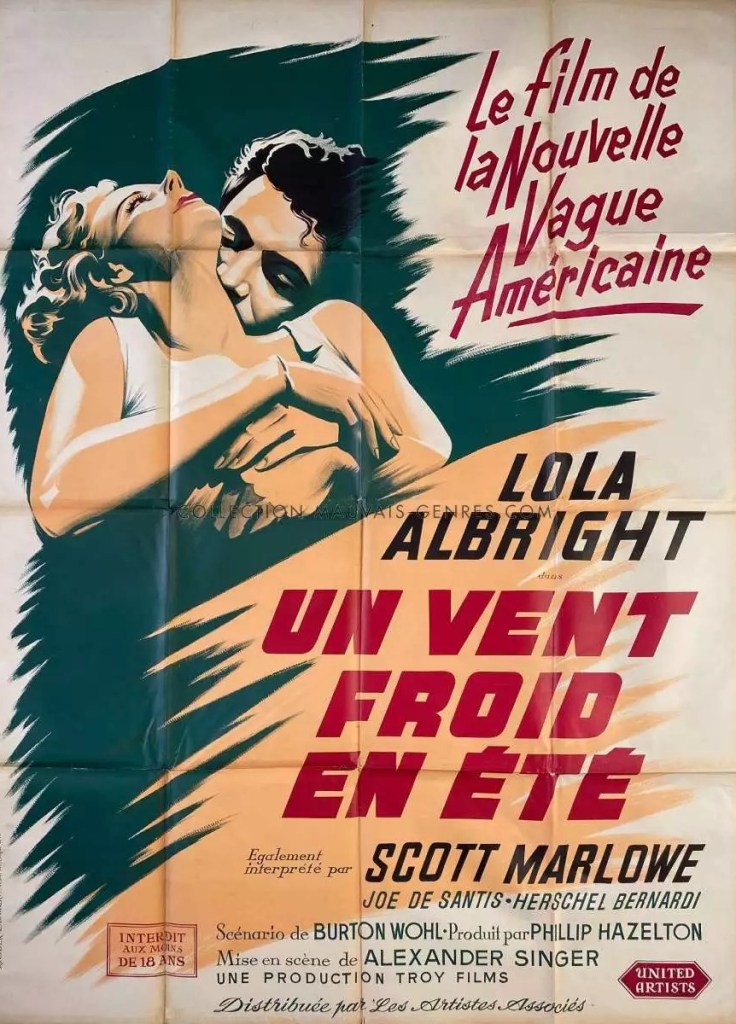
A Cold Wind in August (1961) ***

Touching low-budget B-movie shot in black-and-white of a young man receiving his sexual education from an older woman. Motherless Vito (Scott Maxwell), the son of an apartment block super, is seduced by the older Iris (Lola Albright), three-time divorcee, looking for a son to mother. 

This is not the transactional sex of The Graduate, and seduction is too strong a description for the yearning Iris whose advances are sensual and romantic, stroking Vito’s head, trapping his hand with her foot, and there is nothing clandestine about their affair either, no false names on a hotel register. They dally in the park, eat hotdogs, and he buys her flowers. 

But as he experiences love for the first time, he also experiences more difficult emotions like jealousy and finds it difficult not just to cope with what seems like another man in her life, the wholesaler Juley (Herschel Bernardi), but the fact that she treats him with such contempt. Spoiler alert – well, not really, because you know from the off this is not going to turn out well – the affair ends when he discovers she is a stripper. And while she is left bereft, he now appears more attractive to girls his own age.

In contrast to the powerful emotions stoked up when the pair are together, director Alexander Singer (Psyche ‘59) fills us in on the rest of Vito’s humdrum life, working for his father during the school holidays, goofing off with his pals, and generally failing to make headway with girls his own age.  But Iris’s life is not humdrum. Although she has a rule not to work in her own area, she breaks that to accommodate her estranged husband, whom she seems to tolerate, while at the same time drinking herself into oblivion to avoid any moves from Juley. Nor is she ashamed of her profession. It is an act, a job like any other, and provides her with a nice apartment.

Small wonder she treats men with contempt. Perhaps what she falls in love with is untainted innocence. In some senses she is adrift, at other times in full command. And her love for Vito is convincing.

It is full of incidentals. He gulps down ice-cream, she teaches him to drink one sip at a time, without being patronizing the father (Joe De Santis) tries to educate him to honor his inner feelings.

Lola Albright (Peter Gunn television series) carries off a difficult role very well indeed. Without laughs to help him out as it did Dustin Hoffman in The Graduate, Scott Maxwell is believable both as the youth growing into adulthood and the youth wanting to remain a youth with no adult responsibilities. The low-key performance of Joe De Santis is worth a mention.

While the picture no doubt attracted attention for the risqué material, which would have certainly given the Production Code pause for thoughts, it provided a more rounded picture than was normal at the time of a woman working in the sex industry, even if only in the stripping department. Iris did not fall into any of the cliches. She is presented as a woman first and foremost rather than a stripper.   

Alexander Singer sticks to the knitting and doesn’t come unstuck. John Hayes (Shell Shock, 1964) wrote the screenplay based on the Burton Wohl bestseller.

Unusual variation on the theme.

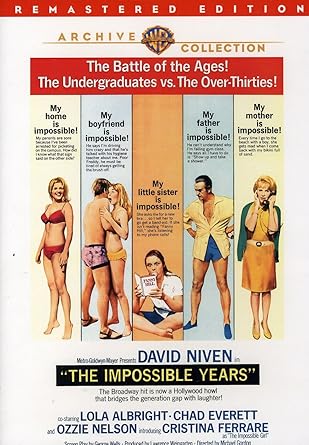
The Impossible Years (1968) ***

Generation gap comedy driven by unmentionables and the prospect of perplexed father getting more pop-eyed by the minute. By default, probably the last bastion of morality before censorship walls – the U.S. Production Code eliminated the following year – came tumbling down and Hollywood was engulfed in an anything goes mentality. Denial enters its final phase, quite astonishing the mileage achieved by not letting the audience in on what’s actually going on.  

Psychiatrist lecturer Jonathan (David Niven) finds his chances of promotion potentially scuppered after lissom teenage daughter Linda (Christine Ferrare) is arrested at a demonstration carrying a banner bearing an unmentionable word. That brings to the boil the notion that Linda may not be quite so sweet as she appears, Jonathan previously willing to overlook minor misdemeanors like smoking and speeding. But it turns out Linda may also have lost her virginity, that word also verboten, and may even be, worse, illegally married.

So the question, beyond just how manic her parents can be driven, is which male is her lover: the main candidates being a trumpet-blowing teenage neighbor and let) or laid-back artist hippie who has painted her in the nude.

Innuendo used to be the copyright of the Brits, in the endlessly smutty Carry On, series, but here the number of words or phrases that can be substituted for “sex” or “virgin” must be approaching a world record, but delivered with gentle obfuscation far removed from the leering approach of the Brits.

It’s a shame this movie appeared in the wake of bolder The Graduate (1967) because it was certainly set in a gentler period and its tone has more in common with Father of the Bride (1950). Setting aside that most of the adults, for fear of offending each other, can’t ever say what they mean, the actual business of a young woman growing up and demanding freedom without ostracising her parents is well done, Linda stuck in the quandary of either being too young or too old to move on in her life.

The scenes where that issue is confronted provide more dramatic and comedic meat than those where everyone is grasping, or gasping like fish, for words that mean the same as the other words they refuse to utter.

Parental issues are complicated in that Jonathan has set himself up as an expert on dealing with the problems growing children present. He views himself as hip when, as you can imagine, to  younger eyes, he’s actually square. And he’s also worried his younger daughter Abbey (Darlene Carr) will start to emulate her sibling.

Compared to today, of course, it’s all very innocent and I’m sure contemporary older viewers might pine for those more carefree times. It doesn’t work as social commentary either, given the rebellion that was in the air although it probably does accurately reflect how adults felt at confronted by children growing up too fast in a more liberal age.

David Niven (Prudence and the Pill, 1968) brings a high degree of polish to a movie that would otherwise splutter. He’s playing the equivalent of the stuffy Rock Hudson/Cary Grant role in the Doris Day comedies who always get their comeuppance from the flighty, feisty female. That fact that it’s father-and-daughter rather than mismatched lovers only adds to the fun. And there were few top-ranked Hollywood actors, outside perhaps of Spencer Tracy (Guess Who’s Coming to Dinner, 1967) who audiences would be interested in seeing play a father.

The unmentionable conceit wears thin at times but Niven and Cristina Ferrare (later better known as the wife of John DeLorean) do nudge it towards a truthful relationship. Former movie hellion Lola Albright (A Cold Wind in August, 1961) is considerably more demure as the Jonathan’s wife. Chad Everett (Claudelle Inglish, 1961) breezes in and out.

Although at times giving off a “beach party” vibe, it manages to examine the mores of the  time.

Director Michael Gordon has moved from outwitted controlling mother (For Love or Money, 1963) to undone controlling father without dropping the ball. It’s based on the Broadway play of the same name by Robert Fisher and Arthur Marx.

Lightweight for sure but worth it for David Niven and the sultry Ferrare.

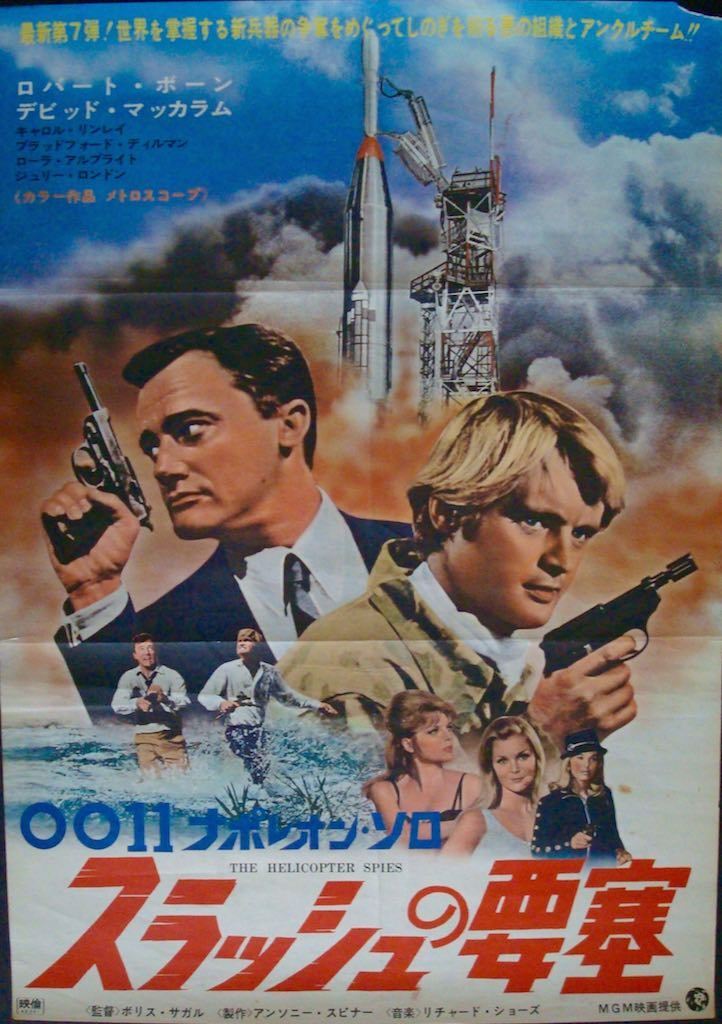
Helicopter Spies (1968) ***

Takes a little while to come to the boil what with disreputable women, a crew of platinum-white-haired thugs, a religious cult, some very dry dialog, a high priestess with her own chorus line of psychedelic dancers, four identical brothers, and a female lead parading a prize shaggy dog story. Our intrepid heroes appear more capable this time round, the previously inept Napoleon Solo (Robert Vaughn) not beaten up quite so often, though he does end up being drowned in sand (water too precious to spare, apparently).

This time round, too, the good guys are taken for a ride by mad scientist Luther Sebastian (Bradford Dillman) who hoodwinks the U.N.C.L.E. organisation into stealing a “thermal prism” from the fortress of another mad scientist Dr Kharmusi (John Dehner). To put his own grand plan into operation Sebastian just has to hijack a rocket. And you should be aware going into this that there’s not the amount of helicoptering you might expect given the title.

This time round, too, there’s hardly a good gal in sight. Azalea (Lola Albright),  aforementioned high priestess of cult The Third Way, has betrayed the good doctor in favor of Sebastian. Sebastian’s wife Laurie (Julie London) pretends to a) be out of contact with him for years and b) maintain a virtuous existence. And that’s before we come to the plainly bonkers, but still traitorous, Annie (Carol Lynley) who will make up any story in a bid to free an imprisoned unseen husband.

Sebastian has some neat touches as a leader, rewarding his team of thugs with booze and women as a prelude to killing them all off. He’s got an ejection seat in his car for getting rid of troublesome passengers. He prefers efficiency, to the point of iciness, to sexiness in his paramour and female underlings. And he has a very dry manner, which elicits a good few laughs.

But some of his thugs just ain’t that bright, the one instructed to follow Solo has just allowed him access to Laurie’s house. Laurie ain’t that bright, either, falling for an old trick by Solo who, as usual, is less bright that Ilya Kuryakin (David McCallum).  

Some of the set pieces are excellent. Sebastian’s followers meet in an abandoned movie theater where Azalea gives the lowdown on the grand plan assisted by her bevy of dancers. Infiltrating the organisation by the simple device of dying his hair, Solo ‘s disguise is uncovered after being sprayed with champagne.

There are a surprising number of human touches. Head henchman Carl (Roy Jenson) vowing to take “Mom” away from her dingy life running her eponymous diner finds she enjoys too much her dingy life. Carl, appreciative of the disguised Solo’s efforts, apologises for making him ride in the baggage train. Annie can stretch innocence to breaking point, to an extent where nobody cares about her problems.

But where The Karate Killers had a straightforward storyline – find the five daughters of a dead scientist – this gets a tad lost in the first section introducing the thermal prism, the cult, doubling down on mad scientists, and giving Annie all the importance of a red herring.

I thought for a moment that this was the end of the line in my appreciation of the U.N.C.L.E. franchise, the one where it all fell flat on its face and we could see the joins, but after the shaky start it picked up and became quite enjoyable in the series’ inimitable barmy fashion. I suppose I should applaud the initial narrative boldness, audience pretty much fooled from the off, the fortress assault not much more than an extended MacGuffin, with neither Sebastian nor Azalea what they seemed.

I could quibble about the guest stars but in fact this is a superb deadpan performance from Bradford Dillman (Sanctuary, 1961) and quite a departure for the Carol Lynley of Bunny Lake Is Missing (1965). And you could say the same for Lola Albright, previously seen essaying a different kind of character in The Way West (1967).

Boris Sagal (The Omega Man, 1971) directed from a screenplay by Dean Hargrove (One Spy Too Many, 1966).

I’ve only got a couple to go to wrap up the entire series and for your sake I will persevere. If you’ve not already done so, it’s back to the box set.

Discover WordPress

A daily selection of the best content published on WordPress, collected for you by humans who love to read.

The Atavist Magazine

by Brian Hannan

WordPress.com News

The latest news on WordPress.com and the WordPress community.