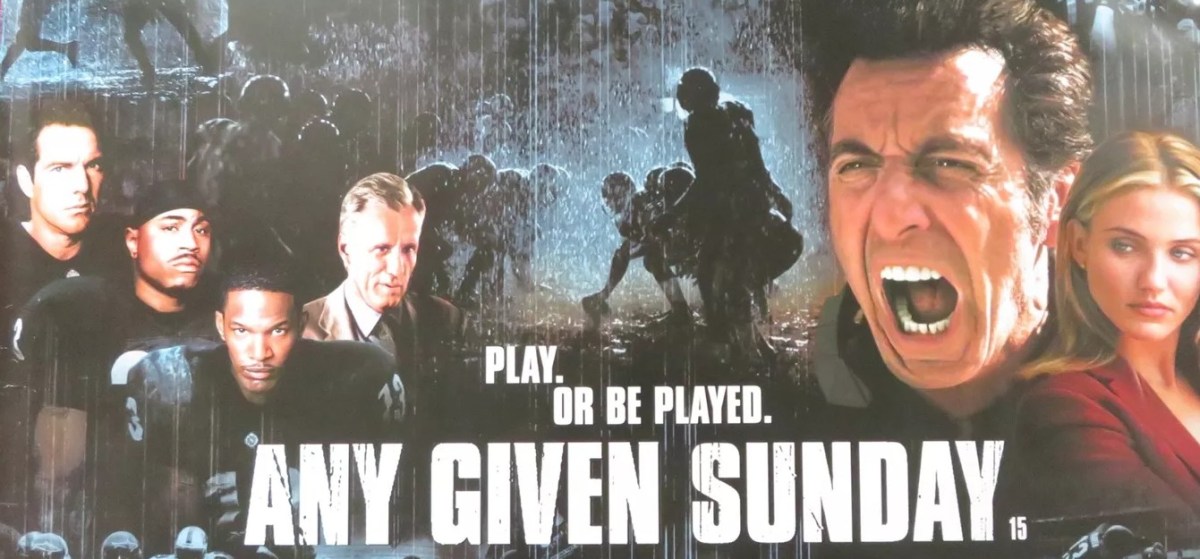
It’s always with trepidation that I go back to a banker, one of my favorite films, hoping that it will remain timeless, and still good enough for a place on my all-time personal Top Ten. I’d planned a double bill of Kingdom of Heaven (2005) and this but the former proved so disappointing that it took me a while to pluck up the courage to watch Oliver Stone’s kaleidoscopic American football epic.
My fears proved misplaced and this is bearing in mind that I know nothing about the sport and have little understanding of what always appear arcane rules that make little sense to someone brought up on the more disciplined (at least in my eyes, rules-wise) football/soccer (or the hybrid “soccerball” as my grandkids refer to it). I’ve always been a fan of sports movies, which means American sports movies, because with the exception of Chariots of Fire (1981) the British don’t seem to have the knack. So I’m used to following movies where I don’t necessarily understand what’s going on the field of play.
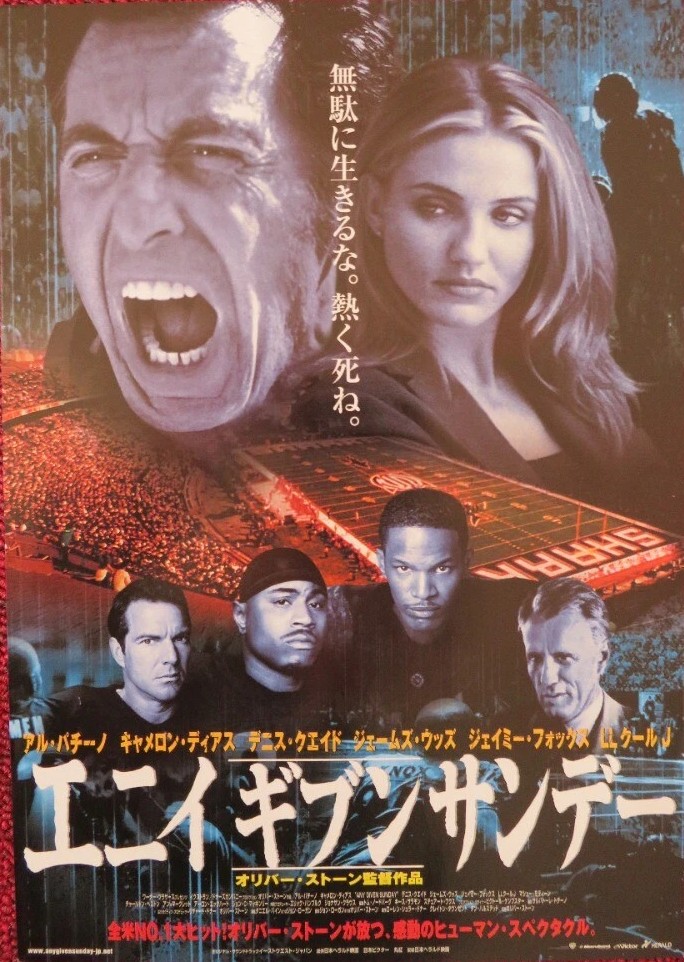
This is driven by three compelling narratives – all power duels of one kind or another, between owner Christina Pagniacci (Cameron Diaz) and various politicians, between her and coach Tony D’Amato (Al Pacino), and between Tony and arrogant rising star quarterback Willie Beaman (Jamie Foxx). And while all these battles are a mixture of discreet management and full-blown blood-and-thunder shouting matches, the movie is liberally sprinkled with tiny cameo moments that add depth.
There’s a blink-and-you-miss moment when team physician Dr Mandrake (James Woods) is seen in conversation on the sidelines with a blonde cheerleader. The next time you see her is when she chooses not to follow Mandrake when he is fired, as curt a signal as you’ll ever find that position rather than personality equates to worth. She appears for one more nanosecond and this time in conversation with his replacement Dr Powers (Matthew Modine).
The saddest moment is when cute sex worker Mandy (Elizabeth Berkley) tries to let Tony down gently that theirs is purely a financial, not romantic, transaction. But that’s run close when Willie’s girlfriend Vanessa (Lela Rochon) is given the brush-off by the established WAGs. And the toughest scene, amidst all these high-powered testosterone-driven adrenalin male and female junkies, is when injured star quarterback Cap Rooney (Dennis Quaid) is given the mother of all slaps by wife Cindy (Lauren Holly). All such moments are merely incidental to the three main narratives, as is the battle for music supremacy in the dressing room, when the head-bangers among the team turn the volume up to eleven.
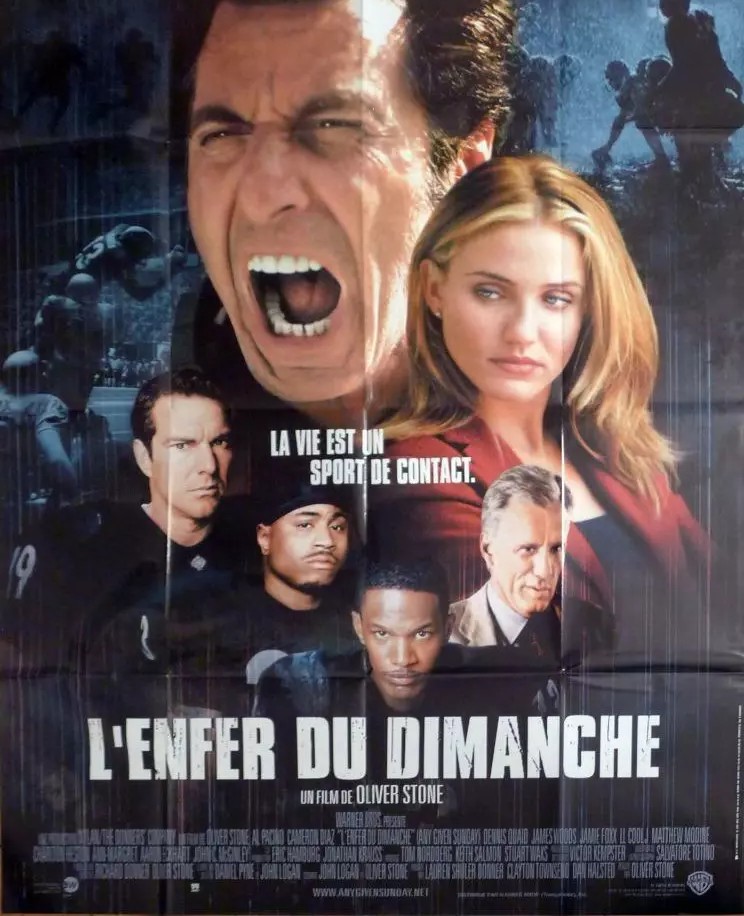
Revenge is a theme. And that can run from setting loose your baby alligator in the team shower room, taking a buzz saw to a rival’s ultra-expensive automobile or his team-mates punishing Willie for his overweening arrogance by not protecting him on the field and allowing him to be battered by the opposition. Though there’s little as sweet as Tony handing Christina her come-uppance by stealing away Willie for his new team. But that’s run close by the grim smile of satisfaction on the face of the Football Commissioner (Charlton Heston) when he, too, brings her up short. And by Tony stiffing cocky pundit Jack Rose (John C. McGinley). Indulgence, by comparison, is sniffing coke off a naked woman’s breast. There’s even moments of comedy, Willie being duped into taking flowers to the coach when invited for dinner, and the holding-up-the-hand scene.
And all of this is before we get to the meat of the movie, the games that mean absolutely everything – more than sex, family and drugs – to the participants. Sometimes Tony, a 30-year-old veteran, conjures up the words to inspire his team, sometimes he doesn’t, occasionally he turns away from them in disgust, occasionally it’s left to the padre (in the days when “take a knee” meant something else) to inject some common sense into the overloaded equation.
If all these characters are larger-than-life that’s no surprise because there’s little room in the hard world of top-level sport for the shy and withdrawn. So shouting matches are titanic. Lives play out only in the fast lane. Winners get the prom queen, losers get…nothing. And unlike sports originating from Britain – like football/soccer/soccerball or cricket – there are no draws. If you’re not a winner, then you’re a loser.
The essential tale of staying on top, maintaining a winning role, reversing a losing one, getting to the playoffs, the holy grail of winning the Super Bowl (known here as the Pantheon) and the coveted ring that accompanies victory, is always going to be packed with drama. But director Oliver Stone (Platoon, 1986) adds other layers, the daughter whose father wanted a son, the coach who’s driven away everyone who ever loved him and now pays through the nose for nights of affection, the quarterback so infused with self-belief and victim mentality that he learns the hard way he needs help.
You can’t deny Stone his quirks, the lightning bolts or seemingly endless snatches of pop tunes and shadowy figures who appear out of nowhere, and cuts to cheerleaders or crowds, and the paraphernalia that surrounds the game. But not a moment is wasted.
The acting is top-notch. Al Pacino (The Godfather, 1972) gives one of his best performances, Cameron Diaz (The Mask, 1994) upends her cute screen persona, James Woods (White House Down, 2013) plays another version of his screen schemer, Jamie Foxx (Back in Action, 2025) gives notice of his talent. Written by John Logan (Gladiator, 2000), the director and Daniel Pyne (The Manchurian Candidate, 2004).
Best-ever sports movie (though maybe tied with Field of Dreams, 1989).
Without doubt retains its place on my All-Time Top Ten.

 The Magnificent 60s