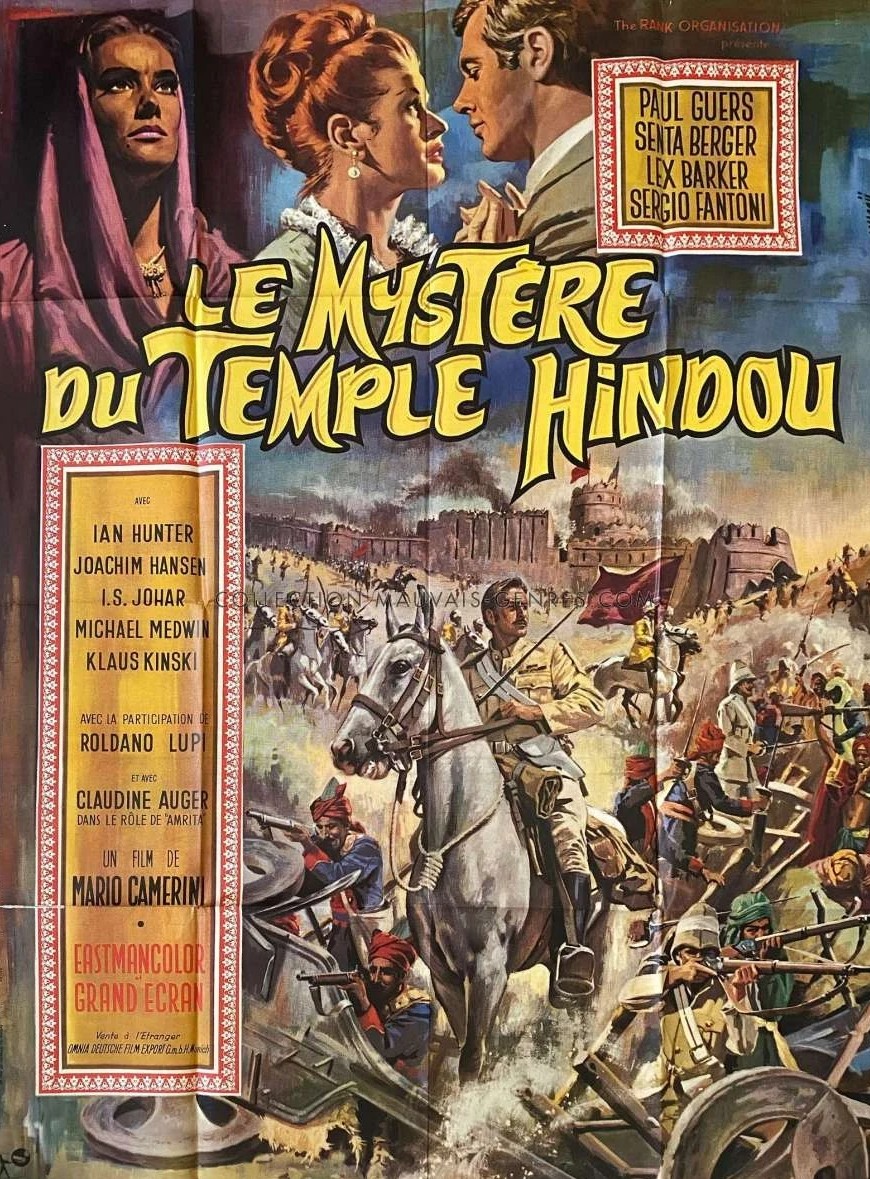
Kali-Yug Part II: The Mystery of the Indian Temple (1963) ***

Earnest students of the Senta Berger Syllabus may be somewhat disappointed, I’m afraid. This turns out to be an epic movie – in two parts – but even with a three-hour running time there’s hardly any space for the second-billed Ms Berger. Instead it’s the second female lead Claudine Auger who leads the way.

And as if it’s forerunner of the contemporary serial there’s a (longish) recap of part one, though this time recounted as if it’s nightmare into which our hero Englishman Dr Simon Palmer (Paul Guers) has unwittingly tumbled. He’s not, as I had imagined from the end of episode one, free. He’s still imprisoned by the Maharajah (Roldano Lupi) along with servant Gopal (I.S. Johar) although he has begun to deduce that all is not what it seems and that an insurrection may be on the cards under the guise of a revival of the cult devoted to the Goddess Kali.
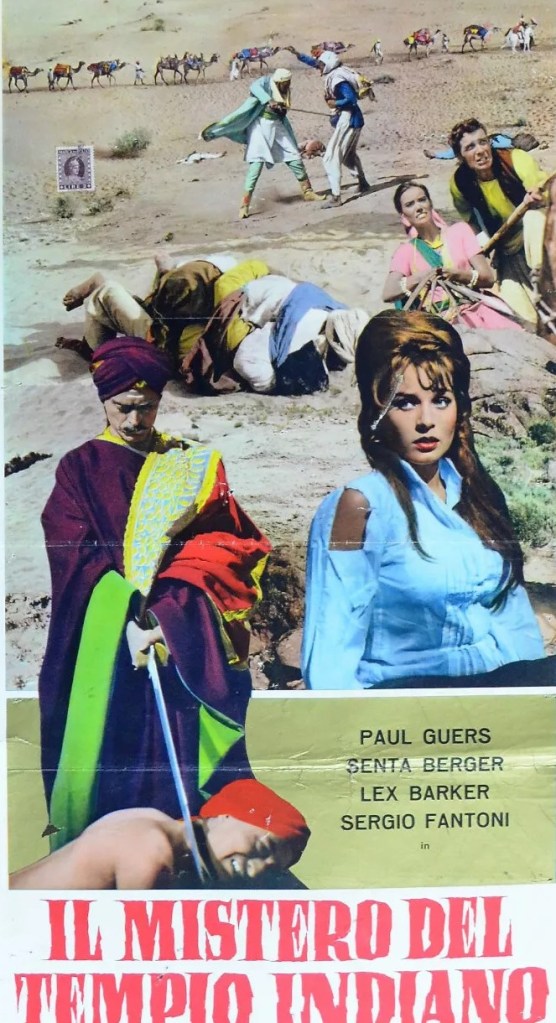
And when exotic dancer (in the old sense, not the contemporary) Amrita (Claudine Auger) fails to convince the Maharajah of Palmer’s innocence she organizes his escape via the old snake in the basket trick. But this is not altogether from altruism. The good doctor is whisked away to treat three children who have caught diphtheria, unaware one of them is the Maharajah’s grandson, kidnapped (in Part One) by the Kali cult of which she is a key participant. However, she is beginning to thaw in her attitude to the Englishman and wonder why the goddess Kali, to whom she is bound by oath, is so determined to kill such a good man.

They end up in the caravanserai of cult leader Siddhu (Klaus Kinski), but Amrita, who’s undergoing a crisis of faith, organizes their escape, along with the boy. She has betrayed her calling – her father was a priest of Kali – in order to save Palmer. They manage to evade the pursuing pack of thugs. When the road back to Hasnabad is blocked, they decide to make for the enemy lair, an abandoned fort in the desert turned into the rebel stronghold, on the basis of hiding in plain sight, nobody expecting them to head in that direction.

Meanwhile, on his way to the fort, the Prince (Sergio Fantoni), now showing his true colors, has kidnapped Catherine Talbot (Senta Berger), planning to trade her for the Maharajah’s grandson who is “absolutely essential” to his plans. Theoretically, there’s nothing her husband can do to save her. According to the Treaty of Delhi, British forces cannot cross state lines. However, Talbot (Ian Hunter) reckons that, as he’s technically a civilian, that rule doesn’t apply to him and Major Ford (Lex Barker) comes up with a similar ploy, explaining that he’s given his soldiers ten days’ leave leave and to his “great surprise” they all decided to spend it in the fort.
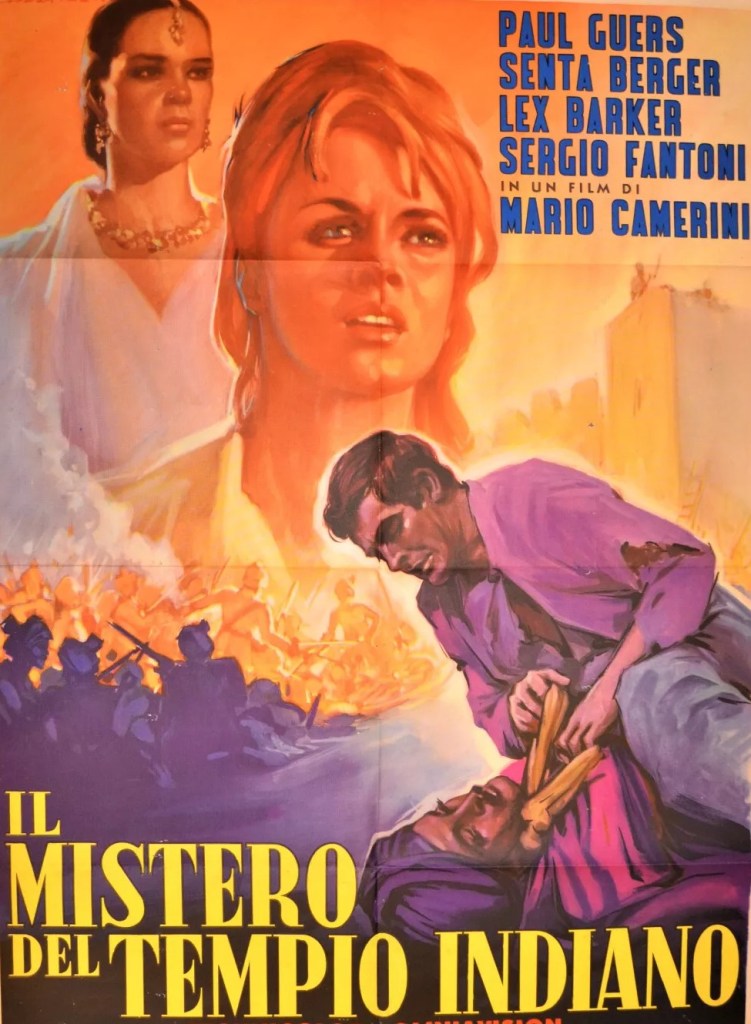
Meanwhile, to complicate matters, Amrita decides Palmer is so far from being a bad guy that he’s worth kissing. But that romance is nipped in the bud when Palmer spots Catherine being dragged along in the Prince’s caravanserai and decides to rescue her. Furious at discovering that Catherine takes precedence in Talbot’s romantic scheme, and correctly assuming she’s going to be dumped, she knocks him out and turns him and the boy over to the Prince. While the child is acclaimed as the “sacred prince” and figurehead of the revolution, Palmer is to be sacrificed to the goddess. While waiting for that, he’s chained up next to Catherine.

So now you know we’re going to be perming two from four. This doesn’t feel like it’s heading in the bold direction of everyone coming out of it bitterly disappointed on the romance front.

And so it transpires. Talbot the Resident, more courageous than you might expect, dies in the attack on the fort while Amrita is killed trying to protect Palmer. Although for a time it’s a close run thing, what with the attackers outnumbered and running out of ammunition, luckily they are saved by the arrival of the Maharajah’s army. And with Amrita and the Resident out of the way, the path is clear for the old flames to renew their romance though that’s implied rather than shown.

No tigers or elephants this time round, wildlife limited to a dancing bear and a performing monkey.

Hardly a story that requires such an epic scale and I’m wondering if it was so long they had to edit it into two parts or whether it was filmed in the fashion of The Three Musketeers (1973)/The Four Musketeers (1974) with both sections shot at the same time. I’m not sure how audiences reacted. From what I can gather moviegoers in some parts of the world only saw part one while others were limited to part two, that recap helping make the narrative comprehensible.

Senta Berger (Cast a Giant Shadow, 1966) completists will come away disappointed given how restricted her role is. But she does bring the necessary emotions of remorse and humiliation to the part. Claudine Auger (Thunderball, 1965) has the better role, femme fatale, conspirator, lovestruck, spurned, and at various points leaping into action. Lex Barker (24 Hours to Kill, 1965) looks as though he’s signed up for a role requiring a hero only to be not called upon to act as one. Fans of Klaus Kinski (Five Golden Dragons, 1967) will be similarly disappointed.

Paul Guers (The Magnificent Cuckold, 1964) looks thoroughly puzzled throughout although he gives plenty lectures on general fairness while Sergio Fantoni (Esther and the King, 1960) concentrates on how unfair the British – considered the exponents of fair play – actually are.

Given it was made outside the British studio system, the producers are free to be quite critical of the British in India and there are pointed remarks about “dirty little Hindus” and about how the British treat even the Indian elite with obvious contempt. In order to retain autonomy, the Maharajah has been forced into becoming a merchant to save his people from starvation thanks to the amount he is taxed. And the story pivots on the lack of medication supplied by the British to natives. The Resident hasn’t even bothered to reply to Palmer’s letters begging for medicine.

The picture is even-handed in its depiction of British rule. Film makers were always in a dichotomy about rebels. Sometimes they were the good guys rising up against despicable authority, sometimes they were the bad guys disrupting a just system. Here, since the rebels belong to a vicious cult that would kill regardless of cause, they come off as the villains of the piece.

Mario Camerini (Ulysses, 1954) directs without the budget to make the most of the story, the battles or the location. Along with writing partners Leonardo Benvenuti and Piero De Bernardi (Marriage Italian Style, 1964) and Guy Elmes (Submarine X-1, 1968), he had a hand in the script adapted from the Robert Westerby novel.

Not complex enough to be an epic, and not enough of Senta Berger to satisfy your reviewer, still interesting enough if you are thinking of seeking it out. Good prints of both parts are on YouTube.
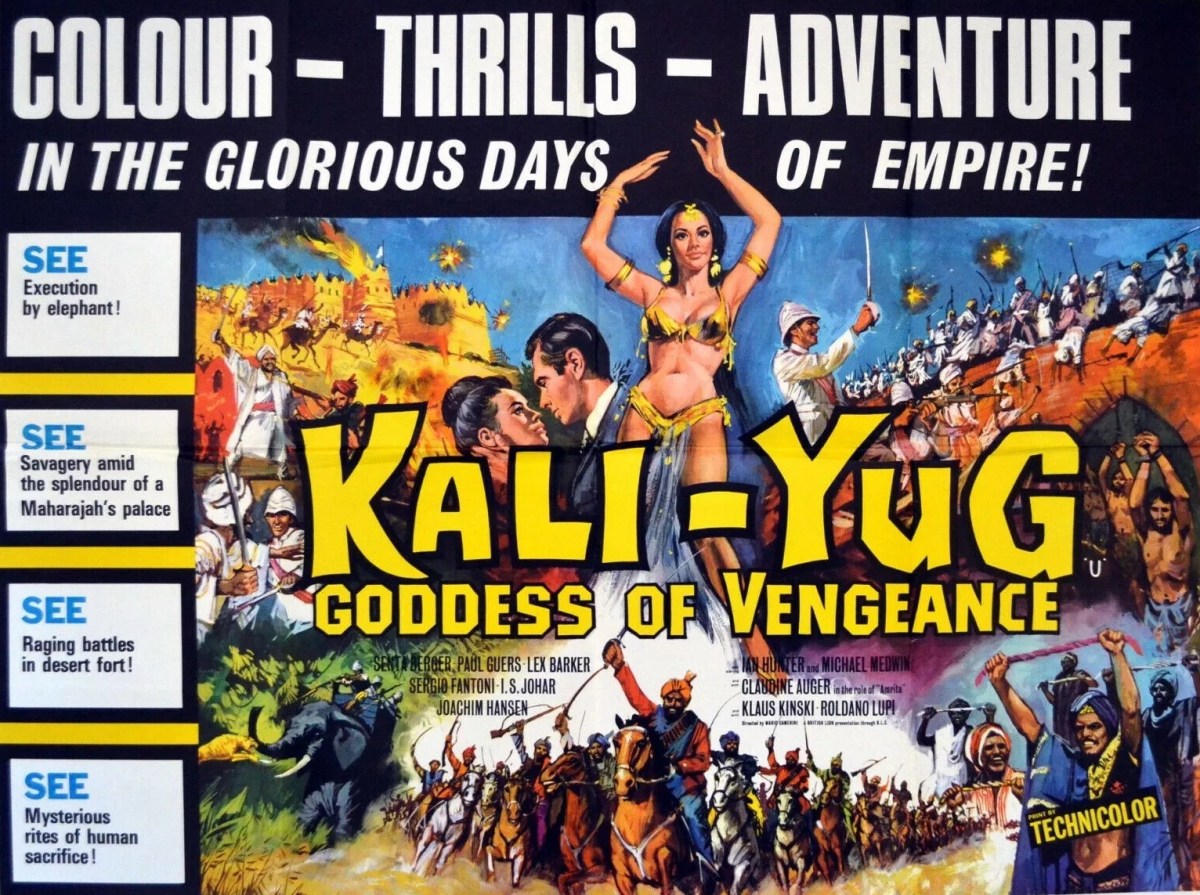
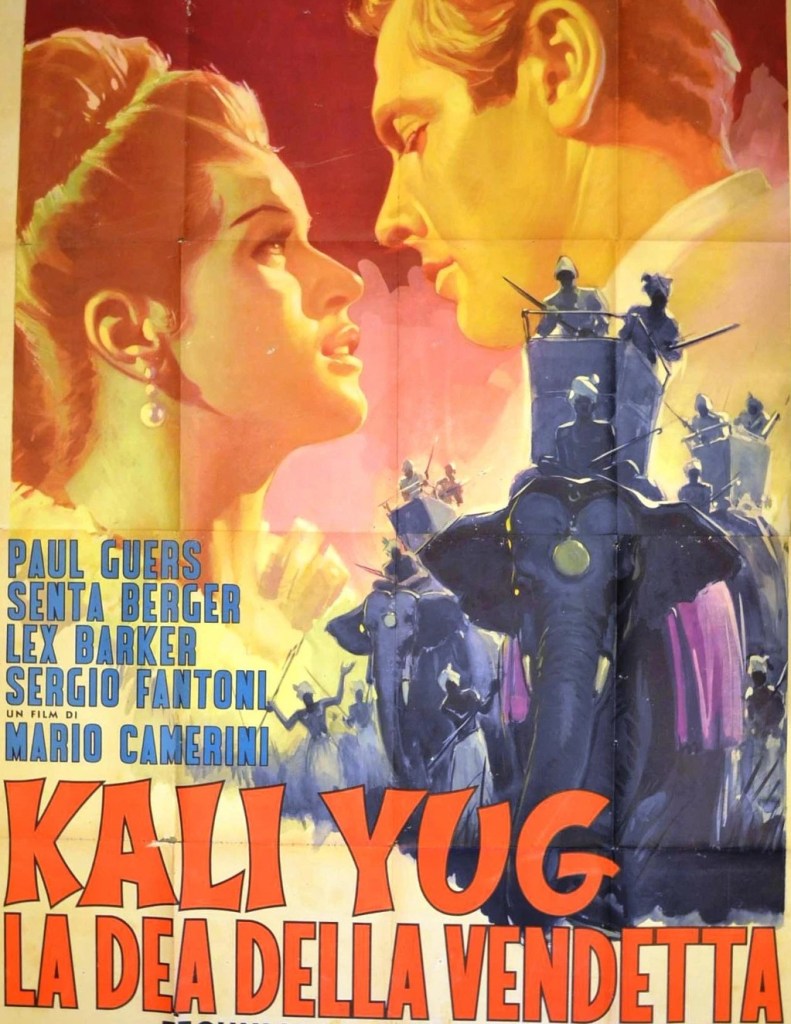
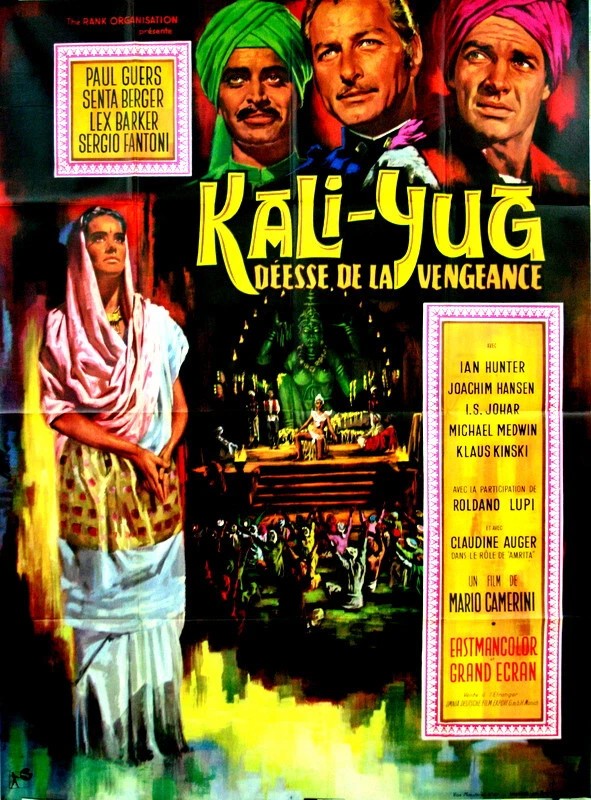
Kali-Yug Goddess of Vengeance (1963) ***

You can’t aspire to being Emeritus Professor of Senta Berger Studies unless you are willing to track down this early effort. Your curiosity can now be sated without much effort since it’s currently playing on YouTube. You’ll notice a preponderance of brownface (Klaus Kinski, Sergio Fantoni, Claudine Auger and eventually, though in legitimate disguise, Paul Guers) among a multicultural cast comprising actors from Germany, Poland, Switzerland, France, Italy, Austria, South Africa, the USA and Britain.  

To avoid confusion, the title of this German-made Indian adventure requires some explanation and once again I have undertaken the necessary research. As long as you make the distinction between “Kali-Yug” and “Kali Yuga” you will be on safe ground. The former refers to a cult while the latter refers to Hindu cosmology and the final age of the yuga cycle – the one predominant at the time – defined as an age of darkness, of moral and spiritual decline.

Even with that out of the way it takes quite a while to get your bearings here. This is India in the 1880s, four years after Queen Victoria has been declared Empress of India, at the height of British rule.  

We begin in rather traditional style with the kind of tale that would provide an Englishman with good reason to be in an impoverished Indian village. Dr Simon Palmer (Paul Guers) is fighting an epidemic of smallpox. Running out of medicine, he despatches a servant with a small convoy to the capital of Madanpur to secure further supplies to combat the disease. On its return this group is ambushed, so Palmer takes it upon himself to personally plead with local Governor (known here as The Resident) Talbot (Ian Hunter) of Madanpur..

It’s worth pointing out that, as this is relevant to the later narrative, a Resident has been appointed in those states such as Madanpur which the British took by force. Other states, which gave in to the British without a fight, such as the neighboring state of Hasnabad continue to enjoy autonomous rule by a Maharajah or Prince, but only in return for paying massive tributes to their conquerors.

After a satisfactory meeting with the Resident, Palmer encounters drunken British officer Capt Walsh (Michael Medwin) and retaliates when insulted. He also meets old flame Catherine Talbot (Senta Berger) who married the Resident. She’s not a gold-digger in the standard sense. Palmer had met her in Calcutta but when he went off to London to complete his medical studies her father died, leaving her impoverished, so in his continued absence she married the older man for security.

Capt Walsh is murdered and after their previous altercation blame falls on Palmer. He should get off scot-free. He has an alibi. At the time of the murder he was dallying with Mrs Talbot. But that wouldn’t go down well in British society. There would be a scandal. A good deal would be read into a moonlit assignation with a man other than her husband. And Palmer, in traditional stiff upper lip fashion, wouldn’t like to get her into trouble.  

So Palmer contacts elite dancer Amrita (Claudine Auger) because he thinks she knows who killed Walsh. Although promising to help, Amrita, it turns out, apart from charming the pants off (possibly quite literally) everyone in sight, is secretly in league with the characters, led by Siddhu (Klaus Kinski), responsible for the robbery and murder. So while Palmer is ambushed yet again, she is sent to Hasnabad where she will undertake her “next mission.”  

Which appears to be to dance for the Maharajah (Roldano Lupi) as entertainment for visiting merchants. Helped by servant Gopal (I.S. Johar), Palmer goes on the run and manages to fake his own death. In this regard, an entire corpse is not required as proof, just a torn limb, stolen from the local vultures, and a torn jacket. (Thus far the highlight of the show with white hunters and Mrs Talbot swaying in baskets atop elephants). To keep him safe, Gopal provides Palmer with brownface disguise. They witness a Kali ritual and follow Siddhu’s gang as they break into the palace to prevent the kidnap of his Maharajah’s grandson.

But Palmer is blamed for that too and condemned to death. That involves being buried up to  your neck in the sand while an elephant stomps on your head. But he is released because the Maharajah doesn’t want trouble with the English. Meanwhile Catherine has fessed up to her husband which, as expected, does not go down at all well.

The End.

So you can imagine my puzzlement. YouTube promotes Klaus Kinski (Grand Slam, 1967) as the reason to watch this, but so far, he’s only appeared briefly, though clearly wielding significant power as chief thug. But we’ve seen as little of third-billed Lex Barker (Old Shatterhand, 1964) as Major Ford. His contribution is to prevent Capt Walsh get even drunker and, as a member of the shooting party, pick up Mrs Talbot when she faints at the thought of Palmer being dead. Sightings of fourth-billed Sergio Fantoni (Hornets’ Nest, 1970) have been as fleeting, his main role as Prince Ram Chand to try and score points off The Resident by arguing about the unfairness of British rule and to partner Catherine briefly on the dance floor.

So this is beginning to look as though it’s a small-scale version of those big-budget pictures featuring an “all-star cast” which consists either of marquee names long past their best or various foreign stars recruited to cover all the bases for the international release rollout.  

The ending is so sudden and with so much unresolved, I also began to think it was one of those elaborate foreign jobs with stars who meant so little to British and American moviegoers that it was drastically edited to fit domestic distribution patterns.

On further research (the bane of any Emeritus Professor’s life) I got to the bottom of the problem.

This was only Part One. It wasn’t the end after all.

Luckily, I’ve found Part Two and will review that (as no doubt you’re delighted to hear) tomorrow.

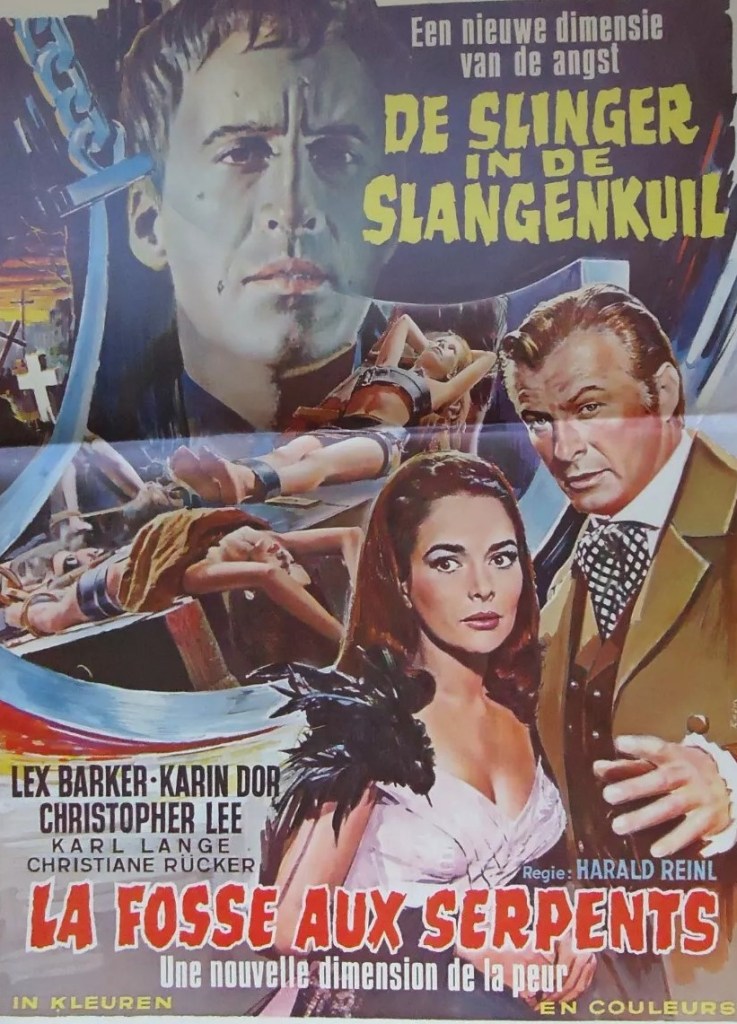
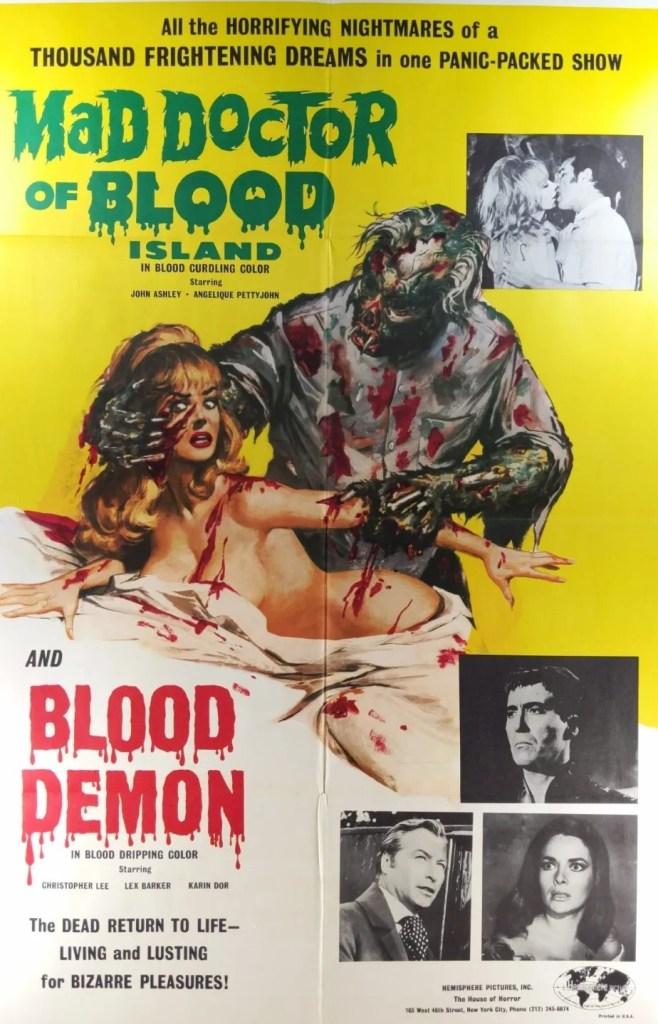
Blood Demon / Blood of the Virgins / The Torture Chamber of Dr Sadism (1967) **

Heavy on atmosphere but not much else, a gender-switch take on the Countess Bathory horror tale (made by Hammer as Countess Dracula, 1971), which sees Count Regula (Christopher Lee) as, oddly enough, being one virgin’s blood short of achieving immortality, thirteen being the vital number, when he is arrested. Condemned to die in traditional fashion, first of all face impaled on a golden iron maiden then body torn apart by a quartet of horses, but not before casting a curse on the prosecutor.

Thirty years later or thereabouts Roger von Marienberg (Lex Barker), son of the prosecutor, turns up seeking the family castle only to find no one will show him the way. And that when he does get going it’s through intermittent fog, past burnt-out buildings and a forest strung with corpses and, it has to be said, a countryside that occasionally takes on an artistic hue, such as one sequence where the coach rides through the countryside with the sky above solid red and the land below solid green.  

Along the way he encounters Baroness Lilian (Karin Dor) – the daughter of the evil count’s intended victim number thirteen – and her maid Babette (Christiane Rucker) who go through a routine of being captured and rescued, captured and rescued. When finally, halfway through, we reach the castle, we find the count in a glass coffin awaiting rebirth.

And then it’s like a reality tv show as the visitors undergo a series of torturous obstacles, Babatte hung over a bed of knives while time runs out, Lilian encountering rats and spiders and potentially dropping into a nest of (rather disinterested) snakes, Roger taking a leaf out of the Edgar Allan Poe playbook and facing either the pit or the pendulum.

The count – his awakening shown in shadow the best sequence in the movie – looks like a survivor from A Quiet Place, face desperately white, and frantic to fulfill his quest, with Lilian designated the unlucky thirteenth. Of course, although it took an iron mask and four stout horses to bring him to heel three decades before, he’s not so familiar with the rules governing the undead and a crucific is all it takes to unhinge him.

Very much horror by the numbers without much pizzazz. Lex Barker (Old Shatterhand, 1964) looks as if he’s more worried about his quiff being out of place than anything else. Christopher Lee (The Devil Rides Out, 1968) isn’t in it often enough and, minus the fangs, hasn’t the wherewithal to drum up a scare. Karin Dor (Topaz, 1969), beautiful though she is, doesn’t quite make it as a Scream Queen.

Atmosphere is the best element here, from the opening march from dungeon to execution through long echoing corridors to the Hieronymous Bosch-inspired backdrop of the castle, and the bodies that appear to have dived headling into trees rather than merely dangling from them.

Lex Varker is the key that this is German-made, directed without requisite suspense or fright, by Harald Reinl (Winnetou, 1963).

But like the fog everything is too strung-out

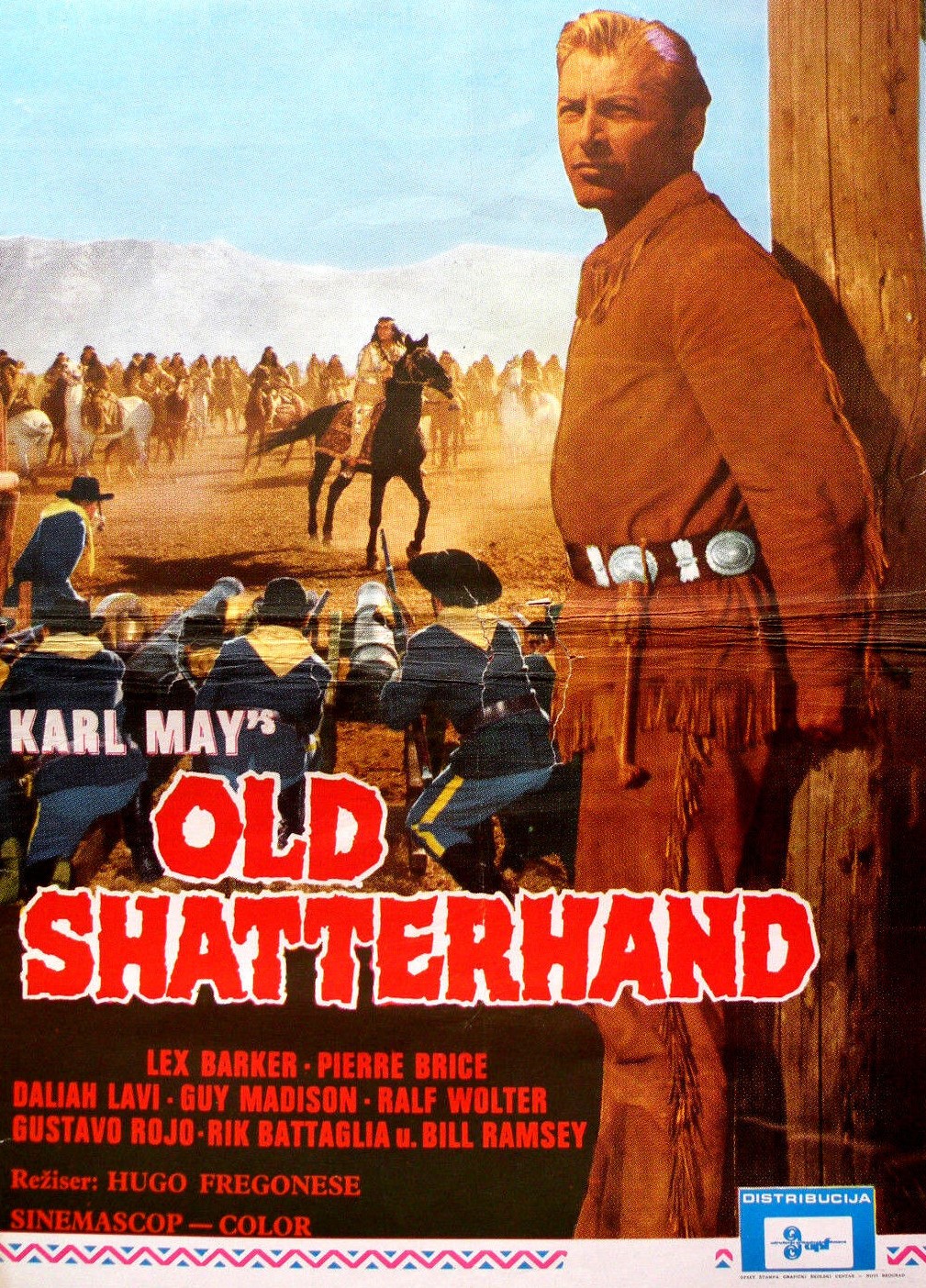
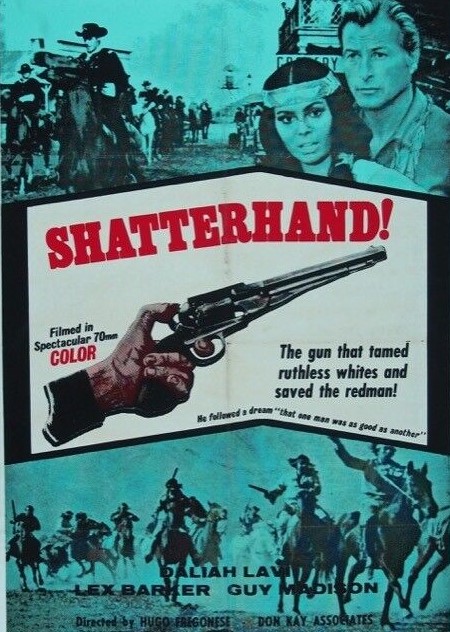
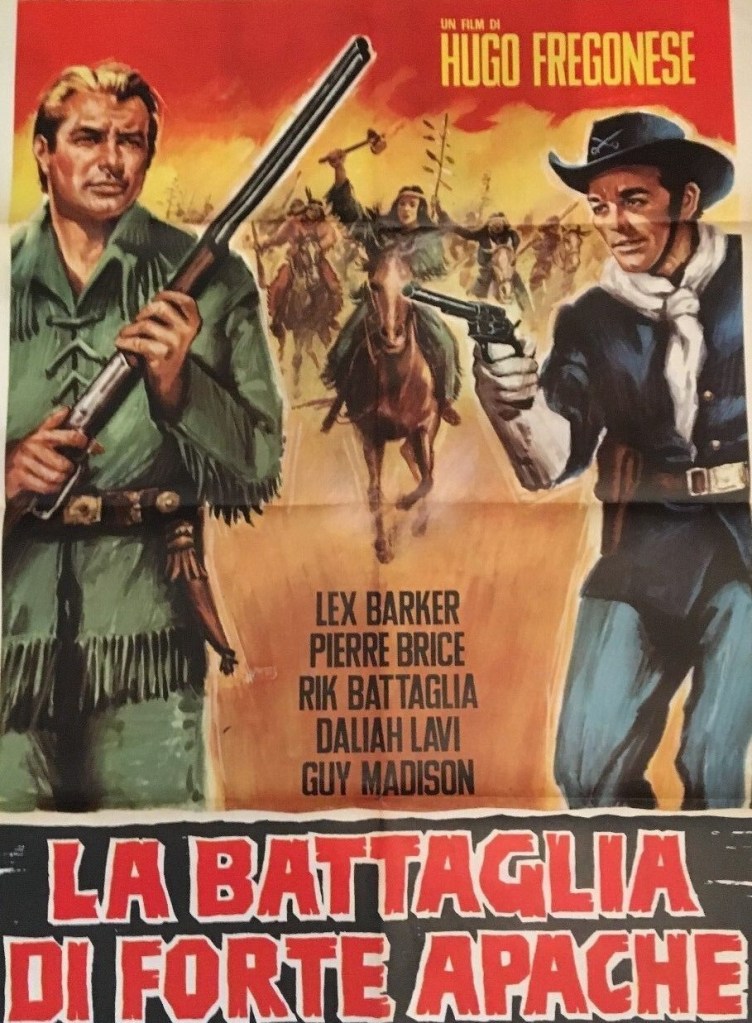
Old Shatterhand (1963) ***

Blame Lex Barker (Pirates of the Coast, 1963) and Daliah Lavi (The Demon, 1963) for my interest in this German-made western. In the aftermath of the spaghetti western and the messianic writings of Christopher Frayling I’d been aware of the Karl May western boom in the early 1960s and a series revolving around cowboy Old Shatterhand and his buddy Apache chief Winnetou, based on the novels of May who died in 1912. Quite why it took the 50th anniversary of his death to make the Germans wake up to his potential is anybody’s guess.

Theoretically, he was the German equivalent of Zane Grey, but unlike the American author whose novels were filmed over 100 times before the 1960s, only six movies were made from May westerns up to that point compared to over 20 and umpteen small-screen features and series since. Treasure of the Silver Lake (1962), the number one film at the German box office that year, was credited with starting the boom.

Story here is quite simple but the cinematography, filmed in 70mm, is breath-taking, even if it’s primarily of Yugoslavia. And there’s an iconic score. Hugo Fregonese (Marco Polo, 1962) isn’t in the Sergio Leone league – he doesn’t come close – but the picture is held together by Lex Barker (Pirates of the Coast, 1963) as Shatterhand and Frenchman Pierre Brice (Samson and the Slave Queen, 1963) as Winnetou with Daliah Lavi popping up as half-breed Paloma, not, interestingly enough, romancing either of the principals, and actually exploring her maternal instinct, looking after the orphaned Tom (Leonardo Putzgruber), more central to the narrative.

Guy Madison (Tobruk, 1967) used his matinee idol looks in kind of a role reversal, the idea of a handsome villain being anathema to audiences of the period, more accustomed to bad guys in the Jack Palance-Lee Marvin vein.

U.S. Cavalry Capt. Bradley (Guy Madison) teams up with the Commanche to frame Winnetou for the murder of settlers in order to disrupt peace negotiations between the Native Americans and the Government. Tom, the only survivor of a massacre, is later brutally murdered by the soldiers. Not quite lingering on the baby blues of ruthless killer Henry Fonda in Once Upon a Time in the West (1969) but still breaking a big taboo.

As you might expect there’s an attempted lynching but you’d be surprised to see this amount of nudity for the time, though, of course, a nice peaceful river always proves too much of a temptation for skinny dipping. There’s some pretty decent action, and the Native Americans get to show off their marksmanship with a bow-and-arrow, and there’s an axe duel instead of the usual fisticuffs. Shatterhand doesn’t always come to the rescue, for the finale he’s tied up. But there’s some interesting authentic detail, a male saloon keeper, for example, hanging out towels to dry, and when Native Americans ambush a wagon train with boulders it is logically achieved – and the boulders look dangerous enough. There’s a pretty big reversal when you’re cheering on a Native American attack on a fort.

Although the American western was about to enter a revisionist period, there was no equivalent to the ongoing friendship between Shatterhand and Winnetou or the idea that the Native American was a regular guy. 

There’s not enough story to support a two-hour movie but the scenery is stunning and you can see why Lex Barker was invited back to the well several times. Daliah Lavi’s talent was often overlooked in favor of her beauty but here, at least, she has a part with some meat.

Interesting.

Selling the Exotic – Pressbook for “24 Hours to Kill” (1965)

No matter how small a picture, its budget had to stretch to a Pressbook. Even if the movie would end up on the bottom half of a double bill or a drive-in programmer and did not have much to shout about, it still needed a Pressbook. Low-budget films meant low-budget advertising campaigns unless your name was Joe Levine who often spent far more promoting films than he did making them.

The Pressbook was essential because it was the source of the movie’s adverts that could appear in a newspaper – these came in a variety of sizes so an  exhibitor could remove the one most relevant and take it down to their local newspaper to make up the display advertisement. In the pre-digital era, it was a crude as that, adverts were effectively cut and pasted.

While some Pressbooks could run to 16, 20 or 24 A3 pages in full color, the most basic requirement would be four pages, enough to show the ads and get the basic message across. This was of the basic variety. In this case, ads took up the first two-and-a-half pages, leaving a half-page to list the credits and explain the plot. The final page contained information about the stars..  

Perhaps as revenge for producer Harry Alan Towers not coughing up enough money for a decent Pressbook, his name was left off it. Instead, filing his slot was Oliver A. Unger, more famous as a pioneer of syndicated television, importer of foreign films and producer of The Pawnbroker (1964). In reality, he was an executive producer, in those days that function being fulfilled by someone who either invested in the picture upfront or once filming was complete bought territorial rights.

Artwork was minimal, one main advertisement, one alternative. But more or less the same taglines appear in both. Hoping to hook in the audiences was the notion of “perfumed harem…in mysterious Beirut…where every hour can be your wildest.. and your last.”

Usually films like these boasting a flotilla of European beauties devoted some space to explaining their origins and puffing up their potential. Not so here. Space is just too tight. The only actors covered are Lex Barker, Mickey Rooney and Walter Szelak. Strangely, no mention is made of Barker’s socko career as a German western hero – the notion that Europeans could make westerns remained absurd at this point (A Fistful of Dollars would take three years following completion to reach U.S. screens).

According to the Pressbook, Barker more or less jumped straight from Tarzan to this kind of thriller. Though he had been out of the loin-cloth for more than a decade (Tarzan and the She-Devil, 1953, his final appearance), the 40 pictures he had made since then (including La Dolce Vita, 1960) did not merit a sentence. The Pressbook did carry a quotable quote from Barker explaining his reasons for quitting jungle life: “It made me feel like a male Bardot because I was always parading around almost nude.” This was the type of quote that only made sense until you realised that Bardot did not become a star till three years after he quit playing Tarzan. Still, who was going to argue?

A strict regimen of physical exercise allowed him to keep in the shape necessary for the film which required him to “run for his life, rescue a pretty hostess from kidnap by helicopter and fight off thug after thug.” 

Mickey Rooney gets a better write-up, especially for making the rare jump from successful child star to accepted by audiences for his adult roles. Though the writer of the Pressbook never appeared to actually go the movies. Spot the mistake in this sentence: “Last seen in runaway box office hit It’s A Mad, Mad, Mad, Mad, World Rooney now appears for producer Oliver A. Under in a drama equally as challenging.” That the first film was actually a comedy and not a drama never seemed to sink in.

The usual promotional material – suggestions for marketing, maybe a record of the soundtrack available, perhaps a theme song to target radio stations, various stunts – was non-existent even though the movie leant itself to a tie-in with an airline or a travel company especially as the National Lebanese Tourist Council had gone out of its way to accommodate the production.

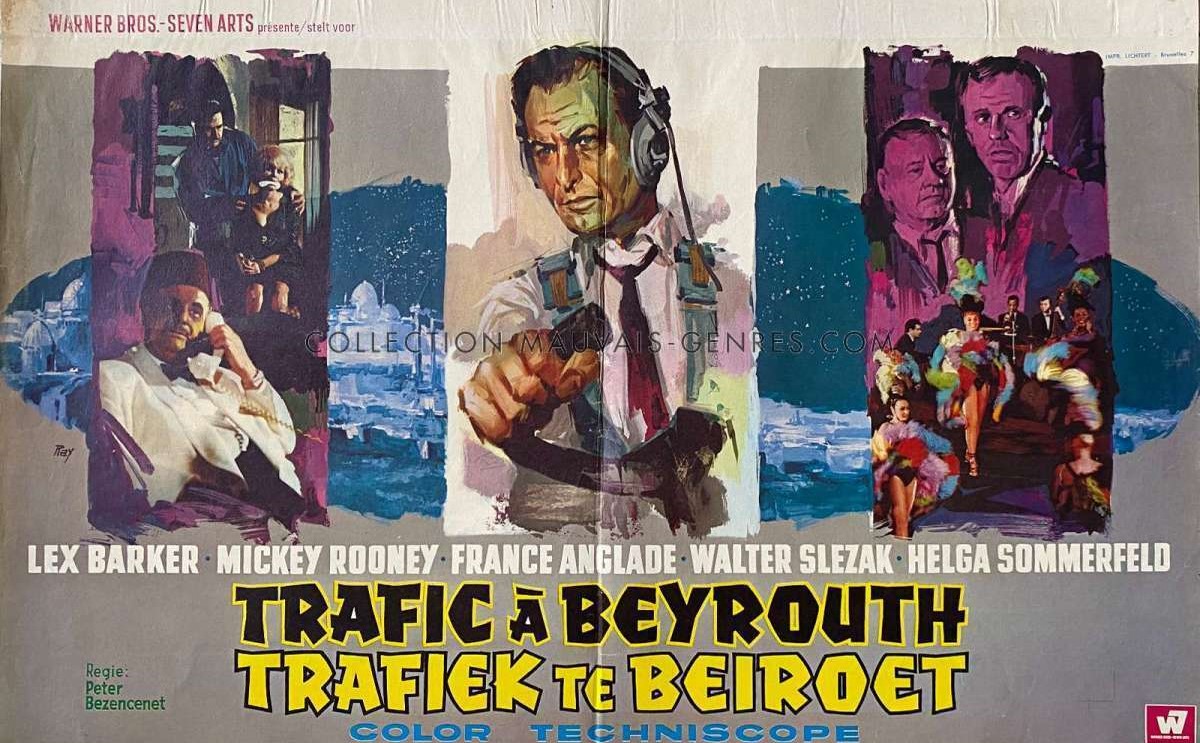
24 Hours To Kill (1965) **

When engine problems force a plane headed for Athens to land in Beirut, the past catches up with purser Norman Jones (Mickey Rooney). He manages to convince captain Jamie Faulkner (Lex Barker) and the crew that claims by ruthless gangster Malouf (Walter Szelak) claiming he has stolen his money is a mistake. But once the kidnappings begin, the doubts set in.

Producer Harry Alan Towers (Five Golden Dragons, 1967), though he remained wedded to the exotic locale, would soon learn to prioritize action over romantic entanglement and this suffers from too much romance – married Faulkner trying to resolve his relationship with stewardess girlfriend Louise (Helga Summerfeld),  co-pilot Tommy (Michael Medwin) ignoring another stewardess Franzi (France Anglade) in favour of local girl Mimi listed in his little black book of previous conquests.

After a failed attempt to kidnap Jones, the gangsters turn their attentions to female members of the crew. Slim built Tommy proves handy with his fists and soon the crew are either running from trouble or running into trouble even as they attempt to enjoy the city high life. The title has a double meaning – the crew take it to mean that they have time on their hands to pass in as pleasant manner as possible only later realizing that their accidental landing provides the gangsters with a complete day to apprehend/kill Jones before the plane’s rescheduled take-off.

Although a good sight more attractive in the 1960s than when  war destroyed the city, Beirut still had comparatively little to offer a visitor beyond a historic site claimed to the Garden of Eden, posh hotels, swimming pools and the kind of belly dancers that you could get anywhere in the Middle East. Still, the movie does its best to convince the audience they are in for an exotic treat. Unfortunately, locale and girls in bikinis do not make up for poor plotting and lack of action.

In terms of casting Towers had hit upon a decent formula in the international coproduction line, Hollywood stars who didn’t cost too much but still retained marquee value and up-and-comers who might be sold as the next best thing to their respective countries, thus bringing in global revenue.  Former MGM child star Mickey Rooney (Secret Invasion, 1964) is the requisite Hollywood star, his credentials buffed up by the hit It’s A Mad, Mad, Mad, Mad World (1963), and continually newsworthy for his love life – he was currently on marriage number five.

All-purpose action hero Lex Barker was the surprise box office package. A former Tarzan he was enjoying a new lease of life as a huge star in Germany thanks to the Old Shatterhand series of westerns. Veteran Walter Slezak (Come September, 1961) completed the small group of actors who audiences might automatically recognize.

Heading the newcomers was Englishman Michael Medwin (Crooks Anonymous, 1962) who would later turn producer of If…(1968) ably supported by a stewardess trio played by German Helga Sommerfeld (The Phantom of Soho, 1964), French starlet France Anglade  (The Oldest Profession, 1967) and Austrian Helga Lehner (Games of Desire, 1964). Likely more memorable for purveyors of the European scene would be a brief appearance by another Austrian, Maria Rohm (Five Golden Dragons), wife of the producer. You might also spot Wolfgang Lukschy (A Fistful of Dollars, 1964).

British director Peter Bezencenet (Bomb in the High Street, 1963) was better known for his editing skills but didn’t cover himself in glory in either department here. Australian Peter Yeldham (The Liquidator, 1965) wrote the screenplay along with Towers. While not a great film, you can see the Towers style in embryo, this being only the fourth of the around 100 films that would go out under his banner.

Discover WordPress

A daily selection of the best content published on WordPress, collected for you by humans who love to read.

The Atavist Magazine

by Brian Hannan

WordPress.com News

The latest news on WordPress.com and the WordPress community.