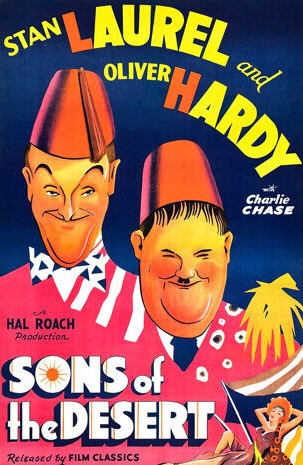
Sons of the Desert (1933) *** – Seen at the Cinema

One of the joys of the current spate of one-day anniversary revivals is that it turns up a 90-year-old gem like this. I haven’t seen Laurel and Hardy on the big screen since I was a child, and that wasn’t even in the cinema, but at our local school in Cumbernauld, Scotland, where the local padre Fr Jaconelli (part of the famed ice-cream clan) ran an impromptu cinema show on Saturday mornings with a shaky 16mm projector.

Actually, I could catch the comedic duo once a week at a pub down the road where the local chapter of the “Sons of the Desert” fan club hosts a showing. “Sons of the Desert,” in case you didn’t know, is an international fan club with hundreds of affiliated clubs (or “tents” as they are known) and this film is the reason.
But the question, as ever, with comedians, is does their schtick stand the test of time. They are perhaps fortunate in that they don’t rely on witty one-liners. On the other hand, the set-ups are so straightforward they are almost prehistoric. And comedy double acts have more or less disappeared.

The movie follows the traditional Laurel and Hardy template, some barmy scheme dreamed up by Ollie, tripping over ever prop in sight, a variety of items to destroy, the pair bedraggled. In this case, Ollie’s wife Lottie (Mae Busch) opposed the idea of them attending the annual convention of the aforesaid desert gang in Chicago so he convinces her that he’s so ill the only way he’ll recover is by taking a trip to Honolulu. Naturally, the liner sinks and they are caught out in the lie.

Meanwhile, all mayhem breaks loose, drenched on the roof, battered at the convention, the target of practical jokes by conventioneer Charley (Charley Chase) who turns out to be Lottie’s long-lost brother. The plot’s pretty much irrelevant where this pair are concerned, just the starting point for a series of gags, whether it’s Stan eating wax fruit, landing Ollie in whatever water is handy, and both doing the wrong thing when the correct would have been simpler.

Sure, Ollie twiddles with his tie and harrumphs and marches his fingers across the table, Stan scratches his hair and looks about to burst into tears, but the combination remains irresistible. Few comic duos have come as close and then for not as long.
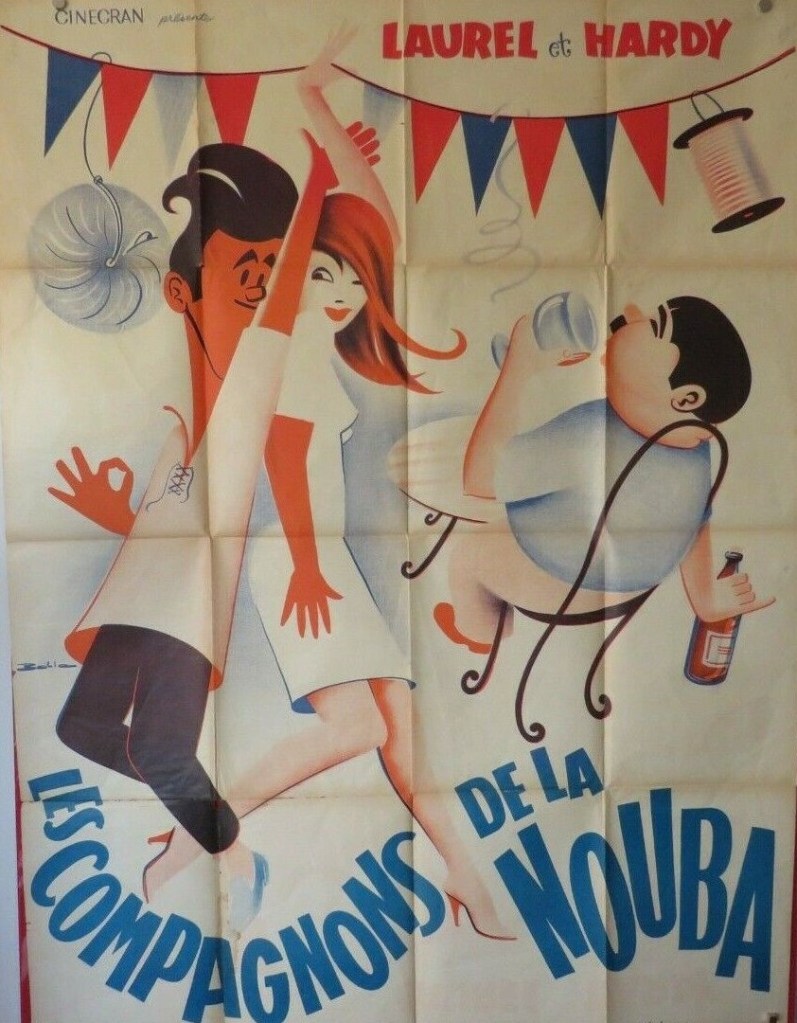
The program also included the short Dirty Work from the same year which sees them as chimneysweeps attending the household of a mad scientist who has discovering the secrets of rejuvenation. I’m not such a big fan that I could tell you where Sons of the Desert ranks in their pantheon, except that it was the inspiration for the fan club (which prefers, incidentally, to be known as a collection of “film buffs”) but it was fantastic just to see them on the big screen and imagine the laughter they have generated down the generations.

There was a big revival in the 1960s, when silent comedy was being rediscovered, and there was a cartoon series, and they made so many films you can probably see one anywhere anytime. These kind of gagsters never went out of fashion, Jim Carrey channeled much of their mirth, but few have matched their sense of timing.

I saw this as part of my self-appointed cinema triple bill on Monday. I’ve reviewed the films in reverse order of seeing them. It’s one of the beauties of my method of going to the cinema that I can compile a program from completely different genres – comedy, crime, horror – and go in with little expectation (I doubted even Laurel and Hardy would stand the test of time on the big screen) and come out thinking I had one of the best cinema outings in a long time.
https://amzn.to/3seQd06

Gimme Slapstick

The spate of slapstick-led comedies like It’s A Mad, Mad, Mad, Mad World (1963) and The Great Race (1965) and British featurettes such as The Plank (1967) did not suddenly appear out of nowhere as was often the case with a moribund genre. The slapstick revival came by way of television. In the 1950s U.S. networks were screening silent shorts featuring Laurel and Hardy, Charlie Chaplin, and some of the Hal Roach and Mack Sennett output.

The driving force behind the big screen resurgence of interest in silent comedy was Robert Youngson who spent $100,000 in 1957 on what purported to be a new documentary The Golden Age of Comedy. In fact it was a good excuse for a compilation of old movie clips featuring Laurel and Hardy, Harry Langdon and actresses known for their comic ability such as Jean Harlow and Carole Lombard. But while the television audience was weighted towards the young, Youngson’s picture reached a more appreciative adult audience in the arthouses, which would prove to be the bedrock for the ambitious revitalizing of the careers of other greats from the Hollywood peak years.

The Golden Age of Comedy was hugely successful, taking $500,000 in rentals. Since arthouses notoriously shared of lot less of their box office with studios there was a fair chance that the gross was in the region of $1.5 million, a tremendous return on investment, and opening the door for further sequels.

Silent comedy also crossed national boundaries. Modern dialogue-driven Hollywood comedies often found it hard to gain a foothold overseas. But The Golden Age of Comedy film was Twentieth Century Fox’s top grosser in India and huge in Italy.

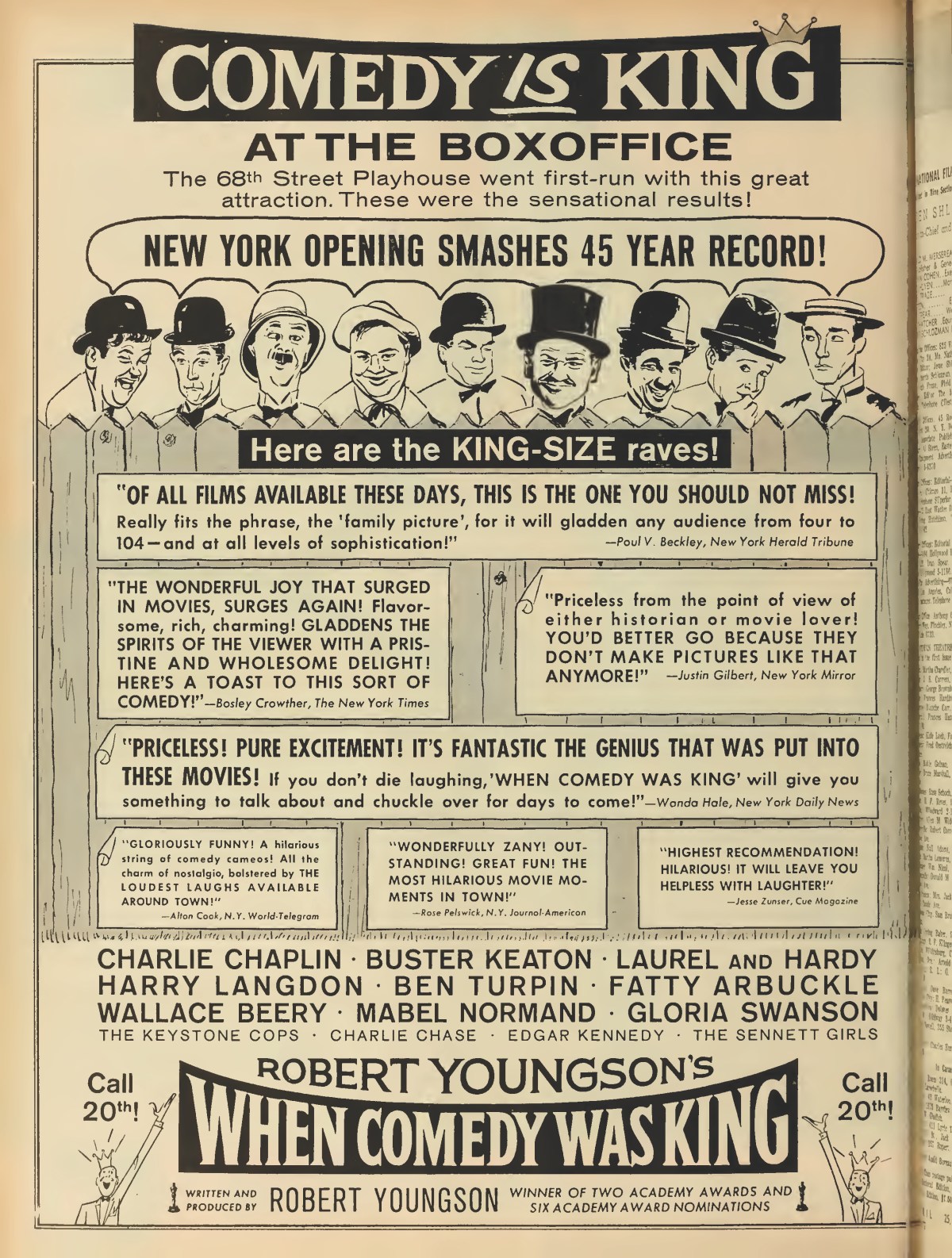
Follow-up When Comedy Was King (1960) smashed box office records in New York at the 370-seat arthouse the 68th St Playhouse and at prices ranging from 90c to $1.65 playing to an estimated 10,000 moviegoers and running for another eight weeks. That gave Fox the greenlight to stick it out on the more commercial circuits as a supporting feature. But that was just the tip of the compilation iceberg, especially when other studios got into the act.

Hardly a year went by without another compilation – from the Youngson camp emerged Days of Thrills and Laughter (1961) and 30 Years of Fun (1963). MGM put marketing muscle behind the producer’s The Big Parade of Comedy (1964) to the extent that it collected rave reviews from Newsweek and the New York Times and the studio held seminars for exhibitors on “sight comedy.” The inevitable double bill When Comedy Was King/Days of Thrills and Laughter appeared in 1965.

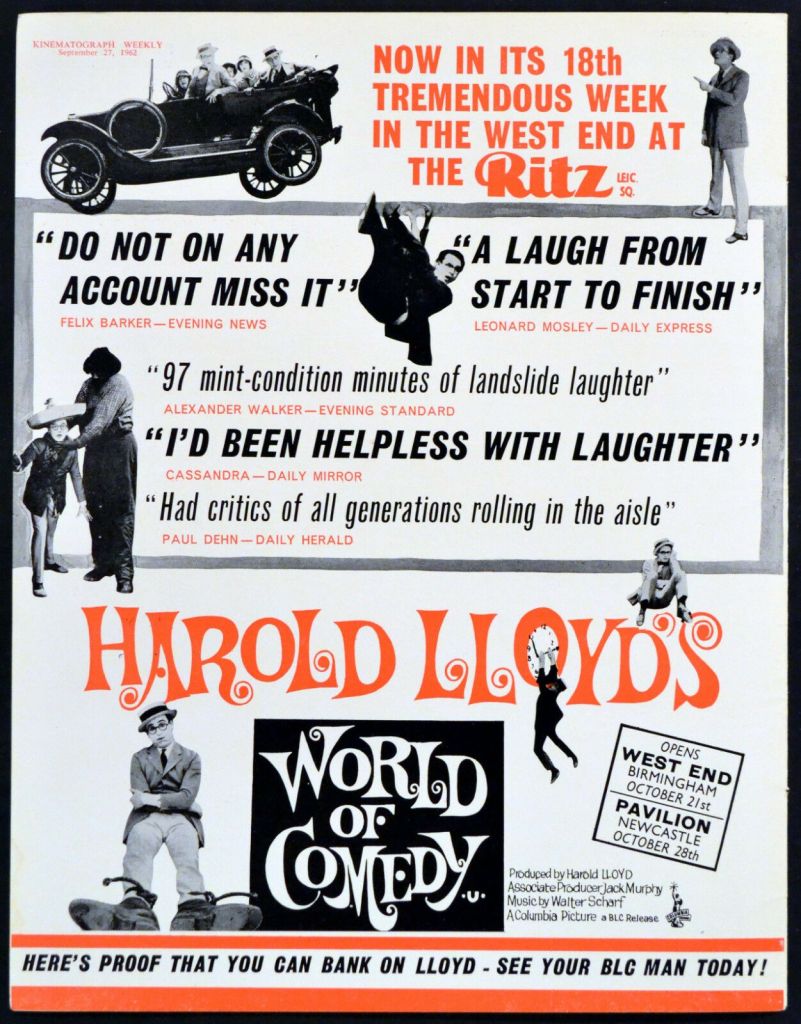
Harold Lloyd owned the copyright to all his films so his work was not chopped up piecemeal to satisfy the demands of a compilation. Harold Lloyd’s World of Comedy (1962) showed the comedian at the peak of his game. It combined eight scenes from silent and sound films Safety Last (1923), Why Worry (1923), Girl Shy (1924), Hot Water (1924), The Freshman (1925), Feet First (1930), Movie Crazy (1932) and Professor Beware (1938). His trademark spectacles were incorporated into the advertising. Follow-up Funny Side of Life (1963) included a complete version of The Freshman.

Mining a different silent tradition and with less emphasis on comedy was The Great Chase (1962) – including a shortened version of The General (1926) – which featured stunts by Douglas Fairbanks, Buster Keaton, William S. Hart and Pearl White.

The Buster Keaton revival had been initiated in less commercial fashion by Raymond Rohauer who had begun staging festival sof his films in arthouses. He tracked down prints of long-lost films in France, Denmark and Czechoslovakia but his compilations Buster Keaton Rides Again (1965) and The Great Stone Face (1966) were more successful abroad than at home.

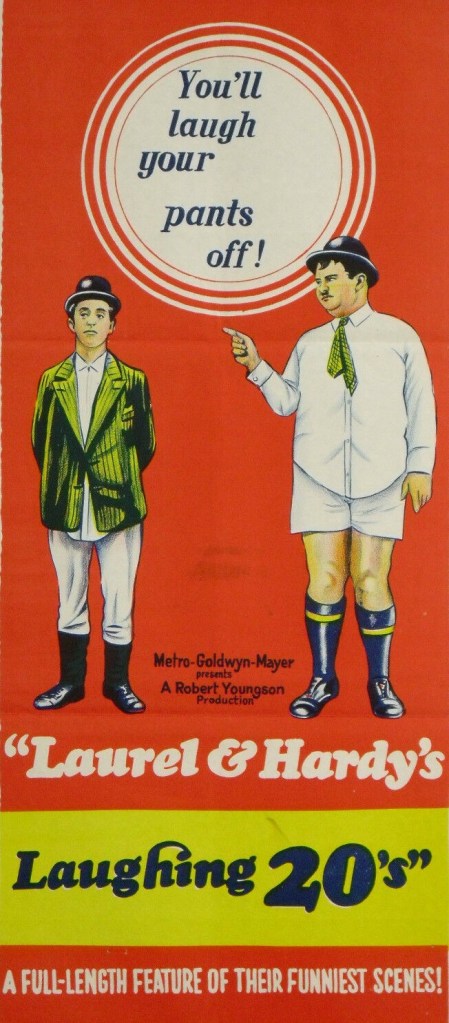
Blake Edwards’ The Great Race was dedicated to Laurel and Hardy who had become more prominent on both small-screen and big-screen thanks in part to the initial Youngson compilations. MGM were first out the traps with Laurel and Hardy’s Laughing 20s (1965). Then came producer Jay Ward’s The Crazy World of Laurel and Hardy (1966) and The Further Perils of Laurel and Hardy (1967) followed by a collection of colorized shorts The Best of Laurel and Hardy while Hanna-Barbera launched a cartoon series on television in 1966 and Pillsbury sold Laurel and Hardy donuts.

SOURCES: Brian Hannan, Coming Back to a Theater Near You: A History of the Hollywood Reissue 1914-2014 (McFarland, 2016), pages 200-205; “Youngson Anthologies of Silents Continue Showing Coin Potential,” Variety, October 19, 1960, p13; “Picture Grosses,” Variety, March 9, 1960, p8; Advertisement, “Sleeper of the Year,” Box Office, October 5, 1964, p7; “MGM Sets Fun Campaign for Laurel and Hardy,” Box Office, September 20, 1965, p112;  “Comedy Seminar Helps MGM Film Promotion,” Box Office, December 13, 1965, p94; “Pillsbury Acquires Rights for Laurel and Hardy Donuts,” Box Office, October 23, 1966, p27; “Archivist Raymond Rohauer,” Los Angeles Times, November 20, 1987.

When Comedy Was King (1960) ***

The 1960s was as much devoted to old movies as to new – the production shortage sent studios and producers back to the vaults to find anything that could fill a slot on a cinema program – and one of the most surprising beneficiaries of this was the silent movie.

It’s impossible to understand the 1960s without realizing what underpinned both the revival of slapstick comedy in such movies as It’s a Mad, Mad, Mad, Mad World (1963) and The Great Race (1965) and, just as crucially, brought to the attention of a new public other non-comedic stars from Hollywood’s “golden age,” the revival of whose movies in turn prompted a reissue boom and a decade or so further on provided the stimulus for the restoration of forgotten masterpieces.

The innovator in the silent comedy field was Robert Youngson, a two-time Oscar-winner (in the one-reel documentary category), who had set the ball rolling with The Golden Age of Comedy (1957).

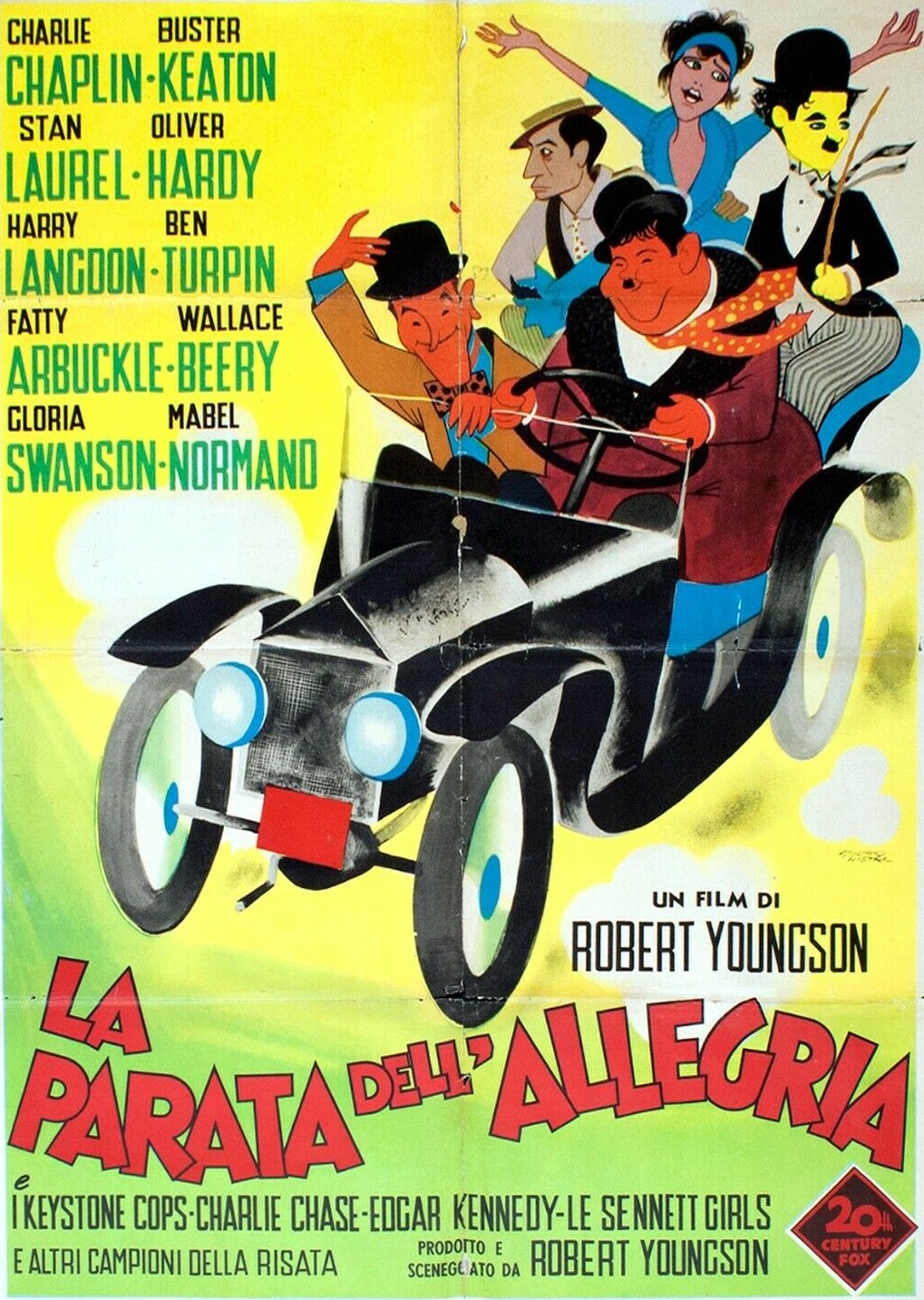
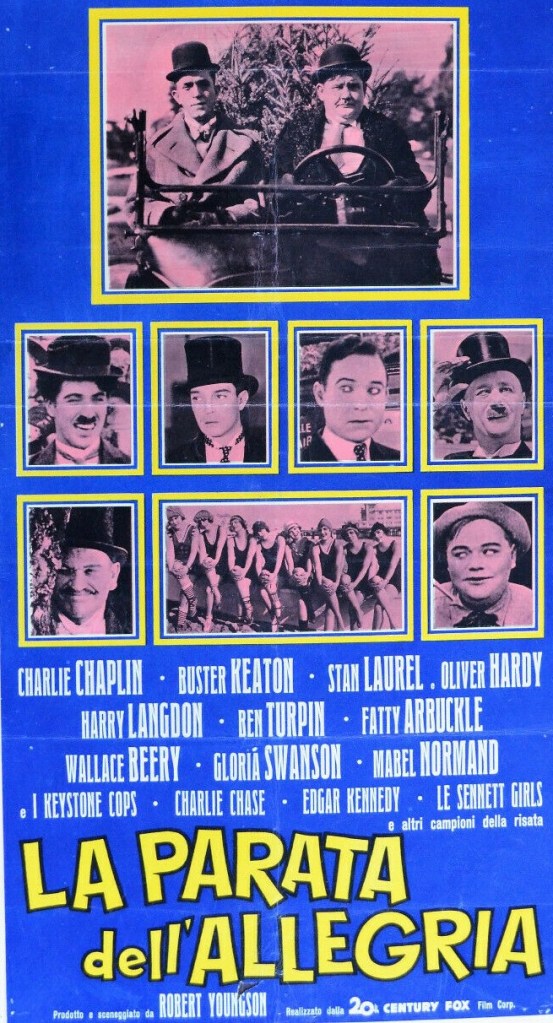
When Comedy Was King sports a greater repertoire of stars and in essence presents a tribute – though not necessarily a greatest hits – to some of the best of the silent comedians The line-up includes Charlie Chaplin, Buster Keaton, Fatty Arbuckle, Laurel and Hardy, Mabel Normand and the Keystone Cops.

It was renamed “The Parade of Joy” for European markets.

None of the shorts featured are necessarily an individual artist’s greatest work – Chaplin’s contribution, for example, is drawn from a trio of 1914 pictures, The Masqurader, Kid Auto in Venice and His Trysting Place, none of which would be seen to represent the actor at his height. But they do give an idea of what silent comedy was all about.

Buster Keaton’s contribution is selected from the 18-minute Cops (1922) with well-timed gags, slapstick and car chases. Mutual self-destruction is a hallmark of Laurel and Hardy and Big Business (1929) sees the pair get into an argument with a customer, ending up demolishing everything in sight.  This is probably the pick of the compilation since the pair’s comedy relies on their relationship with each other and with anyone who gets in their way.

Appreciation of the particular talents of Fatty Arbuckle scarcely survived the scandal that ended his career while memory of Mabel Normand would also have been hazy so Fatty and Mabel Adrift (1916) is a good example of their comedy styles. They play a couple whose bed ends up floating on the sea.

Youngson was not above cashing in on a star’s future fame even when the example used of the person’s work could hardly be considered their best. In the case of Gloria Swanson (Sunset Boulevard, 1950) she was unrecognizable especially as she was only 12-years-old and being billed at the time as Gloria Dawn. Her inclusion is taken from the short Jimmie the Fox (1911) later renamed Bobby’s Sweetheart. Certainly, she is displaying none of the dramatic ability which made her the highest paid actress of the 1920s.

For all the varying quality of the actual footage, it does work as a showcase for the various stars, even though they would achieve greater success in later films. As importantly, it opened up for the 1960s generation the world of silent comedy and seemed to make that decade’s audience laugh as much as it had done previously.

Youngson would go on to make another five of these compilations throughout the decade. Without his initial forays into old school comedy, big-budget 70mm roadshows like It’s A Mad, Mad, Mad, Mad, Mad World would never have seen the light of day, nor would more modest efforts like the British-made The Plank (1967), written, directed and starring Eric Sykes.

Discover WordPress

A daily selection of the best content published on WordPress, collected for you by humans who love to read.

The Atavist Magazine

by Brian Hannan

WordPress.com News

The latest news on WordPress.com and the WordPress community.