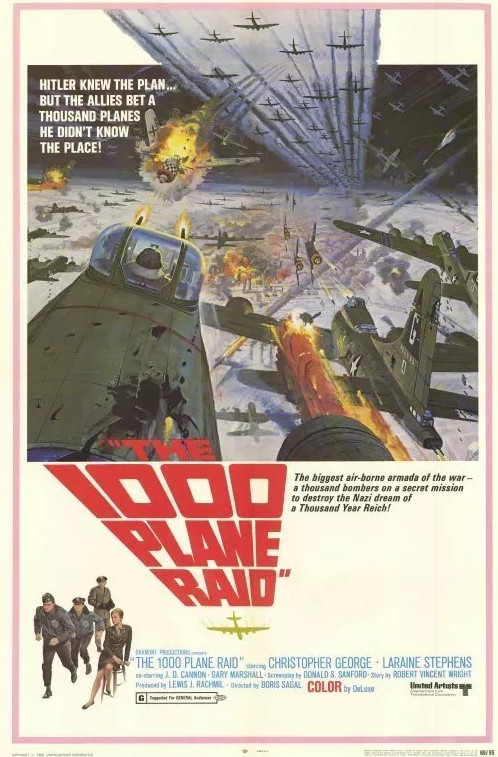
The Thousand Plane Raid (1969) ***

Let’s be honest. Like 633 Squadron (1964) and perhaps even, despite its all-star cast, Battle of Britain (1969), many in the audience will only be there for the hardware, the chance to see the flying battle buses that took the Allies to victory in World War Two. There’s not going to be much of a story anyway – rivalry between commanders, tension on the ground, a romance beginning or breaking apart, a stash of info dumps. That can hardly compare to the grace of the big birds in the air, usually a mixture of stock footage and new work with refurbished old planes.

This one has even re-purposed – perhaps stolen would be a better word – a mission from earlier in the war which was planned and carried out by the RAF so that it could be planned and in part carried out by the Yanks. Still, it was the Yanks putting up the money so I guess they can change history whenever they like.
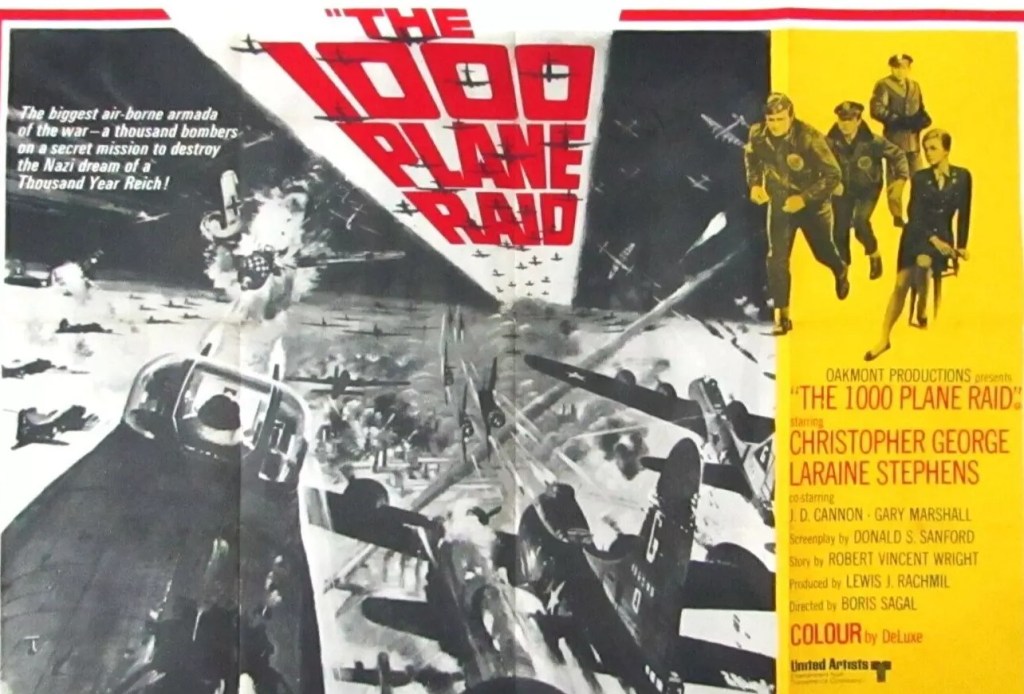
U.S. Air Force Col Brandon (Christopher George), leading an American bomber group stationed in England, has worked out that while night-time missions result in fewer casualties they are increasingly failing to get the job done, only one on five bombs hitting the designated target. He reckons a gigantic air attack in daylight is the only way to succeed. His boss General Palmer (J.D. Cannon) grants him the chance to pitch his idea to the assembled RAF high command. Despite the risks, they agree and then need to come up with about million gallons of fuel and about a million-and-half tons of bombs, and requisition 30 airfields for the bombers and the same number for the fighter support.
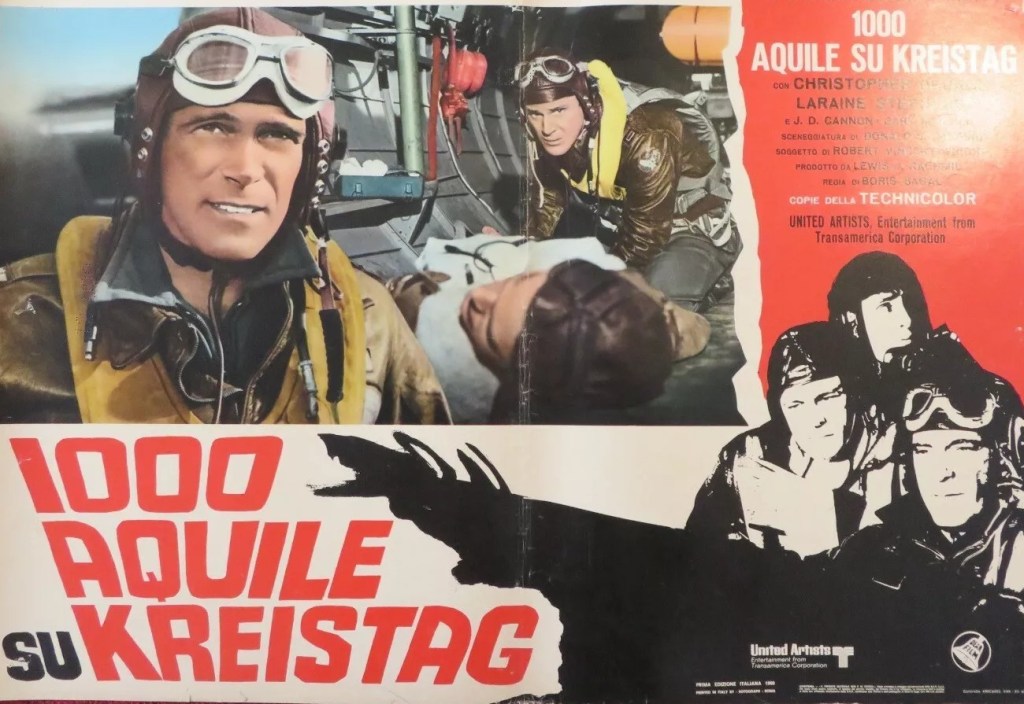
Various elements make life tougher for Brandon. The mission chosen is much further afield than he originally imagined, the deadline is brought forward, his crew is unprepared and needs toughened up, plus his romance with WAC Lt Gabby Ames (Laraine Stephens) has hit a sticky patch and he’s having to deal with a cocky RAF fighter pilot Wing Commander Howard (Gary Marshal) who’s been seconded to the operation. To annoy Brandon further Howard befriends disgraced American pilot Lt Archer (Ben Murphy) who’s been accused of cowardice.

Before we can get to the big event, Brandon also undergoes a crisis of confidence and it’s as much as he can do to pull himself together in time. The screenwriter has arranged for the three main characters to end up in the one plane, allowing Archer to prove himself in battle and Howard to manage some heroics.

The sight of a huge array of WW2 planes in the air without the help of CGI still takes the breath away. Even though the final action pales in comparison with 633 Squadron or Battle of Britain it’s visually powerful enough to see us through.

By the end of the 1960s, B-pictures cost a lot more, but that didn’t necessarily result in better performances. Christopher George (El Dorado, 1966), signed up to a five-picture deal by United Artists, isn’t the breakout star. In fact there isn’t one, neither Laraine Stephens (40 Guns to Apache Pass, 1967) nor Gary Marshal (Camelot, 1967), in his second and final movie, making much of an impression. However, the picture was more notable for members of the supporting cast including J.D. Cannon (Krakatoa: East of Java, 1968), Ben Murphy (Alias Smith and Jones TV series, 1971-193), Bo Hopkins (The Wild Bunch, 1969), future director Henry Jaglom (A Safe Place, 1971) and Tim McIntyre (The Sterile Cuckoo, 1969).

One who certainly made the step up was director Boris Sagal (Made in Paris, 1966); in a couple of years he would be helming cult number The Omega Man (1971). Written by Donald S. Sanford (Midway, 1976).

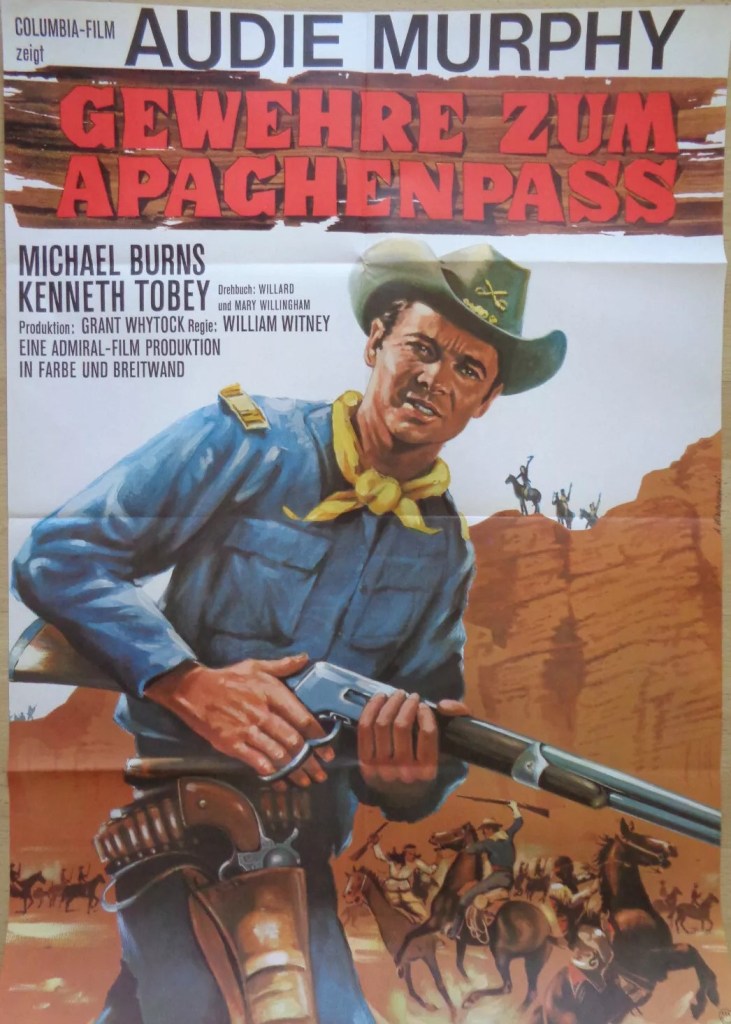
40 Guns to Apache Pass (1967) ***

Spent most of the time watching this wondering what depths Glenn Ford and Inger Stevens would find in this interesting script in which relationships come asunder through situation. Instead, we’ve got war hero turned movie actor – I hesitate to say star because his marquee was virtually always of the B-movie brigade – Audie Murphy (Bullet for a Badman, 1964) in his last starring role looking as wooden as ever and in a superbly-written conflicted role the equally ineffective Laraine Stephens (Hellfighters, 1968).  

That there was still a market for the kind of western that refused to embrace the revisionism expressed by Cheyenne Autumn (1964) or Hombre (1967) was odd in itself. In fact, by this stage most of the best westerns steered cleared of the Native American issue,  preferring subjects like the Civil War (Shenandoah, 1965), errant gunslingers (Cat Ballou, 1965) or standard western tropes with standard villains (The Sons of Katie Elder, 1965, El Dorado, 1967, The War Wagon, 1967).

The title plays around with the more famous Battle of Apache Pass which took place in 1862, seven years before this movie was set. Despite the indifferent playing, the script by Willard W. Willingham and wife Mary (one of the exceptionally few female screenwriters plying their trade in Hollywood at the time) is lean and interesting. Apache chief Cochise is on the warpath and settlers have to abandon their homes and be brought to the safer environs of Apache Wells.

Ramrod stiff Captain Coburn (Audie Murphy) is in charge of the operation which includes bringing his romantic interest Ellen (Laraine Stephens) and her family to safety. There’s not much trouble doing that except rebellious Corporal Bodine (Kenneth Tobey), the kind of subordinate who’s always insubordinate, picks a fight with the officer. Against the ostensibly much tougher opponent, Coburn wins the tussle and beats the living hell out of his underling. But Ellen is of delicate stock and doesn’t take kindly to her potential husband’s violent streak.  

At the makeshift fort Col Reed (Byron Morrow) is driven to desperation by the lack of weaponry, awaiting a long-promised supply of the newest model of repeating rifles. The scouts delivering the titular 40 weapons refuse to risk taking the supply wagons so close to the Apaches so Coburn is designated to undertake the “mission” to secrue them, taking a team of ten men including two of Ellen’s brothers Doug (Michael Burns) and Mike (Michael Blodgett) and Bodine. Doug falters under fire and is responsible for his brother’s death.

Bodine steals the guns, planning to sell them for $1,000 each in Mexico, an enterprise that gains the support of the remaining troopers bar the captain and his sergeant. With a piece of exceptional cunning, Bodine plans for those two to be blown up in a manner that will look like they have sacrificed their lives rather than surrender the weapons. And it’s an equally clever trick indeed that allows Coburn to escape.

This section brings unexpected depth, character revelation the key. Bodine turns out to be a Johnny Reb, joining the Army, wearing the dettestable blue, as an alternative post-war to imprisonment. And he’s not going to ride over 1,000 miles to Mexico when he’s got potential purchasers, the Apaches, hardly any distance away at all. Cochise doesn’t take too kindly to a traitor, though he’s willing ostensibly to do business.

Coburn, it turns out, is anything but the ramrod straight officer he effects to be. He came up the hard way, mostly been a loser all his life, and knowing that he’s blown this chance for future promotion. Back at the fort, not only does he face court martial, but Ellen blames him for the loss of her brothers, one dead, the other heading towards summary execution should he be captured as a deserter.

So, naturally, the only way out of this pickle is for Coburn to steal a couple of horses and attempt to recover the weapons. He’s again got a clever plan, holding off the bad guys by placing a bunch of repeating rifles at crucial points in his retreat so he doesn’t need to stop and reload.

In better hands this would have been a cracker. The duty-bound Coburn undone by duty, Ellen undone by placing her trust in the wrong man, Bodine undone by thinking he could outwit the clever Cochise.

Director William Witney (Arizona Raiders, 1965) had over 100 directoial credits, virtually all low-budget movies or television series, so he knew how to get the job done. A better director would have better use of the situation, characters and physical setting – those enscarpments go to waste for sure.

Calling out as much for a Budd Boetticher as a Glenn Ford and Inger Stevens.  

Discover WordPress

A daily selection of the best content published on WordPress, collected for you by humans who love to read.

The Atavist Magazine

by Brian Hannan

WordPress.com News

The latest news on WordPress.com and the WordPress community.