Who’s Got the Action (1962) ***

Complication. The keenest weapon in the screenwriter’s armory. And the most overused and, conversely, not employed to its greatest potential. Generally, it’s the only device for a romance – boy meets girl, (enter complication as…) boy loses girl, boy gets girl. But, just occasionally, it appears with some skill, layer after layer of deft complication until a whole story is tied up in acceptable and believable knots.

Before we get into all that it’s worth pointing out how language changes. These days mention of “action” will carry connotations of a sexual nature, so, just to be clear, here we’re talking about gambling, betting on horses, the mythical sure thing. And if you want to take a more cosmic perspective, we can apply the scientific rule that every action has a re-action, in other words consequence.
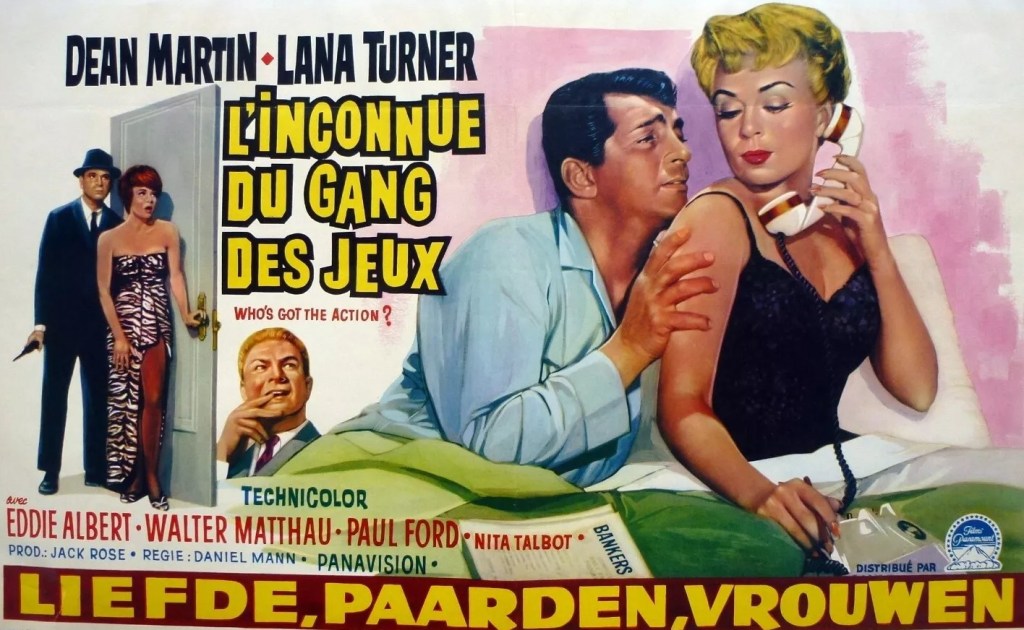
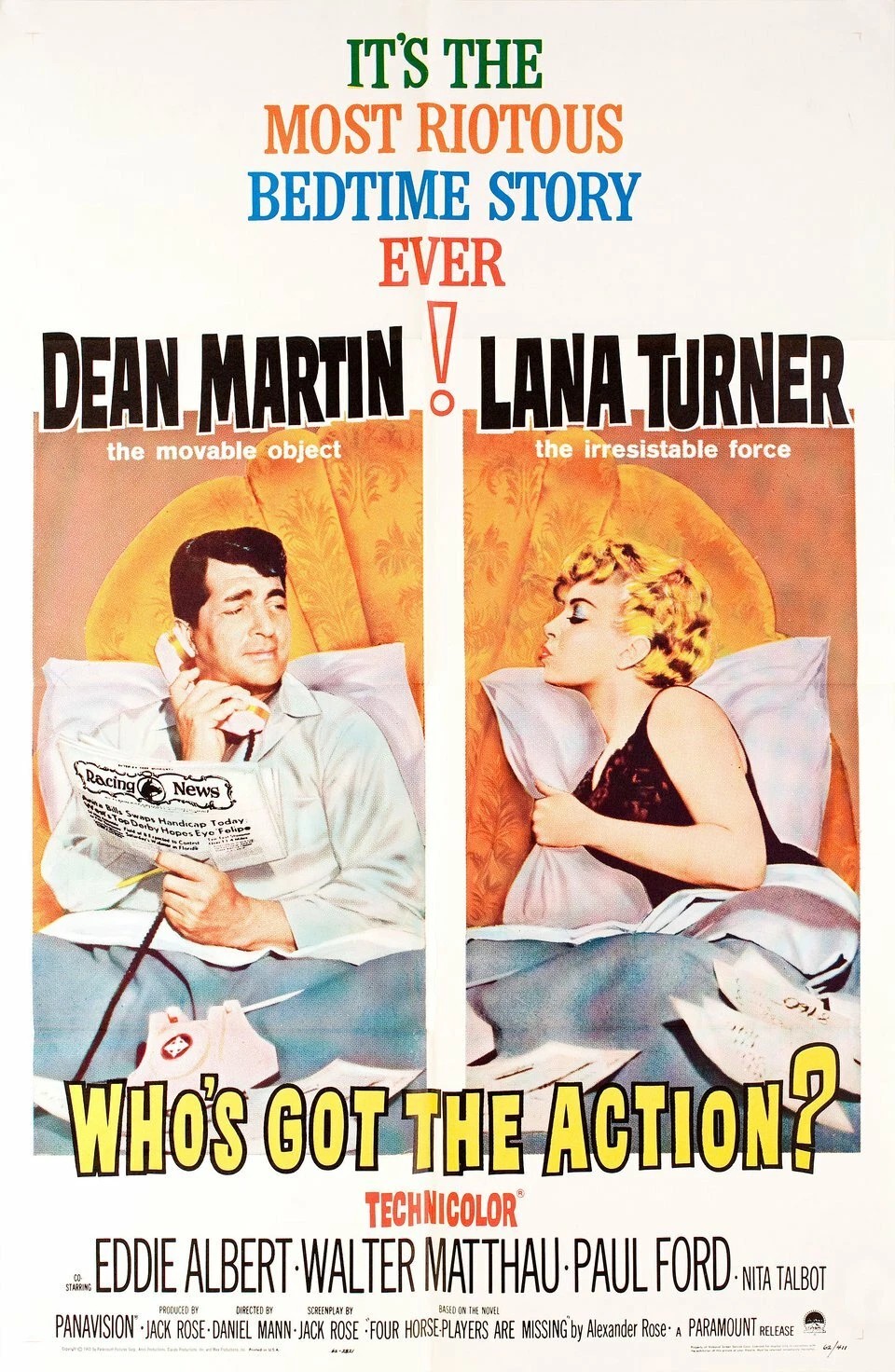
Attorney Steve Flood (Dean Martin) has a gambling addiction. He’s $8,000 in the hole to illegal bookie Clutch (Lewis Charles). Steve’s wife Melanie (Lana Turner) comes up with a clever idea to wean him off his addiction, by creating a fictional bookie, so that her husband’s losses will come to nothing. So she calls in Steve’s partner Clint Morgan (Eddie Albert) triggering Complication No 1. Clint’s always had the hots for Melanie and hopes to take advantage of Steve’s problems, helping her out by agreeing to act as the mythical bookie.

And that would be fine except for Complications No 2 and No 3. Instead of losing, as has been the trend, Steve wins big on his first bet, so now Melanie has to find a large chunk of dough. In dumping Clutch, Steve has come to the attention of mobster Tony Gagouts (Walter Matthau) who’s wondering about the mysterious new bookie queering his pitch and denying him a good customer (such is the definition of a loser).

Steve’s gambling success creates Complication No 4, attracting the interest of a pair of judges who are happy to stake the gambler, whose winning streak shows no sign of stopping.

Complication No 5 – Melanie turns to nightclub singer Saturday Knight (Nita Talbot), her next door neighbor and girlfriend of Tony, for help in raising cash and she obliges by buying some of the couple’s furnishing while Melanie also pawns jewelry.
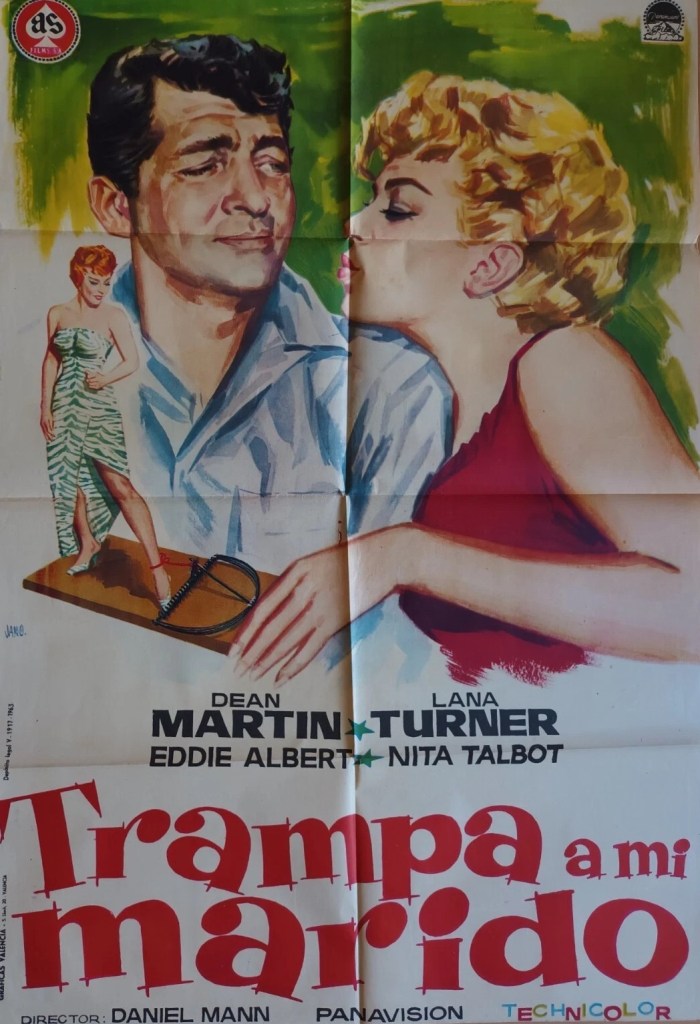
Complication No 6 is created by Tony, who, trying to trace the rival bookie, installs a wiretap that leads him to the Flood apartment. And that should be the end of the tale, and little chance of a happy ending, except for Complication No 7. Tony has incriminated himself via the wiretaps and with an attorney ready to exploit the situation, it all works out fine, original debt to the gangster wiped out and the mobster blackmailed into marrying Saturday.

Now, with so many complications and sub-plots, this isn’t a Dean Martin picture the way the Matt Helm series is, especially not with a co-star like Lana Turner (By Love Possessed, 1961) who, not weighed down by the kind of heavy romantic tangle that seemed her remit at this point of her career, has the chance to steal a good deal of the limelight.

But the strong supporting case also do their best to chisel scenes away from the big stars. Eddie Albert’s (Captain Newman M.D., 1963) idea of a seductive lunch is a cracker and Nita Talbot (Hogan’s Heroes series, 1965), fashion ideas like Audrey Hepburn on speed, can’t help but play up to the camera. Walter Matthau is trying out a characterization for Charade (1963).

The beauty of this is that the narrative follows a neat logic. You can’t just muscle in on the illegal gambling business.

Director Daniel Mann ( A Dream of Kings, 1969) whips up an entertaining Runyonesque comedy from a screenplay by Jack Rose (It Started in Naples, 1960) based on a novel by namesake Alexander Rose   who you might have spotted wearing his acting hat in The Hustler (1961).

They seemed to be a lot better at these effortless concoctions back in the day.
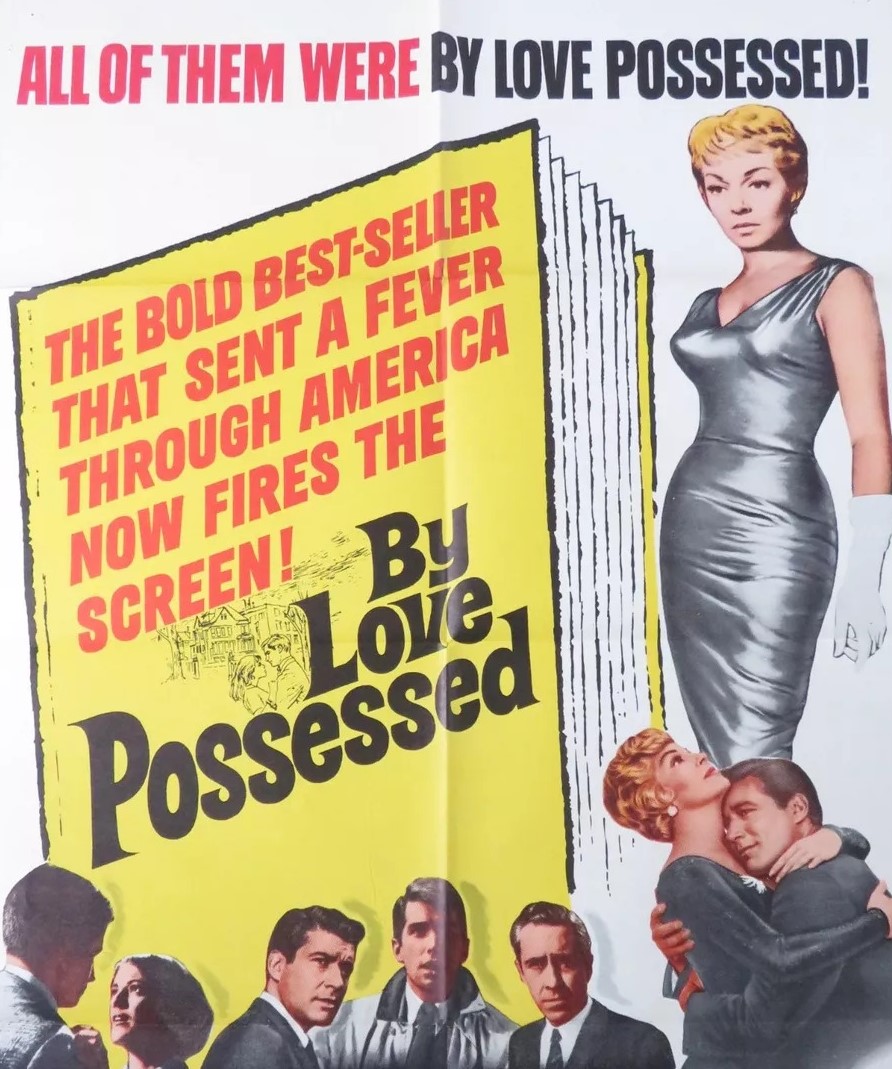
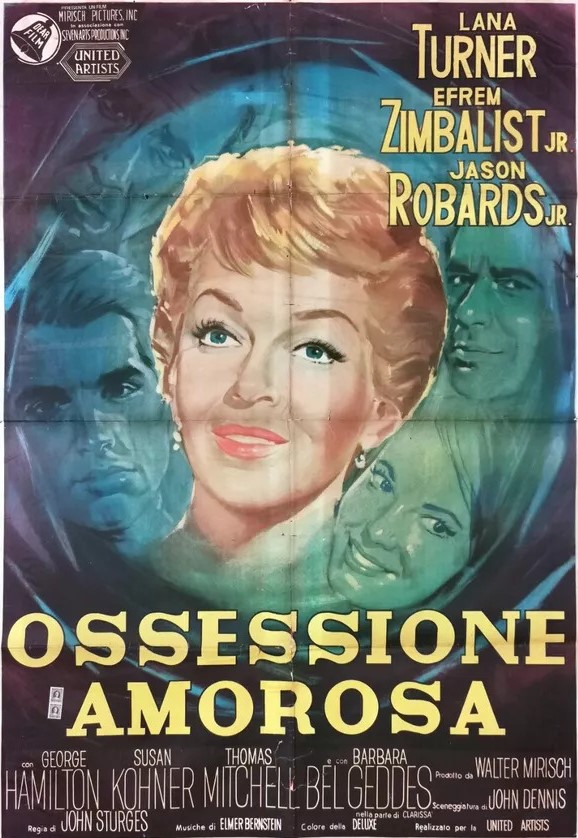
Behind the Scenes: “By Love Possessed” (1961)

Call it friendly persuasion. After The Magnificent Seven (1960), producer Walter Mirisch wanted to keep director John Sturges on-side. Other potential projects were falling by the wayside and Sturges needed, for financial reasons, to keep working while Mirisch wanted to ensure that when they finally licked the script for The Great Escape, still three years off as it happened, they would have a grateful director all set.

Especially, they did not want him to fall into the hands of rival producer Hal Wallis who was making a second attempt to set up The Sons of Katie Elder. Sturges had been the original director in 1955 with Alan Ladd in the leading role but a dodgy script. Although the script was in better shape, Wallis couldn’t get Paramount to bite (and wouldn’t until 1965). Another Sturges prospect was a remake of Vivacious Lady (1938) teaming Steve McQueen and Lee Remick in the Ginger Rogers-James Stewart roles, but that also fell through.

“I didn’t want John to go elsewhere and get tied up in another film,” admitted Mirisch. Partly as a means of finding a vehicle for Lana Turner, Mirisch had struck a deal with Seven Arts to make By Love Possessed by James Gould Cozzens, a 1957 bestseller for which producer Ray Stark had forked out $100,000 as a means of finessing his television-dependent company into the movies.  

Essentially, Mirisch picked up the picture on the rebound. Seven Arts had fallen out with United Artists which had financed the acquisition of three expensive properties: Broadway hits West Side Story and Two for the Seesaw and the novel By Love Possessed, all of which fell into the Mirisch lap. Mirisch enthused about the two stage productions, interesting Robert Wise in the musical and Billy Wilder, at least initially, in the romantic drama. Prior to The Magnificent Seven, Mirisch had tied Sturges down to a long-term deal and now handed him the script for By Love Possessed. “He read it and said he would like to do it.”

Lana Turner had revived her career with an Oscar-nominated turn in Peyton Place (1957), a huge hit, and had hit gold with remake Imitiation of Life (1959). She seemed the ideal candidate for another adaptation of a seamy besteller. At this point the Mirisch company was still trying to make it way in Hollywood. Its prime method of getting its foot in the door was to pay stars over the odds and allow them greater say in their movies, sometimes backing pet projects. The price of working with big marquee names was often a lot of grief.  

Like any other major producer, Walter Mirisch saw himself as a star-maker. Hiring talent on a long-term contract for a low fee was one way of ensuring he could ride on their inexpensive coat-tails in the future. Efrem Zimbalist Jr was the star of hit television series 77 Sunset Strip and the producer “hoped that casting him with Lana in our picture would make him a motion picture star.” He viewed the likes of Jason Robards and George Hamilton as merely supporting actors and not potential stars in their own right, although both would go on to have more stellar careers than Zimbalist.

Ketti Frings, Oscar-nominated for Come Back, Little Sheba (1952), had been paid $100,000 plus a percentage to write the screenplay of what was perceived as a difficult novel to adapt, given it was riddled with flashbacks and introspection. “If we told the book on the screen, we would be making an 18-hour picture,” said Sturges, derisively, as if blockbuster novels (From Here to Eternity etc) were not filetted all the time. Oscar-winner Charles Schnee (Red River, 1948) was drafted in for a rewrite – he had worked on Jeopardy (1953), though uncredited, a Sturges thriller starring Barbara Stanwyck.

Now the screenwriter was dogged with script changes demanded by Lana Turner. According to Mirisch, the actress “never let up” wanting script alterations. But Schnee’s work didn’t meet the director’s expectations and was doctored to such an extent the screenwriter removed his own name from the credits and substituted the pseudonym John Dennis. Mirisch initially brought in Isobel Lennart, who was adapting Two for the Seesaw, for a polish but eventually her version departed significantly from the Schnee original.

Novels could get away with a lot more blatant sexuality than books, though Peyton Place (1957) had made a very good stab at scorching the screen. But the finished script didn’t manage to match the novel’s carnality except in the character of Veronica (Yvonne Craig), the one-night stand who triggers the family downfall. Whatever the problems the script couldn’t nail, Sturges was clearly not the director to get round them with hot onscreen love scenes. Much as he admired strong women, couples getting it on were not his speciality.

The movie was filmed on the Columbia lot with a week on location.

“You get talked into it…or you need the money,” said Sturges. “I knew I had no business making that picture. Sure it was well-acted and staged …but I couldn’t care less about these people. I didn’t like ‘em, didn’t understand ‘em. And if you don’t understand people in a given situation, and you don’t like what’s happening, you shouldn’t try to make a movie out of it.”

Mirisch was as philosophical. “John Sturges was more at home with male-oriented, action pictures than soap opera. I was well aware of that, but I was guilty of ignoring my own misgivings and of wanting to keep him involved in one of our projects while we were doing the script preparation for The Great Escape.” The failure of the movie was, for Mirisch, “a psychological and emotional blow,” one that wasn’t softened by success at the box office.

SOURCES: Glenn Lovell, Escape Artist, The Life and Films of John Sturges (The University of Wisconsin Press, 2008) p218-220; Walter Mirisch, I Thought We Were Making Movies, Not History (The University of Wisconsin Press, 2008) p99, 114-116, 119-120;  

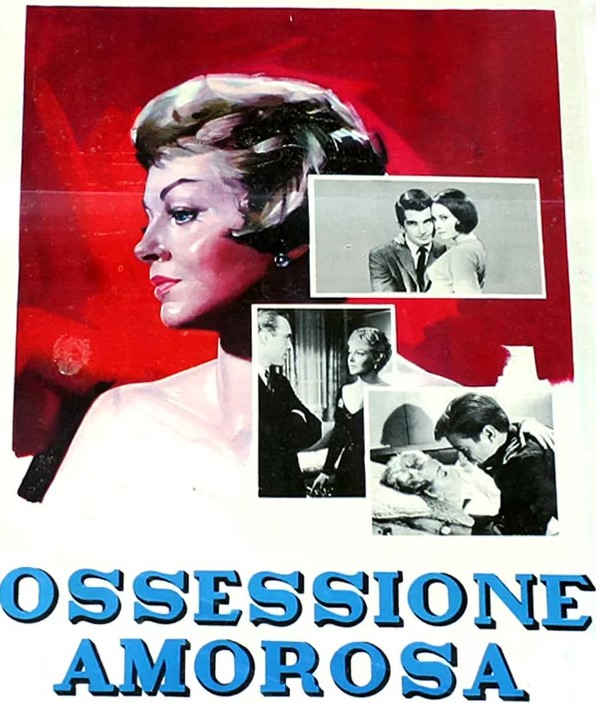
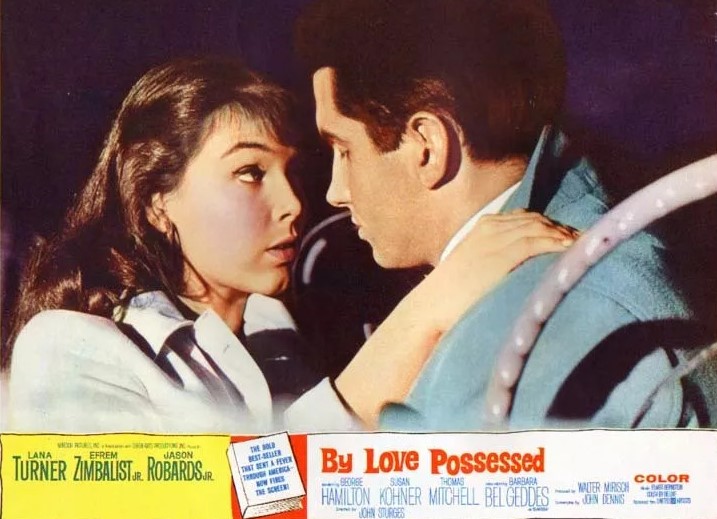
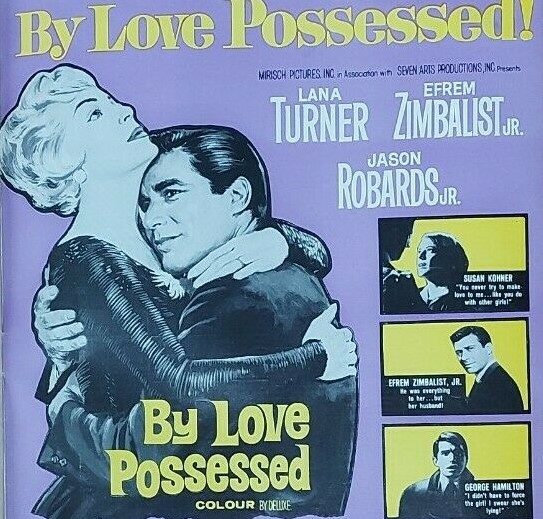
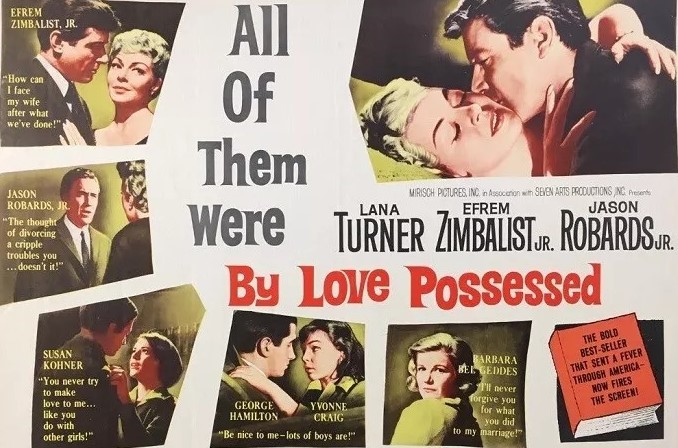
By Love Possessed (1961) ***

You couldn’t get further away from The Magnificent Seven (1960) than this buttoned-up –Peyton Place melodrama but director John Sturges, struggling to put together a more favored project, ended up here. It’s not that he didn’t have experience in this genre, having helmed Spencer Tracy legal drama The People Against O’Hara (1952) and June Allyson in The Girl in White (1952) but it was only when you turned to this field that you realized how much more freedom there was in a western.

There’s no shortage of pithy dialog courtesy of Charles Schnee (Butterfield 8, 1960). The marriage of Arthur Winner (Efrez Zimbalist Jr) and wife Clarissa (Barbara Bel Geddes) is more “merger” than romance. Opposing lawyers are “friendly enemies.” Arthur’s son Warren (George Hamilton) balks at a “smug career.”

There a couple of marvellous scenes and the characters are well-drawn, too well-drawn perhaps, audience constantly being reminded of personality defects, and it reeks of the formulaic, wealthy lives coming apart in Mansionworld. The biggest problem is there’s way too many characters that suffocate the life out of the picture. The heat the director clearly expected to generate is missing, hardly surprising in a world where duty dominates.

We’re pretty much nearly halfway through the picture before adultery crops up, bitter alcoholic wife Marjorie (Lana Turner) falling for Arthur, the business partner of her husband Julius (Jason Robards). Just around the same time Warren avails himself of a one-night stand with local “tramp” Veronica (Yvonne Craig) because he wouldn’t dare lay a hand on fiancee Helen (Susan Kohner), the town’s richest gal.

Simmering in the background is what today we might recognize as early onset dementia, which in those days was just treated as the frailties of old age, when Arthur discovers his boss  Noah (Thomas Mitchell) has been stealing from a client. So, as you can imagine, the whole set-up is all set to explode as characters rebel against self-imposed restraint.

First to crack in the bigger sense is Helen who commits suicide when a spurned Veronica accuses Warren of rape. Then you can take your pick of various other outcomes. And that’s a shame because there’s interesting material here, mostly left unexplored because we’re wrapped up in a game of consequences.

Ace Harvard law student Warren falls out with his father over the case, just discussed but never played out, of a young mother who has killed her baby. The woman, with a mental age of eight, believed her newborn was dead and so buried it. Warren argues his father should offer a plea of insanity, which Arthur rejects as a legal dodge. The question of how the pregnancy occurred is never discussed, but you can guess it could as easily be incest or at the very least someone taking advantage of an incapacitated youngster.

There’s a great scene – the Majorie A and Marjorie B sequence – where Julius explains how on the one hand his wife runs a great house and is a terrific social adjunct and on the other hand is wild, impulsive, demanding and it’s the second one he fell in love with and, although currently rejected, refuses to give a divorce. And it’s Julius again who has the best character defining scene, when he acknowledges that pity is “a dirty word.”

Some surprisingly raw language is used when it comes to the question of rape. “The law assumes a common tramp like Veronica can still be raped” and the question of consent carries a contemporary sting.

Perhaps the biggest issue is the unspoken. It’s not love the main characters are after, it’s sex. Julius is lame after an auto accident and that appears to hinder his activities in the marital bed.  Warren is too scared of Helen’s reaction to engage in the normal fumblings of youth.

The top-billed Lana Turner (who headlined the original Peyton Place, 1957) is kept at bay for too long as the other factors are brought into play and to be honest she is way out of the league of the likes of Efrem Zimbalist Jr (A Fever in the Blood, 1961). He would scarcely come up to scratch for a woman like her unless she was desperate. And perhaps she is. Turner steals every scene she’s in. The only character who shows screen spark is the vengeful Veronica who refers to herself in the third person – “nobody treats Veronica like a tramp but Veronica.”

George Hamilton (A Time for Killing, 1967) has some moments, but not enough. The same goes for Yvonne Craig (Batgirl in the Batman TV series 1966-1968). Jason Robards (A Big Hand for the Little Lady / Big Deal in Dodge City, 1966) takes an early stab at the simmering tense persona he would make his screen template. Charles Schnee was so annoyed with what happened to his original script, adapted from the James Gould Cozzens bestseller, that he insisted on using the pseudonym John Dennis.

A well turned-out potboiler.

Discover WordPress

A daily selection of the best content published on WordPress, collected for you by humans who love to read.

The Atavist Magazine

by Brian Hannan

WordPress.com News

The latest news on WordPress.com and the WordPress community.