Stark Fear (1962) ***

Unless you were unfortunate enough to get mix up in an international conspiracy, or your wealth induced a husband towards your murder – or a la Gaslight towards your insanity – or had taken a shower in strange motel, a wife in American movies was unlikely to live in fear of a sadistic spouse. Wife-beating aka wife-battering had never been high on the Hollywood agenda as an appropriate subject matter, so this picture not only stands out for the period but also strikes a contemporary spark. While many marital dramas of the 1960s have quickly become outdated, this has not.

Opening with an audacious cut from a woman’s eyes seen in a car’s rear-view mirror to her face in a photograph being pelted, being smashed to pieces. Ellen (Beverly Garland) has committed the grievous sin not just of going out to work but of taking up the post of secretary to oil executive Cliff Kane (Kenneth Tobey), a previous rival of husband Gerry (Skip Homeier). But Gerry’s income had unexpectedly tumbled and the couple, married just three years, need her money. He pours a drink over the terrified woman’s head, demands a divorce and promptly disappears.

Her search for him takes her to Quehada, pop. 976, a rundown town she had never heard of and whose existence her husband made no mention despite the fact it was where he grew up. Her husband’s sleazy friend Harvey takes her to the grave of Gerry’s mother (also called Ellen) where he rapes and beats her while, unbeknownst to her, her husband watches.   

Back at the office, she begins to fall for Cliff, but Gerry, even though he no longer wants her, sets out to destroy the budding romance.

Following the classic pattern of course Ellen blames herself for making Gerry unhappy and for getting raped. Her guilt fuels her husband’s sadistic streak. She is unsure whether the threat of divorce is just the most cruel taunt her husband can imagine or for real, which would be just as bad, given her low-self-esteem.

Once she realizes Gerry had an unhappy childhood and is mother-fixated, it makes it even harder for her to abandon him, regardless of the mental and physical torment he inflicts and despite the entreaties of social worker friend Ruth (Hannah Stone). Ruth, too, however, represents an alternative equally fearful future, the now-single woman who regrets separating too quickly from her husband and has no man  in her life or none who come up to scratch.

This is not a picture where men come out well. Gerry is a fiend in a suit. On the way to Quehada she is groped by other men who clearly feel it is their right. Harvey has a history of just taking what he wants. Even the relatively gentle Cliff appears to have an underlying reason for taking an interest in her.

In a world and a time where marriage meant not just financial security, but a safe haven from all the other men who would like as not press themselves upon the opposite sex at any opportunity, and not necessarily with any delicacy, director Ned Hockman presents life as a succession of traps for women. And we know now that not much has changed, and that for women fear is a constant.

Hockman directs with some singularity. He uses black-and-white not quite in the film noir manner of shadows and shafts of light but sets the subject of any night scene in a pool of light with darkness all around, which makes for some striking images. A couple of unusual backdrops include Commanche tribal dancing and a chase in a jukebox museum help place this a couple of notches above the usual B-picture.

Beverly Garland was a 1950s B-picture sci-fi and horror scream queen in movies such as It Conquered the World (1956), Curucu, Beast of the Amazon (1956) and Not of This Earth (1957) so fear was something of a default. Here, she adds something else, desolation at the position she finds herself in, confusion that her marriage is in tatters, hunting for a solution that never emerges, and unable to summon up the anger that might free herself. Hannah Stone has an intriguing role, encouraging her friend to leave her husband, knowing that being single again is not all it is cracked up to be. Unusually for a minor character in this kind of picture, primarily there to shore up the star, she enjoys a spot of lifestyle reversal.  

Heart-breaking.

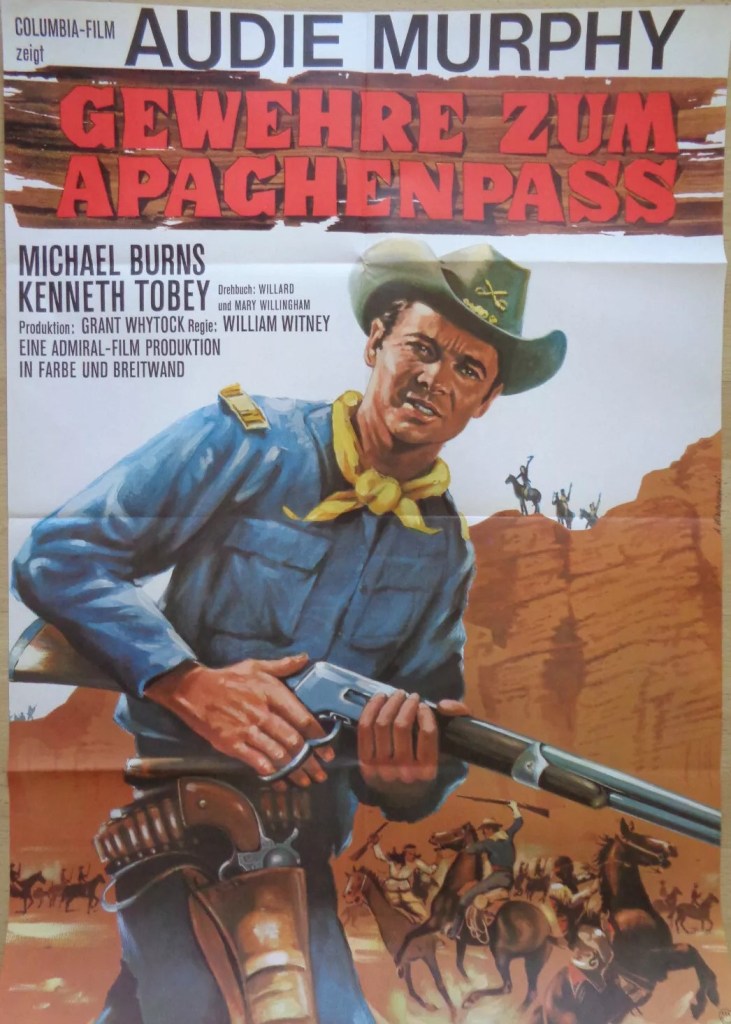
40 Guns to Apache Pass (1967) ***

Spent most of the time watching this wondering what depths Glenn Ford and Inger Stevens would find in this interesting script in which relationships come asunder through situation. Instead, we’ve got war hero turned movie actor – I hesitate to say star because his marquee was virtually always of the B-movie brigade – Audie Murphy (Bullet for a Badman, 1964) in his last starring role looking as wooden as ever and in a superbly-written conflicted role the equally ineffective Laraine Stephens (Hellfighters, 1968).  

That there was still a market for the kind of western that refused to embrace the revisionism expressed by Cheyenne Autumn (1964) or Hombre (1967) was odd in itself. In fact, by this stage most of the best westerns steered cleared of the Native American issue,  preferring subjects like the Civil War (Shenandoah, 1965), errant gunslingers (Cat Ballou, 1965) or standard western tropes with standard villains (The Sons of Katie Elder, 1965, El Dorado, 1967, The War Wagon, 1967).

The title plays around with the more famous Battle of Apache Pass which took place in 1862, seven years before this movie was set. Despite the indifferent playing, the script by Willard W. Willingham and wife Mary (one of the exceptionally few female screenwriters plying their trade in Hollywood at the time) is lean and interesting. Apache chief Cochise is on the warpath and settlers have to abandon their homes and be brought to the safer environs of Apache Wells.

Ramrod stiff Captain Coburn (Audie Murphy) is in charge of the operation which includes bringing his romantic interest Ellen (Laraine Stephens) and her family to safety. There’s not much trouble doing that except rebellious Corporal Bodine (Kenneth Tobey), the kind of subordinate who’s always insubordinate, picks a fight with the officer. Against the ostensibly much tougher opponent, Coburn wins the tussle and beats the living hell out of his underling. But Ellen is of delicate stock and doesn’t take kindly to her potential husband’s violent streak.  

At the makeshift fort Col Reed (Byron Morrow) is driven to desperation by the lack of weaponry, awaiting a long-promised supply of the newest model of repeating rifles. The scouts delivering the titular 40 weapons refuse to risk taking the supply wagons so close to the Apaches so Coburn is designated to undertake the “mission” to secrue them, taking a team of ten men including two of Ellen’s brothers Doug (Michael Burns) and Mike (Michael Blodgett) and Bodine. Doug falters under fire and is responsible for his brother’s death.

Bodine steals the guns, planning to sell them for $1,000 each in Mexico, an enterprise that gains the support of the remaining troopers bar the captain and his sergeant. With a piece of exceptional cunning, Bodine plans for those two to be blown up in a manner that will look like they have sacrificed their lives rather than surrender the weapons. And it’s an equally clever trick indeed that allows Coburn to escape.

This section brings unexpected depth, character revelation the key. Bodine turns out to be a Johnny Reb, joining the Army, wearing the dettestable blue, as an alternative post-war to imprisonment. And he’s not going to ride over 1,000 miles to Mexico when he’s got potential purchasers, the Apaches, hardly any distance away at all. Cochise doesn’t take too kindly to a traitor, though he’s willing ostensibly to do business.

Coburn, it turns out, is anything but the ramrod straight officer he effects to be. He came up the hard way, mostly been a loser all his life, and knowing that he’s blown this chance for future promotion. Back at the fort, not only does he face court martial, but Ellen blames him for the loss of her brothers, one dead, the other heading towards summary execution should he be captured as a deserter.

So, naturally, the only way out of this pickle is for Coburn to steal a couple of horses and attempt to recover the weapons. He’s again got a clever plan, holding off the bad guys by placing a bunch of repeating rifles at crucial points in his retreat so he doesn’t need to stop and reload.

In better hands this would have been a cracker. The duty-bound Coburn undone by duty, Ellen undone by placing her trust in the wrong man, Bodine undone by thinking he could outwit the clever Cochise.

Director William Witney (Arizona Raiders, 1965) had over 100 directoial credits, virtually all low-budget movies or television series, so he knew how to get the job done. A better director would have better use of the situation, characters and physical setting – those enscarpments go to waste for sure.

Calling out as much for a Budd Boetticher as a Glenn Ford and Inger Stevens.  

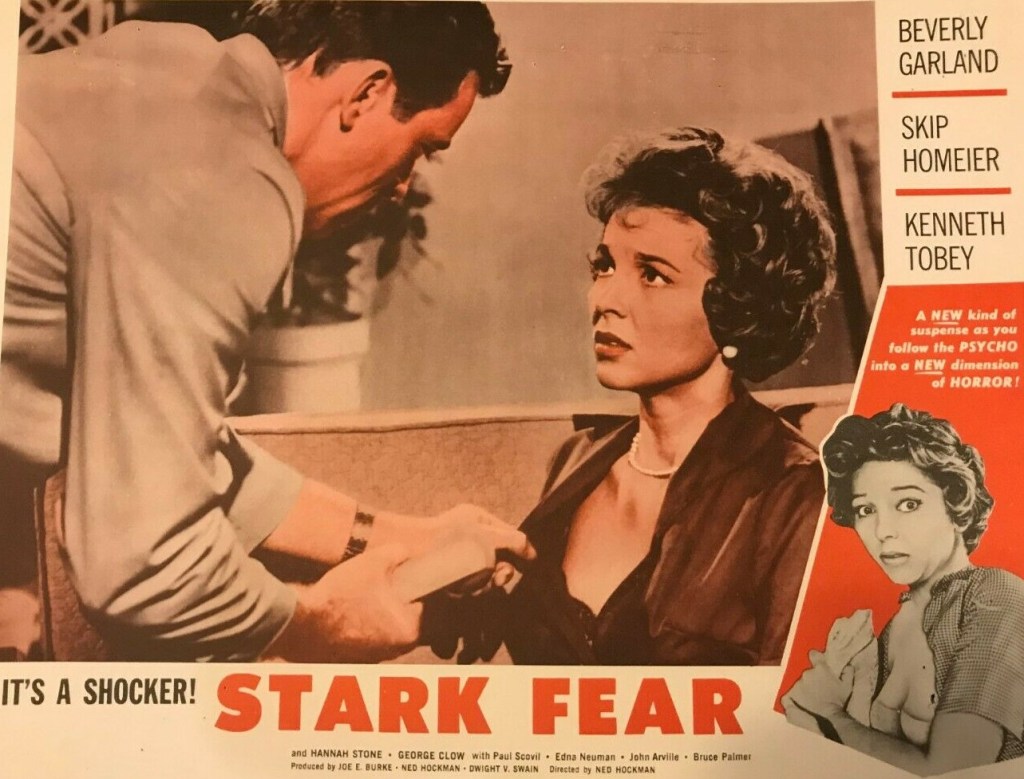
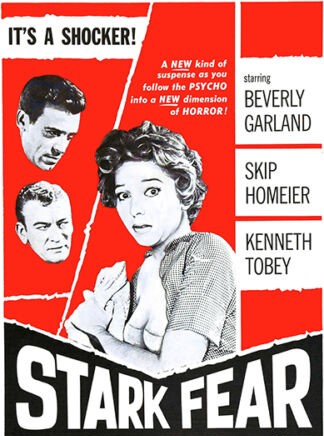
Stark Fear (1962) ***

Unless you were unfortunate enough to get mixed up in an international conspiracy, or your wealth induced a husband into planning your murder – or a la Gaslight your insanity –  or you had taken a shower in strange motel, a wife in American movies was unlikely to live in fear of a sadistic spouse. Wife-beating (a.k.a. wife-battering) had never been high on the Hollywood agenda as an appropriate subject matter so this picture not only stands out for the period but also strikes a contemporary spark. While many marital dramas of the 1960s have quickly become outdated, this has not.

Opening with an audacious cut from a woman’s eyes seen in a car’s rear-view mirror to her face in a photograph being pelted with alcohol, Ellen (Beverly Garland) has committed the grievous sin not just of going out to work but of taking up the post of secretary to oil executive Cliff Kane (Kenneth Tobey), a previous rival of husband Gerry (Skip Homeier). But Gerry’s income had unexpectedly tumbled and the couple, married just three years, need her money. He pours a drink over the terrified woman’s head, demands a divorce and promptly disappears.

Her search for him takes her to Quehada, pop. 976, a rundown town she had never heard of and whose existence her husband made no mention despite the fact it was where he grew up. Her husband’s sleazy friend Harvey takes her to the grave of Gerry’s mother (also called Ellen) where he rapes and beats her while, unbeknownst to her, her husband watches.   

Back at the office, she begins to fall for Cliff, but Gerry, even though he no longer wants her, sets out to destroy the budding romance.

Following the classic pattern of course Ellen blames herself for making Gerry unhappy and for getting raped. Her guilt fuels her husband’s sadistic streak. She is unsure whether the threat of divorce is just the most cruel taunt her husband can imagine or is for real, which would be just as bad, given her low-self-esteem. Once she realizes Gerry had an unhappy childhood and is mother-fixated, it makes it even harder for her to abandon him, regardless of the mental and physical torment he inflicts and despite the entreaties of social worker friend Ruth (Hannah Stone). Ruth, too, however, represents an alternative equally fearful future, the now-single woman who regrets separating too quickly from her husband and has no man  in her life or none who come up to scratch.

This is not a picture where men come out well. Gerry is a fiend in a suit. On Ellen’s way to Quehada she is groped by other men who clearly feel it is their right. Harvey has a history of just taking what he wants. Even the relatively gentle Cliff appears to have an underlying reason for taking an interest in her.

In a world and a time where marriage meant not just financial security, but a safe haven from all the other men who would like as not press themselves upon the opposite sex at any opportunity, and not necessarily with any delicacy, director Ned Hockman presents life as a succession of traps for women. And we know now that not much has changed, and that for many women fear is a constant.

Hockman directs with some singularity. He uses black-and-white not quite in the film noir manner of shadows and shafts of light, but sets the subject of any night scene in a pool of light with darkness all around, which makes for some striking images. A couple of unusual backdrops including Commanche tribal dancing and a chase in a jukebox museum help place this a couple of notches above the usual B-picture..

Beverly Garland was a 1950s B-picture sci-fi and horror scream queen in movies such as  It Conquered the World (1956), Curucu, Beast of the Amazon (1956) and Not of This Earth (1957) so fear was something of a default. Here, she adds something else, desolation at the position she finds herself in, confusion that her marriage is in tatters, hunting for a solution that never emerges, and unable to summon up the anger that might free herself. Hannah Stone has an intriguing role, encouraging her friend to leave her husband, knowing that being single again is not all it is cracked up to be. Unusually for a minor character in this kind of picture, primarily there to shore up the star, she enjoys a spot of lifestyle reversal. Skip Homeier (Commanche Station, 1960) and Kenneth Tobey (X-15, 1961) are outshone by the women. Unusually, and surprisingly, this was the one shot at a movie career afforded both Stone and director Hockman.

This may have been intended as a quick B-picture rip-off to cash in on the expected success of Cape Fear (1962) which appeared eight months prior but it turned out to be a more superior effort than anyone could imagine. And since Cape Fear was far from as successful as most people believe, it possibly had to make its way on its own merits in several markets.

Catch this on Amazon Prime.

Discover WordPress

A daily selection of the best content published on WordPress, collected for you by humans who love to read.

The Atavist Magazine

by Brian Hannan

WordPress.com News

The latest news on WordPress.com and the WordPress community.