The Learning Tree (1969) ****

Director Gordon Parks made a big noise a couple of years later with Shaft (1971), Richard Roundtree shooting to fame as a slick and sexy private eye, memorable score by Quincy Jones. But The Learning Tree had possibly a bigger impact on the Hollywood consciousness, the first movie released by a major studio (Warner Brothers) that was directed by an African American. Although actors like Sidney Poitier and Jim Brown had smashed the Hollywood glass ceiling, directors lagged far behind. And this would have been an interesting tale in its own right of adolescence in 1920s Kansas had the leading character Newt (Kyle Johnson) and buddy Marcus (Alex Clarke) not faced such blatant racism.

Told today, the story would take a different route, concentrating on the dilemma of Newt in coming forward with the evidence that could convict Marcus’s father Booker (Richard Ward) of murdering a white man, not just the guilt at sending another African American to the electric chair but fear of the killing spree that must follow from enraged whites. Instead, that aspect comes at the tail end of a story that sees Newt and Marcus react in different ways to white supremacy. It’s not that Newt is spineless, toeing the line, but that Marcus, filled with venom, sees violence as the only way to establish any kind of equality.

When Newt, a reasonable enough scholar, though hardly in the genius class, is marked down by his teacher on the grounds that it’s a waste of time going to college when he will still end up a cook or a porter, the young man responds, “You hate us colored kids, well, we hate you, every one of you.” Marcus has a similar mantra, “this town don’t want me and I don’t want this town.” That underlying endemic racism contrasts with the more overt vicious bullying of local cop Kirky (Dana Elcar) who casually shoots any African American who sensibly runs away at his approach and who ends every sentence with the word “boy.”

What makes this so powerful is that for long stretches there’s just the ordinary coming-of-age tale of Newt falling in love with Arcella (Mira Waters), sneaking a kiss, finding their own special place among the daffodils, buying each other Xmas presents, the romance conducted among summer picnics, winter snow, rowing on the river, the young man showing his beloved every respect even given that he is not a virgin, having unexpectedly lost his cherry while sheltering from a tornado.  He has a conscience, too, going to work voluntarily for a farmer whose apples he stole.
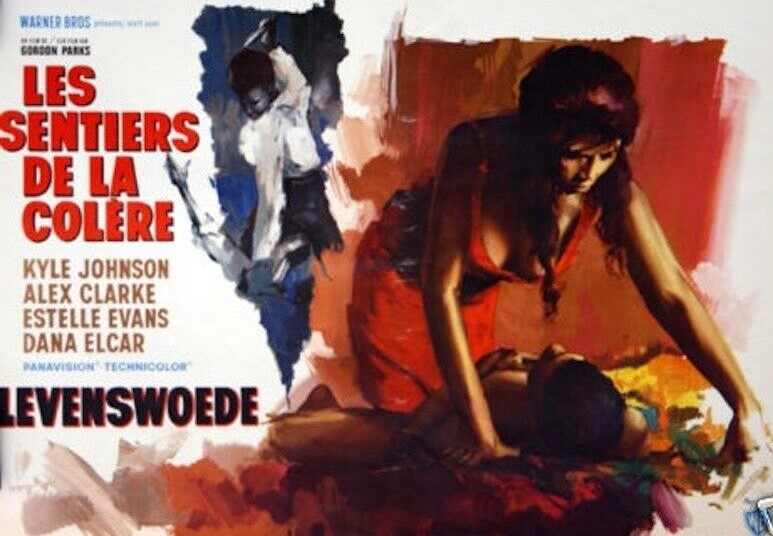
It’s not just Newt’s equable temperament that’s prevents him from reacting like Marcus to the unfairness of the white-dominated world. He has the ability to get the best out of situations. A born negotiator he manages to triple the reward offered by Kirky for helping bring up a dead man from a river, and, having been taught to box, earns good money in a match. Marcus goes to jail for beating up a white man who attacked him with a whip and this not being a sanitised version of the African American world on release ends up working in a whorehouse while his father steals a supply of hooch.  

Even so this is a hierarchy even a prominent white person cannot overturn. When a judge’s son invites Marcus and Arcella into a drug store, the other two must take their drinks outside.

A staff photographer for Life magazine, director Gordon Parks, adapting his autobiographical novel,  avoids the temptation to pack the movie with brilliant images, instead concentrating on core coming-of-age aspects to drive forward the narrative. He doesn’t have to do much to point up the injustice. That’s inherent in the material.

It probably helped that the three young principals were inexperienced, although at the time of course roles for African Americans, except in cliché supporting parts, were hardly abundant.  Kyle Johnson (Pretty Maids All in a Row, 1971) was 16 when playing the 14-year-old, Alex Clarke (Halls of Anger, 1970) pushing 20 and making his debut as was Mira Waters (The Greatest, 1977). There’s no straining for dramatic acting effect. Everyone plays it straight.

Others involved are Estelle Evans (To Kill a Mockingbird, 1962), Dana Elcar (Pendulum, 1968), Richard Ward (Black Like Me, 1964) and Russell Thorson (The Stalking Moon, 1968). Not only did Parks write, produce and direct but he supplied the music too.

It’s an absorbing, if at times difficult, watch. It’s an accomplished picture for a beginner. And you can’t help but wondering how four decades after this story takes place little had changed for ordinary African Americans and another five decades after the film’s release the battle for equality has not been resolved.
Prime Cut (1972) ****

Unusually nuanced thriller. Unusually lean, too, barely passing the 90-minute mark. There’s a Hitchcockian appreciation of the danger lurking in wide open spaces. And the background is the Middle America of annual fairs, marching bands, pie-eating competitions, rural pride in farming and marksmanship.

But there’s an undercurrent that will strike a contemporary audience. The contempt of big business for its customers. The sex trafficking, too, will sound an all-too-common note especially as the young women come from an orphanage set in the heart of homespun America in what appears to be a streamlined service.

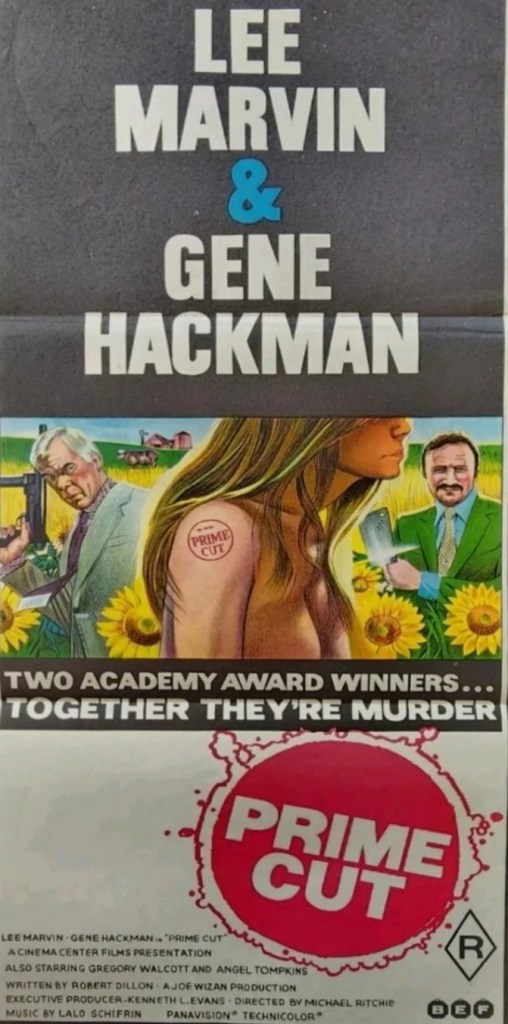
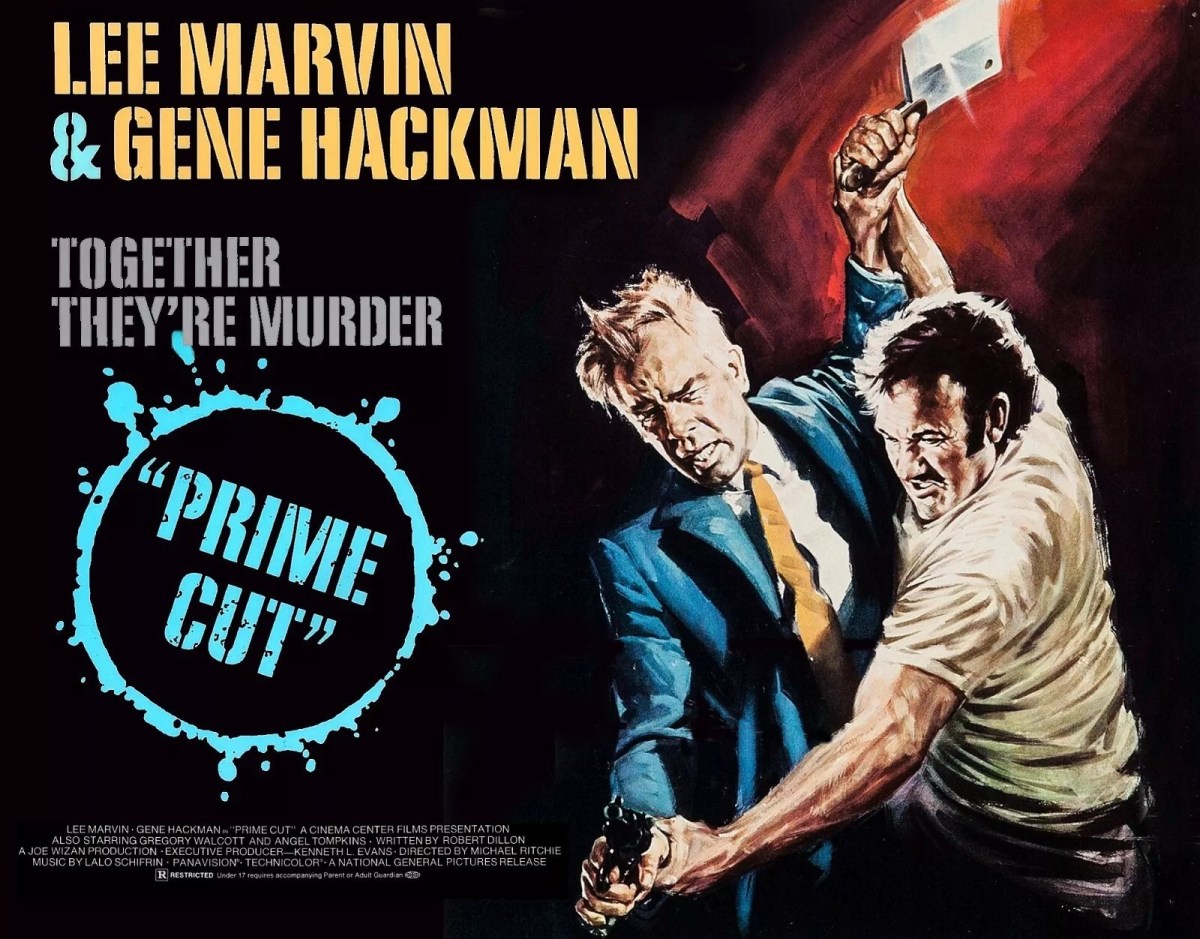
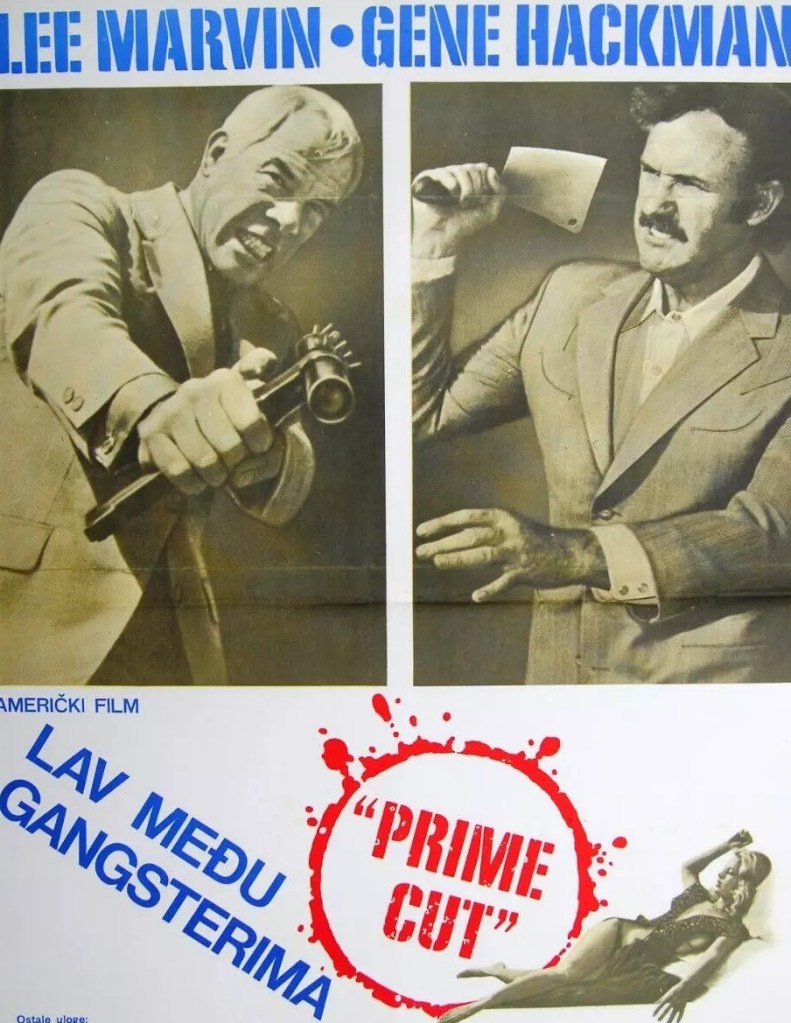
In the actual screen credits, Hackman was not above the title.

We shouldn’t at all take to hitman Nick (Lee Marvin) except that he’s got a code of honor and sparing with words. He’s been sent from Chicago to Kansas to sort out with what would later be termed “extreme prejudice” Mafia boss and meat-packer Mary Ann (Gene Hackman) who’s been skimming off the top. As back-up Nick is handed a trio of young gunslingers anxious to prove themselves while his faithful chauffeur owes Nick his life.

Mary Ann doesn’t just have a factory, he has a fort, a posse of shotgun-wielding henchman standing guard. So Nick has to plunge right in and confront the miscreant. As well as dealing with animal flesh, Mary Ann has a side hustle in sex trafficking, displaying naked women in the same straw-covered pens as his beef.

Responding to a whispered “help me” by Poppy (Sissy Spacek) Nick buys her freedom, but Mary Ann isn’t for knuckling down to the high-ups in Chicago and since he’s already despatched a handful of other hoods sent on a similar mission as Nick he’s intent on turning the tables.

The action, when it comes, is remarkably low-key and all the more effective for it. Swap a crop duster for a combine harvester and the head-high prairie corn for the usual city back streets and you realize someone has dreamed up a quite original twist on the standard thriller. No need for a car chase here to elevate tension, it’s already a quite efficient slow burn.

By the time this came out Hackman had won an Oscar for “The French Connection” (1971), Marvin already in that exalted league thanks to “Cat Ballou” (1965)

This could be an ode to machinery. The entire credit sequence is devoted to the way machines chew up cow flesh and turn it into strings of sausages and the like. The combine harvester chews up and spits out an entire automobile, grinding the metal through its maw. And then there’s the machinery of business, the ability, at whatever cost, to give the public what it wants, in whatever kind of flesh takes its fancy.

You’ll remember the combine harvester sequence and the shootout in the cornfields, but you will come away with much more than that. Remember I mentioned nuance. Sure Mary Ann is an arrogant gangster and you’d think with hardly an ounce of humanity, but that’s until you witness his relationship with his simple-minded brother Weenie (Gregory Walcott). That could as easily have fallen into the trap of cliché sentimentality. Instead, there’s roughhouse play between the pair and it’s all the more touching for being realistic.

There’s a tiny scene where one of the young hoods asks Nick to meet his mother, in the way of a young employee wanting to show off that he was working for a top man. And Nick also goes out of his way to praise what’s on offer at the fair from a couple of women anxious for praise.

One of the tests of a good actor is what they do when they enter an unfamiliar room. Your instinct and mine, like ordinary people, would be to look around not just lock eyes on the person you’ve come to meet. So when Poppy wakes up in a luxurious hotel room she doesn’t go into all that eye-rubbing nonsense, but instead marvels at her surroundings. And although she hangs on his every word – and his arm – Nick isn’t in the seduction business, instead spoiling the young woman with expensive clothes.

There are several other scenes elevated just by touches. The credit sequence ends with a shoe appearing among the meat being processed – Mary Ann’s victims don’t sleep with the fishes but with the sausages. Poppy recalls a childhood spent in a rural wonderland, squirrels, rabbits, the splendors of nature, and reveals a lesbian relationship with another orphan Violet that is the most innocent description of love and sexual exploration you’ll ever hear.

Violet is the victim of multiple rapists. Weenie has passed her onto a bunch of down-and-outs for the price of a nickel. When Nick unclenches her clenched fist you’ll be horrified to see how many nickels tumble out.

Lee Marvin (Point Blank, 1967) is at his laconic best and Sissy Spacek (Carrie, 1976) makes a notable debut but Gene Hackman (Downhill Racer, 1969) overplays his hand.

Director Michael Ritchie (Downhill Racer) was on a roll, following this with The Candidate (1972), Smile (1975), The Bad News Bears (1976) and Semi-Tough (1977) before the execrable The Island (1980) badly damaged his career.

Written by Robert Dillon (The French Connection II, 1975).

Well worth a look.

Discover WordPress

A daily selection of the best content published on WordPress, collected for you by humans who love to read.

The Atavist Magazine

by Brian Hannan

WordPress.com News

The latest news on WordPress.com and the WordPress community.