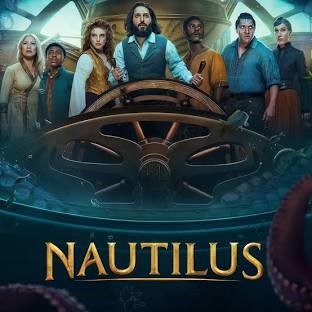
Nautilus (2024) ***

I thought Game of Thrones had got rid of the Lost narrative style wherein characters had mysterious pasts which unfolded episode by episode. In Game of Thrones characters were defined upfront – ambitious, mean, savage, stupid, honourable – and the surprise generally came in the form of idiots being even more idiotic or the brutal indulging in excessive savagery. That nice wee blonde lass, for example, with the wee pet dragons ended up destroying a town – but her vengeful nature was signposted all the way through.

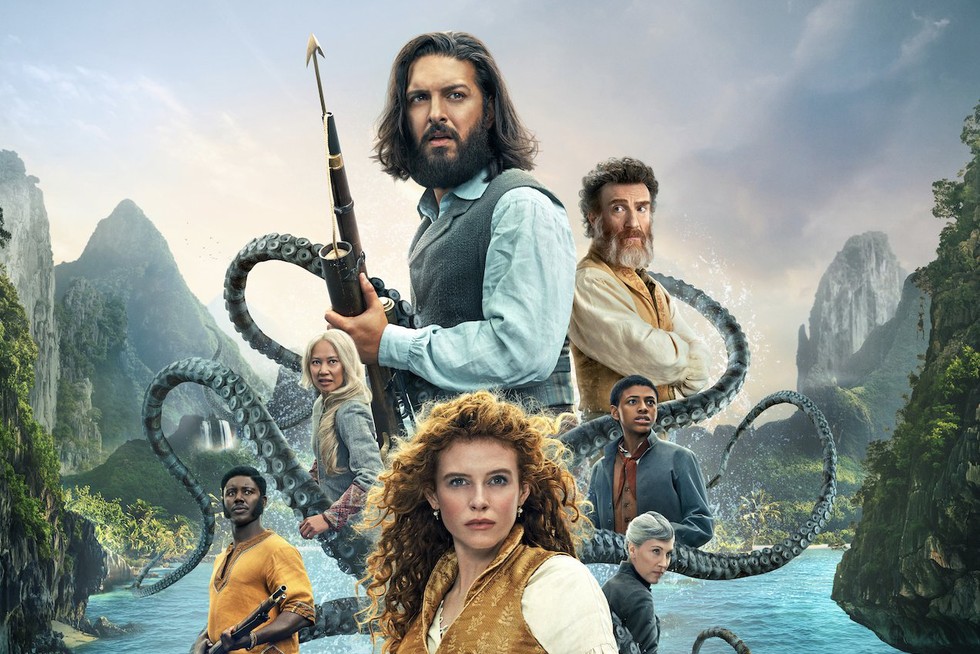
However, Lost-style storytelling has resurfaced in Nautilus. So we discover that Captain Nemo (Shazad Latif) in this version is closer to the original Jules Verne prototype than the sleek James Mason of the Disney feature 20,000 Leagues under the Sea (1954). He’s of Indian heritage, seeking revenge on the East India Company – the nineteenth-century equivalent of a global industrial power that’s bigger than nations – which has killed his family. Anyway, he hijacks the aforesaid company’s latest invention, the submarine Nautilus, complete with razor sharp upper deck for ripping open the hull of ships.
The company, not inclined to take kindly to such theft, sends the iron-clad Dreadnought, the latest in the warship line, complete with depth charges, after them. There’s a surprising amount of invention – ice-cube-making machines also appear – and engineers on hand to make things work or, conversely, know how to sabotage machines.

On board the Nautilus the motley bunch of characters with a job lot of mysterious pasts comprises primarily prison escapees, though Frenchman Gustave (Thierry Fremon) has engineering credentials. Posh Humility (Georgia Flood) and Loti (Celine Manville) are refugees from a shipwreck and there’s also, as you might expect, a dog, and stowaway Cuff (Edward Hardie).

There’s no sign, of course, of a whale hunter like Ned Land (Kirk Douglas in the Disney version). No, this is ecologically-sound, and instead Nemo has harpoon-removing skills and the whales – repaying such kindness apparently – come in handy to save the submarine from a giant squid.

Thank goodness for the squid and the later giant spiders and other fantasy-type creatures that originated in the original’s sequel Mysterious Island. Because this is a genuine oddity, and not necessarily in a good way. The writing is mostly sharp, some characters, especially the women, introduced in great style, and there’s some vivid comedy, and the action very well rendered indeed. The depth charges are used to usual effect but the torpedo launched by the Nautilus fulfils a different, surprising, purpose. Occasionally, it relies on flashback to explain elements better left unsaid – Nemo can hold his breath for a long time underwater, great, a modest super power, but, in fact, the result of being bullied at school.

There are some clever reversals. Humility, trying to save the cabin boy being punished for stealing biscuits, intervenes to say she told him to fetch them. Disbelieving faces all round as she’s handed one. It’s loaded with weevils. At the start we are led to believe that Humility is an ace with cards until we discover it’s actually Loti.

And you can’t really complain about the direction. But the acting is woeful. Whether blame lies with the casting director or the actors themselves and the lack of character depth who knows. Humility is feisty and clever, and can use a hairpin to a variety of ends, pick a lock, sabotage a submarine, and every time she promises not to escape you can be sure she’ll do the opposite. But Georgia Flood (Blacklight, 2022) does little more than speak her lines, nothing much going on behind the eyes. I suppose Shazad Latif (Rogue Agent, 2022) could blame his beard for getting in the way of facial expression.

That’s until they come up against Richard E. Grant as a sly white rajah and he shows just what you can do with a role. Admittedly, he’s not up against much competition but he easily steals the show.

You won’t be surprised to find it weighted down with virtue signalling – female empowerment, rebellion, saving rather than killing whales – and the one area where typically such adventure films from The African Queen (1952) to Romancing the Stone (1984) excel – the male-female verbal duelling –  is all one-sided.

Lower your expectations and accept some stiff-upper-lip Saturday matinee fun and you won’t go wrong. I did, and now at episode four, I’ll probably keep going.

Rocket to the Moon / Those Fantastic Flying Fools (1967) ***

The Jules Verne express grinds to a halt in part because the promise of outer space adventure fails to materialize and in part because the treatment is comedic in the manner of  The Great Race (1965). A series of sketches with a shifting array of characters rarely works. Occasionally it hits the mark in a laugh out loud fashion but too often the jokes are labored  although as a tribute to a maze of inventive invention it’s a treat.

Unusually for such an all-star cast venture, we are, long before the titular action  and a race (of sorts) commences, treated to the greatest hits from the book of all-time failures. So we have electricity setting on fire the first country house, belonging to the Duke of Barset (Dennis Price), to be so illuminated; a new-fangled suspension bridge, courtesy of Sir Charles Dillworthy (Lionel Jeffries), that collapses when Queen Victoria cuts the ribbon; and a new type of explosive invented by German von Bulow (Gert Frobe) that proves a tad overpowering. Meanwhile, making possible the idea of sending a man to the moon is the arrival in Britain of the diminutive General Tom Thumb (Jimmy Clitheroe) accompanied by the bombastic and greedy Phineas T. Barnum (Burl Ives).

Combining the various scientific advances of propulsion and engineering have the flaw of not being able to bring a manned rocket back home. And sinister forces are at work, spies and fraudsters.

As with all these all-star comedies you spend half the time wondering how your favorite star is going to be worked into the equation and, having been squeezed into the narrative, justify their ongoing involvement. Daliah Lavi (Old Shatterhand, 1964), not particulary known for her comic gifts, is a case in point. On her wedding day she (as Madelaine) jilts French groom Henri (Edward de Souza) in favor of balloonist Gaylord (Troy Donohue) who has, literally, appeared on the horizon. Henri trying to down said balloon triggers an awful joke about a shotgun wedding.

To gain revenge, Henri funds the project on the basis of Gaylord being the moon pilot, and, in anticipation of the craft’s failure, that he will regain his bride. Madelaine, having been sidelined by all the developments, suddenly rushes back to center stage when she uncovers the devious plot and is shipped off to a home for wayward girls, run by the very wayward Angelica (Hermione Gingold). But that requires she escape and find her way back to her beloved, that aspect complicated because she loves both men (it transpires).

As the script is in the invidious position of having to place the participants into similar frying pans in order to effect similar rescues it’s as much a game of ping-pong as a movie. But there are some nice gags, a rocket attached to a helmet, the ruination of a teleprinter and the criminally-inclined Washington-Smythe (Terry-Thomas) who rooks billiard players with a magnet. And there’s a very contemporary financial element in that large wagers are placed on failure rather than success, the equivalent of betting on stocks going down rather than up  (short selling in the modern idiom)

The rocket is launched, with rather a different crew than originally anticipated following further skullduggery, and although it’s something of a cosmic joke that it only gets as far as Russia it’s rather a disappointing ending for fans of Verne who anticipated a more rigorous approach. Verne’s novel From the Earth to the Moon was surprisingly accurate in imagining how a projectile would achieve its aims. The novel had even more of a contemporary feel since it left the crew floating in space, a daringly artistically inconclusive climax, leaving the way open – again the contemporary flair – for sequel Around the Moon that explained their fate.

Oddly enough, Daliah Lavi, as the bride who can’t make up her mind, has one of the better parts, more fleshed out than most of the other flimsy characterizations. The likes of Troy Donohue, caught between heroism and doing nothing much at all, often looks flummoxed. Terry-Thomas (How To Murder Your Wife, 1965) in wily mode is the pick of the rest.

Director Don Sharp (The Brides of Fu Manchu, 1966) proves that comedy is not his metier. Screenplay by Dave Freeman (British TV sitcom writer making his movie debut) after Harry Alan Towers (Five Golden Dragons, 1967) altered the author’s original premise. While it could be skewered for taking such liberties with the august author, it is far better than you might expect, but not as good as it could, or should, be.

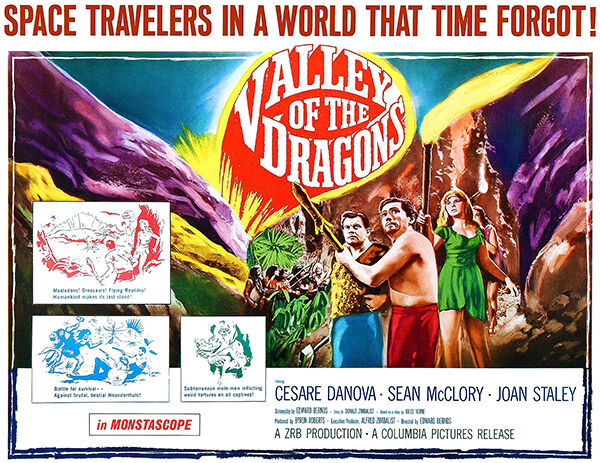
Behind the Scenes: “Valley of the Dragons” / “Prehistoric Valley” (1961)

“Producers must become real businessmen,” said Al Zimbalist, “and settle down to cutting corners.” [1] And he set about giving an object lesson in the art of cutting corners in producing Valley of the Dragons.[2] First of all the source novel by Jules Verne, Hector Servadac or The Career of a Comet, was out of copyright, in the public domain, so nothing was spent on that. Secondly, it just so happened that Columbia had a “magnificent” jungle set standing by, built at the cost of half a million bucks for The Devil at 4 O’Clock (1961), but now, that Spencer Tracy-Frank Sinatra effort complete, standing empty and to a producer with a persuasive tongue available at no cost.[3]

Thirdly, such a persuasive producer could convince Columbia to put a ceiling on the overhead they attached to any picture to cover their general office costs. Fourthly, he had acquired the rights to One Million B.C. (1940) and could plunder that picture for stock shots of prehistoric monsters. And fifthly, with budget limited in any case to $125,000,[4] he couldn’t afford to pay anybody much anyway and so was inclined to offer no more than $6,000 for the script.

Director Bernds was under the misapprehension (see below) that the source book hadn’t been published in the U.S. Well, here’s proof that it was, and pretty much as soon as it appeared in 1877.

As it happened, Zimbalist could possibly afford to spend more given he was sitting on a $3 million worldwide haul from Baby Face Nelson (1957).[5] With partner Byron Roberts, he had just inked a multi-picture deal with Columbia, Valley of the Dragons the first product. Also on his slate: The Well of Loneliness based on the controversial novel by Radclyffe Hall, The Willie Sutton Story to star Tony Randall, a biopic of Bugsy Siegel and four television projects.[6] Zimbalist didn’t hang about. Valley of the Dragons went in front of the cameras on January 30, 1961, and was scheduled to hit U.S. cinemas in May[7] though ultimately it was delayed till the fall. Unfortunately, there was a surfeit of “dragon” pictures on the market what with Goliath and the Dragon and The Sword and the Dragon.

Zimbalist specialized in B-movies like Cat-Women of the Moon (1953), King Dinosaur (1955) and Tarzan the Ape Man (1959) in which Cesare Danova was second-billed. Baby Face Nelson, helmed by Don Siegel, was his best-made and most successful picture. Director Edward Bernds was cut from the same B-picture cloth with titles like Space Master X-7 (1958), Queen of Outer Space (1958) with Zsa Zsa Gabor and Return of the Fly (1959).

“Science takes a beating,” commented the director of the movie’s premise, explaining that it was not only unscientific but “utterly ridiculous.” The book, he claimed, had never been published in the U.S. because it was “viciously anti-Semitic” and it was brought to the producer’s attention by his son Donald, on vacation in London, who happened upon a second-hand copy in a bookstall. Although given a story credit – and thus some residuals – that was the only part Donald played in the making of the movie. The basic story was “shaped” by the stock footage. Bernds knocked out a 10-page treatment that Zimbalist shopped to Columbia. Although the budget was tiny, the producers would be due to pay for any overages.[8]

“The Jules Verne name meant box office at the time,” recalled Bernds.[9] Added Zimbalist, “Jules Verne was as big a name as Marlon Brando” with the advantage that “Verne never had a flop…with Verne you don’t need Marilyn Monroe.”[10] To help promote the movie, Zimbalist sent out on tour 50ft replica monsters and advertised it as being made in “Living Monstascope.”[11]

The special effects didn’t always go according to plan. While the giant spider’s jaws were spring-loaded and snapped shut thanks to magnets, the legs, operated by motors, did not always work and it was largely down to the actors to give the impression of an intense fight.[12] The rest of the special effects were simpler to achieve. An alligator given an extra dimension did duty as the dimetrodon, the T Rex was a giant blue iguana, a white nosed coati was passed off as the megistotherium, an Asian elephant covered in wool for the mastodon, while the pterodactyl came from the stock footage. “The cast was good, we had a reasonably fast cameraman…we didn’t have to spend a single day on location…and we did the impossible – brought the picture in on budget,” said Bernds.[13]

While the picture proved to be first run material, it didn’t top the bill, except in cinemas that gobbled up product, so initially it went out as support in 1961 to William Castle’s Mr Sardonicus (1961) but also played second fiddle to Mysterious Island, Weekend with Lulu and The Mask. [14] Results were mixed: a “fair “  $11,000 in Boston, “bright” $20,000 from five houses in Kansas City, “sluggish” $5,000 in Portland and “good” $13,000 in San Francisco.[15] It must have done well enough for it was revived the following year and topping a bill in Chicago that included Eegah (1962)[16] while an exhibitor in Texas deemed it a “nice surprise…will do good business for a Saturday playdate.[17]

Zimbalist didn’t realize his ambitions with Columbia. None of those projected movies materialized, nor did an anthology television series based around the works of Jules Verne.[18] He was quick off the mark to register the title Lucky Luciano after the gangster’s death in 1962,[19] but that didn’t translate into a movie. In 1964 he lined up a $2 million slate with Allied Artists including King Solomon’s Mines, Planet of the Damned, Jules Verne’s Sea Creature and Young Belle Starr.[20] But none of that quartet reached the screen either and his final pictures were Drums of Africa (1963) with MGM and the indie Young Dillinger (1965) which prompted an outcry over the violence.

Byron Roberts enjoyed a longer career, with credits for The Hard Ride (1971), Soul Hustler (1973) and The Gong Show Movie (1980). For good or bad, Bernds was rewarded for his efforts on Valley of the Dragons by becoming the go-to director for The Three Stooges, helming The Three Stooges Meet Hercules (1962) and The Three Stooges in Orbit (1962) before sidling off for the animated version of their antics.  


[1] “Varied Guesses on IA’S New Wages & Small Pix,” Variety, February 8, 1961, p3.

[2] “Another Jules Verne Yarn To Be Made Into Pic,” Box Office, May 1, 1961, pW!.

[3] Tom Weaver, Interviews with B Science Fiction and Horror Movie Makers (McFarland), p62-64.

[4] Weaver, Interviews, p62-64

[5] “Varied Guesses.”

[6] “Zimbalist, Roberts Pact with Columbia Carried Video Angle,” Variety, January 18, 1961, p17.

[7] “Monsters in Droves,” Variety, February 15, 1961, p4.

[8] Weaver, Interviews, p62-64.

[9] Weaver, Interviews, p62-64.

[10] Murray Schumach, “Hollywood Mines Gold in Jules Verne,” New York Times, February 3, 1961.

[11] “Monsters in Droves.”

[12] Weaver, Interviews, p51-52.

[13] Weaver, Interviews, p62-64.

[14]Back St Holds Pace in 2nd Detroit Week,” Box Office, November 20, 1961, pME4; “Hawaii and Commancheros Neck-and-Neck in Seattle,” Box Office, December 4, 1961, pW3; “Hawaii Is Hartford Favorite a 2nd Timer,” Box Office, December 11, 1961, pNE1; “Mysterious Island Tops,” Box Office, January 8, 1962, pSE8.

[15] “Picture Grosses,” Variety: November 1, 1961, p8; November 8, 1961, p10; November 29, 1961, p15; December 6, 1961, p9.

[16] “Picture Grosses,” Variety, June 6, 1962, p9.

[17] “The Exhibitor Has His Say,” Box Office, July 2, 1962, pB6. This was at the Galena Theater.

[18] “Zimbalist-Roberts 3 Vidfilm Skeins,” Variety, April 5, 1961, p30.

[19] “Dead, Lucky Luciano Looks Sure for Filming,” Variety, January 31, 1962, p1.

[20] “Zimbalist Finances, 12 Go Allied Artists,” Variety, June 10, 1964, p4.

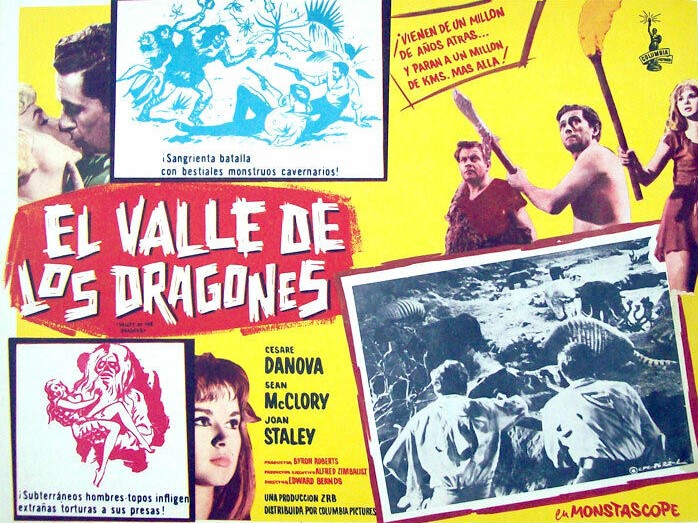
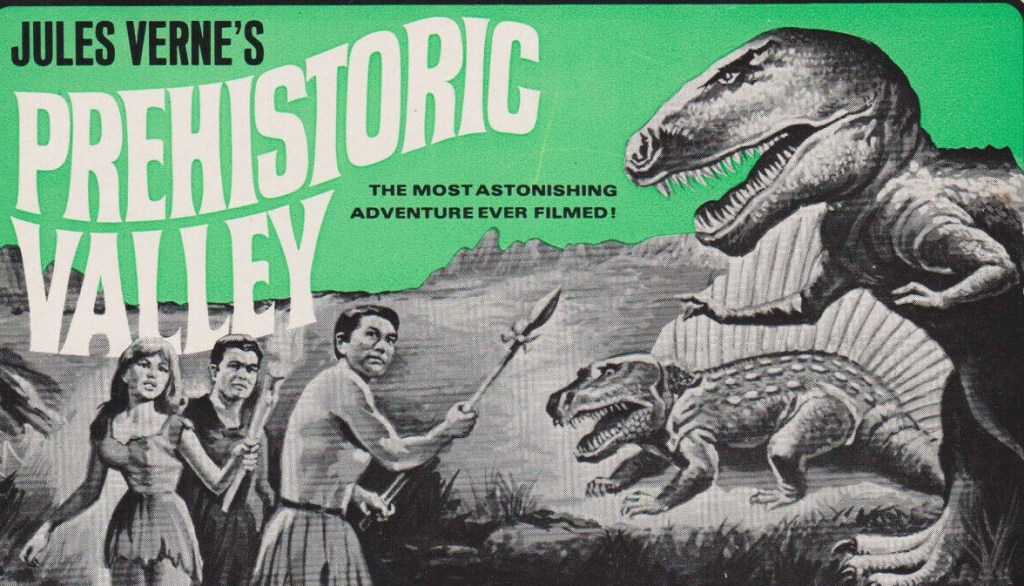
Valley of the Dragons / Prehistoric Valley (1961) ***

Jules Verne was the marquee attraction here after the box office success of 20,000 Leagues under the Sea (1954), the Oscar-winning Around the World in 80 Days (1956) and Journey to the Center of the Earth (1959), and to a lesser extent Master of the World (1961) and Mysterious Island (1961) with just around the corner another megahit In Search of the Castaways (1962) and minor hit Five Weeks in Balloon (1962). His works, I don’t need to tell you, are still being plundered.  

Let’s get the hokey science out of the way first. In 1881 a passing comet scoops a wee bit of Earth including, crucially, some atmosphere, and two dudes Hector (Cesare Danova) and Michael (Sean McClory) who are just about to fire their weapons in a duel. Sensibly, “in the circumstances,” they decide to put their argument on hold, and later, like the true gentlemen they are, give up on the idea after they have saved each others’ lives.

I should point out, for the easily duped, that there ain’t no dragons, certainly nothing of the Games of Thrones variety, though there are prehistoric creatures, including neanderthals, aplenty. And Verne probably set the tone for modern cod sci-fi exposition with this cracker, explaining the existence of these monsters as because said comet had done a previous turn around the Earth a million years ago and snipped off a piece of the world containing such beasties.

Anyway, as you might expect, they are mostly on the run for their lives, until, separated, they end up with two separate tribes, the shell tribe and another with no distinctive fashion accessories, and, as luck would have it, each with a lady. Blonde Deena (Joan Staley) proves particularly feisty, and possessive, beating back other women who take a notion to her prize. On the other hand Michael has to thump the boyfriend of Nateeta (Danielle de Metz) until he gets the message.

As you might expect there’s a dalliance in the river – though nobody thought then to play up the fur bikini element that brought Raquel Welch instant fame in One Million Years BC (1966) – and an erupting volcano and when not battling each other the beasties, including a giant spider, are terrorizing the populace. The tribes, naturally at war, are brought together by the former rivals.

Oddly enough, given later reiterations on this theme, our heroes are scarcely muscle men and Hector, in particular, has a knack for repartee. Observing his own cooking, he remarks, “Even the chefs at Fontainebleu could not have burn it with such finesse.”  

Given that these films are generally judged on the quality of the special effects, this isn’t bad, the spider is certainly duff, but the rest, woolly mammoths and (consults his beloved tattered childhood dinosaur encyclopaedia) T Rex and a goodly number of prehistoric monsters, sometimes just lizards or elephants with bits attached, sometimes just lizards in a close-up fight to the death. Lizards are used to clever effect by dropping them into the cracks in the ground that constitute the earthquake.

Director Edward Bernds (Return of the Fly, 1959) knows what to judiciously use and doesn’t waste any time getting on with the tale written by himself and Donald Zimbalist (Young Dillinger, 1965) from the Verne book Career of a Comet. One of the downsides of appearing in such B-movie pictures is the stars tend to get stuck in that level of picture. But some of these escaped such a fate. Sean McClory turned up in The King’s Pirate (1967) and Bandolero! (1968) and Cesare Danova had parts in Viva Las Vegas! (1964) and Mean Streets (1973). The female stars were less fortunate, Joan Staley’s biggest picture being Roustabout (1964) in a small role though  Danielle de Metz appeared in Jessica (1962) and The Magic Sword (1962).

Minus the gazillions spent on the latest Godzilla/Kong monsterfest, you have to cut this kind of picture a bit of slack.

Enjoyable enough.

The Light at the Edge of the World (1971) ***

Had me at pirates! Unfortunately, I feel suckered. These scumbags, even with a dandified Yul Brynner (The Double Man, 1967) at the helm, give the traditional swashbuckler a bad name. That said, it’s a decent Rambo-esque adventure, derived from a Jules Verne novel, that sees Kirk Douglas (A Lovely Way To Die, 1968) single-handedly take on the venomous pirate crew, with Samantha Eggar (The Collector, 1963) thrown in as lure.

Ex-gold-miner Denton (Kirk Douglas) runs the southernmost lighthouse off the perilous coast of Argentina leading to the dreaded Cape Horn passage, the only route round South America prior to the opening of the Panama Canal. Helping him out are veteran seaman Capt Mortiz (Fernando Rey), who constantly upbraids Denton for his lack of naval lore, and young lad Virgilio (Jean Claude Drouot) and his pet monkey. When a ship hoves into view and anchors off-shore, Mortiz and Virgilio head up the welcome party only to be ruthlessly – and gleefully – cut down as they climb on board.

Pirate chief Kongre (Yul Brynner) has come up with a neat scam. Switch off the whale-oil-fuelled lights in the lighthouse, wait for unsuspecting ships to be wrecked and pocket the proceeds. After being tormented and humiliated, Denton manages to escape and hide out in the caves, but only for as long as Kongre, bored with idleness, decides to hunt him down astride his white horse armed with a unicorn-like sword, the lighthouse keeper only avoiding capture by diving into the sea, where he is presumed drowned.

But when the first victim of Kongre’s scheme breaks asunder, Denton rescues Montefiore (Renato Salvatore) from the ensuing sadistic massacre. The only other person saved, at Kongre’s behest, is the beautiful Arabella (Samantha Eggar), for whom the captain goes through an almost courtly charade before, espying photographs in the lighthouse cottage, deciding that since his captive bears some resemblance to Denton’s former lover he could inflict further torment to Denton by parading the woman, hoping to use her as lure to bring his enemy out from his hiding place.

While Denton has escaped capture and is carrying out guerrilla warfare against the invaders he’s not particularly successful, given he lacks any decent weaponry, is heavily outnumbered and Kongre is pretty cunning. Denton’s innate decency sees him attempting to rescue the girl only, in a stunning twist, to be knocked back as he has little to offer except hiding out in caves and the captain has been treating her royally. Unfortunately for her, when his ruse fails, Kongre tosses her to the sharks in the shape of the lusty crew who proceed to commit mass rape. Meanwhile, Montefiore has been captured, strung up in the rigging and is being flayed alive, slices of skin torn from his body to the delight of his captors.

As it happens, the pirates, to reinforce defence of the island should they themselves come under attack from the British or Argentinian Navy, have brought their ship’s cannons ashore. As it happens, not only are they trained on the ship, but Denton, despite no experience at all, proves an ace artillery commander. As the ship burns and sinks, he turns his attention to Kongre, conveniently swanning around in the lighthouse rather than the cottage, and in a piece of savage irony sets fire to the building with whale oil.

Could do with shaving 20 minutes off the running time, and certainly have to suspend disbelief at other points, but otherwise it’s a pretty early edition of the Rambo-style revenge, the one-man army that can wipe out a superior force. Despite my desire for a decent swashbuckler, the pirates are probably more realistic than anything served up by Errol Flynn or Johnny Depp, and their cruelty seems consistent with their profession. The scenes with Denton being pursued relentlessly by the mounted Kongre are especially effective as is the rejection of Denton by the snooty girl.

Kevin Billington (Interlude, 1968) directed from a screenplay by wife Rachel and Tom Rowe (The Green Slime, 1968).

Long-lost film that deserves an audience.

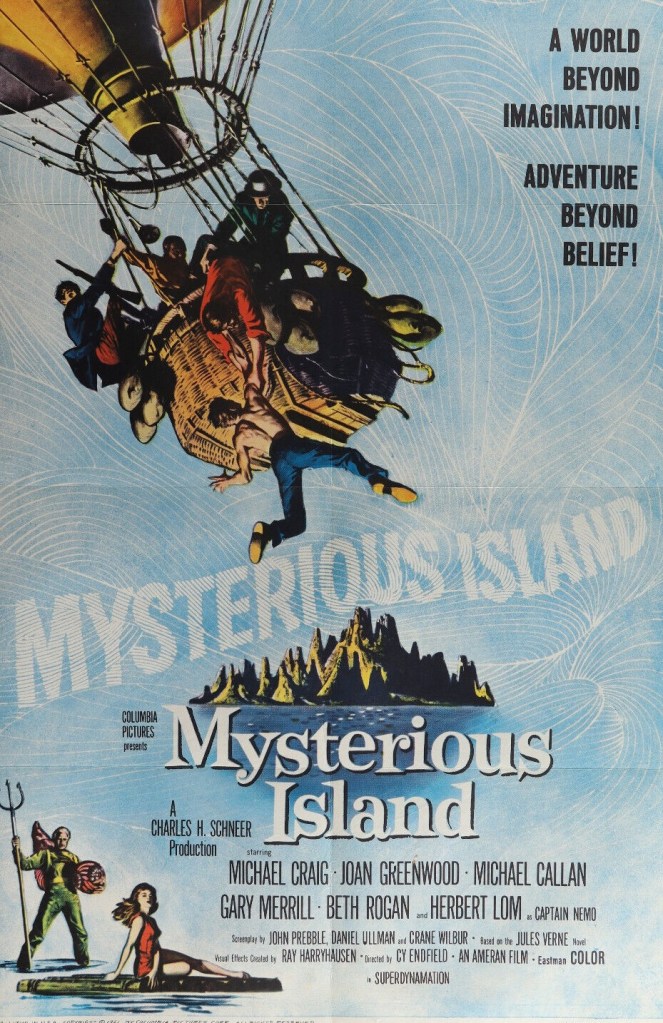
Mysterious Island (1961) ****

It’s the Ray Harryhausen Show. You’re not here for the story, surely, or the characters. You’re just waiting patiently for the monsters to appear. The only element that’s ever wrong with this kind of picture is that in-built delay. The need to set up the story and establish the oddities of the world before the behemoths trundle into view.

Doesn’t matter whether the creatures already live in an accommodating  global ecosystem like Jason and the Argonauts (1963) or One Million Years B.C. (1966). Or whether you are  going to come across them by the simple device, most famously, of dropping through a rabbit hole (Alice in Wonderland) or via a cupboard door (The Lion, the Witch and the Wardrobe) or a  rockface cracking open (Prehistoric Women / Slave Girls, 1967) or a time warp (Wonder Woman, 2017).

Here, it’s a bunch U.S. Civil War soldiers who need to break out of their prison and commandeer a handy hot-air balloon that can fly thousands of miles to the uninhabited volcanic island occupied by giant beasts. So we’ve got a monstrous crab, giant bees, chicken, gigantic octopus. And the success or failure of the picture relies not so much on whether our heroes can overcome these than that they look realistic.

And, boy, they are just brilliant. This is fairly early on the Harryhausen catalogue but if his stop-motion animation was still going through an experimental stage it’s hardly noticeable. Enhanced claws and beaks are just dandy for trapping humans, having them wriggling madly to avoid being split open with one snap. And the bee is pretty cunning, filling in the hole the invading humans have created in the massive honeycomb.

And should, perchance, your mind be wandering director Cy Endfield (Zulu, 1964) has a bout of sequel-itis, throwing in Captain Nemo from author Jules Verne’s 20,000 Leagues under the Sea (1954), and prequel-itis – the pirates from his In Search of the Castaways (1962) – plus, to add the romantic touch, a couple of shipwrecked damsels and, for the climax, volcanic eruption.

No doubt you’re dying to know about the characters you couldn’t really care less about who are encountering this legion of beings. So, we’ve got the grizzled Capt. Harding (Michael Craig), young Herbert (Michael Callan) who will express his romantic side, Sgt. Pencroft (Percy Herbert), Corporal Nugent (Dan Jackson) and Gideon (Gary Merrill). There are joined by posh English lady Mary Fairchild (Joan Greenwood), who happily buckles to and is handy with a rifle, and her niece Elena (Beth Rogan) who decides laziness is the better option when she’s not canoodling with Herbert.

Their job is to squabble, beat off the monsters, adapt a local geyser for cooking purposes, set to building a boat to escape, and await the next monster/person who’s going to upset their plans.

Captain Nemo certainly makes an impression, his ship, the Nautilus, stranded under the volcano and the man himself taking a break from the world since he doesn’t believe he is such a good fit. Turning up out of the waves in an improvised aqualung isn’t quite an entrance on a par with Ursula Andress in Dr No (1962), but it runs it close, though bikini tops rubber-suit all the time.

The pirates are just a menace and I wouldn’t be surprised if you came away with the notion that they are rammed into the tale just so their sunken ship, scuttled by Nemo, can miraculously rise from the waves thanks to the sailor’s ingenuity.

Time has been kind to Harryhausen. What was once viewed as appealing only to children and the childish wondrous aspects of adults has now become cult viewing. And no wonder. In the age of CGI, it’s quite astonishing what he has managed to achieve with what appears the most rudimentary of techniques.

Of the actors, British star Michael Craig (Doctor in Love, 1960) has his hands full to stop the picture being stolen by rising American actor Michael Callan (The Interns, 1962), a grumpy Gary Merrill (A Girl Named Tamiko, 1962), an almost avuncular Herbert Lom (The Frightened City, 1961) and a delightful turn by plummy-voiced Joan Greenwood (The Moon-Spinners, 1964).

You wouldn’t think this was the ideal movie to set you up for Zulu, but Cy Endfield does a good job of keeping the story moving and keeping out of the way during the Harryhausen sections. Screenplay by John Prebble (Zulu), Daniel B. Ullman (the television writer’s only movie of the decade) and veteran Crane Wilbur (The George Raft Story, 1962).

Huge fun. All hail King Ray.

https://amzn.to/3Rmb76d

Discover WordPress

A daily selection of the best content published on WordPress, collected for you by humans who love to read.

The Atavist Magazine

by Brian Hannan

WordPress.com News

The latest news on WordPress.com and the WordPress community.