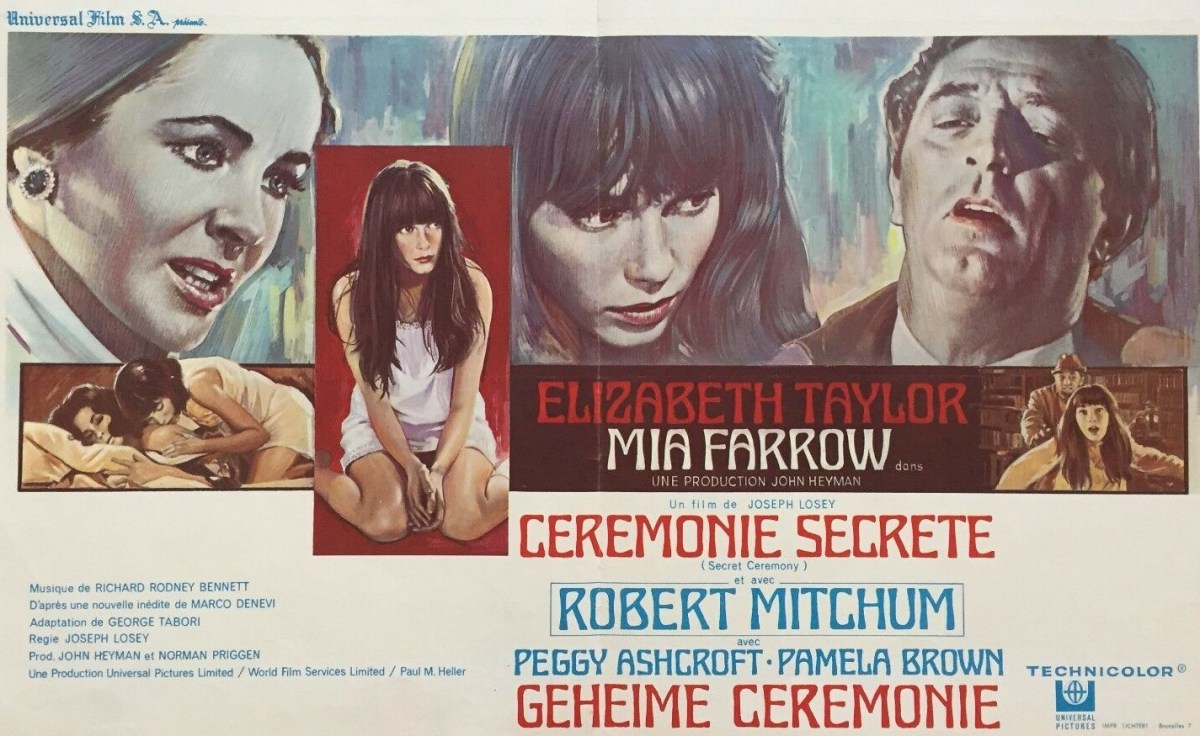
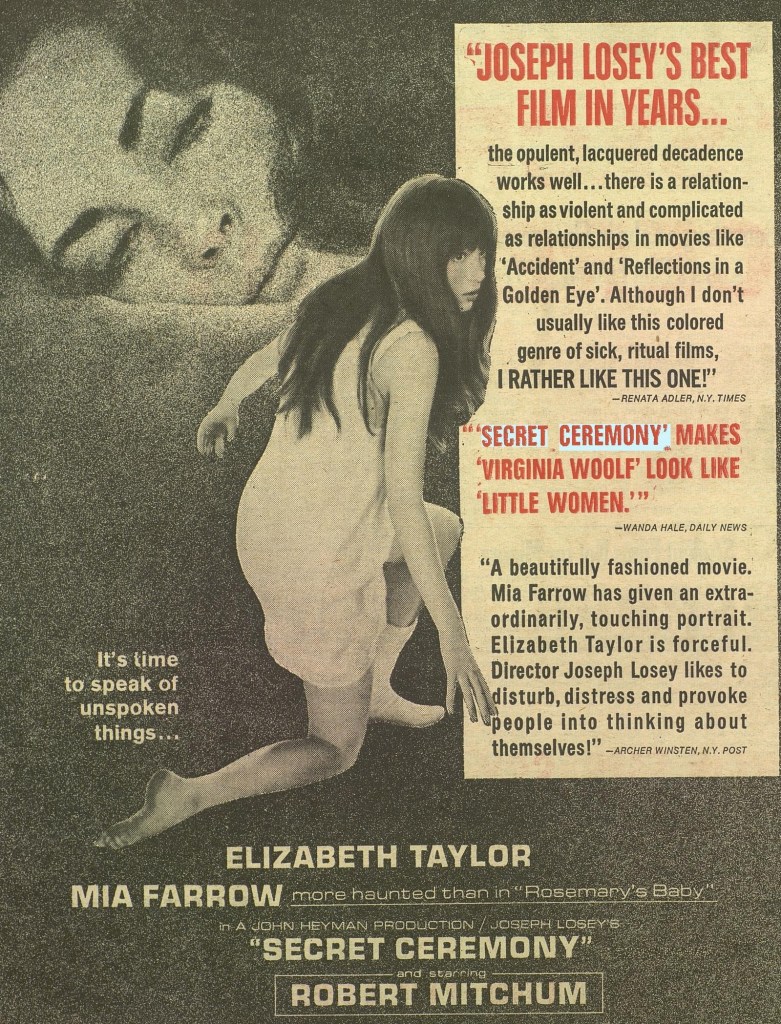
Few stars were as willing to trade their glamorous screen persona for a decent role as Elizabeth Taylor, here eschewing the trademark hip swivel, low cut dresses and elegant costumes for a clumping walk, frumpy look and eating with her mouth full. After a chance meeting on top of a bus with rich waif Cenci (Mia Farrow) middle-aged prostitute Leonora (Elizabeth Taylor) swaps a dingy bedsit for life in a massive mansion, cupboards stuffed full of furs, all her needs met. Cenci seeks a mother; Leonora, whose daughter drowned aged ten, seeks a child substitute.
Soon Leonora is prisoner to a fantasist, her own identity swamped by Cenci’s needs, accepting the role of “mummy” as the price of a life of luxury until she learns that what appears so freely given can be as easily taken away. This cloistered life is creepy. Cenci has rape fantasies. To a pair of interfering and thieving aunts, Leonora pretends to be Cenci’s dead mother’s cousin.
The fantasy conjured is threatened by the presence of Cenci’s poet stepfather Albert (Robert Mitchum) who intends to become the girl’s legal guardian. He talks like a child molester, “the extraordinary purity of my longings,” but given the depth of Cenci’s fantasies Leonora initially discounts inappropriate behavior on his part especially when Cenci wishes to become inappropriate with her. If Leonora stands in Albert’s way it is only to have the girl – and her wealth – to herself.
A psychological drama that appears more like a stage play in structure, skirting around core issues in favor of later revelation, and in essence making a good effort at dealing with behavioral problems which would find greater currency today – inherited mental illness, PTSD, low self-esteem, abuse, and incest. Though the last area is hard to specify, on the basis that, technically, Albert is a stepfather rather than a father, underage sex would appear to be more likely.
In an era when permissiveness virtually ensured audience shock, director Joseph Losey makes a decent stab at presenting the impact of sex on the vulnerable, despite her apparent steely exterior Leonora damaged by life as a sex worker, Cenci pretending to be younger as if that can sustain her innocence, not realizing how appealing that would be to a predator.
At once hypnotic and impenetrable, this is director Joseph Losey (The Servant, 1964) at his best, a story that by its subject matter must remain obscure, a mother-daughter relationship that should be twisted but reveals nothing but tenderness, ending for a time the torment of the emotionally unfulfilled, but when bonds appear to be strengthened they are fragmenting. However, the film is let down by the script and the somewhat grand guignol setting. Losey is wonderful at times with nothing to say just a prowling camera, only two lines of dialog exchanged in the first 15 minutes. You would certainly file it under “eclectic.”
The two main performances are electric. This is Taylor at her powerhouse best, her profession not glamorized as in Butterfield 8 (1968) and no male to bring to heel, and her last scene with Cenci is extremely touching. This was a bold role, too, for Mia Farrow after the success of Rosemary’s Baby (1967) turned her into a box office star. She brings believability to a difficult role, especially as she is far from the spoiled child one might expect.
Robert Mitchum fans must have received the fright of their life to see their hero not just with uncomely beard but portraying a sinister character, not an out-and-out villain which would have been acceptable, but fast forward a couple of years and you can see evidence here of the kind of portrayal he would evince in Ryan’s Daughter (1970). Look out for Peggy Ashcroft (The Nun’s Story, 1959) in a smaller role, her first film in nearly a decade.
Check out the “Behind the Scenes” article for this film.
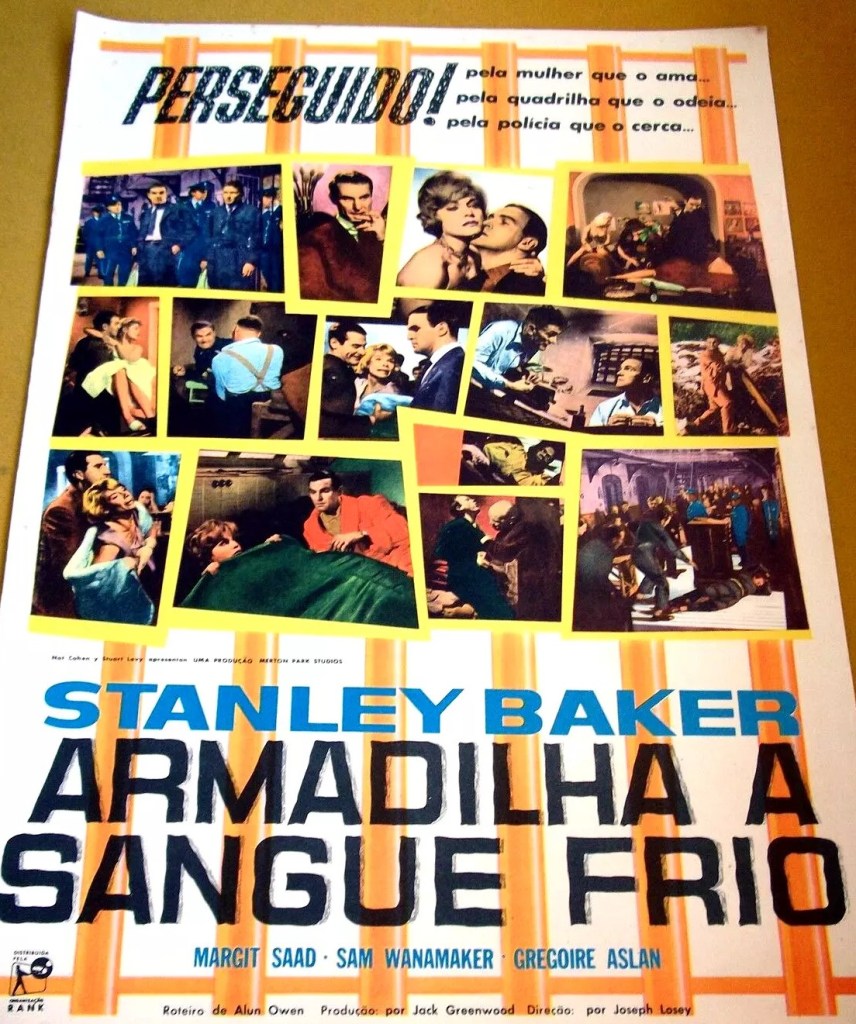
You’d be hard put to imagine from this hard-nosed gangster picture that both director Joseph Losey and star Stanley Baker would be capable of a more discreet arthouse offering like Accident (1966). Except for the director’s penchant for introducing a jazz score more often than suits the material – witness a brutal beating in a prison – this is an exceptionally gruelling blast through the British underworld, as though the domestic film industry had suddenly inhaled a narcotic comprised of Cagney and Bogart at their meanest.
With hardly a redemptive character in sight, it makes terrific demands of both director and star that anyone comes out achieving audience sympathy. Hollywood usually fell back on the trope of the innocent prisoner to instigate character empathy, but there’s no question from the outset that career criminal Bannion (Stanley Baker) is as tough as they come. In the opening section he arranges for rival Kelly (Kenneth Cope) to be viciously beaten with prison guard Barrows (Patrick Magee) turning a blind eye.
Out after a three-year stretch, Bannion plans a robbery of a race track with a partner, American Mike (Sam Wanamaker). But it turns out the track is owned by another gangster. After that, the double-crosses come thick and fast, nobody to be trusted, everyone out for themselves. He ends up back in prison, wanted by both sides of the law, the gangsters desperate to get their hands on the hidden loot.
Inside, he is protected by Italian mob boss Saffron (Gregoire Aslan), ruling his empire from prison, in return for a share of the loot. In due course, he instigates a riot, and double-crossing the other inmates, secures a shift to a low-security prison, and he is rescued from the transfer van. But there’s no escape. It’s a bleak ending all round. He dies on a beach, but without revealing where he has stowed the loot.
There are a couple of gals in the mix. The first, his ex-, Maggie (Jill Bennett) he treats in appalling fashion. The second, something of a present for his release, Suzanne (Margit Saad), sees the better side of him, although you have a sneaking feeling that she’s a plant.
But, really, nobody’s got a better side here. The prison scenes are grittier than had previously been the case in British movies, but the whole gangster set-up has a realistic “goodfellas” feel to it, boozing gangsters welcoming him home even as they are planning to stitch him up. And while Bannion may be unaware of ownership of the race track, clearly Mike isn’t, and Bannion is being set up to take the fall.
Joseph Losey (The Damned, 1962) takes an original approach to the material, cutting out the “big job” element entirely in favor of repercussion. He keeps up a brisk pace, which helps build tension, instead focussing on the relationships between the criminals and the prison hierarchy. Especially in the early prison scenes, more is made of vulnerability than toughness, many of Bannion’s confederates presented as weak and easily controlled rather than constantly challenging, prison guards complicit.
Stanley Baker (Where’s Jack, 1969) has such a malevolent appearance he was often as his best in the toughest arenas and perhaps Losey is making the point that even the toughest of tough guys can be duped by gangsters with more brains. There’s a terrific support cast: Sam Wanamaker (Warning Shot, 1966), Gregoire Aslan (Lost Command, 1966), Patrick Magee (Hard Contract, 1969), Jill Bennett (The Charge of the Light Brigade, 1968), Patrick Wymark (Where Eagles Dare, 1968) and Laurence Naismith (Jason and the Argonauts, 1963). German star Margit Saad (The Magnificent Two, 1967) lends an air of mystery to her character.
This was the third – of four – teamings for Losey and Baker. The British censor took a mighty mild attitude to the unexpected levels of nudity and violence. Alan Owen (A Hard Day’s Night, 1964) and Jimmy Sangster (The Devil-Ship Pirates, 1964) are credited with the script.
You might well enjoy this if a) you are in a very good mood, b) you love psychedelia, Pop Art and the Swinging Sixties, c) you fancy a spy film spoof or more likely d) you are a big fan of one or all concerned. Otherwise, you might be well advised to steer clear because it either takes the mickey out of a number of genres, not just espionage, or plays merry hell with narrative and character and is only loosely based on the source material by Peter O’Donnell.
Bear in mind it originated in a comic strip – later turned into a series of novels – that had more in common with the likes of Danger: Diabolik than the more straightlaced adventures emanating from DC Comics or Marvel. In particular, Modesty had a neat habit of distracting the villains by appearing topless in moments of crisis – a trick adopted in movies like 100 Rifles (1969) and El Condor (1970).
Fans of the comic strip/book may have been left indignant by the audacity of the filmmakers to introduce romance between Modesty and her sidekick Willie Gavin since in the book their relationship was strictly platonic. There was no place, in either comic strip or book, for the musical numbers that pepper the movie. And – check out The Swinger (1966) – for the notion of a character acting out a fictionalized version of herself.
You should be aware that Modesty is a very rich version of the gentleman sleuth, an idea that belonged to the old school, of a person, such as The Saint, bored with wealth, who takes on dangerous assignments in the eternal battle between good and evil.
Anyways, on with the story.
Modesty Blaise (Monica Vitti) is hired by the British government in the shape of MI5 chief Sir Gerald Tarrant (Harry Andrews), in return for immunity for her previous crimes, to deliver a secret shipment of diamonds, part-payment for oil imports, to Sheik Abu Tahir (Clive Revill). Modesty happens to be the sheik’s adopted daughter. Meanwhile, criminal mastermind Gabriel (Dirk Bogarde), believed to be dead, has his eyes on the consignment.
Meanwhile (again), Modesty upsets current lover Hagen (Michael Craig), Tarrant’s aide, by hooking up with old flame Willie Garvin (Terence Stamp). Meanwhile (again again), Garvin hooks up with another of his old flames, magician’s assistant Nicole (Tina Marquand), who has information on Gabriel.
Various assassins employing a variety of methods are sent to kill Modesty so a good chunk of the picture is her avoiding her demise. Gabriel is a pretty touchy employer, so upset by failure that he assigns his Amazonian bodyguard Mrs Fothergill (Rosella Falk) to eliminate all such assassins. Gabriel, however, is something of a contradiction, very sensitive to violence. And just in case you are not keeping up with the plot, conveniently, the bulk of the conversations between Tarrant and his superior (Alexander Knox) will fill you in.
Through a whole bunch of clever maneuvers on Gabriel’s part, Modesty and Willie are forced to steal the diamonds themselves. And, meanwhile, Hagen is on their tail, infuriated at being jilted.
In between the umpteen shifts in plot, which basically lurches like a ship in a storm, the screen is ablaze with color. Nobody complained much when Raquel Welch found it necessary to change her bikini ever few seconds, or that a musical required continuous costume changes, and Modesty here seems to have fallen into the same pattern, the changes in outfit often so swift you imagine she has a disorder.
And be warned, this is a poster film for Pop Art, so if it’s not clothes that are being swapped, it’s décor. You might put Terence Stamp’s blond barnet in the discordant category. You can’t really complain about the plot because espionage storylines are usually something of a conjuring trick with the impossible little more than a standard mission. There’s much to enjoy if you’re of a mind and subscribe to one of the four ideas outlined in the opening paragraph and like the idea of the otherwise critical darling Joseph Losey (Accident, 1967) giving way to stylistic overkill.
Monica Vitti (Girl with a Pistol, 1968) inhabits the role with the necessary verve though Terence Stamp (The Collector, 1963) looks as if he has walked into a spoof and Dirk Bogarde (H.M.S. Defiant / Damn the Defiant!) appears still in experimental mode, having dumped the British matinee idol, unsure of what his screen persona should be. Evan Jones (Funeral in Berlin, 1966) is generally to be blamed/praised for the screenplay.
A movie for which the word confection was invented.
Intellect can present as powerful a sexual magnetism as wealth. And for young women, unlikely to come into the orbit of powerful movie magnates or wealthy businessmen, they are most likely to experience abuse of power in academia, especially in top-notch universities like Oxford and Cambridge or Harvard and the Sorbonne.
Young students, unsure of their place in the world, depend on praise for their self-esteem. To be on the receiving end of flattery from a renowned scholar, a young person (males included) might be willing to overlook other unwanted attention. For young women and men accustomed to being assessed on looks alone this might be a drug too powerful to ignore.
The British system ensured that potential prey was delivered to potential predators. As well as attending lectures, each student was allocated a tutor and could spend a considerable amount of time with them in private in congenial surroundings behind closed doors. And since essays marked by tutors played a considerable element in an overall mark, there was plenty of opportunity for transactional sex.
And it was easy for women to think they wielded the sexual power. I once employed a woman who boasted that she had seduced her university tutor, little imagining that that took any opposition on his part, and that, in reality, she was just another easy conquest.
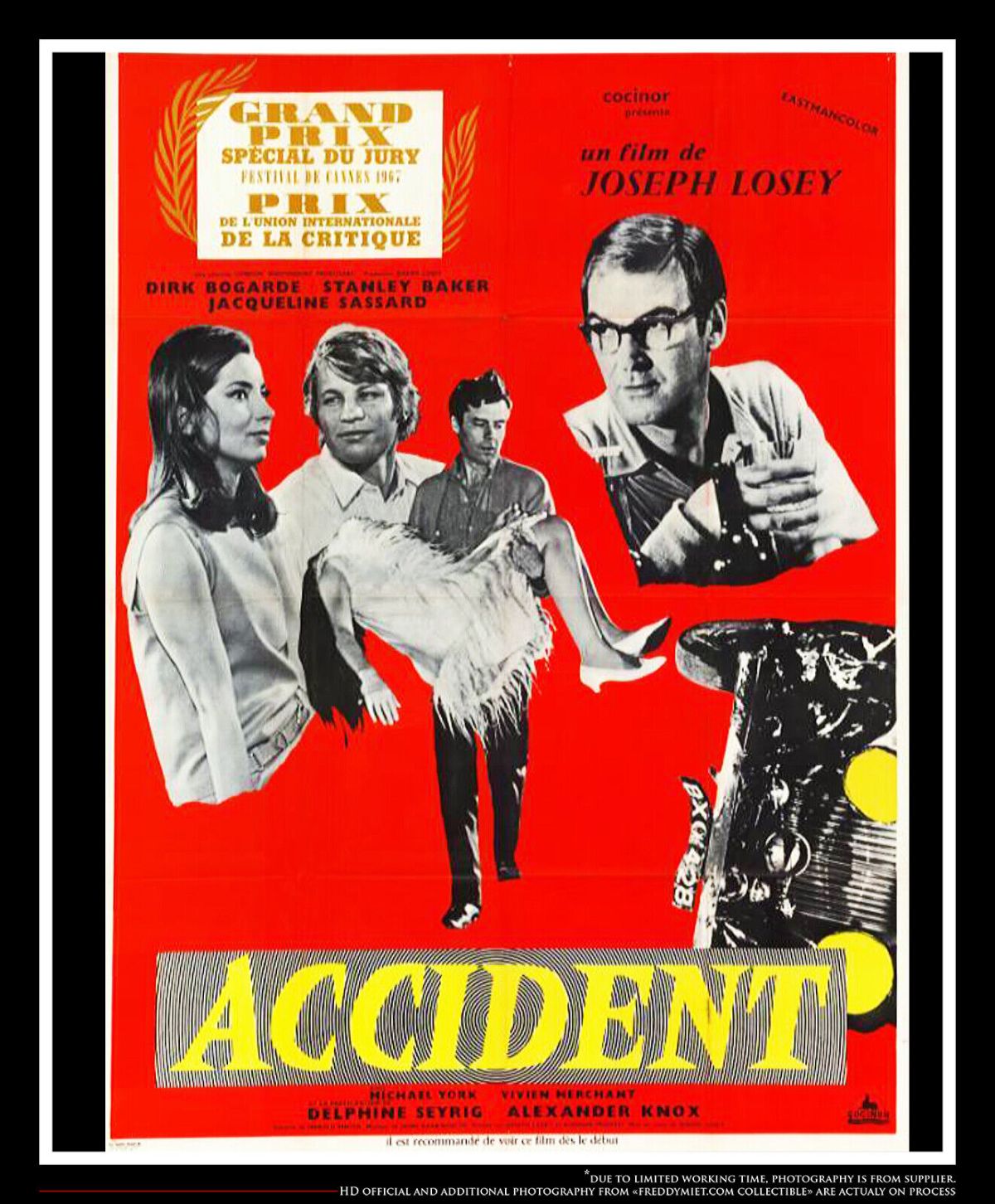
So you might be surprised to learn that when this movie about inappropriate behavior in a university of the caliber of Oxford appeared, nobody gave a hoot about the grooming and exploitation of young Austrian Anna (Jacqueline Sassard) by two professors, Stephen (Dirk Bogarde) and Charley (Stanley Baker).
The story is told in flashback in leisurely fashion. Hearing a car crash outside his substantial house in the country, Stephen finds inside the vehicle an injured Anna and her dead boyfriend William (Michael York). Then we backtrack to Anna’s arrival in Oxford, and how the love quadrangle is created. The presence of William suggests Anna has predatory instincts, but there is no sign of sex in their relationship, rather that he is forever frustrated at being kept on a leash and clearly suspecting he is losing out to others.
Stephen, a professor of philosophy, no higher calling in academe, endless discussion on the meaning of life manna to every student, has a purported happy home life, wife Rosalind (Vivien Merchant) pregnant with their third child. He’s no stranger to infidelity, reviving an affair with the estranged daughter Francesca (Delphine Seyrig) of a college bigwig (Alexander Knox).
But he can’t quite make his move on Anna, despite idyllic walks in the fields and their hands almost touching on a fence. The uber-confident Charley, novelist and television pundit in addition to academic celebrity, has no such qualms and seduces her under the nose of his friend and sometime competitor.
When opportunity does arise for Stephen it does so in the most horrific fashion and, that he takes advantage of the situation, exposes the levels of immorality to which the powerful will stoop without batting an eyelid.
The web Stephen is trying to weave around his potential victim is disrupted by William and Charley and if any anguish shows on Stephen’s face it’s not guilt at the grief he may cause or about his own errant behavior but at the prospect of losing a prize.
Director Joseph Losey (Secret Ceremony, 1968) sets the tale in an idyllic world of dreaming spires, glasses of sherry, tea on the lawn, glorious weather, punting on the river, old Etonian games, the potential meeting of minds and the flowering of young intellect. The action, like illicit desire, is surreptitious, a slow-burn so laggardly you could imagine the spark of narrative had almost gone out.
Stephen is almost defeated by his own uncontrolled desire, taking advantage of his wife entering hospital for childbirth, the children packed off elsewhere, to have sex with Francesca, not imagining that Charley will take advantage of an empty house.
And the young woman as sexual pawn is given further credence by the fact that at no point do we see the events from her perspective.
Anguish had always been a Dirk Bogarde (Justine, 1969) hallmark and usually it served to invite the moviegoer to share his torment. So it’s kind of a mean trick to play on the audience to discover that this actor generally given to playing worthy characters is in fact a sleekit devious dangerous man. Of course, the persona reversal works very well, as we do sympathise with him, especially when relegated to second fiddle in the celebrity stakes to Charley and humiliated in his own attempts to gain television exposure.
Stanley Baker (Sands of the Kalahari, 1965) was the revelation. Gone was the tough guy of previous movies. In its place a charming confident winning personality with a mischievous streak, a far more attractive persona when up against the more introspective Bogarde.
Jacqueline Sassard (Les Biches, 1968) is, unfortunately, left with little to do but be the plaything. There’s an ambivalence about her which might have been acceptable then, but not now, as if somehow she is, with her own sexual powers, pulling three men on a string. In his debut Michael York (Justine, 1969) shows his potential as a future leading man.
You might wonder if Vivien Merchant (Alfred the Great, 1969) was cast, in an underwritten part I might add, because husband Harold Pinter (The Quiller Memorandum, 1966) wrote the script and Nicholas Mosley, who had never acted before, put in an appearance because he wrote the original novel.
Losey, a critical fave, found it hard to attract a popular audience until The Go-Between (1971) and you can see why this picture flopped at the time despite the presence of Bogarde and Baker. And although it is slow to the point of infinite discretion, it’s not just a beautifully rendered examination of middle class mores, and a hermetically sealed society, but, way ahead of its time, and possibly not even aware of the issues raised, in exploring abuse of power, a “Me Too” expose of the academic world.
The acting and direction are first class and it will only appear self-indulgent if you don’t appreciate slow-burning pictures.
I was probably as surprised as anyone to discover that far from being a flop, Secret Ceremony was in fact a hit, taking $3 million in rentals in the U.S., ranking among the Top 20 foreign movies at the French box office, and hitting the target in Italy, Germany and Australia. Yet, outside of France, it was universally derided by the critics.
Joseph Losey (The Servant, 1964) held the unusual position of being a cult director working in Britain. He was the “object of a vociferous cult….his following grown in scope and size with each new film” and, conversely, as his popularity among the arthouse fraternity increased, he attracted more critical ire. Courting popularity by entering the spy genre with Modesty Blaise (1966) and linking up with the Elizabeth Taylor/Richard Burton box office colossus for Boom! (1967) seemed to go against the critical grain. Losey ascribed the critical coruscation Boom! received as less to do with the merits of the film itself than “people using the opportunity to launch personal attacks on the Burtons.”
Boom! had been packaged John Heyman, who coupled acting as agent for Burton and Taylor with being the producer, not necessarily a good combination. Universal was convinced it had “Virginia Woolf in color,” a reference to the previous enormous hit, although the box office told a different story. Jay Kanter, Universal’s London production chief who greenlit the project, commented: “When the Burtons were involved a lot of my judgement was colored by the magnitude of the star she (Taylor) was considered to be.”
So it was something of a surprise to find Losey and Taylor teaming up again for Secret Ceremony. Of course, it may have been the money, Taylor at this point still holding out for a million-dollar purse. Heyman said, “We were regarded as whizz-kids just for making two consecutive films with Elizabeth Taylor and bringing them in under budget.”
Losey’s world reflects a “highly selective form of naturalism.” Except for Accident (1966), from Sleeping Tiger (1954) through to Secret Ceremony, Losey worked with the same design consultant/production designer Richard MacDonald whom the director treated as a sounding board, to “test (ideas) and reject them in the telling.” This is a director for whom “patterned exoticism is extraordinarily precise.” A more important collaborator had been playwright Harold Pinter who had fashioned The Servant (1963) and Accident, bringing to both films his distinctive ear for dialogue. He was hardly required for Boom! whose screenwriter was the even more famous playwright Tennessee Williams (A Streetcar Named Desire, 1951) and for Secret Ceremony Losey went elsewhere for his screenwriter.
Losey was among the string of American talent who taken refuge in Britain in the wake of the anti-Communist hysteria of the late 1940s/early 1950s – others included producer Carl Foreman (The Guns of Navarone, 1961), and directors Cy Enfield (Sands of the Kalahari, 1966) and Edward Dmytryk (Mirage, 1965). By the time of Secret Ceremony, Losey had been working in Britain for nearly a quarter of a century and established himself as a director of distinctive vision, a critical fave in his adopted homeland, wildly appreciated by the French, with an occasional box office home run.
But although regarded as a British film-maker, Losey made Secret Ceremony – and Boom! for that matter – exclusively with Hollywood money, the budget 100 per cent supplied by Universal, that studio having decided that anything coming out of Britain would appeal to younger audiences. There was an untapped pool of talent available in British television who could be hired for substantially less than their U.S. counterparts. In three years Universal’s London production unit, headed by Jay Kanter, spent $30 million on a dozen projects. The biggest budget was allocated to Boom! with $3.9 million followed by $3.5 million to The Countess from Hong Kong (1967) starring Marlon Brando and Sophia Loren. The Night of the Following Day (1968) cost $1.5 million as did Fahrenheit 451 (1967) and Three into Two Won’t Go (1968). Secret Ceremony came in at $2.45 million.
Robert Mitchum and Joseph Losey went way back to a time in Hollywood when both were working their way up the RKO ladder. As well as Losey, Mitchum had been friends with many who would fall foul of the blacklist including screenwriter Dalton Trumbo, Dmytryk and Howard Koch (Casablanca, 1942). When Mitchum’s dalliance with drugs brought him a jail sentence, Losey visited him and brought him chilli from a famed restaurant.
Mitchum was recommended for the role in Secret Ceremony by Roddy McDowell, a friend of Taylor, who had been working with the actor on Henry Hathaway western Five Card Stud (1968). Mitchum received the job offer while on holiday in Mexico. For two weeks’ work he would earn $150,000. The role itself was scarcely onerous, drawing on aspects of the loathsome character he had created for Night of the Hunter (1955), but it did require an English accent of some kind and to his amusement Mitchum found himself on the telephone, like a salesman listing available product, going through the variety of accents he bring to the part.
Whether it was almost having to sell himself to the director or some previous incident, Mitchum and Losey did not resume their friendship. In fact, their relationship was the polar opposite. “He was very unpleasant,” recalled the director, “it was extremely hard for me to work with him.” Losey never found the source of Mitchum’s contempt. “In some curious way I must have made some mistake with him; I don’t know what it was.” Even attempts to recall Mitchum’s collaboration with Charles Laughton on Night of the Hunter failed to break the ice. Losey believed that Mitchum played tough to mask “an intense sense of failure.”
Mitchum wasn’t above sneaking away from the set. On one occasion taking himself off to visit old friend Robert Parrish, he knocked back some tequila and complained about the movie. On the Holland section of the shoot, Mitchum got into a food fight with a hotel diner. In the end, Losey was so disturbed by Mitchum that he was grateful when he departed as per contract despite the fact that some scenes had not been shot, including, according to the actor, the bathtub sequence, which would have accentuated the incest theme rather than the hint of lesbianism. Mitchum’s epitaph to the movie was that he talked Mia Farrow out of True Grit (1969) claiming Hathaway was a terror to work with.
The bath scene turned out to be the cause of some marital anguish. The set was cleared for its shooting of the scene after Taylor froze on emerging from her dressing room to see so many people gathered. But this was hardly Taylor at her beautiful best as she had been gaining weight. Even so Losey filmed her at times as though she was the grand Hollywood star with hair framing her face and the camera glimpsing her cleavage, but at other times her weight was a source of determining her character, when she eats with her mouth full and belches.
Halfway through filming Taylor was afflicted by severe physical pain and she was rushed to hospital for a hysterectomy, an operation that lasted over three and a half hours. Complications followed the surgery and she was given drugs that caused her to hallucinate. Writing in his diaries, Richard Burton noted: “This is the first time I’ve seen a loved one in screaming agony for two days, hallucinated by drugs, sometimes knowing who I was and sometimes not, a virago one minute, an angel the next.” She went from commanding him to leave the room to crying out for him to return. Sometimes she believed she was on board their yacht, other times that a film was playing on the switched-off television set.
The loss of her uterus may have affected her performance since in the film she plays a mother who has lost a child and in reality was a woman who had lost the ability to have another child.
The film exacerbated the tensions in the Burton-Taylor marriage. It was usually Taylor who was the one who had to keep a watchful eye on her partner in case he strayed. In this case, ironically, it was Burton who exhibited the jealous streak. The way Losey had whispered in the actress’s ear to build up her confidence during the bath scene while getting rid of extraneous crew found its way back to Burton who misinterpreted the action as intimacy. “My wife and Joe Losey are having a professional love affair,” he claimed. He spent a lot more time than usual on the set of his wife’s film. He even offered to take on the Mitchum role.
Losey had long been fascinated by a strange-looking house in West Kensington, London, and managed to hire it for the shoot. Debenham House in Addison Road, between Holland Park Avenue and High St Kensington, is one of a handful of truly Gothic London buildings. The church used was in Little Venice, St Mary Magdalene in Rowington Close, also in London, and the antique shop was located at the corner of St Stephen’s Mews and Westbourne Green. When the production shifted to Holland it was to the coastal town of Noordwjik with use made of the Grand Hotel there.
By the time the film opened, Taylor found herself in the middle of a storm over foul language (“gutter talk” in Variety parlance) for which she was seen as the “chief exponent.” It was an ironic position for Taylor to find herself in given her expletive-ridden performance in Who’s Afraid of Virginia Woolf (1966) had not only been critically acclaimed and a huge box office hit but seen as helping to break down the censorship barriers. However, it appeared that the “urination expression” and a word that was prefixed by “bull” were beyond the pale and Variety proclaimed that it was “evidently assumed that if a star of her (Taylor’s) magnitude can be gotten to speak the words, everyone else – actors, actresses, distributors, exhibitors and the public – will be accustomed to strong lingo in pix.” It was hardly coincidence that on the same day that this article was the leading story on the trade paper’s front page that inside six out of seven New York critics gave Secret Ceremony a drubbing, the exception being Renata Adler of the New York Times who called it Losey’s “best film in years.”
Even producer Heyman had his doubts about the material. “It should have been the story of two people who need and trust each other,” he said, “until one leans on the other a little bit more than she should. Unfortunately, the kind of sympathy which Losey shows for people in real life was absent from the relationship which is what I think made it unacceptable.” He summed up, “A cold picture.” (This has the taint of someone trying to work out why the film was a critical failure because otherwise I think Heyman got it exactly right for the movie I saw I did not view as cold nor unacceptable.)
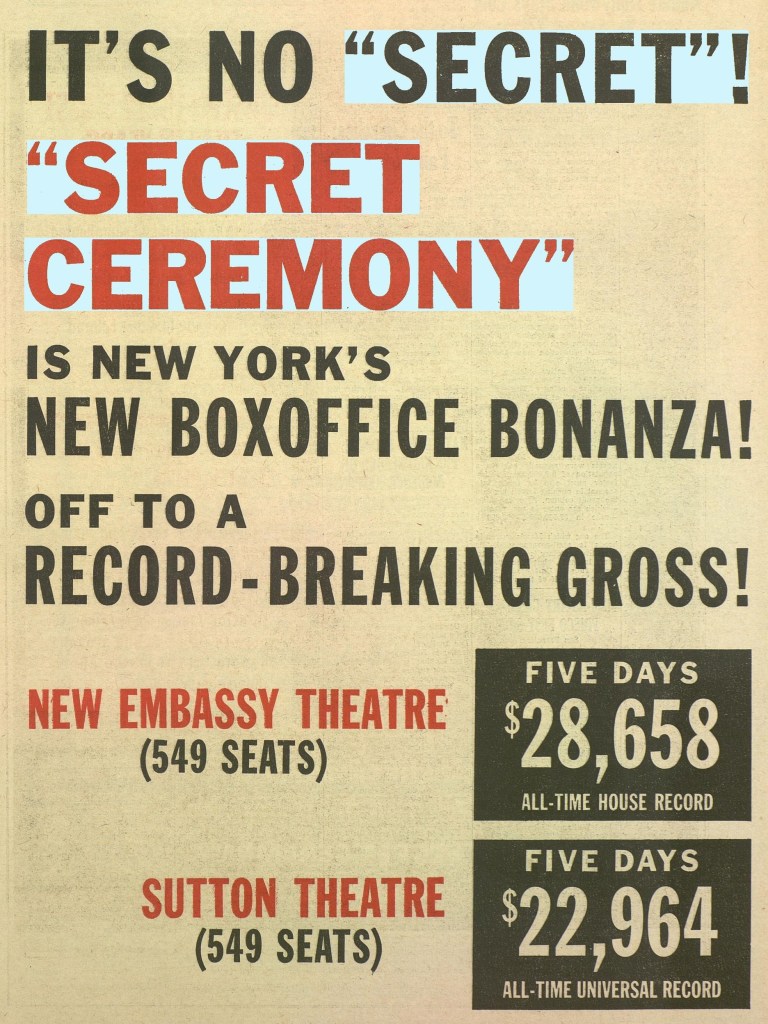
And neither, strangely enough, did the public. Although making a poor showing in Britain, it was not a box office disaster. That was averted by astute marketing, the potency of the stars and a public who, not for the first time, ignored the critics. The movie broke records when it opened at the New York arthouse pair, the Sutton and the New Embassy, and further afield in cities like Dallas. Arthouse success would have been anticipated but nobody would have expected that when it went wide in New York the second week improved upon the first. As well as a decent showing in the States, it hit the ground running around the world, and “ought to be credited” as one of Universal’s “most successful pictures from either domestic or foreign source.” In the French box office rankings, it placed above The Detective (1968) and Hang ‘Em High (1968) and just below The Thomas Crown Affair (1968). Acclaimed by that country’s critics, the Academie du Cinema named it best foreign film with Taylor and Farrow taking the gongs for best foreign actresses.
When Universal sold the movie to television for $1.25 million, a fee which certainly provided the picture with a decent extra profit margin, fourteen minutes were cut out and replaced by a 500 lines of extra dialog and a filmed discussion of the psychological issues raised, prompting Losey to demand his name be removed, claiming it “exactly reversed the meaning an intention of my film.”
SOURCES: Lee Server, Robert Mitchum, Baby I Don’t Care, (Faber and Faber, 2001) p169, 232, 509-512; Sam Kashner & Nancy Schoenberger, Furious Love, (JR Books, 2011)p240, 242-243,2; Alexander Walker, Hollywood England, (Orion Books, 2005) p200, 345, 354-257; “Screen: Secret Ceremony,” New York Times, October 26, 1968; “Joseph Losey Following Has Grown,” Box Office, October 28, 1968, pE1; “No End to Gutter Talk,” Variety, October 30, 1968, p1; “N.Y. Critics This Week: Ouch,” Variety, October 30, 1968, p12; “Secret Ceremony Sets House Mark at Sutton, New Embassy,” Box Office, November 4, 1968, pE2; “Secret Ceremony Setting New Records in Dallas,” Box Office, January 13, 1969, pSW1; “This Week’s N.Y. Showcases,” Variety, February 5, 1969, p9; “Jay Kanter,” Variety, February 26, 1969, p78; “Kanter No Martyr,” Variety, March 19, 1969, p26; “Ceremony, Z Nab Kudos,” Variety, May 7, 1969, p107; “French Filmgoing,” Variety, January 28, 1970, P27; “Paris First Runs,” Variety, April 29, 1970, p76; “Losey Wants His Credit Blipped from Vidversion of U’s Secret Ceremony,” Variety, September 16, 1970, p70; “All-Time Film Rental Champs,” Variety, October 15, 1990, pM184.






 The Magnificent 60s