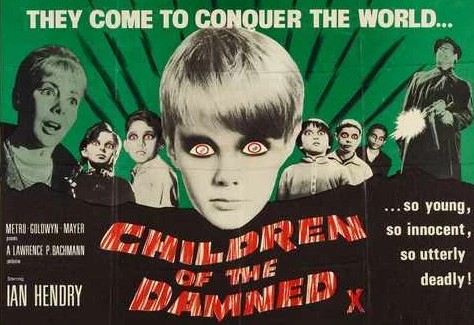
Children of the Damned (1964) ***

I wasn’t aware that celebrated sci fi author John Wyndham had written a sequel to his iconic novel The Midwich Cuckoos, filmed as Village of the Damned (1960). And it turned out he didn’t (he did make an attempt but abandoned it after a few chapters).  So he had nothing to do with the sequel. But the original had proved such a hit MGM couldn’t resist going for second helpings.

And there was nothing the writer could do about it, it being standard procedure that when you sold your novel to Hollywood the studio retained all the rights and could commission a remake, sequel, turn it into a television series, without consulting you.
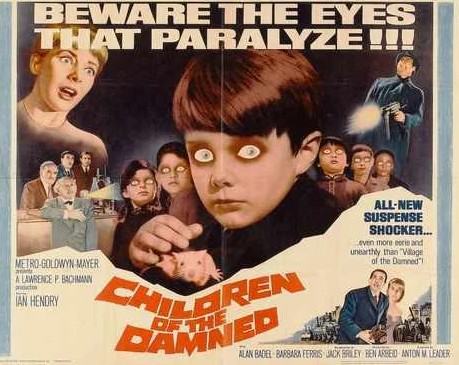
The only drawback for a potential sequel was that main adult character Professor Zellaby (George Sander) and all the kids had died in the original, though the final image of eyes flying out of the burning house might have suggested the children had actually survived. And, as we know these days, just when your main character dies it doesn’t prevent him miraculously returning to life should box office dictate.

So screenwriter John Briley (Oscar-winner for Gandhi, 1982) was handed the sequel. And what we get is a lot of atmosphere, a chunk of running around in empty London streets (the result not of mass evacuation but filming in early morning when roads are clear), a very slinky turn from Alan Badel (Bitter Harvest, 1963) showing what he can do when hero not villain, and a twist on the previous problem – how to vanquish the kids – which is whether to  weaponize them. Mostly, we are reminded of how better telekinesis was dealt with in the original picture and how poorly this compares to the likes of Brian De Palma’s later Carrie (1976) and even his The Fury (1978).
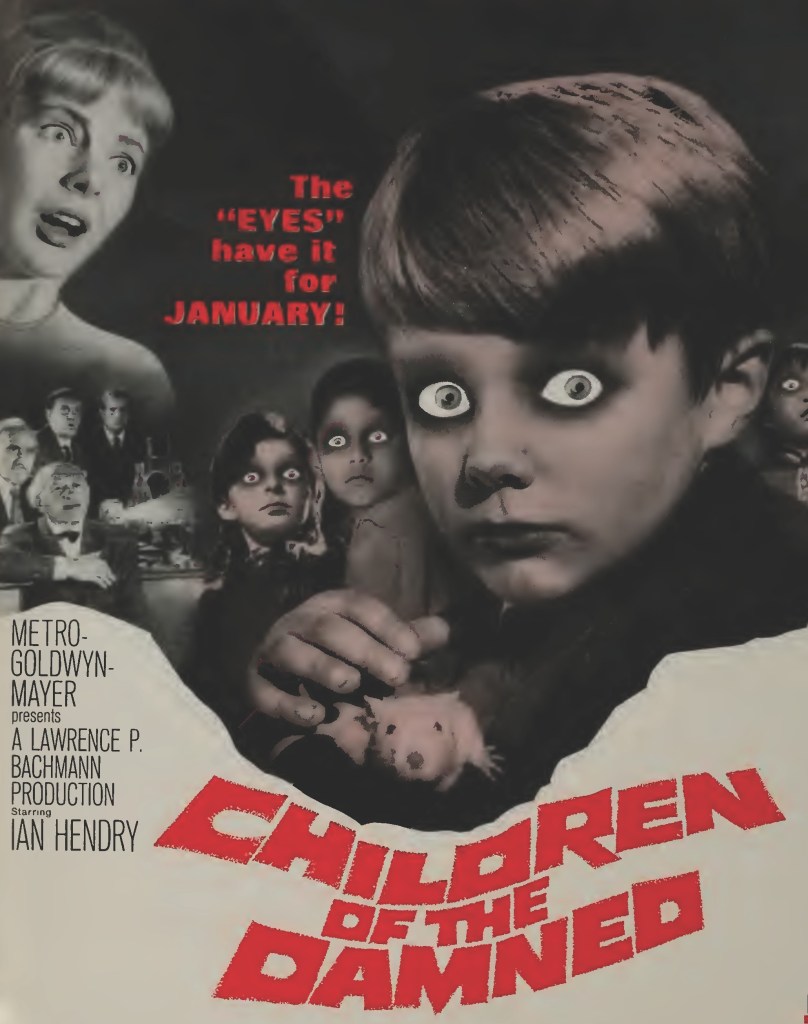
Apart from the title, there’s barely a nod to the previous incarnation, except that discerning the children’s paternity proves impossible. An United Nations project has tracked down six kids with incredible intellects. Like Professor Zellaby, British psychologist Dr Tom Llewellyn (Ian Hendry) and geneticist Dr David Neville (Alan Badel) want to study the kids while the more shadowy figure of Colin Webster (Alfred Burke) appears to have more sinister purpose in mind.

In any case none of the three achieve their goals because the kids escape and take refuge in an abandoned church, defending themselves against the authorities and the military by their brain controlling abilities and by the devising of a sonic weapon. Immediately under their thumb is the aunt, Susan (Barbara Ferris), of the young boy Paul (Clive Powell) who initially excited the interest of the British scientists.

Opinion varies as to whether the children are a genetic freak of nature, aliens or an advanced human race. The authorities can’t decide whether they are a threat or a wonder and decide to eliminate them, then change their mind, while the children decide to fight back then change their minds. The ending is quite a surprise.

Although the kids still have the fearful eyes, they are generally a lot less effective a scare than when the small gang of them stood side by side in the previous picture and stared at adults until they did the childrens’ bidding or killed themselves. There’s way too much discussion among adults. In the previous picture, those kinds of conversations had more emotional impact, since it was the villagers who were left distraught. Here, you couldn’t care less about the adults.

Interestingly enough, the standout isn’t any of the kids at all, but Alan Badel, who comes over as the libidinous sort, but very charming, and views any woman as fair game, but it’s fascinating to see how his usual screen persona here makes him a hero whereas in most other films exhibiting much the same characteristics he comes across as shifty, mean or downright villainous.

Ian Hendry (The Hill, 1965) was a rising British star but isn’t given much to get his teeth into. Barbara Ferris (Interlude, 1968) has a vital role.

Directed by television veteran Anton M. Leader (The Cockeyed Cowboys of Calico County, 1970) who makes his screen debut.

Not a patch on the original.
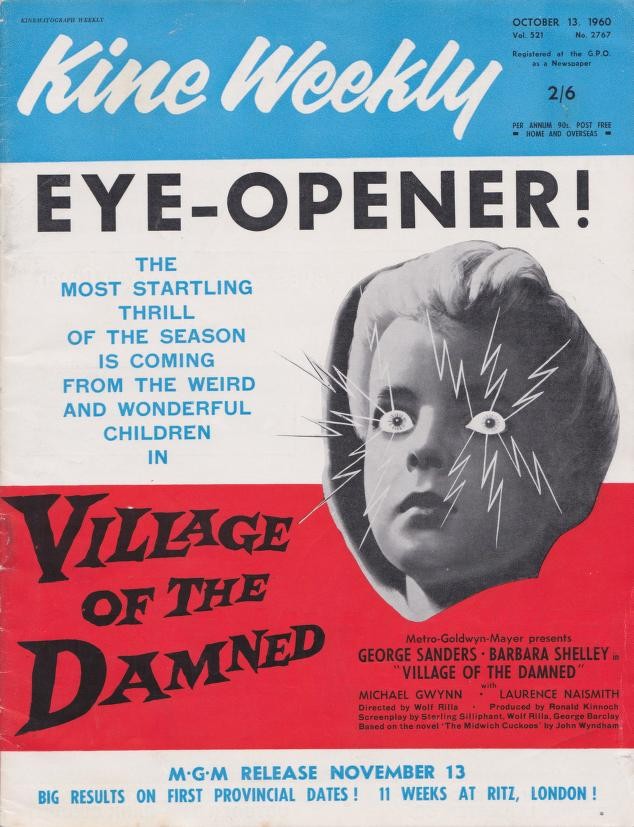
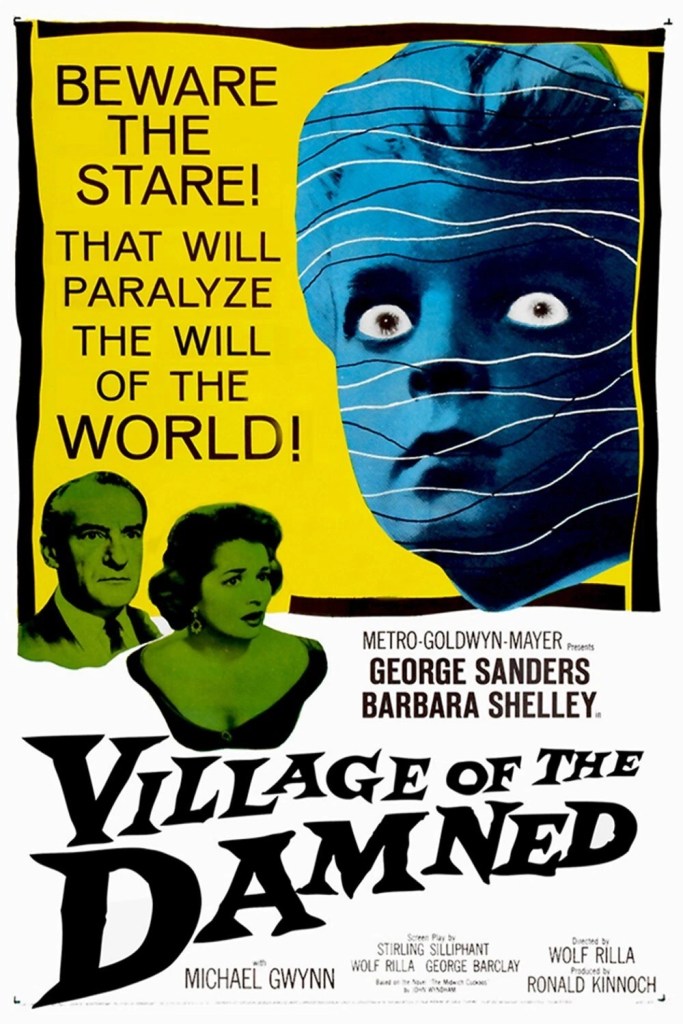
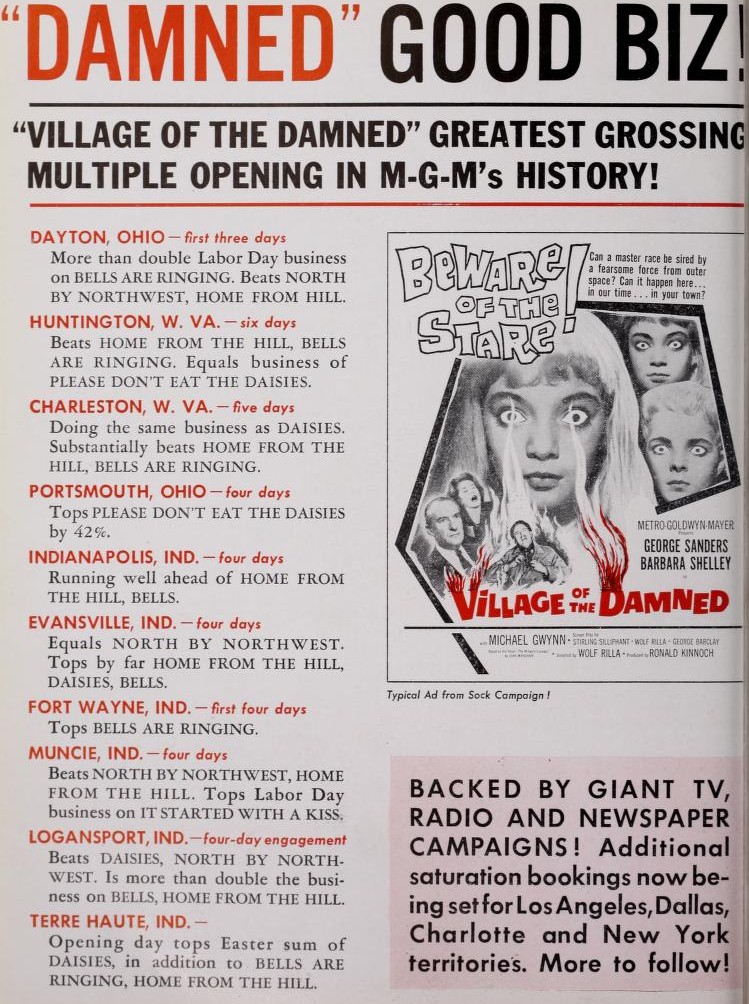
Village of the Damned (1960) ****

Superb chiller that, unusually, takes time to develop several strands over a longer time frame than is normal for a genre where the immediate takes preference. Opens a new dimension of terror, too, with the brain control sub-genre that would spill over into brainwashing. You could also, if you were of a mind, point to the genuine growing social power of the young as emphasized later in the decade with movies about hippies. It might not be too much of a stretch to point to the “Youthquake” at the end of the 1960s when pandering to a youthful audience nearly destroyed Hollywood.  

Terrific opening sequence of everyone in the small village of Midwich dropping to the ground, the immobilized driver of a bus crashing off the road, the driver of a tractor hitting a tree, taps left running, telephone calls cut off, all manner of accidents ensue. You think everyone’s dead, as do the military, called in to investigate. They cordon off the area, employ canaries and then humans to discover how far the danger spreads. But when a soldier who is dragged out unconscious from the forbidden zone wakes up, they soon realize the population is merely unconscious.

Childless couple Professor Gordon Zellaby (George Sanders) and younger wife Anthea (Barbara Shelley) are among those affected, apparently suffering no side effects for having been knocked out for around four hours. A couple of months later Anthea is delighted to report she’s pregnant. She’s not alone. But for many of the villagers what would be a cause for celebration causes untold grief. One husband returns home after a year away to find his wife is pregnant. In the days when pre-marital sex was frowned-upon, virgins, similarly affected, are shamed.

The pregnancies don’t run to the normal period either, and fully-grown children are born within a few months. What’s more, they all look as if they have inherited the same genes. Their blonde hair and striking eyes suggest they share the same father. Soon it transpires they can not only read minds but control them, causing at least two people to commit suicide.

Turns out this is a global problem, several other communities afflicted with the same condition, the Russians so concerned at the prospect that they bomb one village to oblivion, other cultures simply murdering the children.  Here, being English, where fair play still rules regardless of potential threat, the children are taken under the wing of Professor Zellaby, though the military, having sealed off the area, wait in the wings, itching to wipe out the troublemakers.

Quickly, it becomes a duel for power, the children will do anything to protect their species, Professor Zellaby at first wanting just to study the kids and understand them but soon recognizing the threat.

In between bouts of action, most of which is discreetly handled, none of the deliberately shocking scenes that might have emanated from an exploitationer, the authorities have plenty of time to ponder their existence. A leap in genetic mutation, or extraterrestrial origins, are among the options considered.

Eventually the villagers react like terrified Transylvanians confronting Dracula and attempt to set fire to the building where the children are housed but reckon without the brain control that can be exerted. In the end Professor Zellaby comes up with a self-destructive solution.

This is formidable stuff, all the more so, because in the days when most monsters grew fangs or claws or developed huge bodies and were otherwise physically frightening, the worst these kids get up to is to have a striking glow in their eyes, a startling contrast to their blonde hair, calm demeanor and neat uniform clothing.

Tremendously well done and it helps to have cast mainstream actors like George Sanders (Warning Shot, 1967) and Barbara Shelley (only later did she become a Scream Queen) and others who don’t carry the tinge of the horror genre.

Very well paced by German director Wolf Rilla (The World Ten Times Over, 1963) who resists the temptation to overplay his hand, achieving much more by leaving it to your imagination. Stirling Silliphant (The Slender Thread, 1965), George Barclay (Devil Doll, 1964) and the director adapted the groundbreaking novel The Midwich Cuckoos by John Wyndham. Horror maestro John Carpenter remade this in 1995, which only wnent to show how more successful the restraint of the original was.

Top notch.

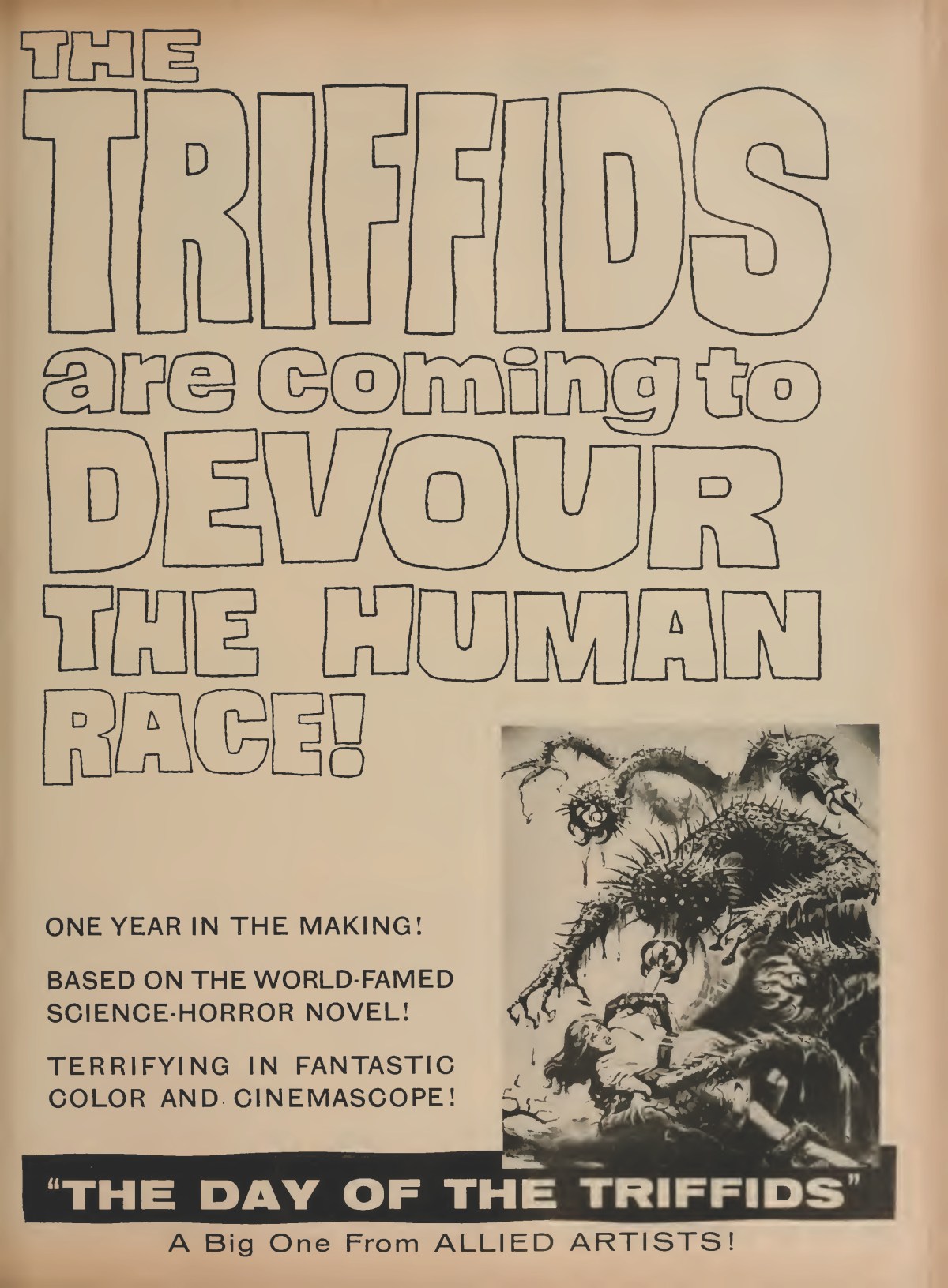
Day of the Triffids (1963) ****

Pandemic means panic and these are by far the best scenes in the adaptation of John Wyndham’s famed sci-fi novel. Virtually everyone in the world is struck blind by the fierce  brightness emitted from a bombardment of meteorites.

When passengers on a plane realize their pilot is blind, the panic is breathtaking. Ditto a train crashing into a station. While those with sight intact such as a busload of convicts can terrorize the blind, forcing them to submit to sexual overtures. On top of that are terrific scenes of deserted cities – very familiar to us all during the current pandemic – and of those unable to see trying to walk hands outstretched or attach themselves to anyone still blessed with sight.

One of the standouts is patient Bill (Howard Keel), saved from seeing the dazzling light display because his eyes were bandaged, walking through a deserted and trashed hospital. And perhaps Jurassic Park found useful the scene where the plants test an electrified fence.

And on top of that, of course, are the unstoppable monstrous man-eating plants whose growth has been triggered by the comets. Steven Spielberg over a decade later showed how to maintain tension by showing a terrifying predator in small doses and indicating its presence through musical cues and especially, when your monster ain’t quite up to scratch, keeping it hidden for as long as possible.

Interestingly, this film uses sound cues, specific noises attributable to the creatures, though the plants are shown too soon and too often but, in terms of special effects, not at all bad for their time and the low budget. And the sheer normality of the locations works very well – a caretaker having his sandwich, hard-boiled egg and flask of coffee the first victim. Some deft humor undercuts the terror. “Once you’ve tasted this coffee of mine,” remarks a character, ”you’ll know nothing worse can happen.”

Leading the fight against the monsters are sailor Bill (Howard Keel), ironically recovering from an eye operation, hotel proprietor Christine (Nicole Maurey) and in an isolated location alcoholic scientist Tom (Kieron Moore) and his wife Karen (Janette Scott).  Bill and Christine are initially intent on mere escape, but in the end have to fight.

A lean 93 minutes (the same as Gravity, 2013), tension is the key. That in itself is astonishing, given cinematographer Freddie Francis was called in at the last minute to puff out what would have been a too-short-to-release feature (under one hour at that point) directed by Steve Sekely (Kenner, 1968). Philip Yordan (El Cid, 1961) and Bernard Gordon (55 Days at Peking, 1963) knocked up the screenplay.

But once again a film like this shows how much more powerful is imagination. We can imagine being blind and walking in a vacuum with the vulnerability and helplessness that fear  entails. As the recent pandemic has shown, the unknown is terrifying and fear of the unknown even worse.

https://amzn.to/3FtsfBt

Day of the Triffids (1963)****

Pandemic means pandemonium and these are by far the best scenes in the adaptation of John Wyndham’s famed sci-fi novel. Virtually everyone in the world is struck blind by the fierce  brightness emitted from a bombardment of meteorites.

When passengers on a plane realize their pilot is blind, the panic is breathtaking. Ditto a train crashing into a station. While those with sight intact such as a busload of convicts can terrorize the blind, forcing them to submit to sexual overtures. On top of that are terrific scenes of deserted cities – very familiar to us all during the current pandemic – and of those unable to see trying to walk hands outstretched or attach themselves to anyone still blessed with sight.

One of the standouts is patient Howard Keel, saved from seeing the dazzling light display because his eyes were bandaged, walking through a deserted and trashed hospital. And perhaps Jurassic Park found useful the scene where the plants test an electrified fence.

And on top of that, of course, are the unstoppable monstrous man-eating plants whose growth has been triggered by the comets. Steven Spielberg over a decade later showed how to maintain tension by showing a terrifying predator in small doses and indicating its presence through musical cues and especially, when your monster ain’t quite up to scratch, keeping it hidden for as long as possible.

Interestingly, this film uses sound cues, specific noises attributable to the creatures, though the plants are shown too soon and too often but, in terms of special effects, not at all bad for their time and the low budget. And the sheer normality of the locations works very well – a caretaker having his sandwich, hard-boiled egg and flask of coffee the first victim. Some deft humor undercuts the terror. “Once you’ve tasted this coffee of mine,” remarks a character, ”you’ll know nothing worse can happen.”

Leading the battle against the monsters are sailor Howard Keel, ironically recovering from an eye operation, hotel proprietor Nicole Maurey and in an isolated location alcoholic scientist Kieron Moore and his wife Janette Scott.  Keel and Maurey are initially intent on mere escape, but in the end have to fight.

But once again a film like this shows how much more powerful is imagination. We can imagine being blind and walking in a vacuum with the vulnerability and helplessness that fear  entails. As the present pandemic has shown, the unknown is terrifying and fear of the unknown even worse.

Discover WordPress

A daily selection of the best content published on WordPress, collected for you by humans who love to read.

The Atavist Magazine

by Brian Hannan

WordPress.com News

The latest news on WordPress.com and the WordPress community.