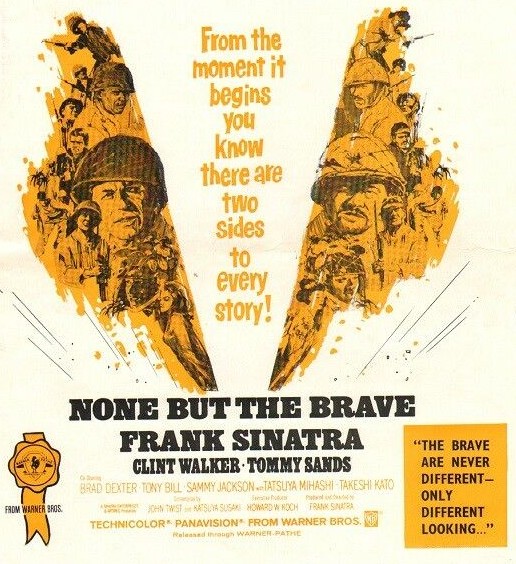
Frank Sinatra’s sole stab at direction is an astonishing piece of work and deserves to be revisited in a more positive frame of mind than it encountered on original release. Maybe critical acclaim depends on your name, and most critics were already tearing into Ol’ Blue Eyes because his acting in the 1960s scarcely matched his work in the 1950s – From Here to Eternity (1953), The Man with the Golden Arm (1955), Guys and Dolls (1955), High Society (1956) and Pal Joey (1957).
On the other hand critics were all over themselves when John Boorman and Clint Eastwood went down a similar route in Hell in the Pacific (1968) and the double header Flags of Our Fathers (2006) and Letters from Iwo Jima (2006), respectively, and American audiences griped about the even-handedness of Tora! Tora! Tora! (1970).
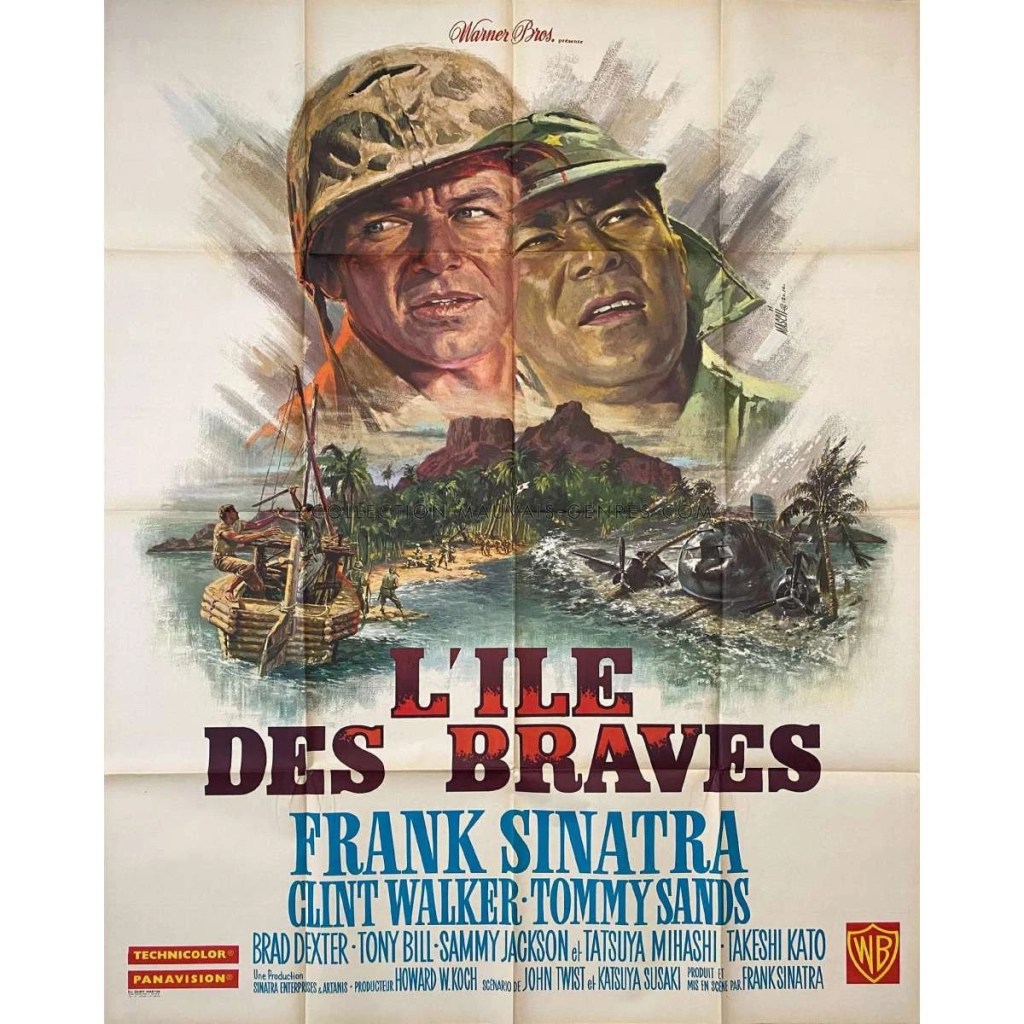
Not only is this primarily presented from the Japanese point-of-view, opening and closing with scenes involving the Japanese, but it is not so much even-handed as presenting the opposing sides in exactly the same manner, so that the “enemy” is never viewed as such but as a rag-tag collection of ordinary men thrust into warfare.
While there’s certainly courage on show, there’s also more than a war movie’s normal share of rashness and stupidity, disobedience, the flouting of orders, the challenging of the line of command and that taboo subject – death from friendly fire. There are clever maneuvers and outwitting the opposition.
The composition of both sides could be echoes of each other. Both have calm leaders in Capt Dennis Bourke (Clint Walker) and Lt Kuroki (Tatsuya Mihashi) who both struggle to keep in line intemperate subordinates, Second Lieut Blair (Tommy Sands) and Sgt Tamuro (Takeshi Kato) who tend to issue orders at a scream and in the latter instance with a slap in the face. Both lieutenant and sergeant, career soldiers, bristle at having to accept orders from less experienced officers.
None of the recruits are worth a button as soldiers. On the Japanese side we have a Buddhist priest, on the American side guys who wouldn’t recognize a trap even when they fell into it. Bourke also has to contend with loudmouth Sgt Bleeker (Brad Dexter), itching to start a fight.
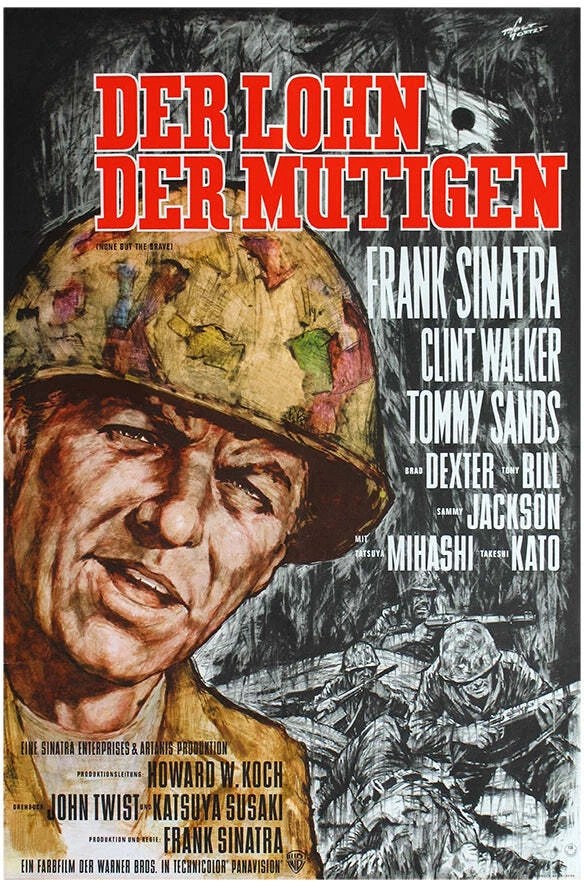
The Americans have one trump card – and it’s not weaponry. They have someone with the medical skill to save a badly wounded Japanese soldier. And although he’s only a pharmacist (Frank Sinatra) he’s got enough knowledge to carry out an amputation. The Japanese have their own trump cards – food and water. And the two leaders effect a truce. You know it won’t last, of course, which leads to a savage ending, though a touching climax.
There’s plenty action, more than you might expect, since generally in this kind of war movie we spend ages getting to know the soldiers long before there’s any reason to fire a shot or explode a bomb. All we know about the Americans is that they shouldn’t be here, they were flying elsewhere when their plane crash-landed on a remote island they believe is unoccupied. All we know about the Japs is that they’re trying to get off the island by building a boat.
Foolish soldiers on either side upset the leader’s strategies so the bullets soon fly. The Japanese on sighting an American warship cruising close by have the cleverest notion, running up a Japanese flag, which the sailors take to mean the island is under Japanese control and begin a bombardment which kills Americans. The Yanks, on the other hand, manage to steal the Japanese boat, but only for a short time before a grenade puts paid to any notions of escape.
In most war movies that pay any attention to the lives of the soldiers, that usually concentrates on sentiment, women left behind, families abandoned and so forth and while this strays into that territory once, the bulk of the time we see character revealed by current action, which is a more difficult thing to achieve, but far more rewarding.
Given his duties behind the camera, Frank Sinatra (Robin and the 7 Hoods, 1964) wisely plays a largely supporting role, restricted to the occasional wisecrack, but allocated one big central scene so that audiences don’t feel they’ve not had their money’s worth. But, actually, he relinquishes the most important scene to someone else. An armed American soldier coming across an unarmed half-naked Japanese who has been catching fish can’t bring himself to shoot him because you shouldn’t shoot a good fisherman.
There’s not much in the way of visuals or composition to write home about, but this film didn’t require such virtuosity, the director more than makes it work by sticking to the knitting, and concentrating on the humanity and refusing to allow the enemy to be portrayed as such.
Clint Walker (Sam Whiskey, 1969) and Tatsuya Mihashi (Tora! Tora! Tora!) carry the picture effortlessly while their rebellious underlings, singer Tommy Sands (Ensign Pulver, 1964) and Takeshi Kato (Yojimbo, 1961) do their best to steal the picture. Look out for Brad Dexter (The Magnificent Seven, 1960) and future producer Tony Bill (The Sting, 1973).
Written by John Twist (A Distant Trumpet, 1964), Katsuya Susaki (Way Out, Way In, 1970) and the film’s producer Kikumaru Okuda.
Not to be missed. A war classic.
 The Magnificent 60s