Brannigan (1975) ***

File under guilty pleasure. And bear in mind in the early 1970s there was no such thing as the police procedural, certainly not as we know it today, when cops have the benefits of DNA, increased forensics and computer technology. Hollywood in this era didn’t waste time with endless knocking on doors or collecting massive amounts of minutiae in the hope of uncovering a clue.

Generally speaking, cops of this period had two things in common. They were mavericks and they constantly fought authority usually represented by some dumb superior. Normally the narrative consisted of the character taking on the  persona of a bull in a china shop and thundering towards a main objective, the more set pieces to demonstrate said bullish tendencies the better, and if in the course of apprehending a criminal he can deliver a catchphrase such as “make my day” or, as here, “knock, knock,” so much the better.
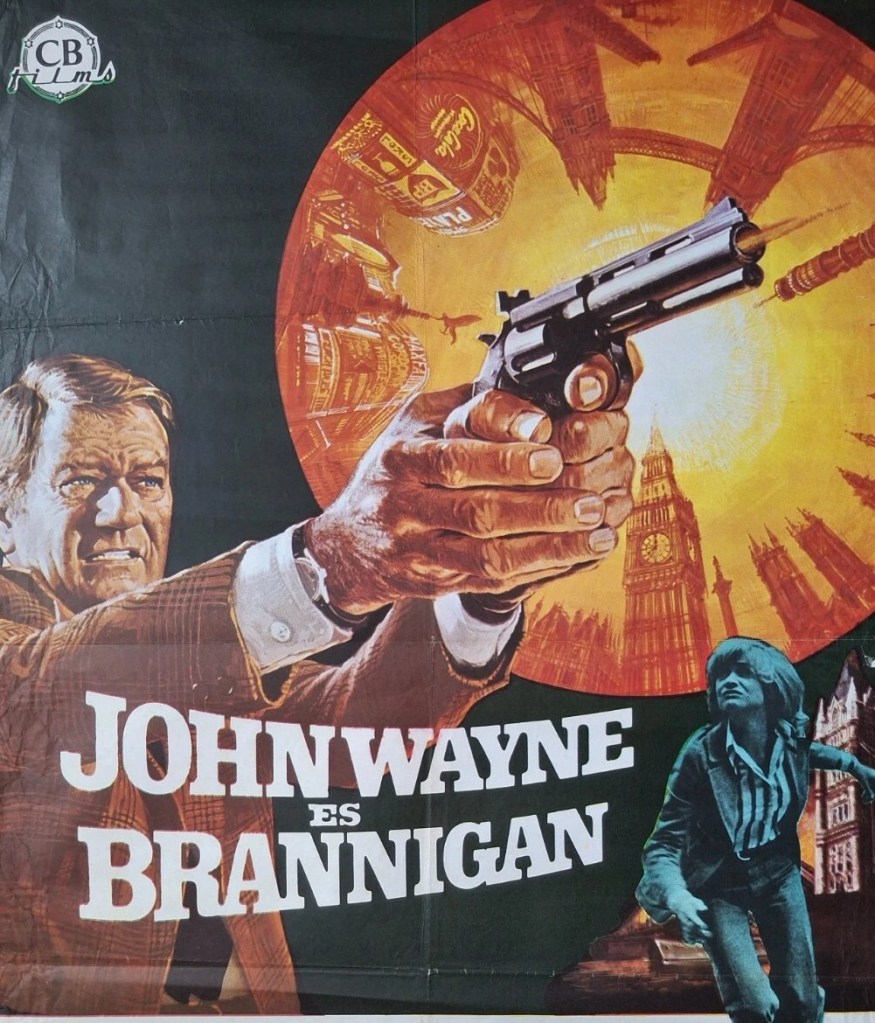
John Wayne had made eight westerns in a row and having turned down Dirty Harry (1971) ventured into the cop genre with McQ (1974) and came straight back for seconds here.

Brannigan (John Wayne) has been shipped over to London to bring back under the extradition treaty Mob gangster Larkin (John Vernon) which would be pretty straightforward except the Brits don’t keep such prisoners in custody – Larkin swans around in a white Rolls Royce – and in any case he’s in custody of another kind, having been kidnapped by some British hoods.

In terms of authority Brannigan battles the sappy Brits who won’t allow him to carry a gun and do things the Chicago way. Luckily, for the picture, top cop Commander Swann (Richard Attenborough) is not the standard stiff-upper-lip buffoon but as likely to pitch in when the fisticuffs begin. There are a couple of excellent car chases and one stunt of French Connection (1971) quality when two cars go sailing over the gap in a raised Tower Bridge. This is a London mixing glory and grit, posh residences and ancient buildings share screen time with rundown docklands. And the movie has the sense not to go all May-December on us and while a certain affection builds up between the U.S. cop and his driver Jennifer (Judy Gesson), it doesn’t teeter into unlikely romance.

The plot’s clever. While in a sauna having a massage Larkin is knocked out cold and bundled into a sweatbox by two apparent delivery guys and then smooth attorney Fields (Mel Ferrer) acts as the go-between, delivering Mob ransom money to the kidnappers, the price increasing with every failed rescue attempt, until the kidnappers are sitting on a cool million. Naturally, there’s some double-crossing and the cops have one tiny magic bullet to use to their advantage.

So mainly the fun is watching Brannigan charge around in a British china shop, mostly bypassing British rules. There’s a subplot involving a hitman hunting Brannigan and even when in a normal cop movie you might think, fair’s fair, the policeman should be able to defend himself with a weapon, that doesn’t equate with the British rules, so you have our hero able to point out that if he wasn’t armed to the teeth Jennifer would be dead, while Swann does his best to insist that it would be better for the young lass to end up on a mortuary slab than British cops go rampaging around with guns.

There’s some gentle fun in poking at British tradition – the obligatory wearing a tie in certain upmarket establishments – and in Swann having to translate to a waitperson Brannigan’s breakfast order.

Except when standing up for rules, Swann is great value, a good match for the American, both in tempering his ruthlessness, and matching him punch-for-punch in a brawl.

Apart from the action sequences, John Wayne is permitted to grow old gracefully, his dialog rarely filled with barbed retorts or salty words and there’s quite nice acting on the Duke’s part when he’s called upon to demonstrate his special skill, which is “reacting”.

Richard Attenborough (Only When I Larf, 1968) has a ball, and not before time, able to let some of the usual repressed intensity burst out. Judy Geeson (The Executioner, 1970) must have been delighted to find a part that didn’t involve her taking off her clothes and she’s afforded some of the best lines. John Vernon (Topaz, 1969) is his usual hardass but Mel Ferrer (The Fall of the Roman Empire, 1964) has a good stab at a bad guy.

Not in the same league as director Douglas Hickox’s Sitting Target (1972). Written by Christopher Trumbo (The Don Is Dead, 1973), William McGivern (The Wrecking Crew, 1968), Michael Butler (The Gauntlet, 1977) and William Norton (The Scalphunters, 1968).  

Erroneously tabbed as a box office disappointment, this was made on a budget of $2.6 million but cleared $7 million in rentals (the studio share of the box office) plus another $1.5 million from television.

Obviously, if you’re in the Clint Eastwood camp this falls short, but otherwise it’s enjoyable stuff.

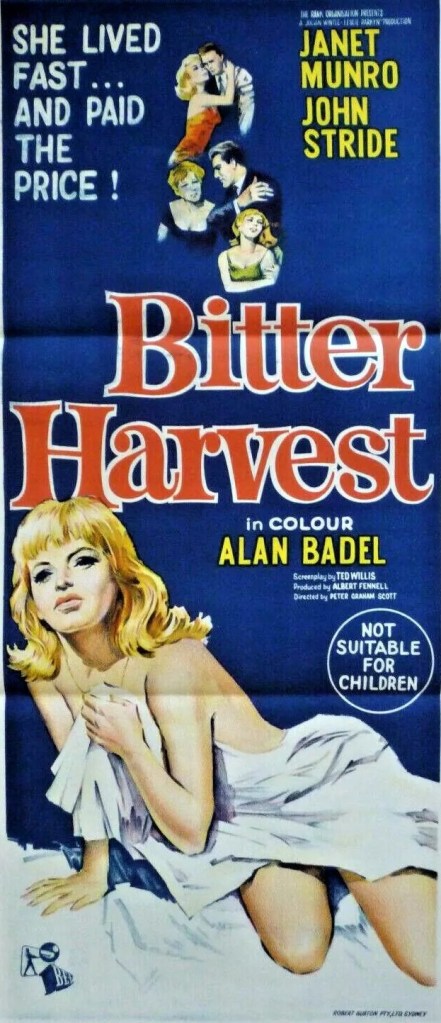
Bitter Harvest (1963) ****

Anyone claiming to be gaslighted will have unwittingly invoked the memory of an English writer who died over 60 years ago. Alfred Hitchcock paid tribute to him in adapting his fiendish play, Rope (1948). Hangover Square (1945) starring Linda Darnell was another of his novels to hit the screen. In all there have been over 50 film and television adaptations of his works.

One of his most famous publications was a trilogy focusing on a London barman and a barmaid in love with him whom he casts aside. I had read it, as I had all of Patrick Hamilton’s novels, with enormous pleasure. The trilogy was published in 1935 under the title Twenty Thousand Streets under the Sky. So it was with some trepidation that I realized Bitter Harvest was based on the middle novel of the trilogy. The DVD had sat, unwatched, in my collection for a couple of years because I was put off by the title, the no-name cast and journeyman director, assuming some routine tale with a sad ending.

Now I’m kicking myself I ignored it for so long. It’s a little gem that packs a punch, climaxing with a stylistic twist, and held together by a virtuoso performance by Janet Munro, one-time Disney ingenue in pictures like Swiss Family Robinson (1960), as she twists the audience and her lover round her little finger. And all the way through, despite the self-imposed travails, she manages to evoke sympathy.

Virgin Jennie (Janet Munro) escapes humdrum life in Wales, running a small shop in a run-down village, looking after her ungrateful father, and about to be dumped as a full-time carer onto a pair of aunts, when she meets smooth salesman Andy (Terence Alexander). He gets her drunk on champagne, whisks her back to his flat where he rapes her. Shame prevents her going home. Friendly barman Bob (John Stride) takes pity on her when she reveals she’s pregnant and lets her sleep, untouched by him, in his bed. Naturally, the relationship progresses, though she makes no move to find a job. But she wants her “share” of the good things in life and a barman isn’t going to provide them.  

Bob soon realizes she isn’t quite the docile waif delighted to be looked after. “When have I taken orders from you?” she snaps. He’s shocked when she reveals that her pregnancy was a ploy, and taken aback when she rejects his marriage proposal. Instead, she’s out on the town with actor neighbor Charles (Colin Gordon) who takes her to a showbiz bash where she wangles an introduction to impresario Karl (Alan Badel). “I’ve got something they want and they can have it and they’ll pay for it,” shows Bob which way the wind is blowing.

The movie begins with a drunken smartly dressed Jennie, long red hair cut in a more fashionable bob, returning to her upper mews apartment. She’s so sozzled she drops her handbag on the steps, only stopping to retrieve her keys before kicking the bag down the staircase. Opening the door, she tosses the key into the street. Inside, she sets about destroying the chintzy apartment, pours whisky over a photo of man later revealed as Karl, smashes bottles, upends furniture, tosses dresses out the window, scrawls something in lipstick on the mirror.

Then we’re into flashback telling the story I’ve just outlined. When she sets herself up to become Karl’s mistress, you think there’s a third act to come. But the movie cuts instead to the mews apartment and the by now dead Jennie.

What distinguishes it is the set-up. Jennie appears initially as the victim until she exerts control, using Bob, and presumably intending to work her way up. Quite how her life came to end in suicide is never revealed. But director Peter Graham Scott (Subterfuge, 1968) has the foresight to realize he doesn’t have to go into the degradation and shame, just show consequence.

And it’s framed with excellent performances. Bob, determined to improve himself, buys a book a month. Barmaid Ella (Anne Cunningham), in love with him, has to endure a scene where he tells her all about Jenny. Bob’s landlady isn’t going to get on a moral high horse about him having a woman in his room when she can rook him for increased rent. You can tell, even if Jenny ignores the obvious, what kind of life she will have as Karl’s mistress when in their first moment of intimacy he slaps her face and rips her expensive dress to make a bandage.

There’s another scene just as shocking and if it was not edited out by the censor at the time it still came as a surprise to see fleeting glimpse of a naked breast, a good year before the U.S. Production permitted similar in The Pawnbroker.  

As I said, the transition of Janet Munro (Hide and Seek, 1964) from victim to predator is exceptionally well-done, her iron fist cleverly concealed for most of the film. And it’s admirable, too, that John Stride, whose career was mostly in television, doesn’t come across as a hapless suitor, though obviously he is gullible. Alan Badel (Arabesque, 1966) only has a couple of scenes but makes a huge impact. Barbara Ferris (Interlude, 1968) has a small part.

Highlight of Peter Graham Scott’s directorial career, well-paced, measured, drawing out good performances all round, especially in the boldness of the closure. Ted Willis (Flame in the Streets, 1961) does an excellent job of updating the novel, though one flaw is that while the early section is set in Wales there’s no sign of a Welsh accent.

Recommended.

Discover WordPress

A daily selection of the best content published on WordPress, collected for you by humans who love to read.

The Atavist Magazine

by Brian Hannan

WordPress.com News

The latest news on WordPress.com and the WordPress community.