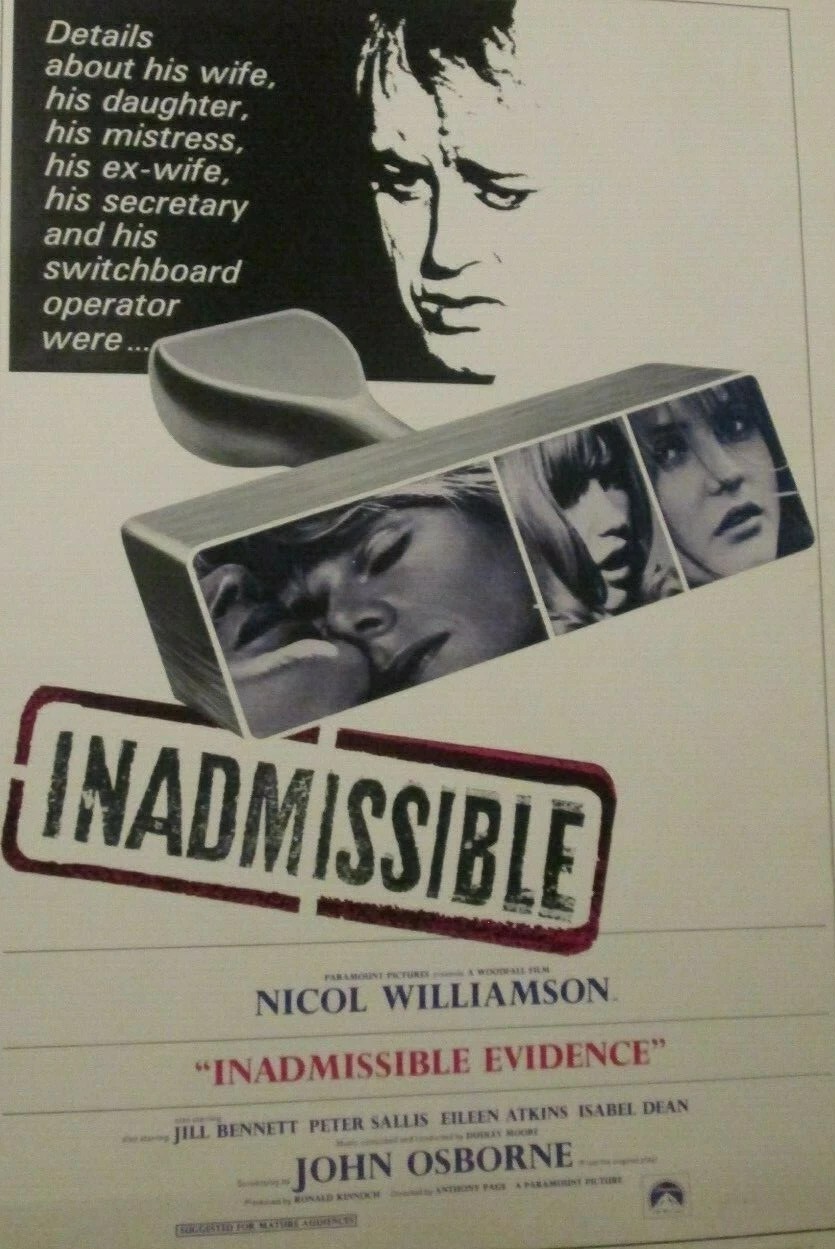
The Angry Young Man approaching 40 is not only a lot angrier but misogynistic, rude, contemptuous, constantly berating society, and, despite his physical energy, completely lacking in the charm that made playwright John Osborne’s groundbreaking Look Back in Anger (1959) with Richard Burton such a conspicuous success.
Lawyer Bill Maitland (Nicol Williamson) exhibits neither self-awareness nor remorse as the aspects of his personality that have fueled his downfall are brought home to roost. He is abandoned by wife, two lovers and colleagues and finds that all the people he has ostracized over the years are unlikely to come to his aid in time of trouble.
Mostly, it’s just a catalog of disaster as his personal and professional life fall apart. While never a high-flyer in the legal field he had done enough to run a reasonably successful business, delegating those tasks for which he was unfit to employees, but treating everyone with disrespect, except temporarily when he is in seduction mode.
There’s an early scene advising a client on her impending divorce where it seems as though the scenario could shift in his favor, in the sense that the audience could be more on his side, empathizing with his situation rather than hating him. Mrs Gamsey (Isabel Dean) doesn’t want to divorce her philandering husband but realizes she can’t make him happy and has no idea what might bring him contentment, a situation that clearly reflects Bill’s own, and though for a moment it looks like he might be on the verge of self-realization the moment passes and he’s back on a rant against the world.
When secretary and lover Shirley (Eileen Atkins) tells him she’s pregnant, his first instinct isn’t congratulations or commiseration, but to try and establish, by working out when they last had sex, whether he could be the father. No sooner has she quit than he’s trying it on with the newest staff member, the comely Joy (Gillian Hills). Despite sleeping with him she doesn’t stay enamored of him for long. No matter, he already has another mistress, Liz (Jill Bennett) but that relationship is on the brink.
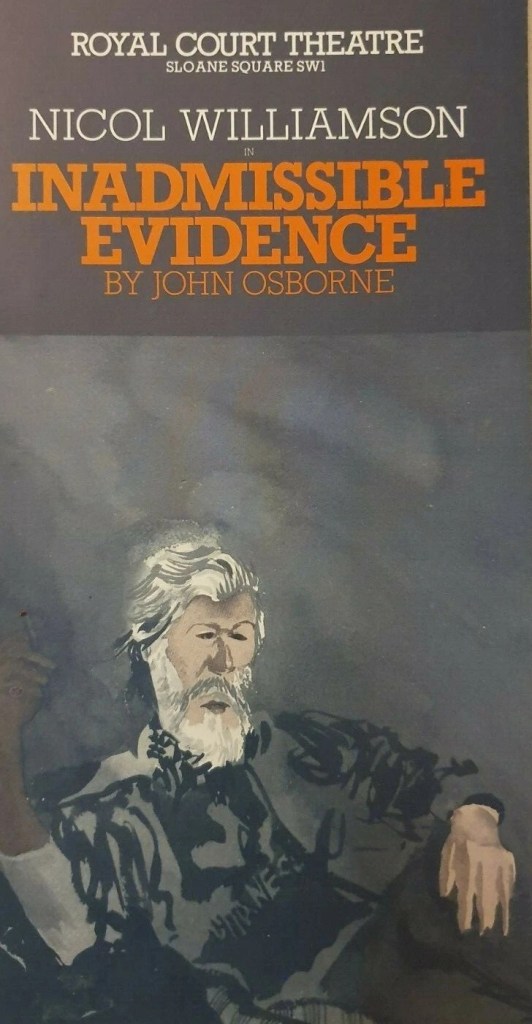
His marriage to Anna (Eleanor Fazan) is falling apart and she at least has the strength of mind to give him a good slap when at a party he insults their friends. That sends him scurrying out of the marital house. Daughter Jane (Ingrid Brett) can’t put up with his behavior either.
He is too late in realizing just how essential his clerk Hudson (Peter Sallis) is and by the time he offers the man a partnership, Hudson is already halfway out the door having received a better offer. He’s a poor operator, leaving a client (and former lover) in the lurch while another client is reduced to tears.
Throughout this, Bill keeps up a steady stream of abuse on virtually anyone his imagination alights. But it’s that imagination that also preys on his mind as he slips into nightmare scenarios of being brought to court for trial for his personal misdemeanors, of being disqualified from the profession, of being cremated. It’s not going to end well but just how it ends is left to the audience’s imagination.
It’s only the energy of Nicol Williamson (The Reckoning, 1970) that makes this fly at all. This falls into the sub-genre of successful men, lacking in self-worth, heading for a nervous breakdown as exemplified by The Arrangement (1969). Williamson was being hailed as the successor to the mantle of Richard Burton, but his choice of films soon scuppered that notion. He was a bigger draw on stage.
Here, director Anthony Page (Absolution, 1978) does him a disservice by, in terms of framing, refusing to give him physical stature. The camera always seems to be looking down on him, squashing his features, rather than elevating him as occurred in other films. Page does the audience a disservice by choosing to film in black-and-white. Whether for budgetary or artistic purposes is unclear. Adapted by Osborne from his play.
For about 30 minutes this is terrific stuff because Williamson can command the screen like few others. But then it’s just too wearing.
 The Magnificent 60s