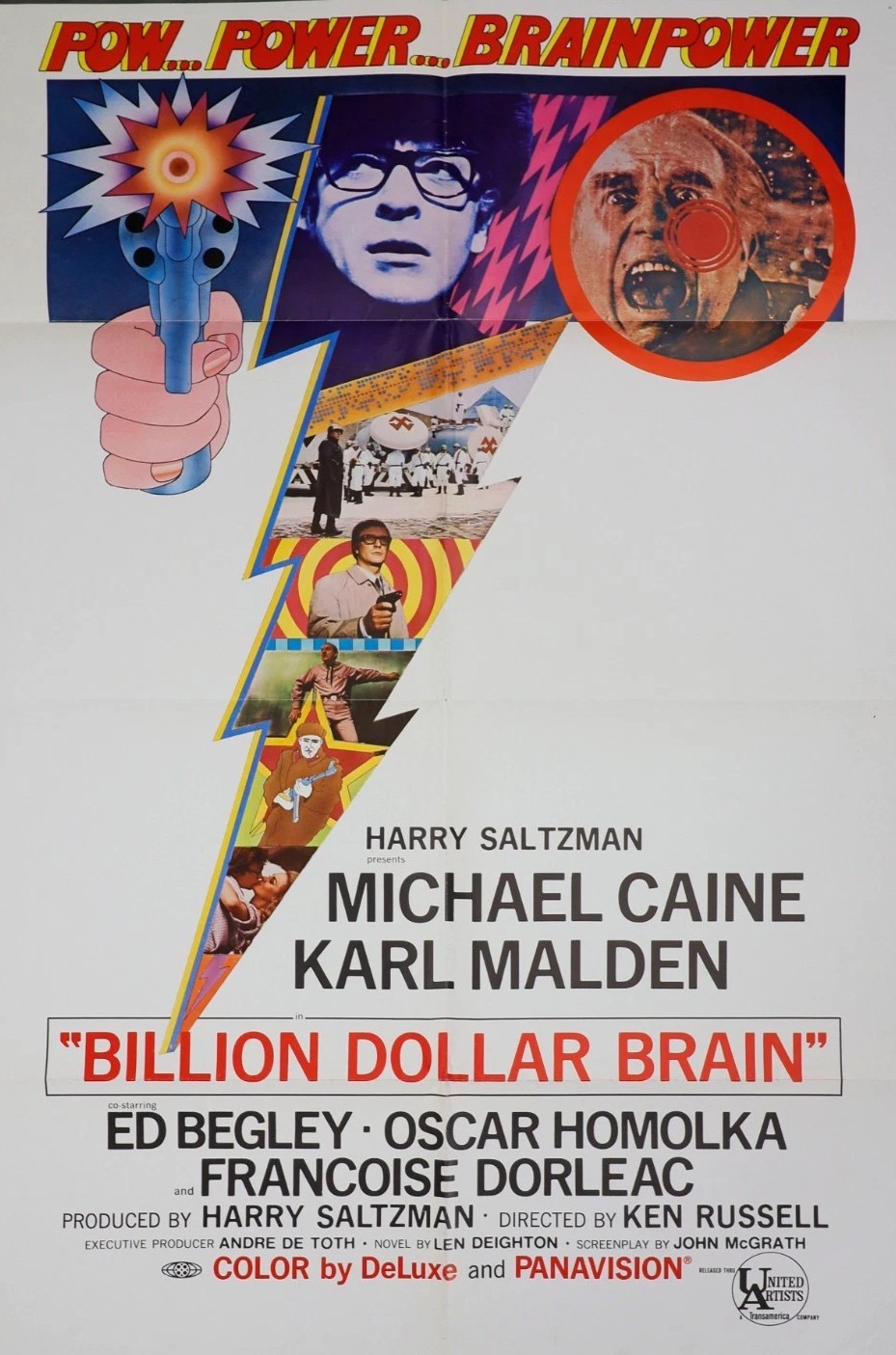
Billion Dollar Brain (1967) ***

Could have been the greatest espionage movie of all time except for one thing – excess. Now director Ken Russell would soon make his reputation based on sexual excess – Women in Love (1969), The Devils (1971) etc – but here he takes self-indulgence in a different direction. The plot is labyrinthine to say the least, and Finland proves to be dullest of arctic locations, no submarine emerging from the ice to liven things up as in Ice Station Zebra (1968), just endless tundra.

Setting that aside, there are gems to be found. Author Len Deighton ploughed a different furrow to Ian Fleming (Goldfinger, 1964) and John le Carre (The Spy Who Came in from the Cold, 1965), none of the glitz of the former nor the earnestness of the latter. He was more likely to trip a narrative around human foibles. And so it is here.
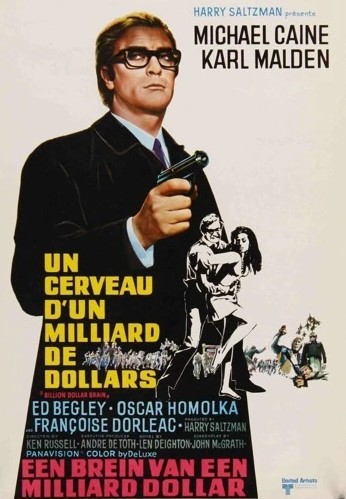
For a start, our hero Harry Palmer (Michael Caine) is the MacGuffin and then is duped – three times. Firstly, he is the reason we end up in Finland in the first place, having responded to an anonymous message and the promise of easy money. Then, in the most foolish action ever to befall a spy, he falls in love with the mistress Anya (Francoise Dorleac) of old buddy Leo (Karl Malden). Finally, he is shafted by former employer Col Ross (Guy Doleman) and generally given the runaround by Russian Col Stok (Oscar Homolka), reprising his role from Funeral in Berlin (1966).

Unlike the previous Harry Palmer iterations, that began with the splendid The Ipcress File (1965), there’s a techie megalomaniac on the loose, General Midwinter (Ed Begley) – think Dr Strangelove on speed – who’s not so intent on world domination as flattening the Soviets, which more or less amounts to the same thing.

Midwinter provides the movie with considerable technological foresight, his billion-dollar computer prefiguring the way in which we have allowed technology to rule our lives, and, unlikely though  it seems, perhaps provided the inspiration for the serried ranks of Stormtroopers from Star Wars (1977).
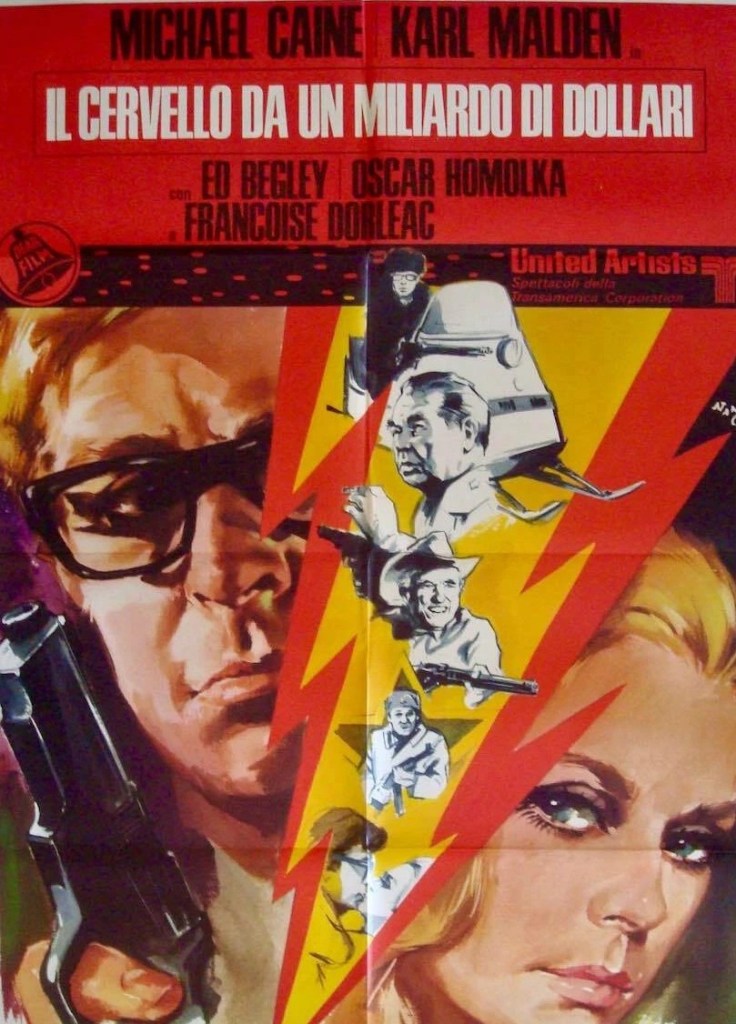
For the most part, lovelorn Palmer is led a merry dance and relies on a deus ex machina in the shape to Col Stok to put an end to Midwinter’s potential Russian uprising. A rebellion was always going to be a tad dicey because Leo has stolen all the money Midwinter provided for him to set up an army of Russian dissidents. Leo thought it made more sense for the cash to be put to better use, namely investing in high living and a glamorous mistress. There we go with the old human foible. But Palmer can match him there, not quite having the brains to realize that a beautiful woman who can play Leo so well could also play him.

There’s a marvelous pay-off where we discover that in the middle of the male-dominated espionage shenanigans, it’s Anya who turns out to be the clear winner. In a terrific scene she takes the case containing the secret McGuffin from Leo rushing to board her train then, with her hands on the valuable cargo, kicks him off the train. And once she has trapped a foolish British spy, who has let his emotions get the better of him, is apt to poison him.

There’s some distinct Britishness afoot. Complaints about salary and endless bureaucracy abound. And there’s a piece of pure Carry On when, in a sauna scene, the camera manages to put objects or bodies in the way of Anya’s nudity. One-upmanship doesn’t get any better than Col Ross smirking when he tricks Palmer into returning to work for him.

Smirking is in the ascendancy here. Palmer smirks at the folly of Leo in believing that the young beauty is after him for anything but his money and his access to potentially dangerous toxin. Anya doesn’t need to laugh behind the backs of the two men she has so easily duped when she can enjoy sweet revenge right to their faces.

Once you get to the end, you can more appreciate the content, although, like me, you probably wished the director could have got a move on, and thought he should have done a lot better in the climactic scene than toy trucks falling into Styrofoam blocks of ice.

The tale isn’t on a par with the previous two, Deighton being more at home with cunning adversaries rather than overblown megalomaniacs, but everyone, with the exception of Anya and Col Stok – i.e. the bad guys – are too easily taken in. Technically, Palmer wins the day, but that’s only to fulfil the requirement that the good guy must appear to win even if the good guy in this instance is smeared all over with impotence and folly.

The camera loves Michael Caine (Gambit, 1966) so there’s no problem there especially as by and large he’s wearing his cynical screen persona. Karl Malden (Nevada Smith, 1966) has a ball, especially as this must be the only time he gets the girl. Ed Begley (Sweet Bird of Youth, 1962) and Oscar Homolka over-act as they should, but Francois Dorleac (The Young Girls of Rochefort, 1967), in her final role, steals the picture from under all of them.

Directed by Ken Russell as if he kept his editor at bay and written by Scottish playwright John McGrath (The Bofors Gun, 1968) in his big screen debut.

So a very interesting twist on the spy picture but be warned before you go in that it takes quite a while to get there.
The Reckoning (1970) ****

Fans of Succession will love the boardroom battles and fans of Get Carter (1971) the gritty violence. Michael Marler (Nicol Williamson) is a thug whichever way you cut it. He’s a business hard-ass, at his nicest he’s obnoxious, at this worst brutal. He drives like a demon. Even in love, he’s fueled by hate, sex with wife Rosemary (Ann Bell) infernal. And all of this made acceptable, according to the left-wing tenets that underwrite the film, because he is a working-class man battling upper-class hypocrisy, never mind that his upper-class wife was hardly foisted upon him, nor that he was forced to live in luxury.

Unexpectedly, the film also explores other themes which have contemporary significance. Computers play a pivotal role and so does honor killing. The picture’s original title – A Matter of Honor – was ironic given that in the upper-class worlds in which Marler moved, courtesy of job and marriage, he is considered to have little in the way of chivalry. But in the working-class world he has escaped he must exact revenge according to a code of honor steeped in violence.   

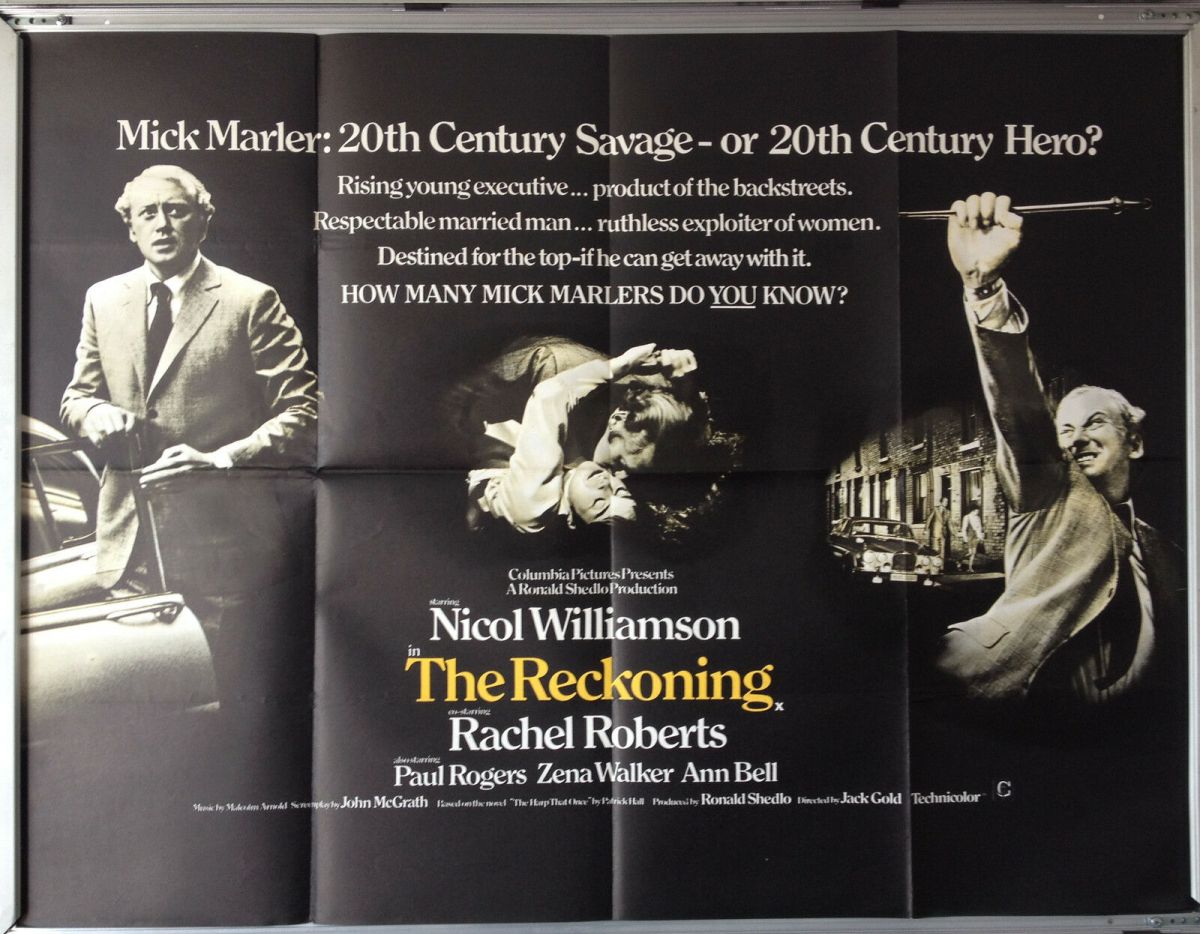
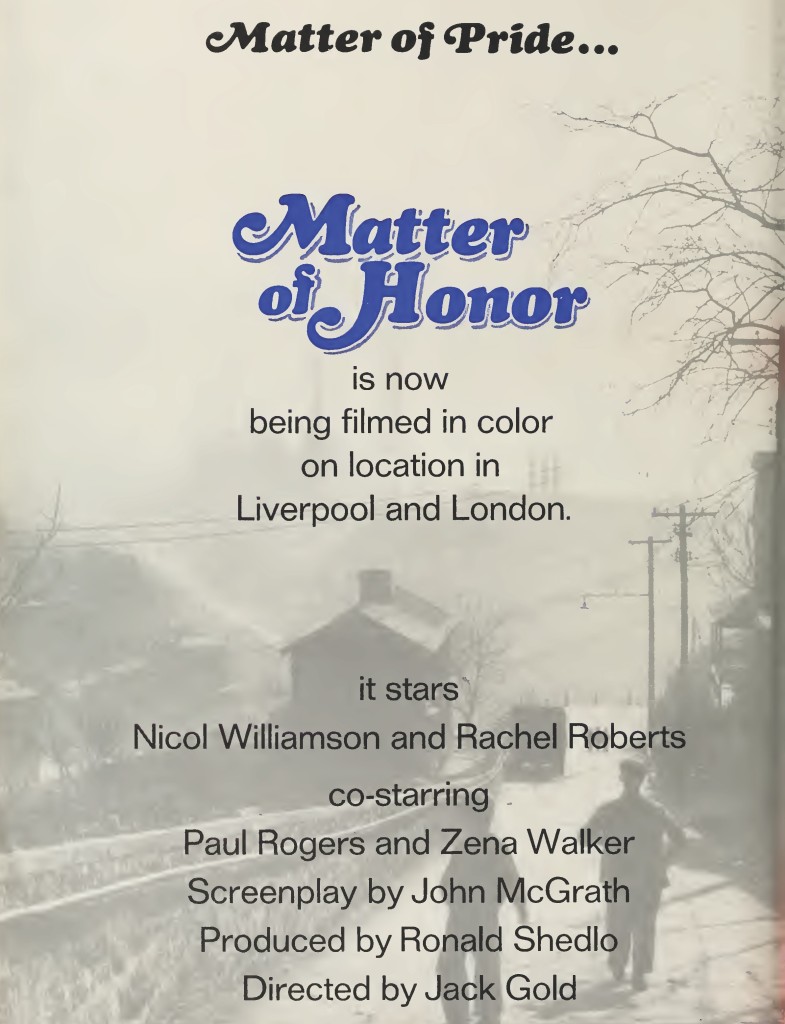
This advert dates from October 1968, which gives an indication of how long the film’s release was delayed, not appearing until January 1970. Interestingly, the advert appeared in the U.S. trade magazine Box Office (October 28, 1968), suggesting Columbia had high hopes for the British production. The title here suggest a different approach to the movie.

The sudden death of his father sends Marler back to Liverpool where he discovers the old man was killed in a pub brawl. But the local doctor and the police, uninterested in complicating what must be a regular occurrence, view his death as accidental. So Marler takes it upon himself to uncover the culprits and wreak revenge, any kind of revenge on any kind of culprit, regardless of the fact that from the outset it is clear they will hardly be gangsters.  While contemplating violence, he strikes up a sexual relationship with the married Joyce (Rachel Roberts).

The story jumps between the back-stabbing corporate world to a scarcely less violent working class environment. The combination of charm and brute energy holds a certain appeal for Rosemary (Ann Bell) and helps keep him in the good books of his boss, but he is otherwise a bully, targeting the weak spots of anyone who stands in his way on his climb to the top, and while heading up the sales division of a company in trouble blaming everyone else for his own failings. And while scorning his wife’s upper-class friends is quite happy to enjoy the benefits of her lifestyle, the flashy car might be the result of his endeavors but not the huge posh house. Marler stitches up another associate with the assistance of another lover, secretary Hilda (Zena Walker), and his long-suffering wife finally takes umbrage at his venomous manner.

Marler hides his hypocrisy behind the façade of a left-wing class-struggle. John McGrath’s screenplay clearly intends Marler’s working-class background to provide him with a get-out-of-jail-free card as well as to launch an attack on upper classes seen as namby-pamby except when it comes to putting the poor in their place. The anti-class polemic has somewhat eroded over time but in its place can be found an accurate portrait of the social mores of ordinary people for whom, alcohol, the drug du jour, plays a massive part.  The going-home element is populated by endless terraced houses without a single parked car, vast caverns of pubs which host wrestling matches and are a tinder spark away from erupting in a brawl. This is in stark contrast to the high-living life Marler enjoys in London.

He has no desire to go back home, hasn’t visited in five years, escaping from there deemed a sign of success, and mostly returns metaphorically to draw on memories with which to scourge the upper-class and excuse his own behavior. 

Nicol Williamson (Inadmissable Evidence, 1968) delivers a tour de force, his screen presence never so vibrant, exhibiting the same raw appeal as Caine in Get Carter. At this point in his career, with a critically-acclaimed Hamlet on stage, he was perceived as the natural successor to Laurence Olivier and Columbia held up the release of The Reckoning to allow the Tony Richardson film of that stage production to pick up critical momentum. Oddly enough Rachel Roberts had not capitalized on her Oscar-nominated role in This Sporting Life (1963), this only her second movie in seven years. Initially coming across as brassy caricature, she soon softens into a surprisingly wistful character. Both Ann Bell and Zena Walker bring greater dimension to their characters rather than as adoring doormats. You can catch Paul Rogers (Three Into Two Won’t Go, 1969) and Tom Kempinski in supporting roles.

Director Jack Gold, who had worked with both Williamson and McGrath on his movie debut The Bofors Gun (based on the writer’s play), does a great job of capturing a particular period of British social history as well as allowing Williamson to stomp around in his pomp.

Discover WordPress

A daily selection of the best content published on WordPress, collected for you by humans who love to read.

The Atavist Magazine

by Brian Hannan

WordPress.com News

The latest news on WordPress.com and the WordPress community.