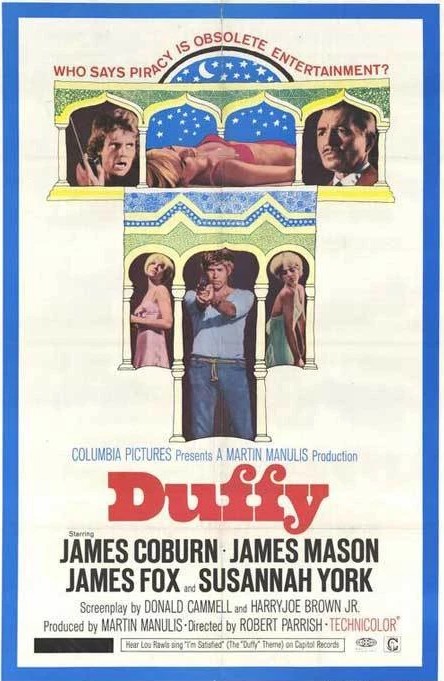
Duffy (1968) ***

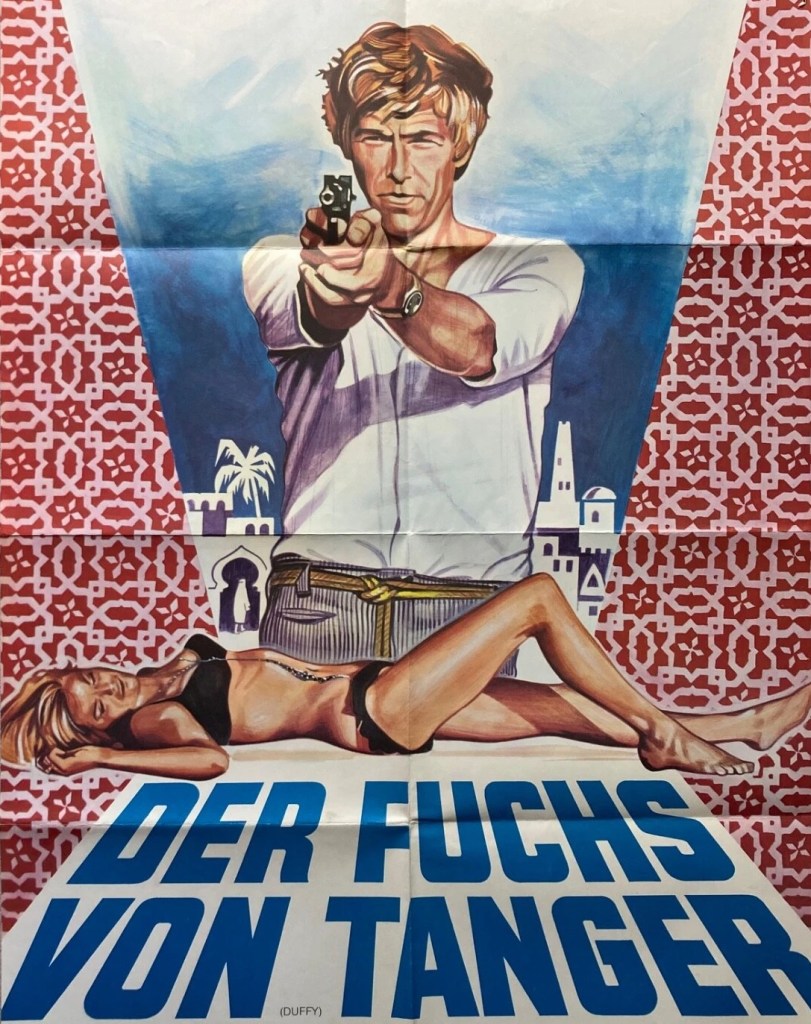
Star James Coburn wasn’t keen on the title. Had it been made today it would have been a contender for the sobriquet of The Nepo Heist. I’m sure many heirs would quite like a large chunk of their inheritance put in their hands long before it was handed over after the death of the father/mother. Luckily, this isn’t about blatant greed. It’s presented as more of a game, a duo of half-brothers, same father/different mother, trying to put one over their arrogant father.

Millionaire businessman J.C. Calvert (James Mason) is as keen on keeping the kids in their place, constantly deriding as incompetent Antony (John Alderton)  – an accurate assessment it has to be said – and more than willing to challenge Stefane (James Fox) to any game of skill, even darts, especially if it involves money.
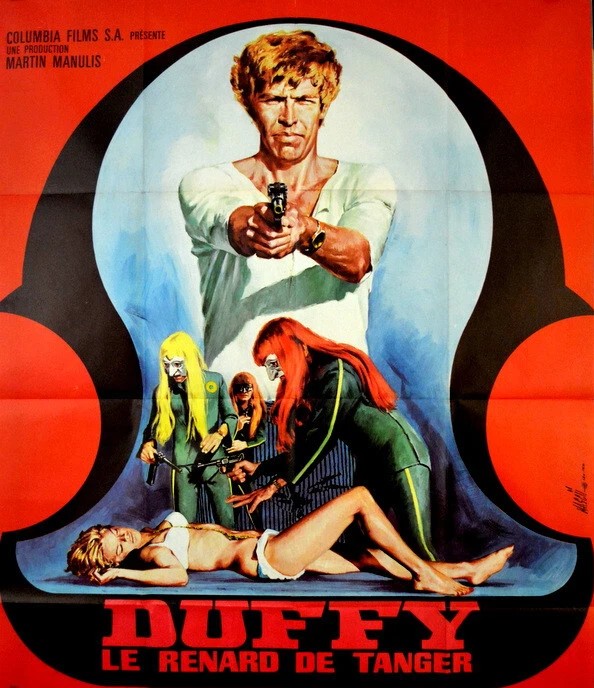
The sons set out to steal £1 million ($3 million) from a shipment of cash their father is transporting aboard the passenger ship Osiris to Naples. To that end they recruit hippy smuggler Duffy (James Coburn). Stefane’s girlfriend Segolene (Susannah York) might have been included as a makeweight except she takes a fancy to Duffy. Given that betrayal is a standard trope of any heist, you are kept wondering if she is, in fact, no matter how she protests her independence, a plant.

It takes quite a while for the plot to gather any steam what with dilly-dallying around Tangier and making considerable adjustments to a yacht. No time is spent either in the planning of the crime, the action just unfolds. The theft itself requires little of the unique set of skills that most thieves possess, nothing more than going on board the Osiris in disguise, both Stefane and Segolene decked out in religious garments, and putting on masks for their incursion into the room containing the safe. The only moment of real tension comes in having to extract the code to the safe.

The escape is better thought-out. The cash is chucked overboard in buoyant bags, connected to Duffy by means of a fisherman’s line which, when reaching the safety of their yacht, transformed for the time being into a fishing boat, Duffy reels in. A helicopter magically appears from the hold and they blow up the yacht before escaping, stashing the loot in 30ft of water in a cove near Tangier.
Assuming J.C. would be able to claim on his insurance then no great harm would be done to the family coffers, and the sons, as well as filling their pockets, would have the pleasure of making a fool of their old man. As you might expect, there’s double crossing still to come. And it’s a gem of a twist. Calvert has been in on the crime from the outset, thanks to the connivance of Segolene who turns out to be his girlfriend.

However, that scam is undone in another twist and it’s Duffy who comes out trumps, though far short of a millionaire.

Relies more than most crime pictures on the charm of the three main characters, with Antony there for nuisance value. However, the will-she-won’t-she games Segolene plays with Duffy and Stefane would have had more impact if Stefane had not been so nonchalant about their romance, and if she had not been so strident as regards her independence and unwillingness to become attached to any man.

That said, she turns out to be the cleverest of the lot, stringing along the two younger men while making a better play for the older one. But there’s something missing in the construction of the picture, so her triumph seems to come out of left field, almost a twist for the sake of it.

James Coburn (What Did You Do In The War, Daddy?, 1966) gives his screen persona an almighty about-turn, and although he appears useful with a pistol, he comes across more as a free-living hippy of the period, with a penchant for erotic pop art, though he has little regard for ecology, literally littering the planet, chucking wrappers and bottles everywhere.

James Fox (King Rat, 1965) has a whale of a time as an insouciant aristocrat, a character trait  he clearly inherits from James Mason (Age of Consent, 1969) as his father  while Susannah York (Sands of the Kalahari, 1965) swans around in cool attire all the more to make herself appear nothing more than a mild distraction rather than a criminal genius.

Leisurely directed by Robert Parrish (Journey to the Far Side of the Sun, 1969) from a screenplay by Donald Cammell (Performance, 1971) and Pierre de la Salle and Harry Joe Brown Jr.

Very slight.

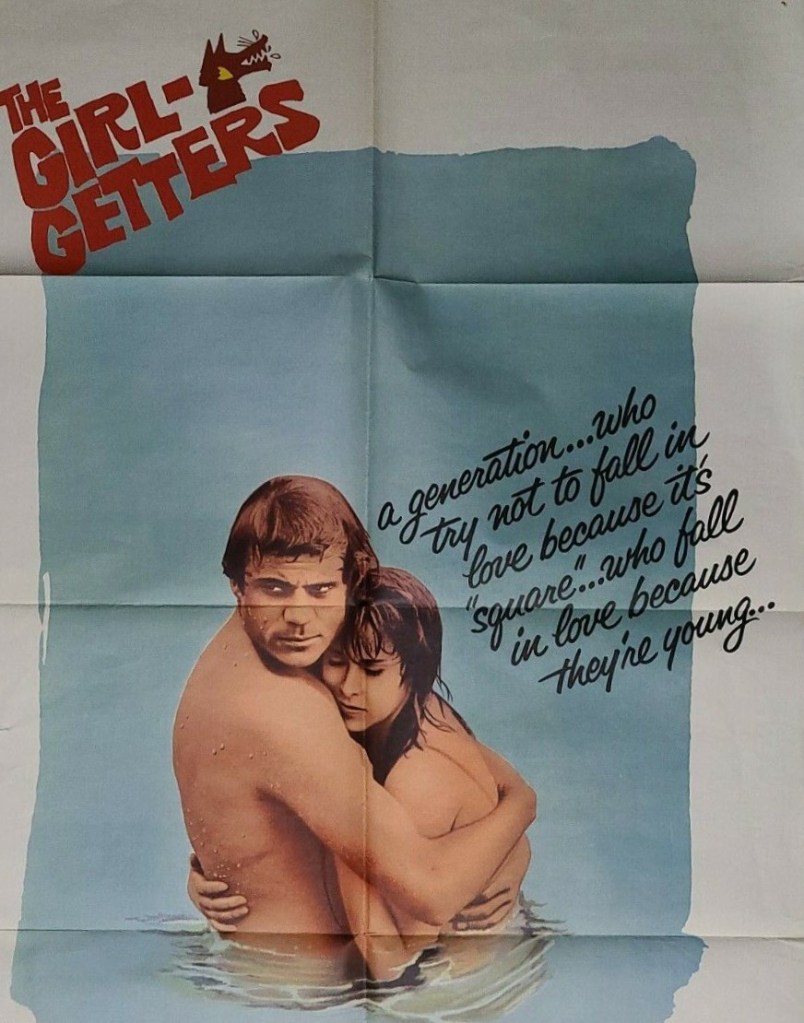
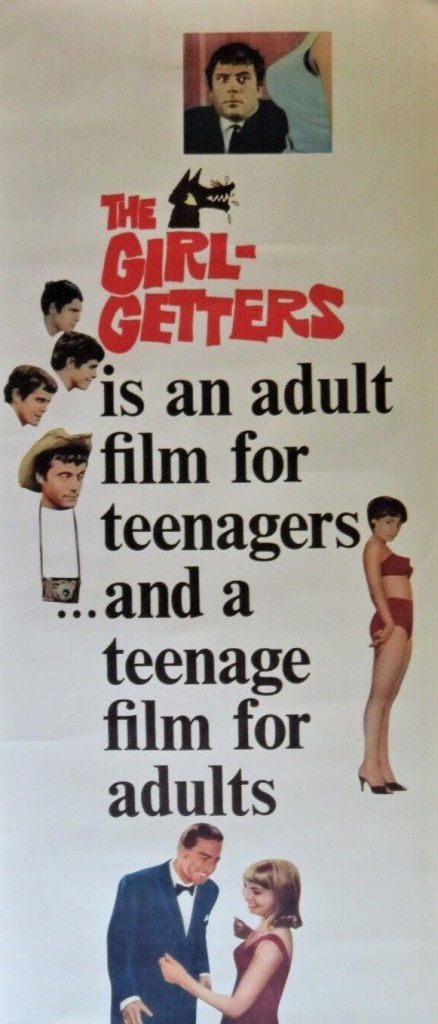
The System / The Girl-Getters (1964) ***

Surprisingly subtle performance from Oliver Reed (Hannibal Brooks, 1968), eschewing the trademark quick inhalation of breath and steely glare, as leader of a gang seducing impressionable young girls during the summer season in an English seaside town.  Surprisingly artistic touches – swipes, montage, a meet-cute involved blowing bubbles – from the more usually heavy-handed director Michael Winner (Hannibal Brooks). Surprising amount of rising talent including cinematographer Nicolas Roeg (Don’t Look Now, 1971).

And unlike the previous The Damned / Those Are the Damned (1963), the impromptu gang headed by Tinker (Oliver Reed) is not hell-bent on violence and destruction, and the various seducers, thankfully, could hardly be described as sexual predators. Young girls away on their own for the first time, disappointed not to find the love of their lives,  are still happy to settle for a holiday affair.

The American title is more appropriate and only an overbearing parent would dream of marketing it – effectively from the male perspective – as girls entering perilous territory rather than with the lightness of tourist romance a la The Pleasure Seekers out the same year. The “system,” a misnomer if ever there was one, involves the guys finding various ways of getting tourists’ addresses – Tinker as a beach photographer has the advantage here – in order to seduce them.

Sometimes the plan goes wrong and a girl gets pregnant leaving Nidge (John Alderton) not only abandoning the frolics but doing the decent thing by proposing. Oddly, there’s no sense of the guys competing with each other for the biggest tally of notches on a bed-post; in fact they’re a democratic bunch, dividing up the potential prospects equally.  Equally oddly, I guess, none of the women come across as virgins, no first-timer angst.

Tinker, who spends most of his time avoiding telling compliant girls what they are desperate to hear, i.e that he is in love with them and that the holiday affair might turn into something more permanent, falls for posh model Nicola (Jane Merrow).

There is some, for the time, risqué material, a view in very long shot of a nude woman, a girl in bra and panties (getting dressed after sex, so perhaps where Roeg got the idea from for the famed montage in Don’t Look Now), a brutal fight between rival photographers, camera smashing on the stairs. But there’s also Tinker’s humiliation by the jet set as he tries to fit in, thumped at tennis, and dumped by the married lover he ignores during the season. There’s surprising inventiveness, a demonic parade where effigies of bride and groom are burned on a pyre, a soulful scene of a bubble salesman blowing bubbles on a deserted beach at night.

The twist is of course that some girls come to the seaside town to find boys from whom they want no commitment, instead just the enjoyment of a casual fling. Should a man like Tinker happy to fall in love, more fool he.

Naturally, with a film aimed at the young crowd, there are snatches of pop performers – the Rockin’ Berries the most prominent – and a rock arrangement of Khachaturyan’s Sabre Dance that would four years later become, for someone else, a hit single.

Oliver Reed proves very engaging, especially when in playful mode, benefitting from lengthy screen time rather than being forced into a supporting actor’s scene-stealing. Jane Merrow (The Lion in Winter, 1968), excellent as the self-aware boy-getter, heads a raft of rising talent that includes David Hemmings (Blow-Up, 1966), almost unrecognisable with a side parting rather than the trademark mop of hair, and really a bystander here. John Alderton (Hannibal Brooks) is also permitted more artistic leeway, and takes it, rather than the comedic gurning of later years.

Look out for Julia Foster (Half a Sixpence, 1967), Barbara Ferris (Interlude, 1968), and Ann Lynn (Baby Love, 1969). Even Harry Andrews (The Hill, 1965) tones down his usual screen persona.

Considerably more thoughtful and visually interesting – and occasionally playful, for goodness sake – than anything else Winner produced during the decade. A good script by Peter Draper on his screen debut makes its points without either being too clever or too forceful.   

Assignment K (1968) ****

By the mid-1960s the screen was awash with spies so other than trying to invent a new hero in the Matt Helm/Derek Flint vein or revamping older characters such as Bulldog Drummond  or sending up the entire genre in the style of Casino Royale (1967), it was difficult to find a fresh angle.

Assignment K does in some measure succeed, in part by going down the grimy  route of The Spy Who Came in from the Cold (1965), in part by stuffing the picture full of glorious scenery – the Austrian Alps – and in part by turning Stephen Boyd into the kind of spy who has begun to question the entire business. For reasons unspecified, former racing driver turned toy salesman Boyd is running his own spy operation loosely linked into British intelligence but when the network is compromised his life and that of new love interest Camilla Sparv is endangered. Things get trickier when she is kidnapped and he has to save her while not compromising his own agents.

There is enough mystery to keep the plot, uncoiling like Russian dolls, ticking along and the entire effort is underwritten by some decent tradecraft, dead letter drops, microfilm hidden inside cigarette filters and so on. tension is surprisingly high. And Boyd is surprisingly human, falling properly in love for one thing, not just treating women in the James Bond/Matt Helm fashion as notches on a bedpost, not ice-cool under pressure either, face knotting in fury on occasion, and not so accomplished in the old fisticuffs department.

Michael Redgrave, Leo McKern and a pre-Please, Sir John Alderton provide decent support though Jeremy Kemp is somewhat subdued. But Boyd is a revelation, given a lot more to do than stick out his chin and growl. Here, his screen charm and charisma is at its best and while he was never going to attract the attention of the Oscar fraternity is entirely believable as a spy coming to wonder at decisions taken.

Sparv, too, is much better than I have ever seen her. Unlike her turn in Murderers Row (1966), her role is not merely decorative and the unfolding romance would work perfectly well just as a love story never mind tucked away in the guise of a spy thriller. There is a lovely demonstration of her acting skill, although an odd one to describe, as she pulls on a bathrobe and shimmies out of the towel underneath; I can’t believe that was ever scripted, but if you watch it you will see what I mean.  

Director Val Guest was usually labelled a “journeyman” despite a repertoire that included The Quatermass Xperiment (1955) and its sequel, Yesterday’s Enemy (1959) and sci-fi The Day the Earth Caught Fire (1961) and he had previous form in this genre with Where the Spies Are (1966) which played more to the comedy gallery and did some work on Casino Royale to boot. His work here falls into the efficient category, but it does zip along at the same time as allowing Boyd and Sparv to develop their characters and make their relationship believable. All in all quite enjoyable.

Discover WordPress

A daily selection of the best content published on WordPress, collected for you by humans who love to read.

The Atavist Magazine

by Brian Hannan

WordPress.com News

The latest news on WordPress.com and the WordPress community.