Hand of Death (1962) ***

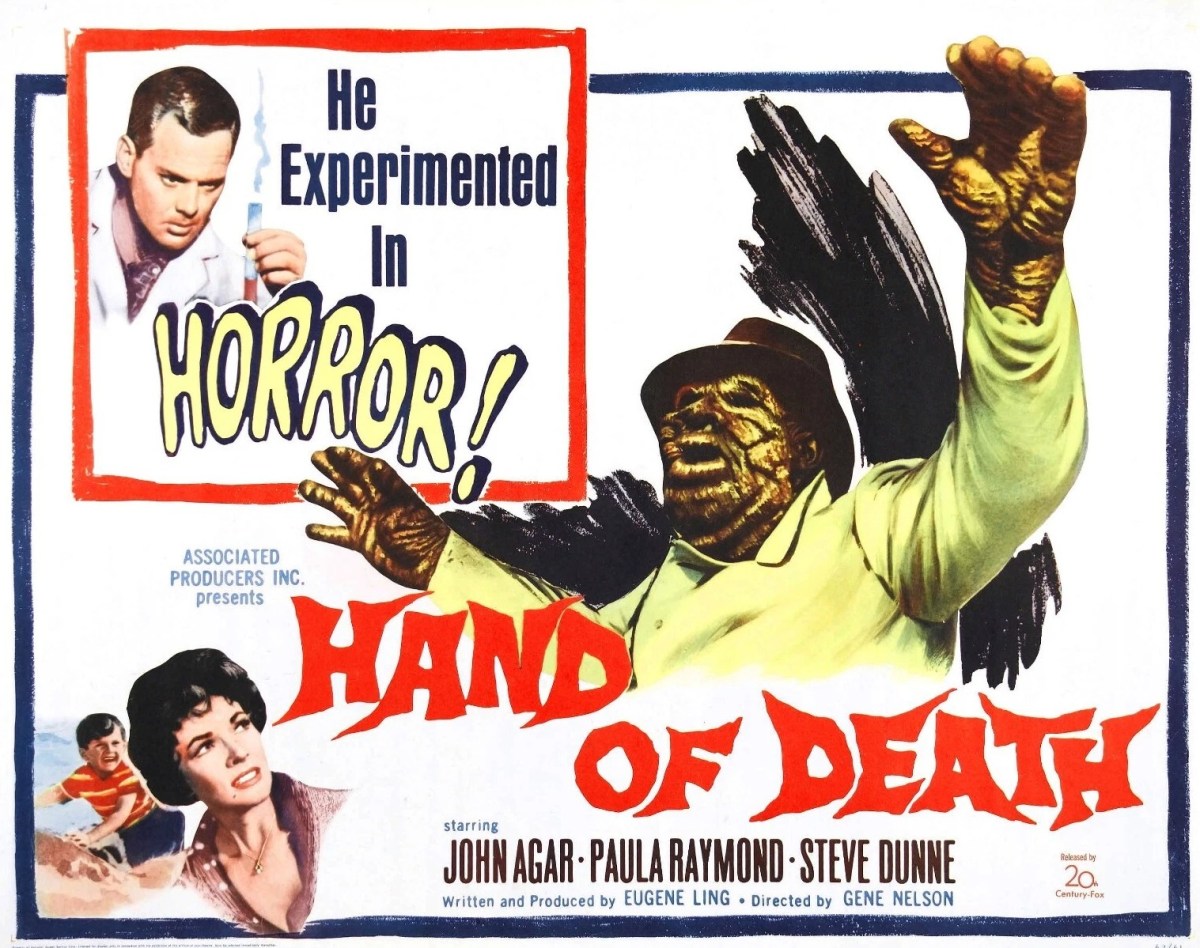
Unless you go by the name of Dr Jekyll, you don’t want to become a guinea pig for your own scientific experiments. Niftily done, memorable opening and finale, minimum expenditure on special effects ensures the shock value is limited until it counts as our hero/villain goes on accidental rampage.

In an echo of Village of the Damned (1960), a mailman, drawing up in front of some gates, falls to the ground. The camera pulls back revealing some senseless sheep. Two guys in Hazchem suits rush out of a building which turns out to be a laboratory. It’s not even a top secret lab although it’s buried in the desert. Dr Alex Marsh (John Agar) is supposed to be engaged on harmless experiments on cacti. Instead, he’s stumbled upon a nerve gas with military potential.
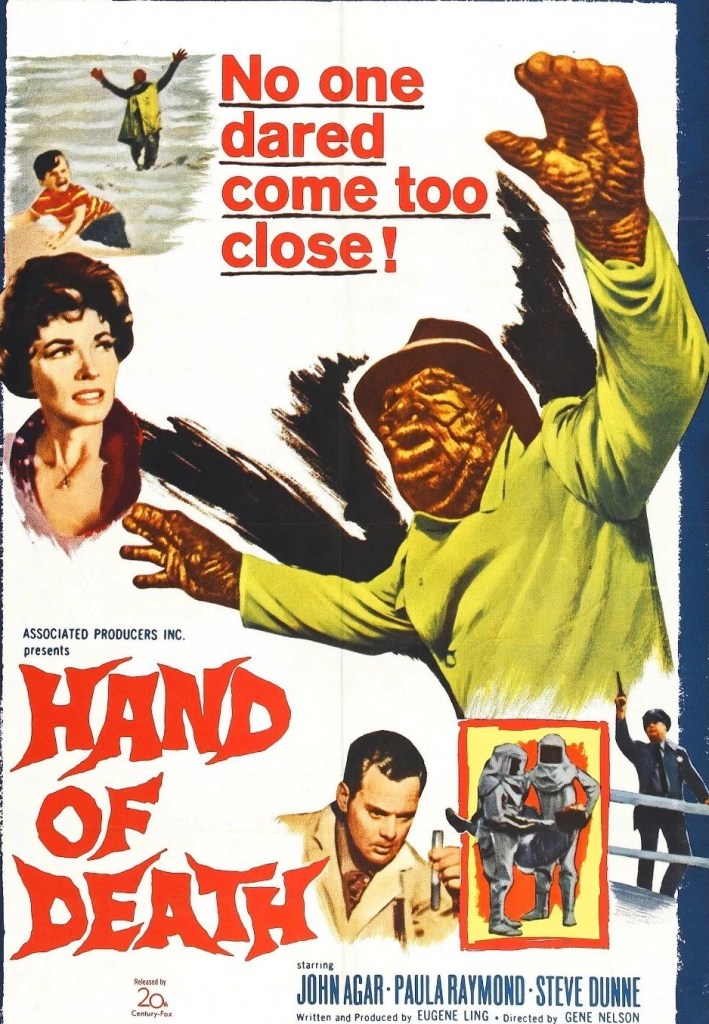
Our mailman and the sheep aren’t dead only unconscious so, through happenstance, Marsh has successfully conducted both animal and human tests, such results an improvement on what went before when the subjects died.

Marsh can’t wait to tell boss Dr Ramsay (Roy Gordon) and his girlfriend Carol (Paula Raymond) the good news. All scientists are mad scientists given the right circumstances. So Marsh has gone from anodyne to dangerous. In Army hands, the nerve gas can not only immobilize the enemy but when they wake up they are under hypnotic influence and will do what the victors tell them thus nullifying the risk of rebellion.

James Bond villains would be queuing at his door. Leaving Ramsay to drum up financial support from legitimate sources, Marsh returns to the lab to further develop the prototype, except too much leaks out and he’s not as immune to its effects as he originally believed. And beyond being cursed by a nightmare, it doesn’t look, initially, as if Marsh is in danger. Just everyone else. Touch him and you’re fried.

While he doesn’t mean to kill anyone, nonetheless heading for the morgue are a colleague and a gas pump attendant. He hides out in Ramsay’s house where serums are concocted to cure him. They fail. Marsh moves from not wanting to hurt anybody to threatening violence. And it’s soon clear he’s not at all immune. Contemporary audiences might enjoy the transformation as he turns into a cross between Hulk and The Thing from The Fantastic Four, with the addition of the kind of raincoat for which Columbo later expressed a preference and Frank Sinatra’s hat.
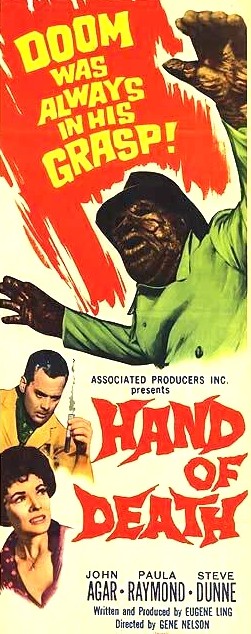
And you might be giggling at the look except that strange things begin to happen. You pity him. He’s not some monster lurching around terrorizing the populace. He’s lurching all right but in the kind of bent-over fashion where you think he’s going to topple over any minute. He turns up at  Carol’s beach house but so do the cops. He heads towards the water but when he turns back at Carol’s call the police interpret that as threat and shoot him dead.

There are some other nice touches, reaction shots from the supporting cast, some sparkling bit parts, a small child who is within seconds of touching him out of curiosity, and an incentive for his other colleague Tom (Stephen Dunne) to win over Carol should he fail to come up with the serum.

John Agar (The St Valentine’s Day Massacre, 1967) was never going to get within a mile of an Oscar but his playing of the monster triggers pity. Paula Raymond (The Flight That Disappeared, 1961) adds some depth to a thankless role.

Directed by Gene Nelson (Kissin’ Cousins, 1964) from a screenplay by producer Eugene Ling in his final work.

I came at this with one big advantage. I hadn’t seen the poster so I had no idea what the monster looked like. Which is just as well because otherwise I might have not bothered.

Tight, short, occasionally clever, surprisingly moving.
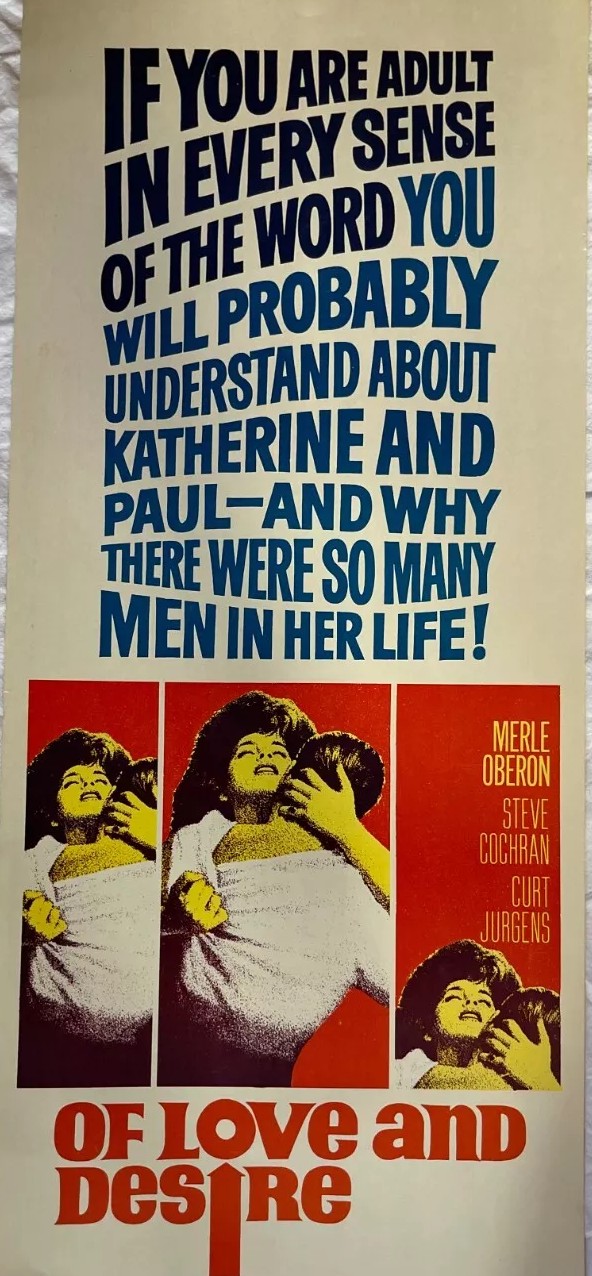
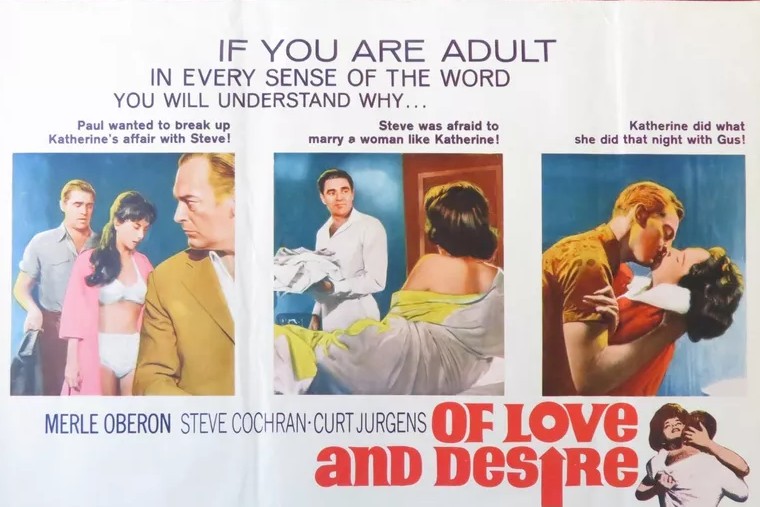
Of Love and Desire (1963) ***

As contemporary as you could get with the core theme of a sexually independent woman picking and choosing her men. Otherwise, a smorgasbord of talent. Star Merle Oberon (Hotel, 1966) hadn’t appeared in a movie in seven years, for co-star Steve Cochran (Tell Me in the Sunlight, 1967) the screen absence was two years, Curd Jurgens (Psyche 59, 1964) was still very much a jobbing actor restricted to playing good and bad Germans, and director Richard Rush (Psych-Out, 1968), in his sophomore effort, was as erratic in the early part of his career as he would be in his later (six years between Freebie and the Bean, 1974, and The Stunt Man).

Of course, this being a somewhat mealy-mouthed decade, psychological mumbo-jumbo was required to explain the woman’s actions rather than the notion that a woman could enjoy being sexually unrepressed and free of desire for marital security. So if you manage to separate the actual movie from the required fitting-in to moral standards, it’s a darned interesting examination of the kind of free spirit later exemplified by Darling (1965) or Modesty Blaise (1966).

Mining engineer Steve (Steve Cochran) on a job in Mexico begins an affair with wealthy Katherine (Merle Oberon), half-sister of his employer Paul (Curt Jurgens). There’s nothing of the usual will-she-won’t-she in this romance, she virtually flings herself at him. Not only that, the morning after, she arranges for all his belongings to be shipped to her splendid mansion, proof of who is usually in control. Just as, more traditionally, males are instantly aroused by beautiful women, she is excited in the presence of an attractive man and makes no bones about it, not too bothered about consequent scandal even though she does her best to keep her activities discreet.

Paul isn’t so happy with the affair. He clearly prefers her unhappy and dependent on him for emotional support. And a bit like Julie in Steve Cochran’s later picture Tell Me in the Sunlight, there’s certainly an assumption that she jumps from man to man, though out of boredom rather than financial security.

So Paul sets out to sabotage the affair by putting in Katharine’s way previous boyfriend  Gus (John Agar) who feels he is owed some sex and is determined she repay the debt. Although she almost succumbs and is subsequently ashamed of how easily her desire is inflamed, she resists and after he has had his way with her attempts to commit suicide.

But the question of rape is never raised and to Steve it appears she has merely resorted to type, falling into bed with the closest man. And in the time it takes to resolve the situation, we are treated to the psychological mumbo-jumbo which falls into two parts. In the first place, there has clearly been a strong sexual attraction between Paul and Katharine, and the strength of their emotional bond is in some ways a substitute for not indulging in incest. Secondly, her fiancé, a fighter pilot, was killed in the Second World War. Based on no evidence whatsoever, she has convinced herself that he committed suicide because she refused to have sex with him before marriage. To make up for that, she gives herself to any man who comes along. Yep, claptrap with a capital C. Which somewhat torpedoes the picture, which had been heading comfortably towards a feminist highpoint.

Merle Oberon almost turns the clock back a couple of decades to Wuthering Heights (1939) and her role there in physically expressing forbidden desire. You can almost feel her quivering with pent-up sexuality and she is unexpectedly superb, in what is essentially a B-picture, especially as the opportunity to tumble into melodrama – which she can’t escape in the final act – so obviously beckons. That the first two acts work so well is primarily down to her believable characterization. And Steve Cochran is no slouch either, shaking off the coil of his pervious incarnation as a tough guy. Curt Jurgens is creepy and sinister.

Director Richard Rush manages to hold his nerve until the end and then it all runs away from him into turgid melodrama. Screenplay contributions from the director, producer Victor Stoloff, Jacquine Delessert  in his debut and Laszlo Gorog (Too Soon to Love, 1960, Richard Rush’s debut)

Nearly but not quite a feminist breakout.

Discover WordPress

A daily selection of the best content published on WordPress, collected for you by humans who love to read.

The Atavist Magazine

by Brian Hannan

WordPress.com News

The latest news on WordPress.com and the WordPress community.