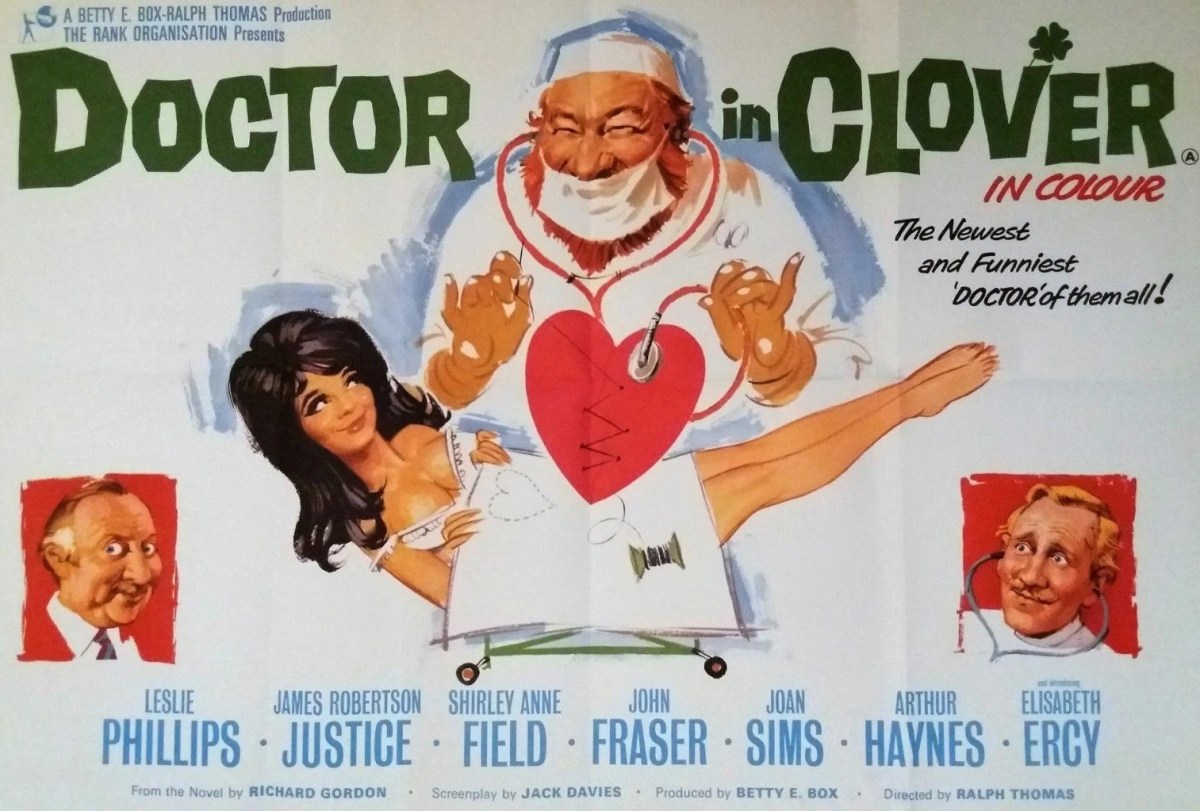
Doctor in Clover / Carnaby M.D. (1966) ***

Ding dong! All change. Out go the dithering twerps and in comes the seductive lothario. Dirk Bogarde after one last charge and no longer the country’s top attraction at the box office has departed for the more receptive arthouse climes of King and Country (1964), Darling (1965) and Accident (1966). In his place, at St Swithins, has come Dr Gaston Grimsdyke (Leslie Phillips) who imbues the character with trademark seductive purr.

With Gaston able to be upfront in his intentions, there is less reliance on the innuendo that suffocated rival Carry On series, and seemed to cover all manner of male deficiencies, most obviously the ability to pursue a girl in the normal acceptable manner. The exceptionally slight narrative is more a series of sketches and falls back on slapstick, some of which is hilarious – two doctors covering everyone in foam – and others less so (how many times can you fall fully clothed into a swimming pool?).
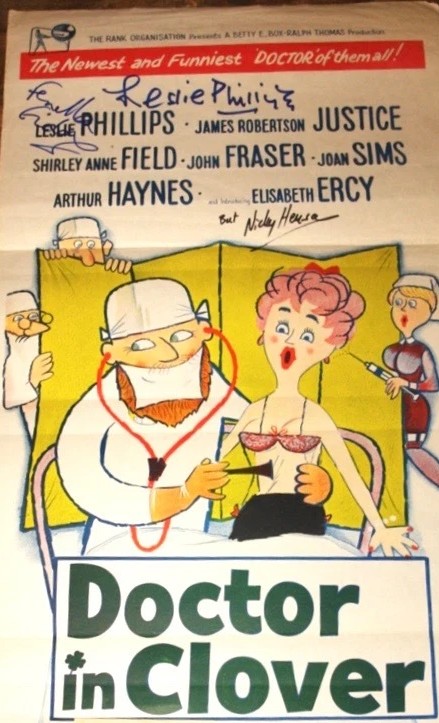
The patients line up to fill any gaps, headed in the main by “I-know-my-rights” walking medical encyclopedia Tarquin Wendover (Arthur Haynes) who despite his rough exterior reveals a penchant for ballet, and Russian ballet dancer Tatiana Rubikov (Fenella Fielding) determined to attract the male gaze.

Now there are two medics to put everyone in their place, Sir Lancelot Spratt (James Robertson Justice) and starchy Matron Sweet (Joan Sims) who revels in handing out a ticking off and takes on Spratt over what might be deemed these days a support animal in the shape of a parrot – and wins. At least she wins round one. But then her steely resolve crumbles as she believes she is secretly being wooed by Spratt.

But in the days when ageing male Hollywood idols were being teamed up, with nary a concern about the obvious age gap, with women half their age, and the likes of James Bond and Alfie never had to countenance rejection, it’s quite amazing that this piece of froth takes a more realistic approach. The main storyline revolves around the 35-year-old Gaston being knocked back by the 20-year-old French physiotherapist Jeannine (Elizabeth Ercy) who, for plot reasons, appears almost constantly in a swimsuit.
In a bid to make himself more appealing, Gaston embarks on a series of rejuvenating activities and treatments, planning to inject himself with a serum which, as you might he expect, he manages to inject into Spratt with hilarious consequence. He then turns to a “mood-enhancing” gas but that rebounds on him when he finds himself instead falling for the matron. As a subplot he is rival with his cousin Miles Grimsdyke (John Fraser) for a plum job – and is passed over, ironically, because he looks too young.

British audiences were taken by the twists to the formula and turned it into one of the top 15 films of the year at the box office. And I can certainly see its continued appeal. The days of the inept romantic are over. This is the permissive sixties after all. And while Gaston is rejected by Jeannine his flirtatious moves are welcomed by the equally seductive Nurse Bancroft (Shirley Anne Field), though since she is already engaged flirtation is as far as she’ll go and Gaston is disinclined to pursue the matter once he notices the size of her future husband.

There’s even a daring, for its time, sequence involving male hands mistakenly caressing each other, with their owners enjoying such fondling before they realize their error.

Leslie Phillips (The Fast Lady, 1962) is in his element – and he has a far better command of comedy than Dirk Bogarde – and a delight especially as his constant amour is constantly curbed. Despite third billing Shirley Anne Field (Kings of the Sun, 1963) has little more than an extended cameo even though she shines in what little she has to do. James Robertson Justice (Mayerling, 1969) remains the grumpy heart of the picture though Carry On regular Joan Sims runs him close. Elizabeth Ercy (The Sorcerers, 1967) has the delightful job of putting Gaston in his romantic place. Suzan Farmer (633 Squadron, 1964) puts in a brief appearance as do a host of British television names including Arthur Haynes (The Arthur Haynes Show, 1957, 1966), Terry Scott (Hugh and I, 1962-1967) and Alfie Bass (Bootsie and Snudge, 1960-1963)

Directed, once again, by series regular Ralph Thomas, taking a break from more serious efforts like The High Bright Sun (1965). Written by Jack Davies (Those Magnificent Men in Their Flying Machines, 1965) from the Richard Gordon bestseller.

Inoffensive Saturday matinee material.
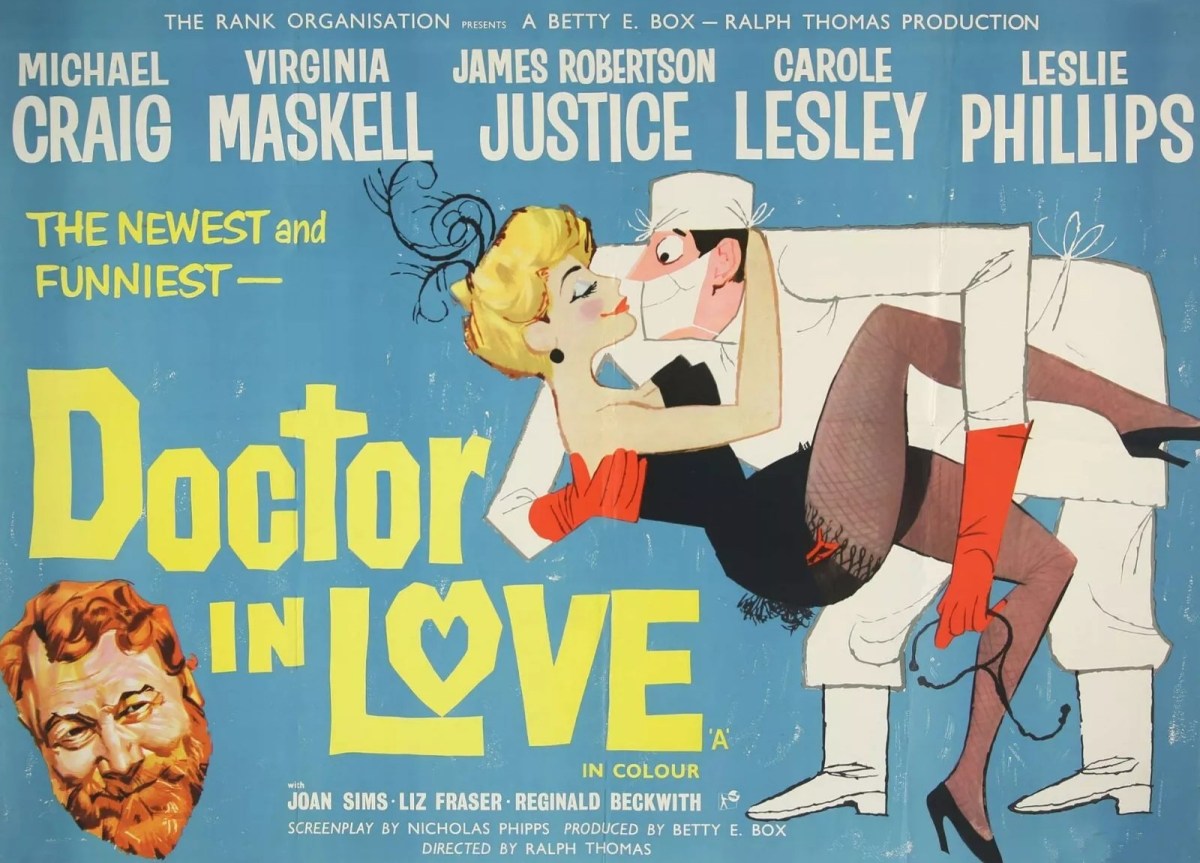
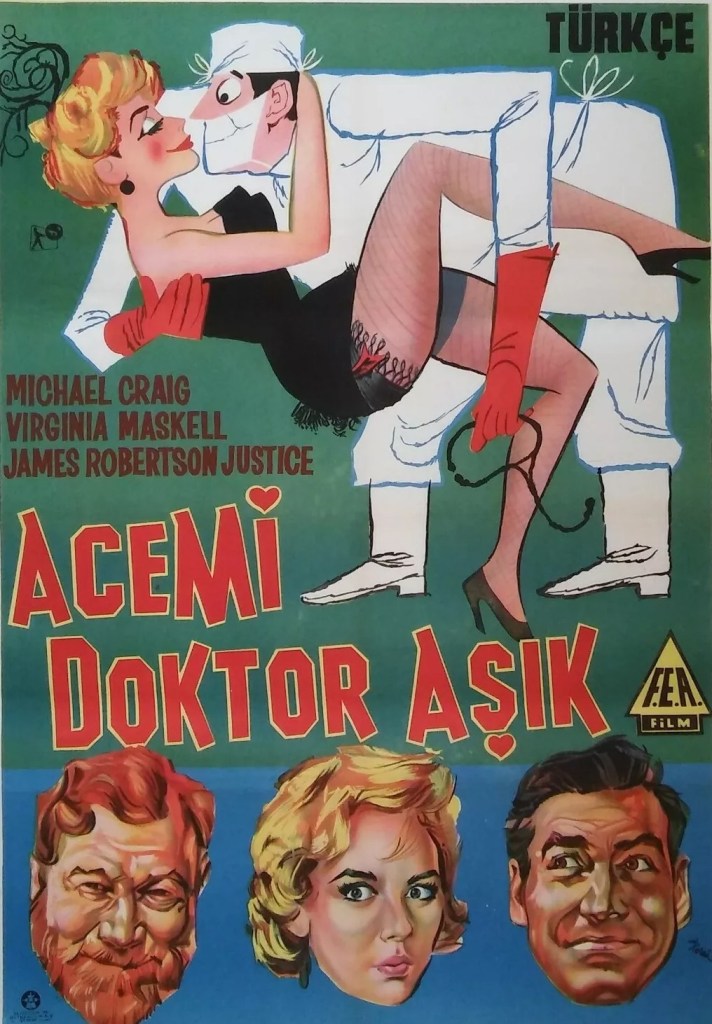
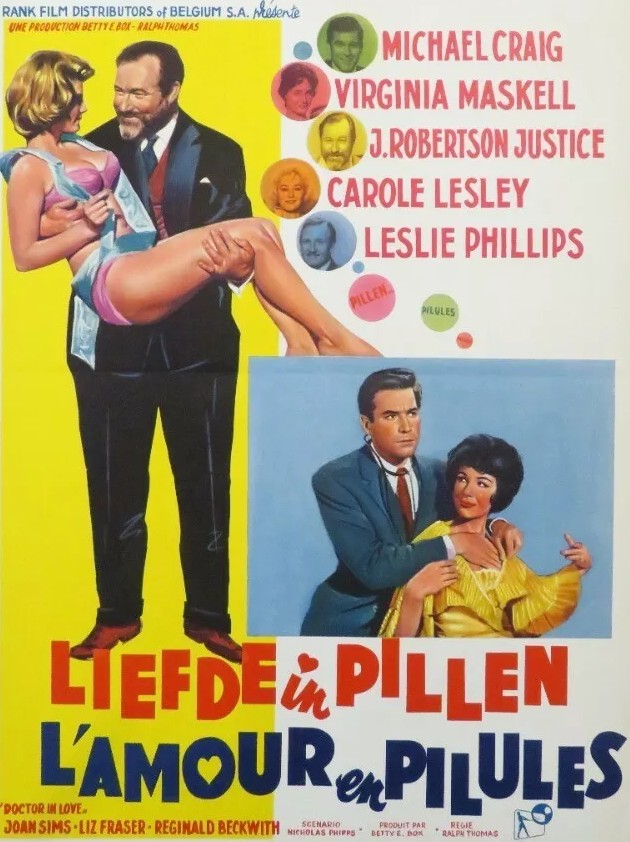
Doctor in Love (1960) ****

Chortled all the way through. You can see why it was the biggest film at the British box office in 1960. Dirk Bogarde had turned up his nose at repeating the character for the fourth time and went off to make more serious pictures like Victim (1961) which, it transpired,  dented his box office appeal. Replacement Michael Craig (Mysterious Island, 1961), while brawnier, passes this particular screen test with flying colors though he has his work cut out to hold his own against such practised scene stealers as James Robertson Justice (Mayerling, 1968) and Leslie Phillips (The Fast Lady, 1962) and once Virginia Maskell (The Wild and the Willing, 1962) enters proceeding her coolness makes the camera her own.

I was surprised how much this relied on innuendo. But this is a gentler exercise in smut than the sniggering guffawing Carry On approach. And there’s little chance of it descending into misogyny since the females hold all the aces. The plot is episodic and none the worse for that and even a diversion into a strip club, which might suggest a narrative clutching at straws,  proves a surprising highpoint.

Basic story shifts Dr Hare (Michael Craig) out of hospital and into general practice which provides ample comedic opportunity via patients and colleagues. But, first of all, just to confuse matters and as if the producers were worried the series might not survive outside the boundaries of St Swithins Hospital, the tale begins with him returning to hospital with what turns out to be jaundice.

Cue the booming interventions of Sir Lancelot Spratt (James Robertson Justice) and the first of the love stories wherein Hare and Dr Hinxman (Nicholas Parsons) are rivals for flighty Nurse Sally Nightingale (Moira Redmond), who, in the first of many knocks to the male ego, while playing off one against the other goes off with another man. Before she does, Dr Hinxman takes revenge by prescribing all sorts of medications which will leave Hare so indisposed he is unable to respond to the nurse’s ardor.

Back in civvy street, as a GP, Dr Hare has to fend off predatory female patients and secretary Kitten Strudwick (Carole Lesley) and deal with standard comedic issues such as the boy who gets his head jammed in a cooking pot and the less common task of explaining the facts of life to a 40-year-old virgin. His boss Dr Cardew (Nicholas Phipps) is under the thumb of a wife who has shipped out to California only to summon her husband every now and then. The ever-amorous Dr Burke (Leslie Phillips) fills in and is the prime mover in an episode that involves strippers Dawn (Joan Sims)  and Leonora (Liz Fraser). There’s a particularly good reversal in a drunken scene where the totally inebriated Wildewinde (Reginal Beckwith) completes all the police drunk tests (if that’s what they’re called) with ease.

When Dr Burke is incapacitated, his place is taken by Dr Nicola Barrington (Moira Redmond). And that should have been enough of a plot to see the picture through but the movie doubles down on complication. Dr Barrington fends off Dr Hare and when Nurse Nightingale reappears Barrington in due course quits. Dr Spratt is also on board for further scene-stealing duties including ruling the roost in a strip club and undergoing an operation.

The romantic situation is resolved, Dr Spratt is put in his place temporarily and our hero effects a return to the hospital.

I wouldn’t say the writing (by Nicholas Phipps) is of the highest caliber but the jokes come at an assembly line pace and the cast are superb, barely a cast member incapable of stealing a scene. You hire James Robertson Justice and Leslie Phillips at your peril. Without Dirk Bogarde hogging the scenery, this flows much better than others in the series, with the supporting cast being more than just foil to a star who was a major box office attraction at the time. And it helps that the women – Moira Redmond (Nightmare, 1964), Virginia Maskell, Carole Lesley (Three on a Spree, 1961), and Carry On regulars Joan Sims and Liz Fraser –  are even more adept at scene-stealing than the men and not merely foil for misogynist jokes as in the Carry On series.

Director Ralph Thomas (The Wild and the Willing) seems to have found a new lease of life without having to deal with Dirk Bogarde and brings a certain verve to proceedings, especially in tripping up male ego.

Comedy is such an odd one to judge. Many a time I have sat through with scarcely a titter movies I’ve been told are hilarious. Other times I’ve been told to give them a free ride because they are making a point. So I stick to my own rule.

Make me laugh – I don’t care how – and this had me laughing all the way through.

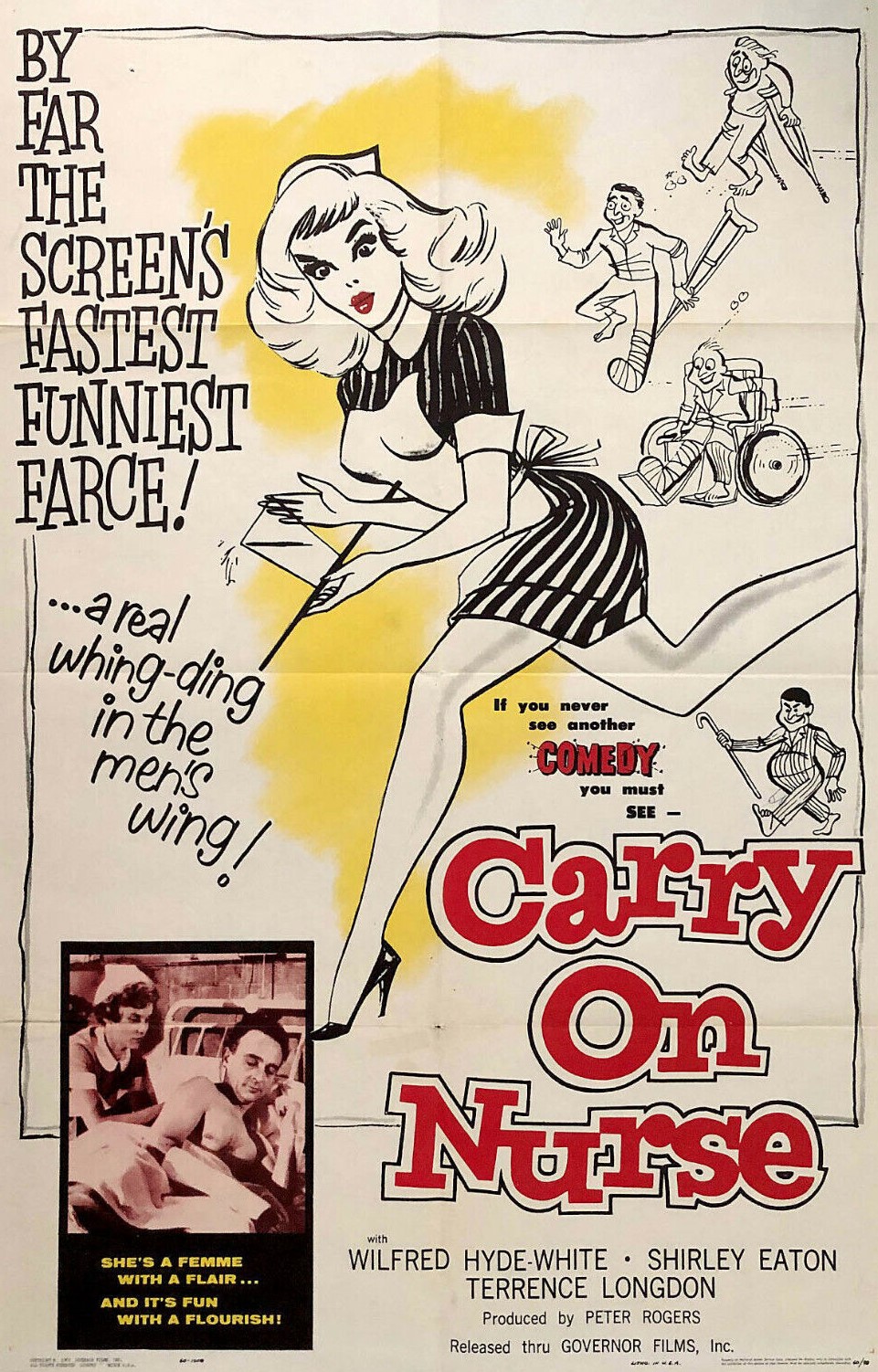
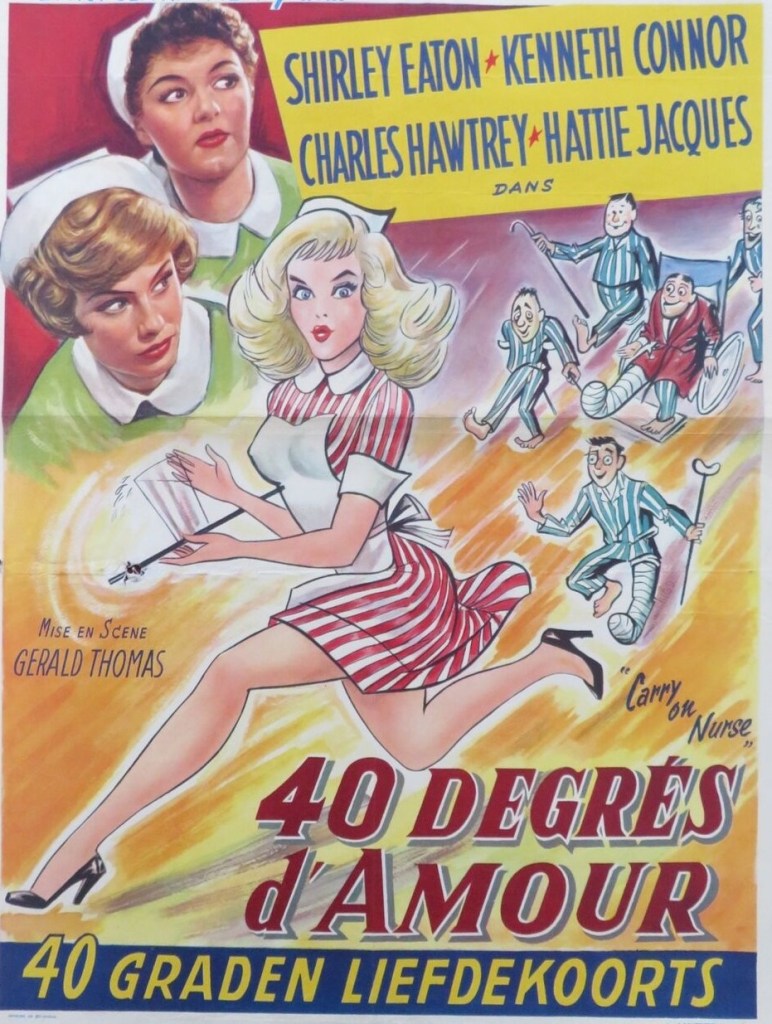
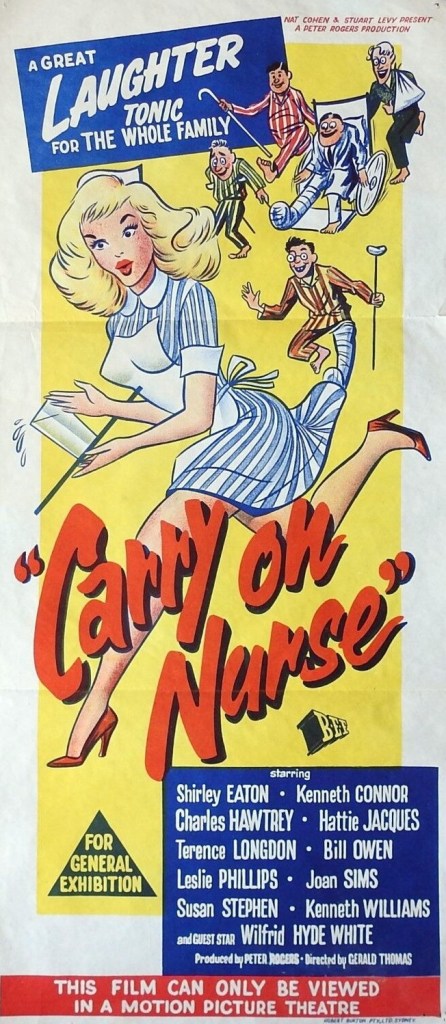
Carry On Nurse (1960) ***

There was no greater divide between audiences and critics in Britain than the long-running comedy “Carry On” series (outside of an occasional satirical bulls-eye like Carry On Up the Khyber, 1968). And a similar gulf existed between the type of audiences the movies attracted in Britain and those in America. In Britain they were vastly popular general releases while in America their usual habitat was the arthouse as if they were seen as the natural successors to the Ealing comedies. And there was a third chasm – between the endearing risqué early comedies and the more lascivious later versions.

Carry On Nurse fell into the endearing camp. The humor was gentle rather than forced, the emphasis on misunderstanding and innuendo and smooth seducers like Leslie Phillips rather than exposed female flesh and the grasping likes of the ever-chortling Sid James. Perhaps you could define this earlier film as pre-nasal Kenneth Williams, his peculiar type of delivery not yet at full throttle. Here there is innocence rather than lust and the males quake in fear not just of the indomitable Hattie Jacques in brusque matron mode but of the other efficient nurses led by Shirley Eaton who have the measure of their rather hapless patients, although student nurse Joan Sims – making her series debut – is an accident-prone soul.

And they say comedy doesn’t travel.

The action is mostly confined to a male ward. There are plenty of gags – alarms rung by mistake, boiling catheters burned to a turn, medication making a patient go wild, patients intoxicated by laughing gas and the famous replacement of a rectal thermometer by a daffodil. Wilfred Hyde-White as a constant complainer and obsessive radio listener Charles Hawtrey provide further ongoing amusement. 

But the thrust of the story is romance. Journalist Terence Longdon fancies Shirley Eaton but his initial advances are spurned as she is in love with a doctor. In a role far removed from his later brazen characters, Williams plays a shy intellectual who finally comes round to the charms of Jill Ireland (later wife of Charles Bronson). Although Leslie Phillips is his usual suave self, he makes no designs on the female staff since he has a girlfriend elsewhere and  his ailment – a bunion on the bum – makes him an unlikely candidate for a hospital liaison.  

Hattie Jacques is in imperious form, Shirley Eaton shows what she is capable of, Kenneth Williams playing against type is a revelation. 

British critics hated the “Carry On” films until late in the decade when Carry On Up the Khyber (1968) hit a satirical note. Critics felt the movies pandered to the lowest common denominator and were a poor substitute for the Ealing comedies which had given Britain an unexpected appreciation among American comedy fans.

It was a well-known fact the comedies did not always travel. Apart from Jacques Tati, the more vulgar French comedies featuring the likes of Fernandel were seen as arthouse fare. Unless they featured a sex angle or the promise of nudity, coarse Italians comedies struggled to find an international audience. The “Carry On” films were bawdy by inclination without being visually offensive

Carry On Sergeant (1958), the first in the series, had been a massive success in Britain. Distributor Anglo-Amalgamated was so convinced it would find a similar response in the U.S. that it was opened in New York at a first run arthouse. Although comedies were hardly standard arthouse fare, this was generally the route for low-budget British films.  The picture lasted only three weeks and taking that as proof of its dismal prospects other exhibitors ignored it. 

The follow-up Carry On Nurse (1959) took an entirely different route when launched in America in 1960. This time New York would be virtually the last leg of its exhibition tour.  Instead it opened on March 10 at the 750-seat Crest in Los Angeles. Away from the New York spotlight, the little movie attracted not just good notices but decent audiences.

Instead of being whipped off screens after a few weeks, it developed legs. In Chicago it ran for 16 weeks in first run before transferring to a further 50 theaters. Within a few months of opening it had been released in 48 cities. In Minneapolis it was booked as a “filler” at the World arthouse, expected to run a week and no more. Instead, it remained for six weeks and when it shifted out to the nabes out-grossed Billy Wilder’s big-budget comedy The Apartment (1960) with a stellar cast of Jack Lemmon and Shirley Maclaine.

In its fourth month at the 600-seat Fox Esquire in Denver where it opened in May, it set a new long-run record for a non-roadshow picture. It had been taking in a steady $4,000 a week since opening.

SOURCES: “How To Nurse a Foreign Pic That’s Neither Art nor Nudie: Skip N.Y.,” Variety, Aug 24, 1960, 3; “British Carry On Nurse A Sleeper in Mpls With Long Lopp Run, Nabe Biz,” Variety, Aug 24, 1960, 18;

Note: by and large this blog follows American release dates so although Carry On Nurse was shown in Britain in 1959 it did not reach America until 1960.

https://amzn.to/3G1h1Ei

Nurse on Wheels (1963) ***

A rude interloper had come trampling over the more sedate world of the “Doctor” franchise, a gentle comedy now in its fifth iteration and even surviving a brief interlude minus original star Dirk Bogarde. Carry On Nurse (1959), the second in that series, had been a massive box office hit and a jolt to the cultural senses.

Who knew that the upright Brits would condescend to a film that depended on smutty jokes, leering male characters and inuendo? But it did open up the mini-genre of films about nurses where they could be presented as ordinary people rather than being heroic in some global famine-stricken or war-torn trouble spot. And make the nurse the top-billed character rather than a doctor’s sidekick whose main characteristic was to whimper at the star in the hope he might take a fancy to her.

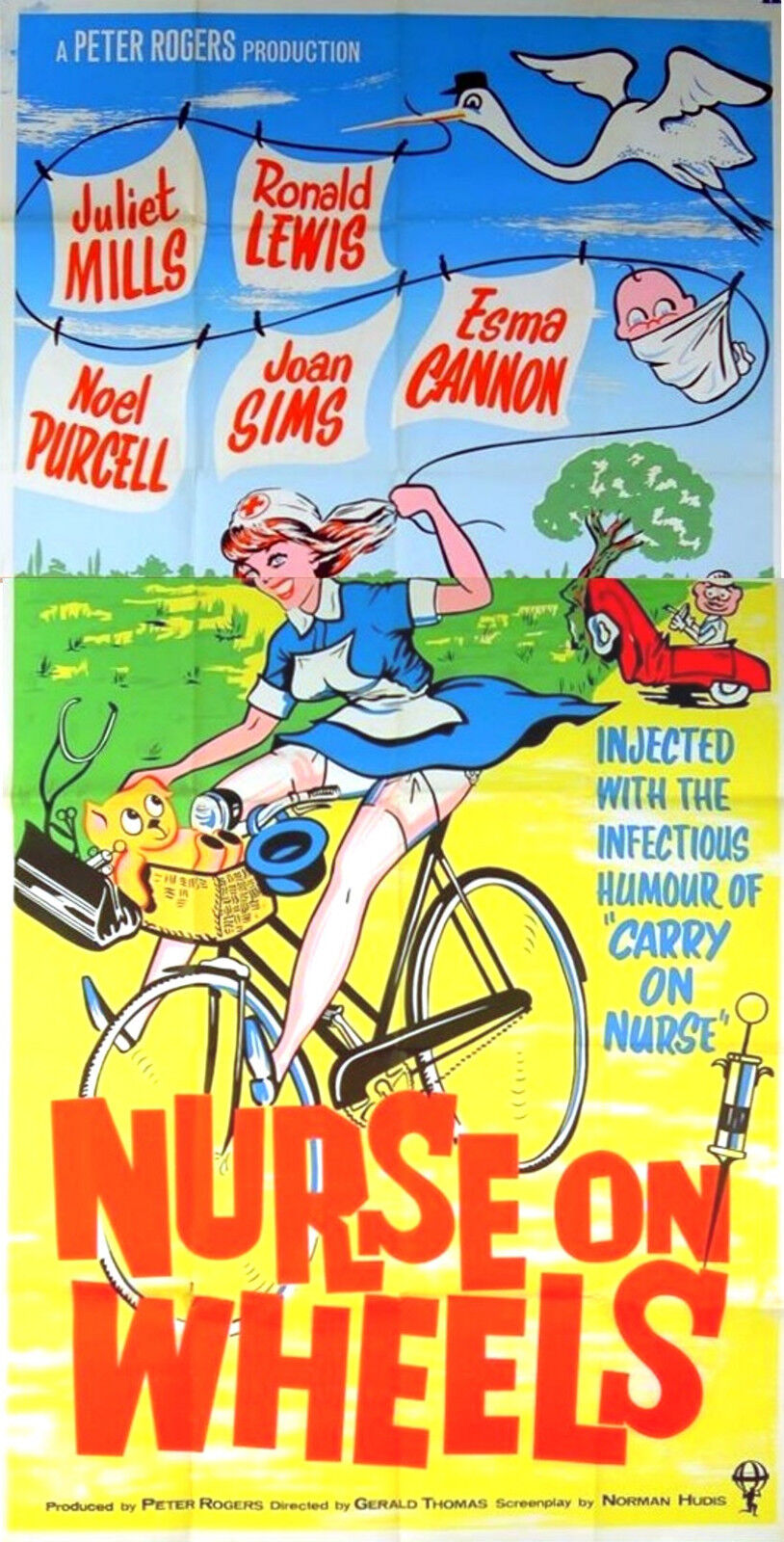
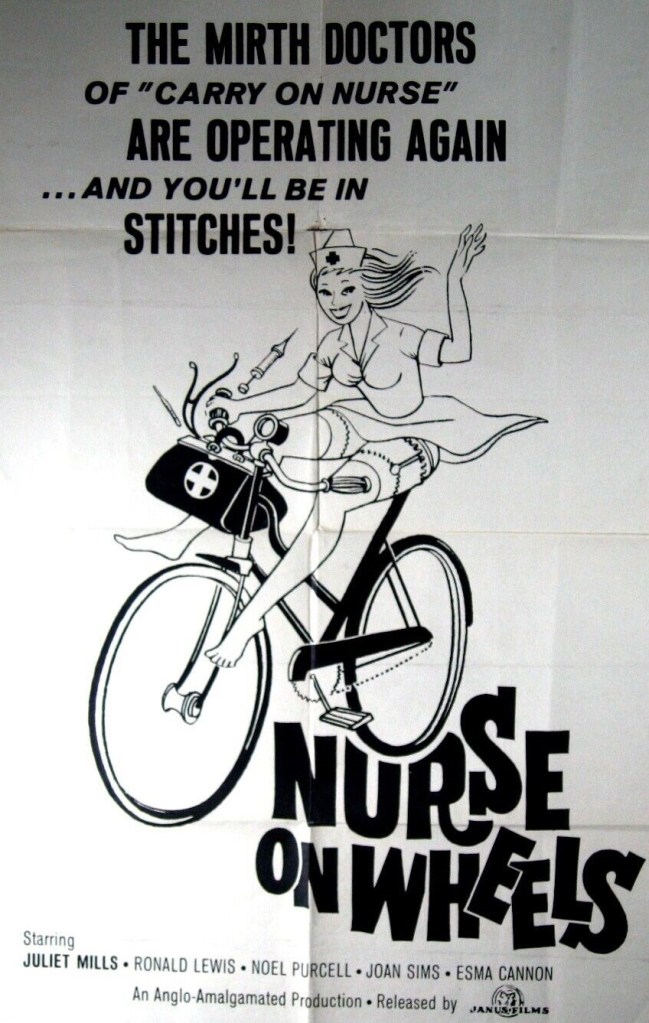
The marketing team clearly decided the slim Juliet Mills needed suspenders
and a bigger bosom to pull in the audiences.

But where the eponymous character in the Doctor series started out as hapless, lovelorn and bullied, here District Nurse Jones (Juliet Mills) has taken a leaf out of the robust book of Hattie Jacques, the bossy, no-nonsense, unperturbed Matron in Carry On Nurse. Not quite as over-the-top as that Matron, she more than holds her own, in perky fashion, in a patriarchal society, answering back a holier-than-thou vicar and dealing with a lecherous patient.

Nurse Jones has shifted from the city to the bland sleepy backwater village of Blandley in part to help her scatterbrain mother (Emma Cannon) cope better with, well, everything. Naturally, romance beckons, between Nurse Jones and local farmer Henry Edwards (Ronald Lewis), although any chance of love blossoming is imperilled by her lack of driving skills (106 lessons to pass her test).

Competent and confident and with a light riposte for every domineering male, it’s a shame that at the first sign of love she turns into a whimpering wreck. But there you go, confident women were acceptable in those days but everyone knew emotion would soon get the better of them. There’s not much in the way of plot, overcoming initial suspicions of patients coming to terms with a younger nurse, the various oddities of her charges, romantic rivalry between Nurse Jones and vicar’s daughter Deborah (Joan Sims).

But it is charming in an old-fashioned English way and certainly the camera adores Juliet Mills (Twice Round the Daffodils, 1962) though she’s neither given much drama to play with nor little opportunity, beyond the ripostes, to develop as a comedienne. Made in black-and-white on a leaky budget I had expected this to be a B-feature, propping up a double bill, but in fact it was given a circuit release on the ABC chain as the main (and sole) feature.

Will keep you entertained on a rainy Saturday afternoon, sufficient witty lines to raise a chuckle along with the batty mum’s battles with telephones, cupboards and rubber plungers. Not sure audiences wouldn’t have preferred smut and inuendo or the more polished presence of the Doctor cast.

But standing out as one of the few movies – comedies or dramas (and pre-dating the mid-60s cultural shift) – where a woman was in control of her own life not subservient or submissive to any passing male, feminism before that word took real root.

Supporting cast includes Joan Hickson (television’s Miss Marple), Carry On alumni Jim Dale and the aforementioned Joan Sims (who would have taken the lead role apparently had she not put on weight), Derek Guyler (Please Sir! television series) and Noel Purcell (Mutiny on the Bounty, 1962).

Director Gerald Thomas could churn out these light-hearted vehicles with his eyes closed and given he helmed the Carry On series shows remarkable restraint.

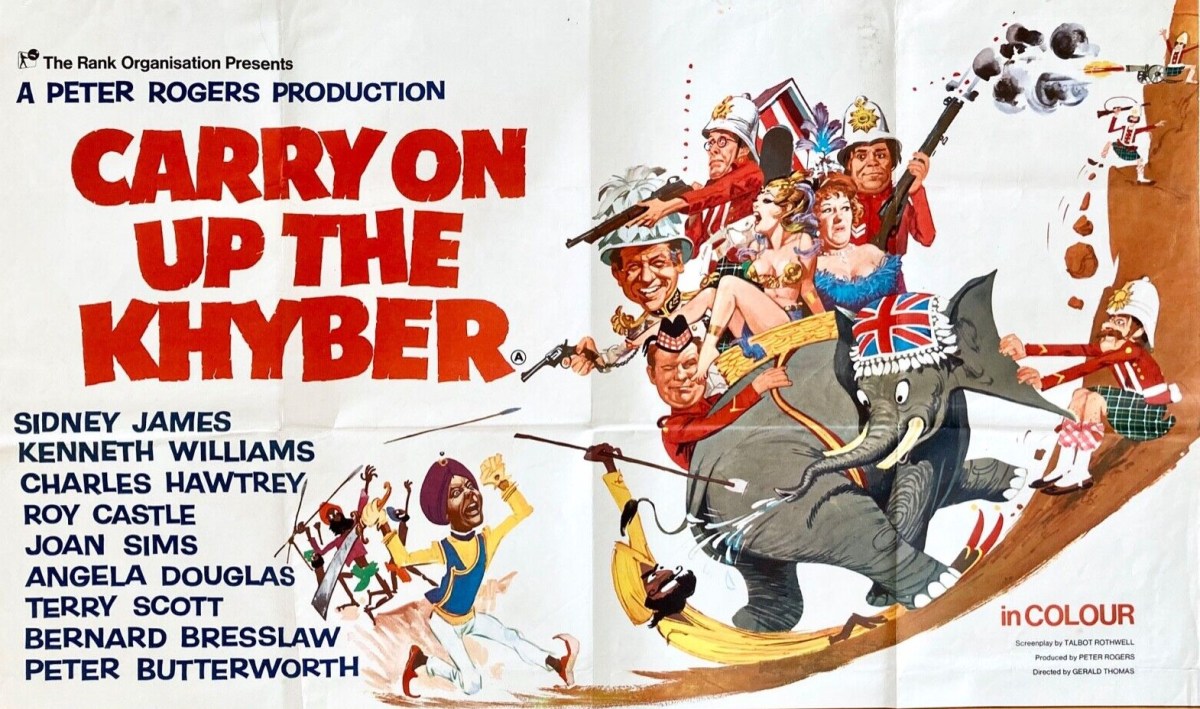
Carry On Up the Khyber (1968) ***

After a spate of serious pictures I thought I’d treat myself to some lighter fare and indulge in double entendres and lavatorial humor. I didn’t realise I had picked the only Carry On picture with serious undertones, exploring the hypocrisy endemic among leadership as much as witnessed in The Charge of the Light Brigade (1969), taking a distinct anti-colonial stance, and poking fun at military inefficiency.  

Despite the need to keep up appearances, British governor Sir Sidney Ruff-Diamond (Sidney James) despises Indian counterpart The Khasi of Kalabar (Kenneth Williams), the truth of their feelings towards each other revealed in muttered asides. Appearances are all that stand between the British and an Indian revolution, the natives fearing the Scottish regiments, the famed kilt-wearing “devils-with-skirts.”

The notion that any army would run a mile from a pair of bollocks – unless of course they had the faint-inducing dimensions of a Thor – is of course bollocks but that’s the film’s central conceit. But when the Indians discover that the British actually wear cotton undergarments as protection against the windy privations of the northernmost parts of the country, and, through the treacherous Lady Ruff-Diamond (Joan Sims), gain potential access to photographic proof, the status quo is threatened.

Lady Ruff-Diamond, furious at her husband’s constant infidelities, has set her eye on the Khasi, and is willing to betray her country for a bit of what could be termed “the other.” A squad of the usual British misfits, despatched to recover the incriminating evidence, naturally enough finds itself in a harem while Sir Ruff has to keep the British end up by entertaining native lasses by the score (he keeps count). When war does break out, the British, under siege, do what they are famous for, which is nothing.

You might have to be British to grasp many of the jokes, Khyber Pass and Khazi both have toilet associations, for example, but other visual gags would not be out of place in a Charlie Chaplin sketch. “Please close the gate” reads a sign on the border. Outside the Governor’s mansion is another sign “No Hawkers.” And you might at times believe the entire production was Chaplinesque, some of the jokes being ancient – “call me an elephant” orders Sir Sidney, referring to the mode of transport, only to be hit by the rejoinder “you’re an elephant.”

Many set-ups are obvious – black-faced British troops tumble into a bath. The double entendres are occasionally inspired – fakir, bullocks and shot among the perfectly innocent words so rendered. But the jokes come so thick and fast that by the time you’ve complained about a poor one an absolute cracker is on the way. Some contemporary notes are struck, references to cuts (at a time when Britain was suffering economically) and a muscular servant striking a gong (reference to the introduction to all films made by British studio Rank).

However, the political insight, if that’s not too complimentary, is not sustained and it soon collapses into more straightforward Carry On territory. A film like this comes of course with multiple warnings about sexism, racial stereotypes, blackface and anything else that could possibly offend, since that was the team’s denoted purpose, and, as you will be aware, it couldn’t be made nowadays so enjoy it – or as much of it as you can stomach – while you can.

Prior to the emergence of the Bond goldmine this was the closest thing the British movie industry had to a solid-gold franchise, this being the 16th in the series. Gerald Thomas directs from a Talbot Rothwell screenplay and the cast involves usual suspects Sidney James, Kenneth Williams, Joan Sims, Charles Hawtrey and Peter Butterworth. Angela Douglas (The Comedy Man, 1964) supplies the glamour and you might spot Wanda Ventham (The Blood Beast Terror, 1968) and Valerie Leon (Blood from the Mummy’s Tomb, 1971) in walk-on parts.

Oddly enough, the early Carry On pictures, seen as the natural successors to Ealing, if somewhat ruder, achieved minor cult status in the United States, Carry On Nurse (1960), the flagship, playing for over 40 weeks in Denver and clocking up $2 million in nationwide rentals (“Carry On Nurse US Rentals Run Over $2,000,000,” Variety, February 14, 1962, p3). However, no others approached that peak and “never received any hard sell to the U.S. and it remained for audiences to discover their buffoonery on double bill programs usually playing second fiddle to reissues of major British  hits” (“Carry On Mostly Discovered By Yankee Fans,” Variety, February 5, 1969, p22). Despite a positive review in Variety (Dec 25, 1968, p18) which deemed it a “beautifully timed and very funny piece of comedy film-making,” Carry On Up the Khyber made little impact on U.S. audiences recording just about $100,000 in rentals (“Variety B.O. Charts 1969 Results,” Variety, April 29, 1970, p26), that figure achieved by rounding up in the normal fashion.

A Home of Your Own (1964) ***

The phrase “classic silent British comedy” isn’t one that naturally trips off the tongue. Add in “of the 1960s” and you can guarantee furrowed brows. Thanks to the boom in recycling Hollywood silent classics in the early 1960s – which I may come back to in a later Blog –  there was a subsequent mini-boom in what were called “wordless” pictures, as if using the term “silent” was blasphemous. The oddity is that so many emerged from Britain, primarily in shortened format – not more than one hour long – as the second feature in a double bill.

Blame for this development lay in the hands of producer and later writer and later still director Bob Kellett, Britain’s unsung comedy king.

A Home of Your Own is beautifully structured, following the mishaps in building a block of new apartments. A credit sequence covers the stultifying bureaucracy involved so that what was a pristine site at the beginning of the endeavor turns into a waterlogged dump before the first brick is laid. Sight gags and slapstick abound with mostly everyone getting in each other’s way, or not, the traditional approach of the work-shy British builder being to provide an audience for someone else to dig up a road or a trench.

No paddle goes unsplashed, mud only exists to drench people, and in pursuit of comedy gold most of building materials end up misused. The gatekeeper’s main job is to make tea and there is naturally an union official whose chief task is to obstruct.

Pick of the gags is Ronnie Barker’s laying of cement, delivered with exquisite comedy timing, followed by Bernard Cribbin’s stonemason delicately chiselling out a plaque only to discover at the end in a laugh-out-loud moment that he has misspelled one word, and the carpenter who appropriates the closest implement with which to stir his tea. Some of the jokes grow legs – the morning tea break, a ham-fisted carpenter, the pipe-smoking architect arriving in a sports car, and a patch of ground on the road outside constantly being dug up by different contractors representing water board, gas, electricity.

Once the building is complete, the job has taken long enough for the aspiring apartment-owner, a mere fiancé at the outset, to lift his wife over the threshold accompanied by three kids. Any sense of personal accomplishment – the British thirst for owning property quenched – is undercut by problems the young couple now face thanks to the shoddy workmanship we have witnessed.  

All this is accompanied by a very inventive Ron Goodwin score which provides brilliant musical cues. As a bonus, the film features a roll-call of British television comedy superstars  including Ronnie Barker (The Two Ronnies, 1971-1987), Richard Briers (The Good Life, 1975-1978) and Bill Fraser (Bootsie and Snudge, 1960-1974).  Peter Butterworth and Bernard Cribbins were Carry On alumni. Janet Brown achieved later fame as an impressionist while Tony Tanner hit Broadway as the star of Half a Sixpence before expanding his career to choreographer-director, Tony-nominated for Joseph and his Amazing Technicolor Dreamcoat.

A Home of Your Own went out as the support to the Boulting Brothers’ comedy Rotten to the Core (1964) which gave a debut to Charlotte Rampling. Despite being effectively a B-film, primarily made to take advantage of the Eady Levy (a cashback guarantee for producers), it was surprisingly successful.  “Will delight arthouse patrons” commented Box Office magazine in America (“Review,” October 4, 1965, p160) as British comedy films in those days tended to end up in the arthouses. In part, this was because it was the official British entry to the Berlin Film Festival. It was distributed in the U.S. there by Cinema V in a double bill with Rotten to the Core and launched in what was misleadingly called a “world premiere engagement” at the prestigious Cinema 1 in New York.

Jay Lewis (Live Now, Pay Later, 1962) directed and co-wrote, along with Johnny Whyte, the mini-feature. Kellett continued in this enterprising vein with the 55-minute San Ferry Ann (1965) – which he wrote – about a group of British holidaymakers going abroad and the 49-minute Futtock’s End (1970) – which he directed – featuring a bunch of guests descending on an ancient country house owned by Ronnie Barker.

Television stars showcased in these two featurettes included Wilfred Bramble (Steptoe and Son, 1962-1974), Rodney Bewes (The Likely Lads, 1964-1966), Warren Mitchell (Till Death Do Us Part, 1965-1975) and Richard O’Sullivan (Man About the House, 1973-1976). Ron Moody composed the Oscar-winning Oliver! (1968) while Joan Sims and Barbara Windsor made their names in the Carry On series and theatrical knight Sir Michael Hordern appeared in Khartoum (1965) and Where Eagles Dare (1968).

Though disdained by critics, Kellett went on to become by far the most influential British comedy director of the 1970s. His output included the Frankie Howerd trilogy Up Pompeii (1971), Up the Chastity Belt (1972) and Up the Front (1972), as well as The Alf Garnett Saga (1972). He was well ahead of his time with the transgender comedy Girl Stroke Boy (1972) and female impersonator Danny La Rue in Our Miss Fred (1972).

You can find all four films in a compilation released by Network under the title Futtock’s End and Other Short Stories.  Thanks to Dolphin PR for a copy. You can catch it on DVD, Blu-Ray and digital services.

Discover WordPress

A daily selection of the best content published on WordPress, collected for you by humans who love to read.

The Atavist Magazine

by Brian Hannan

WordPress.com News

The latest news on WordPress.com and the WordPress community.